14 APRIL 1471: The Battle of Barnet

Late 15th-century artistic portrayal of the battle: Edward IV (left), wearing a crown and mounted on a horse, leads the Yorkist charge and pierces the Earl of Warwick (right) with his lance; in reality, Warwick was not killed by Edward.

Late 15th-century artistic portrayal of the battle: Edward IV (left), wearing a crown and mounted on a horse, leads the Yorkist charge and pierces the Earl of Warwick (right) with his lance; in reality, Warwick was not killed by Edward.

14 APRIL 1471 — the battle of Barnet. Warwick, who had joined with Margaret of Anjou, fought King Edward IV. On this field, Sir Richard Neville, 16th Earl of Warwick (great-uncle to Sir Thomas Parr of Kendal, father to Queen Katherine) AND Sir Thomas Parr (great-uncle of Queen Katherine) died. Uncle Thomas Parr, who had previously fought with Warwick, fell fighting along side the Duke of Gloucester (future King Richard III); fighting for the House of York.

Sir Thomas Parr (brother to Queen Katherine’s grandfather, Sir William, Baron Parr of Kendal) in 1471 had become a retainer of Richard, Duke of Gloucester. His brother, John (later Knt.), had become an esquire of the body in King Edward IV’s household. Lord Parr was given a position in the north with his uncle-by-marriage, Warwick (Lord Parr’s wife, Hon. Elizabeth FitzHugh, was a niece of Warwick). Lord Parr would find himself on the opposite side of his brother’s as Warwick’s power grew. By the time Warwick had made alliances with Margaret of Anjou, Lord Parr had abandoned Warwick. No family was guaranteed to come away from this war without losses and the Parrs’ were no exception. Sir Thomas Parr would die fighting for the York cause alongside the Duke of Gloucester. (Porter)

Sources

  • Linda Porter. “Katherine, the queen: The Remarkable Life of Katherine Parr, the Last Wife of Henry VIII,” Macmillan, Nov 23, 2010. Chapter: “The Courtiers of the White Rose.”

Family of Queen Katherine: The Death of the Marchioness of Northampton

'The Master of the Countess of Warwick', ‘Portrait of a lady, aged 21, possibly Helena Snakenborg’, dated 1569.

‘The Master of the Countess of Warwick’, ‘Portrait of a lady, aged 21, possibly Helena Snakenborg’, dated 1569. (Tate)

10 APRIL 1635: THE DEATH of Helena, the Dowager Marchioness of Northampton (c.1549-10 April 1635) was the daughter of Ulf or Wulfgang Henriksson Snakenborg or Snachenberg of Ostargotland (d.c.1565) and Agneta Knuttson (d.1568+).

Princess Cecilia of Sweden (Cecilia Gustavsdotter Vasa) (16 November 1540 – 27 January 1627)

Princess Cecilia of Sweden (Cecilia Gustavsdotter Vasa) (16 November 1540 – 27 January 1627)

She came as a maid-in-waiting to Princess Cecilia of Sweden on a state visit in the autumn of 1565 and stayed on when Cecilia left in May 1566. She was being courted by Sir William Parr, Marquess of Northampton who had asked her to marry him. Queen Elizabeth stepped in, taking Helena into her keeping at court, as a maid of honor. Helena was given private quarters at Hampton Court Palace. Later she was a gentlewoman of the privy chamber, although without pay. Helena and Parr finally married in May 1571, after the death of his first wife, from whom he had been separated (and annulled) for decades. The Queen attended the wedding which took place in the queen’s closet at Whitehall Palace with pomp and circumstance. The Marquess died soon after, leaving Helena a wealthy widow and, as Dowager Marchioness of Northampton, senior to every other lady at court save the queen and the queen’s cousin, Lady Margaret Douglas. 


Longford Castle in Wiltshire. Longford Castle is located on the banks of the River Avon south of Salisbury, Wiltshire, England. In 1573 Thomas Gorges, of Langford acquired the manor (at the time written “Langford”), which was originally owned by the Cervingtons. Prior to this the existing mansion house had been damaged by fire.

 
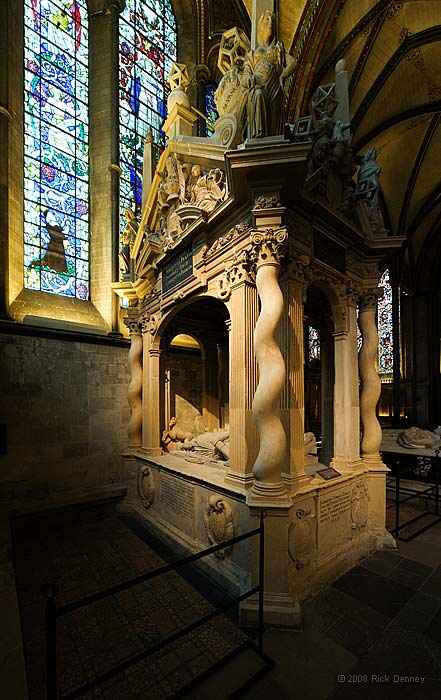
Around 1577 she remarried, taking as her second husband Thomas (later knt.) Gorges. Helena was a patron of the arts, rebuilt Langford Castle in Wiltshire, and was chief mourner at the funeral of Queen Elizabeth Tudor. She was buried at Salisbury Cathedral where an effigy is still present.

Helena, Marchioness of Northampton and Sir Thomas Gorges in Salisbury Cathedral.

Helena, Marchioness of Northampton and Sir Thomas Gorges in Salisbury Cathedral.

Helena's effigy which has a coronet, Salisbury Cathedral.

Helena’s effigy which has a coronet, Salisbury Cathedral.

Links

8 APRIL 1608: THE DEATH of Hon. Magdalen Dacre

Coat of arms of the Barons of Dacre showing their heraldic charges, the Bull. European Heraldry.

Coat of arms of the Barons of Dacre showing their heraldic charges, the Bull. European Heraldry.

Hon. Magdalen Dacre, Viscountess Montagu (January 1538 – 8 April 1608) was an English noblewoman. She was the daughter of William Dacre, 3rd Baron Dacre of Gilsland, and the second wife of Anthony Browne, 1st Viscount Montagu. Magdalen, a fervent Roman Catholic, was a Maid of Honour at the wedding of Mary I of England to Philip II of Spain in Winchester Cathedral. Dacre, despite being a Catholic, managed to remain in high regard with the Protestant Tudor Queen who succeeded Mary, Elizabeth I. Dacre was, according to biographer Lady Antonia Fraser in her historical biography, The Gunpowder Plot: Terror and Faith in 1605, a fine example of “how the most pious Catholic could survive if he (or she) did not challenge the accepted order”.

Effigy of Hon. Magdalen, Viscountess Montague.

Effigy of Hon. Magdalen, Viscountess Montague.

Magdalen Dacre died at Battle Abbey, Sussex on 8 April 1608 at the age of seventy. She was originally buried in Midhurst Church, where a splendid tomb with her effigy was erected. The tomb was moved in 1851 to Easebourne Church.

Magdalen Dacre was a cousin to Queen Katherine Parr via several common ancestors. Her closest connection to Queen Katherine was her paternal great-grandmother, Mabel Parr, Lady Dacre (great-aunt of Queen Katherine) and maternal great-grandmother, Lady Katherine Neville (great-great-aunt of Queen Katherine as sister to Lady Alice, great-grandmother of Queen Katherine).

Ancestors of Queen Katherine: Joan of Kent, Princess of Wales

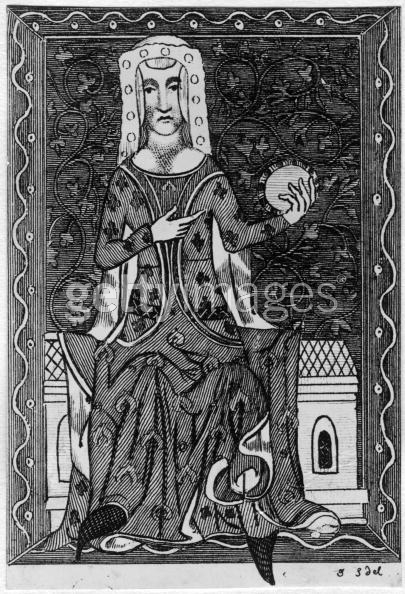
Medieval depiction of Princess Joan of Kent.

Circa 1380, Joan of Kent, Princess of Wales (1328 – 1385), wife of Edward, the Black Prince, mother of Richard II. (Photo by Hulton Archive/Getty Images)

Princess Joan of Kent, suo jure 4th Countess of Kent and 5th Baroness Wake of Liddell, later the first Princess of Wales, as wife to Edward, the Black Prince, son and heir of King Edward III. Joan was the daughter of Prince Edmund of Woodstock, 1st Earl of Kent (5 August 1301-19 March 1330) and his wife Hon. Margaret, suo jure 3rd Baroness of Wake of Liddell (c.1297-29 September 1349). Princess Joan had three other siblings; Edmund, 2nd Earl of Kent (1326 – before 5 October 1331); John, 3rd Earl of Kent and 4th Baron Wake of Liddell (7 April 1330 – 26 December 1352); and Margaret, Viscountess of Tartas. Upon the death of her brother, the 3rd Earl of Kent and 4th Baron Wake, Joan assumed the titles as the 4th Countess and 5th Baroness. Joan is one of the few women in Medieval history to hold/inherit a title in her own right. Joan’s great-granddaughter, Lady Alice Montacute, would be another women to hold that honor as the suo jure 5th Countess of Salisbury. Jean Froissart called her “the most beautiful woman in all the realm of England, and the most loving.”

By her maternal grandfather, Sir John Wake, 1st Baron Wake of Liddell, Joan was descended from Llywelyn the Great, Prince of Gwynedd and Joan, Lady of Wales, the illegitimate daughter of John I of England. Her maternal grandmother, Joan de Fiennes, was a sister of Margaret de Fiennes, making her a cousin of Roger Mortimer, 1st Earl of March. Joan’s great-grandfather, William Fiennes, was killed at the battle of Courtrai in 1302; her great-great-great-grandfather Jean de Brienne was Emperor of Constantinople and King of Jerusalem; and her great-great-great-great-grandmother Berenguela of Castile was the sister of Edward II’s grandfather Fernando III of Castile, both being children of Eleanor of England, Queen of Castile, daughter of Henry II of England and Eleanor of Aquitaine.

The Earl and Countess of Kent, Prince Edmund of Woodstock and Margaret, suo jure Baroness Wake of Liddell.

The Earl and Countess of Kent, Prince Edmund of Woodstock and Margaret, suo jure Baroness Wake of Liddell.

Joan’s father, Edmund of Woodstock, was executed after the deposition of her uncle, Edward II. At the time of her father’s death, her mother was pregnant with John who would become the 3rd Earl at age one after the death of his elder brother in 1331. Joan and her sister Margaret were brought to court after Edward III learned of the injustice done to his uncle by the hand of his mother, Queen Isabella (the French queen consort of Edward II) and her love Roger Mortimer, Earl of March (cousin of Joan’s mother). Joan and her siblings were raised in the royal nursery; therefore she was brought up along side her cousin and future husband, Edward, Prince of Wales. After the death of her mother on 29 September 1349, Joan was made a ward of Edward III and his queen Philippa of Hainault. This connection perhaps led to the marriage of her brother, the 3rd Earl of Kent, to Isabella of Jülich (died 6 June 1411), the daughter of William V, Duke of Jülich and Joanna of Hainaut, a younger sister of Queen consort Philippa of Hainault on 3 April 1348. They couple had no children, but Isabella’s brother, Gerhard VI of Jülich, Count of Berg and Ravensberg, was grandfather to Adolf I, Duke of Cleves and thus was an ancestor to Anne of Cleves, 4th wife of King Henry VIII.
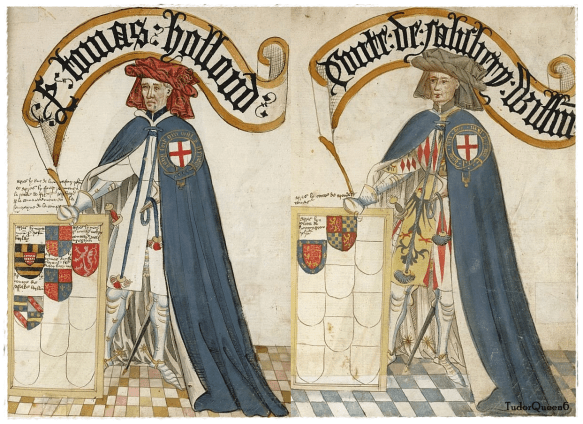
Left, Thomas Holland, Earl of Kent and right William, Earl of Salisbury; from the Bruges Garter Book, 1430/1440, BL Stowe 594

Left, Thomas Holland, Earl of Kent and right William, Earl of Salisbury; from the Bruges Garter Book, 1430/1440, BL Stowe 594

Joan was eventually assigned a govern and governess; William and Catherine Montacute, the 1st Earl and Countess of Salisbury. The couple was determined to have Joan married to their son and heir William. Instead of following their plans, Joan followed her own path and fell in love with Sir Thomas Holland, Baron Holland. She married her first husband, Sir Thomas Holland, around the age of twelve. Thomas was about fourteen years older, which was not considered an issue at the time. Sir Thomas Holland was an English nobleman and would become a military commander during the Hundred Years’ War. He was from a gentry family in Holland, Lancashire. He was a son of Sir Robert Holland, 1st Baron and Maud la Zouche, daughter of Sir Alan le Zouche, 1st Baron and Eleanor de Segrave. Alan Zouche’s mother, Ela Longespee was the granddaughter of the 1st Earl of Salisbury, the illegitimate son of King Henry II of England. His other ancestors included Henry I of England (twice), David I of Scotland (twice), Raoul Count of Marche Lusignan, and Duncan II of Scots. Holland would be granted the honour of being chosen as one of the founders of the Most Noble Order of the Garter. He secretly married Joan of Kent in a clandestine marriage without first gaining the royal consent necessary for couples of their rank. Since the couple did not get consent of the crown and the marriage was simply one of sworn love for each other, Joan was forced by the Salisbury’s to marry their son Sir William Montague, 2nd Earl of Salisbury while her husband was overseas.

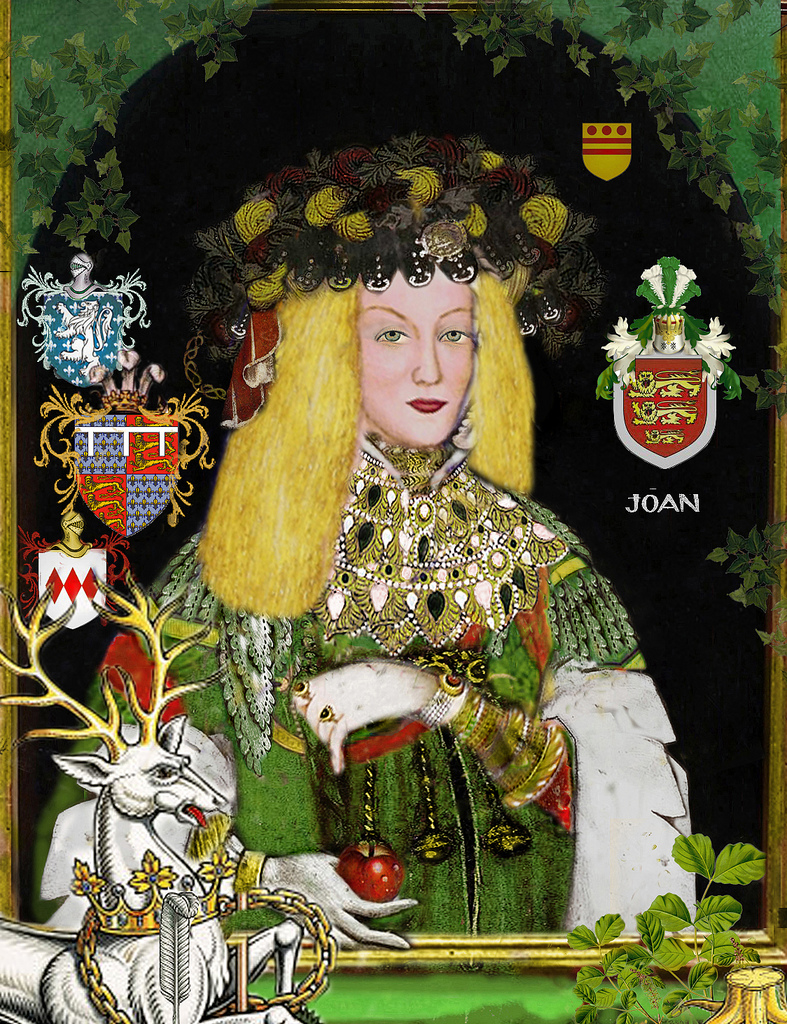
Joan of Kent, Princess of Wales

Joan of Kent, Countess of Kent, Baroness Wake of Liddell, and Princess of Wales. The Montacute arms (bottom left) represent her forced marriage to the 2nd Earl of Salisbury; above Montacute is that of the Prince of Wales; and above both is that of the Holland family. In the top right corner — is her mother’s family crest, Wake of Liddell and below that of her father Prince Edmund of Woodstock.

In 1341 when Holland returned from the Crusades, Salisbury refused to believe the validity of the marriage between Lady Joan and Holland. In 1342, Holland accompanied Robert of Artois to Brittany in support of the Countess of Montfort. In 1346, Holland captured Raoul, Count of Eu, and Jean Tancerville at Caen, France. The same year he fought in the Battle of Crecy as Edward, the Black, Prince of Wales’s chief officers. In 1347, he was awarded 80, 000 florins by the King for the exchange of the Count of Eu. Soon after, Holland appealed to the Pope in Avignon for the return of his wife and confessed to the King. Salisbury decided to keep Joan captive in his home rather than let her return to Holland. In 1349, Pope Clement VI annulled Joan’s marriage to Salisbury and had her sent back to Holland. In 1352, Joan assumed the title of 4th Countess of Kent and 5th Baroness Wake of Liddell after the death of her brother, John, 3rd Earl of Kent. Joan inherited her brother’s title as 4th Countess of Kent and 5th Baroness Wake of Liddell (the barony and title of her mother which passed to her children along with the title of Earl of Kent). These titles were suo jure, meaning “in her own right” as her mother and siblings predeceased her leaving no issue. With the title also came a substantial amount of property and money. The happy couple had three sons and two daughters:

  1. Thomas Holland (later 2nd Earl of Kent), married Lady Alice FitzAlan, daughter of Sir Richard FitzAlan, 10th Earl of Arundel and Lady Eleanor of Lancaster. Katherine Parr and King Henry VIII descended from them.
  2. Edmund who died young, and
  3. John Holland, the youngest son and child — later became 1st Duke of Exeter and married Lady Elizabeth of Lancaster, daughter of his cousin Prince John of Gaunt, 1st Duke of Lancaster by his first wife, also a cousin, Blanche of Lancaster.
  4. Lady Maud Holland, Countess of Ligny (d.1407) as wife to Waleran III of Luxembourg, Count of Ligny; they had one daughter, Jeanne of Luxembourg who married Antoine, Duke of Brabant. The Count and Countess of Ligny’s lineage died out after the death of their two grandsons, John IV, Duke of Brabant (1403–1427) and Philip of St. Pol (1404–1430), Duke of Brabant.
  5. Lady Joan Holland, Duchess of Brittany (1350–1384) who married John V, Duke of Brittany in London, May 1366. They had no issue. The Duke had previously been married to the Duchess’s cousin, Princess Mary of Waltham, daughter of Edward III. John V was knighted by Edward III in 1375-1376 as a member of the Order of the Garter. It is believed he is the only Duke of Brittany to have attained this English honor. The Duke would marry thirdly to Joanna of Navarre (mother to his children), the future queen consort to King Henry IV of England.

Her two surviving sons were the godsons of Lady Kent’s cousin and future husband, Edward, Prince of Wales. Thomas Holland, 1st Earl of Kent died in 1360.

Although marriages within the Royal Family and between Royal Families are the most desirable, it is interesting to note the marital ties of the Holland children also to the English royal family.

The 1st Duke of Exeter married John of Gaunt’s daughter, Lady Elizabeth of Lancaster; their children married nobility. The 3rd Duke would marry into the royal family — as husband to Anne of York, sister of Edward IV and Richard III. Their daughter, also named Anne, would marry the 1st Marquess of Dorset; son of Queen Elizabeth, wife of Edward IV, by her first husband.

The children of the 2nd Earl of Kent: Lady Joan Holland married Edmund of Langley, 1st Duke of York (son of Edward III); no issue. Lady Joan was the sister of Lady Margaret Holland who married firstly to Gaunt’s son John Beaufort, 1st Earl of Somerset (ancestors of Lady Margaret Beaufort) and secondly to the Duke of Clarence (Thomas of Lancaster), grandson of John of Gaunt by his son King Henry IV; she would be known as the Duchess of Clarence for the rest of her life. Another sister, Lady Eleanor Holland was mother-in-law to Richard Neville, 5th Earl of Salisbury, grandson of John of Gaunt by his daughter Lady Joan Beaufort, Countess of Westmorland. Yet another sister, Lady Alianore Holland was mother to Anne de Mortimer, wife to York’s (Langley) son, Richard of Conisburgh, Earl of Cambridge. Another sibling of Lady Joan, Edmund Holland, 4th Earl of Kent would father a child by York’s daughter Constance of York; it has been claimed there was a marriage betrothal between the two, but no evidence that they were officially married.(Richardson)

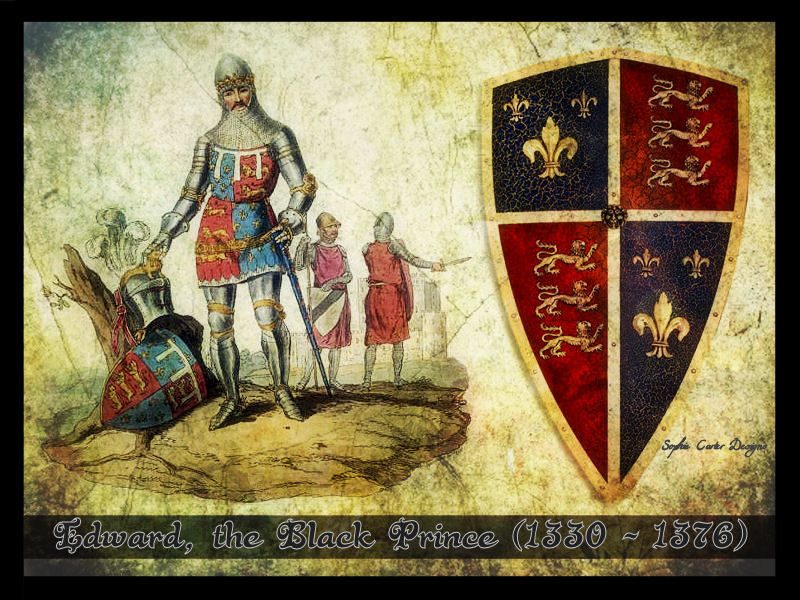
Princess of Wales
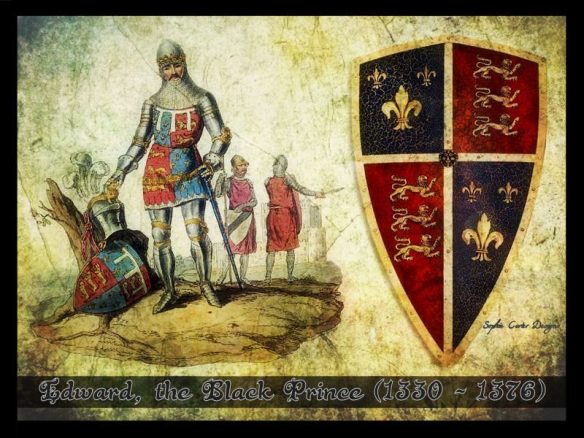
By Sophie Carter.

By Sophie Carter.

Now a rich widow, Joan was sought after by just about every eligible bachelor in the country. The Countess’s royal birth, her extraordinary beauty and grace, and the circumstances of her life had caused this cynosure of every man; that she was the universal subject of men. Joan declined all that approached her. In one instance her cousin, the Prince of Wales, had been approached by a soldier in his entourage to intercede upon his behalf; now identified as a Sir Denis Brocas. According to the story (for the full account see Burrows),

“an English noble, whose name history does not mention, having fallen in love with the widowed Countess of Kent, and found his suit tardy, entreated the Prince’s good word; but that after certain denials, she told him plainly, ‘that when she was under ward, she had been disposed of by others; but now, being mistress of her own actions, she would not cast herself beneath her rank, but remember that she was of the blood-royal of England, and therefore resolved never to marry again but a Prince of quality and virtue like herself;’ and that the hero, while pleading the cause of his friend, felt the old flame rekindled.” (Finch)

A valuable anonymous MS reposited in the National Library at Paris has been edited by the well known antiquary M. Simeon de Luce, called the “Chronique des quatre premiers Valois” of which this one copy alone exists. According to the chronicler:

 “The Prince did speak many times for the knight to the said Lady of Holland; for he went with great good will for his own pleasure to see the said lady, who was his cousin, and he oftentimes observed with admiration her brilliant beauty and most gracious presence, which marvellously delighted him. And when one day the Prince was speaking to the said Countess for the said knight, she gave him her answer. She never would have any husband. And often said she this to the Prince, for she was very subtle and clever. ‘Ha!’ said the Prince fair, ‘cousin if you decline to marry my friends your wonderful beauty will be all the worse for you. If you and I were not so near of kin there is no lady under heaven whom I should love so dearly as I should you.’ Then was the Prince much overcome with love of the Countess; and so the Countess fell a weeping just like the subtle woman that she was and full of wiles. And now the Prince began to console her and tenderly affected by her tears took to kissing her very often and said; ‘Fair cousin, I am come to speak to you for one of the most perfect knights in England, and moreover of high lineage.’ Bathed in tears, Madame the Countess thus addressed him: ‘Ah sire! for God’s sake I beseech you say no more on that point, for I am resolved never to marry. I have already given myself away to the most perfect knight in all the world and for the love of him never do I mean to have so long as I shall live, any spouse but God. It is quite impossible. For his love I forswear the society of men, not one of whom do I intend to marry.’ The Prince was tormented with a vehement desire to know who this most perfect knight in the world might be and repeatedly pressed the Countess to tell him his name. But the said Countess, the more eager she saw him become, the more she besought him that he would ask no further question. Falling on her knees, she cried: ‘For the love of God and of His most sweet Lady Mother, will you not submit to this restraint?’ To bring the story to an end, the Prince told her that if she would not inform him who was the most perfect knight in the world he would be her mortal enemy. Then said the Countess: ‘Most dear and honoured lord, it is you. It is for the love of you that I declare that knight shall never marry me.’ The Prince who was by this time well nigh beside himself with love, then said: ‘Lady, and I also on my part vow to God that as long as you shall be alive, never will I take any other woman to my wife.’ And there and then he plighted her his troth, shortly enough after which the marriage took place. . .Edward, the king of England, was marvellously vexed and annoyed at this affair and was even desirous of putting her to death, for this Prince might have made a very much more lofty match. There was neither emperor, king, nor prince under the sky who would not have been rejoiced to have the Prince enrolled among his lineage.”(Burrows)

The tales and accounts may have been exaggerated as most records were back then. This seems to be a tad too romantic for the time and I doubt anyone would remember such detail as stated in the Burrow’s account. Looking at the dates of the publications — it is no doubt the Victorian romanticized version of the tale.
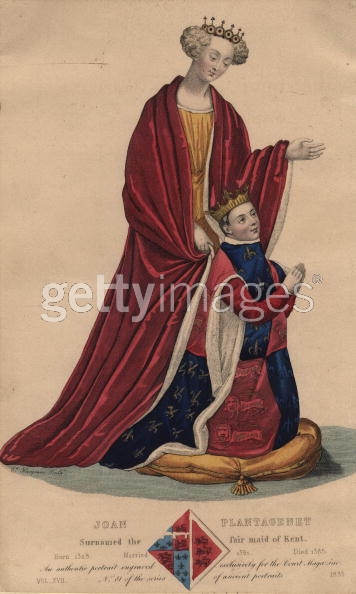
Princess Joan of Kent and her son, King Richard II

Circa 1377, Joan of Kent (1328 – 1385) Princess of Wales, wife of Edward the Black Prince and mother of King Richard II of England (1367 – 1399) (second and only surviving son). (Photo by Hulton Archive/Getty Images)

The Prince of Wales became affectionate towards the Countess of Kent. It is said that even the Prince had fallen for her charm earlier in his lifetime, but that his parents did not approve. Nevertheless, it seems that their marriage was one of love. Although his parents did not approve of the match (they most likely wanted him to marry a foreign Princess to forge some sort of alliance between England and another European country). Although Joan had been a favored ward of the King and queen, the Countess’s living ex-husband was an issue when it came to inheritance. The secret marriage the Prince of Wales and Countess of Kent are said to have contracted in 1360 would have been invalid anyway because of the consanguinity prohibition (they were first cousins, once removed). At the King’s request, the Pope granted a dispensation allowing the two to be legally married. The official ceremony occurred on 10 October 1361, at Windsor Castle with the King and Queen in attendance. The Archbishop of Canterbury presided.

The couple had two children, Edward of Angoulême and Richard of Bordeaux (later King Richard II). The eldest died around age 6 while the couple was ruling in Bordeaux as Prince and Princess of Aquitaine. The couple returned to England in 1371 where the plague had become an issue. Edward was a Prince who enjoyed fighting and was usually pre-occupied with some campaign. In 1371, he attempted one final campaign to regain his father’s French possessions. On 7 June 1376, he died at Westminster, a week before his forty-six birthday. Joan’s son by the Prince, young Richard, became heir to his grandfather Edward III. Edward died circa a year after his son and Richard was crowned King at the age of ten.
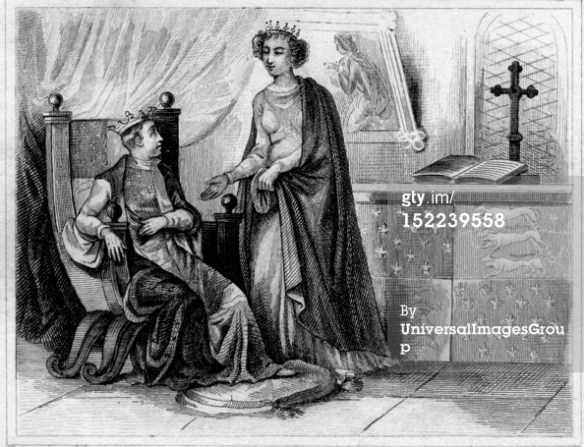
Portrait of Joan of Kent (1328-1385) with her son Richard II, 1377. (Photo by Photo12/UIG/Getty Images)

Portrait of Joan of Kent (1328-1385) with her son Richard II, 1377. (Photo by Photo12/UIG/Getty Images)

As a power behind the throne, she was well loved for her influence over the young king – for example, on her return to London (via her Wickhambreaux estate) from a pilgrimage to Becket’s shrine at Canterbury Cathedral in 1381, she found her way barred by Wat Tyler and his mob of rebels on Blackheath but was not only let through unharmed, but saluted with kisses and provided with an escort for the rest of her journey. She was well loved by the people.
By Sophie Carter Designs.

By Sophie Carter Designs.

In 1385, Sir John Holland (1st Duke of Exeter), son of the Princess of Wales’s first marriage, was campaigning with the King in the Kingdom of Scotland, when a quarrel broke out between him and Ralph Stafford, son of the 2nd Earl of Stafford, a favorite of the new Queen Anne of Bohemia. Stafford was killed, and John Holland sought sanctuary at the shrine of St John of Beverley. The Princess of Wales herself did not take to foreign queens for some reason so one wonders if she got along with Queen Anne of Bohemia. On the King’s return, Holland was condemned to death. Joan pleaded with her son for four days to spare his half-brother. On the fifth day (the exact date in August is not known), she died, at Wallingford Castle. Richard relented, and pardoned Holland (though he was then sent on a pilgrimage to the Holy Land).

This head, believed to represent Joan Plantaganet, wears her hair in a netted fret, a fashion popular in the late 14th century. The actual boss in Canterbury Cathedral is not terribly prominent and takes a few minutes to locate - like most cathedrals it is possible to discover something new on each visit.

This head, believed to represent Joan Plantaganet, wears her hair in a netted fret, a fashion popular in the late 14th century. The actual boss in Canterbury Cathedral is not terribly prominent and takes a few minutes to locate – like most cathedrals it is possible to discover something new on each visit.

Joan was buried, as requested in her will, at the Greyfriars, the site of the present hospital, in Stamford in Lincolnshire, beside her first husband, the Earl of Kent. In her will she stipulated:

‘My body is to be buried in my chapel at Stanford, near the monument of our late lord and husband, the Earl of Kent.’

Her third husband, the Black Prince, had built a chantry for her in the crypt of Canterbury Cathedral where he was buried with ceiling bosses of her face (seen above). She however chose to be buried with the Earl of Kent, as stated above.

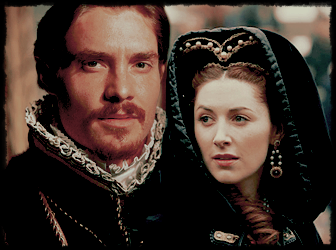
The Prince and Princess of Wales portrayed by James Purefoy and an unknown actress in "A Knight's Tale" (2001)

The Prince and Princess of Wales portrayed by James Purefoy and an unknown actress in “A Knight’s Tale” (2001)

Lady Joan was featured without credit in “A Knight’s Tale” (2001) as the woman sitting next to the Black Prince [alias Coleville in the film] at the final tournament. As the Prince of Wales had no other wife, we can assume that this is the Princess of Wales, Joan.

So just how is Queen Katherine Parr descended from Princess Joan?
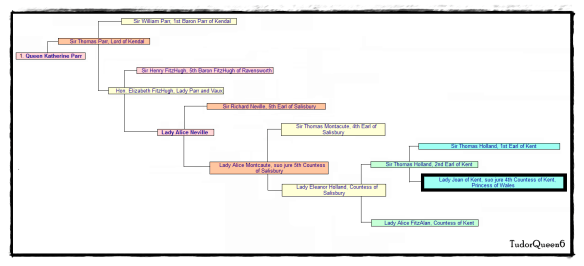
Joan_of_Kent_KP

Sources

  • Wentersdorf, Karl P (1979). “The Clandestine marriages of the Fair Maid of Kent,Journal of Medieval History 5 (3): 203–231.
  • Douglas Richardson. “Magna Carta Ancestry: A Study in Colonial and Medieval Families,” 2nd Edition, 2011.
  • Anne Crawford. “Yorkists: The History of a Dynasty,” Continuum International Publishing Group, Apr 15, 2007.
  • Montagu Burrows. “The family of Brocas of Beaurepaire and Roche court: hereditary masters of the royal buckhounds, with some account of the English rule in Aquitaine,” Longmans, Green, 1886. Google eBook (available for download)
  • Barbara Clay Finch. “Lives of the princesses of Wales,” Volume 1, Remington and co., 1883. Google eBook
  • Getty Images — Search: Joan of Kent, Princess of Wales

© Meg McGath
27 March 2013

Family of Queen Katherine: Sir Edward Herbert of Powis

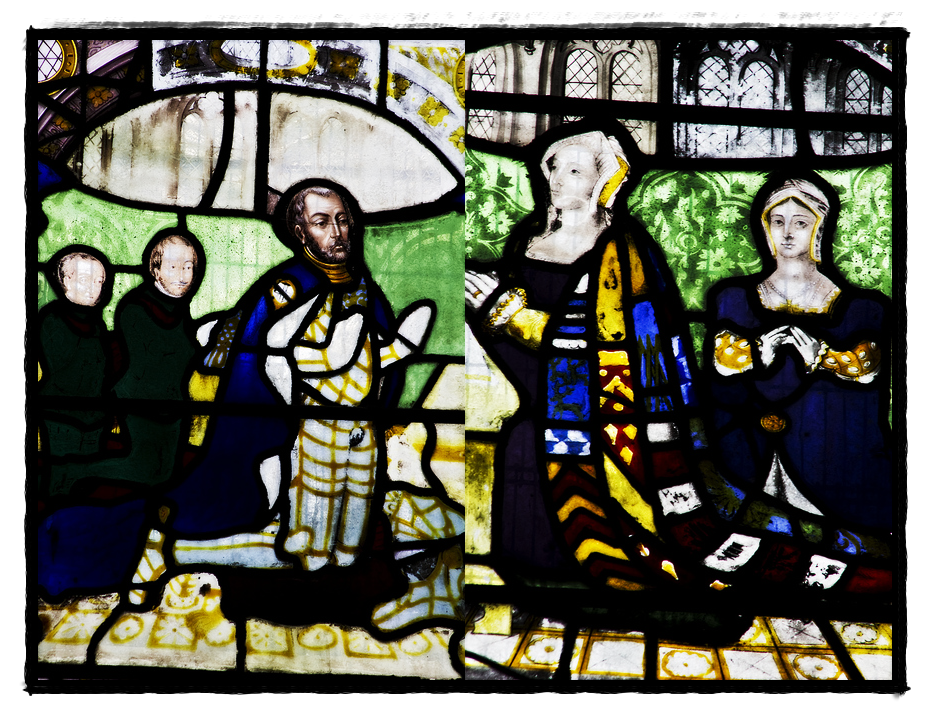
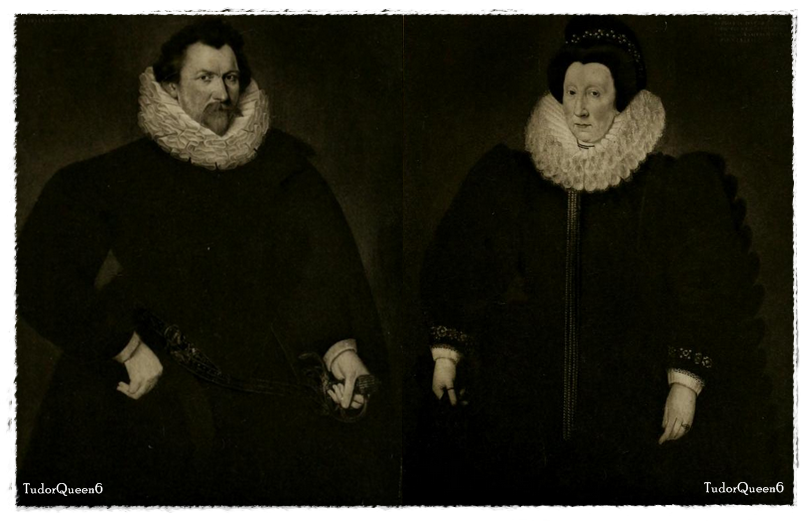
Pembroke family of Wilton. Wilton Church.

Pembroke family of Wilton. Wilton Church. Left panel shows the 1st Earl of Pembroke with his two sons, Henry (future 2nd Earl of Pembroke) and Sir Edward of Powis.

Sir Edward Herbert of Powis Castle (Jun 1544-23 March 1595) was the second child and son of Sir William Herbert, 1st Earl of Pembroke (10th creation) and his first wife, Lady Anne (Parr). His siblings were Lord Henry Herbert (later 2nd Earl of Pembroke) and Lady Anne Talbot, wife of Lord Francis Talbot. Through his mother, Herbert was a nephew to Queen Katherine Parr and the 1st Marquess of Northampton, William Parr. Upon the death of his aunt, Queen Katherine, his mother became the sole heiress to her brother the Marquess of Northampton.

Arms of Sir William Herbert, 1st Earl of Pembroke (10th creation)

Arms of Sir William Herbert, 1st Earl of Pembroke (10th creation) [2]

Herbert was a member of the Herbert family, a Welsh noble family who descended from Sir William ap Thomas of Raglan Castle. His father, Sir William Herbert, 1st Earl of Pembroke of the second creation (within the Herbert family) was the grandson of the first creation also named William (1423-1469). From birth, Edward Herbert had the backing of his family’s powerful clan. It also didn’t hurt that his father, the Earl of Pembroke, would become a large influence at court. Due to his mother’s affiliation to Henry VIII’s last queen, Katherine Parr, Herbert’s father owed some of his advancement to Edward’s mother — Anne. Lady Pembroke (at the time Lady Anne Herbert) was sister to Queen Katherine, the last queen consort to King Henry VIII. In the reign of Henry VIII’s children, especially Edward VI, Pembroke became a guardian to the young king and was part of the court circle of men around the boy. Pembroke tried to advance his standing by marrying his son to a granddaughter of Princess Mary Tudor (Henry VIII’s younger sister and designated heirs to the throne after his immediate children), Lady Katherine Grey. The marriage was to bring the family close to the crown upon the attempt to put Grey’s sister, Lady Jane, on the throne as Queen. When Lady Jane was “deposed,” Pembroke tried to distant himself from the “traitors” which included his brother-in-law, Northampton. Pembroke had the marriage between his son and Lady Katherine annulled and tried to gain favour with the Catholic queen Mary Tudor. The plan worked and his family was spared. Pembroke would also contribute heavily to the reign of Elizabeth I.

Lord Pembroke’s marriage to the queen’s sister advanced the family and Anne gave legitimacy to the Herbert family. Lady Pembroke’s descendants also had the luxury of becoming the heirs of the Parr inheritance once Lady Pembroke’s brother, William, 1st Marquess of Northampton died in 1571 without issue. Although the title of Marquess of Northampton and Earl of Essex were forfeit, the children inherited other “titles”, manors, lands, etc.

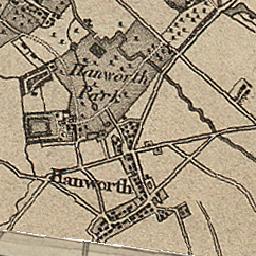
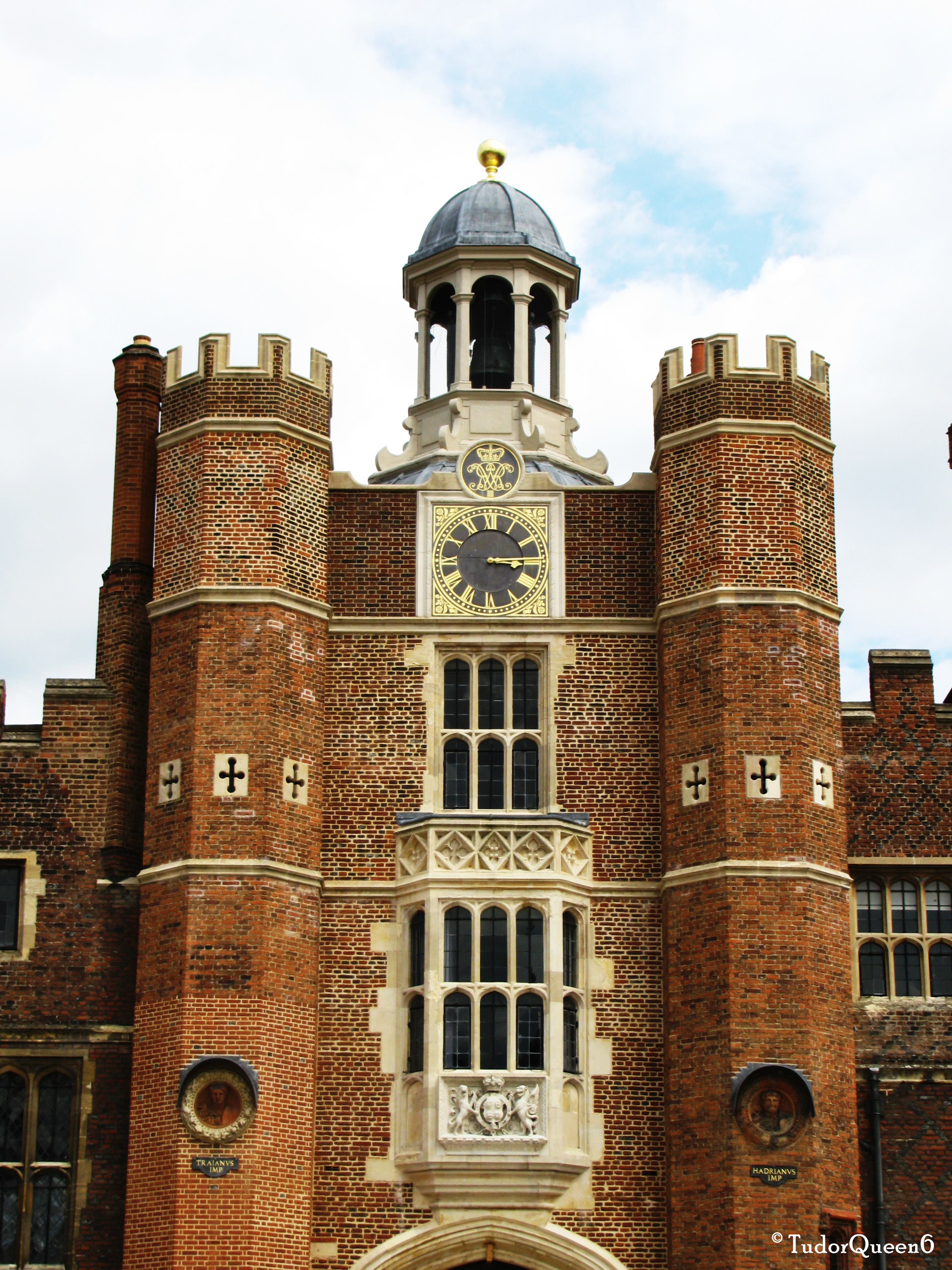
HANWORTH, a village and a parish in Staines district, Middlesex. Ordnance Survey First Series, Sheet 8.

HANWORTH, a village and a parish in Staines district, Middlesex. Ordnance Survey First Series, Sheet 8.

In June 1544, the Queen lent her sister Lady Herbert her manor, Hanworth for the lying-in for her second child. It was there that Anne Herbert gave birth to her second son, Edward (his elder brother was named Henry, was this a coincidence?). The Queen sent regular messengers to Hanworth to inquire on the health of her sister. For the christening, the queen provided a large delegation (five yeo-men, two grooms, and Henry Webbe) from her household to attend. Letters continued well into July between the two sisters while Lady Herbert remained at Hanworth. After the birth, Lady Herbert visited Lady Hertford (Anne Stanhope), who had also just given birth, at Syon House near Richmond.[1]

In August 1544, the queen paid for a barge to bring her sister Lady Herbert by river from Syon House (home to the Hertford’s) to Westminster. The queen’s involvement in the birth and christening of her nephew would eventually lead her to take him in as part of her household after the death of King Henry.[1]

After King Henry VIII’s death in January 1547, when the queen dowager’s household was at Chelsea, both Lady Herbert and her son Edward were part of the household there. The Dowager queen, as always, was keen to have her family close to her. After having no children of her own by her previous three husbands and no role in the new government, the queen probably didn’t mind having her toddler nephew around. While Lady Herbert attended her sister, her husband Lord Herbert was appointed as one of the guardians to the new king, Edward VI. Lord Herbert became part of the circle around the new king which included his brother-in-law, the Marquess of Northampton.[1]

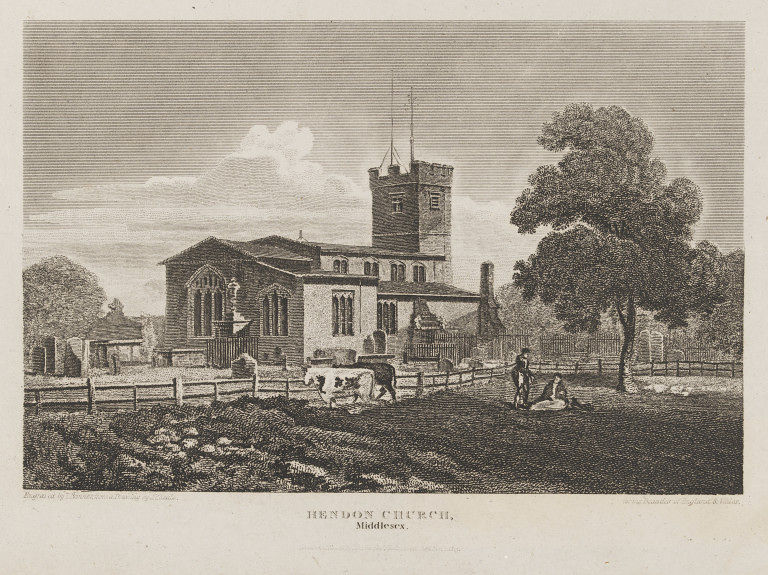
Hendon Church, Middlesex. London, England; June 1, 1815 (published). John Preston Neale, born 1766 - died 1847 (artist); Bonner, Thomas, born 1735 - died 1816 (engraver) Engraving. Given by Dr. G. B. Gardner. V&A Online Collections.

Hendon Church, Middlesex. London, England; June 1, 1815 (published). John Preston Neale, born 1766 – died 1847 (artist); Bonner, Thomas, born 1735 – died 1816 (engraver) Engraving. Given by Dr. G. B. Gardner. V&A Online Collections.

At the age of his majority, Herbert returned for the family borough and never sat for Parliament again. On the death of his father in 1569, Herbert inherited the manor of Hendon, Middlesex. He also inherited his mother’s lands in Northampton and Westmorland (the Parr inheritance).

Powis_Castle

Probably the most important event in his life was the purchase of Powis Castle in Wales (at the time it was called “Poole Castell”).[2] Sir Edward Herbert bought the lordship and castle in 1587 from Edward Grey, a feudal Lord of Powis.[3] Edward Grey was the illegitimate child of the last Lord Powis and Jane Orwell; therefore his father’s estates, which he inherited, came with limitations within Lord Powis’s will.[4] One of those limitations was the obvious title, Baron Powis, which would be bestowed on Herbert’s son, William Herbert, in the reign of James I. The castle Sir Edward took over was probably in serious need of repair and modernisation, and he undertook extensive work between 1587 and 1595, of which only the long gallery survives (completed in 1593).[5]

Herbert’s interests were mostly in Montgomeryshire and he had little to do with public life (most likely by choice). He was knighted in 1574. In 1590, his brother the 2nd Earl of Pembroke put him forward for a membership in the council of the marches. Herbert appears to have been of the Catholic faith and that may also explain his non-involvement in Parliament and at the court of Elizabeth I. Herbert’s wife however was Catholic and it was most likely to her influence that he converted. Lord and Lady Herbert’s names appeared on a list of Catholics drawn up between 1574 and 1577; his wife’s name would appear again in 1582. In 1580, Henry Sydney (brother to his sister-in-law Lady Pembroke), was to arrest recusants and did institute proceedings against them in Montgomeryshire. The Herbert’s were left to be until June 1594 when Lady Herbert and her five children, all under age, were presented for recusancy, not having attended Church services (Protestant) at the parish church in Welshpool for twelve months.

Women were very important to the recusant cause in Wales, as in England. Often a wife stayed at home while her husband kept up appearances by attending Anglican services. Some people outwardly conformed to avoid stiff fines, but secretly remained Catholics.

In 1581, it was made treason to convert to Catholicism, or try to convert someone else to it; further measures followed, and the penalty for being caught was often death. But some Catholics risked their lives all the same. The Jesuit order provided many missionary priests, some raised in Wales but trained on the continent. It was a perilous life, and some Welsh homes still have priest holes, where these men hid from the authorities. A number of Welsh Catholics (mostly priests) were executed in the 16th and 17th centuries.[6]

In 1570, Herbert married Mary Stanley, daughter and heir of Sir Thomas Stanley of Standon, Herts. and London. They had four sons and eight daughters.[7] Their children included the eldest son and heir Sir William Herbert, 1st Baron Powis; George, who died unmarried; Sir John Herbert, Knt, who died without issue; Edward, who died a bachelor; Elizabeth died young; Joyce; Frances; Jane; Mary; Winifred; and two more daughters named Anne and Katherine (most likely named after Herbert’s mother and aunt, the queen).[8][9]

Herbert died on 23 March 1595 and was buried in Welshpool Church, Montgomeryshire, where a monument is erected in his memory on the North side of the Chancel. The Herbert memorial consists of two figures in black marble kneeling. In the middle is an inscription in letters of gold, in roman capitols.[9]

Here lyeth the Bodyes of the Right Worshipful Sir Edward Herbert, Knight, second Son to the Right Honourable Sir William Herbert, Knt. Earl of Pembroke, Lord Cardiffe and Knight of the most Noble Order of the Garter, and of Anne his Wife, Sister and sole Heire to Sir William Parr, Kt. Lord Parr of Kirbeby, Kendall, Marmion, FitzHugh, St. Quintin, Earl of Essex, Marquis of Northampton, and Knt. of the most Noble Order of the Garter. Which Sir Edward Herbert married Mary Daughter and sole Heire to Thomas Stanley of Standen, in the County of Hertford, Esq; Master of the Mint, A.D. 1570, youngest Son of Thomas Stanley of Dalgarthe, in the County of Cumberland, Esq. Which Sir Edward Herbert and Dame Mary his Wife had Issue iv Sonnes and viii Daughters, viz.

William Herbert, Esq; his eldest Sonne and Heire, who married Lady Eleanor, second Daughter to Henry late Earl of Northumberland, George Herbert, 2d Son, John Herbert, 3d Son, and Edward Herbert, 4th Son : Elizabeth, first Daughter died young, Anne 2d Daughter, Joyce 3d Daughter, Frances 4th Daughter, Katharine 5th Daughter, Jane 6, Mary 7, and Winifred 8th Daughter. Which Sir Edward died 23 Day of March DMDLXXXXIV and this Monument was made at the Charge of the sayd Lady Herbert 23 October 1595.[9]

Letters of administration were issued to his widow in April 1595.[7]

Books of Hours belonging to Lady Eleanor Powis, wife to Sir William, 1st Baron Powis.  Lady Eleanor used her Book of Hours to remind her of important anniversaries writing these dates against the Feast Days of the Catholic Calendar at the front of her book. She includes the birthdays of herself, her husband William, and her children. © National Trust Collections

Books of Hours belonging to Lady Eleanor Powis, wife to Sir William, 1st Baron Powis. Lady Eleanor used her Book of Hours to remind her of important anniversaries writing these dates against the Feast Days of the Catholic Calendar at the front of her book. She includes the birthdays of herself, her husband William, and her children. © National Trust Collections

Sources

  1. Susan James. “Catherine Parr: Henry VIII’s Last Love,” The History Press, US Edition: 2009. pg 275-76.
  2. European Heraldry. “House of Herbert
  3. George Edward Cokayne. Complete Peerage of England, Scotland, Ireland, Great Britain and the United Kingdom, Extant, Extinct, Or Dormant , Volume 6. G. Bell & sons, 1895. pg 295.
  4. A letter dated 8 October 1590 from Sir Edward Herbert at “The Poole Castell.” Kynaston Peerage Papers No 148.
  5. Hugh Montgomery-Mass, Christopher Simon Sykes. “Great Houses of England & Wales,” Laurence King Publishing, 1994. pg 44-45. Google eBook.
  6. Katharine Olson. “A New History of Wales: Katharine Olson debates Reformation in Wales – a hidden history?,” Wales Online, 24 September 2010. URL: http://www.walesonline.co.uk/news/welsh-history/articles/2010/09/24/a-new-history-of-wales-katherine-olsen-debates-reformation-in-wales-a-hidden-history-91466-27334897/2/#ixzz2OKGjwyCM
  7. “The History of Parliament: the House of Commons” 1558-1603, ed. P.W. Hasler, 1981. HERBERT, Edward II (c.1542-95), of Wilton, Wilts.; later of Powis Castle, Mont.
  8. Edward Thornton Evans. “The History and Topography of the Parish of Hendon, Middlesex,” Simpkin, 1890 – Hendon (London, England). pg 37.
  9. Arthur Collins. “The Peerage of England,” Volume 1, 1735. pg 506. Google eBook.

Holbein Pendant of Helena, Marchioness of Northampton

Drawn by Hans Holbein the Younger, c.1532-1543

Drawn by Hans Holbein the Younger, c.1532-1543

Description
Pendant, with a lady holding a stone, and three hanging pearls, one of three designs for jewellery with inscriptions, from the ‘Jewellery Book’; half-length figure of a lady facing front, her head turned slightly to right and wearing a head-dress, holding an inscribed rectangular tablet in front
Pen and black ink, with grey wash.

The drawing was acquired in 1753, bequeathed by Sir Hans Sloane. Transferred from the Dept. of Manuscripts to Prints + Drawings on 20 July 1860. For a history of the contents of Sloane 5308, see SL,5308.1.

Inscriptions
Inscription Content: Rowlands 1993
Inscribed by an early hand, in brown ink on the stone, “WELL / LAYDI / WELL”

'The Master of the Countess of Warwick', ‘Portrait of a lady, aged 21, possibly Helena Snakenborg’, dated 1569.

‘The Master of the Countess of Warwick’, ‘Portrait of a lady, aged 21, possibly Helena Snakenborg’, dated 1569. The brooch can be seen around her neck hanging from a gold chain.

‘Although there appears to be no surviving example of this type, as Sjögren has noted, the sitter in the painting, according to Strong, by ‘The Master of the Countess of Warwick’, ‘Portrait of a lady, aged 21, possibly Helena Snakenborg’, dated 1569 (R. Strong, ‘The English Icon’, London and New York, 1969, p. 113, no. 61, repr.) in the Tate Gallery (T400) is wearing a very similar pendant jewel, in which the half-length figure of a lady is depicted holding a large stone. This suggests that the inscription was a later, although probably still sixteenth-century, addition. Sjögren makes the tempting, not impossible, proposal that they are one and the same jewel and further conjectures that it was given to the sitter by William Parr (1513-71), the Marquess of Northampton, brother of Queen Katherine Parr, prior to her becoming his third wife in 1565. It is conceivable, if so, that the jewel had originally been ordered in the 1540s for Parr’s first wife, Anne Bourchier.’

By 1540, Parr’s marriage was already in trouble. It is doubtful Parr ordered this for his adulteress wife who ran away in 1541 with her lover. Helena also did not become Parr’s wife until the death of Anne Bourchier on 28 January 1571. Perhaps it was ordered for Elisabeth Brooke, Parr’s common wife by law.

Sources

20 MARCH 1549: THE EXECUTION of Lord Seymour of Sudeley

Seymour_Thomas1

Portrait of Thomas Seymour (1508-49) 1st Baron of Sudeley from ‘Memoirs of the court of Queen Elizabeth’ — Sarah of Essex, out of copyright

Following the death of Queen Katherine Parr in September 1548, Lord Seymour didn’t even wait for his wife’s funeral before he returned to London. As he was free to marry Lady Elizabeth Tudor again, Seymour went straight to her for the second time. Seymour bombarded Elizabeth with letters, lent her his house in London, and coerced her governess Kat Ashley into pleading his case on any and every occasion possible. Of course, Elizabeth refused to comply, a move that probably kept her from being beheaded herself.

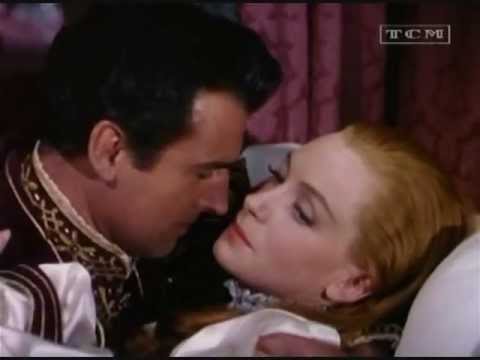
Stewart Granger and Jean Simmons as Lord Seymour and Lady Elizabeth in "Young Bess" (1953)

Stewart Granger and Jean Simmons as Lord Seymour and Lady Elizabeth in “Young Bess” (1953)

In his head, Seymour had a grand plan for himself and had acquired ten thousand men and was preparing for a military coup. As things started to go awry, Seymour refused to wait. He took a gun and broke into the private quarters of the King. On his way to the King, the boy King’s spaniel awoke and started to bark. Seymour shot the dog and the whole household was awoken. Seymour was arrested, thrown in the Tower, and accused of 33 charges of High Treason and misdemeanor.

Death scene of Queen Katherine played by Deborah Kerr and Stewart Granger as Thomas Seymour in "Young Bess." Kerr had a strong resemblance to the real Queen Katherine.

Death scene of Queen Katherine played by Deborah Kerr and Stewart Granger as Thomas Seymour in “Young Bess” (1953). Kerr had a strong resemblance to the real Queen Katherine.

The authorities had thrown everything they could at Seymour. They even accused him in a possible connection to the death of his wife, the Dowager Queen. That ‘he helped to her end to hasten forth his other purposes.’ Seymour was never given a trial before his peers. Instead, an Act of Attainder (the same legal process that had be used to rid Henry VIII of Katherine Howard) was introduced to Parliament. It passed unopposed in the House of Lords on 25 February, and in the House of Commons on March 5, where it was only opposed by a handful of members.

The Act lists thirty-three charges trumped up against Seymour. In “The Annals of Winchcombe and Sudeley” by Emma Dent, she summarizes the charges:

“Articles of High Treason and other Misdemeanors against the King’s Majesty and his Crown objected to Sir Thomas Seymour Kt Lord Seymour of Sudeley and High Admiral of England Article

  1. He was charged with endeavouring to get into his own hands the government of the king

  2. With bribing certain members of the Privy Chamber

  3. With dictating a letter for the king to send to Parliament tending to the disturbance of the government

  4. For endeavouring to gain several of the nobility to join him in making changes in the affairs of state

  5. For threatening to make the Blackest Parliament ever known in England

  6. For refusing to answer a summons to explain certain things laid to his charge

  7. For prejudicing the king against the protector

  8. For suggesting to the king to take upon himself the affairs of government

  9. For plotting to take the king into his custody

  10. For plotting that the king should apply to him alone for all he needed

  11. For intending to control the king’s marriage

  12. For confederating with discontented noblemen to make a strong party abroad ready to serve them when occasion required

  13. 13 For planning that certain noble partisans should counteract those who opposed him

  14. For winning over the yeomanry to be ready to serve in case of need

  15. For strengthening his party by giving away various stewardships

  16. For retaining in his service too great a number of gentlemen and yeomen ready to strengthen his cause if needed

  17. For having 10,000 available men

  18. And having in readiness sufficient money to support the 10,000 for a month

  19. For endeavouring to bring about a clandestine marriage with the Princess Elizabeth second heir to the throne

  20. For having married the queen scandalously soon after the death of the king

  21. For deceiving the king and others in persuading them to plead with the queen they being already married

  22. For refusing to promote every way tl at was to the king’s advantage and of so strengthening his own party by sea and land as to bring within his reach the power of aspiring to the throne

  23. For endeavouring to obtain the public authority for his having the Mint of Bristol and which by fraud he had already got into his hands

  24. For having aided and abetted Sir Wm Sherrington who was known to be a traitor to the king

  25. For defrauding the king of 2,800 having conspired for this object with Sir Wm Sherrington

  26. For extorting large sums of money from ships

  27. For having taken possession of goods seized by pirates

  28. For wrongfully imprisoning those who had captured pirates

  29. For letting go free head pirates thus captured and brought before him

  30. For openly disobeying the Protector’s orders for the restitution of goods taken from pirates

  31. For robbing foreign ships wrecked on the English coast

  32. For betraying the king’s secret counsel

  33. For laying in provisions and money for a great number of men for his servants spreading the report the king was dead of a riot in consequence being expected had it not been stopped by his apprehension and committal to prison”(Dent)

Edward and Anne from "The Tudors"

Edward and Anne Seymour from “The Tudors”

He was sentenced to death; his own brother signed his death warrant. Later it was said that his fate was sealed by the Duchess of Somerset, Anne, who had threatened to leave her husband if he did not act against his own brother. Whether or not that is true we do not know. It may simply be speculation.

The Act of Attainder concluded:

‘considering that he is a member so unnatural, unkind and corrupt and such a heinous offender of your majesty and your laws as he cannot be suffered to remain in body of your grace’s commonwealth but to the extreme danger of your highness and it is too dangerous an example that such a person, so much bound and so forgetful of it … should remain among us.’ He was to be ‘adjudged and attained of high treason and … shall suffer such pains of death as in cases of high treason have been accustomed.’

Stewart Granger and Jean Simmons and Lord Seymour and Lady Elizabeth "Young Bess" (1953)

Stewart Granger and Jean Simmons and Lord Seymour and Lady Elizabeth “Young Bess” (1953)

Seymour remained optimistic to the end and in his last moments tried to send Lady Elizabeth a message sewn into his servants velvet shoes. However, he retreated into silence as far as those who condemned him were concerned. While in the Tower, Seymour made his peace with the God others accused him of rejecting, writing the following lines:

‘Forgetting God
to love a king
Hath been my rod
Or else nothing:
In this frail life
being a blast
of care and strife
till in be past.
Yet God did call
me in my pride
lest I should fall
and from him slide
for whom loves he
and not correct
that they may be
of his elect
The death haste thee
thou shalt me gain
Immortally
with him to reign
Who send the king
Like years as noye
In governing
His realm in joy
And after this
frail life such grace
As in his bliss
he may have place.’ (Harington)

On the even of his death, Seymour requested his daughter should be given into the care of the Dowager Duchess of Suffolk, Katherine Willoughby. A few days later, Lady Mary Seymour, who was now about seven months old, was taken from Syon House (home to the Lord Protector and his wife, Anne) to the Duchess’s home — Grimsthorpe Castle in Lincolnshire. Upon the death of Mary’s mother, Queen Katherine, she had left all her wealth and possessions to her husband. Therefore upon his execution, Seymour’s wealth and possessions (which included that which he inherited by the Dowager Queen) reverted to the Crown and there was no money for his daughter.

Seymour was executed early in the morning of 20 March 1549. It took two blows of the axe to sever his head. He was buried in St. Peter’s Chapel in the Tower of London where other royals like Anne Boleyn, Lady Salisbury (the last Plantagenet “Princess”, daughter of the Duke and Duchess of Clarence), and Katherine Howard had been buried. Seymour’s own brother, Somerset (Edward), would join him in January of 1552 after his own execution under Edward VI; two uncles in one reign.

Elizabeth said, upon hearing of his death: “There died this day a man of much whit and very little judgement.”

References

  • Linda Porter. “Katherine, the queen,” St. Martin’s Press, 2010.
  • John Harington, “Nugae Antiquae,” (London, 1769), vol. 3, pg 259. (Linda Porter)
  • Susan James. “Catherine Parr: Henry VIII’s Last Love,” The History Press, 2009.
  • Young Bess” (1953)

Family of Queen Katherine: DEATH of William, 1st Earl of Pembroke

Pembroke family of Wilton. Wilton Church. Pembroke family of Wilton. Wilton Church.

Yesterday was the anniversary of the death of Sir William Herbert, 1st Earl of Pembroke, husband of Anne Parr, and thus sister-in-law to Queen Katherine. Lord Pembroke died on 17 March 1570 at Hampton Court Palace. William was eldest son of Sir Richard Herbert of Ewyas, Herefordshire, by his wife Margaret, daughter of Sir Matthew Cradock of Swansea. Pembroke’s father, Sir Richard, was an illegitimate son of the original William Herbert, 1st Earl of Pembroke of the first creation (d. 1469), by a mistress, Maud, daughter of Adam ap Howell Graunt. He married firstly to Anne Parr in 1538 and after her death, Lady Anne Talbot, daughter of the Earl of Shrewsbury. Parr gave Pembroke an heir (the 2nd Earl), an heir to spare (ancestor to the Earls of Powis), and a daughter (no issue). Talbot had no issue by Pembroke.

Hampton Court Palace, London, England. Hampton Court Palace, London, England.

On the eve of 17 March 1570, Pembroke took to his bed in his quarters at Hampton Court Palace. He was joined by his younger son, Sir Edward Herbert and the Earl of Leicester, Robert Dudley.

Pembroke had written his will back on 28 December 1569. Pembroke’s executors/witnesses of his will were his heir Henry Herbert (later 2nd Earl of Pembroke was the sole executor), the Earl of Leicester (Robert Dudley); Sir Walter Milday; Sir Nicholas Throckmorton (cousin to his first wife); Gilbert Gerrard. To those men he bequethed £50 to be delivered either in money, plate of jewels, within one month. And by codicil it is mentioned that Pembroke declared to Leicester and his son, Sir Edward Herbert, that on the night before his death, the Lord Keeper of the Great Seal, Sir James Crofts, and Mr. Secretary Cecil be joined in the oversee and receive the same gifts. To his wife, (Anne Talbot) he left her, her own clothes and jewels, which would otherwise go to his son Henry, Lord Herbert and his wife. Lady Pembroke was to be looked after and to be allowed to stay at Baynard’s Castle where Pembroke’s previous wife had died in 1552. Pembroke’s second son, Edward, was given a plate with the value of 500 marks. Pembroke’s daughter, Anne, Lady Talbot, was to receive £500. To his brother-in-law, the Marquess of Northampton (William Parr), he left his second-best gold sword. Leicester received Pembroke’s best gold sword. Pembroke also wanted £200 bestowed upon the poor near Baynard castleward in London, Salisbury in Wiltshire, and Hendon. To the Queen (Elizabeth), he left his “newest fairest and richest bed” and his greatest jewel called the “Great Ballace.” Most importantly, the ordinary men (his servants, etc) were to be looked after by his heir, Henry.

That my lorde Herbert do consider Thomas Gregorie and Tidie with money for their travaile and paines beside that he hath bequethed to them in annuity that he speciallie do appointe to Francis Zouche and Charles Arundell fit and good annuities for them. That he have special care of Henrie Morgan, George Morgan, Phillip Williams, Robert Vaughan, and Thomas Scudamore and either entertaigne them into his service payinge them their wages beforehand or else appoint them sufficient annuities. That he do entertaigne his household and keep them together

Philip Williams had been Pembroke’s secretary; Robert Vaughan, his treasurer; Thomas Scudamore was one of the men who carried his coffin.

Leicester then left Pembroke’s bedside, leaving Pembroke with his son and physicians. Pembroke died the next morning, 17 March 1570 at the age of sixty-three.

In his will, Pembroke listed two possible burial places; Old Saint Paul’s or Canterbury Cathedral. If he died near London, his wishes were to be buried in St. Paul’s Cathedral next to his first wife, Anne Parr. Pembroke obviously loved his wife for when he wrote his will, despite being married again, he wanted nothing more than to be buried “near the place where Anne my late wife doth lie buried” in St. Paul’s. He was buried in April.

Shortly after his death, the Dowager Lady Pembroke received a letter from the Queen in the hand of Cecil, but heavily corrected (most likely by Elizabeth). The Queen expressed her condolences of the loss of “our late cousin.”

See also: “Funeral of William Herbert, 1st Earl of Pembroke

References

  • Adam Nicolson. “Quarrel with the King: The story of an English family on the high road to Civil War,” HarperCollins, Oct 6, 2009.
  • Wiltshire Archaeological and Natural History Society, Devizes : Wiltshire Archaeological and Natural History Society, 1879. pg 126-28.

Family of Queen Katherine: Margaret Fiennes, 11th Baroness Dacre

Margaret Fiennes, 11th Lady Dacre with her husband Sampson Lennard.

Margaret Fiennes, 11th Lady Dacre with her husband Sampson Lennard from Hon. Thomas Barrett-Lennard’s “An Account of the Families of Lennard and Barrett,” 1908.

Margaret Fiennes (or Fynes), 11th Baroness Dacre of the South (1541 – 16 March 1612) was a suo jure peeress having been created Baroness Dacre by King James I of England in 1604. She was the daughter of Thomas Fiennes, 9th Baron Dacre who was executed for murder in the year of her birth. His title and lands, upon his death, were forfeited to the crown. The title would not return to the family until her brother was restored in 1558 by Elizabeth I.

Thomas Fiennes, Baron Dacre, father to Lady Dacre.

Thomas Fiennes, 9th Baron Dacre, father to Lady Dacre.

Family

Mary Neville and her son Gregory Fiennes, 10th Baron Dacre by Hans Eworth c. 1559

Mary Neville and her son Gregory Fiennes, 10th Baron Dacre by Hans Eworth c. 1559

Lady Dacre was born in 1541, the youngest child and only daughter of Thomas Fiennes, 9th Baron Dacre and Mary Nevill, daughter of the 5th Baron Bergavenny. In the year of her birth, her father was hanged for the murder of a gamekeeper by the order of King Henry VIII, and his lands and title were forfeited to the crown. Lady Dacre’s brother, Gregory Fiennes, would become the 10th Baron Dacre upon the ascension of Elizabeth I in 1558. The 10th Baron married to Anne Sackville, cousin to Queen Anne Boleyn; they had one daughter who died young. Upon his death, the barony went into abeyance until it was revived for Margaret under James I of England.

Coat of arms of the 9th Baron Dacre of the South from his tomb in Chelsea Church, London.

Coat of arms of Gregory Fiennes, 10th Baron Dacre of the South from his tomb in Chelsea Church, London.

Lady Dacre was related to three of Henry VIII’s six queens. Her paternal great-grandparents were Thomas Fiennes, 8th Baron Dacre and Anne Bourchier. Anne Bourchier was the uterine half-sister of Lady Elizabeth Howard (mother of Queen Anne Boleyn) and Lord Edmund Howard (father of Queen Katherine Howard). Lady Dacre’s father, the cousin of Queen Katherine Howard, was executed in 1541 despite her position as queen.

The Parr’s shared several connections. Firstly, Fiennes’s great-grandfather, Thomas, 8th Baron Dacre was the first cousin of Sir Thomas Parr of Kendal, father of Queen Katherine Parr. Their mothers, Alice Fiennes (FitzHugh) and Elizabeth Parr/Vaux (FitzHugh) were sisters; both daughters of Sir Henry FitzHugh, 5th Baron FitzHugh and Lady Alice Neville (sister of Warwick, the Kingmaker). The Parr’s also shared the Woodville connection of Mary Neville, Lady Dacre’s great-grandmother, Katherine Woodville, Duchess of Buckingham.

Anne Boleyn (wife no. 2), Katherine Howard (wife no. 5), and Katherine Parr (wife no. 6) were all cousins to Lady Dacre.

Anne Boleyn (wife no. 2), Katherine Howard (wife no. 5), and Katherine Parr (wife no. 6) were all cousins to Lady Dacre.

Marriage and issue

On 10 November 1564 at the age of 23, Margaret married Sampson Lennard (died 1615), who came from a family of landed gentry. They resided at Chevening, Kent. He was a Member of Parliament for various constituencies, and from 1590 to 1591, he held the post of High Sheriff of Kent. Lady Dacre and her husband had four sons and six daughters:[1]

  • John Lennard, born 1567; buried 10 Oct 1575.
  • Sir Henry Lennard, 12th Baron Dacre (25 March 1570 – 8 August 1616); Born in Chevening, Kent, England; married Chrysogona Baker, by whom he had issue.[1]
CHRYSOGNA BAKER, Lady Dacre, aged six (d.1616) who  married the 12th Lord Dacre (1589); a portrait (English 1579) by an unknown artist at The Vyne.

CHRYSOGNA BAKER, Lady Dacre, aged six (d.1616) who married the 12th Lord Dacre (1589); a portrait (English 1579) by an unknown artist at The Vyne. ©National Trust Images/Derrick E. Witty

  • Anne Lennard, born 1 Aug 1572 Chevening, Kent; married Herbert Morley.
  • Elizabeth Lennard, born 5 Jun 1580; buried 20 Oct 1581.
  • Elizabeth Lennard, born 26 Nov 1581; married Sir Francis Barnham, by whom she had issue.
  • Gregory “George” Lennard, born 25 Oct 1573Chevening, Kent; married in 1614 to Maud Llewellyn. Died 1620, without issue.[1]
  • Mary Lennard, born 22 Oct 1574 Chevening, Kent; married Sir Ralph Bosville.
  • Thomas Lennard, died 1638 without issue (d.s.p).[1] He is NOT the ancestor to the “Leonards” of Taunton and Bridgewater in America.[1][2]
  • Margaret Lennard, born 28 Sep 1578; married Sir Thomas Waller, by whom she had issue, including Parliamentarian soldier Sir William Waller.
  • Frances Lennard, born 28 Jul 1583; married Sir Robert More
  • John Lennard,[1] born 11 Oct 1584; died bef. 1615.

Baroness Dacre

The title of Baron Dacre had been restored to Margaret’s brother Gregory by Queen Elizabeth I shortly after her ascension to the throne; however upon his death in 1594, it had once again lapsed in abeyance. On 8 December 1604,[2] King James I created her suo jure Baroness Dacre, and she held this title until her death on 16 March 1612. She was succeeded by her eldest son, Henry.

References

  1. Thomas Barrett-Lennard. “An account of the families of Lennard and Barrett compiled largely from original documents by Thomas Barrett-Lennard,” Spottiswoode and Co. Ltd, 1908. pg 214, 240. Open Library
  2. Wm. R. Deane. “A genealogical memoir of the Leonard family containing a full account of the first three generations of the family of James Leonard, who was an early settler of Taunton, Ms., with incidental notices of later descendants,” Boston: Office of the New England historic-genealogical register, 1851. Open Library

16 MARCH 1485: THE DEATH of Queen Anne

Anne Neville from Cardiff Castle. Anne Neville from Cardiff Castle.

Today, 16 March, in 1485, the death of Queen Anne at Westminster Palace at the age of 28. Anne was Queen consort to Richard III from 26 June 1483 until her death.

She was born, Lady Anne Neville. She was a younger daughter of Sir Richard Neville, 16th Earl of Warwick and 6th Earl of Salisbury, known in history as ”the Kingmaker”, and Lady Anne Beauchamp, suo jure 16th Countess of Warwick.

Anne was betrothed to the son of King Henry VI and Queen Margaret of Anjou, Prince Edward, the Prince of Wales, as a truce between the Lancastrians and the Warwick/Clarence faction while they were exiled in Brittany.

Shortly after Warwick’s defeat at Barnet on Easterday 1471, Queen Margaret and Prince Edward returned from France and were decisively defeated. Prince Edward was killed in the battle of Tewkesbury, and King Henry VI was killed soon after, making Anne, the Princess of Wales a widow at the age of just 15.

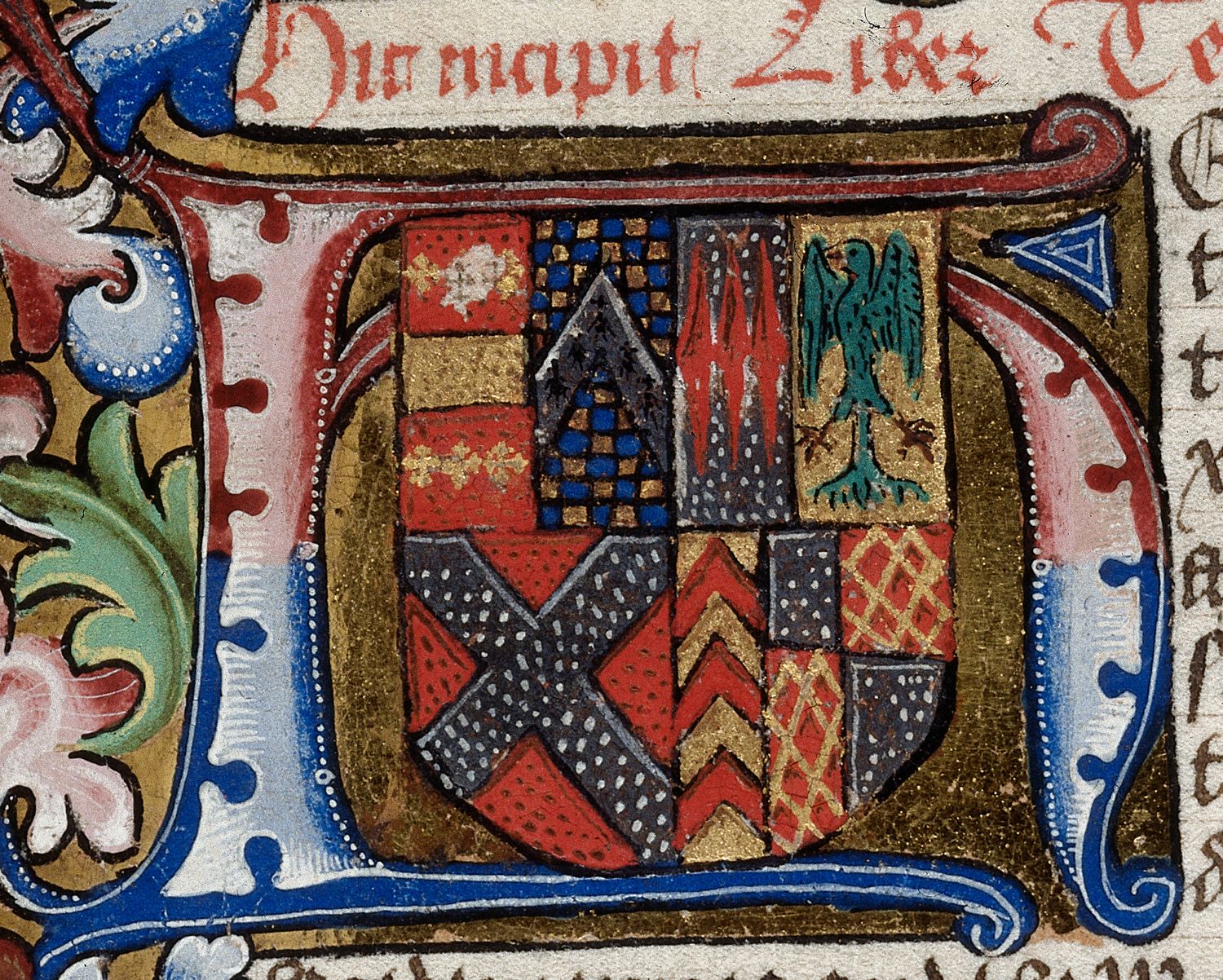
St Katherine by the Tower, Middlesex, England – Queen Anne (Neville) consort of King Richard III from 1483 France modern quartering England; impaling: Quarterly of eight, 1: Checky or and azure a chevron ermine (Newburgh); 2: Gules a fess between six crosscrosslets or (Beuachamp); 3: Argent three fusils conjoined in fess gules (Montague); 4: Or an eagle displayed vert (Monthermer); 5: Gules a saltire argent and a label of five points or (Neville) [label should be compony argent and azure]; 7: Or three chevronels gules (Clare); r three chevronels gules (Clare); 8: Quarterly argent and gules a fret or a bendlet sable (Despenser).

 
Luckily, Anne’s sister Isabel, Duchess of Clarence and her husband George, the Duke of Clarence agreed to take in the Dowager Princess of Wales and by 1474, Anne was married to George’s brother, Richard, Duke of Gloucester.

After the death of his brother, King Edward IV, Richard became Lord Protector of the Realm for the young King Edward V. Edward V and his brother, Richard, the Duke of York, were taken to the Tower as was custom before a Kings coronation. Things unfortunately did not go as planned. The two boys were declared illegitimate under an Act of Parliament by the Lord Protector in 1483. With the Act now in place, the Lord Protector took the throne and crowned himself King Richard III of England.

Lady Anne was elevated from Duchess of Gloucester and was crowned Queen of England with Richard in Westminster Abbey on 6 July in a joint coronation.

Richard and Anne had one son; Edward, Prince of Wales. The young prince died on 9 April 1484.

The Eclipse as portrayed in the the BBC TV Series 'The White Queen' The Eclipse as portrayed in the the BBC TV Series, ‘The White Queen’.

By early 1485, Anne was spending less time at court functions. These absences lead to speculation that the queen was already dead. After the death of her son, Anne’s mental health, no doubt, suffered which could have contributed to the slow decline in health. There were also rumors that Richard was going to kill Anne with poison so that he could marry his niece, Elizabeth of York. This of course, has only been speculation and there are no contemporary sources to prove this. However, the symptoms of Tuberculosis were present in Anne’s last few months; fever, breathlessness, night sweats, coughing up blood, weakness, weight loss and anorexia. Another possibility was cancer. Physicians during this time did not understand illness. There was always some remedy invented that in some cases made patients worse. The doctors, perhaps, may have tried to prescribe garlic and the poisons Mercury and arsenic. To any modern reader, we know today that Mercury and arsenic are toxic and can kill you. Never the less, Anne died on 16 March 1485. Some sources record that she passed away during an eclipse of the sun. The York dynasty used the brilliant sun as one of their motifs — in all its splendor. The eclipse was seen as prophecy for the future of Richard’s reign.

'The White Queen' [BBC] ‘The White Queen’ [BBC]

Few tributes to Queen Anne remain. Her reign was one of the shortest in English history, lasting only twenty-two months. According to Fabyan, she was a woman of ‘gracious fame, upon whose soul … Jesus have mercy’. Agostino Barbarigo, future Doge of Venice, wrote to Richard III, regretting the loss of his ‘beloved’ consort and exhorting him, ‘endowed with consummate equanimity and marvellous virtues, of your wisdom and grandeur of mind to bear the disaster calmly and resign yourself to the divine will’. According to the Italian, who had never met Anne, she lived a ‘religious and catholic life, and was so adorned with goodness, prudence, and excellent morality, as to leave a name immortal’. In the intervening centuries, though, it was Anne’s mortal name that was often overlooked. Her life has been overshadowed by the controversies of Richard’s reign and his death in battle. (Amy Licence p 203)

Queen Anne lying in state as portrayed by the TV series, 'The White Queen'. Queen Anne lying in state as portrayed by the TV series, ‘The White Queen’.

Anne had a magnificent funeral and was buried on the southern side of the Abbey near the altar. No stone or monument marked her grave, possibly because Richard was killed that year at Bosworth.

Detail of an illuminated initial 'H'(ere) with the arms of Anne Neville, wife of Richard III, at the beginning of book 3. Detail of an illuminated initial ‘H'(ere) with the arms of Anne Neville, wife of Richard III, at the beginning of book 3. The British Library, all rights reserved [Royal 18 A XII]

A brass plate and coat of arms, designed by J.S.Comper, was erected in 1960 on the wall of the south ambulatory with the inscription:
ANNE NEVILL 1456-1485 QUEEN OF ENGLAND YOUNGER DAUGHTER OF RICHARD EARL OF WARWICK CALLED THE KINGMAKER WIFE TO THE LAST PLANTAGENET KING RICHARD III. In person she was seemly, amiable and beauteous … And according to the interpretation of her name Anne full gracious. Requiescat in pace.


Plaque of Queen Anne [Neville], consort to the last York King, Richard III


Sources

  • Vegetius, translation attributed to John Walton. De re militari (the Book of Vegecye of Dedes of Knyghthode), England, 1483/85. The British Library [Online]
  • Amy Licence. Anne Neville: Richard III’s Tragic Queen, Amberley Publishing, United Kingdom, 2013. pg 200-05.

See also — The Coronation of King Richard III and Queen Anne