To Queen Katherine Parr, the king’s letter congratulatory, upon her marriage with the Lord Admiral
We thank you heartily, not only for the gentle acceptation of our suit moved unto you, but also for the loving accomplishing of the same, wherein you have declared, not only a desire to gratify us, but also moved us to declare the good will, likewise, that we bear to you in all your requests. Wherefore, ye shall not need to fear any grief to come or to suspect lack of aide in need, seeing that he, being mine uncle, is of so good a nature that he will not be troublesome by any means unto you, and I of such mind, that, for divers just causes, I must favour you.
But even as without cause you merely require help against him whom you have put in trust with the carriage of these letters, so may I merely return the same request unto you, to provide that he may live with you also without grief, which hath given him wholly unto you; and I will so provide for you both, that if hereafter any grief befall, I shall be a sufficient succour in your godly and praiseworthy enterprises.
Fare ye well, with much increase of honour and virtue in Christ.
From St James, the 25th day of June
Edward
Letters of the Kings of England: Now First Collected from the Originals in Royal Archives, and from Other Authentic Sources, Private as Well as Public · Volume 2 By James Orchard Halliwell-Phillipps · 1846
Katherine Parr: Complete Works and Correspondence By Katherine Parr, editor Janel Mueller · 2011, pg 147
The letter was addressed in two different hands: “The Lady Mary to the Lord Admiral, 4th June.” “From the Lady Mary’s Grace“
Addressed to: “To my Lord Admiral”
My lord,
After my hearty commendations, these shall be to declare to you, according to your accustomed gentleness, I have received six warrants from you by your servant, this bearer: for the which, I do give you my hearty thanks. By whom also I have also received your letter, wherein, as me thinketh, I perceive strange news concerning a suit you have in hand to the Queen for marriage. For the sooner obtaining whereof, you seem to think that my letters might do you pleasure.
My lord, in this case I trust your wisdom doth consider that, if it were for my nearest kinsman and dearest friend alive, of all other creatures in the world, it standeth least with my poor honor to be a meddler in this matter, considering whose wife her grace was of late. And besides that, if she be minded to grant your suit, my letters shall do you but small pleasure. On the other side, if the remembrance of the King’s majesty, my father (whose soul God pardons), will not suffer her to grant your suit, I am nothing able to persuade her to forget the loss of him, who is at yet very ripe in my own remembrance.
Wherefore I shall most earnestly require you, the premises considered to think none unkindness in me, though I refuse to be a meddler any ways in this matter. Assuring you that, wooing matters set apart (wherein I, being a maid, am nothing cunning), if other ways it still lie in my little power to do you pleasure, I shall be as glad to do it as you to require it: both for his blood’s sake, that you be of, and also for the gentleness which I have always found in you. As knoweth almighty God, to whose tuition I commit you. From Wanstead this Saturday at night, being the fourth of June.
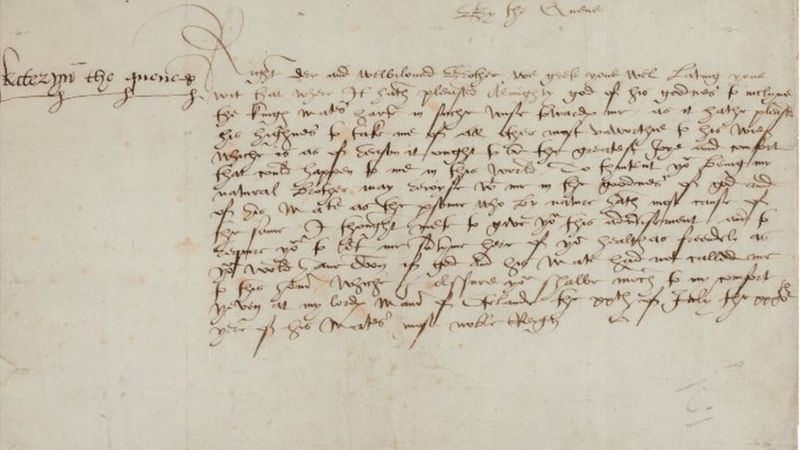
Queen Katherine Parr | Letter signed, announcing her marriage to Henry VIII, 20 July 1543 Sotheby’s“To our right dear and entirely beloved brother, the Lord Parr, Lord Warden of the Marches,” Sotheby’s
Right dear and well-beloved brother, we great you well. Letting you wit that when it hath pleased almighty God of His goodness to incline the King’s majesty in such wise towards me, as it hath pleased his highness to take me of all others, most unworthy, to his wife, which is, as of reason it ought to be, the greatest joy and comfort that could happen to me in this world:
To the intent, you being my natural brother, may rejoice with me in the goodness of God and of his majesty, as the person who by nature hath most cause of the same, I thought meet to give your this advertisement. And to require you to let me sometime hear of your health as friendly as you would have done, if God and his majesty had not called me to this honor: which, I assure you, shall be much to my comfort. Given at my lord’s manor of Oatlands, the twentieth of July, the thirty-fifth year of his majesty’s most noble reign.
Kateryn, the quene
Katherine Parr: Complete Works and Correspondences, editor Janel Mueller. University of Chicago, 2011. pg 46.
Letter signed (“Kateryn the queen”), to her brother William Parr,
ANNOUNCING HER MARRIAGE TO KING HENRY VIII, explaining that “It hath pleased Almighty god of his goodness to incline the Kinges ma[jes]tes harte in suche wise towards me”, celebrating an event which is “the greatest Joye and comfort that could happen to me in this world”, and inviting her brother to “rejoyse with me in the goodness of god and of his Ma[jes]te”, 1 page, oblong folio, Oatlands, 20 July 1543, integral address leaf (“To our right der and entirely beloved Brother the Lord Parre Lord Warden of the Marches…”), docketed, fragile at folds, crude repair to marginal tear, spotting
HENRY VIII’S FINAL QUEEN ANNOUNCES HER MARRIAGE TO THE KING. This remarkable letter was written just days after the marriage between the aging Henry VIII and his final Queen. The wedding ceremony had taken place on 12 July in the Queen’s Closet at Hampton Court Palace, attended by only 18 people. The couple immediately started on the court’s summer progress and this letter was written from the first stop on their journey, Oatlands Palace in Surrey.
Description of Lot from Sotheby’s
The letter is up for auction. I noticed that this is not her handwriting and her signature is not followed by her maiden initials KP. Did the initials come later in her reign as queen?
I found that the ancestor of US President George Washington, Lawrence Washington (c.1500-1584), father to Robert (c.1554-1619), on 26 July 1529, was a bailiff at Warton (in the Barony of Kendal) to Sir William Parr, Baron Parr of Horton, uncle to Queen Catherine. Lawrence was the son of John and Margaret Washington. By his mother, he was a nephew of Sir Thomas Kytson of Hengrave, son of Robert of Warton Hall. His cousin, Lady Katherine Spencer, married into the Spencer family and is an ancestor to the current Prince of Wales and his brother, Harry, Duke of Sussex.
By 1529/30, Washington married the wealthy widow, Elizabeth Gough (unknown maiden name).
By 1529, the future queen Katherine Parr had just married her first husband, Sir Edward Borough (or Burgh). Borough was the eldest son and heir of Sir Thomas, 1st (or 3rd) Baron Borough of Gainsborough and Agnes Tyrwhitt, kin to Elizabeth Tyrwhitt who was related to Parr by marriage and close to Parr during her tenure as queen and dowager queen. Elizabeth was responsible for writing an account of the last few days of the dowager queen. Upon Edward Borough’s death in 1533, his brother, William, became heir to his father. William, the future 2nd (or 4th) Baron, had married Katherine Clinton, daughter of Mistress Bessie Blount, so there is no doubt that the future Queen was associated with the future Lady Borough. Katherine Parr’s mother, Maud, would have known Bessie Blount from the early years of the reign of Henry VIII and Katherine of Aragon. Both were ladies to Queen Katherine. The families were also already connected through Bessie’s son by the king, Henry Firzroy. William Parr, later Baron Parr of Horton was the head of the household for the young boy. His nephew, also named William, was brought up alongside Fitzroy, the Earl of Surrey, and even Edward Seymour who was master of the horse. Lady Borough’s father, the Earl of Lincoln, remarried in 1552 to Parr’s cousin and lady in waiting, Elizabeth FitzGerald (1527-1590). Entries on Ancestry try to tie President Washington to Bessie through her granddaughter, Elizabeth Borough, but she is recorded as marrying a common man with the surname, Rider.
It is suggested that Lord Parr convinced Lawrence Washington to move from Wharton to Northampton where he was to become a wealthy wool merchant. At the dissolution of the monasteries under King Henry VIII, Washington profited by buying the properties he held as tenant of St.Andrew’s Priory, Northampton. In 1532 and 1545, Washington became Mayor of Northampton. In 1538 (some sources state c.1543), he remarried to another wealthy widow, Amy Tomson, daughter of Robert Pargitar. The estate of Sulgrave was brought to the marriage and was held by the family for a small fee. He eventually bought Sulgrave in 1539 from the crown and started the building of the Manor which was completed by 1560.
The Washingtons. Volume 3, Royal Descents of the Presidential Branch · Volume 3 By Justin Glenn · 2014
Sulgrave Manor: An Illustrated Survey of the Northamptonshire Home of George Washington’s Ancestors. By Gerald Michel Veit · 1953
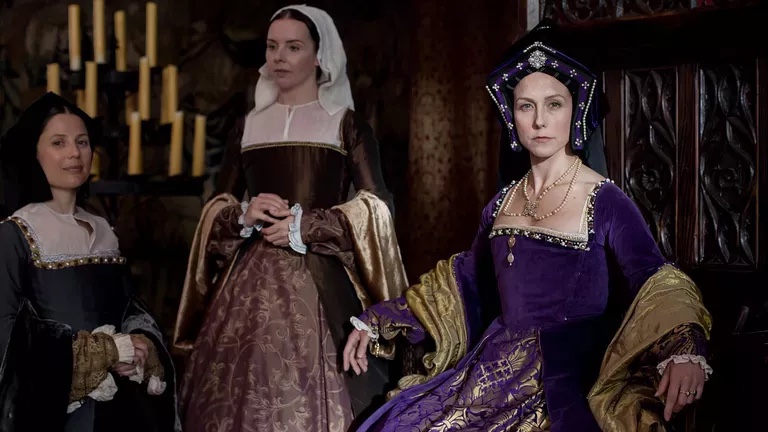
Maria de Salines (Bea Segura), Lady Maud Parr (Natalie Grady), and Katherine of Aragon (Paola Bontempi) in Secrets of the Six Wives (2016)
By Meg Mcgath, 22 March 2023 *be kind and if you find info here…leave breadcrumbs. Thanks!*
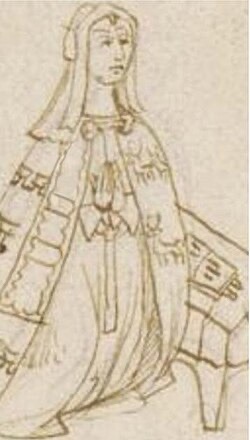
Lady Maud Parr, (6 April 1492 – 1 December 1531) was the wife of Sir Thomas Parr of Kendal, Knt. She was the daughter and substantial coheiress of Sir Thomas Green of Greens Norton, Northamptonshire. The Greens had inhabited Greens Norton since the fourteenth century. Green was the last male heir, having had two daughters. Her mother is named as Joan or Jane Fogge. However, I haven’t been able to prove her parentage. According to Linda Porter, Katherine Parr is a great-granddaughter of Sir John Fogge. When asked for a source, Porter said it came from Dr Susan James. In her biography on Katherine, Susan James states, “he [Green] had made an advantageous with the granddaughter of Sir John Fogge, treasurer of the Royal household under Edward IV”. Fogge was married to Alice Haute (or Hawte), a lady and cousin to Edward’s queen, Elizabeth. By her father, Maud descended from King Edward I of England multiple times. Her sister, Anne, would marry Sir Nicholas Vaux (later Baron). Vaux married firstly to Maud’s would be mother-in-law, the widowed Lady Elizabeth Parr, by whom he had three daughters including Lady Katherine Throckmorton, wife to Sir George of Coughton. Her father spent his last days in the Tower and died in 1506 trumped up on charges of treason.
Ten months after the death of her father, the fifteen year old Maud became a ward of Thomas Parr of Kendal (c.1471/1478 (see notes)-1517) a man nearly twice her age. Around 1508, Maud married to Thomas, son of Sir William Parr of Kendal (1434-1483) and Elizabeth FitzHugh (1455/65-1508), later Lady Vaux. At the time, he was thirty seven while she was about sixteen. He would become Sheriff of Northamptonshire, master of the wards and comptroller to King Henry VIII. He would become a Vice chamberlain of Katherine of Aragon’s household. When Princess Mary was christened, he was one of the four men to hold the canopy over her. He would become a coheir to the Barony of FitzHugh in 1512 and received half the lands of his cousin, George, 7th Baron (d.1512). Had he lived, he most likely would have received the actual title as a favored courtier. The barony is still in abeyance.
Maud became a lady to Queen Katherine of Aragon along with Lady Elizabeth Boleyn, mother of the future Queen Anne. It seems as though the Parrs and Boleyns were indeed in the same circle around the king—something rarely noted! Both Thomas Boleyn and Thomas Parr were knighted in 1509 at the coronation of King Henry VIII and Queen Katherine of Aragon.
Maud’s relationship with the Queen was a relationship that went much deeper than “giddy pleasure”. Both knew what it was like to lose a child in stillbirths and in infancy. It was Katherine Parr’s mother, Maud, who shared in the horrible miscarriages and deaths in which Queen Katherine would endure from 1511 to 1518. The two bonded over the issue and became close because of it. Lady Parr became pregnant shortly after her marriage to Sir Thomas Parr. Most people think that Katherine Parr, the future queen and last wife of Henry, was the first to be born to the Parrs; not so. In or about 1509, a boy was born to Maud and Thomas. The happiness of delivering an heir to the Parr family was short lived as the baby died shortly after — no name was ever recorded. It would be another four years before Maud is recorded as becoming pregnant again. In 1512, Maud finally gave birth to a healthy baby girl. She was christened Katherine, after the queen, and speculations are that Queen Katherine was her godmother. In about 1513, Maud would finally give birth to a healthy baby boy who was named William. Then again in 1515, Maud would give birth to another daughter named Anne, possibly after Maud’s sister.
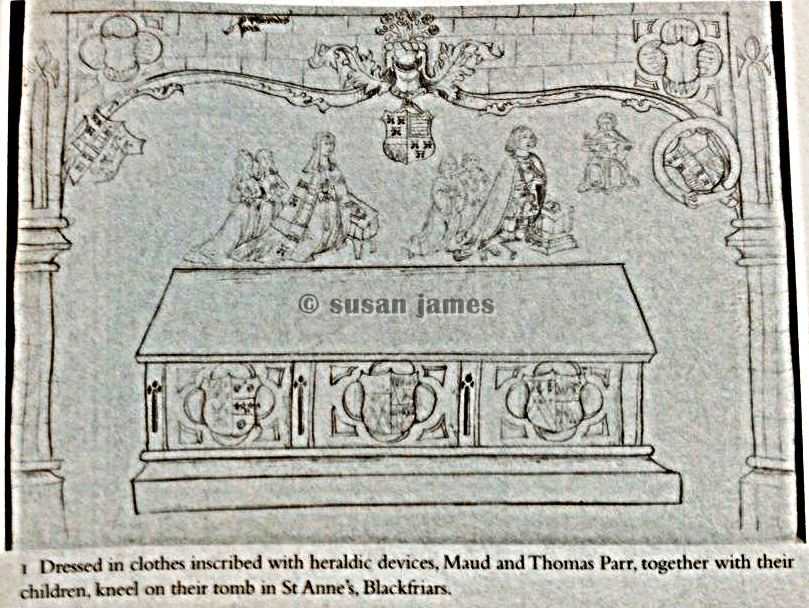
In or about 1517, Maud became pregnant again. It was in autumn of that year that her husband, Sir Thomas, died at his home in Blackfriars of the sweating sickness. Maud was left a young widow at 25, with three small children to provide for. It is believed that the stress from his death caused the baby to be lost or die shortly after birth. No further record of the child is recorded. In a way Maud might have been relieved. He left a will, dated 7 November, for his wife and children leaving dowry’s and his inheritance to his only son, William, but as he died before any of his children were of age, Maud along with Cuthbert Tunstall, their uncle Sir William Parr, and Dr. Melton were made executors. He left £400 apiece as marriage portions for his two daughters. He provided for another son and if the baby was “any more daughters”, he stated “she [Maud] shall marry them at her own cost”. In his will, Parr mentions a signet ring given to him by the King which illustrates how close he was to him. He was buried in St. Anne’s Church, Blackfriars, beneath an elaborate tomb. His tomb read, “Pray for the soul of Sir Thomas Parr, knight of the king’s body, Henry the eigth, master of his wards…and…Sheriff…who deceased the 11th day of November in the 9th year of the reign of our sovereign Lord at London, in the Black Friars..” Maud chose not to remarry for fear of jeopardizing the huge inheritance she held in trust for her children. She carefully supervised the education of her children and studiously arranged their marriages.
In October 1519, Maud was given her own quarters at court. From 7 to 24 June 1520, Maud attended the queen at The Field of the Cloth of Gold, the meeting between King Henry VIII and King Francis I of France. Her sister, Anne, now Lady Vaux, and her husband, Nicholas, along with her other in laws, Lord Parr of Horton and his wife, were also present.
According to this article, which states no sources,
“In 1522, Maud was assessed for a “loan” to the King for the French Wars, of 1,000 marks, a very substantial sum, the same as the amount provided by Lord Clifford. She appears in the various household accounts of Henry VIII and Katharine of Aragon as entitled to breakfast at Crown expense and to suits of livery for her servants, as well as lodgings, which were very hard to come by.
In 1523, Maud started writing letters to find a suitable husband for her daughter, Katherine. Henry le Scrope (c.1511-25 March 1525), son and heir to Sir Henry le Scrope, 7th Baron Scrope of Bolton by his wife Mabel Dacre, was a cousin. The negotiations lead to nothing. By 1529, Maud found a match for her daughter in Sir Edward Borough, son of Sir Thomas.
When regulations for the Royal household were drawn up at Eltham, in 1526, Lady Parr, Lady Willoughby and Jane, Lady Guildford were assigned lodgings on “the queen’s side” of the palace. If an emergency arose, yeoman were sent with letters from the queen “warning the ladies to come to the court”. Maud was still listed, along with only five other ladies, which included the King’s sister, as having the privilege of having permanent suites in 1526. Maud was friendly with the King as well—her husband had been a favored courtier—and gifted him a coat of Kendal cloth in 1530. She was gifted miniatures of the King and Queen from the Queen herself.
In the summer of 1530, Maud visited her daughter, now Lady Katherine Borough, in Lincolnshire. She stayed at her own manor in Maltby, which was eighteen miles from Old Gainsborough Hall. It is thought that her presence there influenced Sir Thomas Borough to give his son, Edward, a property in Kirton-in-Lindsey. This gave Katherine an opportunity to manage a household of her own.
Maud continued her position at court as one of Katherine of Aragon’s principal ladies and stayed close to the Queen even when her relationship with the king started to decline. Henry’s infatuation with Anne Boleyn, one of the Queen’s ladies, became apparent and inevitably the ladies began to take sides. In these times, Queen Katherine never lost the loyalty and affection of women like Maud Parr, Gertrude Courtenay, and Elizabeth Boleyn, who had been with the Queen since the first years of her reign. At the time of her death, Maud was still attending Queen Katherine.
Maud died on 1 December 1531 at age thirty nine and is buried in St. Ann’s Church, Blackfriars Church, London, England beside her husband.
“My body to be buried in the church of the Blackfriars, London. Whereas I have indebted myself for the preferment of my son and heir, William Parr, as well to the king for the marriage of my said son. As to my lord of Essex for the marriage of my lady Bourchier, daughter and heir apparent to the said Earl. Anne, my daughter, Sir William Parr, Knt., my brother, Katherine Borough, my daughter, Thomas Pickering, Esq., my cousin and steward of my house.”
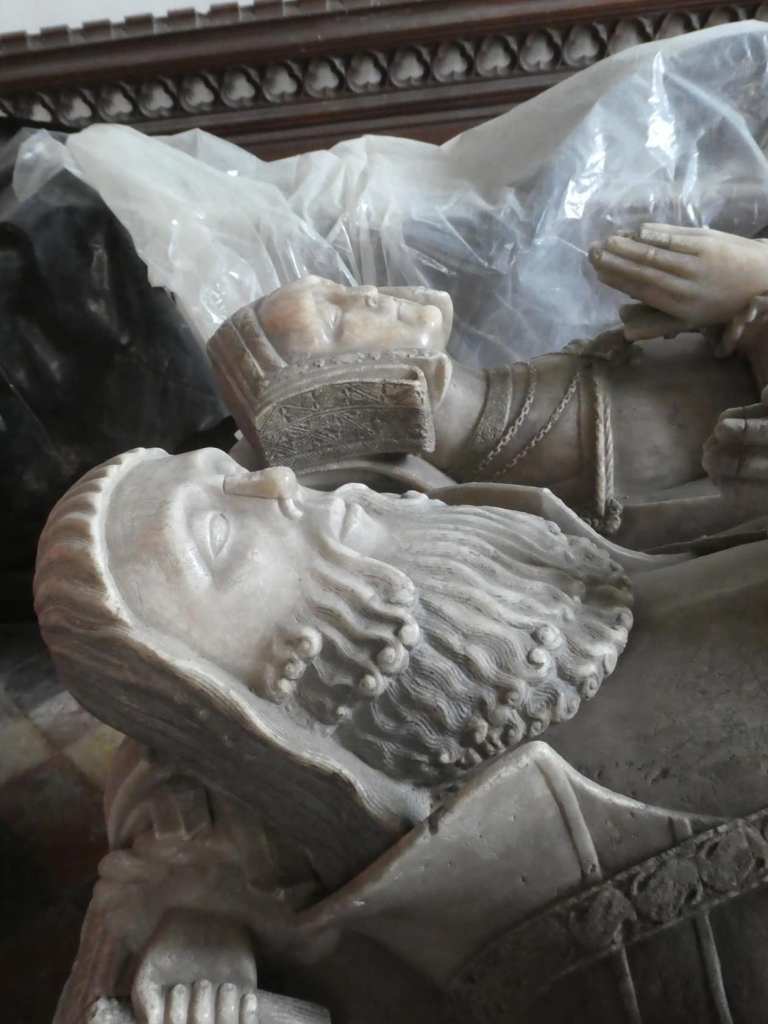
Close up of the Tomb of Sir Thomas Parr and Maud Green (see above)
In her will, dated 20 May 1529, Maud designated that she wanted to be buried Blackfriars where her husband lies if she dies in London, or within twenty miles. Otherwise, she could be buried where her executors think most convenient. Maud left her daughter, Katherine, a jeweled cipher pendant in the shape of an ‘M’. Maud also left Katherine a cross of diamonds with a pendant pearl, a cache of loose pearls, and, ironically, a jeweled portrait of Henry VIII. To her daughter, Anne, she left 400 marks in plate and a third share of her jewels. The whole fortune, Lady Parr had directed, was to be securely chested up ‘in coffers locked with divers locks, whereof every one of them my executors and my … daughter Anne to have every of them a key’. ‘And there’, Lady Parr’s will continued, ‘it to remain till it ought to be delivered unto her’ on her marriage. She also provided 400 marks for the founding of schools and “the marrying of maidens and especial my poor kinswomen”. Cuthbert Tunstall, who was the principal executor of Maud’s will, she left to “my goode Lorde Cuthberd Tunstall, Bisshop of London…a ring with a ruby”. Tunstall had been an executor of her late husband’s will as well. An illegitimate son of Sir Thomas of Thurland Castle, he was a great-nephew of Alice Tunstall, paternal grandmother to Sir Thomas Parr. To her daughter-in-law, Anne, she left substantial amounts of jewelry, “to my lady Bourchier when she lieth with my son” as a bribe to get the marriage consummated. Maud also left a bracelet set with red jacinth to her son, William. She begs him “to wear it for my sake”. Maud was also stated in her will, “I have endetted myself in divers summes for the preferment of my sonne and heire William Parr as well”. For her cousin, Alice Cruse, and Thomas Parr’s niece, Elizabeth Woodhull or Odell, Maud left “at the lest oon hundrythe li”. She wills her “apparrell [to] be made in vestments and other ornaments of the churche” for distribution to three different parish churches which lay close to lands that she controlled. She bequeathed money to the Friars of Northampton. For centuries, historians have confused the first husband of her daughter, Katherine, with his elder grandfather, Edward, the 2nd Baron Borough or Burgh of Gainsborough (d.August 1528). He was declared insane and was never called to Parliament as the 2nd Baron Borough. Some sources mistakenly state she was just a child at the time of her wedding in 1526. Katherine’s actual husband, Sir Edward Borough (d.1533), was the eldest son and heir of the 2nd Baron’s eldest son and heir, Sir Thomas Borough, who would become the 1st Baron Borough under a new writ in December 1529. Katherine and Edward were married in 1529. At the time, Thomas Borough was still only a knight. Maud mentions in her will, Sir Thomas, father of the younger Edward, saying ‘I am indebted to Sir Thomas Borough, knight, for the marriage of my daughter‘. Edward was the eldest son and heir to his father, Sir Thomas, Baron Borough. He would die in 1533. Maud’s will was proved 14 December 1531.
Maud and Thomas had three children to survive infancy.
The children who survived…William, Katherine, and Anne.
Katherine or “Kateryn” (1512-1548), later Queen of England and Ireland, would marry four times. In 1529, Katherine married Sir Edward Borough. He died in 1533. In 1534, Katherine became “Lady Latimer” as the wife to a cousin of the family, Sir John Neville, 3rd Baron Latimer (of Snape Castle). He was dead by March 1543. A few months later, on 12 July, Katherine married King Henry VIII at Hampton Court Palace. The king died in January 1547. In May of that year, Katherine secretly wed Sir Thomas Seymour, 1st Baron Seymour (d.1549) of Sudeley Castle, a previous suitor from 1543. Their love letters still survive. By Seymour, Katherine had a daughter, Mary. Katherine died 5 September 1548. Seymour would be executed 20 March 1549 for countless treasonous acts against the crown (his nephew was King Edward VI).
William (1514-1571) married on 9 February 1527, at the chapel of the manor of Stanstead in Essex, to Anne Bourchier, suo jure 7th Baroness Bourchier (d. 26 January 1571), only child and heiress of Henry Bourchier, 2nd Earl of Essex (d.1540). In 1541, she eloped from him, stating that “she would live as she lusted”. Susan James states the next year, Parr secured a legal separation. James also states that on 13 March 1543, a bill was passed in Parliament condemning Anne’s adulterous behavior and declaring any children bastards. Wikipedia states “On 17 April 1543 their marriage was annulled by an Act of Parliament and any of her children “born during esposels between Lord and Lady Parr””(there were none) were declared bastards. The source is G. E. Cokayne, ”The Complete Peerage”, n.s., Vol.IX, p.672, note (b). I have not been able to access The Complete Peerage to confirm. On 31 March 1551, a private bill was passed in Parliament annulling Parr’s marriage to Anne. She predeceased Parr by a few months. William married Elisabeth Brooke (1526-1565), a daughter of George Brooke, 9th Baron Cobham of Cobham Hall in Kent, by his wife Anne Bray. A commission ruled in favour of his divorce from Anne shortly after he married Elizabeth Brooke in 1547, but Somerset punished Parr for his marriage by removing him from the Privy Council and ordering him to leave Elizabeth. The divorce was finally granted in 1551, and his marriage to Elizabeth was made legal. On 31 Mar 1552, a bill passed in Parliament declaring the marriage of Anne Bourchier and Parr null and void. Their marriage was declared invalid in 1553 under Queen Mary and valid again in 1558 under Queen Elizabeth who adored William. Each change of monarch, and religion, changed Elizabeth’s status. She died in 1565. William married Helena Snakenborg in May 1571 in Elizabeth’s presence in the queen’s closet at Whitehall Palace with pomp and circumstance. Parr would die 28 October 1571.
Anne (1515-1552) who married Sir William Herbert, 1st Earl of Pembroke in 1538. They had three children: Henry, Edward, and Anne. They are ancestors to the current Earl of Pembroke and Montgomery, Earl of Carnarvon, Earl of Powis, Marquess of Abergavenny, and other nobility.
Notes
Porter, James, and Mueller state Thomas Parr was born in 1478. However, in James’s biography of Katherine, she states he was 37 at the time of his marriage to Maud Green in 1508. So that would be about 1471, right?
Katherine Parr: Complete Works and Correspondence, ed. Janel Mueller, 2011. Google eBook (preview)
Sir Nicholas Nicolas. Testamenta Vetusta: being illustrations from wills, of manners, customs, … as well as of the descents and possessions of many distinguished families. From the Reign of Henry II. to the accession of Queen Elizabeth, Volume 2, 1826. Google eBook
Elizabeth Norton. “Catherine Parr Wife, Widow, Mother, Survivor, the Story of the Last Queen of Henry VIII”, 2010. Google eBook (preview)
Linda Porter. Katherine the Queen: The Remarkable Life of Katherine Parr, the Last Wife of Henry VIII (New York: St. Martin’s Griffin Publishing, 2010)
Douglas Richardson. Magna Carta Ancestry: A Study in Colonial and Medieval Families, 2nd Edition, 2011. Google eBook (preview)
Gareth Russell. Young and Damned and Fair: The Life of Catherine Howard, Fifth Wife of King Henry VIII, 2017. Pg 215. Google eBook (preview)
Agnes Strickland. Lives of the Queens of England, from the Norman Conquest With Anecdotes of Their Courts, Volumes 4-5, 1860. Pg 16. Google eBook
Tudor and Stuart Consorts: Power, Influence, and Dynasty, ed. Aidan Norrie, Carolyn Harris, Danna R. Messer, Elena Woodacre, J. L. Laynesmith, 2022. Google eBook (preview)
The Antiquary: A Magazine Devoted to the Study of the Past, volume 24, 1891. Google eBook
Katherine Parr attributed to Master John oil on panel, circa 1545 71 in. x 37 in. (1803 mm x 940 mm) Purchased with help from the Gulbenkian Foundation, 1965 Primary Collection NPG 4451
Katherine Parr was a true Renaissance queen. The Renaissance was literally a time of the rebirth of Classical knowledge and learning, and humanists venerated the wisdom of Ancient scholars, spending their time translating and philosophising of the surviving texts. And of course, this fascination with Antiquity was reflected in other areas of society, such as art, literature, even dress. Katherine was very engaged with humanist scholars and participated in humanist activities such as the study of languages and the translation of classical texts. This appreciation of classical learning can even be seen in her portraiture.
The National Portrait Gallery houses a portrait of Katherine painted by Master John, an artist we know little about except he unusually seems to have been English born, and he had an incredible eye for detail in his work. The portrait is dated to 1545, a year or two into her third marriage to Henry VIII, and is one of three contemporary portraits of Katherine that are extant (for more on Catherine’s contemporary portraits, see my post here: https://tinyurl.com/2p973nph ). It is a beautiful portrait, however it is very easy to miss the exquisite detail work that has gone into it. I certainly did, until I read the wonderful Nicola Tallis’ ‘All The Queen’s Jewel’s, 1445-1548,’ which discusses the minutiae of the jewels of the Tudor queens, as can be found in a whole range of different records, including inventories and portraits.
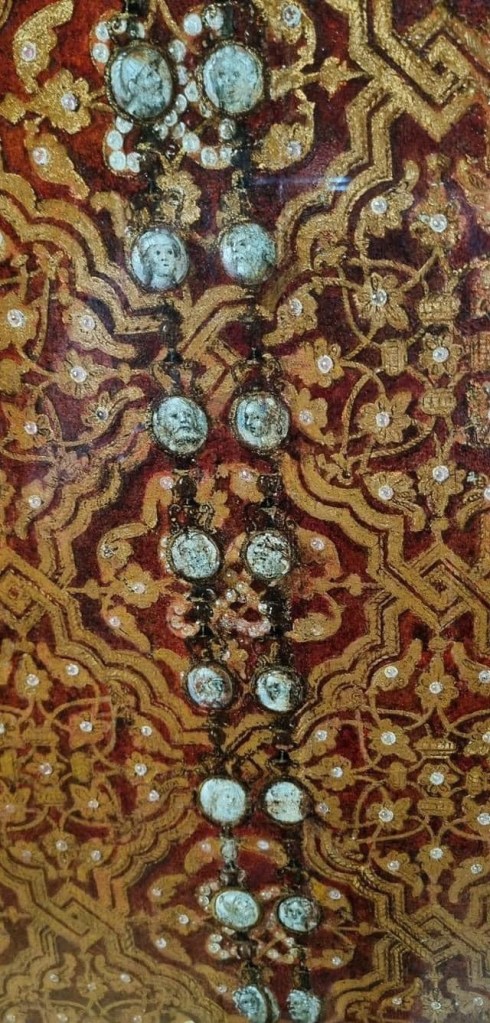
Up close of the NPG 4451
Several aspects of this particular portrait are highlighted by Nicola, but I think the most fascinating are the girdle beads hanging from Katherine’s waist. At first glance, they seem like any other girdle beads – a standard accessory for any Tudor lady – but once you get up close and personal to the portrait, it becomes clear that each bead is a cameo face.
From Nicola Tallis, All the Queen’s Jewels
Cameos were very fashionable, very valuable, and very rare during this period. They most commonly depicted figures from the Ancient world, just as these ones do. In this portrait, the uniqueness of each cameo suggests that each one was supposed to represent a specific figure from Antiquity. Unfortunately, their identities have not survived. From Parr’s inventories as queen we do know that she owned a number of cameos and jewels with ‘antiquez personz.’ From Katherine’s records, and by comparing inventories, we know that some of these pieces were actually inherited from her predecessors, Jane Seymour and Katherine Howard, whilst others were commissioned by Katherine herself.
That Katherine carefully selected this piece to be portrayed in is significant. It shows how much she valued her own learning, and it aligned her with the brightest minds of her day. It also showed her status, to be able to afford such a valuable item. It signalled that she was a lady of learning, and a queen that humanists could approach for patronage.
These cameo beads are such a small detail, but they speak volumes about fashion trends, the skill of the artist, and the character of Katherine herself.
Reference: Nicola Tallis ‘All the Queen’s Jewels’. Pages 126-127 discuss this portrait and the beads in particular, and there is a discussion about the use of cameos and ‘antique faces’ in jewellery on page 87. Thanks to Jessica Carey-Bunning for researching!
“She was the first queen of England to write and publish her own books and to become a recognized author during her lifetime and the first Englishwoman to publish a work of prose in the sixteenth century.” (Susan James, “Catherine Parr: Henry VIII’s Last Love”, 2010, pg 12)
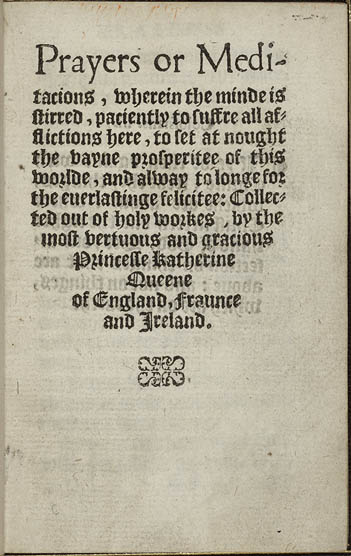
“The first edition of Queen Katherine Parr’s Prayers or Meditations appeared on June 2, 1545, under the title Prayers stirryng the mynd vnto heauenlye medytacions. This volume reprinted the two non-Biblical prayers—one for King Henry, the other for men to say going into battle—that concluded her translation Psalms or Prayers, published a year earlier. A second edition with the same contents, bearing the same date, carried the title Prayers or meditacions, wherin the mynde is styrred paciently to suffre all afflictions here. The definitive version (the third edition) appeared on November 6, 1545, under the title PRAYERS OR Medytacions, wherein the mynd is stirred, paciently to suffre all afflictions here, to set at nought the vayne prosperitee of this worlde, and alwaie to longe for the everlastynge felicitee: Collected out of holy wookes by the most vertuous and graciouse Princesse Katherine quene of Englande, Fraunce, and Irelande.1 This volume concluded with four prayers that may well be Queen Katherine’s compositions, the latter of the two just mentioned and three others that gradate from a public to a private perspective: “A devout prayer to be daily said,” “Another prayer,” and “A devout prayer.” The first two editions, identical except for their titles, and the third, definitive one rapidly gained popularity with English readers, who often knew the work as “The Queen’s Prayers.” Thirteen editions appeared before the end of the sixteenth century.” (Parr, Katherine, and Janel Mueller (ed.). “Introduction to Prayers or Meditations (1545).” In Katherine Parr: Complete Works and Correspondence. Edited by Janel Mueller (ed.).University of Chicago Press, 2011. Chicago Scholarship Online, 2013. https://doi.org/10.7208/chicago/9780226647265.003.0009.)
Folger Shakespeare Library
PDI Record:
—
Call Number (PDI):
STC 4824a
Creator (PDI):
Catharine Parr, Queen, consort of Henry VIII, King of England, 1512-1548.
Title (PDI):
[Prayers stirryng the mind unto heavenlye medytacions]
Created or Published (PDI):
[1550]
Physical Description (PDI):
title page
Image Root File (PDI):
17990
Image Type (PDI):
FSL collection
Image Record ID (PDI):
18050
MARC Bib 001 (PDI):
165567
Marc Holdings 001 (PDI):
159718
Hamnet Record:
—
Creator (Hamnet):
Catharine Parr, Queen, consort of Henry VIII, King of England, 1512-1548.
Uniform Title (Hamnet):
Prayers stirryng the mind unto heavenlye medytacions
Title (Hamnet):
Praiers
Title (Hamnet):
Prayers or meditacions, wherein the minde is stirred, paciently to suffre all afflictions here, to set at nought the vayne prosperitee of this worlde, and alway to longe for the euerlastinge felicitee: collected out of holy workes by the most vertuous and gracious princesse Katherine Queene of England, Fraunce, and Ireland.
Place of Creation or Publ. (Hamnet):
[London :
Creator or Publisher (Hamnet):
W. Powell?,
Date of Creation or Publ. (Hamnet):
ca. 1550]
Physical Description (Hamnet):
[62] p. ; 8⁰.
Folger Holdings Notes (Hamnet):
HH48/23. Brown goatskin binding, signed by W. Pratt. Imperfect: leaves D2-3 and all after D5 lacking; D2-3 and D6-7 supplied in pen facsimile. Pencilled bibliographical note of Bernard Quaritch. Provenance: Stainforth bookplate; Francis J. Stainforth – Harmsworth copy
Notes (Hamnet):
An edition of: Prayers stirryng the mind unto heavenlye medytacions.
Notes (Hamnet):
D2r has an initial ‘O’ with a bird.
Notes (Hamnet):
Formerly STC 4821.
Notes (Hamnet):
Identified as STC 4821 on UMI microfilm, reel 678.
Notes (Hamnet):
Printer’s name and publication date conjectured by STC.
Notes (Hamnet):
Running title reads: Praiers.
Notes (Hamnet):
Signatures: A-D⁸ (-D8).
Notes (Hamnet):
This edition has a prayer for King Edward towards the end.
Citations (Hamnet):
ESTC (RLIN) S114675
Citations (Hamnet):
STC (2nd ed.), 4824a
Subject (Hamnet):
Prayers — Early works to 1800.
Associated Name (Hamnet):
Harmsworth, R. Leicester Sir, (Robert Leicester), 1870-1937, former owner.
Call Number (Hamnet):
STC 4824a
STC 4824a, title page not for reproduction without written permission.
Folger Shakespeare Library
201 East Capitol Street, SE
Washington, DC 20003
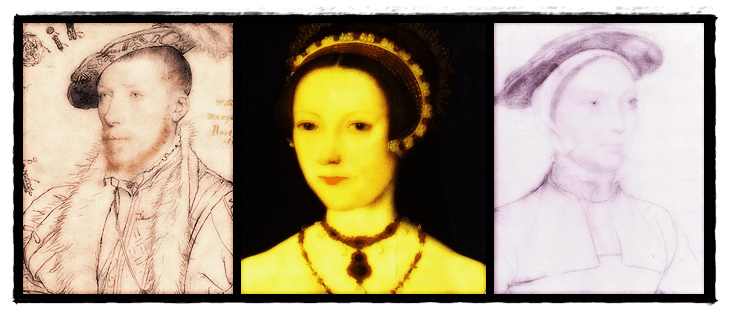
Sir William Parr, 1st Baron Parr of Horton (c. 1483 – 10 September 1546) was the son of Sir William Parr of Kendal and his wife Elizabeth Fitzhugh. His mother was a niece to Warwick, the Kingmaker and thus a cousin of Anne Neville, Duchess of Gloucester and Queen of England as the wife of Richard III. Lady Elizabeth and her mother, Lady Alice FitzHugh, rode in the coronation train for Anne when she became queen and it is believed they stayed on as ladies to the queen. Elizabeth had been in the household since Anne became Duchess.
Parr’s siblings included an elder brother, Sir Thomas Parr of Kendal (d.1517), who was father to the future queen of England, the Marquess of Northampton, and the Countess of Pembroke. Their sister Anne married Thomas Cheney (or Chenye) and was mother to Lady Elizabeth Vaux, wife of the 2nd Baron Vaux of Harrowden. The father of the 2nd Baron was Nicholas Vaux, 1st Baron. His first wife was the widowed Lady Elizabeth Parr, mother to Thomas, William, and Anne. By Elizabeth, Nicholas had 3 daughters, Lady Katherine Throckmorton, Lady Alice Sapcote, and Lady Anne le Strange.
William Parr was a military man who fought in France, where he was knighted by King Henry VIII at Tournai Cathedral, and Scotland. Parr seemed to be uncomfortable in court circles and insecure in securing relationships. None the less he accompanied the King at the ‘Field of the Cloth of Gold’ in France. Like his brother, Sir Thomas Parr, William flourished under Sir Nicholas Vaux.
William was a family man. After the death of his brother, Sir Thomas Parr, William’s sister-in-law Maud, widowed at age 25, called upon him to help in financial matters and to manage her estates in North England while she was busy in the south securing a future for her three children. William had been named one of the executors of his brother’s will. Along with Cuthbert Tunstall, a kinsman of the Parrs, Parr provided the kind of protection and father figure which was missing in the lives of Maud’s children. William’s children were educated along side Maud’s children.
Although William was en-adapt at handling his financial matters, he was ironically appointed the office of Chamberlain in the separate household of Henry FitzRoy, 1st Duke of Richmond and Somerset, the acknowledged illegitimate son of King Henry VIII and Elizabeth Blount, based at Sheriff Hutton Castle in Yorkshire. It was William who found a spot for his nephew, William Parr, later Earl of Essex, in the Duke’s household where he would be educated by the very best tutors and mixed with the sons of other prominent families. Though thought to be a wonderful environment for Parr and his nephew to flourish in, the household was not a great passport to success as Parr hoped for. Henry VIII was very fond of his illegitimate son, but had no intention of naming him his heir. It has been claimed that Parr and his sister-in-law, Maud Parr, coached William to make sure that he ingratiated himself with the Duke, in case the Duke became heir to the throne but there is no factual evidence to support this claim.
Although Parr was named Chamberlain of the Duke’s household, the household was actually controlled by Cardinal Thomas Wolsey in London. This control by Wolsey diminished any opportunity of Parr gaining financial benefit or wider influence. Along with the limited possibilities came other daily frustrations as the Duke’s tutors and the household officers under Parr disagreed on the balance of recreation and study. Parr was a countryman who thought it perfectly normal for boys to prefer hunting and sports to the boring rhetoric of learning Latin and Greek. As the Duke’s behavior became more unruly Parr and his colleagues found it quite amusing. The Duke’s tutor, John Palsgrave, who had only been employed six months, would not tolerate being undermined and decided to resign. Such was the household in which Parr presided over. Parr was suspicious of schoolmaster priests and anyone of lesser birth, even though he was not considered a nobleman at the time. The experience did not further the Parr family. If Sir William had paid more attention to his duties and responsibilities he may have reaped some sort of advancement; thus when the overmanned and over budgeted household was dissolved in the summer of 1529, Parr found himself embittered by his failure to find any personal advancement or profit from the whole ordeal.
Despite his failed attempts at achieving personal gain from the household of the Duke, Sir William made up for it during the Pilgrimage of Grace during 1536. William showed impeccable loyalty to the Crown during the rebellion. He had been in Lincolnshire along with Charles Brandon, 1st Duke of Suffolk and supervised the executions at Louth and Horncastle. William tried to ingratiate himself with Thomas Howard, 3rd Duke of Norfolk and Thomas Cromwell, 1st Earl of Essex. Parr’s presence at the execution in Hull of Sir Robert Constable prompted Cromwell to share in confidence a correspondence in which he received from the Duke of Norfolk on William’s “goodness” which “never proved the like in any friend before.”
Sir William was Sheriff of Northamptonshire in 1518 and 1522. He was also Esquire to the Body to Henry VII and Henry VIII. In addition to this, he was a third cousin to King Henry VIII through his mother. William was appointed Chamberlain to his niece Katherine Parr and when she became Queen regent during Henry’s time in France, Catherine appointed William part of her council. Although he was too ill to attend meetings, the appointment shows her confidence in her uncle.
Parr was knighted by King Henry VIII on Christmas Day, 1513. He was made a peer of the realm as 1st Baron Parr of Horton on 23 December 1543. Upon his death in 1546, with no male heirs, the barony became extinct.
He married Mary Salisbury, the daughter and co-heir of Sir William Salisbury; who brought as her dowry the manor of Horton. It was a happy marriage which produced four daughters who survived infancy:
* Maud (Magdalen) Parr, who married Sir Ralph Lane of Orlingbury. One of their children was Sir Ralph Lane, the explorer. Maud grew up with her cousin Katherine Parr, who would later become the last queen of Henry VIII. Maud would become a lifelong friend and confidante of the queen. * Anne Parr, who married Sir John Digby. * Elizabeth Parr, who married Sir Nicholas Woodhall. * Mary Parr, who married Sir Thomas Tresham I.
He is buried at Horton, Northamptonshire where the family estate was.
Lady Maud Lane and Lady Mary Tresham are ancestors to the Prince of Wales and the Duke of Sussex through their late mother, the Princess of Wales.
Sir Thomas Tresham was born by 1500 to Sir John of Rushton and Isabel, daughter of Sir James Harrington of Hornby. He was married to a daughter of Sir William Parr, 1st Baron Parr of Horton, uncle to Queen Katherine Parr. Which daughter? Oh dear! Depends on the source. Some say Mary. Some say Anne. So let’s look at these sources. Can we finally identify which daughter of Lord Parr became Lady Tresham?
“Francis Tresham was the grandson of Thomas Tresham by his first wife, Mary Parr. Thomas’s second wife was Lettice’s paternal grandmother, Lettice Peniston.”
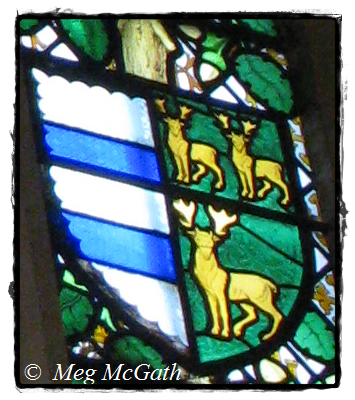
Arms: Argent, two bars, azure: a border engrailed [?] from The History of the County Palatine and Duchy of Lancaster
“Anne, daughter and coheir of William Parr, afterwards Lord Parr of Horton”
So… who is who?? You got me. All I know is that a daughter of Lord Parr of Horton married Sir Thomas Tresham. Anyone else think they can solve this? Why does it matter? Just thought it would be nice to sort out the daughters.
EDIT: found the article for Sir John Digby on History of Parliament. His wife?
“m. settlement 1528/29, Mary, da. and coh. of Sir William Parr, Baron Parr of Horton…
The book, “Britain’s Royal Families”, was written back in 1989!! Alison Weir keeps reissuing her publications and doesn’t seem to update anything when she does. Would love to know her sources for some of these: the entry for Queen Catherine Parr. If you look at her entry—she has the grandfather of Parr’s actual husband as Parr’s husband. In actuality, Parr was married to Sir Edward Burgh, GRANDSON of Sir Edward, [2nd] Lord Borough, in 1529. The younger Edward died c. April 1533. Catherine would have been known as Lady Burgh or Borough (depends on how you spell it) as her husband was only a knight. She is not the subject of Holbein’s “Lady Borow”. It is now thought to be her mother-in-law. Parr’s marriage to Latimer took place in 1534 according to Dr Susan James and Linda Porter. Weir has that wrong too — stating 1530 or before the end of 1533. Catherine would have been known as Lady Latimer or Baroness Latimer (of Snape). She became Her Majesty, Queen Catherine on 12 July 1543. She was known as “Regent General of England” from July to 30 September 1544 and signed her name, “Kateryn, the Quene regente, KP”. On the death of King Henry she became Dowager Queen Catherine. She was to retain the title of queen even when she remarried. She took precedence over all the women at court, was allowed to keep the jewels of the queens of England until the next queen. There is no official date for Parr’s marriage to Sir Thomas Seymour. A lot of sources state in secret, May 1547. Janel Mueller states May 1547 due to a letter written by Seymour to the Dowager Queen. The marriage wasn’t made public until June. Weir incorrectly states before the end of April 1547. She would have been known as Queen Catherine as that was her highest honor, but she was technically Queen Catherine, Baroness (or Lady) Seymour of Sudeley. Weir says Catherine died on the 7th of September. Weir seems to not do her research here AGAIN as Parr’s FUNERAL was 7 September 1548 in Sudeley’s, St Mary’s Chapel. At Sudeley you can find a copy of what they inscribed on her lead coffin. It’s next to her tomb, which states the date of her death is the 5th. She is buried in St. Mary’s Chapel, Sudeley Castle.
Catherine’s daughter was Mary Seymour who was born on 30 AUGUST 1548. There is no death date for her as records on her disappear after her second birthday. Weir seems to think she either died in the 1560s or repeats the myth that she married.
References
Susan James, “Catherine Parr: Henry VIII’s Last Love”, 2009.
Linda Porter, “Katherine the Queen: The Remarkable Life of Katherine Parr”, 2010.
Janel Mueller, editor, “Katherine Parr: Complete Works and Correspondence”, 2011.












 tudorqueen6 by Meg McGath