Catherine NEVILLE, Lady Constable (1529/30-27 Mar 1591) was the daughter of Sir Henry NEVILLE, 5th Earl of Westmoreland and Anne MANNERS. They were parents to several children including Sir Charles, 6th Earl of Westmorland and Lady Eleanor Pelham. Her parents were related to Queen Katherine Parr through several lines, Neville, de Ros, etc. Her maternal grandmother, Lady Eleanor Manners (born Paston), Countess of Rutland, was related to Queen Anne Boleyn through her mother, Bridget Heydon, who’s mother was Anne Boleyn, great aunt to Queen Anne. Eleanor took advantage of her husband’s death in September 1543 to retire from the Court and she was replaced as the dominant force in Queen Katherine Parr’s Household by her sister, Lady Anne Herbert, who became Chief Lady of the Queen’s Privy Chamber.
Catherine married Sir John Constable of Holderness (1527-1579) in 1563-4 as his second wife at Raby. He was the son of Sir John CONSTABLE of Halsham and Joan NEVILLE, daughter of Sir Ralph Neville, Esq. They descended from Sir Ralph Neville, 2nd Baron Neville of Raby, who was the grandfather of Sir Ralph Neville, 1st Earl of Westmorland (ancestor to Queen Katherine Parr), who married twice, secondly to Joan Beaufort, daughter of John of Gaunt.
She was the Lady Constable who was a recusant and who spent time in prison at Sheriff Hutton in 1582-84.
Apparently they had a son, John CONSTABLE (b. ABT 1564)
Another image by Robert Peake the Elder, dated 1590, can be found at Burton Constable Hall
HANS HOLBEIN THE YOUNGER (1497/8-1543) An unidentified man c.1532-43 Black and coloured chalks, white bodycolour, pen and ink, and brush and ink on pale pink prepared paper | 27.1 x 18.9 cm (sheet of paper) | RCIN 912260 Wikipedia
Written and researched by Meg Mcgath
While researching Sir William Parr, 1st Marquess of Northampton, I came upon this portrait AGAIN! According to Susan James’ “Catherine Parr: Henry VIII’s Last Love”, written in 2009, this portrait may be his closest companion, Sir John Dudley, Lord Lisle, later Duke of Northumberland. *Note: Parr had his portrait done by Holbein.
The portrait is also featured in anarticle for the future Duke. While this website sometimes checks out, it’s not always 100% reliable unless sources are listed. Here it’s labeled “An unidentified man, possibly John Dudley by Hans Holbein”.
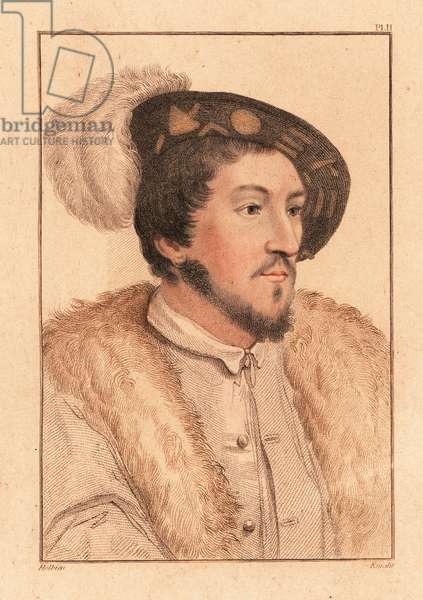
On the site Alamy, I have found this portrait. It is a later copy of the original “An unidentified man”.
Portrait of an unknown man, court of King Henry VIII, c. 1532. Possibly John Dudley, 1st Duke of Northumberland, who tried to install Lady Jane Grey as Queen. Handcoloured copperplate stipple engraving by Charles Knight after a portrait by Hans Holbein the Younger from Imitations of Original Drawings by Hans Holbein, John Chamberlaine, London, 1812.
There are a few more that say it’s possibly John Dudley.
Fine Holbein portrait. Unidentified Man engraved by Bartolozzi c1799. Classic Holbein portrait of an elegant young man. Engraved by Bartolozzi c1799. (Perhaps John Dudley. Lord Dudley was 1st Duke of Northumberland)
Portrait of an unknown man, court of King Henry VIII, c. 1532. ,1812 (engraving) Portrait of an unknown man, court of King Henry VIII, c. 1532. Possibly John Dudley, 1st Duke of Northumberland, who tried to install Lady Jane Grey as Queen. Handcoloured copperplate stipple engraving by Charles Knight after a portrait by Hans Holbein the Younger from Imitations of Original Drawings by Hans Holbein, John Chamberlaine, London, 1812.
The copy of the original pops up again a few more times with no identity.
An unknown Knight from the court of Henry VIII by Bartolozzi after Holbein 1884. Antique hand-coloured portrait plate, engraved from the original drawings by Hans Holbein; This series of portraits, engraved from the original drawings of Hans Holbein by F Bartolozzi (engraver to the King), shows Lords & Ladies from the court of King Henry VII of England (1884). 28.5 x 20.0cm, 11.25 x 7.75 inches. Condition: Good. There is nothing printed on the reverse side, which is plain. Seller Inventory # P-7-005013
The portrait pops up on Tudors Dynasty which says “possibly John Dudley, 1st Duke of Northumberland”.
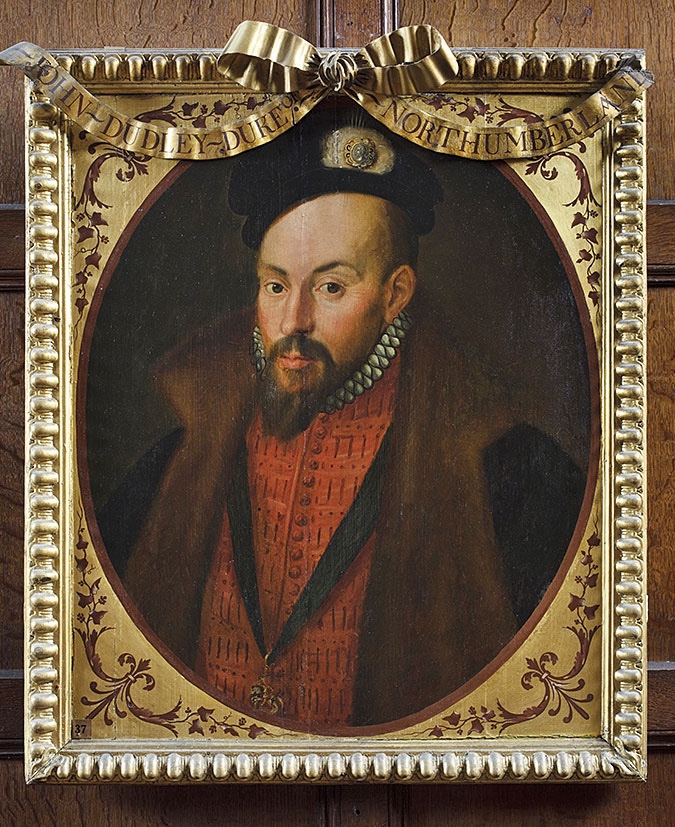
Dudley seems to have one portrait which was done around 1605-08, well after his death. Any similarities? Is it a copy of another portrait from his lifetime?
Portrait of John Dudley, Duke of Northumberland. Oil on panel, 690 x 543 mm. English school, 1605–1608. On show at Knole, Kent (National Trust collections, NT 129763). National Trust Images/John Hammond
Description English: A portrait drawing of an unidentified man, possibly George Boleyn, 2nd Viscount Rochford Date c.1532-43 Source Royal Collection
By 10 August 2020, the portrait had already circulated online and was the official portrait on his Wikipedia. Username “Ammelida” edits from 04:52 to 05:48. Her first edit,
Added [en] caption: An unidentified man c.1532-43, Hans Holbein the Younger
By the last edit, Ammelida has completely redone the page. They take out the original description by UrikSweden (above) and replace it with,
description = {{en|1=A portrait drawing of an unidentified man. A bust length portrait facing three-quarters to the right. He wears a fur collar and hat with a feather and gold ornaments pinned to its brim.}}
Added as reference: “https://www.rct.uk/collection/912260/an-unidentified-man RCIN 912260” and “Parker, K. T. (1945). ”The Drawings of Hans Holbein in the Collection of His Majesty the King at Windsor Castle.” London: Phaidon Press, p. 48, pl. 44.”
As of 22 March 2022, the Royal Collection Trust has it labeled as “An unidentified man”. There is no mention of George Boleyn or John Dudley for that matter.
So what’s all this? Wikipedia is where it seems to have originated. There are articles that feature this portrait as “George Boleyn”, they use the Wikipedia upload as a source.
Was it used in a documentary? Did they not see Susan James’ biography on Katherine Parr from 2009 saying it may be John Dudley? There just is NO source as to where the identification came from. With Dudley, at least there is a copy of the “An unidentified man” identified as “possibly John Dudley”.
At 01:31, username Ammelida takes the portrait out of George Boleyn’s Wikipedia stating,
Deleted image: the drawing by Holbein is that of an unidentified man. Parker, K. T. (1983). The Drawings of Hans Holbein in the Collection of His Majesty the King at Windsor Castle. London: Phaidon Press, pl. 44.
Hever Castle’s display showing the “An Unidentified man” as “sometimes identified as George Boleyn”. By who? Photo by Natalie on Facebook at On the Tudor Trail: Retracing the steps of Anne Boleyn.
Hever Castle, home to the Boleyns, at one point started displaying it as “possibly George”. I think the description of the portrait states Dr Owen Emmerson as the expert. Comments?
I found a photo of the display at Hever. I commented on it. Brought up the identification of John Dudley and asked why it was thought to be George? No answer. Also note that it’s dated c.1526 here. The date for the portrait on RCT is c.1532-43. Not sure if that really matters.
Discussions of the portrait possibly being George have arisen on Facebook. Dr Sarah Morris was brought up as another expert who thinks it’s “George”. Comments?
Anne Boleyn’s brother was a prominent, early, and enthusiastic supporter of the Protestant Reformation. He was also described as being as handsome as Adonis. Framed and executed on a charge of incest in 1536, it’s been assumed for centuries that all portraits of George, Lord Rochford, were lost or destroyed.
But there’s a modern theory that this sketch could be him.
It’s possible – and some see a similarity between this man and a sketch alleged to show his sister, Queen Anne. However, the two of them had dozens of first cousins on their mother Lady Ormond’s side, for instance. There were also Butler and Boleyn cousins on their father’s side. So people with a physical resemblance to Anne or George wouldn’t have been hard to find at court. Cousins often look as alike, or more alike, than siblings.
It’s not impossible that this shows George Boleyn, but it’s also possible it shows some other prominent courtier.
That’s the only reason people have started associating this with George? A similarity between the portrait and the one thought to be Queen Anne? You guys gotta do better than that. We don’t even know what Anne really looks like. Thanks to some random person it was uploaded as possibly George Boleyn to Wiki and it’s been showing up as factually correct all over the internet. However, if people took the time to click on the portrait (actually do some research on the portrait) they would eventually see that there is a link to the drawing in the RCT where it remains unidentified and there is no mention of this ridiculous idea of it being George.
So… ya’ll it’s “An unidentified man”… but copies say it could possibly be John Dudley…comments, thoughts?
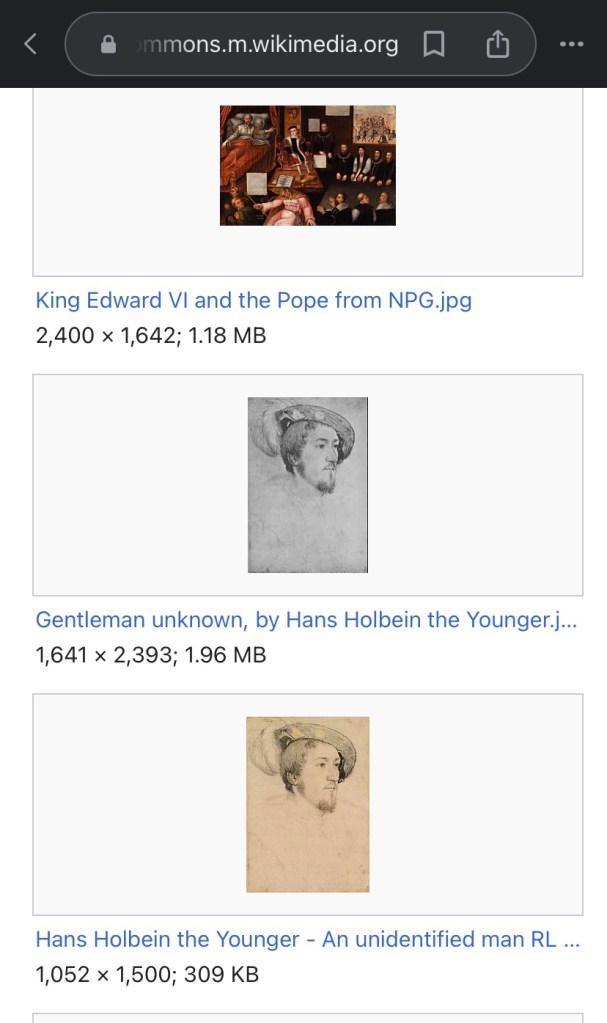
Update: I just found the portrait has been uploaded to Wikipedia twice before. The uploads are still identified as “An unknown man”, but the portraits were added to the media page for John Dudley, 1st Duke of Northumberland. When you click on the portraits for more info, you find the portraits remain unidentified, but were added to the media collection for Dudley in 2015.
Wikipedia Media page for John Dudley, 1st Duke of Northumberland.
Another one for “possibly John Dudley”
Portrait d’un homme inconnu, cour du roi Henri VIII, c. 1532. Peut-être John Dudley, 1er duc de Northumberland, qui a essayé d’installer Lady Jane Gray comme reine. Gravure à la main en paper-plaque de Charles Knight après un portrait de Hans Holbein le plus jeune à partir d’imitations de dessins originaux de Hans Holbein, John Chamberlaine, Londres, 1812.
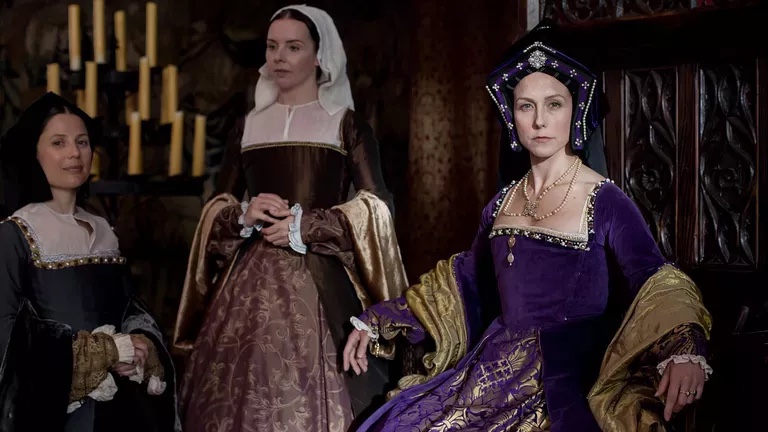
Maria de Salines (Bea Segura), Lady Maud Parr (Natalie Grady), and Katherine of Aragon (Paola Bontempi) in Secrets of the Six Wives (2016)
By Meg Mcgath, 22 March 2023 *be kind and if you find info here…leave breadcrumbs. Thanks!*
Lady Maud Parr, (6 April 1492 – 1 December 1531) was the wife of Sir Thomas Parr of Kendal, Knt. She was the daughter and substantial coheiress of Sir Thomas Green of Greens Norton, Northamptonshire. The Greens had inhabited Greens Norton since the fourteenth century. Green was the last male heir, having had two daughters. Her mother is named as Joan or Jane Fogge. However, I haven’t been able to prove her parentage. According to Linda Porter, Katherine Parr is a great-granddaughter of Sir John Fogge. When asked for a source, Porter said it came from Dr Susan James. In her biography on Katherine, Susan James states, “he [Green] had made an advantageous with the granddaughter of Sir John Fogge, treasurer of the Royal household under Edward IV”. Fogge was married to Alice Haute (or Hawte), a lady and cousin to Edward’s queen, Elizabeth. By her father, Maud descended from King Edward I of England multiple times. Her sister, Anne, would marry Sir Nicholas Vaux (later Baron). Vaux married firstly to Maud’s would be mother-in-law, the widowed Lady Elizabeth Parr, by whom he had three daughters including Lady Katherine Throckmorton, wife to Sir George of Coughton. Her father spent his last days in the Tower and died in 1506 trumped up on charges of treason.
Ten months after the death of her father, the fifteen year old Maud became a ward of Thomas Parr of Kendal (c.1471/1478 (see notes)-1517) a man nearly twice her age. Around 1508, Maud married to Thomas, son of Sir William Parr of Kendal (1434-1483) and Elizabeth FitzHugh (1455/65-1508), later Lady Vaux. At the time, he was thirty seven while she was about sixteen. He would become Sheriff of Northamptonshire, master of the wards and comptroller to King Henry VIII. He would become a Vice chamberlain of Katherine of Aragon’s household. When Princess Mary was christened, he was one of the four men to hold the canopy over her. He would become a coheir to the Barony of FitzHugh in 1512 and received half the lands of his cousin, George, 7th Baron (d.1512). Had he lived, he most likely would have received the actual title as a favored courtier. The barony is still in abeyance.
Maud became a lady to Queen Katherine of Aragon along with Lady Elizabeth Boleyn, mother of the future Queen Anne. It seems as though the Parrs and Boleyns were indeed in the same circle around the king—something rarely noted! Both Thomas Boleyn and Thomas Parr were knighted in 1509 at the coronation of King Henry VIII and Queen Katherine of Aragon.
Maud’s relationship with the Queen was a relationship that went much deeper than “giddy pleasure”. Both knew what it was like to lose a child in stillbirths and in infancy. It was Katherine Parr’s mother, Maud, who shared in the horrible miscarriages and deaths in which Queen Katherine would endure from 1511 to 1518. The two bonded over the issue and became close because of it. Lady Parr became pregnant shortly after her marriage to Sir Thomas Parr. Most people think that Katherine Parr, the future queen and last wife of Henry, was the first to be born to the Parrs; not so. In or about 1509, a boy was born to Maud and Thomas. The happiness of delivering an heir to the Parr family was short lived as the baby died shortly after — no name was ever recorded. It would be another four years before Maud is recorded as becoming pregnant again. In 1512, Maud finally gave birth to a healthy baby girl. She was christened Katherine, after the queen, and speculations are that Queen Katherine was her godmother. In about 1513, Maud would finally give birth to a healthy baby boy who was named William. Then again in 1515, Maud would give birth to another daughter named Anne, possibly after Maud’s sister.
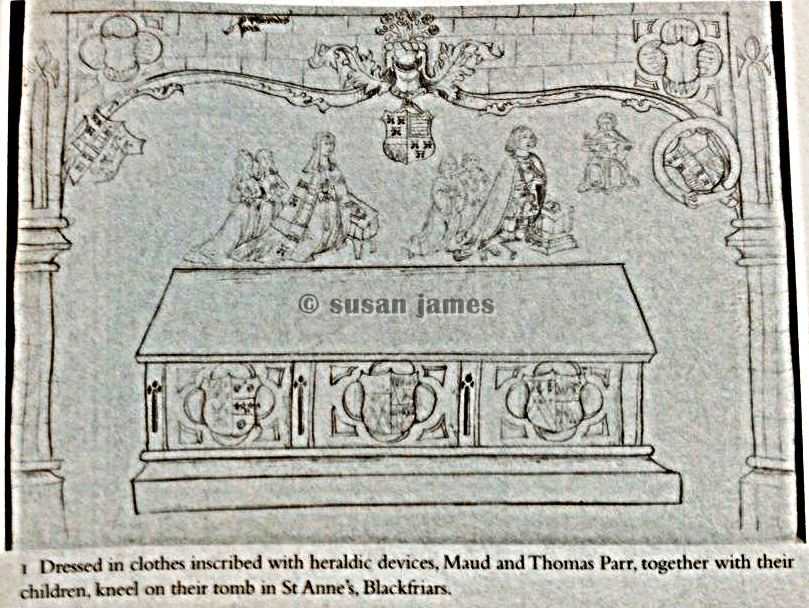
In or about 1517, Maud became pregnant again. It was in autumn of that year that her husband, Sir Thomas, died at his home in Blackfriars of the sweating sickness. Maud was left a young widow at 25, with three small children to provide for. It is believed that the stress from his death caused the baby to be lost or die shortly after birth. No further record of the child is recorded. In a way Maud might have been relieved. He left a will, dated 7 November, for his wife and children leaving dowry’s and his inheritance to his only son, William, but as he died before any of his children were of age, Maud along with Cuthbert Tunstall, their uncle Sir William Parr, and Dr. Melton were made executors. He left £400 apiece as marriage portions for his two daughters. He provided for another son and if the baby was “any more daughters”, he stated “she [Maud] shall marry them at her own cost”. In his will, Parr mentions a signet ring given to him by the King which illustrates how close he was to him. He was buried in St. Anne’s Church, Blackfriars, beneath an elaborate tomb. His tomb read, “Pray for the soul of Sir Thomas Parr, knight of the king’s body, Henry the eigth, master of his wards…and…Sheriff…who deceased the 11th day of November in the 9th year of the reign of our sovereign Lord at London, in the Black Friars..” Maud chose not to remarry for fear of jeopardizing the huge inheritance she held in trust for her children. She carefully supervised the education of her children and studiously arranged their marriages.
In October 1519, Maud was given her own quarters at court. From 7 to 24 June 1520, Maud attended the queen at The Field of the Cloth of Gold, the meeting between King Henry VIII and King Francis I of France. Her sister, Anne, now Lady Vaux, and her husband, Nicholas, along with her other in laws, Lord Parr of Horton and his wife, were also present.
According to this article, which states no sources,
“In 1522, Maud was assessed for a “loan” to the King for the French Wars, of 1,000 marks, a very substantial sum, the same as the amount provided by Lord Clifford. She appears in the various household accounts of Henry VIII and Katharine of Aragon as entitled to breakfast at Crown expense and to suits of livery for her servants, as well as lodgings, which were very hard to come by.
In 1523, Maud started writing letters to find a suitable husband for her daughter, Katherine. Henry le Scrope (c.1511-25 March 1525), son and heir to Sir Henry le Scrope, 7th Baron Scrope of Bolton by his wife Mabel Dacre, was a cousin. The negotiations lead to nothing. By 1529, Maud found a match for her daughter in Sir Edward Borough, son of Sir Thomas.
When regulations for the Royal household were drawn up at Eltham, in 1526, Lady Parr, Lady Willoughby and Jane, Lady Guildford were assigned lodgings on “the queen’s side” of the palace. If an emergency arose, yeoman were sent with letters from the queen “warning the ladies to come to the court”. Maud was still listed, along with only five other ladies, which included the King’s sister, as having the privilege of having permanent suites in 1526. Maud was friendly with the King as well—her husband had been a favored courtier—and gifted him a coat of Kendal cloth in 1530. She was gifted miniatures of the King and Queen from the Queen herself.
In the summer of 1530, Maud visited her daughter, now Lady Katherine Borough, in Lincolnshire. She stayed at her own manor in Maltby, which was eighteen miles from Old Gainsborough Hall. It is thought that her presence there influenced Sir Thomas Borough to give his son, Edward, a property in Kirton-in-Lindsey. This gave Katherine an opportunity to manage a household of her own.
Maud continued her position at court as one of Katherine of Aragon’s principal ladies and stayed close to the Queen even when her relationship with the king started to decline. Henry’s infatuation with Anne Boleyn, one of the Queen’s ladies, became apparent and inevitably the ladies began to take sides. In these times, Queen Katherine never lost the loyalty and affection of women like Maud Parr, Gertrude Courtenay, and Elizabeth Boleyn, who had been with the Queen since the first years of her reign. At the time of her death, Maud was still attending Queen Katherine.
Maud died on 1 December 1531 at age thirty nine and is buried in St. Ann’s Church, Blackfriars Church, London, England beside her husband.
“My body to be buried in the church of the Blackfriars, London. Whereas I have indebted myself for the preferment of my son and heir, William Parr, as well to the king for the marriage of my said son. As to my lord of Essex for the marriage of my lady Bourchier, daughter and heir apparent to the said Earl. Anne, my daughter, Sir William Parr, Knt., my brother, Katherine Borough, my daughter, Thomas Pickering, Esq., my cousin and steward of my house.”
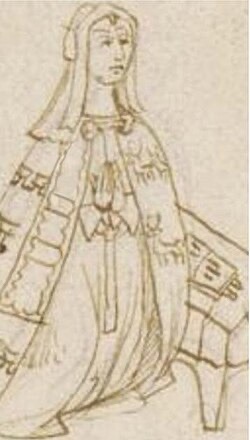
Close up of the Tomb of Sir Thomas Parr and Maud Green (see above)
In her will, dated 20 May 1529, Maud designated that she wanted to be buried Blackfriars where her husband lies if she dies in London, or within twenty miles. Otherwise, she could be buried where her executors think most convenient. Maud left her daughter, Katherine, a jeweled cipher pendant in the shape of an ‘M’. Maud also left Katherine a cross of diamonds with a pendant pearl, a cache of loose pearls, and, ironically, a jeweled portrait of Henry VIII. To her daughter, Anne, she left 400 marks in plate and a third share of her jewels. The whole fortune, Lady Parr had directed, was to be securely chested up ‘in coffers locked with divers locks, whereof every one of them my executors and my … daughter Anne to have every of them a key’. ‘And there’, Lady Parr’s will continued, ‘it to remain till it ought to be delivered unto her’ on her marriage. She also provided 400 marks for the founding of schools and “the marrying of maidens and especial my poor kinswomen”. Cuthbert Tunstall, who was the principal executor of Maud’s will, she left to “my goode Lorde Cuthberd Tunstall, Bisshop of London…a ring with a ruby”. Tunstall had been an executor of her late husband’s will as well. An illegitimate son of Sir Thomas of Thurland Castle, he was a great-nephew of Alice Tunstall, paternal grandmother to Sir Thomas Parr. To her daughter-in-law, Anne, she left substantial amounts of jewelry, “to my lady Bourchier when she lieth with my son” as a bribe to get the marriage consummated. Maud also left a bracelet set with red jacinth to her son, William. She begs him “to wear it for my sake”. Maud was also stated in her will, “I have endetted myself in divers summes for the preferment of my sonne and heire William Parr as well”. For her cousin, Alice Cruse, and Thomas Parr’s niece, Elizabeth Woodhull or Odell, Maud left “at the lest oon hundrythe li”. She wills her “apparrell [to] be made in vestments and other ornaments of the churche” for distribution to three different parish churches which lay close to lands that she controlled. She bequeathed money to the Friars of Northampton. For centuries, historians have confused the first husband of her daughter, Katherine, with his elder grandfather, Edward, the 2nd Baron Borough or Burgh of Gainsborough (d.August 1528). He was declared insane and was never called to Parliament as the 2nd Baron Borough. Some sources mistakenly state she was just a child at the time of her wedding in 1526. Katherine’s actual husband, Sir Edward Borough (d.1533), was the eldest son and heir of the 2nd Baron’s eldest son and heir, Sir Thomas Borough, who would become the 1st Baron Borough under a new writ in December 1529. Katherine and Edward were married in 1529. At the time, Thomas Borough was still only a knight. Maud mentions in her will, Sir Thomas, father of the younger Edward, saying ‘I am indebted to Sir Thomas Borough, knight, for the marriage of my daughter‘. Edward was the eldest son and heir to his father, Sir Thomas, Baron Borough. He would die in 1533. Maud’s will was proved 14 December 1531.
Maud and Thomas had three children to survive infancy.
The children who survived…William, Katherine, and Anne.
Katherine or “Kateryn” (1512-1548), later Queen of England and Ireland, would marry four times. In 1529, Katherine married Sir Edward Borough. He died in 1533. In 1534, Katherine became “Lady Latimer” as the wife to a cousin of the family, Sir John Neville, 3rd Baron Latimer (of Snape Castle). He was dead by March 1543. A few months later, on 12 July, Katherine married King Henry VIII at Hampton Court Palace. The king died in January 1547. In May of that year, Katherine secretly wed Sir Thomas Seymour, 1st Baron Seymour (d.1549) of Sudeley Castle, a previous suitor from 1543. Their love letters still survive. By Seymour, Katherine had a daughter, Mary. Katherine died 5 September 1548. Seymour would be executed 20 March 1549 for countless treasonous acts against the crown (his nephew was King Edward VI).
William (1514-1571) married on 9 February 1527, at the chapel of the manor of Stanstead in Essex, to Anne Bourchier, suo jure 7th Baroness Bourchier (d. 26 January 1571), only child and heiress of Henry Bourchier, 2nd Earl of Essex (d.1540). In 1541, she eloped from him, stating that “she would live as she lusted”. Susan James states the next year, Parr secured a legal separation. James also states that on 13 March 1543, a bill was passed in Parliament condemning Anne’s adulterous behavior and declaring any children bastards. Wikipedia states “On 17 April 1543 their marriage was annulled by an Act of Parliament and any of her children “born during esposels between Lord and Lady Parr””(there were none) were declared bastards. The source is G. E. Cokayne, ”The Complete Peerage”, n.s., Vol.IX, p.672, note (b). I have not been able to access The Complete Peerage to confirm. On 31 March 1551, a private bill was passed in Parliament annulling Parr’s marriage to Anne. She predeceased Parr by a few months. William married Elisabeth Brooke (1526-1565), a daughter of George Brooke, 9th Baron Cobham of Cobham Hall in Kent, by his wife Anne Bray. A commission ruled in favour of his divorce from Anne shortly after he married Elizabeth Brooke in 1547, but Somerset punished Parr for his marriage by removing him from the Privy Council and ordering him to leave Elizabeth. The divorce was finally granted in 1551, and his marriage to Elizabeth was made legal. On 31 Mar 1552, a bill passed in Parliament declaring the marriage of Anne Bourchier and Parr null and void. Their marriage was declared invalid in 1553 under Queen Mary and valid again in 1558 under Queen Elizabeth who adored William. Each change of monarch, and religion, changed Elizabeth’s status. She died in 1565. William married Helena Snakenborg in May 1571 in Elizabeth’s presence in the queen’s closet at Whitehall Palace with pomp and circumstance. Parr would die 28 October 1571.
Anne (1515-1552) who married Sir William Herbert, 1st Earl of Pembroke in 1538. They had three children: Henry, Edward, and Anne. They are ancestors to the current Earl of Pembroke and Montgomery, Earl of Carnarvon, Earl of Powis, Marquess of Abergavenny, and other nobility.
Notes
Porter, James, and Mueller state Thomas Parr was born in 1478. However, in James’s biography of Katherine, she states he was 37 at the time of his marriage to Maud Green in 1508. So that would be about 1471, right?
Katherine Parr: Complete Works and Correspondence, ed. Janel Mueller, 2011. Google eBook (preview)
Sir Nicholas Nicolas. Testamenta Vetusta: being illustrations from wills, of manners, customs, … as well as of the descents and possessions of many distinguished families. From the Reign of Henry II. to the accession of Queen Elizabeth, Volume 2, 1826. Google eBook
Elizabeth Norton. “Catherine Parr Wife, Widow, Mother, Survivor, the Story of the Last Queen of Henry VIII”, 2010. Google eBook (preview)
Linda Porter. Katherine the Queen: The Remarkable Life of Katherine Parr, the Last Wife of Henry VIII (New York: St. Martin’s Griffin Publishing, 2010)
Douglas Richardson. Magna Carta Ancestry: A Study in Colonial and Medieval Families, 2nd Edition, 2011. Google eBook (preview)
Gareth Russell. Young and Damned and Fair: The Life of Catherine Howard, Fifth Wife of King Henry VIII, 2017. Pg 215. Google eBook (preview)
Agnes Strickland. Lives of the Queens of England, from the Norman Conquest With Anecdotes of Their Courts, Volumes 4-5, 1860. Pg 16. Google eBook
Tudor and Stuart Consorts: Power, Influence, and Dynasty, ed. Aidan Norrie, Carolyn Harris, Danna R. Messer, Elena Woodacre, J. L. Laynesmith, 2022. Google eBook (preview)
The Antiquary: A Magazine Devoted to the Study of the Past, volume 24, 1891. Google eBook
Sir William Parr, 1st Baron Parr of Horton (c. 1483 – 10 September 1546) was the son of Sir William Parr of Kendal and his wife Elizabeth Fitzhugh. His mother was a niece to Warwick, the Kingmaker and thus a cousin of Anne Neville, Duchess of Gloucester and Queen of England as the wife of Richard III. Lady Elizabeth and her mother, Lady Alice FitzHugh, rode in the coronation train for Anne when she became queen and it is believed they stayed on as ladies to the queen. Elizabeth had been in the household since Anne became Duchess.
Parr’s siblings included an elder brother, Sir Thomas Parr of Kendal (d.1517), who was father to the future queen of England, the Marquess of Northampton, and the Countess of Pembroke. Their sister Anne married Thomas Cheney (or Chenye) and was mother to Lady Elizabeth Vaux, wife of the 2nd Baron Vaux of Harrowden. The father of the 2nd Baron was Nicholas Vaux, 1st Baron. His first wife was the widowed Lady Elizabeth Parr, mother to Thomas, William, and Anne. By Elizabeth, Nicholas had 3 daughters, Lady Katherine Throckmorton, Lady Alice Sapcote, and Lady Anne le Strange.
William Parr was a military man who fought in France, where he was knighted by King Henry VIII at Tournai Cathedral, and Scotland. Parr seemed to be uncomfortable in court circles and insecure in securing relationships. None the less he accompanied the King at the ‘Field of the Cloth of Gold’ in France. Like his brother, Sir Thomas Parr, William flourished under Sir Nicholas Vaux.
William was a family man. After the death of his brother, Sir Thomas Parr, William’s sister-in-law Maud, widowed at age 25, called upon him to help in financial matters and to manage her estates in North England while she was busy in the south securing a future for her three children. William had been named one of the executors of his brother’s will. Along with Cuthbert Tunstall, a kinsman of the Parrs, Parr provided the kind of protection and father figure which was missing in the lives of Maud’s children. William’s children were educated along side Maud’s children.
Although William was en-adapt at handling his financial matters, he was ironically appointed the office of Chamberlain in the separate household of Henry FitzRoy, 1st Duke of Richmond and Somerset, the acknowledged illegitimate son of King Henry VIII and Elizabeth Blount, based at Sheriff Hutton Castle in Yorkshire. It was William who found a spot for his nephew, William Parr, later Earl of Essex, in the Duke’s household where he would be educated by the very best tutors and mixed with the sons of other prominent families. Though thought to be a wonderful environment for Parr and his nephew to flourish in, the household was not a great passport to success as Parr hoped for. Henry VIII was very fond of his illegitimate son, but had no intention of naming him his heir. It has been claimed that Parr and his sister-in-law, Maud Parr, coached William to make sure that he ingratiated himself with the Duke, in case the Duke became heir to the throne but there is no factual evidence to support this claim.
Although Parr was named Chamberlain of the Duke’s household, the household was actually controlled by Cardinal Thomas Wolsey in London. This control by Wolsey diminished any opportunity of Parr gaining financial benefit or wider influence. Along with the limited possibilities came other daily frustrations as the Duke’s tutors and the household officers under Parr disagreed on the balance of recreation and study. Parr was a countryman who thought it perfectly normal for boys to prefer hunting and sports to the boring rhetoric of learning Latin and Greek. As the Duke’s behavior became more unruly Parr and his colleagues found it quite amusing. The Duke’s tutor, John Palsgrave, who had only been employed six months, would not tolerate being undermined and decided to resign. Such was the household in which Parr presided over. Parr was suspicious of schoolmaster priests and anyone of lesser birth, even though he was not considered a nobleman at the time. The experience did not further the Parr family. If Sir William had paid more attention to his duties and responsibilities he may have reaped some sort of advancement; thus when the overmanned and over budgeted household was dissolved in the summer of 1529, Parr found himself embittered by his failure to find any personal advancement or profit from the whole ordeal.
Despite his failed attempts at achieving personal gain from the household of the Duke, Sir William made up for it during the Pilgrimage of Grace during 1536. William showed impeccable loyalty to the Crown during the rebellion. He had been in Lincolnshire along with Charles Brandon, 1st Duke of Suffolk and supervised the executions at Louth and Horncastle. William tried to ingratiate himself with Thomas Howard, 3rd Duke of Norfolk and Thomas Cromwell, 1st Earl of Essex. Parr’s presence at the execution in Hull of Sir Robert Constable prompted Cromwell to share in confidence a correspondence in which he received from the Duke of Norfolk on William’s “goodness” which “never proved the like in any friend before.”
Sir William was Sheriff of Northamptonshire in 1518 and 1522. He was also Esquire to the Body to Henry VII and Henry VIII. In addition to this, he was a third cousin to King Henry VIII through his mother. William was appointed Chamberlain to his niece Katherine Parr and when she became Queen regent during Henry’s time in France, Catherine appointed William part of her council. Although he was too ill to attend meetings, the appointment shows her confidence in her uncle.
Parr was knighted by King Henry VIII on Christmas Day, 1513. He was made a peer of the realm as 1st Baron Parr of Horton on 23 December 1543. Upon his death in 1546, with no male heirs, the barony became extinct.
He married Mary Salisbury, the daughter and co-heir of Sir William Salisbury; who brought as her dowry the manor of Horton. It was a happy marriage which produced four daughters who survived infancy:
* Maud (Magdalen) Parr, who married Sir Ralph Lane of Orlingbury. One of their children was Sir Ralph Lane, the explorer. Maud grew up with her cousin Katherine Parr, who would later become the last queen of Henry VIII. Maud would become a lifelong friend and confidante of the queen. * Anne Parr, who married Sir John Digby. * Elizabeth Parr, who married Sir Nicholas Woodhall. * Mary Parr, who married Sir Thomas Tresham I.
He is buried at Horton, Northamptonshire where the family estate was.
Lady Maud Lane and Lady Mary Tresham are ancestors to the Prince of Wales and the Duke of Sussex through their late mother, the Princess of Wales.
Sir Thomas Tresham was born by 1500 to Sir John of Rushton and Isabel, daughter of Sir James Harrington of Hornby. He was married to a daughter of Sir William Parr, 1st Baron Parr of Horton, uncle to Queen Katherine Parr. Which daughter? Oh dear! Depends on the source. Some say Mary. Some say Anne. So let’s look at these sources. Can we finally identify which daughter of Lord Parr became Lady Tresham?
“Francis Tresham was the grandson of Thomas Tresham by his first wife, Mary Parr. Thomas’s second wife was Lettice’s paternal grandmother, Lettice Peniston.”
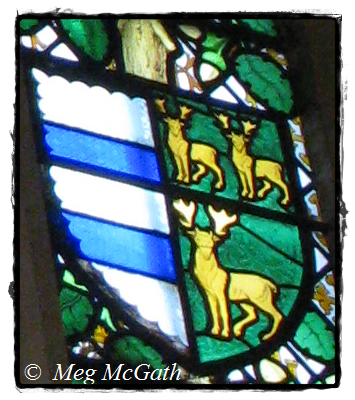
Arms: Argent, two bars, azure: a border engrailed [?] from The History of the County Palatine and Duchy of Lancaster
“Anne, daughter and coheir of William Parr, afterwards Lord Parr of Horton”
So… who is who?? You got me. All I know is that a daughter of Lord Parr of Horton married Sir Thomas Tresham. Anyone else think they can solve this? Why does it matter? Just thought it would be nice to sort out the daughters.
EDIT: found the article for Sir John Digby on History of Parliament. His wife?
“m. settlement 1528/29, Mary, da. and coh. of Sir William Parr, Baron Parr of Horton…
The book, “Britain’s Royal Families”, was written back in 1989!! Alison Weir keeps reissuing her publications and doesn’t seem to update anything when she does. Would love to know her sources for some of these: the entry for Queen Catherine Parr. If you look at her entry—she has the grandfather of Parr’s actual husband as Parr’s husband. In actuality, Parr was married to Sir Edward Burgh, GRANDSON of Sir Edward, [2nd] Lord Borough, in 1529. The younger Edward died c. April 1533. Catherine would have been known as Lady Burgh or Borough (depends on how you spell it) as her husband was only a knight. She is not the subject of Holbein’s “Lady Borow”. It is now thought to be her mother-in-law. Parr’s marriage to Latimer took place in 1534 according to Dr Susan James and Linda Porter. Weir has that wrong too — stating 1530 or before the end of 1533. Catherine would have been known as Lady Latimer or Baroness Latimer (of Snape). She became Her Majesty, Queen Catherine on 12 July 1543. She was known as “Regent General of England” from July to 30 September 1544 and signed her name, “Kateryn, the Quene regente, KP”. On the death of King Henry she became Dowager Queen Catherine. She was to retain the title of queen even when she remarried. She took precedence over all the women at court, was allowed to keep the jewels of the queens of England until the next queen. There is no official date for Parr’s marriage to Sir Thomas Seymour. A lot of sources state in secret, May 1547. Janel Mueller states May 1547 due to a letter written by Seymour to the Dowager Queen. The marriage wasn’t made public until June. Weir incorrectly states before the end of April 1547. She would have been known as Queen Catherine as that was her highest honor, but she was technically Queen Catherine, Baroness (or Lady) Seymour of Sudeley. Weir says Catherine died on the 7th of September. Weir seems to not do her research here AGAIN as Parr’s FUNERAL was 7 September 1548 in Sudeley’s, St Mary’s Chapel. At Sudeley you can find a copy of what they inscribed on her lead coffin. It’s next to her tomb, which states the date of her death is the 5th. She is buried in St. Mary’s Chapel, Sudeley Castle.
Catherine’s daughter was Mary Seymour who was born on 30 AUGUST 1548. There is no death date for her as records on her disappear after her second birthday. Weir seems to think she either died in the 1560s or repeats the myth that she married.
References
Susan James, “Catherine Parr: Henry VIII’s Last Love”, 2009.
Linda Porter, “Katherine the Queen: The Remarkable Life of Katherine Parr”, 2010.
Janel Mueller, editor, “Katherine Parr: Complete Works and Correspondence”, 2011.
The Paston letters, 1422-1509 A.D.: A new ed. containing upwards of four hundred letters, etc., hitherto unpublished, Volume 3, edited by James Gairdner.
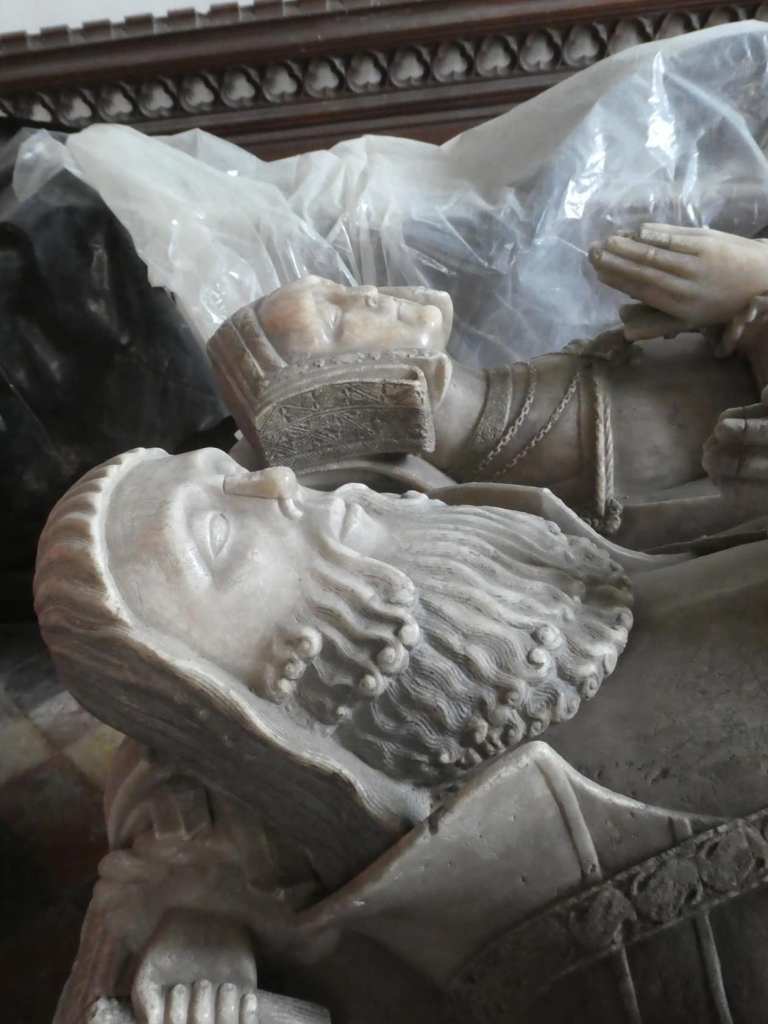
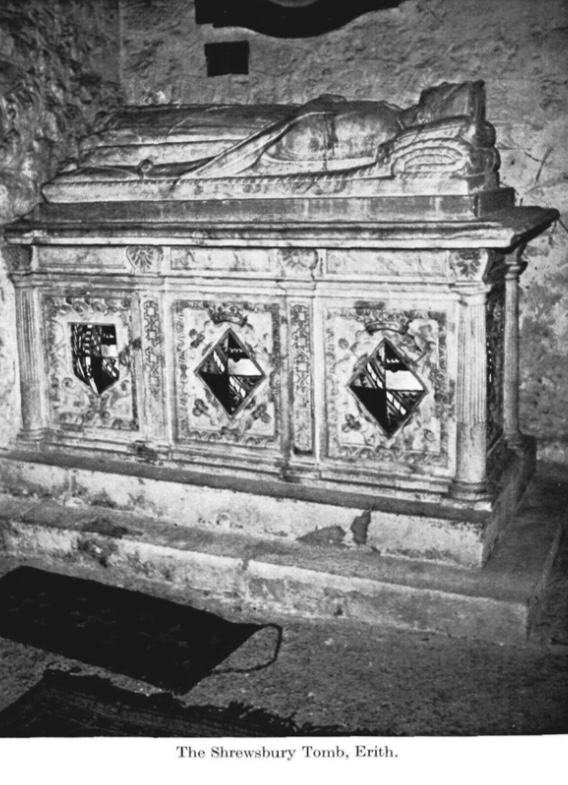
Anne Talbot was the daughter of George Talbot, 4th earl of Shrewsbury and his second wife, Elizabeth Walden, dau. and coheir of Sir Richard Walden of Erith.
Her half brother was Francis Talbot, fifth Earl of Shrewsbury; and she also had many half sisters, among them Mary, Countess of Northumberland, Margaret and Elizabeth, Baroness Dacre of Gillesland.
A contract was made in 1530 with George Talbot, 4th Earl of Shrewsbury to marry Anne Talbot with a Darcy, probably SirGeorge or his son Thomas. Although there was no subsequent marriage. On 29 May 1537, she married Peter Compton and was the mother of Henry, 1st baron Compton.
In May 1552, Anne became the second wife of William Herbert, 1st earl of Pembroke, who married her for her money and connections. On frequent occasions Queen Elizabeth dined with Lady Pembroke at Baynard’s Castle in London. On 25 Apr 1559, the Queen supped at Baynard’s Castle, Pembroke’s house. On 15 Jan 1562, the Queen stayed overnight at Baynard’s Castle. On 28 Apr 1562, according to rumor from the Spanish Ambassador, the Queen married Lord Robert Dudley there.
On 17 Feb 1563, a double marriage was celebrated at Baynard’s Castle between the Herbert and Talbot families. Francis, son of George Talbot, 6th Earl of Shrewsbury (nephew of the Countess), married the Countess’s stepdaughter, Anne Herbert, and her stepson, Henry, later 2nd Earl of Pembroke, married Catherine Talbot.
On 28 Jun 1564, the Queen went secretly to Baynard’s Castle to dine and to see St Peter’s Watch. On 14 Feb 1566, Elizabeth went ‘disguised’ to dine at Baynard’s Castle. Between the 8 and the 10 of Jul, the Queen stayed at Pembroke’s Hendon house.
When Pembroke died, Anne received a letter of condolence from the Queen and was allowed to keep her own clothes and jewels, which would otherwise have gone to her eldest stepson, and stay in Baynard’s Castle.
18 JULY 1588: THE DEATH of Anne Talbot, Countess of Pembroke, 2nd wife to Sir William Herbert, Earl of Pembroke.
Anne Talbot (18 March 1523 – 18 July 1588) was the daughter of George Talbot, 4th earl of Shrewsbury and his second wife, Elizabeth Walden, dau. and coheir of Sir Richard Walden of Erith. She had been previously married to Peter Compton (d. 30 January 1544). Their posthumous son was Henry Compton, 1st Baron Compton.
After the death of his first wife, Anne née Parr, sister of Queen Catherine, Pembroke married Anne after 1552. The two had no issue, but she was stepmother to three children. Her nephew, the 6th Earls children included Lord Francis and Catherine Talbot who married her stepdaughter and elder stepson.
No info is given on where she’s buried. She wasn’t buried with her 2nd husband who’s buried with his 1st wife at St Paul’s Cathedral, London. Anne may be back at Sheffield Cathedral where the Shrewsbury family has a chapel. However, research into her finds on Tudor Place that she was buried in Elrith, Kent where her mom was heiress. Anne became heiress to her mother. The Complete Peerage says, “Anne Talbot was buried on 8 August 1588 at Erith, Kent, England.”
Image of Sheffield Manor, home of the 4th Earl of Shrewsbury and his family. The manor stayed in the Talbot family until the death of the 6th Earl. After the death of George Talbot, the Earls rarely visited the site and the land was leased to tenant farmers. It fell to the Duke of Norfolks in 1660.
Henry Herbert, 1st Earl of Powis, and Barbara with their children: George Edward Henry Arthur Herbert, 2nd Earl of Powis (1755-1801) and Lady Henrietta Antonia Herbert (1758-1830). (c) Powis Castle; Supplied by The Public Catalogue Foundation
Barbara Herbert, Countess of Powis (24 June 1735 – 12 March 1786),[1] was the wife of General Henry Herbert, 1st Earl of Powis, and the mother of George Herbert, 2nd Earl of Powis. Barbara was a descendant of Lady Anne (Parr) Herbert, Countess of Pembroke. Through her daughter, Lady Henrietta, the Earldom of Powis descended to her son-in-law.
Barbara’s father, Lord Edward Herbert, was a younger son of William Herbert, 2nd Marquess of Powis; he married Lady Henrietta Waldegrave, but died only a few months after the wedding, in 1734. Barbara was born three months after her father’s death, and was fifteen when she married Henry Herbert on 30 March 1751; Henry was in his late forties. Henry was descended from Richard Herbert, 2nd Baron Herbert of Chirbury, and was created Earl of Powis in 1748,[2] following the death without heirs of William Herbert, 3rd Marquess of Powis.
The couple had two children:
George Edward Henry Arthur Herbert, 2nd Earl of Powis (1755-1801), who died unmarried.
Lady Henrietta Antonia Herbert (1758-1830), who married Edward Clive, later created Earl of Powis, and had children.
In 1771, shortly before the earl’s death, the family seat at Oakly Park was sold to Robert Clive, 1st Baron Clive,[3] and they moved permanently to Powis Castle. A portrait of Barbara by an unknown artist, dated to approximately 1750, is held at Powis Castle, in the care of the National Trust.













 tudorqueen6 by Meg McGath

