The Queen’s Mother: Lady Maud Parr

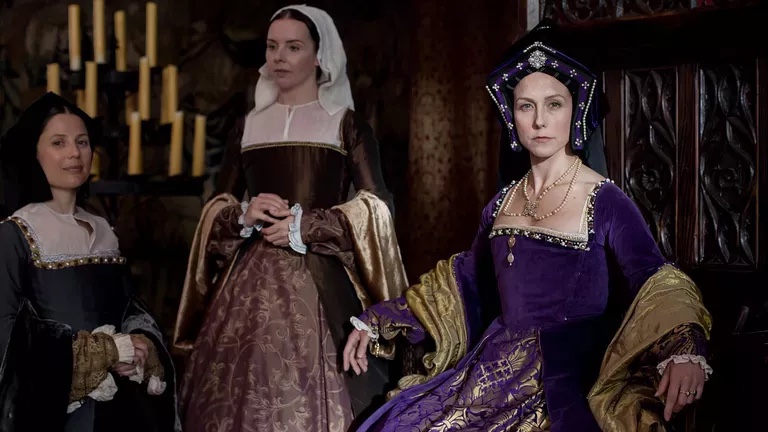
Maria de Salines (Bea Segura), Lady Maud Parr (Natalie Grady), and Katherine of Aragon (Paola Bontempi) in Secrets of the Six Wives (2016)

By Meg Mcgath, 22 March 2023 *be kind and if you find info here…leave breadcrumbs. Thanks!*

Lady Maud Parr, (6 April 1492 – 1 December 1531) was the wife of Sir Thomas Parr of Kendal, Knt. She was the daughter and substantial coheiress of Sir Thomas Green of Greens Norton, Northamptonshire. The Greens had inhabited Greens Norton since the fourteenth century. Green was the last male heir, having had two daughters. Her mother is named as Joan or Jane Fogge. However, I haven’t been able to prove her parentage. According to Linda Porter, Katherine Parr is a great-granddaughter of Sir John Fogge. When asked for a source, Porter said it came from Dr Susan James. In her biography on Katherine, Susan James states, “he [Green] had made an advantageous with the granddaughter of Sir John Fogge, treasurer of the Royal household under Edward IV”. Fogge was married to Alice Haute (or Hawte), a lady and cousin to Edward’s queen, Elizabeth. By her father, Maud descended from King Edward I of England multiple times. Her sister, Anne, would marry Sir Nicholas Vaux (later Baron). Vaux married firstly to Maud’s would be mother-in-law, the widowed Lady Elizabeth Parr, by whom he had three daughters including Lady Katherine Throckmorton, wife to Sir George of Coughton. Her father spent his last days in the Tower and died in 1506 trumped up on charges of treason.
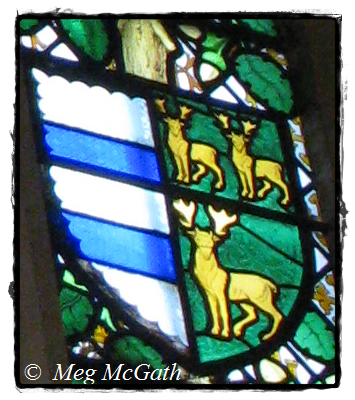
Coat of arms of Queen Katherine’s parents; Sir Thomas Parr and Maud Green from The Great Hall at Hampton Court Palace which features the royal pedigrees of the six wives from Edward I of England.

Ten months after the death of her father, the fifteen year old Maud became a ward of Thomas Parr of Kendal (c.1471/1478 (see notes)-1517) a man nearly twice her age. Around 1508, Maud married to Thomas, son of Sir William Parr of Kendal (1434-1483) and Elizabeth FitzHugh (1455/65-1508), later Lady Vaux. At the time, he was thirty seven while she was about sixteen. He would become Sheriff of Northamptonshire, master of the wards and comptroller to King Henry VIII. He would become a Vice chamberlain of Katherine of Aragon’s household. When Princess Mary was christened, he was one of the four men to hold the canopy over her. He would become a coheir to the Barony of FitzHugh in 1512 and received half the lands of his cousin, George, 7th Baron (d.1512). Had he lived, he most likely would have received the actual title as a favored courtier. The barony is still in abeyance.

Maud became a lady to Queen Katherine of Aragon along with Lady Elizabeth Boleyn, mother of the future Queen Anne. It seems as though the Parrs and Boleyns were indeed in the same circle around the king—something rarely noted! Both Thomas Boleyn and Thomas Parr were knighted in 1509 at the coronation of King Henry VIII and Queen Katherine of Aragon.

Maud’s relationship with the Queen was a relationship that went much deeper than “giddy pleasure”. Both knew what it was like to lose a child in stillbirths and in infancy. It was Katherine Parr’s mother, Maud, who shared in the horrible miscarriages and deaths in which Queen Katherine would endure from 1511 to 1518. The two bonded over the issue and became close because of it. Lady Parr became pregnant shortly after her marriage to Sir Thomas Parr. Most people think that Katherine Parr, the future queen and last wife of Henry, was the first to be born to the Parrs; not so. In or about 1509, a boy was born to Maud and Thomas. The happiness of delivering an heir to the Parr family was short lived as the baby died shortly after — no name was ever recorded. It would be another four years before Maud is recorded as becoming pregnant again. In 1512, Maud finally gave birth to a healthy baby girl. She was christened Katherine, after the queen, and speculations are that Queen Katherine was her godmother. In about 1513, Maud would finally give birth to a healthy baby boy who was named William. Then again in 1515, Maud would give birth to another daughter named Anne, possibly after Maud’s sister.

In or about 1517, Maud became pregnant again. It was in autumn of that year that her husband, Sir Thomas, died at his home in Blackfriars of the sweating sickness. Maud was left a young widow at 25, with three small children to provide for. It is believed that the stress from his death caused the baby to be lost or die shortly after birth. No further record of the child is recorded. In a way Maud might have been relieved. He left a will, dated 7 November, for his wife and children leaving dowry’s and his inheritance to his only son, William, but as he died before any of his children were of age, Maud along with Cuthbert Tunstall, their uncle Sir William Parr, and Dr. Melton were made executors. He left £400 apiece as marriage portions for his two daughters. He provided for another son and if the baby was “any more daughters”, he stated “she [Maud] shall marry them at her own cost”. In his will, Parr mentions a signet ring given to him by the King which illustrates how close he was to him. He was buried in St. Anne’s Church, Blackfriars, beneath an elaborate tomb. His tomb read, “Pray for the soul of Sir Thomas Parr, knight of the king’s body, Henry the eigth, master of his wards…and…Sheriff…who deceased the 11th day of November in the 9th year of the reign of our sovereign Lord at London, in the Black Friars..” Maud chose not to remarry for fear of jeopardizing the huge inheritance she held in trust for her children. She carefully supervised the education of her children and studiously arranged their marriages.

In October 1519, Maud was given her own quarters at court. From 7 to 24 June 1520, Maud attended the queen at The Field of the Cloth of Gold, the meeting between King Henry VIII and King Francis I of France. Her sister, Anne, now Lady Vaux, and her husband, Nicholas, along with her other in laws, Lord Parr of Horton and his wife, were also present.

According to this article, which states no sources,

“In 1522, Maud was assessed for a “loan” to the King for the French Wars, of 1,000 marks, a very substantial sum, the same as the amount provided by Lord Clifford. She appears in the various household accounts of Henry VIII and Katharine of Aragon as entitled to breakfast at Crown expense and to suits of livery for her servants, as well as lodgings, which were very hard to come by.

In 1523, Maud started writing letters to find a suitable husband for her daughter, Katherine. Henry le Scrope (c.1511-25 March 1525), son and heir to Sir Henry le Scrope, 7th Baron Scrope of Bolton by his wife Mabel Dacre, was a cousin. The negotiations lead to nothing. By 1529, Maud found a match for her daughter in Sir Edward Borough, son of Sir Thomas.

When regulations for the Royal household were drawn up at Eltham, in 1526, Lady Parr, Lady Willoughby and Jane, Lady Guildford were assigned lodgings on “the queen’s side” of the palace. If an emergency arose, yeoman were sent with letters from the queen “warning the ladies to come to the court”. Maud was still listed, along with only five other ladies, which included the King’s sister, as having the privilege of having permanent suites in 1526. Maud was friendly with the King as well—her husband had been a favored courtier—and gifted him a coat of Kendal cloth in 1530. She was gifted miniatures of the King and Queen from the Queen herself.

In the summer of 1530, Maud visited her daughter, now Lady Katherine Borough, in Lincolnshire. She stayed at her own manor in Maltby, which was eighteen miles from Old Gainsborough Hall. It is thought that her presence there influenced Sir Thomas Borough to give his son, Edward, a property in Kirton-in-Lindsey. This gave Katherine an opportunity to manage a household of her own.

Maud continued her position at court as one of Katherine of Aragon’s principal ladies and stayed close to the Queen even when her relationship with the king started to decline. Henry’s infatuation with Anne Boleyn, one of the Queen’s ladies, became apparent and inevitably the ladies began to take sides. In these times, Queen Katherine never lost the loyalty and affection of women like Maud Parr, Gertrude Courtenay, and Elizabeth Boleyn, who had been with the Queen since the first years of her reign. At the time of her death, Maud was still attending Queen Katherine.

Maud died on 1 December 1531 at age thirty nine and is buried in St. Ann’s Church, Blackfriars Church, London, England beside her husband.
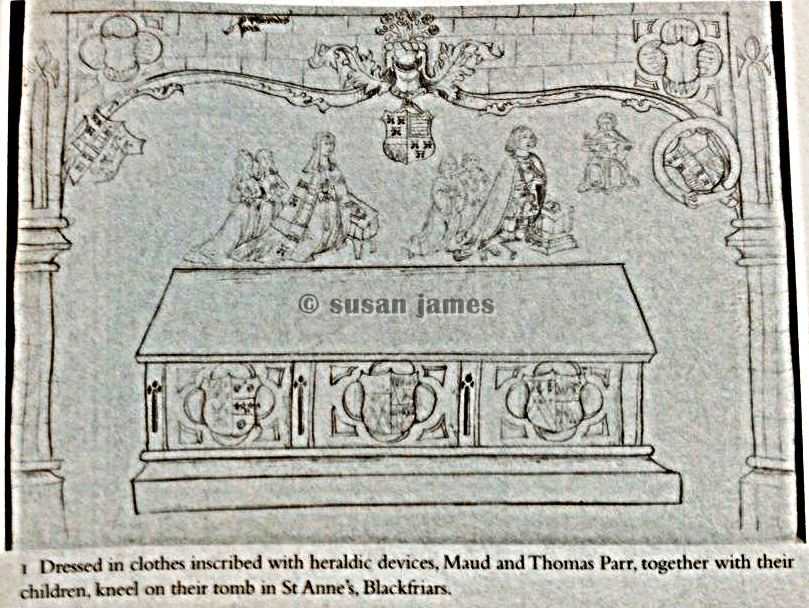
Drawing of the Parr tomb at St. Anne’s, Blackfriars, London which was destroyed. Dressed in heraldic robes, Thomas and Maud kneel with their children on the tomb. The presence of the Nevill arms with three labels [children of the 5th Earl, eldest son and heir, and Countess of Salisbury, sole heiress] is stressed several times. Also notice the addition of another son kneeling by Thomas. Maud had had a son before the birth of Catherine [b.1512]; he died before the birth of Catherine. © Susan James, biographer of Queen Catherine.

“My body to be buried in the church of the Blackfriars, London. Whereas I have indebted myself for the preferment of my son and heir, William Parr, as well to the king for the marriage of my said son. As to my lord of Essex for the marriage of my lady Bourchier, daughter and heir apparent to the said Earl. Anne, my daughter, Sir William Parr, Knt., my brother, Katherine Borough, my daughter, Thomas Pickering, Esq., my cousin and steward of my house.”
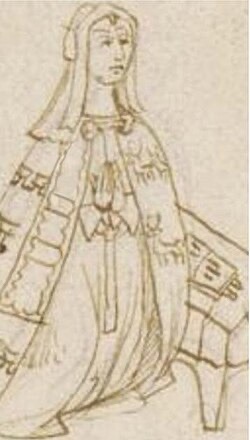
Close up of the Tomb of Sir Thomas Parr and Maud Green (see above)

In her will, dated 20 May 1529, Maud designated that she wanted to be buried Blackfriars where her husband lies if she dies in London, or within twenty miles. Otherwise, she could be buried where her executors think most convenient. Maud left her daughter, Katherine, a jeweled cipher pendant in the shape of an ‘M’. Maud also left Katherine a cross of diamonds with a pendant pearl, a cache of loose pearls, and, ironically, a jeweled portrait of Henry VIII. To her daughter, Anne, she left 400 marks in plate and a third share of her jewels. The whole fortune, Lady Parr had directed, was to be securely chested up ‘in coffers locked with divers locks, whereof every one of them my executors and my … daughter Anne to have every of them a key’. ‘And there’, Lady Parr’s will continued, ‘it to remain till it ought to be delivered unto her’ on her marriage. She also provided 400 marks for the founding of schools and “the marrying of maidens and especial my poor kinswomen”. Cuthbert Tunstall, who was the principal executor of Maud’s will, she left to “my goode Lorde Cuthberd Tunstall, Bisshop of London…a ring with a ruby”. Tunstall had been an executor of her late husband’s will as well. An illegitimate son of Sir Thomas of Thurland Castle, he was a great-nephew of Alice Tunstall, paternal grandmother to Sir Thomas Parr. To her daughter-in-law, Anne, she left substantial amounts of jewelry, “to my lady Bourchier when she lieth with my son” as a bribe to get the marriage consummated. Maud also left a bracelet set with red jacinth to her son, William. She begs him “to wear it for my sake”. Maud was also stated in her will, “I have endetted myself in divers summes for the preferment of my sonne and heire William Parr as well”. For her cousin, Alice Cruse, and Thomas Parr’s niece, Elizabeth Woodhull or Odell, Maud left “at the lest oon hundrythe li”. She wills her “apparrell [to] be made in vestments and other ornaments of the churche” for distribution to three different parish churches which lay close to lands that she controlled. She bequeathed money to the Friars of Northampton. For centuries, historians have confused the first husband of her daughter, Katherine, with his elder grandfather, Edward, the 2nd Baron Borough or Burgh of Gainsborough (d.August 1528). He was declared insane and was never called to Parliament as the 2nd Baron Borough. Some sources mistakenly state she was just a child at the time of her wedding in 1526. Katherine’s actual husband, Sir Edward Borough (d.1533), was the eldest son and heir of the 2nd Baron’s eldest son and heir, Sir Thomas Borough, who would become the 1st Baron Borough under a new writ in December 1529. Katherine and Edward were married in 1529. At the time, Thomas Borough was still only a knight. Maud mentions in her will, Sir Thomas, father of the younger Edward, saying ‘I am indebted to Sir Thomas Borough, knight, for the marriage of my daughter‘. Edward was the eldest son and heir to his father, Sir Thomas, Baron Borough. He would die in 1533. Maud’s will was proved 14 December 1531.

Maud and Thomas had three children to survive infancy.
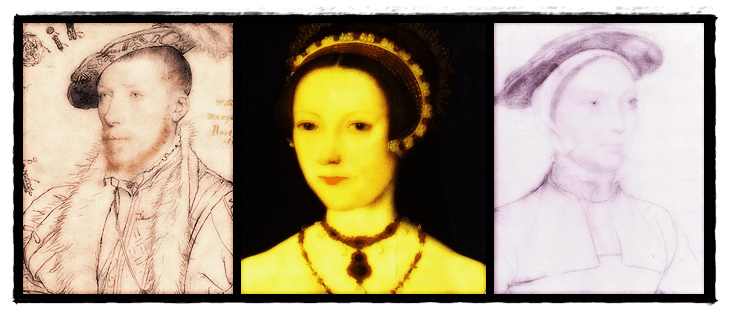
The children who survived…William, Katherine, and Anne.

Katherine or “Kateryn” (1512-1548), later Queen of England and Ireland, would marry four times. In 1529, Katherine married Sir Edward Borough. He died in 1533. In 1534, Katherine became “Lady Latimer” as the wife to a cousin of the family, Sir John Neville, 3rd Baron Latimer (of Snape Castle). He was dead by March 1543. A few months later, on 12 July, Katherine married King Henry VIII at Hampton Court Palace. The king died in January 1547. In May of that year, Katherine secretly wed Sir Thomas Seymour, 1st Baron Seymour (d.1549) of Sudeley Castle, a previous suitor from 1543. Their love letters still survive. By Seymour, Katherine had a daughter, Mary. Katherine died 5 September 1548. Seymour would be executed 20 March 1549 for countless treasonous acts against the crown (his nephew was King Edward VI).

William (1514-1571) married on 9 February 1527, at the chapel of the manor of Stanstead in Essex, to Anne Bourchier, suo jure 7th Baroness Bourchier (d. 26 January 1571), only child and heiress of Henry Bourchier, 2nd Earl of Essex (d.1540). In 1541, she eloped from him, stating that “she would live as she lusted”. Susan James states the next year, Parr secured a legal separation. James also states that on 13 March 1543, a bill was passed in Parliament condemning Anne’s adulterous behavior and declaring any children bastards. Wikipedia states “On 17 April 1543 their marriage was annulled by an Act of Parliament and any of her children “born during esposels between Lord and Lady Parr””(there were none) were declared bastards. The source is G. E. Cokayne, ”The Complete Peerage”, n.s., Vol.IX, p.672, note (b). I have not been able to access The Complete Peerage to confirm. On 31 March 1551, a private bill was passed in Parliament annulling Parr’s marriage to Anne. She predeceased Parr by a few months. William married Elisabeth Brooke (1526-1565), a daughter of George Brooke, 9th Baron Cobham of Cobham Hall in Kent, by his wife Anne Bray. A commission ruled in favour of his divorce from Anne shortly after he married Elizabeth Brooke in 1547, but Somerset punished Parr for his marriage by removing him from the Privy Council and ordering him to leave Elizabeth. The divorce was finally granted in 1551, and his marriage to Elizabeth was made legal. On 31 Mar 1552, a bill passed in Parliament declaring the marriage of Anne Bourchier and Parr null and void. Their marriage was declared invalid in 1553 under Queen Mary and valid again in 1558 under Queen Elizabeth who adored William. Each change of monarch, and religion, changed Elizabeth’s status. She died in 1565. William married Helena Snakenborg in May 1571 in Elizabeth’s presence in the queen’s closet at Whitehall Palace with pomp and circumstance. Parr would die 28 October 1571.

Anne (1515-1552) who married Sir William Herbert, 1st Earl of Pembroke in 1538. They had three children: Henry, Edward, and Anne. They are ancestors to the current Earl of Pembroke and Montgomery, Earl of Carnarvon, Earl of Powis, Marquess of Abergavenny, and other nobility.

Notes

Porter, James, and Mueller state Thomas Parr was born in 1478. However, in James’s biography of Katherine, she states he was 37 at the time of his marriage to Maud Green in 1508. So that would be about 1471, right?

References

Susan James. “Catherine Parr: Henry VIII’s Last Love”, 2010. Google eBook (preview)

Susan James. Women’s Voices in Tudor Wills, 1485–1603: Authority, Influence and Material Culture, 2016. Google eBook (preview)

Meg McGath. “Childbearing: Queen Katherine of Aragon and Lady Maud Parr”, 2012.

Katherine Parr: Complete Works and Correspondence, ed. Janel Mueller, 2011. Google eBook (preview)

Sir Nicholas Nicolas. Testamenta Vetusta: being illustrations from wills, of manners, customs, … as well as of the descents and possessions of many distinguished families. From the Reign of Henry II. to the accession of Queen Elizabeth, Volume 2, 1826. Google eBook

Elizabeth Norton. “Catherine Parr
Wife, Widow, Mother, Survivor, the Story of the Last Queen of Henry VIII
”, 2010. Google eBook (preview)

Linda Porter. Katherine the Queen: The Remarkable Life of Katherine Parr, the Last Wife of Henry VIII (New York: St. Martin’s Griffin Publishing, 2010)

Douglas Richardson. Magna Carta Ancestry: A Study in Colonial and Medieval Families, 2nd Edition, 2011. Google eBook (preview)

Gareth Russell. Young and Damned and Fair: The Life of Catherine Howard, Fifth Wife of King Henry VIII, 2017. Pg 215. Google eBook (preview)

Agnes Strickland. Lives of the Queens of England, from the Norman Conquest With Anecdotes of Their Courts, Volumes 4-5, 1860. Pg 16. Google eBook

Tudor and Stuart Consorts: Power, Influence, and Dynasty, ed. Aidan Norrie, Carolyn Harris, Danna R. Messer, Elena Woodacre, J. L. Laynesmith, 2022. Google eBook (preview)

The Antiquary: A Magazine Devoted to the Study of the Past, volume 24, 1891. Google eBook

The Reliquary, Volume 21, 1881. Google eBook

Ladies-in-Waiting: Lucy, Lady Latimer

Lucy Somerset Lady Latimer

Effigy of Lucy (née Somerset), Lady Latimer in Hackney Parish Church by Unknown artist, hand-coloured etching, early 19th century, 8 3/8 in. x 5 1/4 in. (212 mm x 132 mm) paper size. Purchased with help from the Friends of the National Libraries and the Pilgrim Trust, 1966 Reference Collection NPG D43022

Lady Lucy Somerset, Baroness Latimer (c.1524 – 23 February 1583) was an English noblewoman and the daughter of Henry Somerset, 2nd Earl of Worcester and his second wife, Elizabeth Browne.

By her mother, Lucy descended from the brother of “Warwick, the Kingmaker” (Richard Neville, Earl of Warwick), John Neville, 1st Marquess of Montagu. The Marquess was also brother to Lady Alice FitHugh (born Neville); great-grandmother of Queen Katherine Parr. Warwick and Montagu were casualties of the War of the Roses. Montagu’s surviving children included Lucy’s grandmother, also named Lucy. Lucy married Sir Anthony Browne and they were parents to Lady Elizabeth Somerset, who became Countess of Worcester upon her marriage to Sir Henry Somerset, Earl of Worcester. Lady Worcester’s sister, Anne, married to Charles Brandon, later Duke of Suffolk, in 1508. As such, the Countess was aunt to Ladies Anne and Mary Brandon. Lady Worcester became a lady-in-waiting to Queen Anne Boleyn, the second wife of King Henry VIII. However, Lady Worcester was an informant against the Queen when she was tried in 1536. Queen Anne was tragically sentenced to death and was executed shortly after.

Lucy Somerset may have served as a Maid of Honour to Queen consort Catherine Howard. Queen Catherine was the other ill fated wife of King Henry VIII. After Catherine was found to have had liaisons with other men before and possibly during her marriage to the King, she was also beheaded like her cousin, Queen Anne. Interesting fact: The holder of Catherine’s jewels after her execution would become the next sister-in-law to King Henry–Lady Herbert, lady-in-waiting to Queen Catherine Howard.

Lady Lucy married in 1545 to John Neville, 4th Baron Latimer, the stepson of King Henry’s sixth consort, Katherine Parr. As a teenager, John had proved to be a confident sulking, lying, and over-sensitive boy. His father, the 3rd Baron, did not name him as heir to his properties and made sure that his son could not meddle with his inheritance or the Baron’s legacy. In the 3rd Latimer’s will, Katherine Parr was named guardian of his daughter and was put in charge of his affairs which were to be given over to his daughter at the age of her majority. Despite the turbulance of the 4th Baron’s youth, Katherine Parr kept her stepchildren close, especially the Baron’s sister, Margaret. As Queen, Katherine made the new Lady Latimer a lady-in-waiting. Parr and the new Lady Latimer also happened to be cousins as their great-grandparents were siblings.[1]

Unfortunately, the 4th Baron became an emotionally unstable man later in life. The imbalance must have made it difficult for Lady Latimer. In the summer of 1553, John was sent to Fleet Prison on charges of violence done to a servant. He was arrested for attempted rape and assault in 1557 and in 1563, he killed a man. Of the situation in 1553, Thomas Edwards wrote to the Earl of Rutland describing the violence which had taken place with the servant quoting “too great a villainy for a noble man, my thought.”[1]

The couple had four daughters who all married quite well.

  • Hon. Elizabeth Neville (c. 1545 – 1630), married firstly Sir John Danvers of Dauntsey, and secondly Sir Edmund Carey, a cousin to Queen Elizabeth I. Her children include Sir Charles Danvers, who was executed for his part in the Essex Rebellion in 1601.  Elizabeth’s descendants by John Danvers included the Dukes of Leeds [extinct in 1964]; the Earls of Lichfield; and the Earls of Leicester of Holkham from which Sarah, Duchess of York (mother of Princess Beatrice and Eugenie of York) descends.

Elizabeth Neville Danvers

Monument to Lady Elizabeth Carey (1545/50–1630), also known as Elizabeth Danvers, née Neville) in St Michael’s parish church, Church Stowe, Northamptonshire, England. The stonework is by Nicholas Stone, master mason to James I (and then Charles I). It was put up during the subject’s lifetime (1620). It is said to be ‘one of the finest pieces of sculpture of the age’. (Wikipedia)

  • Hon. Katherine Neville (1546 – 28 October 1596), married firstly Henry Percy, 8th Earl of Northumberland, and secondly Francis Fitton of Binfield. Lord and Lady Northumberland were parents to Sir Henry, 9th Earl of Northumberland. Her descendants include Lady Diana Spencer, Princess of Wales; HM Queen Elizabeth II by her mother; Sarah, Duchess of York; and others. Katherine was buried in the Chapel of St. Nicholas in Westminster Abbey, within the Percy family, Dukes of Northumberland.
  • Hon. Dorothy Neville (1547 – 23 March 1609), married Sir Thomas Cecil, Queen Elizabeth’s counselor, later Earl of Exeter. Cecil was the half-brother of the Earl of Salisbury. Her descendants also include Lady Diana Spencer, the late Princess of Wales (mother of the future King William and the Duke of Sussex).

Dorothy Neville, Countess of Exeter

The Hon. Dorothy Neville who became Countess of Exeter when her husband Thomas Cecil was elevated to Earl in 1605

  • Hon. Lucy Neville (c. 1549 – April 1608), married Sir William Cornwallis of Brome Hall. Their daughters made advantageous marriages to nobility such as the marriage of their daughter Anne to the 7th Earl of Argyll by whom she had issue. Another daughter, Elizabeth, became Viscountess Lumley as the wife of Sir Richard, 1st Viscount Lumley.

Lord Latimer died in 1577. He was buried in St. Michael’s Church, Well, North Yorkshire which adjoined Neville’s home, Snape Castle. The church had a long standing history with the Neville family going back to John, Lucy, and Queen Katherine Parr’s ancestor, Sir Ralph Neville, the 1st Earl of Westmorland. Westmorland who married Lady Joan Beaufort; the only daughter of Prince John of Gaunt, 1st Duke of Lancaster by his mistress, later wife, Katherine Roet Swynford. Ralph Neville was responsible for the building of the present church c. 1330. The 4th Lord Latimer’s mural monument lies in Nevilles’ Chapel within Well’s Church. Latimer’s daughter, Dorothy, Countess of Exeter inherited Snape Castle and is also buried there with her husband Thomas Cecil, 1st Earl of Exeter.[4] According to a card placed upon the tomb of the 4th Baron, the four coat of arms on his tomb represent that of his four daughters and their husband.

The Latimers died without sons and their four daughters became joint heiresses. The barony became abeyant until 1913, when its abeyance was terminated in favour of the 4th Baron Latimer’s descendant Francis Money-Coutts, who became the 5th Baron Latymer.

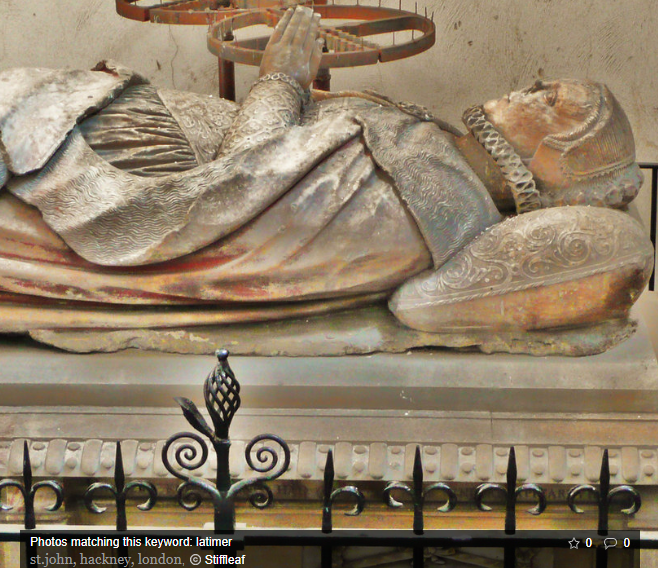
Tomb of Lucy, Lady Latimer

Document on the magnificent tomb of Lady Lucy Somerset, Lady Latimer; wife of the 4th Lord Latimer and lady to HM Queen Katherine Parr.

Lady Latimer died on 23 February 1583. She was buried away from her husband in Hackney Parish Church in London. Her grand tomb has her effigy surrounded by her four daughter’s coats of arms.[2] Her tomb is one of only a few in England which feature such noble bearings; the other being the tomb of George Clifford, Earl of Cumberland at Skipton which is surrounded by no fewer than seventeen richly adorned shields which include that of Brandon, Dacre, de Clare, St. John, and more.[3] The Earl himself was a descendant of Queen Katherine Parr’s great-aunt, Mabel Parr, Lady Dacre. Lady Latimer’s tomb not only includes the arms many of those on Clifford’s tomb as Neville, Beauchamp, Dacre, Berkeley, and Percy but also those of de Vere Earl of Oxford, Walcot, and Cecil.[2] Lord Latimer’s arms (the Neville) are at one end of the tomb. The statues of the four daughters were two on each side of the monument; at the side of each the shield of the husband impaling the Neville arms. These arms are thus repeated five times. At the other end are Lady Latimer’s arms: the lions and fleur de lis that is France and England, quarterly, the arms of Beaufort, as she descended from the eldest legitimated son of John of Gaunt, Duke of Lancaster; John Beaufort, 1st Earl of Somerset as well as his sister, Lady Joan, Countess of Westmorland.[2]

lucy somerset neville

Tomb of Lucy, Lady Latimer in St. John Church, Hackney, London, UK. Photo Credit: Here.

In Robinson’s History of Hackney we find:

“The effigy of Lady Latimer was exquisitely sculptured and was fixed on the top of the table monument She appears to be dressed in a scarlet robe with a coronet on her head and the other part of the dress was richly gilt This effigy was probably intended for a portrait of her.”

Her epitaph reads:

Such as she, is such surely shall yee bee; Such as shee was, such if yee bee, be glad: Faire in her youth though fatt in age she grew; Virtuous in bothe whose glosse did never fade. Though long alone she ledd a widowe’s life, Yet never ladye live da truer wife. From Wales she sprang, a Branch of Worcester’s race, Grafte in a stock of Brownes her mother’s side: In Court she helde a maide of honor’s place, Whilst youth in her, and she in Court did byde. To John, Lord Latimer, then became she wife; Four daughters had they breathing yet in life. Earl of Northumberland tooke the first to wife; The nexte the heire of Baron Burleigh chose: Cornwallis happ the third for terme of life: And Sir John Danvers pluckt the youngest Rose. Their father’s heirs, them mothers all she sawe: Pray for, or praise her: make your list the Lawe, Made by Sir William Cornwallis, Knight, this Ladye’s Sonne in Lawe.[2]

Links

Sources

  1. Susan E. James. Catherine Parr, Henry VIII’s Last Love. The History Press, 2009.
  2. Richard Simpson. Some Accounts of the Monuments in Hackney Church, Billing and Sons, 1881; Chapter: Lady Latimer.
  3. W. Harbutt Dawson. History of Skipton, Simpkin, Marshall, London, 1882.
  4. History: Village of Well, North Yorkshire. http://www.wellvillage.org.uk/history/


copyright_meg_tudorqueen

10 JULY 1543: Archbishop Cranmer’s License for the Marriage of Henry & Kateryn

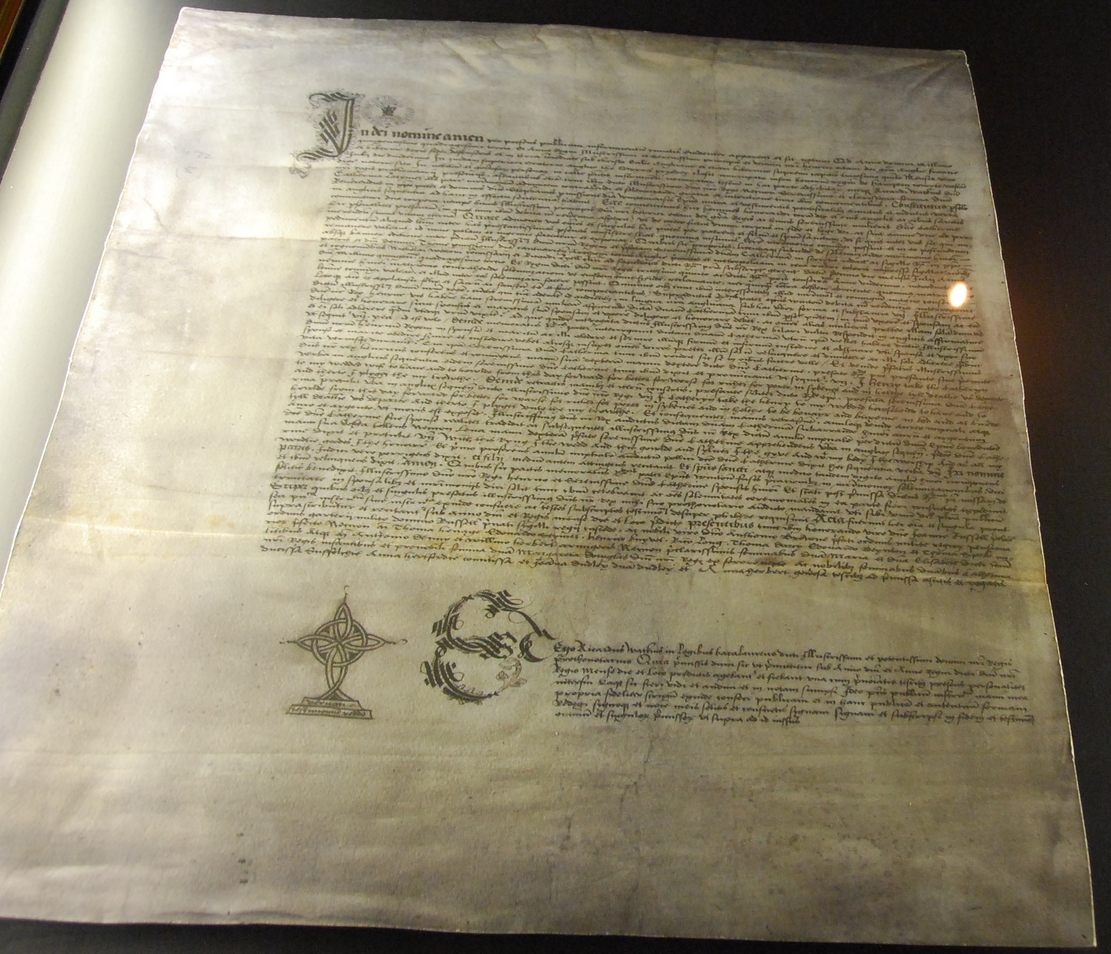
Marriage Certificate

The actual Marriage Certificate of King Henry VIII and Kateryn Parr. The certificate was on display in 2012 at Hampton Court Palace where they were married on 12 July 1543.

ARCHBISHOP THOMAS CRANMER’S LICENSE FOR THE MARRIAGE OF KING HENRY VIII AND KATHERINE PARR LATIMER, INCLUDING DISPENSATION OF THE REQUIRED PROCLAMATION OF BANNS, JULY, 10, 1543

To the most excellent and most invincible prince on a throne, and our supreme lord Henry VIII, by the Grace of God King of England, France, and Ireland, Defender of the Faith, and on earth Supreme Head, under Christ, of the Churches of England and Ireland: Thomas, by divine compassion Archbishop of Canterbury, Primate of all England, and Metropolitan, dully and lawfully invested therein by the subscribed authority of the Parliament of England:

Health and perpetual happiness, with honor.

Since by your most excellent royal majesty it has been considered worthy to lead into matrimony the noble and distinguished woman Lady Katherine Latimer, lately the wife of the distinguished and powerful man, Lord Latimer, during his natural life, now deceased, she being favored by the most good and most great God and by your initiatives:

Therefore, that marriage between your most excellent kingly majesty and the said noblewoman, Lady Katherine, in whatever Church, chapel, or oratory or wherever else your kingly majesty may wish to choose, without any proclamation of banns, may be solemnized by any bishop or priest whatsoever; and that you may exempt from actual constraints,

We and our soul, moved in this regard duly and legitimately by the honor of your estate and concerned for the benefit of the whole realm of England, with the authority established by these presents, do dispense with constitutions and ordinances propounded to the contrary, nothing whatsoever standing in the way.

Given at our manor of Lambeth, under our seal for enactments, the tenth day of the month of July, the year of our Lord one thousand five hundred forty-three; and of your majesty’s most happy and most illustrious reign, the thirty-fifth; and of our consecration, the eleventh year.

[Witnessed by]

Nicholas Wotton, Comissioner

Richard Lyell, Clerk for enactments by the said very Reverend [Lord Archbishop]

Source: Kew, Surrey: The National Archives, E 30/1472(6). A formulaic Latin writ in the engrossing hand of Richard Lyell, Cranmer’s clerk for enactments, sealed with the archbishop’s outsized seal.

  • From Katherine Parr: Complete Works & Correspondences, edited by Janel Mueller.

Which Queen Katherine: The Lambeth Portrait

It has been identified as Queen Katherine Parr for centuries. Thanks to modern technology used to examine the portrait by the NPG in London, it has been concluded that the portrait is indeed that of wife no.1, Queen Katherine of Aragon.

Disputed Lambeth Palace portrait; Katherine Parr or Katherine of Aragon

Lambeth Palace portrait; now identified as Queen Katherine of Aragon, wife no. 1

The young woman in the picture is blessed with good features, an oval-shaped face with a firm jawline and a clear complexion. But it is the overall impression of intelligence and intensity that is so compelling. There is an inner strength in the face that commands attention. The woman looks confident. This is a woman full of grace and maturity. The portrait is carefully composed. She is very much the aristocratic lady, expensively dressed and already demonstrating a love of jewels and fashion that would develop over the years. Her clothing is red and gold, with the hood perfectly matching the gown. At the period of time the portrait was painted the Telegraph quotes,

Academics working on the ‘Making Art in Tudor Britain’ project had noticed the facial features and costume worn by the woman were far more similar to works depicting the first Catherine, and dated from the 1520s or 30s. (Furness)

The 1520s — Katherine’s mother was still negotiating for a marriage. In 1529, she was married to Sir Edward Borough, son of Sir Thomas, 3rd Baron Borough of Gainsborough (Lord Chamberlain to Queen Anne Boleyn). The status wouldn’t have made her that important enough to paint. However, the 3rd Barons wife, Agnes Tyrwhitt had her portrait done by Holbein. Sir Thomas, however, had to pull his connections just to get his wife, Lady Borough, painted by Holbein. (Porter pg 55) By 1533, Katherine was a widow. Her next marriage to Lord Latimer took place in 1534 and it lasted until 1543. The hood was most likely outdated by the 1530s, but Katherine had not been living at court so perhaps she did not know the current fashions. Her home from 1529-1534 was spent in the Northern part of England; Lincolnshire. After her marriage to Sir John Neville, 3rd Lord Latimer her home was Snape Castle, in North Yorkshire. Her mother and sister would have been at court. Her mother served Katherine of Aragon until her household was dissolved. Her sister, Anne, would continue to serve under Queen Anne Boleyn. The two sisters were close so perhaps Anne wrote about the current fashions at court; Katherine was to become a fashionable queen so her interest must have developed early on. Therefore it is contradictory as to what Katherine actually wore.

Lambeth Portrait of Katherine of Aragon.

Lambeth Portrait of Katherine of Aragon.

Interestingly, although the gown has fashionable slashed undersleeves and a gauzy partlet, covering the throat and chest, the coifed gable hood that the woman is wearing was a more conservative choice. Anne Boleyn supposedly made the French hood popular, but the hood had been introduced to England well before she returned from France in 1522. The French hood showed more hair, so therefore in some circles it was still considered unseemly. Jane Seymour favoured the gabled hood, though this may have been less a personal preference than a conscious decision to differentiate herself from her more flighty, disgraced predecessor. (Porter)

In Katherine Parr’s case, she had married a man whose overall outlook was conservative and it is possible that her head-wear reflected his taste. Her jewels, three ropes of pearls and a large, round gold, pearl and ruby brooch, are also a sign of wealth without ostentation. In this portrait, Katherine is very much the elegant nobleman’s wife. (Porter on the portrait being Katherine as Lady Latimer)

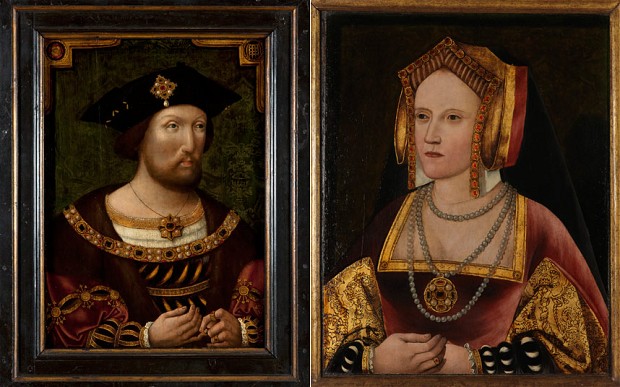
The two paintings will now be hung together for the first time in the National Portrait Gallery, nearly 500 years after they were painted Photo: National Portrait Gallery

The two paintings will now be hung together for the first time in the National Portrait Gallery, nearly 500 years after they were painted. Photo: National Portrait Gallery

Technical analysis of the paint and “rare” engraved frame by the NPG (National Portrait Gallery in London) are believed to show it was painted at the same time as a portrait of Henry VIII, with a similar style and scale. (Furness) (See above)

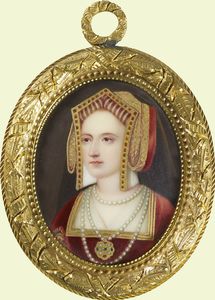
However, there is still more than a few portraits with Henry and his other wives that still use this depiction as Katherine Parr. For example, the only miniature in the Royal Collection (from Queen Victoria’s miniature collection) that depicts Queen Katherine Parr is this same depiction. Hopefully they will not change the description now as there is no other depiction of Parr and all six wives are represented.

Katherine Parr or Katherine of Aragon

‘Portrait of a lady called Katherine Parr’, by Henry Pierce Bone, 1844. Enamel; 4.8 x 3.9cm.The miniature was purchased by Queen Victoria in 1844, to add to her growing collection of portraits of sixteenth-century figures. It is still part of the Royal Collection.
The Earliest Portrait of Katherine Parr or Katherine of Aragon?

On the back of the portrait is the following inscription:

‘Katharine Parr / London Febr 1844 / Painted by Henry Pier. / Bone Enamel Painter / to Her Majesty & H.R.H. / Prince Albert &c. From / the Original in / Lambeth Palace.’

Detail of the Miniature.

Detail of the Miniature.

In early 2011, after inquiring about the portrait, I was told (by email from the Lambeth Palace Library) that this had been re-identified as Katherine of Aragon. Lambeth Palace’s site had this image as Katherine Parr; the image was uploaded in 2008. The re-identification took place in 2009, but was not officially announced or re-identified until recently.

The portrait you are inquiring about used to be referred to as the “Unknown Woman” thought to be Katherine Parr.  However, in 2009 we had the National Portrait Gallery here to look at another painting in our possession.  As we walked by the portrait a period costume expert, who so happened to be among them, took great notice in it and declared that the clothes were far too early to be Katherine Parr.  The National Portrait Gallery took it away with them to research further.  The conclusion was that it was in fact a rare survival of a Tudor portrait of Catherine of Aragon, not Katherine Parr as originally thought.  You can imagine it was rather exciting for all concerned.

Obviously they had not made the announcement official until now — due to years of research at the NPG. But as of 24 January 2013, this is now identified as Queen Katherine of Aragon. For details on the examination process and the conservation of the portrait — see links.

Links

References

Katherine Parr: Lady Latimer of Snape Castle

Lady Latimer

Katherine’s arms as Lady Latimer from her tomb at Sudeley Castle ©Meg McGath

In the year of 1533, Katherine is thought to have spent her widowhood with her cousins, the Strickland family at Sizergh Castle in Westmorland (now Cumbria). In the summer of 1534 she married John Neville, 3rd Baron Latymer, of Snape, North Yorkshire. At age 40, Lord Latimer was twice Katherine’s age. Latimer was her father’s second cousin, a twice-widowed descendant of George Neville, 1st Baron Latimer; Warwick, the ‘Kingmaker’s’, ‘idiot uncle’ and a 2nd great-grand uncle to Katherine [The Kingmaker’s sister, Lady Alice, was Katherine’s paternal great-grandmother]. From his first marriage to Dorothy de Vere, sister of John de Vere, 14th Earl of Oxford [m. by 1520], he had two children, his son and heir John and Margaret. After the death of his first wife on 7 February 1527, Neville remarried to Elizabeth Musgrave, daughter of Sir Edward Musgrave, c. 20 June 1528. They had no children and Neville was widowed again in 1530.[3] Neville was one of fifteen children born to Richard Neville, 2nd Lord Latimer and Anne Stafford, daughter of Sir Humphrey Stafford. Latimer’s branch of the Neville family was in line for the title of Earl of Warwick [via his great-grandmother, Lady Elizabeth Beauchamp, daughter of the 13th Earl of Warwick] and because of this, Lord Latimer, dealt with quite a bit of sibling rivalry. Legal actions were taken by his younger brothers and Latimer, at the time of his marriage to Katherine, was having financial difficulties. But as Lady Latimer, Katherine now had a home of her own, a husband with a position and influence in the north, a ready-made family, and a title. Katherine would become the only female Parr, apart from her great-aunt, Mabel, to marry into the peerage. Katherine’s brother-in-law, William Herbert, would later become Earl of Pembroke during the reign of Edward VI promoting her sister from Lady Herbert to Countess of Pembroke from which the current Earls and other branches descend from. From the beginning of the marriage, Katherine tried to be a good wife. Her affection for her husband would grow deep enough to cherish a remembrance of him, his New Testament with his name inscribed inside, which she kept until her death. Katherine would also prove to be a good step-mother to her step-children; a trait which she would again show after her marriage to the King. Her “teenage” step-son, John, proved to be difficult. There is some indication that Margaret, his sister, was their father’s favorite. Never the less, Katherine would continue a relationship with the two after her marriage to King Henry, bringing Margaret to court as her maid-in-waiting and securing a position for John’s wife, Lucy, the new Lady Latimer in her household.[1]

Latimer was a supporter of the old religion and bitterly opposed the king’s divorce and remarriage and it’s religious ramifications. In 1536, within two weeks of the riot in Louth, a mob appeared before the Latimer’s home threatening violence if Lord Latimer did not join their cause. Katherine watched as her husband was dragged away by the rebels. As prisoner of the rebels, conflicting stories of which side Latimer was truly on began to reach Cromwell and the King in London. The rebellion in Yorkshire put him in a terrible dilemma. If he was found guilty of any kind of treason his estates would be forfeited leaving Katherine and her step-children penniless. The King himself, wrote to the Duke of Norfolk pressing him to make sure Latimer would ‘condemn that villain Aske and submit [himself] to our clemency’.[2] Latimer was more than happy to comply. Both Katherine’s brother, William Parr and uncle, William Parr, 1st Baron Parr of Horton fought with the Duke of Norfolk and the Duke of Suffolk against the rebellion. It is to most likely to Katherine’s credit that Lord Latimer survived; both her brother and uncle probably intervened at one point and saved Lord Latimer’s life.[1]

From the months of October 1536 and April 1537 Lady Latimer lived alone in fear with her step-children, struggling to survive. It is probable that in these uncertain times that Katherine’s strong reaction against the rebellion strengthened her adherence to the reformed church. In January 1537, Katherine and her step-children were held hostage at Snape Castle during the uprising of the North. The rebels ransacked the house and sent word to Lord Latimer, who was returning from London, that if he did not return immediately they would kill his family. When Lord Latimer returned to the castle he somehow talked the rebels into releasing his family and leaving, but the aftermath to follow with Lord Latimer would prove to be taxing on the whole family.[1]

The family would later move south after the executions of the rebels which pleased Cromwell and the King. Although now charges were found, Latimer’s reputation which reflected upon Katherine, was tarnished for the rest of his life. He spent the last seven years of his life blackmailed by Cromwell. Katherine would spend much of her time in the south during the years of 1537-42. Her husband was called away frequently to do the biding of Cromwell and the King and be present during Parliament. With Cromwell’s fall in 1540, the Latimer’s reclaimed some dignity and as Lord Latimer attended Parliament in 1542 he and Katherine spent time in London that winter. Her brother, William and sister, Anne had been present at court. Anne entered court service in 1531 as maid-in-waiting to Henry’s queens. It was here that she made acquaintances and met her future fourth husband Sir Thomas Seymour. The atmosphere of the court was much different from the rural and parochial estates. It was at court that Katherine could find the latest trends, not only in religious matters, but in frivolous matters such as fashion and jewellery which she loved.[1]

By the winter of 1542, Lord Latimer’s health had broken down after a grueling life of what some would call ‘political madness’. Katherine spent the winter of 1542-1543 nursing her husband. John Neville, Lord Latimer, died in 1543. In Lord Latimer’s will, Katherine was named guardian of his daughter, Margaret, and was put in charge of Lord Latimer’s affairs which were to be given over to his daughter at the age of her majority. Latimer left Katherine Stowe Manor and other properties. He also bequeathed money for supporting his daughter and in the case that his daughter did not marry within five years, Katherine, was to take £30 per annum out of the income to support her step-daughter. Katherine was left a rich widow faced with the possibility of having to return north after Lord Latimer’s death.[1]

Using her late mother’s relationship with Henry’s first queen Katherine of Aragon, Katherine took the opportunity to renew her friendship with Lady Mary. By 16 February 1543, Katherine had established herself with Mary and was now part of her household although this has been disputed.

This slideshow requires JavaScript.

References:

  1. Susan E. James. Catherine Parr: Henry VIII’s Last Love. The History Press, 2009 US Edition. pg 61-73.
  2. Letters and Papers, Foreign & Domestic of the Reign of Henry VIII, II, no. 1174.
  3. The History of Parliament: the House of Commons 1509-1558, ed. S.T. Bindoff, 1982. ‘NEVILLE, Sir John I (1493-1543), of Snape, Yorks.

© Meg McGath

2 April 2011

King Henry VIII: the account of marriage to wife no. 6 to Kateryn Parr

Letters and Papers, Foreign and Domestic, Henry VIII, Volume 18 Part 1: January-July 1543

The wedding of Henry and Kateryn, Dowager Baroness Latimer as recorded
Written by Meghan McGath

Notarial instrument witnessing that, on 12 July 1543, 35 Hen. VIII., in an upper oratory called “the Quynes Pryevey closet” within the honor of Hampton Court, Westm. dioc., in presence of the noble and gentle persons named at the foot of this instrument and of me, Ric. Watkins, the King’s prothonotary, the King and lady Katharine Latymer alias Parr being met there for the purpose of solemnising matrimony between them, Stephen bp. of Winchester proclaimed in English (speech given in Latin) that they were met to join in marriage the said King and Lady Katharine, and if anyone knew any impediment thereto he should declare it. The licence for the marriage without publication of banns, sealed by Thos. abp. of Canterbury and dated 10 July 1543, being then brought in, and none opposing but all applauding the marriage, the said bp. of Winchester put the questions (recited) to which the King, hilari vultu, replied “Yea” and the lady Katharine also replied that it was her wish; and then the King taking her right hand, repeated after the Bishop the words, “I, Henry, take thee, Katharine, to my wedded wife, to have and to hold from this day forward, for better for worse, for richer for poorer, in sickness and in health, till death us depart, and thereto I plight thee my troth.” Then, releasing and again clasping hands, the lady Katharine likewise said “I, Katharine, take thee Henry to my wedded husband, to have and to hold from this day forward, for better for worse, for richer for poorer, in sickness and in health, to be bonayr and buxome in bed and at board, till death us depart, and thereto I plight unto thee my troth.” The putting on of the wedding ring and proffer of gold and silver (described) followed; and the Bishop, after prayer, pronounced a benediction. The King then commanded the prothonotary to make a public instrument of the premises. Present : John lord Russell, K.G., keeper of the Privy Seal, Sir Ant. Browne, K.G., captain of the King’s pensioners, and Thos. Henage, Edw. Seymer, Hen. Knyvet, Ric. Long, Thos. Darcy, Edw. Beynton, and Thos. Speke, knights, and Ant. Denny and Wm. Herbert, esquires, also the ladies Mary and Elizabeth the King’s children, Margaret Douglas his niece, Katharine duchess of Suffolk, Anne countess of Hertford, and Joan lady Dudley, and Anne Herbert.
Notarial attestation by Ric. Watkins, Ll. B., King’s prothonotary.
Large parchment.

The marriage of Henry VIII and Kateryn Parr ©Meghan McGath (2009)
Source: 

James Gairdner and R. H. Brodie (editors). “Henry VIII: July 1543, 11-15.” Letters and Papers, Foreign and Domestic, Henry VIII, Volume 18 Part 1: January-July 1543 (1901): 480-489. British History Online. Web. 10 January 2012. <http://www.british-history.ac.uk/report.aspx?compid=76754&strquery=queen+catherine&gt;