Problems with Identification: Tudor Portraits

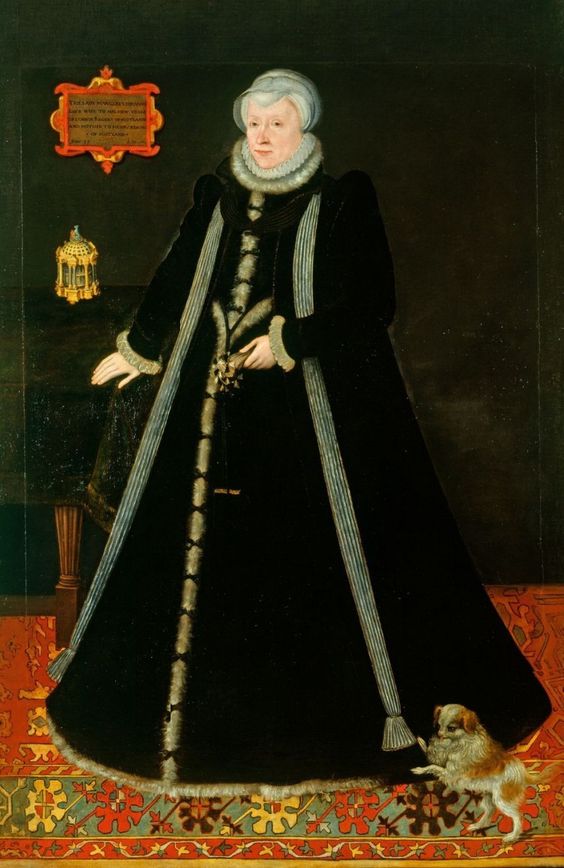
Portrait of an Unknown Lady c.1565-8 by Hans Eworth active 1540-1573

Portrait of an Unknown Lady c.1565-8 by Hans Eworth (1540-1573), Tate Gallery, London, United Kingdom

There is a yet another discrepancy as to who the sitter is in another Hans Eworth portrait from the Tudor era. This time around, the actual sitter is, in fact, unknown. The proposed sitter of the painting was (and still is often) Lady Eleanor Clifford. Wikipedia has the portrait as Lady Eleanor’s main portrait. However, there has been a nod to perhaps the sitter being Eleanor’s daughter, Lady Margaret Clifford. As to who is really is–we’re not sure, so let’s study the background of each woman.

Lady Clifford was born Lady Eleanor Brandon in 1519 – 27 September 1547) She was the second daughter of Sir Charles Brandon, Duke of Suffolk and his wife the former Princess Mary, Queen of France. Her mother was the younger sister of King Henry VIII; making Eleanor a grandchild of King Henry VII and Elizabeth of York. In March 1533, a marriage contract was written up for Lady Eleanor and Lord Henry Clifford, the eldest son and heir of Henry Clifford, 1st Earl of Cumberland by Lady Margaret Percy.[2] However, since her mother died nine months later, she waited to go and live with her young husband and in-laws. Eleanor officially married Lord Clifford at Brandon house, Bridewell, in 1537; her uncle King Henry VIII was present.[3][4][5][6] 

Lady Clifford served several of her uncle’s queens. In 1536, she was Chief Mourner to Queen Katherine of Aragon; the deposed wife Henry put aside for his second, Anne Boleyn.

Lady Eleanor and her husband had one surviving child, Lady Margaret, who was born in 1540. Eleanor died on 27 September 1547, nine months after her uncle Henry VIII. At the time of her death, her cousin Edward VI was King.

Lady Margaret Clifford would have been born in the process of King Henry VIII’s wife swaps. In 1540, Katherine Howard was consort. A short lived marriage that put Katherine on the chopping block dissolved and Henry was single again. In 1543, the King would marry for the 6th and final time to the widowed Lady Latimer (born Katherine Parr). Queen Katherine had a sturdy circle of religious women around her at all times. In her list of ladies-in-waiting, we see that both Lady Cumberland (mother to Margaret) and the Duchess of Suffolk (Lady Frances Brandon; aunt to Margaret) are listed. Margaret would have only been three when her granduncle married Katherine Parr.

The scandal of Lady Jane Grey hit Lady Margaret’s immediate family hard. Her cousin, Jane was in line to the throne after King Edward VI and his two sisters; Ladies Mary and Elizabeth. King Edward saw fit to bypass his sisters in his will and give his cousin Lady Jane the crown. Jane was the daughter of Lady Frances Brandon, Duchess of Suffolk. As such, Jane was the niece of Lady Eleanor Clifford; mother of Lady Margaret. The scandal was quickly suppressed and the will of Henry VIII (Edward’s father) was upheld. Lady Mary Tudor came to court to denounce her cousin Jane. The will of Henry VIII held more sway over Edward’s. Also, the blood descendants of King Henry VIII were preferred over the descendants of his father, Henry VII. There were two still living. Mary claimed her right to the throne and Jane was disposed. Jane, her father, her husband, and a few others were implicated and eventually executed under the new queen. As for Lady Margaret? She joined the court of Queen Mary. Queen Mary consented to the marriage of Lady Margaret to the heir of the Earldom of Derby and the two were married at Westminster Palace on February 12, 1555.

In 1557, Lady Margaret started to cause somewhat of a ruckus by claiming a superior succession to the crown than her cousins, Lady Catherine Grey and Lady Mary Grey. Margaret stated that because her cousin Jane had been tainted, tried, and executed, the whole line of the Grey family should be barred from the succession.

The death of Queen Mary set Lady Margaret in the attendance of the new Queen, Elizabeth. She held the rank of two of the highest noblewomen in the country along with her cousin, Lady Margaret Douglas (daughter of the eldest sibling of Henry VIII; Queen Margaret of Scots). Lady Margaret Clifford’s status may have been enough for a portrait. Her cousin, Margaret Douglas, certainly got a few.

adbdc68bd823116ac48d57efcf945ffe

Full-length portrait of Lady Margaret Douglas, Countess of Lennox (1515-78), standing with a Griffon at her feet. She is holding gloves in her left hand and resting her right on a table on which stands a clock in the form of a tempietto, the dial surmounted by a hound and a shield with the arms of Scotland. Inscribed: THE LADY MARGARET. HIR GRACE / LATE WIFE TO MATHEW ERLLE / OF LENNOX REGENT OF SCOTLANDE / AND MOTHER TO HENRY KINGE / OF SCOTLAND / Aetatis 55 Aí Dni. 1572.


What We Know About the Portrait

The coat of arms in the top left corner, which may have been added later, are the impaled arms (those of a husband and wife) of Henry Clifford, 2nd Earl of Cumberland, and his wife Lady Eleanor, daughter of Charles Brandon, 1st Duke of Suffolk and Mary Tudor, Dowager Queen of France. As a result the painting has been frequently exhibited in the past as a portrait of Lady Eleanor, regardless of the fact that she died in 1547, well before the date of this portrait [the roman numerals MDLX at the top right = 1560]. It is, however, a rule of heraldry that impaled arms are not used by the children of a marriage, as they would have their own. Hence the later addition and erroneous use of the arms here suggests that the identity of the portrait was already unclear only two or three generations after it was painted, a situation by no means unusual amid the frequent early deaths, multiple marriages, and shifting alliances and fortunes of the most powerful families of the Tudor era. Later the portrait was thought to represent the only child of Eleanor and Henry to survive infancy, Margaret. Unfortunately the inscription on the right which might have provided a check (Margaret would have been aged 25-28 at the time of this portrait) has been truncated; although the Roman numerals of the year can apply only to 1565-8, the age of the sitter cannot be ascertained with any useful accuracy. The National Portrait Gallery has an online sketch of this portrait identified as Lady Eleanor, but the portrait remains in dispute.

Another unfortunate aspect of the portrait is the clothing; the clothing does not match the time period of Lady Eleanor Brandon. The dress is third quarter of the 16th century and is of Spanish influence.

According to Richard Davey. The sisters of Lady Jane Grey and their wicked grandfather, E.P. Dutton and co., 1912:

The Lady Eleanor Brandon was a better looking woman than her sister Frances. When her tomb in Skipton Church was disturbed in the seventeenth century her skeleton which was in perfect condition proved her to have been very tall and large boned whereas the Lady Frances was of medium stature. Lady Eleanor, if we may judge by her portrait, which hangs at Skipton Castle, was pretty rather than beautiful. The writer confesses that the portrait at Skipton did not impress him as that of one who could have put forward the slightest pretensions to good looks; the cheeks are high, the forehead abnormally broad, the eyes however are fine, and the hair fair but the complexion according to this venerable picture must have been quite ghastly. The portrait is very badly painted; a poor thing worth little as a work of art but none the less interesting.

The site for the Tate Gallery concludes that the painting is still unidentified, yet there is an identical sketch on the site for the National Portrait Gallery identified as Lady Eleanor. Who’s who?

Another proposal for the sitter is given as Hon. Margaret Wentworth, daughter of Thomas Wentworth, 1st Baron and his wife Margaret Fortescue. Sir Thomas was a nephew of Queen Jane Seymour’s mother, Margaret Wentworth. Thomas’s daughter, Margaret, married three times; Sir John, Baron Williams of Thame; Sir William Drury; and Sir James Croft. The new identification is given by Dr. Roy Strong based on the comparison to her sister, Jane Wentworth, Lady Cheney [below].

Problems with Identifying Tudor Portraits

npg_4451_Katherine_Parr

Queen Katherine Parr attributed to Master John c. 1544. NPG, London. (c) National Portrait Gallery, London; Supplied by The Public Catalogue Foundation

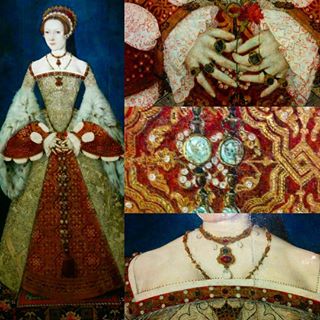
For years Queen Katherine Parr’s many portraits were thought to be Lady Jane Grey; it is just recently that the portrait in the NPG in London (first portrait) was finally changed permanently to Queen Katherine Parr based on the research of the Queen’s inventory of jewels which was recorded in the documents of King Henry VIII. They are also recorded in the back of the recently published book, “Katherine Parr: Works and Correspondences.” Those very same jewels that belonged to the Queens of England were last worn by Queen Katherine Parr. After the death of King Henry, and after Edward Seymour proclaimed himself Lord Protector, the jewels, along with her personal jewels, were put into the Tower for safekeeping. Since Edward VI had no queen the jewels would not have been in use unless Edward’s wife Anne Stanhope got a hold of them; which she was not entitled to. Lady Jane Grey was in the household of Queen Dowager Katherine Parr until her death in 1548, but as stated the queen’s jewels were not accessible to Lady Jane and the portrait which is dated in the early 1540s also proves that the person painted had to have possession of those jewels; and who had possession during that time — only Queen Katherine Parr.

Let’s Talk to an Expert

The portrait at the Tate is certainly not of Eleanor Brandon. The artist of that painting is identified as Hans Eworth, an artist who did not become active in England until after Brandon’s death. Too, the style of the sitter’s costume also quite firmly dates the painting to at least a decade after Brandon’s death.
It seems quite logical that a portrait of Eleanor would have hung at Skipton, since that castle belonged to the family of Eleanor’s husband Henry Clifford, Earl of Cumberland. I do see that Richard Davey claims to have viewed the portrait in situ just prior to World War I. Whether or not his claim is factual is an open question, however. Davey too often simply invented the “facts” presented in his books. His list in Nine Days Queen of portraits of Jane Grey is packed with errors and deliberate falsehoods.
I understand that Skipton is now partially derelict, though it may still have some limited habitable spaces. Have you contacted Skipton Castle directly through their website to ask for any information they may have? That is certainly where I would start. I did check the Getty Research Institute’s Provenance Research Database, but that did not turn up any portraits of Eleanor Brandon Clifford appearing at public auction between 1700 and 1900. But the portrait may have been sold privately. –Dr. Stephan Edwards (Author of A Queen of a New Invention and The Lady Jane Grey Prayer Book)

I have contacted Skipton Castle looking for information. I have yet to receive and email. So for now, as of the end of 2016, the portrait remains unknown.

Sources

  • Lawrence Manley, “From Strange’s Men to Pembroke’s Men: 2 “Henry VI” and “The First Part of the Contention”.”, Shakespeare Quarterly, vol. 54, No. 3 (Autumn, 2003), pp. 253-287.
  • Sir Sidney Lee. Dictionary of national biography, Volume 54, Smith, Elder, & co., 1898. pg 70.Google eBook 
  • Eleanor Clifford (née Brandon), Countess of Cumberland, probably by Alfred Thomas Derby, after Unknown artist, Purchased, 1893, Reference Collection NPG D23066. National Portrait Gallery 
  • The Tate Gallery 1984-86: Illustrated Catalogue of Acquisitions Including Supplement to Catalogue of Acquisitions 1982-84, Tate Gallery, London 1988, pp.66-8. Tate Collections
  • Katherine Parr, attributed to Master John, circa 1545. Purchased with help from the Gulbenkian Foundation, 1965 Primary Collection. Reference Collection NPG 4451

  • Lady Margaret Douglas, Countess of Lennox (1515-78), c.1572, British School, 16th Century, Royal Collection Trust. RCIN 401183
  • Kathy Lynn Emerson Who’s Who in Tudor Women.

Portraits of Queen Katherine: Reason and Logic vs Opinion

NOT_Margaret_Douglas

God love that Pinterest, but did I read that correctly? The woman in the middle is Margaret Douglas? Wasn’t that identified as Queen Katherine Parr in 1965 and then again in 1996? So where does the Margaret Douglas identity come from?

Pinterest, the new online addiction for millennials. Pinterest is a website where you can “pin” photos online to a virtual “board”. I was merely looking for a picture on the web and did an image search. I noticed that several of my articles photos popped up. So, why is this website using my photo? Welcome to Pinterest! The rest is history!

Pinterest can be your best friend or your worst nightmare, depending on who you are. If you’re a historian, like me, it’s a complete mess! Portraits are mislabeled, facts are not true, the link that provided the photo has disappeared yet the photo remains, etc.

Most people catch on and realize that they can indeed change the caption that is mindlessly being re-pinned onto other boards. Yes, when you Pin something, the caption (in this case, the wrong one) doesn’t change unless you manually do it. So…we find portraits from the Tudor era that have been incorrectly identified and re-pinned hundreds of times! Oh, my head!

I have been wanting to write something on Pinterest for a long time; about the relentless misidentified Tudor portraits. Well, this final pin has my full attention.

The pin is right in the middle of the screen cap above. It seems that someone pinned the portrait “Katherine Parr” from a website that identifies the portrait as “Margaret Douglas”. Confused? Me, too!

So I thought I would check out the website and boy did I get more than I bargained for!

kleio_false3

Kleio.org: the website run by Ms. Vogt-Luerssen. This is her page for “Margaret Douglas, Countess of Lennox”. As you can read for yourself, Ms. Vogt-Luerssen insists that the portrait is Margaret Douglas and NOT Katherine Parr. “Margaret Douglas, daughter of the Scottish Queen Margaret Tudor and one of the favourite nieces of the English King Henry VIII., c. 1532 The depicted is NOT Katherine Parr!”

Kleio.org is a personal website run by a woman named Maike Vogt-Luerssen. I was somewhat taken back by what I saw under the portrait. Ms. Vogt-Luerssen insists that the portrait is Lady Margaret Douglas, niece of King Henry VIII, and daughter of Margaret, Queen of Scots. The portrait on her page is dated c.1532. Underneath the caption, Ms. Vogt-Luerssen has written “The depicted is NOT Katherine Parr!”

And to that, I reply “au contraire mon fraire”!!

In an earlier article I did in March of 2013, I studied the portrait that has actually been long associated with Lady Jane Grey; grandniece of King Henry VIII by his other sister Queen Mary of France (Duchess of Suffolk). Surprisingly, through research, I learned that the original portrait came to the Portrait Gallery in 1965 as “Katherine Parr”.

“Most people don’t even realize that the painting came in as “Katherine Parr.” In fact, unless you do thorough research you won’t even know that the portrait was originally at Glendon Hall, the seat of the Lane family. Glendon Hall once belonged to Sir Ralph Lane who married Hon. Maud Parr, a cousin and lady-in-waiting to Queen Katherine Parr. The portrait came to be generally accepted as Lady Jane for decades. The re-naming to “Lady Jane” was based on what you ask?”

Following research published in 1996, the identity of the sitter has been reassessed and the traditional identification of the sitter as “Katherine Parr” has been re-confirmed (James, 1996). Several of the jewels worn in the portrait can be traced to certain lists. James used several different inventories of jewels belonging to queens Katherine Howard (inventory as of 1542), ‘The Quene’s Jewells’ (inventory as of 1550), and a third undated list entitled “Inventory of jewels — parcel of the Queen’s Jewels and other stuff which came from the late Admiral’s [Thomas Seymour] house of Sudeley.” The 1542 list is of particular interest due to the fact that after Howard was arrested, her jewels were handed over to her lady-in-waiting, Lady Anne Herbert (sister of the future queen Katherine Parr). The list of 1550 was ordered by the Lord Protector as part of a comprehensive inventory of the ‘goods of Henry VIII.’ This list was entitled “The Quene’s Jewells.” Each list was looked at by James. The coronet shaped brooch was not found in the list for 1542. However, a similar one was described in the 1550 list and that of Parr’s possessions. The brooch may be identified with one described in the 1550 jewel list as, an ‘ouche’ or ‘flower’ was a brooch worn pinned to the bodice.

– Meg McGath, “Queen Katherine Parr: The Coronet Brooch“, 2013

catherineparrchest

Detail of “Queen Katherine Parr”; NPG 4451.

Argument for a Necklace

So I was very surprised when I went on to the site Ms. Vogt-Luerrsen runs. She had no actual sources for her claim that the portrait was “Margaret Douglas”. Nothing. Until September 1st when she published a private email she had received from “M.M” (which she has since changed to “just an email”). Hmm, wonder who that is. The email basically asked what Ms. Vogt-Luerrsen’s sources were. The writer even tried to offer some help to show why the portrait was not Margaret Douglas. Her response, is a fabrication she put together using my original response to this…

Dear M.M.,
I am a historian and a researcher too, and my knowledge is based on the contemporary historical sources of the 16th century, the written and the pictorial ones. The depicted woman you mentioned is without any doubt Margaret Douglas and certainly NOT Queen Katherine Parr. Actually not too long ago the depicted young lady was declared to be “Jane Grey” by the art historians. They now have changed their mind to “Katherine Parr”. My research is based on the history of the fashion. How can anybody make the claim that the depicted is Katherine Parr? Does this person have any idea what Katherine Parr really looked like? We have plenty of images of her. See here:

http://www.kleio.org/en/history/famtree/vip/abb20t/
Let’s look at the portrait of Margaret Douglas. Her costume is the only tool to date the painting. It was in fashion around 1528 to 1535. Jane Grey was born in 1537. She was not even born when this portrait was made. Therefore we can rule her out.
Katherine Parr got married to her second husband John Neville around 1530/1531. She married the English King Henry VIII in the year 1543. And in 1543 she was already a woman of the age of 31 years. Does this young woman (15 – 20 years old) look like 31 years old? We are in the Renaissance! Do you have any idea what a woman looked like when she was 30 years old?
The fashion tells us that the depicted on the portrait cannot be Katherine Parr. The portraits of Katherine Parr also tell us the depicted on this portrait can not be Katherine Parr. Margaret Douglas and her cousin Eleanor Brandon were the favourite nieces of Henry VIII (at least in the beginning of the 1530s).

Look at portraits of Eleanor Brandon: http://www.kleio.org/en/history/famtree/vip/abb2vv/
Margaret Douglas and Eleanor Brandon both received a specific piece of jewellery *(a necklace) from him which he also gave – according to Susan James – to his new bride Katherine Parr in 1543. The two specimens of these *necklaces of Margaret Douglas and Eleanor Brandon look almost the same, but there are small differences. Susan James was therefore not very well informed when she made her claim that the depicted is Katherine Parr.
You should read my biography about Margaret Douglas (Margarete Douglas: Die hinreißend schöne Schottin in der englischen Königsfamilie) in my E-Book: Die Frauen des Hauses Tudor – Das Schicksal der weiblichen Mitglieder einer englischen Königsdynastie:

http://www.kleio.org/de/buecher/tudor/
Kind Regards, Maike Vogt-Lüerssen

*The now PUBLIC email that Ms. Vogt-Luerssen published on her site differs from her original printed here after I responded to THIS email. However, let us examine this email and pick it apart.

Argument of Period Clothing

The argument against Katherine Parr holds no sustenance. Ms. Vogt-Luerssen questions as to how the painter actually knew who the sitter was. Well, for one, the sitter was actually present when the portrait was done. Ms. Vogt-Luerrsen then goes on to say that the fashion worn in the portrait pertained to only 1528-1535. Pretty sure that no one wore that style of clothing during that supposed time period.

The Earliest Portrait of Katherine Parr or Katherine of Aragon?

Although thought to be a portrait of Henry VIII’s sixth wife, Katherine Parr, the costume, which dates to the 1520s or 1530s, and the facial features matched far more closely with portraits of Henry’s first wife, Katherine of Aragon. (National Portrait Gallery, 2008)

Let’s see, Katherine of Aragon was still the Queen of England in 1528. In fact, her title wasn’t taken away until 1533. So, no, that was not the fashion at the time. Even when Mistress Anne Boleyn started to emerge at court, her style, as drawn by Holbein in 1532-35, stayed relatively the same. Anne was more in tune with the fashions of the French Court, but she is still seen wearing the Gable Hood, even in the most authentic depiction that we have of her. As for Katherine of Aragon’s fashion, she was known for her specific style of clothing that included the Gable. She also introduced the Spanish Farthingale which would become popular later on in the reigns of Katherine Howard (1540-41) and Katherine Parr (1543-47).

Tradition holds that the Spanish Farthingale arrived in England in the early 1500s, introduced by Katharine of Aragon, Henry VIII’s future queen. In a description of the marriage of Katherine and Prince Arthur in 1501, her clothing is described as:

“…her gown was very large, bothe the slevys and also the body with many plightes, much litche unto menys clothyng, and aftir the same fourme the remenant of the ladies of Hispanyne were arayed; and beneath her wastes certayn rownde hopys beryng owte ther gownes from the bodies aftir their countray maner.”

Despite this early reference, it is only in the 1540s–four decades later–that clear evidence of a stiffened hoopskirt begins to appear in documents, portraits and paintings of the time. The classic mid-16th century English look is created in large part by the farthingale: an inverted small triangle of the bodice over a larger one of the skirt. Queen Mary Tudor had several farthingales in her wardrobe: two farthingales of crimson satin edged with crimson velvet, and one of crimson grosgrain edged with crimson velvet.{2}

The appearance of the fashion in the portrait of Katherine Parr appears to have become documented and portrayed in portraiture in the 1540s. Katherine Parr was known for her love of fashion. In fact, Parr and the Lady Mary (daughter of Katherine of Aragon) bonded over their clothing. The two were always wearing the latest fashions. Katherine made it known that she preferred Spanish relations to the French. Katherine was keen on presenting the Lady Mary above all. The two were constantly seen together.

12783855_1688370734769470_1797439626_n

Detail of the NPG portrait of “Queen Katherine Parr“.

My Argument: The Brooch

I’m not sure where you are getting your info. I have researched this issue thoroughly since Susan James’s book came out in 2009. Your theory is based off your own opinions. There are no concrete sources listed in your argument. I can list over a dozen that prove that the portrait IS Katherine.
Katherine married Henry in 1543. The portrait was done circa 1545. Margaret Douglas was a lady to Queen Katherine. And in England, Margaret Douglas was not treated to any type of special kind of attention. Margaret held no rank that would have put her above the Queen. In fact, Margaret was behind several women. Under Henry VIII’s succession act, she wasn’t even named as a successor. She was merely a daughter of Queen Margaret and her noble husband–not even a Princess! Henry cut any ties to his Scottish family.
Check records for the time–was there a portrait commissioned by Henry VIII for his niece? Not that I know of. You have anything? And any sources saying Henry gifted a specific necklace to Margaret; description and all?
How can you deny the research that was done by the NPG? The portrait came in as “Katherine Parr” and was challenged. Due to research done by Susan James, the portrait was returned to the ORIGINAL identity of Katherine Parr in 1996.
Dr Susan James came out with a SPECIFIC study on this portrait — identifying it as Katherine Parr. Her sources were the lists of jewels worn by the Queens of England and Katherine Parr’s inventory. There is NO study that identifies this portrait as Margaret Douglas. There are no sources that even propose the portrait to be Margaret!
The portrait was actually done circa 1545. Jane Grey had NO access to the specific jewels in question. Even Margaret Douglas would have NO access to those jewels. Pretty sure Margaret was lower than Lady Jane in status due to Henry’s succession act. Also, Jane would have been extremely young if she was painted in 1545 (you say she wasn’t born under your date of when the portrait was done). When Susan James focused on changing the identity BACK to Katherine Parr, she used the brooch Katherine is wearing in the portrait. Also, Margaret Douglas wouldn’t be wearing such rich clothing and jewels as a lady in waiting. Katherine was always the top lady when it came to fashion (along with Lady Mary Tudor, later Queen). Margaret’s full length portrait done later in full black is basically what Katherine Parr had her ladies wear along with Parr’s Royal emblem.
As for dates, Katherine Parr was still married to Edward Borough in 1531. She didn’t marry Latimer until 1534!
On the argument of her age–does the portrait of Lady Mary look like a woman only a few years younger than Katherine? The half length portrait was painted around the same time (c.1543/45). The NPG also did a long exhausting study on that portrait also done by Master John. That portrait is listed as being commissioned in actual records.
And when scientific tests were done on Parr’s portrait, this was revealed: “Head

In infrared reflectography it is clear that the hairline has been raised, the face made slightly fuller along the left-hand side, and the position of the nose altered. The headdress has been drawn in a sketchy manner.” This was found by infrared reflectography. The original portrait done by Master John was altered — most likely an attempt to preserve the portrait. There were some extra marks around the eyes in Katherine’s portrait.
You have no concrete sources. You are asking me to look at your portraits that you have compiled. There is no link to any source except your own site which states it’s Margaret. I don’t read German, however my brother is fluent.
Going against actual biographers such as Dr Susan James, Linda Porter, Dr David Starkey, the curators at the National Portrait Gallery in London, the curators at Sudeley Castle, and the many sources available is ridiculous. The labeling of the portrait as Margaret is not correct; the facts that have been presented by ACTUAL historians label the portrait as Katherine Parr.
I’ve been studying Katherine Parr for over a decade! A historian who works on the identity of portraits claimed to be Jane Grey, Dr Stephan Edwards, has his own pages that state that the portrait is Katherine. This portrait has been thoroughly studied and Margaret was NEVER even brought up as a possible sitter! It was between Katherine Parr and Jane Grey. Again, Margaret had her own full length portrait done much later on. This portrait of Katherine Parr looks NOTHING like Margaret’s other portraits. Here are some actual links that state WHY the portrait is Katherine Parr. A lot of research and work was done to positively identify this portrait as Katherine Parr and hopefully you can put down the ego and open your mind on this subject.
Meg McGath

tudorqueen6.com

From Dr Edwards: “Susan James convincingly re-identified NPG 4451 as Katherine Parr by comparing the bodice brooch to items described in inventories of the jewels owned by Henry VIII’s wives, including Parr. The brooch is unique as James suggests and the sitter in NPG 4451 is indeed Katherine Parr.” Would you like me to send you Parr’s inventory and the queen of England’s jewel inventory which was held by Lady Anne Herbert (sister of Queen Katherine)??

NPG_brooch

Detail of the Coronet Brooch of Katherine Parr, NPG; © Susan James (black&white detail) © National Portrait Gallery (color detail)

This is the subject of the so called debate in which I revealed to Ms. Vogt-Luerssen that the portrait was indeed “Katherine Parr” based on the studies done by the NPG and biographer Dr Susan James.

Many sources were attached to this email response. Shortly after, I found that the woman actually published my private email on her public site. Fine, game on. What really made me angry about the publishing of a private email was the fact that this woman, Ms. Vogt-Luerssen, took MY own words (research, see below) from this reply and inserted them into her refutation on her site. What words did Ms. Vogt-Luerssen replace with MINE? A few paragraphs back, I made sure to highlight words in RED.

Margaret Douglas and Eleanor Brandon both received a specific piece of jewellery *(a necklace) from him which he also gave – according to Susan James – to his new bride Katherine Parr in 1543. The two specimens of these *necklaces of Margaret Douglas and Eleanor Brandon look almost the same, but there are small differences. Susan James was therefore not very well informed when she made her claim that the depicted is Katherine Parr.

EMAIL from Ms. Vogt-Luerssen

And now, I have a side by side comparison of the email to Ms. Vogt-Luerssen’s page on “Margaret Douglas”.

kleio_false2

The discrepancies of the email and what is posted on the actual LIVE site. On the left, is the original email from Ms. Vogt-Luerssen [photo still taken by my Iphone]. On the right, is the actual website in which she took my research and information (about the brooch) to make her own “research” seem legit. Again, no sources and no portraits of Margaret Douglas and Eleanor Brandon to prove either claims in these two highlighted sections (necklace OR brooch).

You also have Ms. Vogt-Luerssen calling Dr. Susan James, a well known biographer of Katherine Parr, “not well informed”. To my knowledge, James has had the most experience when it comes to researching Katherine Parr to this date.

Ms. Vogt-Luerssen now has FALSE information on her website. She has been confronted by several people; including some Doctoral Scholars who are well known in the Tudor community. So, the cat is out of the bag so to say. This is ONE of several issues this woman refuses to fix on her website. Her reputed knack for identifying Tudor portraits (by opinion only) is horrific and goes to show what passes as “Historical Accuracy” online. I have had conversations with several Tudor scholars on this and the final conclusion is that Ms. Vogt-Luerssen is not a Historian and IS a hack trying to sell her own compilation of opinions and ill research. And to boot, she has written a “non-fiction” book called, The Women of the House of Tudor – The fate of female members of an English royal dynasty,which she points to at every mention she can.

Follow ups to the other vital mistakes will be linked to here.

  • Queen Katherine Parr in Art: False Portraits of Queen Katherine [currently working on]

Sources


copyright_meg_tudorqueen

20 November 2016


Queen Katherine Parr: Pregnant, At Last!


Katherine Parr (Deborah Kerr) and Lord Seymour (Stewart Granger) in “Young Bess” (1953); A Metro-Goldwyn-Mayer Picture.

In December of 1547, Queen Katherine Parr became pregnant for what most people believe to be the first time by her fourth and final husband, Sir Thomas Seymour. After four husbands and twenty years of marriage, Katherine was about to fulfill what she felt was the primary duty of a wife, to give birth to a healthy baby; boys being preferred in aristocratic circles. Like today, some titles still cannot be inherited by the eldest or only daughter of a peer; meaning a girl cannot inherit the title of her father which is usually then passed to the closest living male relative, that being usually an uncle or cousin.

Katherine Parr (Deborah Kerr), Lord Seymour (Stewart Granger), and Lady Elizabeth (Jean Simmons) in “Young Bess” (1953).

Queen Katherine found pregnancy difficult. She still had an on-going feud with her brother-in-law, the Lord Protector and his rather nasty wife, had morning sickness, was constantly worrying about her step-daughter Lady Elizabeth, and the temper of her husband and lack of discretion towards his feelings for Lady Elizabeth must have made the early months of pregnancy extremely hard for the Queen Dowager.[1] In 1549, after the death of the Queen, two cramp rings for use against the pains of childbirth and three pieces of unicorn horn, sovereign remedy for stomach pains, were found in the chest of Katherine’s personal belongings which were talismans most likely from her husband and friend’s to alleviate the pains of childbirth and anticipated pangs of childbirth. Katherine was almost thirty-six, an advanced age to begin a pregnancy. The emotional strain of her household with Seymour’s infatuation with Lady Elizabeth couldn’t have helped her early months either.

As Katherine’s pregnancy progressed, her involvement in politics, if not her interest, diminished. She viewed her approaching motherhood with delight despite knowing the risks and the possibility that death in child birth was a very real possibility.

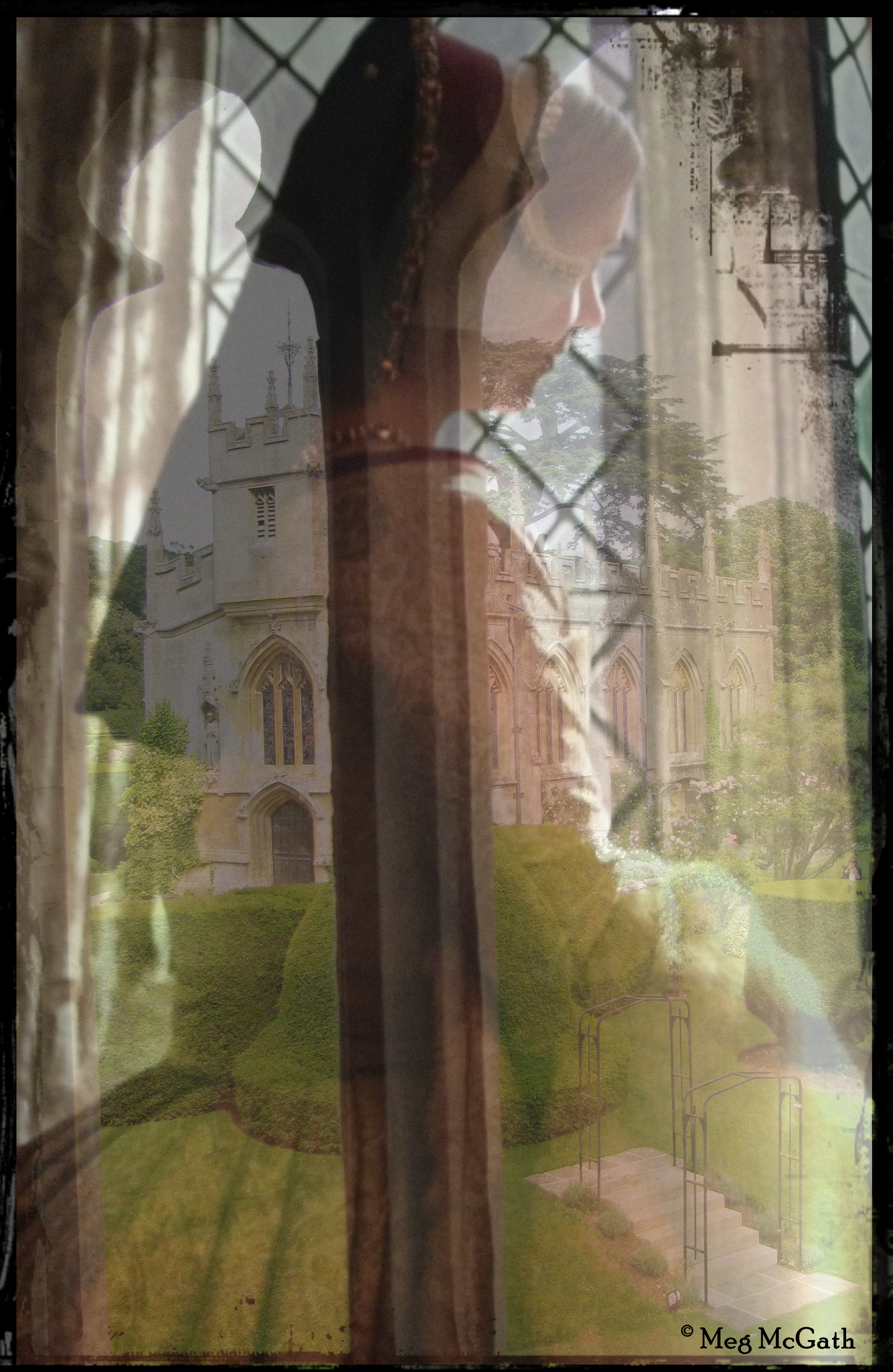
Compiled digital art featuring Hampton Court’s Katherine Parr over looking the gardens and Chapel on the grounds at Sudeley Castle. © Meg McGath, 2012.

Seymour decided that Katherine should be confined as far away possible from the press of business and turmoil of the court as well as the summer plagues of London. Katherine was taken to Sudeley Castle in Winchcombe, England, outside of Cheltenham. The castle has a long history stretching back to William de Tracy. Richard III used the castle as campaign headquarters during the Battle of Tawkesbury; in which Katherine’s grandfather fought. Upon the death of Richard III, the castle reverted to the crown and new monarch, Henry VII; who gave the castle to his uncle, Jasper Tudor. After the death of Jasper Tudor, Sudeley reverted to the crown again, to King Henry VIII. In fact, the King made a visit to the castle with Anne Boleyn in 1535. Upon the ascension of Edward VI, Sir Thomas was created Lord Seymour of Sudeley and was granted the castle. In preperation for her lying-in, Seymour spent 1,000 pounds having the rooms prepared for her in his newly aquired house at Sudeley in Gloucestershire.[2] With beautiful gardens and walks, the castle would have been a perfect place for Katherine to spend the last three months of her pregnancy.

One of several plaques on the wall in the exhibit for Katherine Parr at Sudeley. © Meg McGath, 2012.

On Wednesday, 13 June 1548, Seymour accompanied his wife, who was now six months pregnant, and his young ward, Lady Jane Grey, from Hanworth to Sudeley Castle in Gloucestershire. Lady Elizabeth Tudor had been sent away that Spring so she did not accompany them. In this castle, Katherine spent the last three months of her pregnancy and the last summer of her life. Typical of Queen Katherine, she spared no expense when it came to attendants. She was attended by her old friend and doctor, Robert Huicke, and was surrounded by other old friends, Miles Coverdale, her chaplain, her almoner, John Parkhurst, Sir Robert Tyrwhitt, and the ladies who had been with her over the years such as Elizabeth Trywhitt and Mary Wodhull. Katherine also had a full compliment of maids-of-honour and gentlewomen as well as 120 gentlemen and yeomen of the guard. In spite of his duties, Sir Thomas Seymour seems to have spent most of that summer with his wife. Katherine whiled away her summer days overseeing the education of Lady Jane Grey while preparing for her baby. Her affections for her husband seemed as strong as ever, as was her belief in the final analysis, Seymour would make the moral choice over the immoral one.

The nursery at Sudeley Castle.

While Katherine awaited her confinement, Katherine continued decorating the nursery which overlooked the gardens and the Chapel. The nursery of an expected heir was done up in crimson and gold velvet and taffeta, with furniture and plate enough for a royal birth. In Seymour’s eyes, the child would be a member of the royal family as Katherine was still officially the only queen in England. After his daughter’s birth, Seymour was overheard telling Sir William Sharington that,

“it would be strange to some when his daughter came of age, taking [her] place above [the duchess of] Somerset, as a queen’s daughter.”[3]

Besides the baby’s cradle was a bed with a scarlet tester and crimson curtains and a separate bed for the nurse.

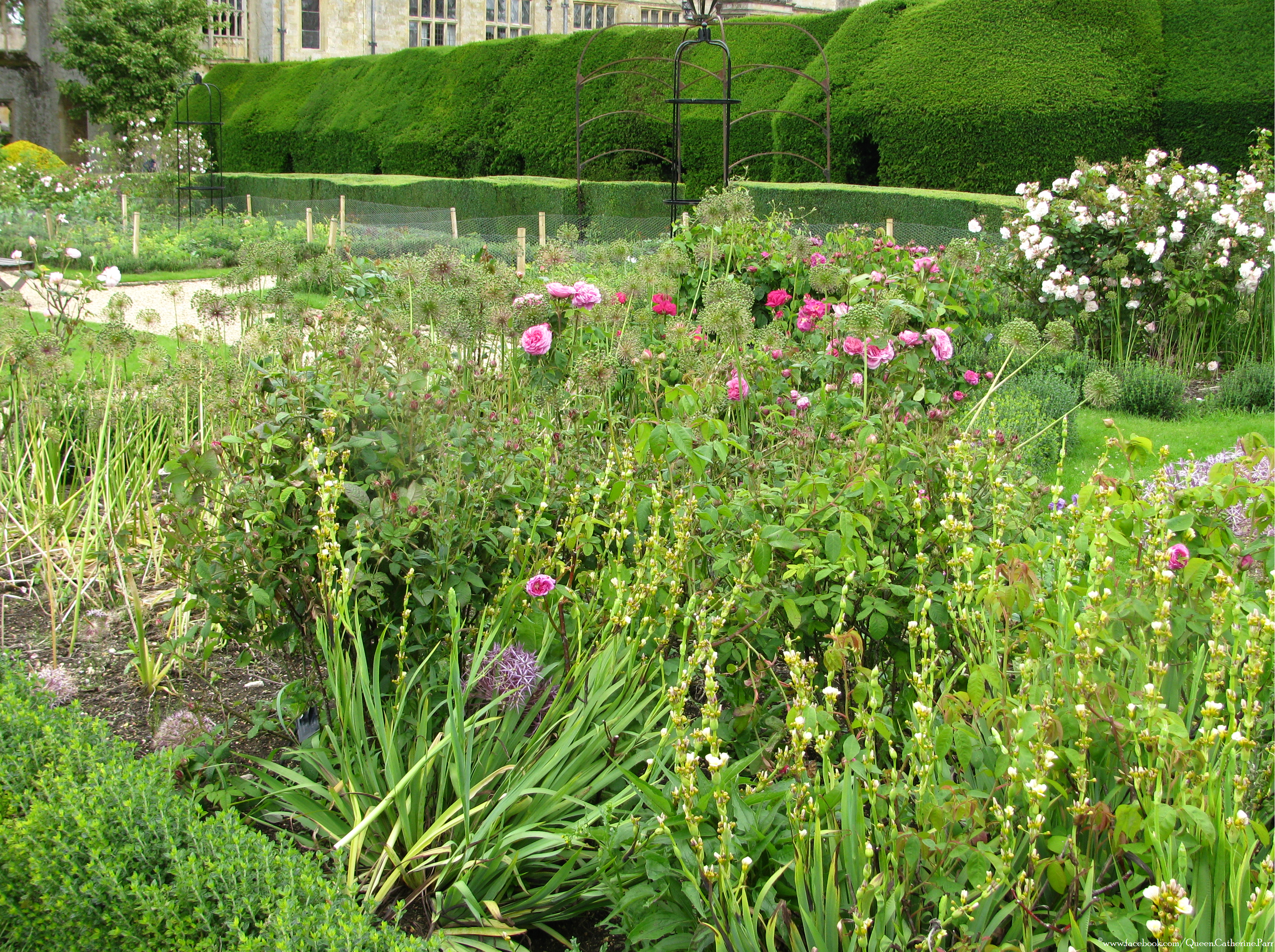
The Queen’s Gardens at Sudeley Castle; Katherine Parr would spend her final days walking with Lady Jane Grey in these gardens. © Meg McGath, 2012.

The Queen continued to take the advice of her doctor and walked daily among the grounds of Sudeley, but she was still concerned about the politics and overseeing of the new boy king.

On the eve of August 30th, Katherine went into labour.
Sources

  1. Linda Porter. ‘Katherine, the queen,’ Macmillan, 2012.
  2. Susan James. ‘Catherine Parr: Henry VIII’s Last Love,’ The History Press, Gloucestershire, 2008, 2009 [US Edition].
  3. Janel Mueller. ‘Katherine Parr: Complete Works and Correspondences,’ University of Chicago Press, Jun 30, 2011.
  4. Emma Dent. ‘Annals of Winchcombe and Sudeley,’ London, J. Murray, 1877. Out of copyright; use of images and info.

The original post from which this was taken

copyright_meg_tudorqueen

30 December 1460: The Debt is Paid

On the 30th of December 1460, Richard Plantagenet, Duke of York and his forces were caught by surprise by the Queen’s forces at Sandal Castle near Wakefield where they had been stationed for over two weeks. Richard knew the battle was lost and that he would likely die so he sent his son (Edmund, Earl of […]

https://tudorsandotherhistories.wordpress.com/2016/01/11/30-december-1460-the-debt-is-paid/

Dispelling myths: The Truth Behind Edward IV & Cecily Neville

From the blog of Carolina Casas.

Carolina Casas's avatartudors & other histories

Cecily and Edward IV Edward IV “the Rose of Rouen” and his mother “Proud Cis” Cecily Neville, Duchess Dowager of York.

Today historians still debate Edward IV’s parentage but a poem done in his honor, shortly after he was sworn in as King, leaves it very clear he was Richard, Duke of York’s son:

“Y is for York that is manly and mighty
That be grace of God and great revelation
Reining with rules reasonable and right-full
That which for our sakes hath suffered vexation.

E is for Edward whose fame the earth shall spread
Because of his wisdom named prudence
shall save all England by his manly deeds
Wherefore we owe to do him reverence

M is for March, through every trial
Drawn by discretion that worthy and wise is
conceived in wedlock and coming of blood royal
Joining unto virtue, excluding all vices.”

There was a scene in the White Queen, both…

View original post 2,261 more words

Family of Queen Katherine: The Duchess, Cecily of York

Written by Carolina Casas and Meg McGath

Different depictions of Lady Cecily, Duchess of York. Drawing on the left by Lisa Graves.

Lady Cecily (born Neville), Duchess of York, aka “Queen by Right” was one of the leading women of the War of the Roses. Mother of Kings; she was mother to Edward IV and Richard III of the House of York. She was the youngest daughter of Sir Ralph, Earl of Westmorland and his second wife, Lady Joan Beaufort. Joan was part of the illegitimate children of Prince John of Gaunt, 1st Duke of Lancaster (son of King Edward III) and his mistress, later wife, Katherine (née Röet). Katherine had been a lady-in-waiting to the Duke’s mother, Queen Philippa. Their romance started during Lancaster’s second marriage to Constanza of Castile. After Constanza’s death, Katherine and Lancaster were married. A bill in Parliament was passed to legitimise their children. However, they were barred from the Royal Succession.

wars-of-the-roses-family-tree

The Houses of Lancaster & York descended from the sons of Edward III of England

Lady Cecily married to Richard of York (Plantagenet) when she was just a teenager. This was normal for the time. The legal age for girls to marry was twelve and for boys it was fourteen. Richard was only a few years older. He was the son of Lord Richard, Earl of Cambridge and Lady Anne de Mortimer. Both of his parents had claims to the throne as descendants of King Edward III. Lord Richard was a grandson of Prince Edmund of Langley, 1st Duke of York (fourth surviving son of King Edward) while Lady Anne was a granddaughter of Philippa of Clarence; daughter of Prince Lionel of Antwerp, 1st Duke of Clarence (the second surviving son of King Edward).
richardyorkdeath

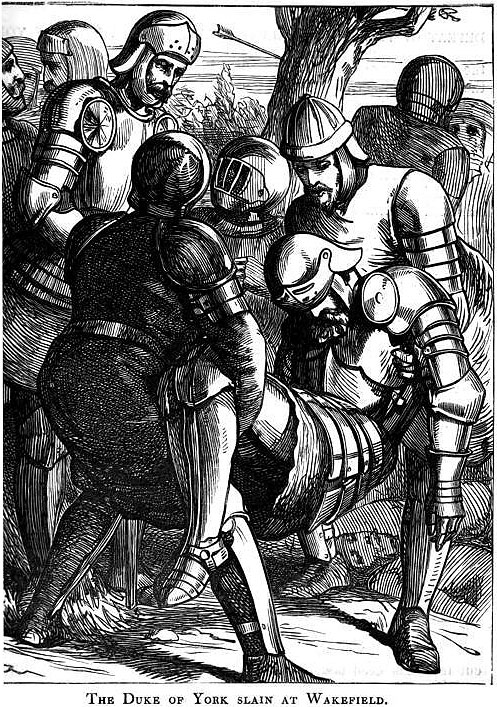
When Richard and his son were killed at the battle of Wakefield in December of 1460, Cecily was forced to send her two youngest sons to Burgundy. At the time, Cecily’s cousin Isabel (of Portugal), was Duchess of Burgundy as the wife to Philip “the good”. The boys didn’t return until after their brother had successfully deposed Henry VI and made himself King.

cecily

Cecily, the widowed Duchess of York by Geoffrey Wheeler

Before Edward IV married Elizabeth, Cecily was one of the most influential women in the land. In the White Queen she is depicted as proud and an elitist, with many fans taking on the side of poor, poor, Jaquetta and her eldest daughter when they had to defend themselves against mean ol’ Cecily telling them she doesn’t approve of the marriage and will do anything to disinherit him, just to see the Woodvilles finished.

Portrayal in “The White Queen

It is fashionable to see girl vs girl on screen, especially when it is royals. After all, in the realm of fiction it should be a woman’s show, right?
york

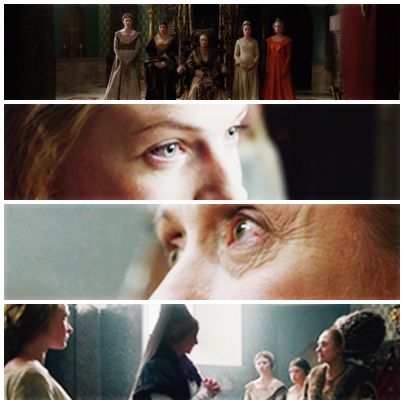
“The Scene” — Jacquetta vs Cecily; a true cat-fight invented by Philippa Gregory, solely for modern viewers entertainment. “The White Queen“, Episode 1.

Except that this woman is based on a real person and contrary to popular belief, she wasn’t out to destroy the Woodvilles. Her son’s marriage really set things back for his dynasty (and the House of York). As far as Cecily knew, if one king could easily be deposed and coerced, another one could be too. And the Woodvilles weren’t royal so they brought no alliance, nothing to the table.

Elizabeth’s father was a mere knight when he married her mother. She lost her right to call herself Duchess of Bedford after their union. After he became Baron, she became Baroness, and the two were staunch Lancastrians. Elizabeth’s first husband, Lord Grey (a knight), had died fighting the Yorks after all. Cecily’s own husband, son, and brother died fighting for York. They were beheaded and paraded before the people. There must have been some animosity there on the part of the Yorks. Cecily would be denied her life long goal of becoming Queen of England only a few weeks before the wars ended.

Although the Rivers had been pardoned as early as 1461, after Edward IV became King, it didn’t change the fact that they had fought for the other side and after having lost so many family members, it was only natural Cecily was fearful of their union.

Elizabeth Woodville, proved to be everything that was expected out of a royal consort; but that didn’t make matters better for the nobles who saw this as a betrayal. They had risked their sons and fortunes to make Edward King, and when he turned their backs on them, choosing a Lancastrian widow over Warwick’s proposed betrothal with Bona of France, it was pretty much an all out war then.

Portrayal of Duchess Cecily (portrayed by Caroline Goodall) and her son George, Duke of Clarence (the Fictional depiction of “The White Queen” by Historical Fiction writer, Philippa Gregory).

No one is sure what Cecily’s role was during this time. If she instigated her next son and nephew to rebel against Edward is not recorded. However, why would she risk the shame of being labeled an adulterer? When the rumor of Edward not being the son of Richard, but of a Welsh archer named Blaybourne spread throughout the country, Cecily spoke against it. The rumour tactic was sparked after Edward married Elizabeth. As many know, it was not a good match. The royal family did not benefit. The match would bring Elizabeth’s large family to court. The Rivers wanted to make sure that they had a strong hold at court by marrying their children to the highest nobles. Some of the marriages were forced upon the nobles who had an impressive pedigree which would now be “tainted” by the common Woodvilles.

In the only biography of Cecily Neville, Amy Licence lists many possibilities, one of them being that Cecily probably didn’t agree with what George and Warwick were about to do but as a mother, gave her son his blessing before he went to Calais.

Another is that “she traveled to Sandwich in an attempt to talk George out of going through with the potentially dangerous union.” By this she meant the union between George and Warwick’s eldest daughter, Isabel. Warwick was a nephew of Cecily so the affinity was one that would have required a proper papal dispensation.
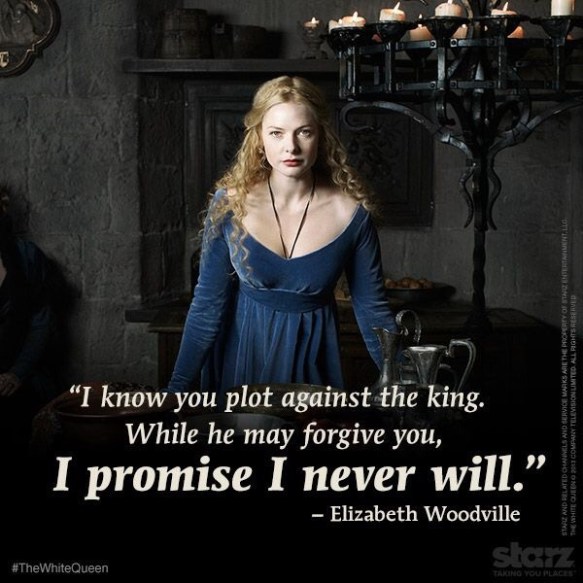
Quote from “The White Queen”, a historical fiction novel and series by Philippa Gregory.

Following their disastrous attempt to overthrow Edward IV, the King reconciled with Warwick and George. We can only imagine what Elizabeth must have felt. After all, the Duke of Clarenece and Warwick had killed her father and younger brother before they imprisoned her husband. But she was forced to accept Edward’s reconciliation with them, having little to no agency.

Cecily in the meanwhile invited her sons the following year to Baynard’s Castle. “She may have had apologies” Licence theorizes, about the previous events. If she had attempted to dissuade George from turning against his brother, she might have felt she could have done more and this was her way of bringing her two sons together.

“For a woman of her status and pride, it seems unlikely that she would wish to see her sons in direct combat, as she knew all too well the personal, political and material losses she may suffer as a result.”

But if this was the case, it came to nothing. George and Warwick were back at their old schemes, only this time they didn’t only fail (again) but were forced to leave England and Warwick had to make another ally -one he probably swore never to make; an alliance with Margaret of Anjou, the Lancastrian queen.

Margaret of Anjou and the Duchess of York

Much has been said about the friendship between Jacquetta and Margaret of Anjou, but there is almost no mention of the friendship between her and Cecily.

At the time that Margaret was in the first stages of prregnancy, the two women travelled the countryside together. And it is very possible that the two visited Norfolk shrine to give thanks. That same year, the two women wrote to each other, once again expressing gratitude towards the holy mother.

Cecily had been previously placed under house arrest with her sister Anne, the Duchess of Buckingham following her husband and son’s exile. Her sister had sided with the Lancastrians out of loyalty to her husband (the Duke of Buckingham). It was also at this time that Cecily saw many of Henry and Margaret’s army rob her of her valuables. Hearnes’ Fragment, a chronicle written by a servant of Edward IV, recorded that the Lancastrian troops “burnt and pillaged the town; and the Duchess of York residing there, had her wardrobe rifled and her furniture spoiled.”

To make matters worse, Cecily had her three youngest children with her, and as many mother in her position would, she did everything she could to protect them. So she left the castle and bravely met with her old friend, the Queen, pleading with her. The Queen was merciful enough to let her stay with her sister, Duchess Anne.

After her husband’s return, he sent for Cecily. The two entered London triumphantly. Cecily was dressed for the occasion in a beautiful blue gown. It was at this time that Richard made his bid for the throne but the people were not ready for a Yorkist monarch, especially when their present King (although having proved himself incapable of ruling) was still alive. So Richard had to settle for an accord which stated that following the King’s death, he and his heirs would inherit the throne.

It is by this act alone that Cecily had ever right to call herself “Queen by Rights”. She was after all, one step away from being the first Consort of the House of York.

“It was at this time” Licence writes, referring to the year after Elizabeth Woodville was given a lavish coronation, “that she started using the title of “My Lady the King’s Mother” and retreated into the royal apartments whenever she was at court. As for her later self-given title, this came during the 1470s, after Edward IV had regained his throne and rid himself of the Lancastrian threat.

Cecily became very religious during this time, and while she still kept up with the latest fashions, the Duchess followed a strict regime.

The Princes in the Tower

“What did Cecily believe had happened to her grandsons? Did she and Richard have a conversation about their futures?” (Licence)

When Richard, Duke of Gloucester, her younger son, made a bid for the English throne, she stayed silent. In the “White Queen”, she is not silent. Instead, the show portrays the fictional Cecily as whispering in Richard’s ear along with the other PG’s Lady Macbethesque character (Richard’s wife) Anne Neville. The two women try to convince Richard to rid himself of the Princes in the tower. They are after all Woodville puppets.

It is true that Richard was fearful for his safety. Like the Woodvilles, he wanted control over his royal nephew. And while some historians contest that Richard was never made Lord Protector and that is was just a lie to get power. Other historians argue that he was and that the Woodvilles were simply out to get him. The truth is that they were all scrambling for power over the new boy King and that they were all in danger.

This was the real life “Game of Thrones” and the Woodvilles became more influential following the Lancastrian Readeption. The appointment of Elizabeth’s brother, Anthony, Earl of Rivers, as the Prince of Wales’s governor was also a road block after the death of Edward. As the new King was escorted to London, Richard intercepted them. The boy haughtily replied that he would trust no one other than his uncle Anthony. As the day went on, the boy showed that he had a defiant attitude towards his paternal uncle, Richard. The trust that was built with his mother’s family started early on, and it was apparent that it would not be broken.

To suggest that Cecily would have coldly advocated their murder is taking a lot of artistic licence. Hollywood loves to play loose with history and this time, there was no exception when it came to “The White Queen”. While there is some basis for her disconent, it is unlikely that she would have condoned two of her grandchildren’s murder. We don’t know what her feelings were; we can only speculate. Historically, Richard did use one of Cecily’s residences as he plotted his rise to power. But, nobody knows for certain if she was present. There is no evidence either way. However, that didn’t stop the show from placing her in residence as one of the plotters.

Death

Amidst betrayal, intrigue, and more death, Cecily left this world in May of 1495. This was a woman who had lived through the murders of her husband, son, and brother; the internal war of her sons Edward and George, which ended in George’s execution; her House’s rise and fall, and the vilification of the last King of the House of York, her son Richard. The House of Tudor defeated Richard in 1485 and Cecily was still alive when her granddaughter, Elizabeth of York (eldest daughter of Edward), become queen to the new King, Henry VII.

Cecily left several religious items to the church at Fotheringhay and other valuable items to her next of kin, including her great-grandson, Prince Arthur (Tudor) of Wales. She even left something for the current “My Lady the King’s Mother”, Margaret Beaufort, which was a service book covered with black cloth of gold with gold claps.

Tomb of Cecily and the Duke of York along with their son, Edmund.

Cecily was buried with her husband Richard and son Edmund in Fortheringhay. The current memorial is the work commissioned by her great-great-granddaughter, Queen Elizabeth I (Tudor).

‘Cecily Neville: Mother of Kings’ by Amy Licence

For more information on Cecily, check out “Cecily Neville: Mother of Kings” by Amy Licence and “Blood Sisters” by Sarah Gristwood which is about all the women in the wars of the roses, stretching to the Tudor period with Henry VIII’s ascension and joint coronation with his first wife, Catherine of Aragon.

copyright_meg_tudorqueen

The OTHER Elizabeth Cheney

Lately on Pinterest I have noticed that a certain portrait has become labeled as a member of Queens Anne Boleyn and Katherine Howard’s family. The woman in the portrait is being credited as their grandmother (or whatever) “Lady Elizabeth Cheney Tilney“. The link used on each pin belongs to The Royal Collection of Her Majesty Queen Elizabeth II and if clicked on — the title is clearly stated as being “Elizabeth Cheyne, Lady Vaux (1509-1556)“.[1]

The actual Lady Elizabeth Tilney was born in 1422 as a Cheney, the daughter of Lawrence and Elizabeth Cokayne. Elizabeth married firstly to Sir Frederick Tilney by whom she had a daughter named Elizabeth Tilney. By Lord Tilney, Elizabeth was in actuality the great-grandmother of Queens Anne Boleyn (wife no. 2) and Katherine Howard (wife no. 5). As the widowed Lady Tilney, Elizabeth made a second marriage to Sir John Saye. By that marriage she was also the great-grandmother of Queen Jane Seymour (wife no. 3). Lady Elizabeth Saye (born Cheney) died in 1473.

The only daughter of Sir Frederick Tilney and Lady Elizabeth (born Cheney), Elizabeth, married firstly to Sir Humphrey Bourchier by whom she had issue. After her first husband died, the widowed Lady Bourchier became the wife of Sir Thomas Howard, Earl of Surrey (later Duke of Norfolk) on 30 April 1472. This couple was parents to Lady Elizabeth Howard (mother of Anne Boleyn) and Sir Edmund Howard (father of Katherine Howard)–the two doomed queens of King Henry VIII.

Will the Real Elizabeth Cheney Please Stand Up?

il_fullxfull.740790797_tf54

A copy of “Lady Vaux” originally by Hans Holbein c. 1536. This copy was done in 1938.

As for the REAL Elizabeth Cheyne (or Cheney)–she was born in 1509; around the time that Anne Boleyn may have been born. Elizabeth was the daughter of Sir Thomas Cheyne of Irthlingborough, an Esquire of the Body to Henry VIII, and Lady Anne (born Parr). Sir Thomas Cheyne (d.1514) was the son of Sir John Cheyne of Fen Ditton (c.1424-1489) and his wife Elizabeth Rempston (born c.1418)–see below for more info.[8] Lady Anne’s parents were Sir William Parr, Baron Parr of Kendal and Lady Elizabeth (born FitzHugh). By her parents, Lady Anne was a paternal aunt to Henry VIII’s last queen, Katherine Parr. In 1516, Elizabeth Cheyne became a ward of of her step-grandfather, Sir Nicholas (later 1st Baron Vaux of Harrowden). In 1523, she was married to Sir Thomas Vaux (later 2nd Baron Vaux of Harrowden); the heir of Lord Nicholas Vaux by his second wife.[1][2][3]

The Close Circle of Nobility

Step-grandfather you say?

Now this is where the history of the Vaux and Parr families become extremely confusing to some–Elizabeth Vaux and Katherine Parr’s grandmother, the widowed Lady Elizabeth Parr (born FitzHugh), married secondly to Sir Nicholas Vaux (later 1st Baron) as his first wife. This move was made as a measure to ensure loyalty to the new Tudor King, Henry VII. Lord Vaux’s mother, Katherine, had been a loyal supporter of the House of Lancaster and Queen Margaret of Anjou (wife of Henry VI). Elizabeth FitzHugh, herself, was loyal to the House of York. Her mother Lady Alice Neville was a daughter of Sir Richard, 5th Earl of Salisbury. As such, Elizabeth was a niece of Richard, Earl of Warwick “Warwick, the Kingmaker”. As close family members, Elizabeth and her mother were part of the coronation train of Queen Anne (born Neville) and attended her as ladies afterwards. Elizabeth and Nicholas had three daughters. One was the wife of Sir George Throckmorton, also named Katherine (née Vaux). After Elizabeth FitzHugh died, Lord Vaux married secondly to Anne (née Greene); the maternal aunt of Queen Katherine Parr. By Anne, Lord Nicholas had his heir–Thomas–who married Elizabeth Cheyne. Upon Thomas and Elizabeth’s marriage in 1523, Elizabeth was formally titled Lady Elizabeth Vaux or Lady Vaux. The family tree of Anne Boleyn and Katherine Howard have no such lady with this title.[2][3]

As for Sir Thomas Cheyne–here is where some people may have confused the portrait. Cheyne was of the same lineage as Lady Elizabeth Tilney/Saye (born Cheney), daughter of Sir Lawrence (d.1461) and Elizabeth Cokayne. Thomas’s father, Sir John (d.1489), was Elizabeth Cheney’s brother. So there is a connection there, but the daughter of Sir Thomas was not an ancestress to the Boleyn or Howard family.[7][8]

About the Work of Art

elizabeth2c_lady_vaux2c_by_hans_holbein_the_younger

‘Elizabeth Cheyne, Lady Vaux (1509-1556)’ c. 1536 by Hans Holbein. Windsor Castle. The Royal Collection of Her Majesty Queen Elizabeth II, 2012–RL 12247.[1]

Above: the actual sketch from Windsor Castle’s collection of Holbein’s portraits. It is described as using Black and coloured chalks, white bodycolour, wash, pen and ink, brush and ink, and metalpoint on pale pink prepared paper; 28.1 x 21.5 cm[1]

The original sketch was acquired by Edward VI in 1547 after the death of his father, Henry VIII. Henry FitzAlan, 12th Earl of Arundel bequeathed the portrait to John, Lord Lumley in 1580. Lord Lumley probably bequeathed the portrait to Henry, Prince of Wales in 1609, and thus, it was inherited by Prince Charles (later Charles I) in 1612. Charles I exchanged the portrait with Philip Herbert, 4th Earl of Pembroke (the grandson of Lady Vaux’s other cousin, Lady Anne Pembroke (sister of Queen Katherine Parr) around 1627/8. Charles II acquired the painting through Thomas Howard, 2nd Earl of Arundel in 1675. It has been in the Royal Collection ever since.[1]

This drawing of Lady Vaux with the companion image of her husband was probably made as a study for a painted portrait. Holbein’s painting of Lady Vaux is known only through copies. No painting of Lord Vaux survives.[1]

lady vaux

The Hampton Court painting of ‘Elizabeth, Lady Vaux’ c. 1600-30 (Twitter user Sir William Davenant)[5][6][9]

Henry VIII loved art and collected his fair share of portraits and drawings. There is a painting of ‘Lady Vaux’ at Hampton Court (above) which is said to have been painted by Holbein. It is one of three paintings recognized as genuine by the experts. However, others debate the authenticity and the painting at Hampton is labeled ‘After Holbein–Elizabeth, Lady Vaux‘. Elizabeth is depicted looking to the front, wearing a brown dress with ermine, with a jewel at her bosom decorated with the Madonna and Child enthroned. She holds a pink carnation in her right hand, and a cherry in her left. This is thought to be a competent copy after a lost original by Hans Holbein. The original was painted in 1535. This portrait hangs in the Haunted Gallery at Hampton. The authentic sketch of ‘Lady Vaux’ by Holbein (RCIN 912247) is at Windsor Castle.[1][4][5][6]

The only other copy of the painting of Lady Vaux is in Prague Castle Gallery of all places!

hans_holbein_the_younger_28after29_-_elizabeth_vaux_28prague29

The portrait of ‘Lady Vaux’ hangs in the gallery at Prague Castle.

Authors Notes

So, if you see the portrait of Lady Vaux on Pinterest; the caption is incorrect. The fact that people refuse to or do not know how to change the caption is rather sad in my opinion. Elizabeth had no direct connection to the Boleyn or Howard families. Why do I feel like the painting was and still is being labeled incorrectly? My theory: most people do not know anything about Katherine Parr’s extended family; it seems so much easier to associate a lot of things to the Boleyn family for some fans. And when some are called on it, it can get pretty nasty. I’ve had some really nasty comments after leaving my own comment about the true identity of the sitter. For some Boleyn fans, the research, so they think, has already been done. The caption must be correct. No. But who am I? Some random pinner–or so they think.

I won’t deny that as a writer on Parr, this whole situation makes me extremely angry. I have been writing for years on this family and just trying to correct a simple image has become tiresome and pretty unpleasant. What really bothers me is the fact that putting the wrong label on a portrait deprives the memory of the real person. To me, somehow that person becomes erased.

Elizabeth, Lady Vaux died shortly after her husband on 20 November 1556. She was most likely a victim of the plague which killed her husband.[9]

More info:

Sources

  1. Holbein, Hans. “Royal Collection – Elizabeth, Lady Vaux,” circa 1536. RL 12247. Royal Collection Trust / © HM Queen Elizabeth II, 2015. URL: https://www.royalcollection.org.uk/egallery/object.asp?maker=12102&object=912247&row=82
  2. Douglas Richardson. “Plantagenet Ancestry,” Genealogical Publishing Com, 2004. pg 144, 561.
  3. Burke, Sir Bernard. “A Genealogical History of the Dormant: Abeyant, Forfeited, and Extinct Peerages of the British Empire,” New Edition. London: Harrison, 1866. pg 418.
  4. ‘Spelthorne Hundred: Hampton Court Palace, pictures’, in A History of the County of Middlesex: Volume 2, General; Ashford, East Bedfont With Hatton, Feltham, Hampton With Hampton Wick, Hanworth, Laleham, Littleton, ed. William Page (London, 1911), pp. 379-380 http://www.british-history.ac.uk/vch/middx/vol2/pp379-380 [accessed 13 February 2016].
  5. Sir William Davanant on Twitter: “I give thee Elizabeth Cheyne, Lady Vaux (1509-1556). After Hans Holbein. #HamptonCourt” [https://twitter.com/SirWilliamD/status/297996052068450304]
  6. Holbein, After Hans. “Royal Collection: Elizabeth Cheyne, Lady Vaux,” circa 1600-30. RCIN 402953. Royal Collection Trust / © HM Queen Elizabeth II, 2014. URL: https://www.royalcollection.org.uk/collection/402953/elizabeth-cheyne-lady-vaux-1505-1556
  7. A F Wareham and A P M Wright, ‘Fen Ditton: Manors’, in A History of the County of Cambridge and the Isle of Ely: Volume 10, Cheveley, Flendish, Staine and Staploe Hundreds (North-Eastern Cambridgeshire) (London, 2002), pp. 123-124 http://www.british-history.ac.uk/vch/cambs/vol10/pp123-124 [accessed 11 February 2016].
  8. Richardson, Douglas. “Plantagenet Ancestry: A Study In Colonial And Medieval Families,” 2nd Edition, 2011. pg 526-7. Google eBook
  9. Johnson, Graham and Humphries, Lund. “Holbein and the Court of Henry VIII: The Queen’s Gallery, Buckingham Palace,” London and Bradford, The Gallery, 1978. pg 95-96.

©Meg McGath, 12 February 2016

This is the work and research of Meg McGath. You may not reproduce or copy this material without written permission.

The Men Who Took Power

“It is difficult to say for how long Warwick had been casting envious eyes on supreme power, and exactly when he gave serious thought to undermining the Protector; but that former friendship of which Somerset was soon to remind him had never gone very deep, and it evaporated entirely when at the beginning of the new reign Somerset took from him the coveted post of Lord High Admiral, and gave it to Thomas Seymour. Certainly Warwick was scheming against the Protector at the time of Thomas’ nefarious deeds. He quickly realized that by stirring the brotherly quarrel to its ultimate disastrous conclusion he must weaken Somerset’s standing in the country,, for there were many who, unaware of the full extent of Thomas’s treachery, and the unenviable position into which some members of the Council had manoeuvered the elder brother, regarded the affair as little short of fratricide. More recently Warwick had been in direct conflict with the protector over Somerset’s refusal to remove a justice in favour of Warwick’s nominee, and to grant his son, Ambrose, the reversion of two offices held by Sir Andrew Flammock.” -William Seymour; Ordeal by Ambition: An English Family in the Shadows of the Tudors

Not to undermine Seymour’s work but I don’t agree with him on this point. Thomas Seymour wasn’t exactly patient when it came to plotting and although I don’t agree with his reasons, or Dudley and Grey’s reasons for turning their backs against the Protector, they had valid reasons.

Thomas Seymour married before everyone told him it was a bad idea, or perhaps he didn’t care. Knowing what we know about Tommy, it was probably the latter. A century later somebody had done the same with Catherine of Valois, the Queen Dowager of England and mother to the baby-king Henry VI of England and II of France. Owen Tudor paid dearly for this, and although he got off in the end and proved himself to be a loyal Lancastrian, there were still consequences. Kathryn Parr was not as royal as Catherine of Valois had been but she had noble and Roya blood, and she was an important figure in the English Reformation. Edward VI loved her and Elizabeth looked up to her.

Thomas had always been ambitious and probably resented that he wasn’t being given as much honors as his brother was receiving. Not only that, some historians like Warwick dispute the allegations from later chroniclers that their wives quarreled over precedence and Anne asked Kathryn to give up her jewels. I love Warnicke and once again, I am not trying to put down their research, but I do think there was some form of quarrel between the two. Anne was as pragmatic as Kathryn was. She knew how dangerous Thomas was, and what he was doing and probably saw Katherine as a danger. That her influence over all these wards (who had royal blood and a claim to the throne) could be detrimental to her husband and what affected him, directly affected her and her children.

Also, she must have felt more important than the Queen Dowager since she married Thomas Seymour who despite his appointments and new title, was still several ranks lower than his older brother.

John Dudley was a staunch Protestant but a cold pragmatist when it came to war and foreign relations unlike Edward Seymour. The latter was following the same disastrous foreign policy of his predecessor, Henry VIII of invading Scotland, causing more death and destruction that supposedly would have intimidated them and forced the country into submission but what ended up happening was the opposite. As for his countrymen though, Edward showed he had better intentions than his opponent and former ally. Dudley wanted a more religious regime like the King, but Edward Seymour believed there should be compromise. (Another person who thought like this was Cranmer.) He tried pushing for policies that helped the poor and the needy but most of them did very little to improve the economy. 

Edward’s intentions were good, but his way of doing things were not. When he was elected Lord Protector, his supporters thought that he was going to work for them instead of the common people and it ended turning the other way around. Edward could have succeeded in his domestic policies if he had been a better politician and not done many things (such as slapping one courtier) that ended up alienating him from the nobles and turned them against him. Furthermore, he refused to rule with the same iron fist as his predecessor. The ruthlessness he showed on Scotland, was something he was averse to showing on his fellow countrymen, even his enemies. Whereas with Dudley, it was the complete opposite.

Lastly, William Seymour like so many biographers that have become enchanted with their subjects, is against speaking too ill of him. He points out his flaws, his disastrous policies but he always adds that a lot of these are due to the nobles ceaselessly plotting against him. This is partially true as I’ve already stated, but he was also to blame.

Thomas was ultimately executed, Edward suffered the same fate years prior. The charges laid against him were outrageous, going so far as to plotting the murder of John Dudley, newly elevated to Duke of Northumberland. There’s no question that Edward did want to escape and was concocting all kinds of schemes to get out. Even going so far as to use his daughter Jane to entice the King and Jane was as Jane Grey, an accomplished young girl. A few years younger than her, she had translated and written many religious works. But his rivals sustained that he had plotted to invite everyone to a dinner and murder everyone there. Eventually new charges were laid on him were because the others weren’t enough to convict him. On November, Northumberland put all the evidence together and laid out the new charges against him. They were read out, and as it was customary of the time, the accused did not have to be present for his guilt to be established. Ned Seymour was accused with sedition, treason and conspiracy to “overthrow the government, imprison Northumberland and Northampton, and convene Parliament”.

Ned Seymour was able to show himself at the hearings at last in December. Lord Strange was one of the witnesses who was brought in, to accuse him of plotting to marry his young daughter, the nine year old Jane Seymour –an accomplished young woman, who as the other Jane [Grey], could read, write in Latin, Greek and many other languages, and had already translated many works- to the King. As ludicrous as all these charges were, this one was not. Ned Seymour did ask some of his allies to speak favorably of his daughter to the King, in the hopes that the young King would be impressed by her and this would release him [and his wife] from prison.

After this trial and his sentence was pronounced, Ned Seymour finally gave up. He knew the end was coming and prepared for the inevitable, praying hard and taking shelter as so many before him had done, in the religion that comforted him. There are a lot of version of his last words, one of them come from his chaplain, a man he largely favored, John Foxe. John was not present during his execution but he maintained that his account was taken from a “certain noble personage” who was.

His last words were: “Dearly beloves maisters and friends, I am brought hither to suffer, albeit that I never offended against the King neither by word nor deed, and have been always as faithful and true unto this realm as any man hath been. But forsomuch as I am by a law condemned to die, I do acknowledge myself, as well as others, to be subject thereunto …” Then he told them he had come to die, according to the law and gave thanks “unto the divine goodness, as if I had received a most ample and great reward” and asked them to continue to embrace the new religion. 

Why was the Warwick Earldom given to the Dudleys? I should check the ancestry there. I’m sure there were senior lines but the “regency council” just handed out titles like candy. The death of Henry VIII — or even Edward IV — put an end to the rightful ways of nobility and male inheritance. What a joke. Henry was so stupid to entrust men over someone like Katherine Parr who had the best interests in mind when it came to Edward VI. But hey, there is speculation about Henry’s will which may have been altered. The men around Henry purposely kept the queen and Lady Mary away from the King and when he died…they weren’t told for days!! Those men thought they were helping, but in actuality–THEY killed the Tudor dynasty in a way.

Katherine Parr: A Possible Jewel of Lady Latimer?

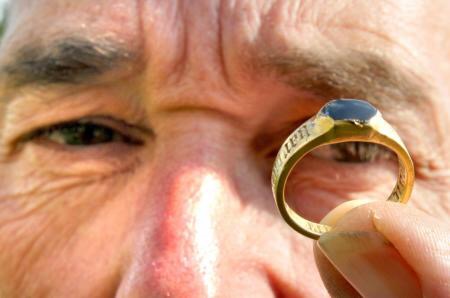
A METAL detectorist, Steve Whitehead, said he was left shaking after finding a gold ring he hopes could be linked to one of Henry VIII’s wives.

A possible ring belonging to Queen Katherine Parr was found near an estate that belonged to her second husband, Lord Latimer, also know as Lord of the manor of Sinnington. The ring was found near the manor of Sinnington. A Lombardic inscription on it suggests the ring dates from between the ninth to the 15th century. 
Katherine spent time in the area as Lady Latimer from 1534-1543; wife of Sir John Nevill. It is said that Sinnington was a favourite during Katherine’s days as Dowager Lady Latimer. As well as Sinnington Manor, several manors near by belonged to Latimer and Katherine’s family. Nunnington Manor, which belonged to Katherine’s brother William, was close by. 


The ring, which could be worth £20,000, is likely to date from the ninth to 15th centuries due to the Lombardic text on it.

 
HISTORY OF the manor: In 1284–5 the Nevills of Raby had obtained a mesne lordship, which descended to Sir Ralph first Earl of Westmorland (husband of Lady Joan Beaufort, only daughter of Prince John of Gaunt, Duke of Lancaster by his third wife, Katherine). Westmorland must have given it to his fifth son by Lady Joan; George, who was created Lord Latimer in 1432. George died seised in 1469, and in 1531 the manor was still held by his great-grandson Sir John Nevill, third Lord Latimer.

Sources and More info

6 AUGUST 1552: THE DEATH of Sir George Throckmorton of Coughton

The Tudor gate at Coughton Court, Warwickshire, England. Commissioned by Sir George.

The Tudor gate at Coughton Court, Warwickshire, England. Commissioned by Sir George. [Source: National Trust Coughton Court]

6 AUGUST 1552: THE DEATH of Sir George Throckmorton of Coughton Court [uncle by marriage and cousin]. George was the eldest son of Sir Robert Throckmorton of Coughton by Catherine, daughter of William Marrow. Sir Robert Throckmorton was a courtier and Councillor to Henry VII. Before his death, in Italy while on pilgrimage to the Holy Land, Sir Robert had seen George launched at court and in local government and in enjoyment of numerous leases and stewardships. This early advancement may have owed something to Throckmorton’s marriage to a daughter of another courtier, Sir Nicholas Vaux, whose stepson Sir Thomas Parr, comptroller of the Household to Henry VIII.

George was a loyal subject to the crown, however when it came to Henry’s divorce from Katherine of Aragon he opposed it. He did not approve of Henry marrying Anne Boleyn and was vocal about it. After all, he was close to Sir Thomas More and the Throckmorton was a devout Catholic family [still are to this day]. George’s circle included supporters of Katherine of Aragon which included Lady Maud Parr, his sister-in-law [wife to Sir Thomas Parr, brother of his wife Katherine]. Maud stayed with her mistress until her death in 1531.

Later on, George was steward from 1528-40 for Thomas Seymour, [later Baron Seymour of Sudeley]. The marriage of Katherine Parr to King Henry VIII in 1543 proved helpful to his children, but George was still in disfavor at court. George was part of the fall of Thomas Cromwell, but his part in it is obscure. Cromwell had somewhat kept George in disfavor for quite some time. The two clashed on religious ideals and other matters of state. The Throckmortons who had converted to Protestantism were held high at court and helped out their cousin Katherine Parr during her reign as queen and as dowager queen. Several Throckmortons did stick to the “old” religion and later found themselves in trouble during the reign of Elizabeth I [daughter of Henry VIII and Anne Boleyn].

Family

By 1512, George married Katherine, daughter of Sir Nicholas Vaux [later 1st Lord Vaux of Harrowden] and his first wife, Elizabeth FitzHugh. Elizabeth FitzHugh was the paternal grandmother of Queen Katherine Parr; daughter of Lady Alice FitzHugh [born Neville, granddaughter of Lady Joan Beaufort, Countess of Westmorland]. The couple had eight sons including Anthony, Clement, George, John I, Kenelm, Nicholas and Robert and eleven daughters.

Tomb of Sir George and his wife Katherine [Vaux] in St. Peter's Church, Coughton Court, Warwickshire, England.

Tomb of Sir George and his wife Katherine [Vaux] in Coughton Church, Warwickshire, England.

Throckmorton died on 6 August 1552 and was buried in the stately marble tomb which he had prepared for himself in Coughton church. The most impressive monument which he left, however, was the gatehouse of Coughton court. Throckmorton spent most of his life rebuilding the house: in 1535 he wrote to Cromwell that he and his wife had lived in Buckinghamshire for most of the year, ‘for great part of my house here is taken down’. In 1549, when he was planning the windows in the great hall, he asked his son Nicholas to obtain from the heralds the correct trickling of the arms of his ancestors’ wives and his own cousin [and niece by marriage] Queen Katherine Parr. The costly recusancy of Robert Throckmorton and his heirs kept down later rebuilding, so that much of the house still stands largely as he left it.

Wenceslas Hollar's depiction of the heraldry at Coughton Court. The additions were made by Sir George.

Wenceslas Hollar’s depiction of the heraldry at Coughton Court. The additions were made by Sir George.

References