20 September: Queen Katherine Parr’s Letter in Latin to Princess Mary

Written by Meg McGath

The official date of the letter is actually confusing. It was either written while Katherine Parr was Queen Regent in 1544 or as Dowager Queen in 1547.

The messenger mentioned in the letter is most likely Walter Erle, groom of the Queen’s privy chamber, who also served as her musician on the virginals, but possible Robert Cooch, steward of her wine cellar whose skill in music was commended by Parr’s chaplain, John Pankhurst.

Also mentioned in the letter is Francis Mallet who became chaplain to the Princess Mary in 1544 leaving the employment of Parr. (Wikipedia)

While the reasons are many, most notable and most beloved lady, that readily invite me at this time to writing, still nothing quite so much moves me as care for your health, which as I hope it is the best, so I very greatly desire to be made of certain of it. Wherefore, I send you this messenger who, I judge, will be very pleasing to you both because of his skill in music, in which, I am not unaware, you as well as I delight exceedingly, and also because he, having been in service to me, can report to you most certainty on my whole state and health. And truly, before this day it was in my mind to have made a journey to you and greeted you in person, but indeed not all things answer to my will: I hope now that, at a very early day this winter, you will be visiting us. Then which truly nothing will be a greater joy or a greater pleasure.

Since, however, as I have heard, the last touch has now been put by Mallet on Erasmus’s work On John (which he saw through translation), and nothing else now remain except some due attention and care to be applied in correcting it, I pray you to send to me this very fine and very useful work, now emended by Mallet or someone of yours, that it may be given to the press in its time. And further, that you signify whether you wish it to go out most happily into the light under your name, or whether rather by an unknown author. To which work really, in my opinion, you will be seen to do an injury, if you refuse the book to be transmitted to posterity on the authority of your name: for the most accurate translating of which you have undertaken so many labors for the highest good of the commonwealth; and more than these (as is well enough known) you would have undertaken, if the health of tour body had permitted. Since no one does not know the amount of sweat that you have laboriously put into this work, I do not see why you should reject the praise that all confer on you deservedly. However, I leave this whole matter to your prudence, so that whatever position you wish to take, I will esteem it most greatly to be approved.

As for the sum of money you sent to me as a gift, I thank you exceedingly. I pray the most good and most great God that He will think it fit to bless you perpetually with true and unblemished happiness: in whom, indeed, may you fare well a very long while. From Hanworth September 20.

You most devoted and most loving,
Katherine the Queen KP

Hanworth by David Bridges

Sources

Katherine Parr: Works and Correspondence by Katherine Parr, Janel Mueller (Google eBook preview)

© 2024 Meg McGath. All research and original commentary belong to the author.

25 August 1544: The ‘Quene Regente’ writes Henry VIII

[Endorsed] The queen’s Grace to the King’s majesty 25 August 1544

[Addressed] To the King’s most excellency majesty

Pleaseth it your majesty to be advertised: albeit I had at this present none occurrences of importance to be signified unto your highness, your realm being, thanks to almighty God, in very good order and quiet: yet, foreasmuch as Richard Higham is at this time dispatched hence unto your majesty with a mass of twenty thousand pounds, I thought it my duty to advertise your majesty of the sending of the same, praying almighty God to send your majesty continuance of health and most prosperous success in all your highness’s most notable enterprises.

My Lord Prince and the rest of your majesty’s children be in very good health. And thus, with my most humble commendations unto your majesty, I pray almighty God have the same in His most blessed keeping. From your majesty’s honor of Hampton Court, the twenty-fifth of August, the thirty-sixth year of your majesty’s most noble reign.

Your grace’s most humble, loving wife and servant,

Kateryn the quene, KP

Katherine Parr: Complete Works and Correspondences edited by Janel Mueller, 2011. (Google eBooks preview)

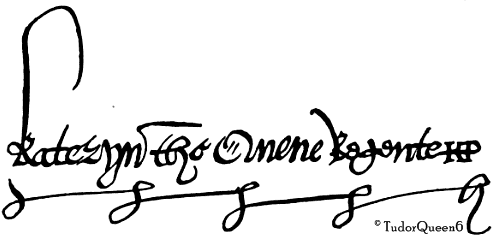
It was in August of 1544 that the General Regent is recorded as signing her letter “Kateryn the quene Regente, KP” keeping with her signature of “Kateryn the quene, KP” as consort.

Source: “Henry VIII: July 1544, 21-25.” Letters and Papers, Foreign and Domestic, Henry VIII, Volume 19 Part 1, January-July 1544. Eds. James Gairdner, and R H Brodie. London: His Majesty’s Stationery Office, 1903. 581-596. British History Online. Web. 26 August 2023. http://www.british-history.ac.uk/letters-papers-hen8/vol19/no1/pp581-596.

Katherine’s signature as Queen Regent.

Queen Katherine Parr: Prayers or Meditations (1545)

“She was the first queen of England to write and publish her own books and to become a recognized author during her lifetime and the first Englishwoman to publish a work of prose in the sixteenth century.” (Susan James, “Catherine Parr: Henry VIII’s Last Love”, 2010, pg 12)

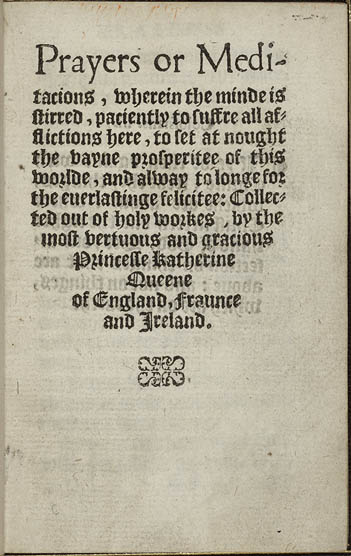
“The first edition of Queen Katherine Parr’s Prayers or Meditations appeared on June 2, 1545, under the title Prayers stirryng the mynd vnto heauenlye medytacions. This volume reprinted the two non-Biblical prayers—one for King Henry, the other for men to say going into battle—that concluded her translation Psalms or Prayers, published a year earlier. A second edition with the same contents, bearing the same date, carried the title Prayers or meditacions, wherin the mynde is styrred paciently to suffre all afflictions here. The definitive version (the third edition) appeared on November 6, 1545, under the title PRAYERS OR Medytacions, wherein the mynd is stirred, paciently to suffre all afflictions here, to set at nought the vayne prosperitee of this worlde, and alwaie to longe for the everlastynge felicitee: Collected out of holy wookes by the most vertuous and graciouse Princesse Katherine quene of Englande, Fraunce, and Irelande.1 This volume concluded with four prayers that may well be Queen Katherine’s compositions, the latter of the two just mentioned and three others that gradate from a public to a private perspective: “A devout prayer to be daily said,” “Another prayer,” and “A devout prayer.” The first two editions, identical except for their titles, and the third, definitive one rapidly gained popularity with English readers, who often knew the work as “The Queen’s Prayers.” Thirteen editions appeared before the end of the sixteenth century.” (Parr, Katherine, and Janel Mueller (ed.). “Introduction to Prayers or Meditations (1545).” In Katherine Parr: Complete Works and Correspondence. Edited by Janel Mueller (ed.).University of Chicago Press, 2011. Chicago Scholarship Online, 2013. https://doi.org/10.7208/chicago/9780226647265.003.0009.)

Folger Shakespeare Library PDI Record: — Call Number (PDI): STC 4824a Creator (PDI): Catharine Parr, Queen, consort of Henry VIII, King of England, 1512-1548. Title (PDI): [Prayers stirryng the mind unto heavenlye medytacions] Created or Published (PDI): [1550] Physical Description (PDI): title page Image Root File (PDI): 17990 Image Type (PDI): FSL collection Image Record ID (PDI): 18050 MARC Bib 001 (PDI): 165567 Marc Holdings 001 (PDI): 159718 Hamnet Record: — Creator (Hamnet): Catharine Parr, Queen, consort of Henry VIII, King of England, 1512-1548. Uniform Title (Hamnet): Prayers stirryng the mind unto heavenlye medytacions Title (Hamnet): Praiers Title (Hamnet): Prayers or meditacions, wherein the minde is stirred, paciently to suffre all afflictions here, to set at nought the vayne prosperitee of this worlde, and alway to longe for the euerlastinge felicitee: collected out of holy workes by the most vertuous and gracious princesse Katherine Queene of England, Fraunce, and Ireland. Place of Creation or Publ. (Hamnet): [London : Creator or Publisher (Hamnet): W. Powell?, Date of Creation or Publ. (Hamnet): ca. 1550] Physical Description (Hamnet): [62] p. ; 8⁰. Folger Holdings Notes (Hamnet): HH48/23. Brown goatskin binding, signed by W. Pratt. Imperfect: leaves D2-3 and all after D5 lacking; D2-3 and D6-7 supplied in pen facsimile. Pencilled bibliographical note of Bernard Quaritch. Provenance: Stainforth bookplate; Francis J. Stainforth – Harmsworth copy Notes (Hamnet): An edition of: Prayers stirryng the mind unto heavenlye medytacions. Notes (Hamnet): D2r has an initial ‘O’ with a bird. Notes (Hamnet): Formerly STC 4821. Notes (Hamnet): Identified as STC 4821 on UMI microfilm, reel 678. Notes (Hamnet): Printer’s name and publication date conjectured by STC. Notes (Hamnet): Running title reads: Praiers. Notes (Hamnet): Signatures: A-D⁸ (-D8). Notes (Hamnet): This edition has a prayer for King Edward towards the end. Citations (Hamnet): ESTC (RLIN) S114675 Citations (Hamnet): STC (2nd ed.), 4824a Subject (Hamnet): Prayers — Early works to 1800. Associated Name (Hamnet): Harmsworth, R. Leicester Sir, (Robert Leicester), 1870-1937, former owner. Call Number (Hamnet): STC 4824a STC 4824a, title page not for reproduction without written permission. Folger Shakespeare Library 201 East Capitol Street, SE Washington, DC 20003