20 September: Queen Katherine Parr’s Letter in Latin to Princess Mary

Written by Meg McGath

The official date of the letter is actually confusing. It was either written while Katherine Parr was Queen Regent in 1544 or as Dowager Queen in 1547.

The messenger mentioned in the letter is most likely Walter Erle, groom of the Queen’s privy chamber, who also served as her musician on the virginals, but possible Robert Cooch, steward of her wine cellar whose skill in music was commended by Parr’s chaplain, John Pankhurst.

Also mentioned in the letter is Francis Mallet who became chaplain to the Princess Mary in 1544 leaving the employment of Parr. (Wikipedia)

While the reasons are many, most notable and most beloved lady, that readily invite me at this time to writing, still nothing quite so much moves me as care for your health, which as I hope it is the best, so I very greatly desire to be made of certain of it. Wherefore, I send you this messenger who, I judge, will be very pleasing to you both because of his skill in music, in which, I am not unaware, you as well as I delight exceedingly, and also because he, having been in service to me, can report to you most certainty on my whole state and health. And truly, before this day it was in my mind to have made a journey to you and greeted you in person, but indeed not all things answer to my will: I hope now that, at a very early day this winter, you will be visiting us. Then which truly nothing will be a greater joy or a greater pleasure.

Since, however, as I have heard, the last touch has now been put by Mallet on Erasmus’s work On John (which he saw through translation), and nothing else now remain except some due attention and care to be applied in correcting it, I pray you to send to me this very fine and very useful work, now emended by Mallet or someone of yours, that it may be given to the press in its time. And further, that you signify whether you wish it to go out most happily into the light under your name, or whether rather by an unknown author. To which work really, in my opinion, you will be seen to do an injury, if you refuse the book to be transmitted to posterity on the authority of your name: for the most accurate translating of which you have undertaken so many labors for the highest good of the commonwealth; and more than these (as is well enough known) you would have undertaken, if the health of tour body had permitted. Since no one does not know the amount of sweat that you have laboriously put into this work, I do not see why you should reject the praise that all confer on you deservedly. However, I leave this whole matter to your prudence, so that whatever position you wish to take, I will esteem it most greatly to be approved.

As for the sum of money you sent to me as a gift, I thank you exceedingly. I pray the most good and most great God that He will think it fit to bless you perpetually with true and unblemished happiness: in whom, indeed, may you fare well a very long while. From Hanworth September 20.

You most devoted and most loving,
Katherine the Queen KP

Hanworth by David Bridges

Sources

Katherine Parr: Works and Correspondence by Katherine Parr, Janel Mueller (Google eBook preview)

© 2024 Meg McGath. All research and original commentary belong to the author.

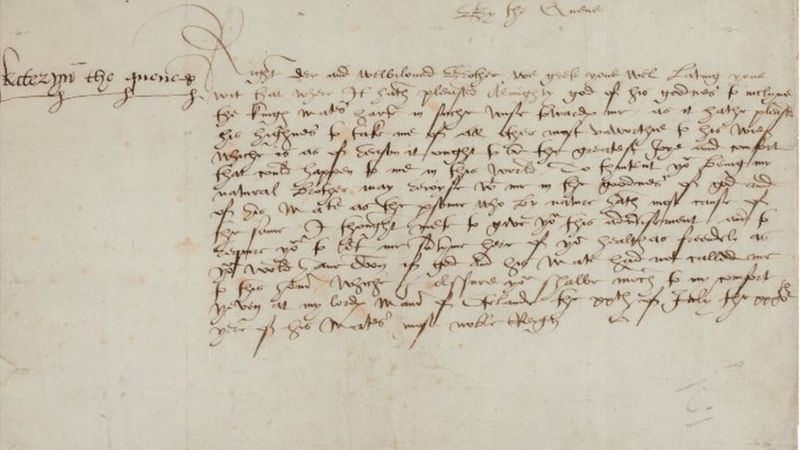
Queen Katherine Parr: Letter to Brother William—Up for Auction 2023

Queen Katherine Parr | Letter signed, announcing her marriage to Henry VIII, 20 July 1543
Sotheby’s
“To our right dear and entirely beloved brother, the Lord Parr, Lord Warden of the Marches,” Sotheby’s

“Right dear and well-beloved brother, we great you well. Letting you wit that when it hath pleased almighty God of His goodness to incline the King’s majesty in such wise towards me, as it hath pleased his highness to take me of all others, most unworthy, to his wife, which is, as of reason it ought to be, the greatest joy and comfort that could happen to me in this world:

To the intent, you being my natural brother, may rejoice with me in the goodness of God and of his majesty, as the person who by nature hath most cause of the same, I thought meet to give your this advertisement. And to require you to let me sometime hear of your health as friendly as you would have done, if God and his majesty had not called me to this honor: which, I assure you, shall be much to my comfort. Given at my lord’s manor of Oatlands, the twentieth of July, the thirty-fifth year of his majesty’s most noble reign.

Kateryn, the quene”

Source: Katherine Parr: Complete Works and Correspondences, editor Janel Mueller. University of Chicago, 2011. pg 46.

ANNOUNCING HER MARRIAGE TO KING HENRY VIII, explaining that “It hath pleased Almighty god of his goodness to incline the Kinges ma[jes]tes harte in suche wise towards me”, celebrating an event which is “the greatest Joye and comfort that could happen to me in this world”, and inviting her brother to “rejoyse with me in the goodness of god and of his Ma[jes]te”, 1 page, oblong folio, Oatlands, 20 July 1543, integral address leaf (“To our right der and entirely beloved Brother the Lord Parre Lord Warden of the Marches…”), docketed, fragile at folds, crude repair to marginal tear, spotting

HENRY VIII’S FINAL QUEEN ANNOUNCES HER MARRIAGE TO THE KING. This remarkable letter was written just days after the marriage between the aging Henry VIII and his final Queen. The wedding ceremony had taken place on 12 July in the Queen’s Closet at Hampton Court Palace, attended by only 18 people. The couple immediately started on the court’s summer progress and this letter was written from the first stop on their journey, Oatlands Palace in Surrey.

Description of Lot from Sotheby’s

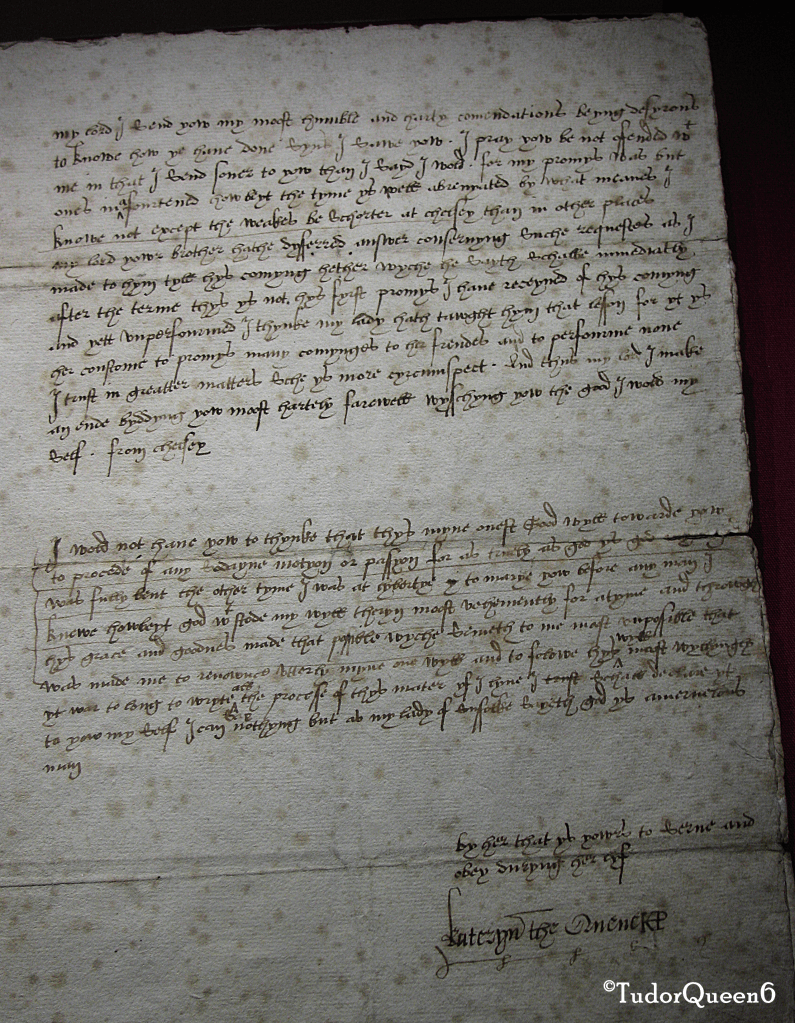
I noticed that this letter is not in her handwriting. Only the signature is authentically hers. You can compare it to the letter below that now sits on display at Sudeley Castle where she is buried.

A letter from Kateryn to Lord Seymour as shown at Sudeley Castle, February 1547.

Also, the signature is not followed by her maiden initials KP. Did the additional of her initials come later in her reign as queen? This letter was written on the 9th day of the reign of Queen Kateryn on 20 July 1543. Would be interesting to see when it was added.

Queen Katherine: Letter to Lady Wriothesley

Queen Katherine writes to Lady Wriothesley after the death of her son. The letter suggests that the two were not the best of friends. Katherine comes off a tad parental in her letter.

Good my lady Wriothesley,

Understanding it hath pleased God, of late, to disinherit your son of this world, of intent he should become partner and chosen heir of the everlasting inheritance (which calling and happy vocation ye may rejoice), yet when I consider you are the mother by flesh and nature, doubting how you can give place quietly to the same, inasmuch as Christ’s mother, endued with all godly virtues, did utter a sorrowful, natural passion of her Son’s death, whereby we have all obtained everlastingly to live: therefore…I have thought with mine own hand to recommend unto you my simple counsel and advice desiring you not to so utter your natural affection by inordinate sorrow that God have cause to take you as a m[urm]urer against His appointments and ordinances.

For what is excessive sorrow but a plain evidence against you, that your inward mind doth repine against God’s doings, and a declaration that you are not contented God hath put your son — but nature, but His by adoption — in possession of the heavenly kingdom? Such as have doubted of the everlasting life to come doth sorrow and bewail the departure hence. But those which be persuaded that, to die here, is life again, do rather hunger for death, and count it a foolish thing to bewail it as utter destruction. How much, Madam, are you to be counted godly wise that will and can prevent, through your godly wisdom, knowledge, and humble submission, that thing that time would at length finish? If you lament your son’s death, you do him great wrong and show yourself to sorrow for happiest thing there ever came to him, being in the hands of his best Father. If you be sorry for your own commodity, you show yourself to live to yourself…

Source

Mueller J. (ed.) Katherine Parr – Complete Works and Correspondences, Chicago, 2011, pp. 80-81.