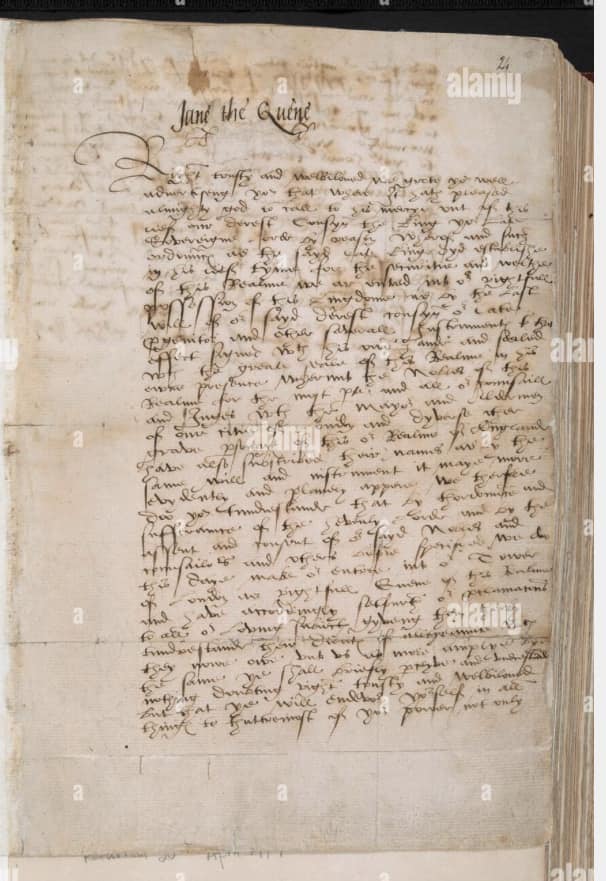
10 JULY 1553: LETTER written to Sir William Parr, 1st Marquess of Northampton, Earl of Essex, Baron Parr of Kendal from ”Jane, the Quene” ordering him to levy forces, 1553 (British Library) from Alamy
Written by Meg McGath
A letter from Queen Jane to William Parr ordering him to levy forces, 1553 . folio.A Volume, containing Letters, &c. written by royal, noble, and eminent Persons of Great Britain, from the time of King Henry VI. to the reign of his present Majesty. These are originals, except where otherwise expressed. [1449]-1761. Source: Lansdowne 1236, f.24.
I love how much people dismiss Queen Kateryn Parr. There may be evidence that she WAS supposed to be Regent for Edward VI. See her signature AFTER Henry died.
Credit: Elizabeth Norton
She was apparently signing as “Kateryn, the quene regente KP”. The theory goes that she was indeed made Regent for her stepson, King Edward VI. Which would make sense with the use of her signature. It is believed that Edward Seymour, Duke of Somerset, Kateryn’s brother the Marquess of Northampton, her brother-in-law the Earl of Pembroke and the council ousted her and rewrote the will. She would have made a wonderful Queen Regent. She proved she was capable of being Regent while Henry went to war with France. Perhaps she would have lived longer and prevented the succession from being rewritten. She gets credit for the placement of Princesses Mary & Elizabeth back into the line of succession behind their brother in 1545. That succession act seems to have overwritten or they disregarded King Edward’s will and supported the actual heir to the throne, Mary. Mary WAS the rightful heir. Jane was further down the approved line of succession. Why would you accept someone below the status of the actual daughters of King Edward’s father, Henry VIII? Kateryn Parr’s brother and brother in law were again involved in matters of the state and actually pulled off putting Lady Jane Grey on the throne for 9 days! Jane somehow outranked her own mother who was STILL alive and technically would have been the next heiress to the throne after Princesses Mary & Elizabeth. I never understood that. The Protestants feared the Catholic “Bloody Mary” (her nickname was started as Protestant propaganda, the pro Queen Elizabeth movement, lol) would try to return the country to the Pope and Catholicism. Mary was deeply religious. Kateryn Parr and Mary got on despite differences in matters like religion. Parr’s mother, Lady Maud, had served Mary’s own mother, Queen Katherine of Aragon, the first wife and crowned Queen consort to King Henry. The two women were pretty close. The Parrs backed Queen Katherine of Aragon when her lady in waiting became the Kings new obsession. Parr let Mary be and encouraged her every chance she could. One could argue she loved Mary more than Elizabeth. Heck, Kateryn named her only daughter and child, Mary, before the queen passed on 5 September 1548. Don’t think there were any other important Marys. The French Queen, Mary Tudor, had died long before Parr became Queen. Pretty sure it’s not after The Virgin Mary. Protestants aren’t that attached to her, right? I was raised Catholic, so I honestly don’t know. Anyway, Queen Kateryn Parr was VERY important. Read a book. She wasn’t an ex-queen. She remained Queen (consort) of England, Ireland, and France until she died. She was the LAST Tudor Queen Consort as King Edward died young. She was also the FIRST Queen of Ireland. Her funeral was the FIRST Protestant funeral for a Queen. Her mourner was none other than Lady Jane Grey, who would have probably stayed with Kateryn had the queen lived. Having Parr around seemed to pacify things. She knew how to handle tricky and dangerous situations. For Gods sake, she almost lost her head after she spoke with the King. It was overheard by the queens enemy, Bishop Gardiner, who saw an opportunity to “get rid” of Kateryn. I mean why not? He already KILLED TWO WIVES!! Lordy, so Gardiner tried to fuck with the Kings head. Saying shit like “it is a petty thing when a woman should instruct her husband” or some stupid sexist bs! Story goes, Kateryn was warned by an anonymous source who found her death warrant lying on the ground. YEAH RIGHT!! That’s straight up narcissistic abuse, my man!! Why do I feel like Henry set her up to test her loyalty? He was such a theatrical douche bag. No, no love for King Henry here. I have yet to see the film “Firebrand” which follows the reign of Kateryn as queen consort and queen Regente I believe. It’s based off Elizabeth Freemantle’s “Queen’s Gambit”. Anyway, Kateryn talked her way out of being arrested or worse by stroking the Kings ego and basically submitting to him just to fuvking survive. Imagine going through this marriage without psych meds like Benzos. I do believe they dabbled in potions however and she was known to “treat” melancholy with herbs from the gardens. Sudeley Castle where she is buried has a garden full of deadly herbs. Physic gardens. I have photos somewhere…
Helena, Marchioness of Northampton c.1603 by Robert Peake, the elder. She’s wearing coronation robes for the coronation of James I. Inscription, top left reads: “Helena, Relict of WillmParr Marquis of Northampton, and wife to Sir Thos Gorge of Longford near Salisbury, Daughter of Wafancus Knacenburg of Sweden. She was Chife Mourner at the Funeral of Queen Elizabeth April 28, 1603.” (Wikipedia)
Helena Parr, marchioness of Northampton (1548-1635), a courtier, was born in 1548 in Sweden, the daughter of Ulf Henriksson (d. 1560×68), a nobleman of Östergötland, and his wife, Agneta Knuttson (d. after 1568). Helena (Elin) had two brothers and several sisters. Her father was a supporter of Gustav Vasa, king of Sweden, and came from the old noble family of Bååt, while her mother was a descendant of the jarls or earls of Orkney. The name Snakenborg was taken from her mother’s family, which was originally from Mecklenburg.
Helena was one of six young Swedish girls appointed from 1564 to 1566 as maids of honour to Princess Cecilia, margravine of Baden, daughter of Gustav Vasa. Late in 1564, when she was fifteen, they embarked on a voyage to England. It was rumoured that Cecilia decided to visit England to revive the suit of her brother Erik XIV to marry Elizabeth I, but it is not clear that this was the case. Taking a roundabout route over land and travelling through Poland and Germany, in order to steer clear of hostile countries, the party was so hampered by bad weather that almost a year passed before it reached its destination.
‘A Young Lady Aged 21, Possibly Helena Snakenborg, Later Marchioness of Northampton’ 1569. (Tate Museum)
On its arrival in England many prominent members of the nobility received the party. Helena was by all accounts a beautiful woman, having large brown eyes, red hair, and a perfect pink and white complexion. She caught the attention of William Parr, marquess of Northampton (1513-1571), nobleman and courtier, the third and only surviving son of Sir Thomas Parr of Kendal, Westmorland, and his wife, Maud. He soon endeavored to court her. Northampton presented her with many extravagant gifts such as clothes and jewels, and ‘being an impressionable and romantic young girl, Helena was swept off her feet by the experienced older man’ (James, 395). Cecilia built up large debts due to a lavish lifestyle and left England in April 1566 in order to escape her creditors. She wanted to take Helena back to Sweden with her; however, her young maid, enjoying life in her new country and becoming close to the marquess, was keen to remain. This wish was granted through Elizabeth’s influence.
Northampton hoped to marry Helena but felt prevented from doing so because, although divorced in 1551, his first wife, Lady Anne Bourchier, was still alive. Elizabeth was fond of Helena and appointed her a maid of honour from about 1567, before promoting her to gentlewoman of her privy chamber-a highly respected position at the heart of the court in which she was among the queen’s most intimate servants and controlled access by the press of courtiers. She was entitled to many privileges, such as her own lodgings at court, servants, and a horse. However, she was not a waged member of the privy chamber and it is not known how regularly she attended court. Bourchier died on 26 January 1571 and Northampton and Helena were finally able to marry in May. The wedding took place in Elizabeth’s presence in the queen’s closet at Whitehall Palace. The bride was twenty-two and the groom fifty-seven. They seemed happy together and divided their time between their houses in Guildford, Surrey, and at Stanstead Hall, Essex. The marriage came to a sudden end within a few months when the marquess died on 28 October in Thomas Fisher’s house in Warwick. There were no children. The marchioness received a substantial dower of £368 per annum, drawn from her husband’s estates in Cumberland. This may have been exchanged for lands worth £400 per annum in Huntingdonshire.
It was not too long before Helena captivated another admirer, Thomas Gorges [see below]. The queen was originally in favour of his approaches to Helena but changed her mind and refused to consent to a marriage, perhaps as a result of her notorious sexual jealousy regarding gentlewomen of her privy chamber or because she had strong views on unequal marriages; Helena was a marchioness and Gorges only a gentleman. The couple wed in secret about 1576. When Elizabeth learned of their deceit, Helena was banned from court, although she was later reinstated, possibly with the help of her influential friend Thomas Radcliffe, third earl of Sussex, the lord chamberlain. The queen warmed to her again and with wholly uncharacteristic generosity granted her manors in Huntingdonshire and Wiltshire.
The couple’s first child was born in June 1578 and named Elizabeth (1578-1659) after the queen, who was her godmother. Their first son, Francis (d. in or before 1599), was probably born in 1579. Gorges was persuaded by his wife to make his property of Longford, Wiltshire, bought after 1573, more appealing by rebuilding it. The mansion had been damaged by fire when he acquired it and a replacement was completed at great expense by 1591, under the final supervision of John Thorpe, since the entrance on its north-east front bears that date. Longford was the model for the ‘Castle of Amphialeus’ in Sir Philip Sidney’s Arcadia. Gorges was knighted in 1586. During this time Helena settled down to raise her family. She had two more daughters, Frances (1580-1649) and Bridget (1584-c.1634), and four more sons, all of whom were knighted: Edward Gorges, first Baron Gorges of Dundalk (b. 1582/3, d. in or before 1652); Theobald (1583-1647); Robert (1588-1648); and Thomas (b. 1589, d. after 1624).
Queen Elizabeth I’s Funeral Procession. Part of The Funeral Procession of Queen Elizabeth From a Drawing of the Time, Supposed to be by the Hand of William Camden (Society of Antiquaries, 1791). Folding panorama nearly 29 feet long. Zoom in for Helena, Marchioness of Northampton. Look and Learn / Peter Jackson Collection
The marchioness was still valued highly by Elizabeth and often acted as her deputy at the baptism of the children of distinguished noblemen, particularly towards the end of the reign, when the queen’s health was deteriorating. Helena must have been distressed when Elizabeth, whose friendship and guidance she had known ever since her arrival in England, died in March 1603 and she was the chief mourner in the funeral procession as senior peeress because Arabella Stuart refused to undertake the role. The accession of James VI to the English throne paved the way for the removal of many of Elizabeth’s old courtiers and Gorges was demoted. Helena did not retain all her privileges but was probably glad to escape the rivalry that existed among the gentlewomen of the privy chamber to Anne of Denmark. After Gorges died on 30 March 1610 at the age of seventy-four, Helena increasingly retreated from public life, although she remained a devoted member of the Church of England.
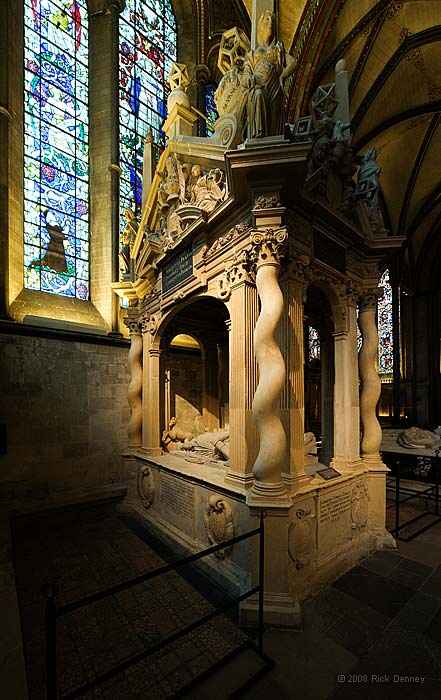
Helena, Marchioness of Northampton and Sir Thomas Gorges in Salisbury Cathedral.
Helena died on 10 April 1635 at Redlynch, Somerset, the residence of her son Sir Robert Gorges, and was buried on 14 May in Salisbury Cathedral. She had no fewer than ninety-two direct descendants at the time. She granted over £1700 in annuities and bequests in her will.
Sir Thomas Gorges (1536-1610), courtier, was born in Wraxall, Somerset, the fifth son of Sir Edward Gorges, landowner, of Wraxall, and his wife, Mary, daughter of Sir Anthony Poyntz of Iron Acton, Gloucestershire, and his wife, Elizabeth. He was a member of the royal household, groom of the privy chamber from 31 December 1571, JP for Huntingdon and Wiltshire from about 1579, special ambassador to Sweden in 1582, and MP for Longford, Wiltshire, in 1586, as well as keeper of many important royal estates. Gorges acted as Elizabeth’s ‘high grade messenger’ (HoP, Commons, 1558-1603, 2.208). He was one of the wealthiest gentlemen in Wiltshire. Gorges, like his wife, was buried in Salisbury Cathedral.
Sources
C. A. Bradford, Helena, marchioness of Northampton (1936) · S. E. James, Kateryn Parr: the making of a queen (1999), 394-7 · HoP, Commons, 1558-1603, 2.208 · will, TNA: PRO, PROB 11/167, sig. 41 · TNA: PRO, PROB 11/116, sig. 64 · administration, TNA: PRO, PROB 6/2, fol. 22r · GEC, Peerage, 4.16 Paul Harrington, ‘Gorges , Helena, Lady Gorges [other married name Helena Parr, marchioness of Northampton] (1548-1635)’, Oxford Dictionary of National Biography, Oxford University Press, Sept 2004; online edn, Jan 2008 http://www.oxforddnb.com/view/article/69751
Further reading
Roses Have Thorns: A Novel of Elizabeth I Sandra Byrd
Tate Gallery Report, 1960-61, pp.16-17 Gunnar Sjogren, ‘Portrait of a young lady, 1569; an identification’, Burlington Magazine, October 1980, pp.698-700
The Collegiate Church of St Mary in the town of Warwick, England. It is a Parish Church of the Church of England. (Wikipedia)
On 2 December 1571 Sir William Parr, 1st Marquess of Northampton was laid to rest in St. Mary’s Collegiate Church, Warwick, England.
The only commemoration of Northampton even being buried in St. Mary’s is marked by a stone tablet.
The inscription on the stone tablet reads:
‘Died in Warwick 28 October 1571. [Unknown] with the ceremonial due [of a] Knight of the Garter to the Order of Queen Elizabeth who bore the expense of the funeral, 2 December 1571.‘
Lord Robert Dudley, Earl of Leicester and favorite of Elizabeth I was also buried in St. Mary’s in September of 1588.
Coincidentally, William was buried in the same church as Elizabeth’s favorite, Robert Dudley, 1st Earl of Leicester. As he had requested, Leicester was buried in the Beauchamp Chapel—in the same chapel as Richard Beauchamp, his ancestor, and the “noble Impe”, his little son.
Collegiate Church of St Mary in Warwick, Beauchamp Chapel, tomb of Lord Robert and Lettice Dudley (born Knolly). (Wiki Commons)
His widow, Countess Lettice, was also buried there when she died in 1634, alongside the “best and dearest of husbands”, as the epitaph, which she commissioned says.
Wenceslaus Hollar, ‘Richard Beauchamp, Earl of Warwick (tomb)‘, University of Toronto Wenceslas Hollar Digital Collection. Wikimedia Commons.
The Beauchamp family vault is also in St. Mary’s. The tomb of the 13th Earl of Warwick features several of Northampton’s ancestors and cousins such as the Neville family. Northampton’s paternal great-grandmother, Lady Alice FitzHugh (born Neville), was sister to Richard Neville, 16th Earl of Warwick (“Warwick, the Kingmaker”) who is featured on the Beauchamp Monument. Also featured is the parents of Lady FitzHugh and Lord Warwick, The Earl and Countess of Salisbury, Richard and Lady Alice Montacute.
Tomb of Richard Beauchamp, 13th Earl of Warwick which is surrounded by mourners of his family and in-laws. (Moriarty Blog)
Lord Robert, Earl of Leicester descended from the 13th Earl via his paternal great-great-grandfather John Talbot, 1st Viscount of Lisle who was the son of Lady Margaret Beauchamp, Countess of Shrewsbury; eldest daughter of the 13th Earl of Warwick and his first wife, Elizabeth Berkeley.
When in doubt–don’t post a portrait of an unknown noble in the place for someone who has no known portrait. I have noticed that certain blogs have taken unknown portraits of Tudor women and used them as an example for their blog. What’s wrong with this? Well thanks to PinInterest and other sites, people come by web pages and snatch the portraits without properly identifying them. I should know, it’s happened to me several times. And due to this..there is a circulation of one portrait for a certain relation of Queen Katherine Parr who in fact has no known portrait. What’s worse is the woman in the painting is pregnant when we know there were no children by her husband, but rather by her lover.
Unknown Woman by Gower, 1578 is NOT Anne Bourchier.
So let’s get this straight. Wives 1, “2”, and 3. Sir William Parr, Baron Parr of Kendal, Earl of Essex, and eventually 1st Marquess of Northampton had three wives. Only two are known to have legit portraits. That’s William’s common law wife, Elisabeth Brooke, whom he wasn’t technically allowed to marry due to the fact that he could not get a divorce from his first wife, Lady Anne Bourchier who had left him for her lover. William could only file for an Act of Parliament to keep any illegitimate offspring of Anne and her lover from inheriting from him. This, he was granted during Henry VIII, Edward VI, and Elizabeth I’s reign. In the reign of Mary I, however, Parr had to endure his wife after being thrown in the Tower for trying to put Lady Jane Grey on the throne. People think that Lady Anne saved Parr’s life — honestly, she was only after money and property. Queen Mary finally relented however and let him go free but without his titles, etc.
Back to the portraiture — Elisabeth Brooke and his third wife, Helena were painted.
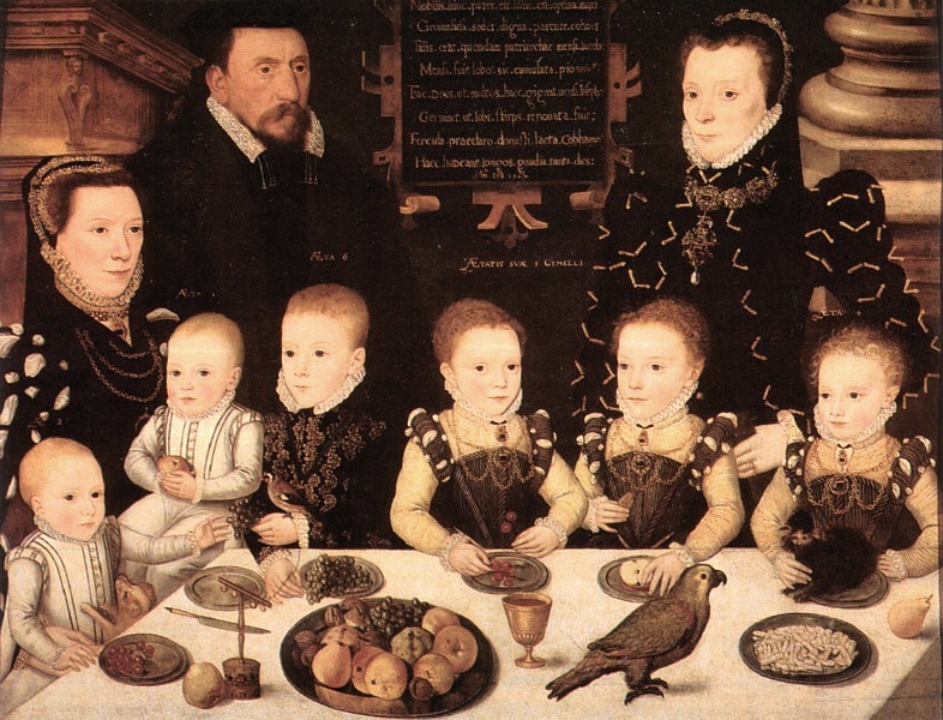
Elisabeth Brooke, Lady Northampton from the family portrait of the Brooke family.
Elisabeth Brooke’s portrait is from a larger portrait of her family. There is also a coin issued for her.
The Brooke Family of Elisabeth Brooke.
The portrait of Helena — there are thought to possibly be two.







 tudorqueen6 by Meg McGath

