Family of Queen Katherine Parr: Bishop Cuthbert Tunstall

Bishop Cuthbert Tunstall

Cuthbert Tunstall (c. 1474/5 Hatchford, Richmondshire, England – 18 November 1559 Lambeth Palace, London, England) was an English church leader during the reign of four Tudor monarchs. Through out his lengthy career he was Bishop of Durham, Bishop of London, Archdeacon of Chester, Lord Privy Seal, Royal adviser, and a diplomat. He was “lucky” enough to have served as Bishop of Durham [among other offices] and actually survive the reigns of three Tudor monarchs; King Henry VIII, Edward VI [Protestant], Mary I [Catholic]. Under the Protestant Queen Elizabeth I, Tunstall would be arrested in 1559 after refusing to take the Oath of Supremacy and die under house arrest at Lambeth Palace [home to the Archbishops of Canterbury].

“Tunstall’s long career of eighty-five years, for thirty-seven of which he was a bishop, is one of the most consistent and honourable in the sixteenth century. The extent of the religious revolution under Edward VI caused him to reverse his views on the royal supremacy and he refused to change them again under Elizabeth.”The Anglican historian Albert F. Pollard

Tunstall was illegitimate at birth, although his parents later married and the irregular circumstances of his background were never held against him. He was the son of Sir Thomas Tunstall, one of two sons of Sir Thomas of Thurland. Sharing a great-great-grandfather, Sir Thomas of Thurland Castle [Tunstall’s grandfather], Tunstall was a first cousin, twice removed on his father’s side to Queen Katherine Parr and her siblings Lady Anne Herbert and Sir William, 1st Marquess of Northampton. Tunstall was appointed as the executor of Sir Thomas Parr’s will. After his death, Tunstall continued to stay close to the Parr family. Tunstall advised Lady Maud Parr on the education of her children; especially that of her daughters. Maud named Tunstall as one of the executors of her will as well.

Tunstall was an outstanding scholar and mathematician, he had been educated in England, spending time at both Oxford and Cambridge, before a six year spell at the University of Padua in Italy, from which he received two degrees. His Church career began in 1505, after he returned to England. He was ordained four years later. At the time of his ordination four years later he had caught the attention of the Archbishop of Canterbury, William Warham, who sponsored Tunstall’s advancement and brought him to court. Tunstall was also a close to Wolsey, who recognized his potential to serve his country and diplomacy.
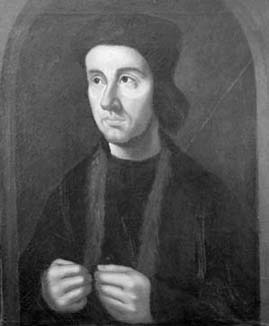
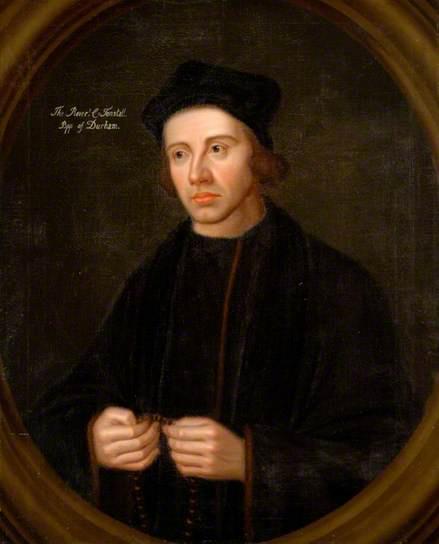
Cuthbert Tunstall [a portrait painted before the Reformation showed him with a rosary. It was obviously painted over].

Tunstall was close to all the great names of English humanism in the early sixteenth century, especially Sir Thomas More. The European humanist Erasmus greatly admired Tunstall’s modesty, scholarship, and charm. Tunstall helped Erasmus in his publishing.

Tunstall was a great publisher of many books including De arte supputandi libri quattuor (1522), which enhanced his reputation among the leading thinkers of Europe. This book would be used later by Mary Tudor and his cousin Catherine Parr as queen.

Like More, Tunstall was on intimate terms with King Henry VIII. During the King’s ‘Great Matter‘, Tunstall defended Queen Katherine of Aragon, but not with the vigour or absolute conviction of Bishop Fisher. Tunstall had been bold enough to tell Henry that he could not be Head of the Church in spiritual matters and he may have been one of the four bishops of the northern convocation who voted against the divorce, but he recognized that the queen’s cause was hopeless and never attempted opposition to the King. In fact, he attended Anne Boleyn’s coronation. But Tunstall felt he could not keep quiet, he wrote a letter personally to Henry about the rejection of Christendom, and other matters that bothered him. Henry disagreed and refuted every point Tunstall made. These exchanges led to a search of Tunstall’s home by order of the King, but no incriminating evidence was found. Rumor was that Sir Thomas More warned Tunstall in time to dispose of anything that might incriminate him.

Bishop Cuthbert Tunstall [right] confronts Katherine of Aragon in "The Tudors".

Bishop Cuthbert Tunstall [right] portrayed by Gordon Sterne confronts Katherine of Aragon in “The Tudors“.

Tunstall agreed to take the oath, unlike More and Fisher. He and Archbishop Lee of York were required to explain to the imperial ambassador, Eustace Chapuys, and subsequently the very angry Katherine of Aragon the justification for the annulment of her marriage. They did not succeed in getting her to agree or acknowledge the fact that she was no longer queen.

After the ‘great matter’ was resolved, Tunstall turned his loyalty back to the King. Tunstall was an executor of King Henry VIII’s will. Tunstall would go on to serve in the reigns of Edward VI, Mary I, and Elizabeth I.

On 19 July 1553, Mary was proclaimed Queen. After being imprisoned in The Tower under the rule of Edward VI, Mary released him and he went back to being Bishop of Durham. During the reign of Mary, Tunstall was very lenient on the Protestants involved in the “Marian Persecutions.”

Lambeth Palace, London. The oldest parts of the present buildings date from the 1400’s. The most obvious external feature is the gatehouse which is framed on either side by two towers, built by in tudor brick by Archbishop Morton in 1495. This is consequently known as Morton’s Tower.

It was during Elizabeth’s reign that Tunstall refused to take Elizabeth’s Oath of Supremacy and was subsequently arrested. Even though he had been Elizabeth’s godfather, he was deprived of his diocese in September 1559, and held prisoner at Lambeth Palace, where he died within a few weeks, aged 85. He was one of eleven Catholic bishops to die in custody during Elizabeth’s reign. He was buried in the chancel of Lambeth church under the expense of the Archbishop that had overseen his confinement, Parker.
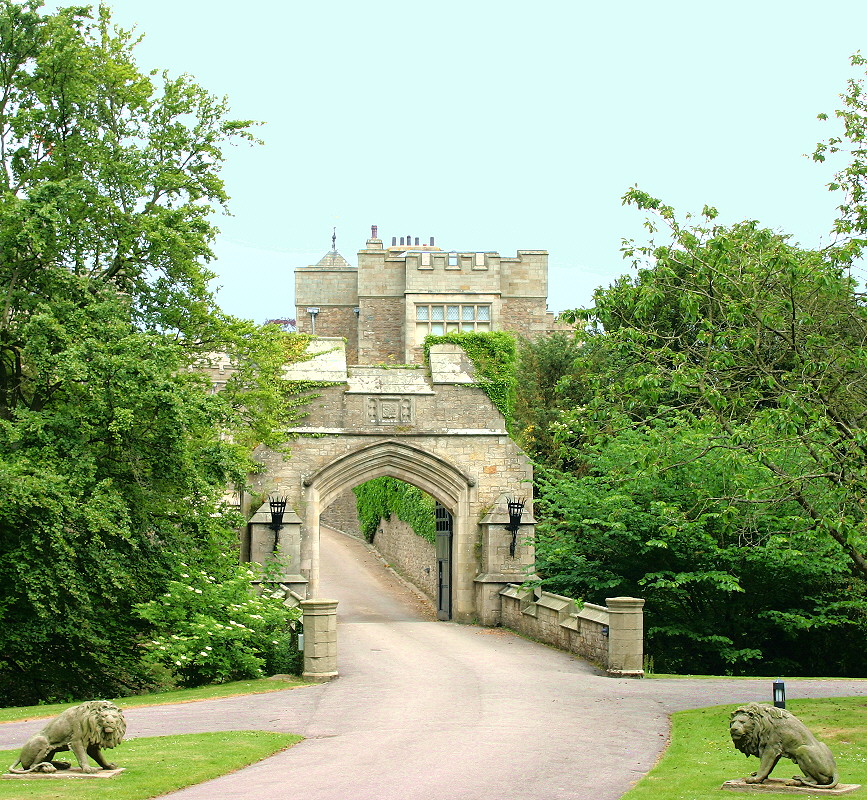
Thurland Castle Gate; Lancashire.gov.uk
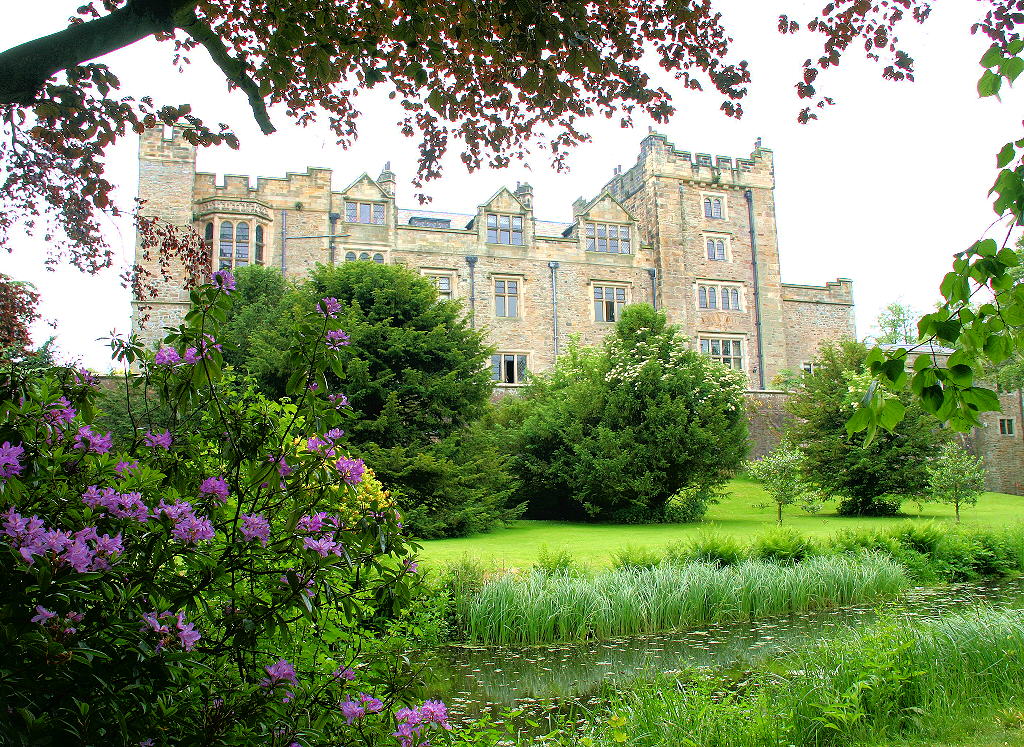
Thurland Castle; Lancashire.gov.uk

De arte supputandi libri quattuor

De arte supputandi libri quattuor Cuthbert Tunstall London: R. Pynson, 1522 [DeM] L.1 [Tunstall] SSR

De arte supputandi libri quattuor
Cuthbert Tunstall
London: R. Pynson, 1522 [DeM] L.1 [Tunstall] SSR

De Morgan in his Arithmetical Books was laudatory about Tunstall: “This book is decidedly the most classical which was ever written on the subject in Latin, both in purity of style and goodness of matter. The author had read every thing on the subject, in every language which he knew … and had spent much time, he says, ad ursi exemplum, in licking what he found into shape. … For plain common sense, well expressed, and learning most visible in the habits it had formed, Tonstall’s book has been rarely surpassed, and never in the subject of which it treats”. As hinted by De Morgan, Tunstall’s work is not original, but a confessed compilation. Tunstall‘s motivation for writing it was a suspicion that that the accounts goldsmiths with whom he was dealing were incorrect; he renewed his study of arithmetic in order to check their figures. His work was the first printed in Great Britain to be devoted wholly to mathematics.

Copy of Tunstall’s book from Lehigh University.

This is the first of three 16th-century editions in De Morgan’s library. De Morgan’s designation of it on the title page as “very rare” has since been disproved: nineteen other copies are recorded in Britain on ESTC, chiefly held in Oxford and Cambridge libraries, with another five in North America. (DeMorgan Library, London)

Tunstall Chapel

In Durham Castle, Tunstall constructed a Chapel in 1540. For more info: Tunstall Chapel.

Sources

  1. William Fordyce. “The history and antiquities of the county palatine of Durham:comprising a condensed account of its natural, civil, and ecclesiastical history, from the earliest period to the present time; its boundaries, ancient, parishes, and recently formed parochial districts and chapelries, and parliamentary and municipal divisions; its agriculture, mineral products, manufactures, shipping, docks, railways, and general commerce; its public buildings, churches, chapels, parochial registers, landed gentry, heraldic visitations, local biography, schools, charities, sanitary reports, population, &c,” Volume 1, A. Fullarton and co., 1857. Google eBook.
  2. Edward Foss. “The Judges of England: With Sketches of Their Lives, and Miscellaneous Notices Connected with the Courts at Westminster, from the Time of the Conquest,” Volume 5, Longman, Brown, Green, and Longmans, 1857. pg 237-40.
  3. Katherine Parr. “Katherine Parr: Complete Works and Correspondence,” editor Janel Mueller, University of Chicago Press, Jun 30, 2011.
  4. Linda Porter. “Katherine, the Queen,” Macmillian, 2010.

Family of Queen Katherine: Fogge of Kent

Sir John Fogge is know for being the great-grandfather of Queen Katherine Parr and other prominent Tudor courtiers.

Sir John Fogge (c.1417-1490) was Lord of the manor of Repton. His family was one of the first families in Kent, England. It was this John Fogge of Ashford who built and endowed the noble Church and the College at Ashford, Kent circa 1450, where he is also buried.

There is some uncertainty over the parents of Fogge. The most well-known source, “The Family Chronicle of Richard Fogge” shows John as the son of Sir William Fogge and an un-named daughter of William Wadham (his second wife).[17] “The Antiquary” states that he was the son of Sir William and his first wife, a daughter of Sir William Septvans.[15] However, Rosemary Horrox argues that he was the son of another John [and Jane Cotton]; Sir William’s younger brother.[12] Horrox also states he must have been born about 1417, since he was of legal age in 1438, and came to prominence when he inherited the senior line of the family by February 1447.[12]

John Fogge was for certain the grandson of Sir Thomas Fogge, who died in 1407. Fogge was buried in Canterbury Cathedral. He had been a soldier and courtier under King Richard II and his successor, the Lancastrian usurper, King Henry IV. Fogge’s standing in Kent was owed much to his early career as a Captain of war in France. His military service began in the retinue of Henry, Duke of Lancaster, the King’s lieutenant in Brittany from 1356. Like the Parrs’, he served John, Duke of Lancaster; the third surviving son of Edward III. He was of service to Lancaster in Spain in 1386.[13] It is uncertain for how long Fogge had been a retainer of Lancaster, but on 13 June 1372, the Duke formally retained him for life. Lancaster made mention of Fogge’s good service in the past and indicated by the size of the annuity granted (100 marks) that he ranked him high in his esteem. Under Lancaster, Fogge was Captain of Calais among other high postings.[19]

Thomas Fogge’s eldest son, John, came to the court of the Lancastrian King Henry IV. John served on a number of commissions and was appointed Sheriff of Kent in 1453.  John would continue to hold favor under the new King and gained the esteemed office of Comptroller of the Household in 1460 and keeper of the wardrobe to Henry VI in the last year of his first reign. John was knighted by the King in 1461.

In 1461 and 1463, under the Yorkist King, Edward IV, John Fogge was elected to Parliament as knight of the shire for Kent. Fogge became a Privy Councillor. From 1461-68, he was Comptroller and Treasurer of the Household [later known as Lord Chamberlain under the Tudor monarchs]. Fogge would continue that role for the Prince of Wales (later King Edward V). In 1461, Fogge was granted the office of keeper of the writs of the Court of Common Pleas.[2] He took part in the investigation of the possible treason of Sir Thomas Cooke. In 1467, he was MP for Canterbury and Sheriff of Kent, again, in 1472 and 1479. He represented Kent in parliament in 1478 and 1483.[1] It is thought that Fogge may have accompanied Edward into exile.[16] For Fogge’s continued loyalty to the Crown, he was awarded the Constableship of Rochester Castle, the keeping of Hothfield Manor, and the manors of Towton and Dane, which had formerly belonged to the Lancastrian loyalist, Sir Thomas Brown.[16]

From 1473, he was on the council and one of the tutors of Prince Edward (the future King Edward V).[16] He undertook administration of his property and was made Chamberlain jointly with Sir John Scott.[1] Fogge’s kinsman, Anthony, Earl of Rivers, was appointed the Prince’s Governor.[16] Fogge’s Haute kinsmen also rose in royal favor; Richard Haute had also become one of Prince Edward’s tutors and councilors and by 1483 Haute was controller of this household.[16]

In 1483, he supported Richard Guildford in Kent against Richard III, this rising being in support of Edward V, and becoming part of the unsuccessful Buckingham’s rebellion.[4] This was despite an apparent reconciliation with the king as soon as he came to the throne, after Fogge had taken sanctuary in June 1483 at the time of Richard’s coup in Westminster Abbey.[5][6] The rising was blocked at Gravesend by John Howard, 1st Duke of Norfolk; and the rebel force retreated.[7] The king acted mercifully once order had been restored;[8] but Fogge later did have lands in Kent confiscated and given to Sir Ralph Ashton.[9]Throughout the many conflicts which arose with the War of the Roses, Sir John was lucky enough to survive, especially when Richard III came to the throne. Sir John was a supporter of Henry Tudor and reportedly had a role in the Battle of Bosworth field. Because of this, Sir John’s lands that were attained during King Richard’s reign were restored as soon as King Henry VII came to power.

There is some confusion as to which wife he married first; they were both named Alice. It is thought that Alice Haute was Fogge’s first wife. His second wife was Alice de Criol or Kyriell, the daughter of the Yorkist Sir Thomas de Kyriell who was killed at the second battle of St. Albans. This marriage brought him Westenhanger Castle.[10]The “History of Ashford” states that Alice de Kyriell was Fogge’s first wife and that Alice Haute was his subsequent marriage. However, it then states that Alice was formerly married to a Woodville; which is not true. She was the daughter of a Woodville.

Fogge’s switch from the Red Rose of Lancaster to the White Rose of York was most likely due to his marriage into either the Woodville or Kyriel family; both families joined the Duke of York [later King Edward IV] in 1460. Fogge, Sir William Haute [father of Alice], and Sir Thomas Kyriel [father of Alice] were part of the first group to join the Yorkist earls when they arrived at Kent in 1460.[16]

Family

Edward IV and Elizabeth Woodville by Sophie Carter.

Edward IV and Elizabeth Woodville by Sophie Carter.

Fogge’s first wife was Alice Haute or Hawte (born circa 1444),[11] whom he had married c. 1465. She was the daughter of Sir William Haute of Hautsbourne, Kent (c.1390-1462) and Joan Woodville, sister of Richard Woodville, 1st Earl Rivers; and as so Alice was first cousin to Elizabeth Woodville, queen consort to Edward IV, and mother to Elizabeth of York.[12][13] When Elizabeth became queen, she brought her favorite female relatives to court.[21] As Lady Alice Fogge, Alice was one of the queen’s five ladies-in-waiting during the 1460s.[21]

According to Susan James and Linda Porter, they believe Sir John Fogge was the great-grandfather of Queen Katherine Parr.[11]  The other children included Sir John Fogge of Repton Manor and Margaret, Lady Stafford (mother of Sir William Stafford, husband to Mary Boleyn).[14][18]

His son Sir Thomas Fogge, Sgt of Calais was the son of his second marriage to Alice Kyriell.[14][15] His daughters Anne and Elisabeth were probably from the second marriage as well.[12]Illegitimate Daughter of Richard III Theory

There is a very slight possibility that Richard III’s mistress (or one of them) and mother to his illegitimate daughter was the sister-in-law to Lady Fogge. Katherine was the wife of James Haute (son of William Haute and Joan Woodville). Little is known about her; however in 1477 Richard in a grant gave to Katherine Haute 100 shillings per annum for life (DL29/637/10360A). There is no apparent reason for Richard to give her an annuity, and her Christian name is of course that of Richard’s illegitimate daughter, an uncommon one in the Yorkist Neville families. All of this may of course be far from the truth, although it is suggestive.[23]

Burial

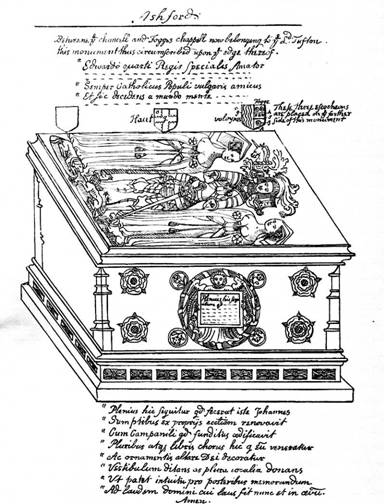
The tomb of Sir John Fogge and his two wives at Repton Church, Kent, England. An inscription round the margin of the slab, of which only a part remained in the days of Dering, completed the memorial. It seems to have recorded “that Sir John was a special friend of Edward IV., … and departed this world universally esteemed by the common people.”

Fogge died in 1490. The tomb in which he’s buried stands on the North side of the altar between the chancel and Fogge Chapel. The original ornaments have been stripped, but there were originally brass effigies of his two wives, Alice Kyriell and Alice Haute. The mantels of the wives were fastened with a rose. At their feet were crouched dogs with knotted leading strings. On the south side of the tomb had been enriched with Gothic arches where three shields were found; Kryiell, Haute, and Valoignes impaling Fogge. Fogge’s effify was attired in rich armor and decorated with the Yorkist collar of suns and roses with the white lion of Marche. His head reclined on his helmet, adorned with mantlings and crest. At his feat sat an Italian greyhound. On the north side the center ornament was an angel supporting an inscription panel with an endless circle formed of rose sapling sticks firmly bound together perhaps to show the stability of the family unity, the vitality of which is indicated four small sprouts of rose branches with leaves and blossoms. Four large bosses of the united Roses proclaimed a Yorkist’s acquiescence in the peaceable conclusion of the commotion.[22]

Coat of Arms

Fogge of Kent

Fogge of Kent

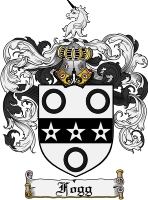
Their arms, Argent, on a fess, between three annulets, sable, three mullets, pierced of the first, which coat is carved in stone on the porch of Ashford church, on the roof of the cloysters at Canterbury, and in several windows of the cathedral there.[20]

Images

  • Drawings by Sir Edward Dering, 17th Century, published in Archaelogica Cantiana, Vol 2, 1859 [out of copyright].

Notes

    1. Charles Ross, Richard III (1981), p.106.
    2. J. R. Lander, Conflict and Stability in Fifteenth-century England (1971), p. 180.
    3. Arelene Okerlund, Elizabeth, England’s Slandered Queen (2006), p. 104.
    4. Paul Murray Kendall, Richard III (1972), p. 261.
    5. Ross, p. 112.
    6. Michael Bennett, The Battle of Bosworth (1987), p. 41 and p. 43.
    7. Kendall p. 271.
    8. Kendall p. 276.
    9. Ross, p. 119.
    10. http://www.fortifiedengland.com/Home/Categories/ViewItem/tabid/61/Default.aspx?IID=3415
    11. The Lineage and Ancestry of H.R.H. Prince Charles, Prince of Wales, by Gerald Paget, Vol. I, p. 95.
    12. Rosemary Horrox. “Fogge, Sir John“, on the website of the Oxford Dictionary of National Biography
    13. Peter Fleming. “Haute family“, on the website of the Oxford Dictionary of National Biography
    14. ‘Parishes: Stanford’, The History and Topographical Survey of the County of Kent: Volume 8 (1799), pp. 63-78. URL: http://www.british-history.ac.uk/report.aspx?compid=63459&strquery=fogge Date accessed: 05 December 2012.
    15. E.W. Allen. “The Antiquary,” Vol. 3-4, 1873.
    16. Sheila Sweetinburgh. “Later Medieval Kent, 1220-1540,” Boydell & Brewer, Nov 18, 2010. pg 258.
    17. Archaelogica Cantiana, Vol 5, 1863
    18. Douglas Richardson. “Plantagenet Ancestry: A Study In Colonial And Medieval Families,” 2nd Edition, 2011. pg 219-25.
    19. The History of Parliament: the House of Commons 1386-1421, ed. J.S. Roskell, L. Clark, C. Rawcliffe., 1993.
    20. Edward Hasted. ‘The town and parish of Ashford’, The History and Topographical Survey of the County of Kent: Volume 7 (1798), pp. 526-545.
    21. Barbara J. Harris. “English Aristocratic Women, 1450-1550 : Marriage and Family, Property and Careers: Marriage and Family, Property and Careers,” Oxford University Press, Jul 26, 2002. pg 218.
    22. Rev. A. J. Pearman. “History of Ashford,” H. Igglesden, 1868.
    23. Peter Hammond. “His Illegitimate Children,” Dr Rosemary Horrox notes. Richard III Society: Richard III — His Family.