Link

Lady Jane Grey Discoveries

 Jane Grey9
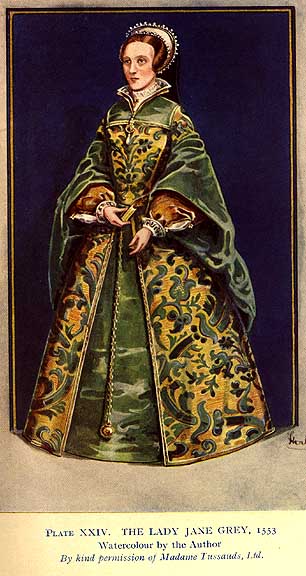
Historian Stephan Edwards has concluded in his latest research that Leanda de Lisle [author of “Tudor: The Family Story”] was correct in writing in ‘The Sisters Who Would be Queen’ that the famous description of Lady Jane Grey’s procession to the Tower, supposedly written by a witness called Spinola, is a twentieth century fraud. Lisle noted in an article for BBC History magazine (which is on her website under ‘articles’) that the costume Spinola describes resembles this Victorian image. Anyway, Dr Edwards has done further research into the fraud, and every interesting it all is. See here: http://www.somegreymatter.com/spinola.htm

Dr Edwards has, however, also published and translated for the first time two Italian letters that actually were written in 1553. This really is brilliant work! They give the first authentic description of Guildford Dudley’s appearance and also describe Jane! Thank you Dr Edwards and Leanda de Lisle for your incredibly generous sharing of your research online. http://www.somegreymatter.com/lettereintro.htm

Ancestral Homes for Sale

The Castles include Thurland which has been converted into luxury apartments and Westhanger. Both castles belonged to Queen Katherine’s ancestors.

Westhanger was part of her maternal grandmother’s family, the Fogges of Kent, from 1461 to 1509. Jane Fogge was a daughter of Sir John Fogge, who married a cousin and lady to Queen Elizabeth (consort of Edward IV).

In 1509, the two manors of Ostenhanger and Westenhanger which stood here were merged into one ownership by Sir Edward Poynings and we know from historic papers that he began to build magnificently. Unfortunately he died with the work incomplete in 1522 but his son, Sir Thomas Poynings, went on with the building, later exchanging Westenhanger with King Henry VIII for other lands.

By 1544 we know that the house was extensive and incorporated separate suites of rooms for the use of royalty. Later Queen Elizabeth I visited ‘her house at Westenhanger’. (From their official site)

Impressive though Westenhanger is, it isn’t the only castle with a history to be proud of on sale. Thurland was home to Queen Katherine’s paternal great-grandmother’s family; Alice, daughter of Sir Thomas Tunstall. Thurland Castle in Lancashire, although split into several apartments, still retains its moat and was owned by Sir Bryan Tunstall, a heroic soldier immortalised in a poem by Sir William Raleigh.

He was a hero of the Battle of Flodden in 1513, and was dubbed the ‘Stainless Knight’ by King Henry VII. He was followed by his son Marmaduke, who became High Sheriff of Lancashire.

http://www.dailymail.co.uk/femail/article-2465371/Got-spare-2-5million-Then-amazing-CASTLES-.html

The White Queen: The REAL Duchess of York

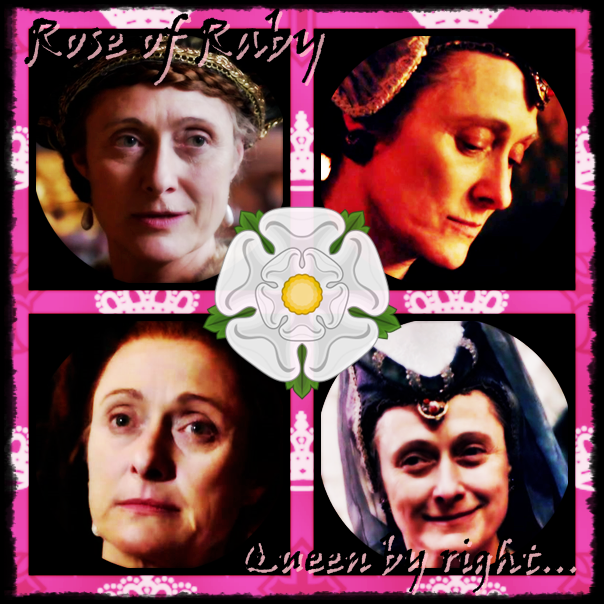
Lady Cecily, Duchess of York portrayed by Caroline Goodall.

Lady Cecily, Duchess of York portrayed by Caroline Goodall.

Scene RE-DONE the way it should have been done! You bow twice to the King’s mother and she doesn’t back down!

After the first episode of ‘The White Queen’, I was quite upset at the representation of the King’s mother, the Duchess of York [I even wrote a blog I was SO upset]. As a royal Duchess who would have become Queen if her husband had not died — she was in fact practically queen in all but name; Queen Mother. Her husband, Richard, Duke of York, was granted the title of Prince of Wales and Lord Protector so Cecily was technically Princess of Wales before her husband died.

“But for an accident of fate would have been queen”. (‘At the King’s Pleasure’: The Testament of Cecily Neville by Alison Spedding)

Born Lady Cecily Neville, she was part of the powerful Neville family which would help bring her son to the throne. Cecily was the youngest daughter of Sir Ralph Neville, 1st Earl of Westmorland and his second wife, Lady Joan Beaufort, herself the daughter of one of the most powerful royal Princes and noblemen in history, Prince John of Gaunt, Duke of Lancaster. As such, Lady Cecily was a niece of King Henry IV of England, cousin of King Henry V, and cousin, once removed of King Henry VI. And by the marriages the children of the Duke of Lancaster made, Cecily was kin to several royal houses on the continent, i.e, Portugal, Castile, and Burgundy. She was of royal blood being the great-granddaughter of King Edward III and his consort Philippa of Hainault.

Her husband, the Duke of York, was the leading contender for the House of York’s claim to the throne of England. York was made Lord Protector of England in 1453 and 1455, however he did not press his claim to the throne during these two periods.[1] In 1460, York was named Prince of Wales and again Lord Protector of the Realm.[2] With King Henry VI in custody, the Duke of York became the de facto ruler of England. However, before York could claim his crown, he was defeated in December 1460 at the Battle of Wakefield with his son, Edmund of York, and his brother-in-law the Earl of Salisbury.[3] The Duchess of York narrowly missed becoming queen of England and her eldest son, Edward, Earl of March, was crowned Edward IV of England in March of 1461.[3]

However, in 1477, following the marriage of her grandson Richard of York, the Duchess was accorded the title ‘Queen of right‘ after using the title of ‘Cecily, the king’s mother and late wife unto Richard in right king of England and of France and lord of Ireland’ since 1464.[4]

Titles

Princess of Wales[2]
Duchess of Cornwall[2]
Duchess of York
Countess of March
Countess of Cambridge
Countess of Ulster
Countess of Chester[2]

“Warwick rose toweringly. His rose-dappled mantle swirled; black hair curled on his brow. Everything of him was puissant and challenging and might have said: Behold us! We of the royal blood, of Edward the Third…” — ‘The King’s Grey Mare’ pg 53. [Warwick was Cecily’s powerful nephew who helped Edward to his throne].

The first episode as dictated by Gregory and her writer — was a travesty towards the Duchess.

“It was in the exchange with Duchess Cecily (Caroline Goodall) however, that Jacquetta, as her daughter’s mouthpiece, really overstepped the historical mark. The disapproving Duchess, who was known in real life as “proud Cis,” is too easily overcome by her social inferiors when they whip out her apparent “secret” affair with a French archer. Lost for words, she is silenced within minutes, almost cowed by them. While contemporary notions of “courtesy” dictated extreme forms of submission to the queen, this is a Cecily straight from the pages of a novel rather than the actual proud aristocrat who asserted her own right to rule.” — Amy Licence

cecily1

“You can lower you eyes all you want — I shall laugh and thank you for your visit…I AM the King’s mother and Duchess of York; queen of right!” — Lady Cecily, Duchess of York.

Sources

  1. DK Publishing. History of Britain & Ireland, Penguin, May 2, 2011. pg 122. Google eBooks
  2. Davies, John S. An English Chronicle of the Reigns of Richard II, Henry IV, Henry V, and Henry VI, folios 208-211 (Google ebooks, retrieved 15 July  2013)
  3. Alison J Spedding. ‘At the King’s Pleasure’: The Testament of Cecily Neville, University of Birmingham. Midland History, Vol 35, No 2, 2010. pg 256-72.
  4. Joanna Laynesmith. ‘The Kings’ Mother,’ History today. 56, no. 3, (2006): 38.

Historical Dinner Party Guests

Author Lauren Johnson invites Katherine Parr to dinner as one of her historical dinner party guests!

laurenjohnson1's avatarLauren Johnson

My amazing radio career has begun! Which is to say, I’ve been on the radio once, on someone else’s show. But I didn’t spill coffee on the computers and, according to friends who I presume would not lie about such crucial matters, I didn’t sound like a blithering imbecile.

This weekend I had a quick jaunt back to my hometown of Bristol to appear on Dr Phil Hammond’s Saturday morning show on BBC Radio Bristol. (You can hear the show again here – I’m on for the first hour.) As part of that rather excellent experience, I had to decide who would be my four ideal dinner party guests. They could have been living or dead, but if I had turned up and said “my mum, my dad, my little brother and my husband” I think most listeners would have felt rather cheated. So for me, it was a…

View original post 1,831 more words

STARZ ‘The White Queen’: The Family Tree

After watching several episodes of ‘The White Queen’, I have stopped at episode 8 feeling disgusted with the pace, inaccuracy, and portrayal of the historical figures who were indeed people who lived over 500 years ago.

However, I am trying to dispell the many inaccurate facts that have popped up. Hence the family tree on STARZ.com — you can find the page X

Issues:

Sir Richard Neville, 16th Earl of Warwick and 6th Earl of Salisbury portrayed by James Frain

Sir Richard Neville, 16th Earl of Warwick and 6th Earl of Salisbury portrayed by James Frain

  • Warwick, the Kingmaker: Born Richard Neville, he was the son of the Earl [grandson of John of Gaunt, 1st Duke of Lancaster via his daughter Lady Joan Beaufort] and Countess of Salisbury [Lady Alice Montacute, a Countess in her own right was a great-granddaughter of Lady Joan, Countess of Kent and Princess of Wales]. His grandfather, the Earl of Westmorland, had wardship over Richard, Duke of York [father of Edward IV]. Westmorland married the Duke of York to his daughter Lady Cecily; his daughter by his second wife Lady Joan Beaufort. Warwick grew up with Edward and his other brothers as his father was the brother of the Duchess of York. The Neville family was the most powerful noble family in England at the time. Richard’s marriage to the heiress Lady Anne Beauchamp was a powerful match. When Edward married Elizabeth Woodville, she brought her whole family to court. With all those family members, they were married off to most of the nobility at court — his family. The first marriage of a Woodville was Elizabeth’s brother, John, to the widowed aunt of Warwick, Lady Katherine who was a wealthy heiress 40 years his senior. This not only outraged Warwick, but most to all of the court! The marriages of the common Woodville family would continue — sweeping up whatever wealthy noble they could.
Image

Richard III portrayed by Aneurin Barnard

  • Richard, Duke of Gloucester: Richard is NOT an ancestor to the American President George Washington! He is not an ancestor to anyone! He had one legitimate son who predeceased him. Richard was the youngest surviving son of eight. The last male standing of the Duke and Duchess of York. His mother, Lady Cecily, would outlive him.
George and Isabel portrayed by David Oakes and Eleanor Tomlinson

George and Isabel portrayed by David Oakes and Eleanor Tomlinson

  • George, Duke of Clarence: was NOT the second son of the Duke and Duchess of York, but the third surviving son of eight sons. He had an elder brother who died with his father and uncle [father of Lord Warwick]. In the video on George, Philippa claims that there is no evidence that George and Isabel cared for each other; there was no love. On the contrary. See X
Richard and his queen, Anne portrayed by Faye Marsay

Richard and his queen, Anne portrayed by Faye Marsay

  • Lady Anne Neville: later queen, is a pawn — enough, that is not a politically correct term — in those days women who were wealthy heiresses married to whomever their family chose. So the King’s mother, Lady Cecily, was a pawn as well? Hardly! The King’s mother was a very strong, influential, and pious woman. Lady Anne as Duchess of Gloucester would share the piety with her grandaunt/mother-in-law; the two would discuss religious works.
Lady Warwick portrayed by Juliet Aubrey

Lady Warwick portrayed by Juliet Aubrey

  • The Countess of Warwick: born Lady Anne de Beauchamp, was the heiress to her father and eventually her brother, the Duke of Warwick. Her father, the 13th Earl of Warwick, was a grandson of Thomas, 11th Earl and Katherine Mortimer [listed on the tree]. The 13th Earl had been previously married and had three daughters by his first wife. Lady Warwick’s half-sister, Lady Eleanor, became Duchess of Somerset and through her daughter a grandmother of Humphrey Stafford, 2nd Duke of Buckingham [see below]. Lady Warwick’s husband, Richard Neville, became Earl of Warwick through her. More info on that X. Lady Warwick was of royal descent and shared Edmund of Langley, 1st Duke of York as a common ancestor with King Edward, George of Clarence, and Richard III [they were 2nd cousins]. So her daughters were close cousins to their husbands [George of Clarence and Richard of Gloucester] by both father and mother. They both required a dispensation from Rome to marry; the show acts as if Lady Anne did not get one. On the contrary, Lady Anne and Lord Richard did; they were lawfully married.
Lord Stafford and Lady Margaret Beaufort portrayed by Michael Maloney and Amanda Hale

Lord Stafford and Lady Margaret Beaufort portrayed by Michael Maloney and Amanda Hale

  • Edmund Stafford: son of Hugh, Lord Stafford and Lady Philippa Beauchamp married to Anne of Gloucester, a granddaughter of Edward III via his youngest son, Thomas of Woodstock. Stafford’s son became Duke of Buckingham and married to Lady Anne Neville, a sister of Lady Cecily, Duchess of York [mother of King Edward IV]. His eldest son, Humphrey married to the half-sister of Lady Warwick [above] but predeceased his father. The Dukedom went to his son. Lord Henry Stafford, husband of Lady Margaret Beaufort, was a cousin of King Edward IV and Lord Warwick.
"Lady Beauchamp" portrayed by Frances Tomelty

Lady Beauchamp” portrayed by Frances Tomelty

  • Lady Beauchamp: born Margaret Beauchamp, she was not a noblewoman by birth. Her title of “Lady Beauchamp” is incorrect in that she was never married to a Beauchamp [of Knight status or above]. From March 1461-1482 [her death] she was known as the Dowager Lady Welles being the widow of Lionel Welles, Lord Welles. Her son by Lord Welles was John Welles, 1st Viscount — she never had a son named Richard. The historical Viscount Welles was married to Cecily of York, daughter of Edward IV and Elizabeth Woodville.
Lady Margaret Beaufort portrayed by Amanda Hale.

Lady Margaret Beaufort portrayed by Amanda Hale.

  • Lady Margaret Beaufort: a distant cousin of King Henry VI via an illegitimate line, the Beauforts. Lady Margaret’s grandfather was a half-brother to King Henry IV. The two shared John of Gaunt, 1st Duke of Lancaster as a great-grandfather thus making them 2nd cousins. Lady Margaret descended from the third marriage of John of Gaunt — the King descended from the Duke’s first marriage to Lady Blanche of Lancaster. Lady Margaret is buried in Westminster Abbey — but not next to Mary, Queen of Scots. The tombs are in the same vicinity, but Queen Mary was moved there under her son’s reign [about a hundred years after the death of Lady Margaret].
King Henry VI portrayed by David Shelley

King Henry VI portrayed by David Shelley

  • King Henry VI: the King who had a mental breakdown. According to the tree, he was an ancestor of King Henry VIII and Elizabeth I. Uh, I think they mean Henry VII Tudor?
Edward of Lancaster and Margaret of Anjou portrayed by Joey Batey and Veerle Baetens

Edward of Lancaster and Margaret of Anjou portrayed by Joey Batey and Veerle Baetens

  • Edward of Lancaster: portrayed in the tree as a bastard child of Margaret of Anjou and one of her loyalists. True? Doubtful. Why would she fight so hard for a bastard son?
Jacquetta Rivers and Elizabeth Grey [later Queen Elizabeth]  portrayed by Janet McTeer and Rebecca Ferguson

Jacquetta Rivers and Elizabeth Grey [later Queen Elizabeth] portrayed by Janet McTeer and Rebecca Ferguson

  • Jacquetta Rivers and Elizabeth Grey: born Jacquetta of Luxembourg, she was married to the Duke of Bedford, son of the Lancastrian King Henry IV. After his death she married without consent to the Duke’s squire, Richard Woodville. They were of course heavily fined and suffered consequences. Jacquetta’s daughter, Elizabeth, would marry the Lancastrian Sir Thomas Grey who would die in battle. As a widow of a traitor [the House of York defeated Lancaster by the time Elizabeth met Edward], she sought out to have her inheritance reinstated for her two sons. The two, and the rest of the Woodville family, come to court and everything was/is turned upside down when Edward marries Elizabeth and makes her queen. As Philippa Gregory clearly states, she loves Jacquetta and of course her daughter. The series is heavily pro-Woodville and makes anyone who goes against them seem evil or “the enemy“. There is a huge sense of bias through out this show. From insulting the King’s mother, cursing everyone who doesn’t like her or her family [and not even thinking about karma in the process], treating Edward’s family horribly, and whining when she doesn’t get her way — the portrayal of “fictional” Elizabeth is horrid and would make the real queen probably role in her grave. The other two women get demonized and Lady Anne is constantly being attacked by Elizabeth who verbally abuses and eventually curses her, her husband, and child. Honestly the two remind you of a 15th century version of “Mean Girls“. It has gotten so bad that they now have team Woodville vs team Neville! A complete insult to the actual historical figures. For more on that — see X.

Did George Clarence poison Isobel Nevill?

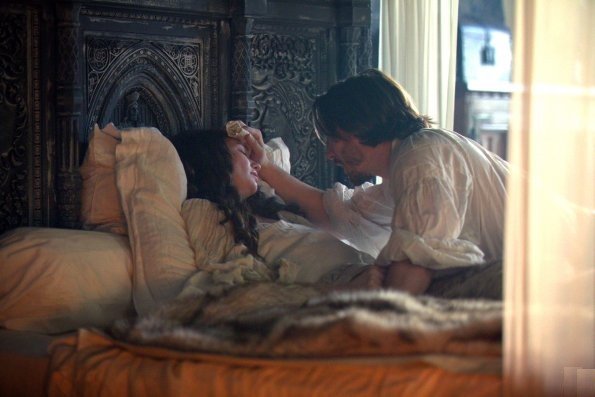
George attends Isabel .

George attends Isabel.

Did he or didn’t he? Well people have been searching for the answer…

anevillfeast's avatarA Nevill Feast

It’s come up a few times in my search list since episode 7 of The White Queen aired.

Did George, duke of Clarence, poison Isobel, duchess of Clarence?

George certainly thought someone poisoned her and reacted swiftly, to his ultimate detriment. He accused one of the duchess’s serving women, Ankarette Twynho, essentially abducted her and took her to Warwick, where she was tried and, not surprisingly, found guilty. She was immediately hanged. So far as I’m aware, the Queen, Elizabeth Wydeville, wasn’t implicated in this plot, nor did George hire a ‘sorcerer’ to determine the date of Edward IV’s death. George did a couple of other things that weren’t particularly helpful and was arrested and charged, initially, with bringing the law of England into disrepute. This was later changed to treason. In TWQ, the document that implicates him is a horoscope of Edward IV. Casting the king’s horoscope was certainly…

View original post 85 more words

The White Queen, episode 7

Richard, episode 7. Richard, episode 7.

Countess of Warwick: Anne, I’m going to tell you something that makes it clear that whoever wrote this didn’t read the primary sources very well.

Anne: It’s episode 7, Mother. Tell me something I don’t know!

anevillfeast's avatarA Nevill Feast

Edward: I’m a shagger.
Elizabeth: I’m a breeder.
Stanley: I’m a schemer.
Margaret Beaufort: To tell you the truth, I’m not sure what I’m supposed to be.
Clarence: Let’s go to France!
Edward: I’d rather shag. But why the hell not?
Gloucester: I’ve not forgotten you’re a derp, George.
Clarence: And I’ve not forgotten that you’ve got Warwick Castle, despite the fact that you live at Middleham.
Gloucester: It’s just this pesky truth thing, George. It’s so utterly boring.
Margaret Beaufort: That’s right! I’m a prayer. Oh, and I need another sign.
Woman: Destiny calls!
Margaret Beaufort: Good one, God!
Elizabeth: It’s a boy!
Margaret Beaufort: Here, let me save his life so I can have an attack of conscience when I decide to kill him and his brother in, let’s say, episode 9, just before I send him off to be Perkin Warbeck. Oh, look, he’s breathing.
Elizabeth: I’ll…

View original post 696 more words

The White Queen: The REAL ending of Isabel and George

The death of Lady Isabel, episode 7.

The death of Lady Isabel, episode 7.

So in tonight’s episode — they decided to kill TWO major characters off. And if you don’t feel a tad bit sorry for either one — remember these were actual people. Although the series is LOOSELY based off of historical events and people — these people DID die during one of the most dangerous periods of time in England.

Episode 7

Episode 7

X

On 22 December 1476 Isabel Neville, Duchess of Clarence died at Warwick at the age of twenty-five. Her body was removed for burial to Tewkesbury Abbey, the mausoleum of her Despenser ancestors. It was received there on 4 January 1477 by Abbot Strensham and other prelates. A service of nine lessons was conducted by suffragans of the Bishops of Worcester and Lincoln with the assistance of the dean and chaplains of Clarence’s chapel. Members of his houseshold stood vigil for a whole night. On the morrow the bishops and the abbot conducted three masses, one in honour of the Virgin Mary, a second for the Holy Trinity and a Requiem mass. At the latter a Franciscan friar, Dr Peter Webb, made an oration. The duchess’s body lay in state in the middle of the choir until 25 January 1477, when it was placed in a vault newly constructed behind the high altar, where probably Clarence himself was laid to rest. In the meantime masses were celebrated daily for the duchess’s soul.
MA Hicks, False Fleeting Perjur’d Clarence, p 114.

Clarence quite probably kept vigil with his household. He was from all accounts deeply grieved by his wife’s death. Their marriage was a happy one and it does seem that he was faithful to her. Her funeral itself points to a widower who wished his wife to be remembered and honoured in death. Their children, Margaret and Edward, were 3 and 1 respectively.

Barely a month after Isobel’s death, Margaret duchess of Burgundy, newly widowed, suggested Clarence (her favourite brother) as a husband for her stepdaughter Mary. Edward opposed the idea. Around the same time, an idea was put to Edward that Clarence marry the sister of James III. This, too, Edward declined. Despite Clarence’s no doubt real sense of grief at Isobel’s death, and there’s no way of knowing if he would have married either party had the decision been left up to him, Edward’s disapproval of both matches greatly upset him and relations between the brothers, already shaky, began to deteriorate further.

In May 1477, two men associated with Clarence were executed for treason at Tyburn. There is no evidence that Clarence was involved, or that Edward believed Clarence to be involved. However, after their deaths, he went with a Dr William Goddard to a session of council where Goddard read out a declaration of the men’s innocence. Also in May, Ankarette Twynho, one of Isabel’s servants, along with two others, was arrested, tried, convicted and executed on a charge of poisoning the duchess. The conduct of the trial, which included the kidnapping and forced removal of Twynho to Warwick, was highly irregular.  Edward arrested his brother, not on accusations of treason but for bringing the laws of England and the justice of the king into question. This was not a charge that carried the death penalty. Some time before November, however, Edward changed his mind and Clarence was charged with treason.

The Death of George, Duke of Clarence via "The White Queen"

The Death of George, Duke of Clarence via “The White Queen”

Clarence was tried in parliament on 16 January, condemned as a traitor and sentenced to death, which sentence was carried out in the Tower on 18 February. Edward honoured his brother’s wishes and allowed him to be buried with his duchess at Tewkesbury. Several contemporary and near contemporary sources speak of Edward’s almost immediate regret at Clarence’s death and his part in it. Cecily Nevill pleaded for her son’s life, and as a result of her appeal the sentence was commuted from the traditional traitor’s death. Though this has been called into doubt in recent times, it also seems that both Gloucester and Hastings made some attempt to see Clarence spared. This doesn’t quite tie in with the fact that, of everyone, Gloucester stood to gain most from Clarence’s death. He and Hastings were certainly not as closely involved in the process and proceedings as the earls Rivers and Dorset. However, neither of them, both influential with the king, spoke up quite loudly or clearly enough to save Clarence’s life. Both men, at the time, enjoyed friendly relations with the queen and her kin. The Wydevilles were four square behind both the changes to the charges against Clarence, his conviction and the carrying out of the sentence.

[Karen Clark. Nevill Feast, “Marriage and the Nevills – Isobel Nevill and George Duke of Clarence“, 15 June 2010]

The White Queen: Medieval Birth for a Royal Baby

"The White Queen", episode 6 shows Elizabeth giving birth. Unlike real life, no men would have been present and the windows would have been covered.

“The White Queen”, episode 6 shows Elizabeth giving birth. In reality, no men would have been present and the windows, floors, and walls would have been covered.

Elizabeth Woodville’s marriage to Edward IV produced ten babies in fourteen years. Edward’s own mother, Lady Cecily [Neville], had thirteen children of whom only seven survived to adulthood. Lord Warwick [father of Queen Anne Neville] and Lady Alice FitzHugh’s [great-grandmother to Queen Katherine Parr] mother, Lady Alice, Countess of Salisbury [sister-in-law to Lady Cecily], also gave birth to no less than twelve children herself. So how dangerous was it to have a royal baby in the 15th Century? Historian Dr. Jeremy Goldberg assesses what childbirth would have been like for the White Queen [and other women].

The White Queen and medieval birth for a royal baby

More info on childbirth in Tudor times: Childbearing: Queen Katherine of Aragon and Lady Maud Parr

The White Queen, episode 6

Richard X Anne fan art. Richard X Anne fan art.

Best moment of the episode? Anything and everything Richard X Anne.

anevillfeast's avatarA Nevill Feast

Edward: See my shiny cardboard crown!
Anne: Yes, I was married to the Prince of Wales. But I didn’t like him.
Edward: That’s all right, then.
Elizabeth: I still hate you!
Isobel: I’m going to be a bitch, now. I’m over the limping gazelle thing.
Anne: Where’s Mummy?
Isobel: Forget Mummy!
Clarence: Look at me, pretending to be nice.
Isobel: Bitch fight!
Margaret Beaufort: Give me a sign.
Messenger: Your mother’s dying.
Margaret Beaufort: *high fives God* Yesss!
Elizabeth: Jane Shore! The name of doom! She’s going to make everything go in slow motion, just you watch.
Margaret Beaufort: Dear Jasper, do you still want me?
Anne: I want Mummy!
Jaquetta: I’m dying. You’ll be senior witch soon, Elizabeth. Can you handle it?
Anne: Can I have my healing shag, now?
Gloucester: Soon, I promise.
Anne: George wants to keep my stuff!
Gloucester: I want your stuff as well, but…

View original post 338 more words