Queen Katherine Parr: Pregnant, At Last!


Katherine Parr (Deborah Kerr) and Lord Seymour (Stewart Granger) in “Young Bess” (1953); A Metro-Goldwyn-Mayer Picture.

In December of 1547, Queen Katherine Parr became pregnant for what most people believe to be the first time by her fourth and final husband, Sir Thomas Seymour. After four husbands and twenty years of marriage, Katherine was about to fulfill what she felt was the primary duty of a wife, to give birth to a healthy baby; boys being preferred in aristocratic circles. Like today, some titles still cannot be inherited by the eldest or only daughter of a peer; meaning a girl cannot inherit the title of her father which is usually then passed to the closest living male relative, that being usually an uncle or cousin.

Katherine Parr (Deborah Kerr), Lord Seymour (Stewart Granger), and Lady Elizabeth (Jean Simmons) in “Young Bess” (1953).

Queen Katherine found pregnancy difficult. She still had an on-going feud with her brother-in-law, the Lord Protector and his rather nasty wife, had morning sickness, was constantly worrying about her step-daughter Lady Elizabeth, and the temper of her husband and lack of discretion towards his feelings for Lady Elizabeth must have made the early months of pregnancy extremely hard for the Queen Dowager.[1] In 1549, after the death of the Queen, two cramp rings for use against the pains of childbirth and three pieces of unicorn horn, sovereign remedy for stomach pains, were found in the chest of Katherine’s personal belongings which were talismans most likely from her husband and friend’s to alleviate the pains of childbirth and anticipated pangs of childbirth. Katherine was almost thirty-six, an advanced age to begin a pregnancy. The emotional strain of her household with Seymour’s infatuation with Lady Elizabeth couldn’t have helped her early months either.

As Katherine’s pregnancy progressed, her involvement in politics, if not her interest, diminished. She viewed her approaching motherhood with delight despite knowing the risks and the possibility that death in child birth was a very real possibility.

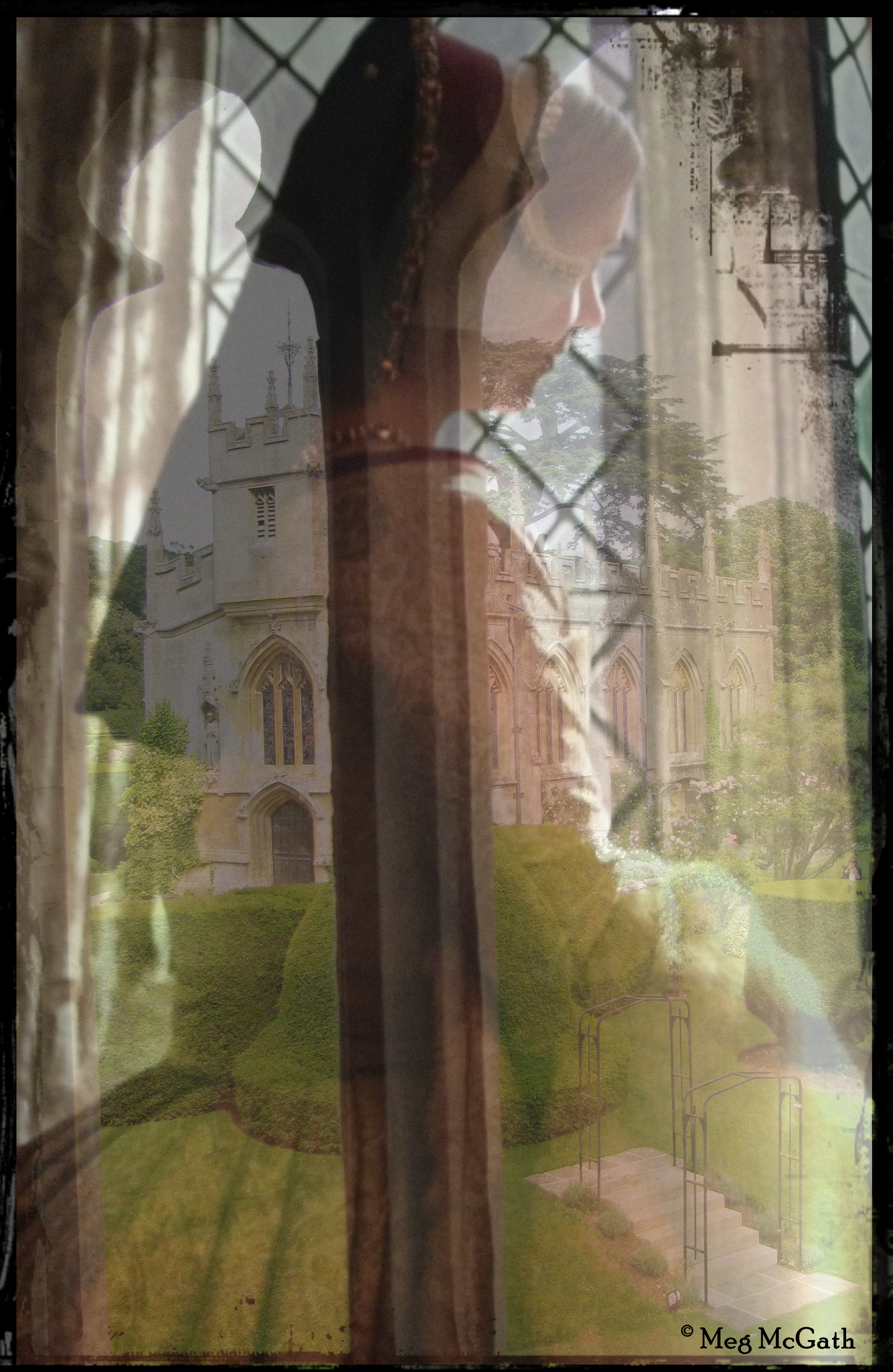
Compiled digital art featuring Hampton Court’s Katherine Parr over looking the gardens and Chapel on the grounds at Sudeley Castle. © Meg McGath, 2012.

Seymour decided that Katherine should be confined as far away possible from the press of business and turmoil of the court as well as the summer plagues of London. Katherine was taken to Sudeley Castle in Winchcombe, England, outside of Cheltenham. The castle has a long history stretching back to William de Tracy. Richard III used the castle as campaign headquarters during the Battle of Tawkesbury; in which Katherine’s grandfather fought. Upon the death of Richard III, the castle reverted to the crown and new monarch, Henry VII; who gave the castle to his uncle, Jasper Tudor. After the death of Jasper Tudor, Sudeley reverted to the crown again, to King Henry VIII. In fact, the King made a visit to the castle with Anne Boleyn in 1535. Upon the ascension of Edward VI, Sir Thomas was created Lord Seymour of Sudeley and was granted the castle. In preperation for her lying-in, Seymour spent 1,000 pounds having the rooms prepared for her in his newly aquired house at Sudeley in Gloucestershire.[2] With beautiful gardens and walks, the castle would have been a perfect place for Katherine to spend the last three months of her pregnancy.

One of several plaques on the wall in the exhibit for Katherine Parr at Sudeley. © Meg McGath, 2012.

On Wednesday, 13 June 1548, Seymour accompanied his wife, who was now six months pregnant, and his young ward, Lady Jane Grey, from Hanworth to Sudeley Castle in Gloucestershire. Lady Elizabeth Tudor had been sent away that Spring so she did not accompany them. In this castle, Katherine spent the last three months of her pregnancy and the last summer of her life. Typical of Queen Katherine, she spared no expense when it came to attendants. She was attended by her old friend and doctor, Robert Huicke, and was surrounded by other old friends, Miles Coverdale, her chaplain, her almoner, John Parkhurst, Sir Robert Tyrwhitt, and the ladies who had been with her over the years such as Elizabeth Trywhitt and Mary Wodhull. Katherine also had a full compliment of maids-of-honour and gentlewomen as well as 120 gentlemen and yeomen of the guard. In spite of his duties, Sir Thomas Seymour seems to have spent most of that summer with his wife. Katherine whiled away her summer days overseeing the education of Lady Jane Grey while preparing for her baby. Her affections for her husband seemed as strong as ever, as was her belief in the final analysis, Seymour would make the moral choice over the immoral one.

The nursery at Sudeley Castle.

While Katherine awaited her confinement, Katherine continued decorating the nursery which overlooked the gardens and the Chapel. The nursery of an expected heir was done up in crimson and gold velvet and taffeta, with furniture and plate enough for a royal birth. In Seymour’s eyes, the child would be a member of the royal family as Katherine was still officially the only queen in England. After his daughter’s birth, Seymour was overheard telling Sir William Sharington that,

“it would be strange to some when his daughter came of age, taking [her] place above [the duchess of] Somerset, as a queen’s daughter.”[3]

Besides the baby’s cradle was a bed with a scarlet tester and crimson curtains and a separate bed for the nurse.

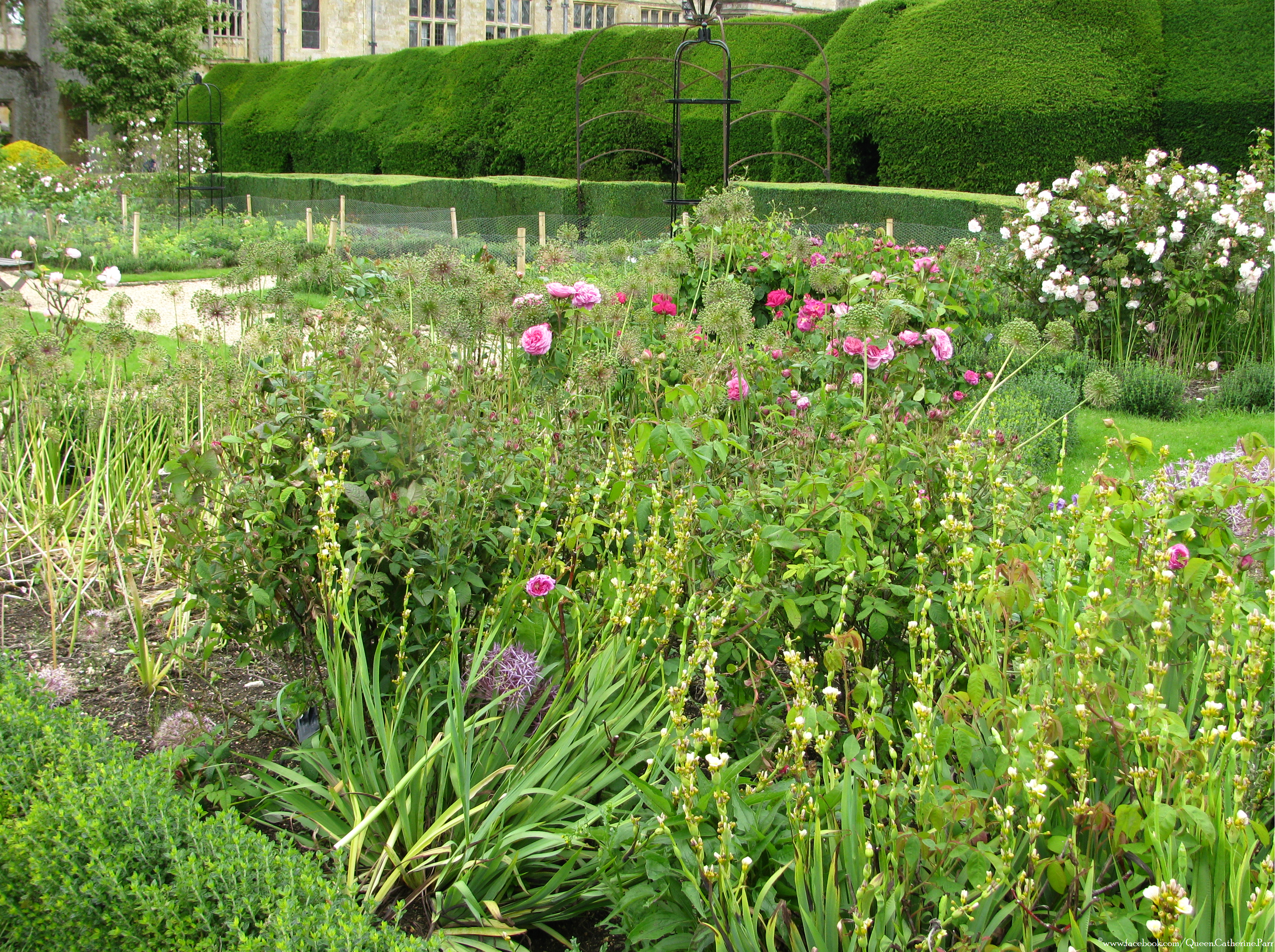
The Queen’s Gardens at Sudeley Castle; Katherine Parr would spend her final days walking with Lady Jane Grey in these gardens. © Meg McGath, 2012.

The Queen continued to take the advice of her doctor and walked daily among the grounds of Sudeley, but she was still concerned about the politics and overseeing of the new boy king.

On the eve of August 30th, Katherine went into labour.
Sources

  1. Linda Porter. ‘Katherine, the queen,’ Macmillan, 2012.
  2. Susan James. ‘Catherine Parr: Henry VIII’s Last Love,’ The History Press, Gloucestershire, 2008, 2009 [US Edition].
  3. Janel Mueller. ‘Katherine Parr: Complete Works and Correspondences,’ University of Chicago Press, Jun 30, 2011.
  4. Emma Dent. ‘Annals of Winchcombe and Sudeley,’ London, J. Murray, 1877. Out of copyright; use of images and info.

The original post from which this was taken

copyright_meg_tudorqueen

30 December 1460: The Debt is Paid

On the 30th of December 1460, Richard Plantagenet, Duke of York and his forces were caught by surprise by the Queen’s forces at Sandal Castle near Wakefield where they had been stationed for over two weeks. Richard knew the battle was lost and that he would likely die so he sent his son (Edmund, Earl of […]

https://tudorsandotherhistories.wordpress.com/2016/01/11/30-december-1460-the-debt-is-paid/

The OTHER Elizabeth Cheney

Lately on Pinterest I have noticed that a certain portrait has become labeled as a member of Queens Anne Boleyn and Katherine Howard’s family. The woman in the portrait is being credited as their grandmother (or whatever) “Lady Elizabeth Cheney Tilney“. The link used on each pin belongs to The Royal Collection of Her Majesty Queen Elizabeth II and if clicked on — the title is clearly stated as being “Elizabeth Cheyne, Lady Vaux (1509-1556)“.[1]

The actual Lady Elizabeth Tilney was born in 1422 as a Cheney, the daughter of Lawrence and Elizabeth Cokayne. Elizabeth married firstly to Sir Frederick Tilney by whom she had a daughter named Elizabeth Tilney. By Lord Tilney, Elizabeth was in actuality the great-grandmother of Queens Anne Boleyn (wife no. 2) and Katherine Howard (wife no. 5). As the widowed Lady Tilney, Elizabeth made a second marriage to Sir John Saye. By that marriage she was also the great-grandmother of Queen Jane Seymour (wife no. 3). Lady Elizabeth Saye (born Cheney) died in 1473.

The only daughter of Sir Frederick Tilney and Lady Elizabeth (born Cheney), Elizabeth, married firstly to Sir Humphrey Bourchier by whom she had issue. After her first husband died, the widowed Lady Bourchier became the wife of Sir Thomas Howard, Earl of Surrey (later Duke of Norfolk) on 30 April 1472. This couple was parents to Lady Elizabeth Howard (mother of Anne Boleyn) and Sir Edmund Howard (father of Katherine Howard)–the two doomed queens of King Henry VIII.

Will the Real Elizabeth Cheney Please Stand Up?

il_fullxfull.740790797_tf54

A copy of “Lady Vaux” originally by Hans Holbein c. 1536. This copy was done in 1938.

As for the REAL Elizabeth Cheyne (or Cheney)–she was born in 1509; around the time that Anne Boleyn may have been born. Elizabeth was the daughter of Sir Thomas Cheyne of Irthlingborough, an Esquire of the Body to Henry VIII, and Lady Anne (born Parr). Sir Thomas Cheyne (d.1514) was the son of Sir John Cheyne of Fen Ditton (c.1424-1489) and his wife Elizabeth Rempston (born c.1418)–see below for more info.[8] Lady Anne’s parents were Sir William Parr, Baron Parr of Kendal and Lady Elizabeth (born FitzHugh). By her parents, Lady Anne was a paternal aunt to Henry VIII’s last queen, Katherine Parr. In 1516, Elizabeth Cheyne became a ward of of her step-grandfather, Sir Nicholas (later 1st Baron Vaux of Harrowden). In 1523, she was married to Sir Thomas Vaux (later 2nd Baron Vaux of Harrowden); the heir of Lord Nicholas Vaux by his second wife.[1][2][3]

The Close Circle of Nobility

Step-grandfather you say?

Now this is where the history of the Vaux and Parr families become extremely confusing to some–Elizabeth Vaux and Katherine Parr’s grandmother, the widowed Lady Elizabeth Parr (born FitzHugh), married secondly to Sir Nicholas Vaux (later 1st Baron) as his first wife. This move was made as a measure to ensure loyalty to the new Tudor King, Henry VII. Lord Vaux’s mother, Katherine, had been a loyal supporter of the House of Lancaster and Queen Margaret of Anjou (wife of Henry VI). Elizabeth FitzHugh, herself, was loyal to the House of York. Her mother Lady Alice Neville was a daughter of Sir Richard, 5th Earl of Salisbury. As such, Elizabeth was a niece of Richard, Earl of Warwick “Warwick, the Kingmaker”. As close family members, Elizabeth and her mother were part of the coronation train of Queen Anne (born Neville) and attended her as ladies afterwards. Elizabeth and Nicholas had three daughters. One was the wife of Sir George Throckmorton, also named Katherine (née Vaux). After Elizabeth FitzHugh died, Lord Vaux married secondly to Anne (née Greene); the maternal aunt of Queen Katherine Parr. By Anne, Lord Nicholas had his heir–Thomas–who married Elizabeth Cheyne. Upon Thomas and Elizabeth’s marriage in 1523, Elizabeth was formally titled Lady Elizabeth Vaux or Lady Vaux. The family tree of Anne Boleyn and Katherine Howard have no such lady with this title.[2][3]

As for Sir Thomas Cheyne–here is where some people may have confused the portrait. Cheyne was of the same lineage as Lady Elizabeth Tilney/Saye (born Cheney), daughter of Sir Lawrence (d.1461) and Elizabeth Cokayne. Thomas’s father, Sir John (d.1489), was Elizabeth Cheney’s brother. So there is a connection there, but the daughter of Sir Thomas was not an ancestress to the Boleyn or Howard family.[7][8]

About the Work of Art

elizabeth2c_lady_vaux2c_by_hans_holbein_the_younger

‘Elizabeth Cheyne, Lady Vaux (1509-1556)’ c. 1536 by Hans Holbein. Windsor Castle. The Royal Collection of Her Majesty Queen Elizabeth II, 2012–RL 12247.[1]

Above: the actual sketch from Windsor Castle’s collection of Holbein’s portraits. It is described as using Black and coloured chalks, white bodycolour, wash, pen and ink, brush and ink, and metalpoint on pale pink prepared paper; 28.1 x 21.5 cm[1]

The original sketch was acquired by Edward VI in 1547 after the death of his father, Henry VIII. Henry FitzAlan, 12th Earl of Arundel bequeathed the portrait to John, Lord Lumley in 1580. Lord Lumley probably bequeathed the portrait to Henry, Prince of Wales in 1609, and thus, it was inherited by Prince Charles (later Charles I) in 1612. Charles I exchanged the portrait with Philip Herbert, 4th Earl of Pembroke (the grandson of Lady Vaux’s other cousin, Lady Anne Pembroke (sister of Queen Katherine Parr) around 1627/8. Charles II acquired the painting through Thomas Howard, 2nd Earl of Arundel in 1675. It has been in the Royal Collection ever since.[1]

This drawing of Lady Vaux with the companion image of her husband was probably made as a study for a painted portrait. Holbein’s painting of Lady Vaux is known only through copies. No painting of Lord Vaux survives.[1]

lady vaux

The Hampton Court painting of ‘Elizabeth, Lady Vaux’ c. 1600-30 (Twitter user Sir William Davenant)[5][6][9]

Henry VIII loved art and collected his fair share of portraits and drawings. There is a painting of ‘Lady Vaux’ at Hampton Court (above) which is said to have been painted by Holbein. It is one of three paintings recognized as genuine by the experts. However, others debate the authenticity and the painting at Hampton is labeled ‘After Holbein–Elizabeth, Lady Vaux‘. Elizabeth is depicted looking to the front, wearing a brown dress with ermine, with a jewel at her bosom decorated with the Madonna and Child enthroned. She holds a pink carnation in her right hand, and a cherry in her left. This is thought to be a competent copy after a lost original by Hans Holbein. The original was painted in 1535. This portrait hangs in the Haunted Gallery at Hampton. The authentic sketch of ‘Lady Vaux’ by Holbein (RCIN 912247) is at Windsor Castle.[1][4][5][6]

The only other copy of the painting of Lady Vaux is in Prague Castle Gallery of all places!

hans_holbein_the_younger_28after29_-_elizabeth_vaux_28prague29

The portrait of ‘Lady Vaux’ hangs in the gallery at Prague Castle.

Authors Notes

So, if you see the portrait of Lady Vaux on Pinterest; the caption is incorrect. The fact that people refuse to or do not know how to change the caption is rather sad in my opinion. Elizabeth had no direct connection to the Boleyn or Howard families. Why do I feel like the painting was and still is being labeled incorrectly? My theory: most people do not know anything about Katherine Parr’s extended family; it seems so much easier to associate a lot of things to the Boleyn family for some fans. And when some are called on it, it can get pretty nasty. I’ve had some really nasty comments after leaving my own comment about the true identity of the sitter. For some Boleyn fans, the research, so they think, has already been done. The caption must be correct. No. But who am I? Some random pinner–or so they think.

I won’t deny that as a writer on Parr, this whole situation makes me extremely angry. I have been writing for years on this family and just trying to correct a simple image has become tiresome and pretty unpleasant. What really bothers me is the fact that putting the wrong label on a portrait deprives the memory of the real person. To me, somehow that person becomes erased.

Elizabeth, Lady Vaux died shortly after her husband on 20 November 1556. She was most likely a victim of the plague which killed her husband.[9]

More info:

Sources

  1. Holbein, Hans. “Royal Collection – Elizabeth, Lady Vaux,” circa 1536. RL 12247. Royal Collection Trust / © HM Queen Elizabeth II, 2015. URL: https://www.royalcollection.org.uk/egallery/object.asp?maker=12102&object=912247&row=82
  2. Douglas Richardson. “Plantagenet Ancestry,” Genealogical Publishing Com, 2004. pg 144, 561.
  3. Burke, Sir Bernard. “A Genealogical History of the Dormant: Abeyant, Forfeited, and Extinct Peerages of the British Empire,” New Edition. London: Harrison, 1866. pg 418.
  4. ‘Spelthorne Hundred: Hampton Court Palace, pictures’, in A History of the County of Middlesex: Volume 2, General; Ashford, East Bedfont With Hatton, Feltham, Hampton With Hampton Wick, Hanworth, Laleham, Littleton, ed. William Page (London, 1911), pp. 379-380 http://www.british-history.ac.uk/vch/middx/vol2/pp379-380 [accessed 13 February 2016].
  5. Sir William Davanant on Twitter: “I give thee Elizabeth Cheyne, Lady Vaux (1509-1556). After Hans Holbein. #HamptonCourt” [https://twitter.com/SirWilliamD/status/297996052068450304]
  6. Holbein, After Hans. “Royal Collection: Elizabeth Cheyne, Lady Vaux,” circa 1600-30. RCIN 402953. Royal Collection Trust / © HM Queen Elizabeth II, 2014. URL: https://www.royalcollection.org.uk/collection/402953/elizabeth-cheyne-lady-vaux-1505-1556
  7. A F Wareham and A P M Wright, ‘Fen Ditton: Manors’, in A History of the County of Cambridge and the Isle of Ely: Volume 10, Cheveley, Flendish, Staine and Staploe Hundreds (North-Eastern Cambridgeshire) (London, 2002), pp. 123-124 http://www.british-history.ac.uk/vch/cambs/vol10/pp123-124 [accessed 11 February 2016].
  8. Richardson, Douglas. “Plantagenet Ancestry: A Study In Colonial And Medieval Families,” 2nd Edition, 2011. pg 526-7. Google eBook
  9. Johnson, Graham and Humphries, Lund. “Holbein and the Court of Henry VIII: The Queen’s Gallery, Buckingham Palace,” London and Bradford, The Gallery, 1978. pg 95-96.

©Meg McGath, 12 February 2016

This is the work and research of Meg McGath. You may not reproduce or copy this material without written permission.

Katherine Parr: A Possible Jewel of Lady Latimer?

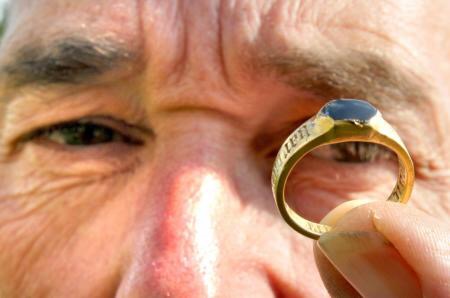
A METAL detectorist, Steve Whitehead, said he was left shaking after finding a gold ring he hopes could be linked to one of Henry VIII’s wives.

A possible ring belonging to Queen Katherine Parr was found near an estate that belonged to her second husband, Lord Latimer, also know as Lord of the manor of Sinnington. The ring was found near the manor of Sinnington. A Lombardic inscription on it suggests the ring dates from between the ninth to the 15th century. 
Katherine spent time in the area as Lady Latimer from 1534-1543; wife of Sir John Nevill. It is said that Sinnington was a favourite during Katherine’s days as Dowager Lady Latimer. As well as Sinnington Manor, several manors near by belonged to Latimer and Katherine’s family. Nunnington Manor, which belonged to Katherine’s brother William, was close by. 


The ring, which could be worth £20,000, is likely to date from the ninth to 15th centuries due to the Lombardic text on it.

 
HISTORY OF the manor: In 1284–5 the Nevills of Raby had obtained a mesne lordship, which descended to Sir Ralph first Earl of Westmorland (husband of Lady Joan Beaufort, only daughter of Prince John of Gaunt, Duke of Lancaster by his third wife, Katherine). Westmorland must have given it to his fifth son by Lady Joan; George, who was created Lord Latimer in 1432. George died seised in 1469, and in 1531 the manor was still held by his great-grandson Sir John Nevill, third Lord Latimer.

Sources and More info

6 AUGUST 1552: THE DEATH of Sir George Throckmorton of Coughton

The Tudor gate at Coughton Court, Warwickshire, England. Commissioned by Sir George.

The Tudor gate at Coughton Court, Warwickshire, England. Commissioned by Sir George. [Source: National Trust Coughton Court]

6 AUGUST 1552: THE DEATH of Sir George Throckmorton of Coughton Court [uncle by marriage and cousin]. George was the eldest son of Sir Robert Throckmorton of Coughton by Catherine, daughter of William Marrow. Sir Robert Throckmorton was a courtier and Councillor to Henry VII. Before his death, in Italy while on pilgrimage to the Holy Land, Sir Robert had seen George launched at court and in local government and in enjoyment of numerous leases and stewardships. This early advancement may have owed something to Throckmorton’s marriage to a daughter of another courtier, Sir Nicholas Vaux, whose stepson Sir Thomas Parr, comptroller of the Household to Henry VIII.

George was a loyal subject to the crown, however when it came to Henry’s divorce from Katherine of Aragon he opposed it. He did not approve of Henry marrying Anne Boleyn and was vocal about it. After all, he was close to Sir Thomas More and the Throckmorton was a devout Catholic family [still are to this day]. George’s circle included supporters of Katherine of Aragon which included Lady Maud Parr, his sister-in-law [wife to Sir Thomas Parr, brother of his wife Katherine]. Maud stayed with her mistress until her death in 1531.

Later on, George was steward from 1528-40 for Thomas Seymour, [later Baron Seymour of Sudeley]. The marriage of Katherine Parr to King Henry VIII in 1543 proved helpful to his children, but George was still in disfavor at court. George was part of the fall of Thomas Cromwell, but his part in it is obscure. Cromwell had somewhat kept George in disfavor for quite some time. The two clashed on religious ideals and other matters of state. The Throckmortons who had converted to Protestantism were held high at court and helped out their cousin Katherine Parr during her reign as queen and as dowager queen. Several Throckmortons did stick to the “old” religion and later found themselves in trouble during the reign of Elizabeth I [daughter of Henry VIII and Anne Boleyn].

Family

By 1512, George married Katherine, daughter of Sir Nicholas Vaux [later 1st Lord Vaux of Harrowden] and his first wife, Elizabeth FitzHugh. Elizabeth FitzHugh was the paternal grandmother of Queen Katherine Parr; daughter of Lady Alice FitzHugh [born Neville, granddaughter of Lady Joan Beaufort, Countess of Westmorland]. The couple had eight sons including Anthony, Clement, George, John I, Kenelm, Nicholas and Robert and eleven daughters.

Tomb of Sir George and his wife Katherine [Vaux] in St. Peter's Church, Coughton Court, Warwickshire, England.

Tomb of Sir George and his wife Katherine [Vaux] in Coughton Church, Warwickshire, England.

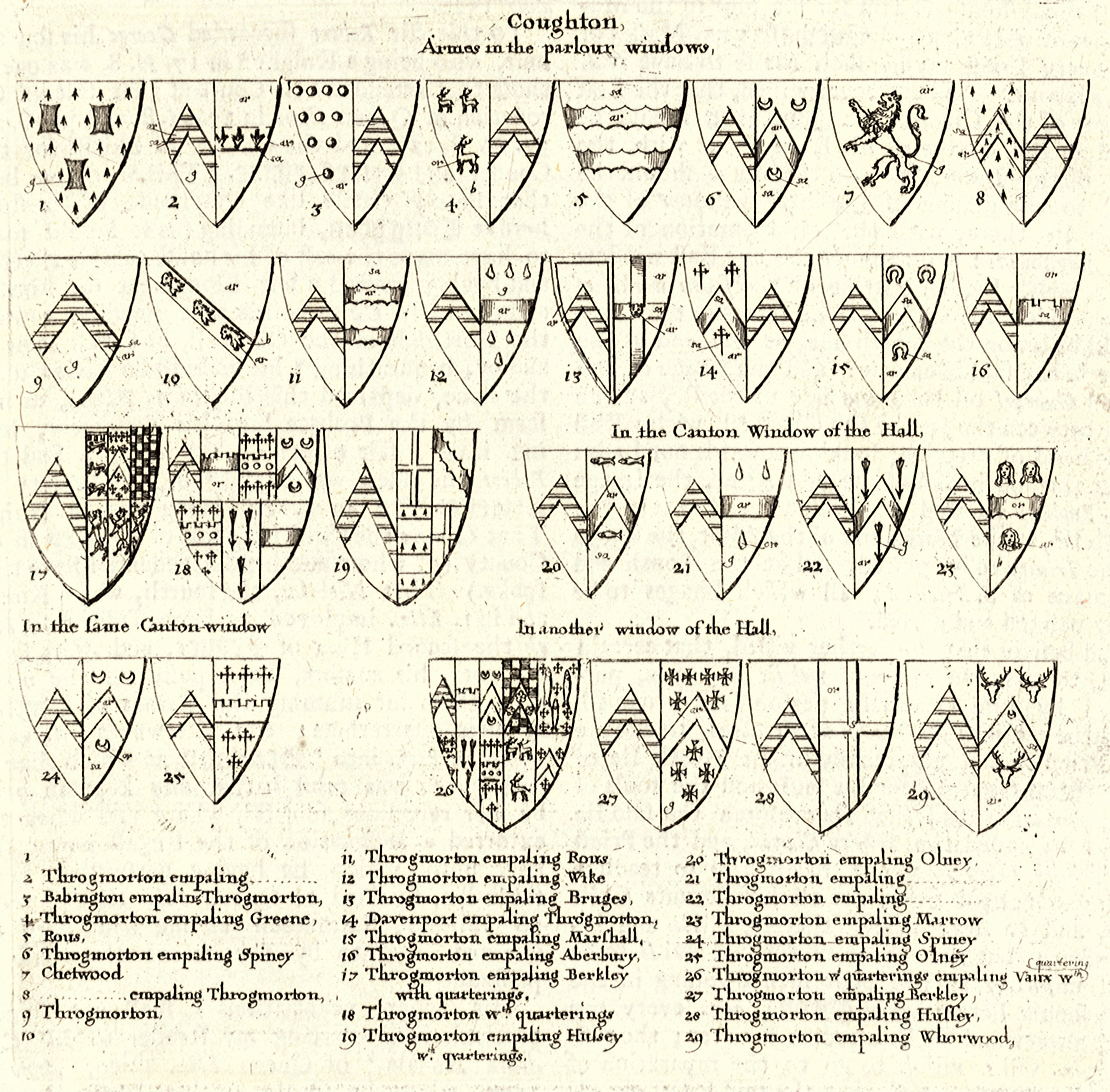
Throckmorton died on 6 August 1552 and was buried in the stately marble tomb which he had prepared for himself in Coughton church. The most impressive monument which he left, however, was the gatehouse of Coughton court. Throckmorton spent most of his life rebuilding the house: in 1535 he wrote to Cromwell that he and his wife had lived in Buckinghamshire for most of the year, ‘for great part of my house here is taken down’. In 1549, when he was planning the windows in the great hall, he asked his son Nicholas to obtain from the heralds the correct trickling of the arms of his ancestors’ wives and his own cousin [and niece by marriage] Queen Katherine Parr. The costly recusancy of Robert Throckmorton and his heirs kept down later rebuilding, so that much of the house still stands largely as he left it.

Wenceslas Hollar's depiction of the heraldry at Coughton Court. The additions were made by Sir George.

Wenceslas Hollar’s depiction of the heraldry at Coughton Court. The additions were made by Sir George.

References

29 JULY 1504: THE DEATH of Thomas Stanley, 1st Earl of Derby

29 JULY 1504: THE DEATH of Thomas Stanley, 1st Earl of Derby

Portrait purported to be of the first Earl of Derby but the costume is of a later period.

Thomas Stanley was born c. 1435 to Sir Thomas Stanley, 1st Baron Stanley and Joan Goushill, daughter of Sir Robert of Heveringham Goushill and Lady Elizabeth FitzAlan, Duchess of Norfolk; herself the daughter of the 11th Earl of Arundel and Lady Elizabeth de Bohun. Lady Elizabeth was aunt to a royal Duchess, Lady Eleanor, who married Prince Thomas of Woodstock, Duke of Gloucester [youngest son of King Edward III] and the wife of the future King Henry IV, Lady Mary [she died in 1394; Henry was crowned in 1399]. Mary was the mother of Henry IV’s heir, Henry V.

King Henry VI, unknown artist, late 16th or early 17th century. Transferred to the National Portrait Gallery in 1879 from the British Museum.

So, Thomas was born in to good stock having connections to the Lancastrian monarchs. Thomas would have been a 3rd cousin of King Henry VI having shared 2nd great-grandparents; Sir William de Bohun, 1st Earl of Northampton [grandson of Edward I] and Lady Elizabeth [born Badlesmere].

Although Henry VI was King during Stanley’s career at court, Stanley’s family married him to a daughter of Sir Richard Neville, 5th Earl of Salisbury and Lady Alice Montacute, Countess of Salisbury.

Through his paternal grandmother, Lady Elizabeth Stanley [born Harrington], Lord Stanley was a first cousin, twice removed of Sir Thomas Parr of Kendal. The two shared Sir Nicholas Harrington and Isabel English as grandparents [Parr was a 2nd great-grandchild]. Lady Elizabeth Stanley was aunt to Lady Alice Parr [born Tunstall] by her sister, Lady Elizabeth Tunstall [born Harrington]. Lady Alice Parr married Sir Thomas Parr, Sheriff of Westmorland; they were grandparents to Sir Thomas Parr of Kendal.

In addition to being related to Thomas Parr by Lady Alice, Parr’s grandaunt was Lady Eleanor Neville; wife of Thomas Stanley. Eleanor and Thomas had seven sons and six daughters. Eleanor died shortly after Edward IV was reinstated as King for the second time [1471].

"The White Queen", BBC. The portrayal of the marriage of Lord Stanley to Lady Margaret Beaufort.

“The White Queen”, BBC. The portrayal of the marriage of Lord Stanley to Lady Margaret Beaufort.

Upon Stanley’s marriage to Lady Margaret Beaufort in 1482–it was not expected of Margaret to supply him with anymore children. Margaret must have been relieved. After her birth of her only child, Henry Tudor, at the age of 12/13, she probably didn’t want to experience the pain that she had at such a young age.

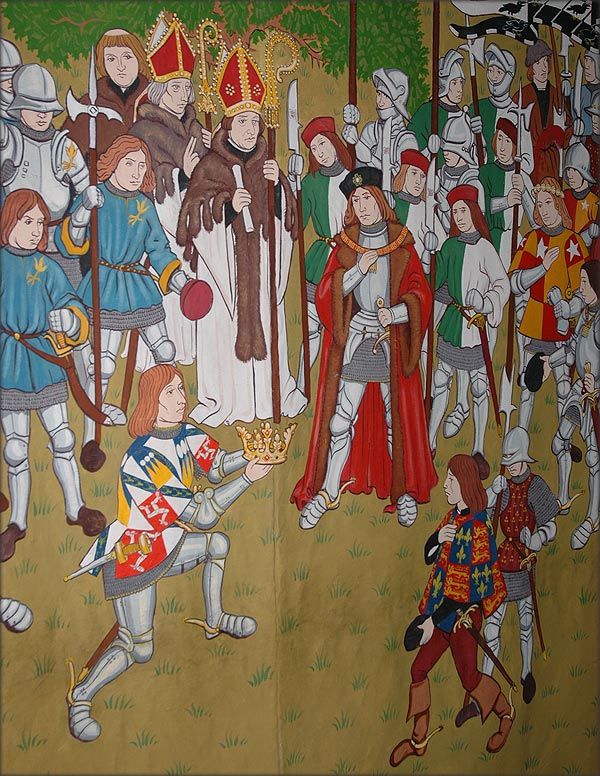
Stanley offers the crown to Henry of Richmond on the battlefield.

Stanley offers the crown to Henry of Richmond on the battlefield.

Stanley is known for his support of his stepson, Henry Tudor, against Richard III at the Battle of Bosworth. His decision to back Tudor ultimately decided the fate of the outcome. Richard would be defeated. On the battlefield, it is said that Stanley crowned his stepson, King of England, as King Henry VII [of the House of Tudor]. Did Stanley’s attachment to Henry’s mother have anything to do with the defeat? Most likely. However, there was another reason Stanley may have switched loyalties.

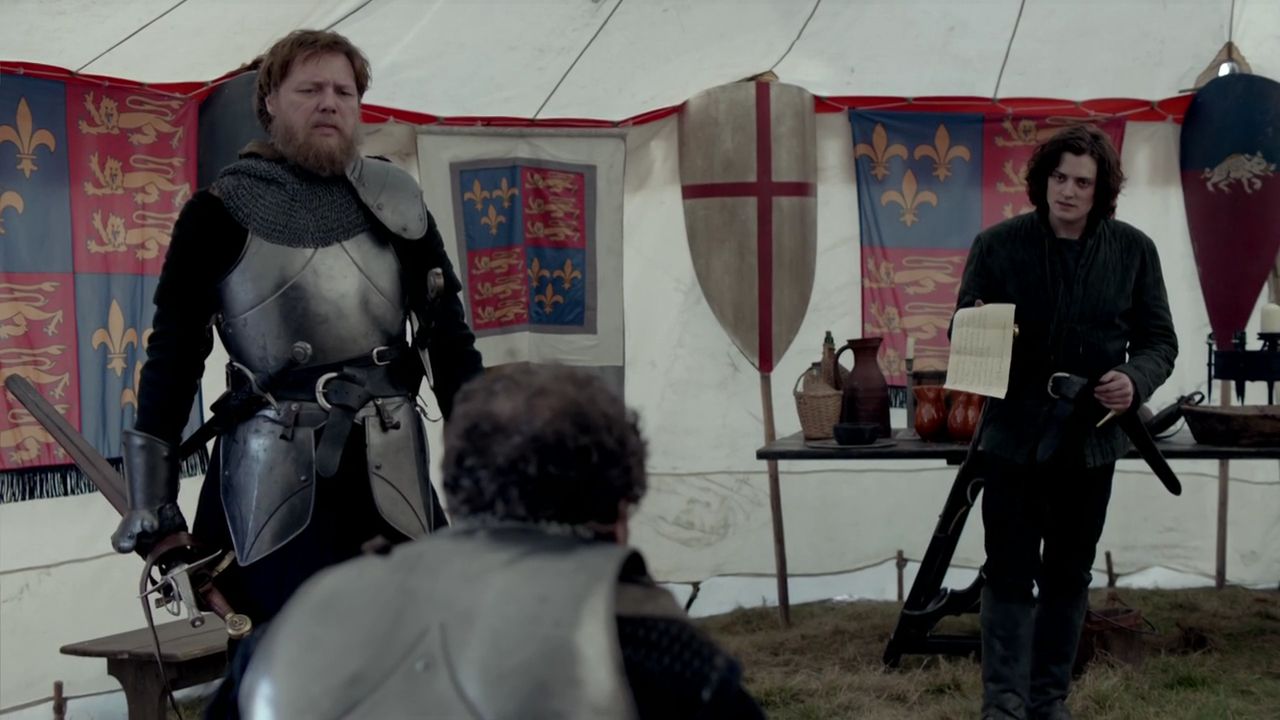
"The White Queen", BBC. Richard III detains Stanley's eldest son, Lord Strange.

“The White Queen”, BBC. Richard III detains Stanley’s eldest son, Lord Strange.

The following is the statement of the Croyland Chronicler, a contemporary of the events which he records:

A little before the landing of these persons (Richmond and his adherents) Thomas Stanley, Steward of the King’s Household, had received permission to go into Lancashire to visit his house and his family, from whom he had long been separated. Still, however, he was permitted to stay there on no other condition than that of sending his eldest son, George Lord Stanley, to the King at Nottingham in his stead, which he accordingly did“.

The same chronicler avers that after the landing of Richmond was known to Richard, the King summoned Lord Stanley to join him at Nottingham, and received a refusal on the plea of sickness. Soon afterwards, it is added, Lord Strange attempted to escape, was prevented, then confessed his guilt, acknowledging that his uncle, Sir William Stanley, was privy to Richmond’s expedition, but declaring that his father was innocent, and if his own life were spared would still join the King.

If Lord Stanley did not join Richmond on his landing, it was, we are told, because he feared for the life of his son, then very possibly safe and sound at Latham. It is Lord Strange’s perilous position that, in the old chronicles, makes Lord Stanley pretend to retreat from Lichfield, which he left open to Richmond; this is what he pleaded as an excuse for his neutrality, during, the alleged interview with Richmond at Atherstone three nights before the battle; and this is to account for his indecision during the battle itself. Perhaps it may turn out that Lord Strange was never in Richard’s hands at all, and that Lord Stanley never stirred a finger or moved a man until the fate of the battle was decided. All accounts agree that Richard’s final charge might have been successful had not Sir William Stanley, with his three thousand men, suddenly come to the rescue of Richmond. But Sir William seems to have been a rasher, or rapider man than his elder brother, and much more ready to run risks. When Richard was killed and the battle over, the battered crown which had fallen from his helmet during the conflict was, according to a plausible tradition, placed by Lord Stanley or his brother on the head of the victorious Richmond. There was no longer room for doubts, scruples, hesitations. Nor did the Stanleys show any pity for those of their coadjutors of the ended reign, who to the last had remained faithful and true to Richard. Three days after the battle a batch of Richard’s adherents was executed -Catesby among them. He made his will on the day of execution, and it contained this significant, this striking passage and petition: “My Lord Stanley, Strange, and all that blood! help! and pray for my soul, for ye have not for my body, as I trusted in you“.

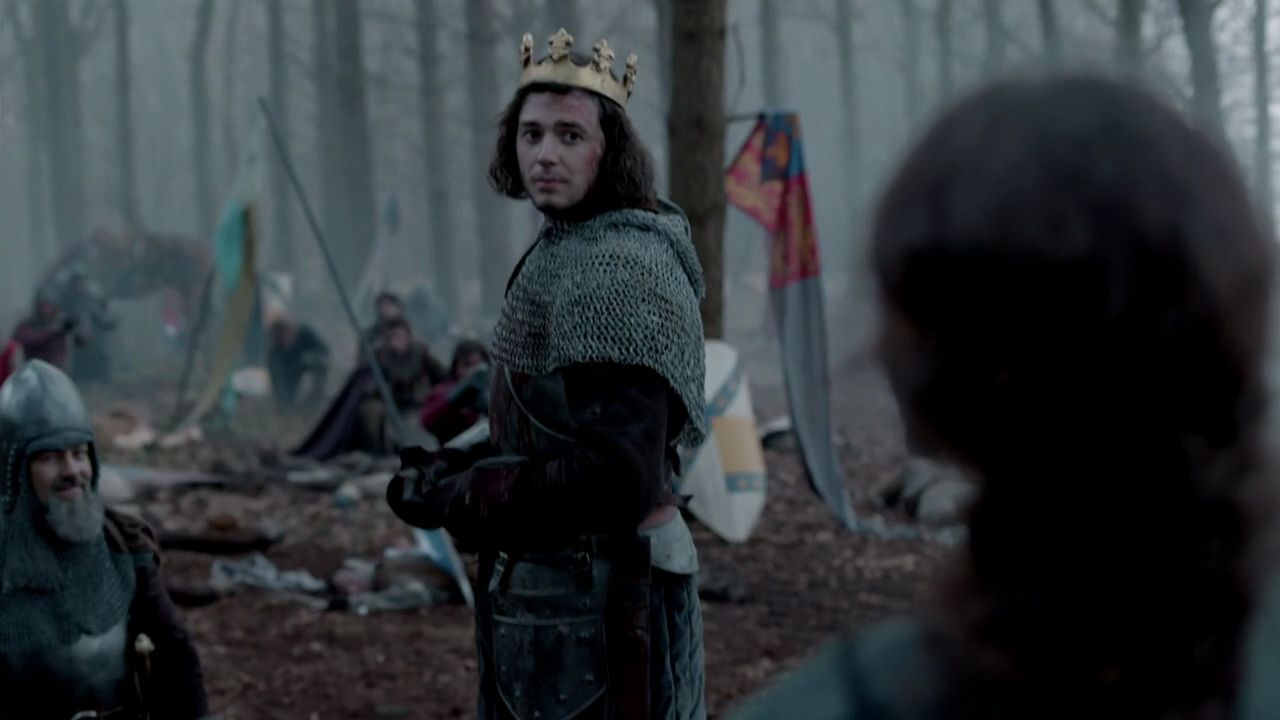
"The White Queen", BBC. Lord Stanley offers the crown to Henry Tudor. Lady Margaret stands on the battlefield to see her son crowned.

“The White Queen”, BBC. Lord Stanley offers the crown to Henry Tudor. Lady Margaret stands on the battlefield to see her son crowned.

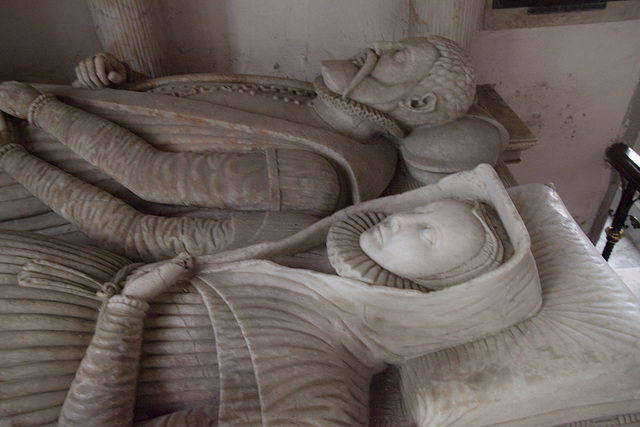
Eleanor was buried in London’s St. James’s Church, Garlickhithe. There is no evidence that her body was reinterred at Burscough Abbey, the Stanleys burial place in Lancashire; although an effigy of her was added to Lord Stanley’s grave when he was buried in 1504.

Effigy of the Earl of Derby and Lady Stanley [Lady Eleanor Neville].

Effigy of the Earl of Derby and Lady Stanley [Lady Eleanor Neville].

Lord Stanley [Earl of Derby by now] died, probably about the age of seventy. His death must have occurred between the 28 Jul 1504, on which day his will was dated, and the 29 Nov in the same year, the day on which it was proved. He left to the King a cup of gold, and legacies to this abbey and to that, duly providing too for masses on behalf of his own soul, of those of his wives, relations, friends, servants, and in one case, especially for the souls of all them lie had in any wise offended, and for all Christian souls.

Sources

  • David Baldwin. The Kingmaker’s Sisters: Six Powerful Women in the War of the Roses, 2009. The History Press, Gloucestershire, England, UK.
  • Tudor Place Bios. Thomas Stanley, 1st Earl of Derby, Online Source.

Family of Queen Katherine Parr: Sir John Throckmorton of Coughton

John was born at Coughton Court circa 1524. He was one of the eight sons and of the seventeen children of Sir George Throckmorton of Coughton Court and his wife Kathryn Vaux, daughter of Sir Nicholas, Baron Vaux of Harrowden and his first wife, the widowed Lady Elizabeth Parr [born FitzHugh]. By his mother, he was cousin to Queen Katherine Parr, the sixth queen and wife of King Henry VIII.

Household of Katherine Parr at Chelsea Manor.

Household of the Dowager Queen Katherine Parr.

Throckmorton isn’t as well known as his elder brothers like Sir Nicholas and Sir Robert. John most likely started his career at court inside the household of Queen Katherine. In the years to come, he definitely had his cousin, Queen Katherine, to thank for his advancement at court. However, when she died in 1548, the advancement wasn’t favored as much and John had to rely on others like the Duke of Northumberland who took over after Edward VI sent his uncle [and Lord Protector] to the scaffold. Among the leading men, Throckmorton had several friends and family links; Queen Katherine’s brother, William, who was now Marquess of Northampton, and the Earl of Pembroke who had married the queen’s sister, Anne.
 
When the little curbuffle with Lady Jane Grey came to pass — loyalties changed. After Sir William Cecil refused to write up the proclamation of Lady Jane becoming queen, the task was given to Throckmorton. Like Cecil, he refused to have anything to do with it. Throckmorton would go on to back the Lady Mary [eldest daughter of King Henry VIII by his first wife, Katherine of Aragon] at Framlingham. Those who remained with Lady Jane [including one of his brothers and the Marquess of Northampton], were met with harsh penalties and punishment for their treason against Mary. His cousin, John [II], was eventually executed under Mary’s command for his role in the Dudley conspriracy.
 
During the five Marian parliaments, Throckmorton would be present for four. His first appearance, with his brother Nicholas, was most likely due to their cousin-in-law, William Herbert, Earl of Pembroke [husband to the late Anne Parr, sister of Queen Catherine and the Marquess of Northampton]. As a Catholic, Throckmorton suffered somewhat under the reign of Mary’s sister, Elizabeth. Four years after his death, his heir would be executed for his role in a revolt against the Protestant queen Elizabeth.
 
Throckmorton married to Margaret Puttenham, daughter of Robert of Sherfield-upon-Loddon. They had at least four sons and two daughters. His son, Francis, would be involved in the great Throckmorton Plot of 1584 which would have replaced Queen Elizabeth with Mary, Queen of Scots [a senior legitimate descendant of the Tudor family by King Henry VIII’s elder sister, Princess Margaret]. Francis is featured in the film Elizabeth: The Golden Age.
The children of Sir Thomas and Lady Maud Parr.

The children of Sir Thomas and Lady Maud Parr. [L to R: William, later Marquess of Northampton; Queen Katherine; and Anne, later Countess of Pembroke]

By both parents, John was cousin to Queen Katherine Parr. However, his mother was the queen’s paternal aunt as her father and Katherine shared the same mother. Parr’s father was the result of his mother’s first marriage to Sir William Parr, Lord of Kendal, while Katherine was the result of their mother’s second marriage to the Lancastrian Sir Nicholas Vaux [later Baron Vaux of Harrowden]. By Katherine Parr’s mother, Maud Green, Katherine was a second cousin, once removed of Sir George Throckmorton as they shared Sir John Throckmorton (born circa 1380) and Eleanor de la Spiney (born circa 1385) as common ancestors.

Queen Katherine Parr: The First Woman and Queen of England to be Published

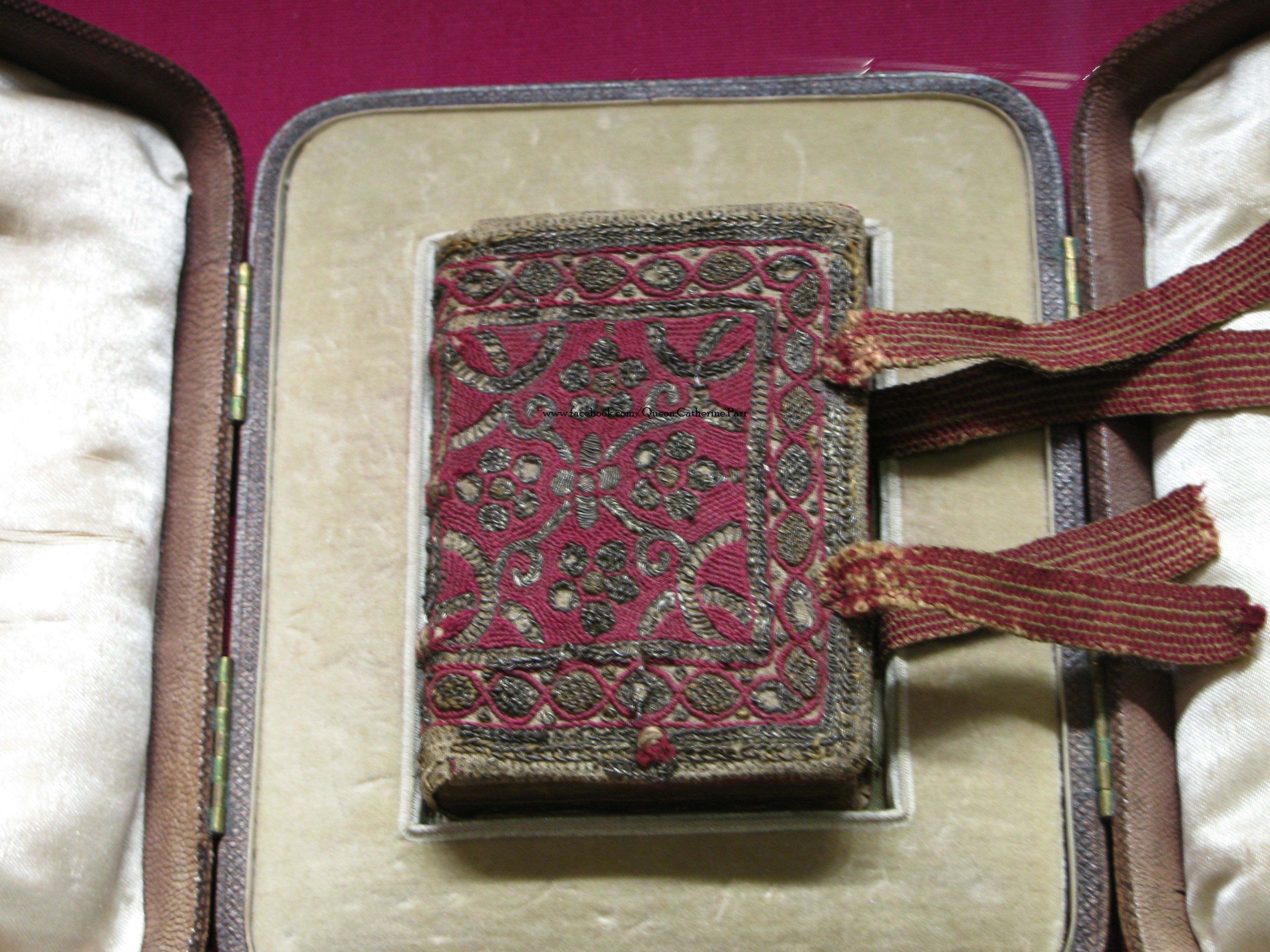
First published in 1545, Prayer of Meditations by Katherine Parr. Photo by Meg Mcgath (2012)

“Prayers or Meditations” by Queen Katherine Parr at Sudeley Castle. Photo by Meg Mcgath (2012).

First published in 1545, “Prayers or Meditations” by Queen Katherine Parr became so popular that 19 new editions were published by 1595 (reign of Elizabeth I). This edition was published in 1546 and bound by a cover made by the Nuns of Little Gedding. Located at Sudeley Castle, Winchcombe.

Queen Katherine Parr published two books in her lifetime. The first, ‘Prayers and Meditations’, was published while King Henry VIII was still alive [1545].

Folger Shakespeare Library PDI Record: --- Call Number (PDI): STC 4824a Creator (PDI): Catharine Parr, Queen, consort of Henry VIII, King of England, 1512-1548. Title (PDI): [Prayers stirryng the mind unto heavenlye medytacions] Created or Published (PDI): [1550] Physical Description (PDI): title page Image Root File (PDI): 17990 Image Type (PDI): FSL collection Image Record ID (PDI): 18050 MARC Bib 001 (PDI): 165567 Marc Holdings 001 (PDI): 159718 Hamnet Record: --- Creator (Hamnet): Catharine Parr, Queen, consort of Henry VIII, King of England, 1512-1548. Uniform Title (Hamnet): Prayers stirryng the mind unto heavenlye medytacions Title (Hamnet): Praiers Title (Hamnet): Prayers or meditacions, wherein the minde is stirred, paciently to suffre all afflictions here, to set at nought the vayne prosperitee of this worlde, and alway to longe for the euerlastinge felicitee: collected out of holy workes by the most vertuous and gracious princesse Katherine Queene of England, Fraunce, and Ireland. Place of Creation or Publ. (Hamnet): [London : Creator or Publisher (Hamnet): W. Powell?, Date of Creation or Publ. (Hamnet): ca. 1550] Physical Description (Hamnet): [62] p. ; 8⁰. Folger Holdings Notes (Hamnet): HH48/23. Brown goatskin binding, signed by W. Pratt. Imperfect: leaves D2-3 and all after D5 lacking; D2-3 and D6-7 supplied in pen facsimile. Pencilled bibliographical note of Bernard Quaritch. Provenance: Stainforth bookplate; Francis J. Stainforth - Harmsworth copy Notes (Hamnet): An edition of: Prayers stirryng the mind unto heavenlye medytacions. Notes (Hamnet): D2r has an initial 'O' with a bird. Notes (Hamnet): Formerly STC 4821. Notes (Hamnet): Identified as STC 4821 on UMI microfilm, reel 678. Notes (Hamnet): Printer's name and publication date conjectured by STC. Notes (Hamnet): Running title reads: Praiers. Notes (Hamnet): Signatures: A-D⁸ (-D8). Notes (Hamnet): This edition has a prayer for King Edward towards the end. Citations (Hamnet): ESTC (RLIN) S114675 Citations (Hamnet): STC (2nd ed.), 4824a Subject (Hamnet): Prayers -- Early works to 1800. Associated Name (Hamnet): Harmsworth, R. Leicester Sir, (Robert Leicester), 1870-1937, former owner. Call Number (Hamnet): STC 4824a STC 4824a, title page not for reproduction without written permission. Folger Shakespeare Library 201 East Capitol Street, SE Washington, DC 20003 Folger Shakespeare Library
PDI Record:

Call Number (PDI):
STC 4824a
Creator (PDI):
Catharine Parr, Queen, consort of Henry VIII, King of England, 1512-1548.
Title (PDI):
[Prayers stirryng the mind unto heavenlye medytacions]
Created or Published (PDI):
[1550]
Physical Description (PDI):
title page
Image Root File (PDI):
17990
Image Type (PDI):
FSL collection
Image Record ID (PDI):
18050
MARC Bib 001 (PDI):
165567
Marc Holdings 001 (PDI):
159718
Hamnet Record:

Creator (Hamnet):
Catharine Parr, Queen, consort of Henry VIII, King of England, 1512-1548.
Uniform Title (Hamnet):
Prayers stirryng the mind unto heavenlye medytacions
Title (Hamnet):
Praiers
Title (Hamnet):
Prayers or meditacions, wherein the minde is stirred, paciently to suffre all afflictions here, to set at nought the vayne prosperitee of this worlde, and alway to longe for the euerlastinge felicitee: collected out of holy workes by the most vertuous and gracious princesse Katherine Queene of England, Fraunce, and Ireland.
Place of Creation or Publ. (Hamnet):
[London :
Creator or Publisher (Hamnet):
W. Powell?,
Date of Creation or Publ. (Hamnet):
ca. 1550]
Physical Description (Hamnet):
[62] p. ; 8⁰.
Folger Holdings Notes (Hamnet):
HH48/23. Brown goatskin binding, signed by W. Pratt. Imperfect: leaves D2-3 and all after D5 lacking; D2-3 and D6-7 supplied in pen facsimile. Pencilled bibliographical note of Bernard Quaritch. Provenance: Stainforth bookplate; Francis J. Stainforth – Harmsworth copy
Notes (Hamnet):
An edition of: Prayers stirryng the mind unto heavenlye medytacions.
Notes (Hamnet):
D2r has an initial ‘O’ with a bird.
Notes (Hamnet):
Formerly STC 4821.
Notes (Hamnet):
Identified as STC 4821 on UMI microfilm, reel 678.
Notes (Hamnet):
Printer’s name and publication date conjectured by STC.
Notes (Hamnet):
Running title reads: Praiers.
Notes (Hamnet):
Signatures: A-D⁸ (-D8).
Notes (Hamnet):
This edition has a prayer for King Edward towards the end.
Citations (Hamnet):
ESTC (RLIN) S114675
Citations (Hamnet):
STC (2nd ed.), 4824a
Subject (Hamnet):
Prayers — Early works to 1800.
Associated Name (Hamnet):
Harmsworth, R. Leicester Sir, (Robert Leicester), 1870-1937, former owner.
Call Number (Hamnet):
STC 4824a
STC 4824a, title page not for reproduction without written permission.
Folger Shakespeare Library
201 East Capitol Street, SE
Washington, DC 20003

Henry was said to be proud and at the same time jealous of his wife’s success. ‘Lamentations of a Sinner’ was not published until after Henry died [in 1547]. In ‘Lamentations‘, Catherine’s Protestant voice was a bit stronger. If she had published ‘Lamentations’ in Henry’s lifetime, she most likely would have been executed as a heretic despite her status as queen consort. Henry did not like his wives outshining him [i.e. Anne Boleyn]…hence her compliance and submission to the King when she found that she was to be arrested by the Catholic faction at court. Her voice may have been dialed down a notch, but once her step-son, the Protestant boy King Edward took the throne — she had nothing to hold her back. Her best friend, the Dowager Duchess of Suffolk, and brother Northampton encouraged Parr to publish.

A publication of the book The Lamentation of a Sinner c.1550 [after the death of Queen Katherine] from the book “Vivat Rex!: An Exhibition Commemorating the 500th Anniversary of the Accession of Henry VIII” by Arthur Schwarz

Published in 1547 [according to Sudeley Castle] after the death of King Henry VIII, “The Lamentation of a Sinner” was Katherine’s second book which was more extreme than her first publication. She was encouraged by her good friend the Duchess of Suffolk and her brother, the Marquess, to publish. The transcription of the title page here is… “The Lamentacion of a synner, made by the most vertuous Lady quene Caterine, bewailyng the ignoraunce of her blind life; let foorth & put in print at the inflance befire of the right gracious lady Caterine, Duchesse of Suffolke, and the ernest request of the right honourable Lord William Parre, Marquesse of Northampton.”

I was lucky enough to see a copy both a Sudeley Castle and at the Folger Shakespeare Library in Washington, D.C. I am really interested in going to the Library and studying the actual book…one day!

Queen Katherine's Queen Katherine’s “Lamentations of a Sinner” on display at the Vivat Rex Exhibition at the Folger Shakespeare Library. Photo by Meg Mcgath (2009). See above for full description of the book the Folger has in their collection which can be seen in this photo.

Family of Queen Katherine Parr: Anne Devereux, Countess of Pembroke

Lady Anne Devereux, Countess of Pembroke

© Meg McGath 24 January 2015

Pembroke Castle which was taken over from Jasper Tudor [uncle of the future King Henry VII], Earl of Pembroke. The castle and Tudor’s title was then given to the Yorkist supporter, Sir William Herbert. Anne Devereux would have spent time here while she was married.

Lady Anne Devereux, Countess of Pembroke, Baroness Herbert (c. 1430, Bodenham – after June 25, 1486), was a daughter of a Yorkist Knight. By her marriage to Sir William Herbert, 1st Earl of Pembroke and Baron Herbert, Anne became a leading noblewoman in Wales.

Family

Walter_Devereux,_7th_Baron_Ferrers_of_Chartley,_KGAnne was the daughter of Sir Walter Devereux, the Lord Chancellor of Ireland, and his wife Elizabeth Merbury.[1] Lord Devereux and his son-in-law, Lord Herbert, were responsible for the capture of Sir Edmund Tudor [father to the future King Henry VII]. Tudor was a half-brother to the Lancastrian King Henry VI by his mother’s second marriage to Owen Tudor. 

Anne had two siblings, Walter and John. Walter was knighted after the Battle of Towton on 29 March 1461 by the Yorkist King Edward IV. By right of his wife, the heiress Lady Anne, 7th Baroness Ferrers of Chartley, he was raised to Baron Ferrers of Chartley on 26 July 1461. Lord Walter held various positions during the ruling of the House of York [Kings Edward IV, Edward V, and Richard III] but was ultimately killed in the last battle of the War of the Roses, the Battle of Bosworth 22 August 1485. He was succeeded by his son and heir, John, who became the 8th Baron Ferrers of Chartley. The 8th Baron would marry Lady Cecily Bourchier [her paternal grandparents were both descendants of King Edward III. Cecily was also a niece of queen consort Elizabeth Woodville by Cecily’s mother, Anne]. The couple were 2nd great-grandparents to Sir Robert Devereux, 2nd Earl of Essex who was a favorite of Queen Regnant Elizabeth I [daughter of King Henry VIII of the House of Tudor].[8][9][10]

The Crophull Inheritance

Anne’s grandfather, Walter, was the son of Agnes Crophull. By Crophull’s second marriage to Sir John Parr, Anne was a cousin to the Parr family which included Sir Thomas Parr; father of King Henry VIII’s last queen consort, Katherine Parr.[2][3][4] 

Tomb of Agnes Crophull and her third husband, Sir John Merbury. Weobley, Herefordshire, England.

Anne’s great-grandmother was a great heiress of her father. She was married firstly to Sir Walter Devereux [died 1402] while she was still underage. Upon Agnes’s coming of age in September 1385, Devereux seized the remaining estates based on his marriage right in 1386.[7] These included Weobley manor (Herefordshire); Sutton Bonnington manor and lands at Arnold (Nottinghamshire); the manors of Cotesbach, Braunston, and Hemington (Leicestershire); and an estate at Market Rasen (Lincolnshire). Weobley would become his principal residence.

When Agnes Crophull died on 9 Feb 1436, Crophull’s heir was Anne Devereux’s father, Sir Walter Devereux [grandson of Crophull]. Estates like Lyonshall passed to Walter from Agnes, and also by right of his wife, Elizabeth Merbury, who was the daughter [step-daughter of Agnes] of Agnes Crophull’s third husband, John Merbury, by a previous marriage. Merbury and Agnes were buried together in Weobley’s Parish of St. Peter and St. Paul. Anne’s great-grandfather, Walter [first husband to Agnes Crophull], is also supposedly buried there in a separate tomb. Through her father, Anne was a descendant of King Henry II and his wife Eleanor of Aquitaine by their children John, King of England and Eleanor of England, Queen of Castile.[1]

Marriage

About 1445, Anne married Sir William Herbert, [later 1st Earl of Pembroke], in Herefordshire, England. He was the second son of Sir William ap Thomas of Raglan, a member of the Welsh Gentry Family, and his second wife Gwladys ferch Dafydd Gam.[1]

William_Herbert,_1st_Baron_Herbert,_KG

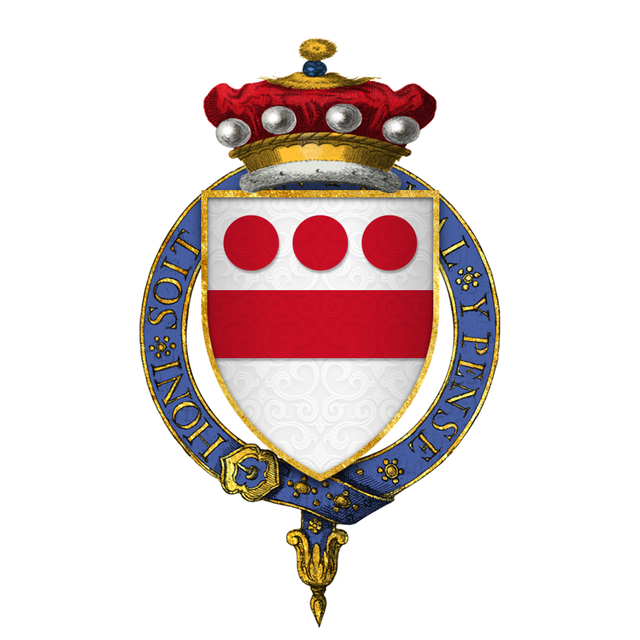
The arms of Lord William Herbert, K.B.

Sir William Herbert was a very ambitious man. During the War of the Roses, Wales heavily supported the Lancastrian cause. Jasper Tudor, 1st Earl of Pembroke and other Lancastrians remained in control of fortresses at Pembroke, Harlech, Carreg Cennen, and Denbigh. On 8 May 1461, as a loyal supporter of King Edward IV, Herbert was appointed Life Chamberlain of South Wales and steward of Carmarthenshire and Cardiganshire. King Edward’s appointment signaled his intention to make replace Jasper Tudor with Herbert who would become the premier nobleman in Wales. Herbert was created Lord Herbert on 26 July 1461. Herbert was then ordered to seize the county and title of Earl of Pembroke from Jasper Tudor. On 29 March 1461, Lord Herbert became the 1st Earl of Pembroke. By the end of August, Herbert had taken back control of Wales with the well fortified Pembroke Castle capitulating on 30 September 1461. With this victory for the House of York came the inmate at Pembroke; the five year old nephew of Jasper Tudor, Henry, Earl of Richmond. Determined to enhance his power and arrange good marriages for his daughters, in March 1462 he paid 1,000 for the wardship of Henry Tudor. Herbert planned a marriage between Tudor and his eldest daughter, Maud. At the same time, Herbert secured the young Henry Percy who had just inherited the title of Earl of Northumberland. Herbert’s court at Raglan Castle was where young Henry Tudor would spend his childhood, under the supervision of Herbert’s wife, Anne Devereux. While at Raglan Castle, Anne must have understood the importance of the potential marriage between her daughter and Henry Tudor. Therefore, Anne insured that young Henry was well cared for.[5]
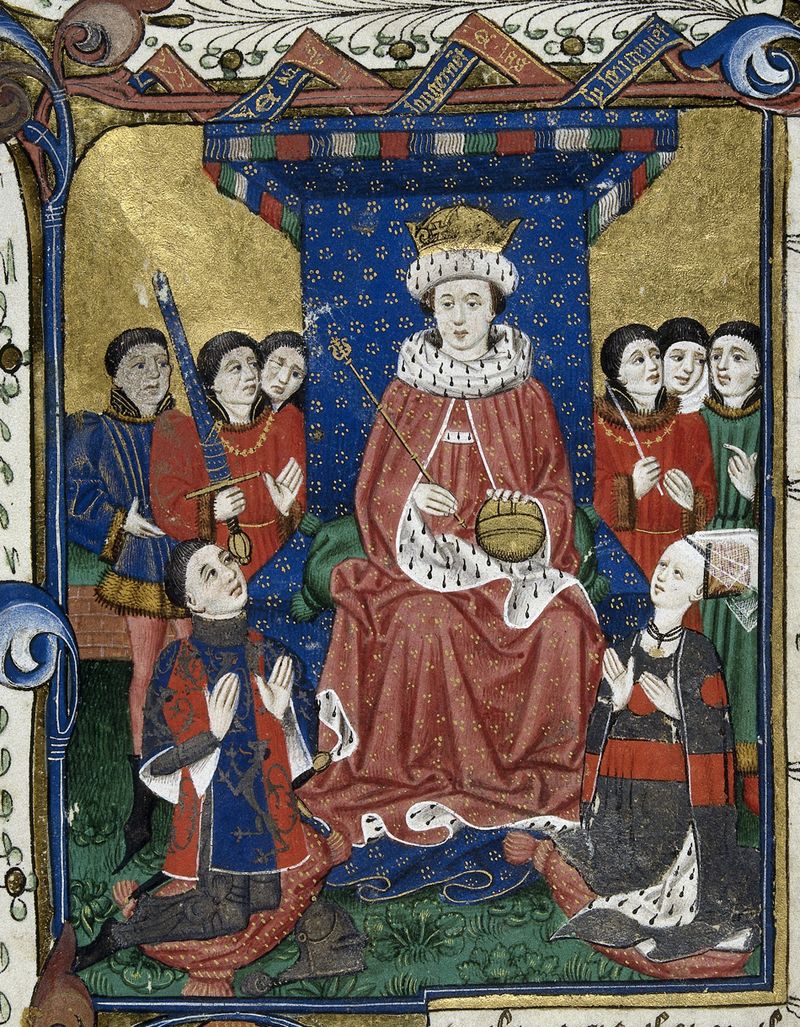
Detail of a miniature of a king enthroned surrounded by courtiers with Sir William Herbert and his wife, Anne Devereux kneeling before him, wearing clothes decorated with their coats of arms, from John Lydgate's Troy Book and Siege of Thebes, with verses by William Cornish, John Skelton, William Peeris and others, England, c. 1457 (with later additions), Royal 18 D. ii, f. 6.

Detail of a miniature of a king enthroned surrounded by courtiers with Sir William Herbert and his wife, Anne Devereux kneeling before him, wearing clothes decorated with their coats of arms, from John Lydgate’s Troy Book and Siege of Thebes, with verses by William Cornish, John Skelton, William Peeris and others, England, c. 1457 (with later additions), Royal 18 D. ii, f. 6. © British Library, 2015.

In the Battle of Edgecote on 26 July 1469, the Yorkists, led by Pembroke, were defeated by the Lancastrians. The Lancastrians were lead by Sir Richard Neville, 16th Earl of Warwick; the man who helped Edward, Earl of March become King Edward IV.[a] Warwick had decided to fight against his cousin Edward and restored the Lancastrian King Henry VI for a few years while Edward went into exile. After the battle, the Earl of Pembroke and his brother Richard were executed near Banbury by the Lancastrians. Henry Tudor was lead from the battlefield to the home of Pembroke’s brother-in-law, Lord Ferrers, at Weobley in Herefordshire. It was there that Sir Reginald Bray, a servant of Henry Tudor’s mother Lady Margaret Beaufort, found Tudor six days after the battle. Anne, now Dowager Countess of Pembroke, was found sheltered by Lord Ferrers where she continued to look after Henry Tudor.[5]

Issue

The Earl and Countess of Pembroke had three sons and seven daughters:[1]

  • Sir William Herbert, 2nd Earl of Pembroke, Earl of Huntingdon[1], married firstly to Mary Woodville; daughter of Richard Woodville, 1st Earl Rivers and thus sister to King Edward IV’s queen consort Elizabeth Woodville. He married secondly to Lady Katherine Plantagenet, the illegitimate daughter of King Richard III.[1] [b]
  • Sir Walter Herbert[1]
  • Sir George Herbert[1]
  • Lady Maud Herbert, wife of Sir Henry Percy, 4th Earl of Northumberland, 7th Lord Percy.[1]
  • Lady Katherine Herbert, wife of Sir George Grey, 2nd Earl of Kent.[1]
  • Lady Anne Herbert, wife of Sir John Grey, 1st Baron Grey of Powis.[1]
  • Lady Margaret Herbert, wife of Sir Thomas Talbot, 2nd Viscount Lisle, and of Sir Walter Bodrugan.[1]
  • Lady Cecily Herbert, wife of John Greystoke.[1]
  • Lady Elizabeth Herbert, wife of Sir Thomas Cokesey.[1]
  • Lady Crisli Herbert, wife of Mr. Cornwall.[1]

Sadly, the earldom did not pass down through his son, the 2nd Earl of Pembroke. The 2nd Earl’s only child by Mary Woodville was a daughter, Lady Elizabeth Herbert. Lady Elizabeth became Baroness Herbert in her own right. As a woman, Lady Herbert could not inherit the Earldom of Pembroke. She did receive extensive lands in Wales.[c]

The Earl of Pembroke also fathered several children by various mistresses.[1]

  • Sir Richard Herbert of Ewyas, Herefordshire was the illegitimate son of William Herbert, 1st Earl of Pembroke and most likely Maud, daughter of Adam ap Howell Graunt (Gwynn). Their son, William, would be created Earl of Pembroke [of the tenth creation] on 11 October 1551 by King Edward VI [son of King Henry VIII]. This brought the Earldom back into the Herbert family where it remains to this day. Pembroke was lucky enough to marry to Anne Parr.[d]
  • Sir George Herbert. The son of Frond verch Hoesgyn. Married Sybil Croft.[2]
  • Sir William Herbert of Troye. Son of Frond verch Hoesgyn. Married, second, Blanche Whitney (née Milborne) see Blanche Herbert, Lady Troy. They had two sons.[6]

After the death of her husband, the Dowager Countess was recorded as still living after 25 June 1486. She most likely died soon after.

Notes

[a] Lord Warwick was the son of Sir Richard Neville, 5th Earl of Salisbury and Lady Alice, Countess of Salisbury [in her own right]. Salisbury and his siblings by Lady Joan Beaufort was a grandson of Prince John of Gaunt, 1st Duke of Lancaster and Titular King of Castile [son of King Edward III]. One of Salisbury’s siblings was none other then Lady Cecily [Duchess of York] who would marry to the Yorkist rival, Richard, 3rd Duke of York. The couple were parents to both Kings Edward IV and Richard III. Lord Warwick’s siblings included Lady Alice FitzHugh [born Neville] who was mother to Lady Elizabeth Parr; the second husband of Sir William Parr, Baron Parr of Kendal. The two were grandparents to queen consort of Henry VIII [great-grandson of the Duke and Duchess of York], Katherine Parr.

[b] Lady Herbert married to Lord Charles Somerset, Earl of Worcester, a legitimized son of Lord Henry Beaufort, 3rd Duke of Worcester. The 3rd Duke was a son of Lord Edmund, 2nd Duke and Lady Elizabeth Beauchamp. Both parents had royal and noble descent. The 2nd Duke was from the legitimized line, the Beauforts, who were children of Prince John of Gaunt, 1st Duke of Lancaster. Elizabeth Beauchamp was the daughter of the 13th Earl of Warwick who was the father of Lady Anne Beauchamp who became the 16th Countess of Warwick in her own right after the death of her brother. Her title was inherited by her husband, the infamous “Warwick, the Kingmaker” [Sir Richard Neville,16th Earl of Warwick].

[c] In 1479, the Earldom was bestowed upon Prince Edward of York, later King Edward V [Plantagenet]. When the King went missing after being lodged in The Tower of London, the Earldom merged into the crown. It was restored under the new King, Henry Tudor, who became Henry VII of England. An interesting turn of events was in 1532. Henry VII’s son, Henry VIII decided to grant the title to Anne Boleyn as ‘Marquess of Pembroke’ two months before their marriage to elevate her status. Anne Boleyn had been lady-in-waiting to Henry VIII’s first wife, Queen Katherine of Aragon. A romance blossomed between the two despite her position as the daughter of a knight. They were eventually married under the “new religion” that made Henry VIII Supreme Head of the Church of England. The Catholic Church never granted an annulment from his first marriage and never recognized the marriage of Henry and Anne. Anne was crowned queen and gave birth to a daughter, Elizabeth [later queen]. After failing to produce a son, Anne had charges brought up against her that eventually led to her execution. Coincidentally, her own lady-in-waiting Jane Seymour, took Anne’s place as the next wife and queen consort. Queen Jane did give birth to a son, Edward [later King].

[d] Herbert married to Anne Parr, daughter of Sir Thomas [a courtier and favorite of King Henry VIII] and Lady Maud Parr [Green]. At the time, it was a step up for Herbert as Anne was descended from a great lineage. It has been said, that because of his marriage to Anne, it brought some legitimacy to the Herbert family. In 1543, Herbert’s sister-in-law, the Dowager Lady Katherine Latimer [widow of Sir John Neville, 3rd Baron Latimer of Snape], would become the sixth and final queen consort to King Henry VIII. Both Lord and Lady Herbert were present at the ceremony. The marriage only brought on more advancement for Herbert and his family. After the death of King Henry VIII in 1547, Herbert became one of the guardians of the young King Edward VI. He was made a Knight of the Garter in 1549, and created Baron Herbert of Cardiff on 10 October 1551, and 1st Earl of Pembroke of the [tenth creation] the following day.

References

  1. :a b c d e f g h i j k l m n o p Douglas Richardson. Plantagenet Ancestry, 2nd Edition, 2011. pg 249.
  2. Douglas Richardson. Magna Carta Ancestry, 2nd Edition, Vol. II, pg 2.
  3. Douglas Richardson. Magna Carta Ancestry, 2nd Edition, Vol. III, pg 297-298.
  4. Douglas Richardson. Royal Ancestry, Vol. V, pg 248.
  5. Chris Skidmore. The Rise of the Tudors: The Family That Changed English History, Macmillian, 14 January 2014. pg 47.
  6. Ruth E. Richardson. Mistress Blanche: Queen Elizabeth I’s Confidante, Logaston Press. 1 November 2007.
  7. Calendar of Close Rolls, Richard II, Volume 3. H.C. Maxwell Lyte (editor). 1921. pages 32 to 35, 27 September 1385, Westminster.
  8. Douglas Richardson. Plantagenet Ancestry, 2nd Edition, 2011. pg 607-8.
  9. Douglas Richardson. Plantagenet Ancestry, 2nd Edition, 2011. pg 45-6.
  10. Charles Mosley (editor). Burke’s Peerage & Baronetage, 106th Edition. Chicago: Fitzroy Dearborn Publishers, 1999. Volume 1, pages1378-80

Written and Researched by Ms. McGath

© Meg McGath 24 January 2015

All Rights Reserved

2 DECEMBER 1571: THE BURIAL of Sir William Parr, 1st Marquess of Northampton

The Collegiate Church of St Mary in the town of Warwick, England. It is a Parish Church of the Church of England. (Wikipedia)

On 2 December 1571 Sir William Parr, 1st Marquess of Northampton was laid to rest in St. Mary’s Collegiate Church, Warwick, England.

The only commemoration of Northampton even being buried in St. Mary's is marked by only a stone tablet.

The only commemoration of Northampton even being buried in St. Mary’s is marked by a stone tablet.

The inscription on the stone tablet reads:

‘Died in Warwick 28 October 1571. [Unknown] with the ceremonial due [of a] Knight of the Garter to the Order of Queen Elizabeth who bore the expense of the funeral, 2 December 1571.

Lord Robert Dudley, Earl of Leicester and favorite of Elizabeth I was also buried in St. Mary's in September of 1588.

Lord Robert Dudley, Earl of Leicester and favorite of Elizabeth I was also buried in St. Mary’s in September of 1588.

Coincidentally, William was buried in the same church as Elizabeth’s favorite, Robert Dudley, 1st Earl of Leicester. As he had requested, Leicester was buried in the Beauchamp Chapel—in the same chapel as Richard Beauchamp, his ancestor, and the “noble Impe”, his little son.

Collegiate Church of St Mary in Warwick, Beauchamp Chapel, tomb of Lord Robert and Lettice Dudley (born Knolly). (Wiki Commons)

His widow, Countess Lettice, was also buried there when she died in 1634, alongside the “best and dearest of husbands”, as the epitaph, which she commissioned says.

Wenceslaus Hollar, ‘Richard Beauchamp, Earl of Warwick (tomb)‘, University of Toronto Wenceslas Hollar Digital Collection. Wikimedia Commons.

The Beauchamp family vault is also in St. Mary’s. The tomb of the 13th Earl of Warwick features several of Northampton’s ancestors and cousins such as the Neville family. Northampton’s paternal great-grandmother, Lady Alice FitzHugh (born Neville), was sister to Richard Neville, 16th Earl of Warwick (“Warwick, the Kingmaker”) who is featured on the Beauchamp Monument. Also featured is the parents of Lady FitzHugh and Lord Warwick, The Earl and Countess of Salisbury, Richard and Lady Alice Montacute.

Tomb of Richard Beauchamp, 13th Earl of Warwick which is surrounded by mourners of his family and in-laws. (Moriarty Blog)

Lord Robert, Earl of Leicester descended from the 13th Earl via his paternal great-great-grandfather John Talbot, 1st Viscount of Lisle who was the son of Lady Margaret Beauchamp, Countess of Shrewsbury; eldest daughter of the 13th Earl of Warwick and his first wife, Elizabeth Berkeley.

© Meg McGath; author. All Rights Reserved.