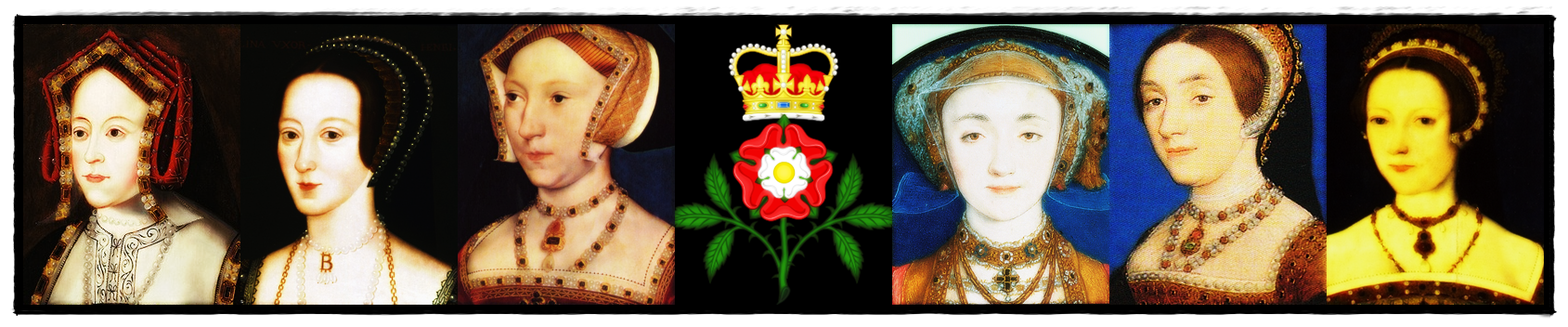
English Ancestry of The Six Wives: Descent from Edward I

The Six Wives of King Henry VIII

Yes, all six wives of King Henry VIII had English ancestry; some more than others.

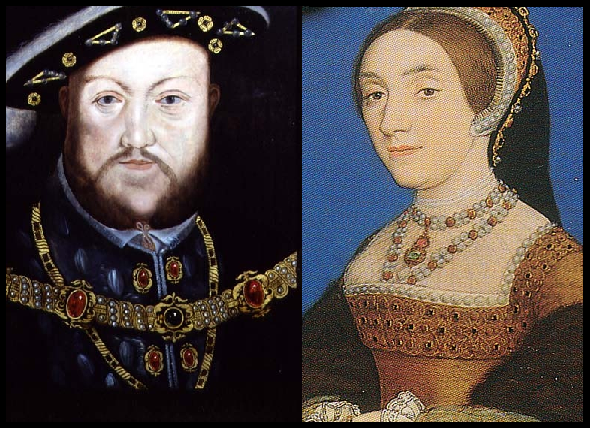
Henry VIII after Hans Holbein c. 1535-44

Miniature of Henry VIII [1540-1570] after Hans Holbein the Younger. Watercolour and bodycolour on vellum, diameter 3.6 cm, Royal Collection, Windsor Castle.

FACT: King Henry VIII descends from Edward I of England only six times!

  • By his paternal grandmother, Lady Margaret Beaufort, Henry descended from Edward I by Margaret’s paternal grandparents; John Beaufort, 1st Earl of Somerset and his wife Lady Margaret of Kent [born Holland], later Duchess of Clarence.
    • Lord Somerset was a grandson of Edward III [grandson of Edward I and his first wife, Eleanor of Castile] by his father Prince John of Gaunt, 1st Duke of Lancaster.
    • Lady Margaret of Kent was a granddaughter of Princess Joan of Kent, Princess of Wales [wife of Edward, Princes of Wales, heir to Edward III, and mother to Richard II]; granddaughter of Edward I and his second wife, Marguerite of France, by their second son, Edmund of Woodstock, 1st Earl of Kent.
  • By his maternal grandfather, Edward IV, Henry descended from Edward I by Edward’s parents; Lord Richard, Duke of York and Lady Cecily [born Neville], Duchess of York:
    • The Duke of York’s parents, Lord Richard, 3rd Earl of Cambridge and his wife Lady Anne [born Mortimer], Countess of Cambridge both descended from Edward I.
      • Cambridge was a grandson of Edward III by his father, Edmund of Langley, Duke of York, 4th surviving son of Edward III.
      • Lady Anne Mortimer was a granddaughter of Edward III by her paternal grandmother, Lady Philippa of Clarence, 5th Countess of Ulster; granddaughter of Edward III by his second surviving son, Lionel of Antwerp, 1st Duke of Clarence. Lady Anne also had a second connection to Edward I, by her maternal grandfather, Sir Thomas Holland, 2nd Earl of Kent; son of Princess Joan, Princess of Wales. Princess Joan was, as mentioned before, a granddaughter of Edward I and his second wife Marguerite.
    • Lady Cecily, Duchess of York, was the youngest daughter of Sir Ralph, Earl of Westmorland and his second wife, Lady Joan Beaufort. Lady Joan was the only daughter of Prince John of Gaunt, 1st Duke of Lancaster and his third wife, Katherine [Roet]. John of Gaunt was of course the son of Edward III.

292px-Tudor_Rose_Royal_Badge_of_England.svgWould it surprise you to know that even Katherine of Aragon and Anne of Cleves had Edward I in their pedigree?

In fact, Katherine of Aragon descended from two wives of Prince John of Gaunt, 1st Duke of Lancaster, Titular King of Castile [the son of Edward III of England and Philippa of Hainault]; Blanche of Lancaster AND Constanza of Castile, heir to the throne of Castile.

Royal Emblem of Queen Katherine of Aragon

1. Katherine of Aragon – daughter of Ferdinand II of Aragon and Isabella I of Castile [2 times]

  • By her mother — Isabella of Castile’s paternal grandmother, Katherine of Lancaster, daughter of Prince John of Gaunt [son of Edward III] and his second wife, Constanza of Castile, she descended from Edward I and Eleanor of Castile.
  • Isabella of Castile’s maternal great-grandmother, Philippa of Lancaster, was also a daughter of Prince John of Gaunt, but by his first wife, Blanche of Lancaster. Lady Philippa was brother to King Henry IV [Bolingbroke]. Queen Katherine’s Hampton Court Pedigree shows this line from Edward I’s son, Edward II, onwards.

Royal Emblem of Queen Anne Boleyn

2. Anne Boleyn – daughter of Sir Thomas Boleyn and Lady Elizabeth Howard [5 times]

  • By both paternal great-great-grandparents [through the Butler’s of Ormonde], Sir James, 4th Earl of Ormonde and Joan Beauchamp; she descended from Edward I and Eleanor’s daughter Princess Elizabeth of Rhuddlan. The Earl and Countess of Ormonde were parents to the 7th Earl of Ormonde.
  • By her paternal great-great-grandmother, Lady Anne Montacute, daughter of the 3rd Earl of Salisbury [also an ancestor of Queen Katherine Parr] she descends from Princess Elizabeth’s elder sister, Princess Joan of Acre. Lady Anne was the mother of Anne Hankford, Countess of Ormonde as wife to the 7th Earl.
  • By her maternal [Howard] line she descended from Edward I and Eleanor of Castile via her great-great-grandmother Lady Margaret Mowbray, wife of Sir Robert Howard; Lady Margaret descended from Elizabeth of Rhuddlan, by way of Lady Eleanor Fitzalan [wife of Thomas Mowbray, 1st Duke of Norfolk].
  • By Sir Thomas Mowbray, 1st Duke of Norfolk, she descended from Edward I and Marguerite of France through their son, Thomas of Brotherton Plantagenet, Duke of Norfolk [Hampton Court Pedigree shows this line from Edward I’s son, Thomas of Brotherton onwards]

Royal Emblem of Queen Jane Seymour

3. Jane Seymour – daughter of Sir John Seymour and Margery Wentworth [twice]

  • By her maternal great-grandmother, Hon. Margaret Clifford, whose father John Clifford, 7th Lord descended from Joan of Acre, daughter of Edward I and Eleanor of Castile. Lord Clifford’s great-great-grandmother was Lady Margaret de Clare, Countess of Gloucester [daughter of Princess Joan] who married Sir Hugh Audley, 1st and last Earl of Gloucester.
  • By Hon. Margaret Clifford’s mother, Lady Elizabeth Percy, whose grandmother was Lady Philippa of Clarence, 5th Countess of Ulster who was the daughter of Lionel of Antwerp, the second son of Edward III. [Hampton Court Pedigree shows this line from Edward I’s son, Edward II, onward]

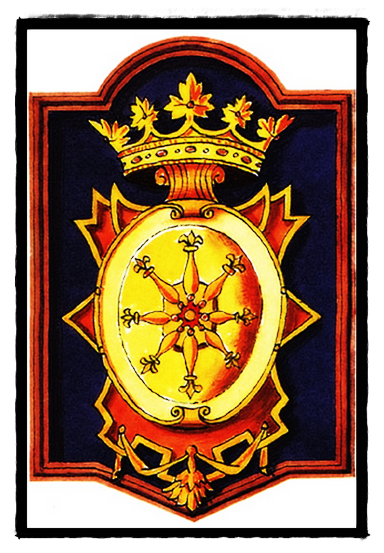
Royal Emblem of Queen Anne of Cleves

4. Anne of Cleves – daughter of John III, Duke of Cleves and Marie von Julich [twice]

  • By both paternal great-grandparents, Johan I Duke of Cleves and Elizabeth of Nevers; who were great-grandchildren of Marguerite of Dampierre, suo jure Countess of Flanders. Marguerite was the great-granddaughter of Margaret of England, Duchess of Brabant; daughter of Edward I and Eleanor. [Hampton Court Pedigree shows the lineage of Johan I of Cleves from Edward’s daughter, Margaret of England who’s son became Johan III, Duke of Brabant]

Royal Emblem of Queen Katherine Howard

5. Katherine Howard – daughter of Lord Edmund Howard and Jocasa Culpepper [3 times]

  • Like Anne Boleyn, by her paternal line [Howard] she descended from Edward I and Eleanor by Elizabeth of Rhuddlan by way of Lady Eleanor Fitzalan [wife of Thomas Mowbray, 1st Duke of Norfolk].
  • By Sir Thomas Mowbray, 1st Duke of Norfolk, she descended from Edward I and Marguerite of France through their son, Thomas of Brotherton Plantagenet, 1st Duke of Norfolk [Katherine’s Hampton Court Pedigree shows this line from Edward I’s son, Thomas of Brotherton onwards]
  • By her maternal great-great-grandfather, Sir William Ferrers, 5th Baron Groby, she descends from Princess Joan of Acre, daughter of Edward I and Eleanor, via her daughter Lady Elizabeth de Clare, wife of Sir Theobald, 2nd Lord Verdun.

Royal Emblem of Queen Katherine Parr

6. Katherine Parr – daughter of Sir Thomas Parr of Kendal and Maud Greene [6 times]

  • By her paternal grandmother the Hon. Elizabeth FitzHugh, daughter of Lady Alice Neville [sister of “Warwick, the Kingmaker”] she descended from Lady Joan Beaufort and her second husband Sir Ralph Neville, 1st Earl of Westmorland; Lady Joan was the legitimized daughter of Prince John of Gaunt, 1st Duke of Lancaster, third son of Edward III and thus she descended from Edward I and Eleanor of Castile. [Katherine’s Hampton Court Pedigree shows this line from Edward I’s son, Edward II onwards]
  • By her paternal great-great-grandmother, Lady Alice Montacute, suo jure Countess of Salisbury [wife of Sir Richard, 5th Earl of Salisbury, son of Lady Joan and Sir Ralph mentioned above]. Both parents of the Countess of Salisbury descended from Edward I; by her father the 4th Earl of Salisbury she descended from Princess Joan of Acre, daughter of Edward I and Eleanor by her son 2nd Lord Monthermer by her second husband Lord Monthermer, Earl of Gloucester. By her mother Lady Eleanor de Holland [daughter of Lady Joan of Kent, Princess of Wales and niece of King Richard II] she descended from Prince Edmund of Woodstock, son of Edward I and his second wife Marguerite of France.
  • By her maternal great-great-grandfather, Sir Thomas Greene, Sheriff of Northamptonshire, she descended from Princess Elizabeth of Rhuddlan, daughter of Edward I and Eleanor; Sir Thomas Greene descended from Princess Elizabeth’s daughter Lady Eleanor Bohun, Countess of Ormonde. His wife, Hon. Philippa de Ferrers descended from Elizabeth of Rhuddlan’s elder sister, Princess Joan of Acre, TWICE; by her daughters Lady Margaret de Clare, Countess of Gloucester and Lady Eleanor de Clare, Lady Despenser.

For more on their pedigrees, featuring the windows from Hampton Court Palace — see also —

The Hampton Court Pedigrees

Written and researched by Meg McGath, 2012.

Sir Edward Borough: first husband of Katherine Parr

Sir Edward Borough (d. bef April 1533)

*the original Wikipedia article “Edward Burgh (Knight)” was written by Lady Meg
Gainsborough Old Hall, at one time was home to Katherine and her husband, Sir Edward.

Maud Parr looked to the Northern families for her daughter’s marriage after the deal with Lord Scrope of Bolton did not play out. In the lands of Sheriff Hutton, where her son William had once resided in the Duke of Richmond’s household, Maud found the royal surveyor of the castle, manor and lands, Sir Thomas Borough of Gainsborough, who was a distant kinsman of her husband, Sir Thomas Parr.[1]

The Boroughs of Gainsborough in Lincolnshire were and old and well-established gentry family. Sir Thomas’ grandfather, the 1st Baron had been an outstanding Yorkist in the reign of King Edward IV in the neighborhood of fanatical Lancastrians. He was a tough-minded and hard-handed individual who was given the Order of the Garter in 1496 by King Henry VII proving his ability to change and adapt with the constant royal change. Sir Thomas’ father, Sir Edward Borough, who became the 2nd Baron in name only, in 1496, was not so fortunate. Sir Edward, only a few years after succeeding to the barony, was declared a lunatic and was kept under restraint in his own home, Gainsborough Old Hall. After his incarceration, Sir Thomas, his son, took over as head of the family.[2][2.1]

Both Sir Thomas and his first wife Agnes Tyrwhit were kin to the Parrs and marriage into the family was seen as a suitable solution. Sir Thomas’ eldest son, Edward, was in his early twenties and although almost nothing is known about his character, it appears that his health kept him in a frail condition. Whether his health was frail or perhaps he inherited the bad seeds of his grandfather’s lunacy is uncertain. There were also rumors that Edward may have been homosexual. Whatever the ordeal, Edward was competent enough for his father to allow him the duties and responsibilities of part of his inheritance — he served as both a feofee and a justice of peace.[3]

For centuries, historians like Agnes Strickland, Alison Weir, and antiquarians alike have confused the grandfather, Lord Borough — with the grandson — Sir Edward — throwing the Scrope-Parr marriage negotiations into the mix for good measure. The story of twelve year old Katherine being sent away to marry an aged lunatic was/is a wonderful story filled with drama — but none the less was a myth that can now be laid to rest. The truth although is not quite so lurid and had its own moments of drama.*[see below for side notes]

Sketch titled “Lady Borow” by Holbein;
thought by some to be Katherine Parr.
Katherine’s father-in-law, Sir Thomas,
had to pull his connections just to get his own
wife, Lady Borough, painted by Holbein. (Porter pg 55)

Most likely in the Spring of 1529,[4] Katherine, now aged sixteen, set out for Lincolnshire to become the bride of Sir Edward Borough taking with her a wedding gift from her mother of two gold bracelets and a rosary. This was Katherine’s first venture north and given her closeness to her mother and her family it must have made her somewhat homesick.

Life at Old Gainsborough Hall with an unfamiliar husband and an over-bearing father-in-law given to violent rages, and the memories of the recently deceased lunatic in the attic must have frightened Katherine. Katherine’s new father-in-law ruled his family with an iron hand requiring absolute obedience. Some time after her marriage, Katherine’s father-in-law had another daughter-in-law, Elizabeth Owen, thrown out of the household and her children with his younger son Thomas declared bastards. Katherine’s husband lived in fear of his own father.[5]

In May 1533, at the celebrations for the coronation of Anne Boleyn, Katherine’s father-in-law was severely rebuked for ‘ripping Queen Katherine of Aragon’s [coat of] arms off her barge and for seizing the barge.’ Having been appointed Boleyn’s Lord chamberlain, he maintained a high profile and rode in her barge as she was received at the Tower on her coronation day. Appearing in the procession he wore a surcoat and mantle of white cloth of tissue and ermine as he held the middle of Anne Boleyn’s coronation train.[6] After being involved with the Queen’s affairs of state, Sir Thomas ended up being one of the twenty-six Peers summoned in May 1536 to Anne Boleyn’s trial; which would find her guilty and sentence her to death. In 1541, Sir Thomas would entertain King Henry VIII and his 5th ill-fated queen consort, Katherine Howard. Some ‘historians’ state that during this visit the King was introduced to his 6th and final queen consort, Katherine Parr, but by this time Katherine was now Lady Latimer, wife to Sir John Neville, 3rd Baron Latimer of Snape Castle.[7]

Thomas Borough had an ambitious reform-minded chaplain with whom he discussed his opinions in the matter of religion with. The passion for the reformed religion in the household of the Borough’s could have been where Katherine was first introduced to the new religion.[8]

Yet Katherine’s duty was not to discuss religion but to bear sons, which she did not do. Failure to do so may not have been all her fault. Having been raised in a liberal and enlightened household maintained by her mother — Edward Borough’s new bride was unused to the paternal tyranny of the household at Gainsborough. If Sir Thomas attempted to intimidate Katherine, he did not succeed. In fact, Sir Thomas came to find that Katherine was made of sterner stuff than his own sons! Another reason for the failure, which may have also put a strain on the marriage, could have been due to Katherine’s marriage portion which had not yet been paid for. For in Maud [Green] Parr’s will, written in 1529, she remarked ‘I am indebted to Sir Thomas Borough, knight, for the marriage of my daughter’.[4] The historical record on whether or not Katherine was ever pregnant by Edward is silent. If she was, certainly none survived to full term or survived infancy. Although her immediate family would have known, they, along with Katherine never spoke of it and there is no record of children by Sir Edward.[9]

Gainsborough Old Hall

For a time, Katherine and Edward lived with Edward’s family at Gainsborough Old Hall. If Katherine was homesick or unhappy, she had reason to be and wrote frequently to her mother for advice. Her mother would travel north in 1530 to see Katherine and it is most likely at her urging that the couple move out of the Old Hall after two years of marriage. Sir Thomas was a steward to the manor of the soke of Kirton-in-Lindsey, a small village about ten miles above Gainsborough. Thomas was persuaded to secure a joint patent in survivorship with his son. Katherine and Edward moved to Kirton-in-Lindsey. It was a modest residence, but mainly it was away from her in-laws and was a household in which she was the sole mistress. Instead of becoming the passive lady of the household, Katherine took control of her fortunes. But with the joy of escaping the Old Hall came the tragic news of her mother’s death less than a year after she moved.

“In learning, charity, and responsibility for the welfare of her family, Maud was the pattern from which Katherine constructed her own self-image.” (James. pg 55)

Saint Andrew's Church, Kirton in Lindsey. Saint Andrew’s Church, Kirton in Lindsey.

A year and a half after the death of her mother, Katherine’s marriage to the fragile Edward came to an end. In 1532, Katherine’s husband was named to the various commissions of peace that held session in the area, but by April of 1533, Edward Borough “Burgh” was dead. Unable to remain at Kirton-in Lindsey, which belonged to her father-in-law, Katherine’s options were limited. Her in-laws showed no desire in having her move back into Gainsborough Old Hall or in even keeping her around. Sir Thomas turned over the income of two of his manors in Surrey and one in Kent as her dower and that was the end of it. With no children from her marriage to Edward, she no longer had ties to the Borough’s and was most likely more than happy to be rid of them.[10] As a young widow barely out of her teens, Katherine found herself with little money, no home and no support system among her late husband’s circle. Katherine found herself all alone with the question of what to do and where to go.

*Notes: Until recently, many sources online stated that Katherine married the elderly Edward Burgh, 2nd Baron Burgh in 1529 [and some as early as 1526], at the age of seventeen, but the 2nd Baron died in August 1528. Truth be told that since Antonia Fraser’s release of The Wives of Henry VIII in 1994, and David Starkey’s 2004 release on the six wives, Katherine’s first husband has been identified as Sir Edward Borough. For seventeen years the preconceived notion that Katherine married the elderly 2nd Baron has been posted on many websites including Wikipedia. Some blame could be attributed to 19th century historian Agnes Strickland’s book on the Queens of England, Alison Weir’s book on the six wives [which seems to be a romanticized version of Parr’s life with sources from Strickland’s Victorian biography], lack of research, or lack of interest in Katherine. Coincidentally, recent interest in Parr sparked the release of two biographies on Katherine by Susan James and Linda Porter. In both books, research of documents and the will of Katherine’s mother confirm that she married the 2nd Baron’s grandson, who shared his first name. Sir Edward Borough was the eldest son and heir of the 2nd Baron’s eldest son and heir, Sir Thomas Borough, who would become the 1st Baron Burgh under a new writ in December 1529 after his father was declared insane and was never called to Parliament as the 2nd Baron Borough. In her will, dated May 1529, Maud Parr mentioned Sir Thomas, father of Edward, saying ‘I am indebted to Sir Thomas Borough, knight, for the marriage of my daughter‘. At the time of his son’s marriage, Thomas, was thirty-five which would have made Edward around Katherine’s age. Edward was in his twenties and may have been in poor health. The younger Sir Edward Borough died in the spring of 1533 never fulfilling the title of Lord (Baron) Borough.

Biographers of Katherine Parr, Susan James and Linda Porter, state that the younger Sir Edward Burgh died in the spring of 1533. Others state ”before April 1533”.[7]

Sources:
Primary: James, Susan E. Kateryn Parr: The Making of a Queen. Aldershot, England: Ashgate Publishing Ltd. 1999. pg. 60-63.
– Douglas Richardson, Kimball G. Everingham. Magna Carta ancestry: a study in colonial and medieval families, Genealogical Publishing Company, 2005. pg 838.
[1] Letters and Papers, Foreign and Domestic, of the Reign of Henry VIII; I, i, no. 563 (10).
[2] M.E. James, ‘Obediance and Dissent in Henrician England: The Lincolnshire Rebellion, 1536’, Past and Present, 48 (August 1970), 3-78.
[2.1] Letters and Papers, Foreign and Domestic, of the Reign of Henry VIII; 2, i, no. 1363.
[3] Letters and Papers, Foreign and Domestic, of the Reign of Henry VIII; 5, no. 1694, and II, no. 943 (7).
[4] National Archives, London. PROB: 11/24; Image Reference 149/110. *The wording of Maud Parr’s will implies that Katherine’s marriage had only recently taken place and the making of the will itself may have been inspired by the recently concluded marriage of Lady Parr’s eldest daughter.
[5] Letters and Papers, Foreign and Domestic, of the Reign of Henry VIII.
[6] Letters and Papers, Foreign and Domestic, of the Reign of Henry VIII; 6, p. 241.
[7] Cole, Robert Eden George. History of the manor and township of Doddington, otherwise Doddington-Pigot, in the county of Lincoln and its successive owners, with pedigrees. James Williamson, Printer, 1897. pg 41-50.
[8] D. Willen: 1989, 148-152.
[9] Porter, Linda. ‘Katherine the Queen’. Macmillan, 2010. pg 55.
[10] Letters and Papers, Foreign and Domestic, of the Reign of Henry VIII; 12, ii, no. 187(6).

© Meg McGath

5 September 1548: The Death of Queen Katherine Parr

The nursery and apartments of the dowager queen with Lady Anne Herbert standing by [the queen's sister] © Meg McGath, 2012.

The nursery and apartments of the dowager queen with Lady Anne Herbert standing by [the queen’s sister] © Meg McGath, 2012.

Unfortunately for Katherine, Dr. Huicke, so advanced in matters of diet and exercise for proper prenatal care, was a man of his time when it came to matters of hygiene. Having survived disease, civil insurrection, mob violence, charges of heresy and treason, four husbands including King Henry VIII, and the vicissitudes of life in sixteenth-century England for thirty-six years, Katherine succumbed most likely to puerperal or child-bed fever contracted from her doctor’s dirty hands and just a lack of hygiene in general. Two other Tudor queens had succumbed to the same disease and shortly died after; Jane Seymour [Henry’s third queen and mother of Edward VI who succeeded King Henry in January of 1547] and Elizabeth of York [queen to King Henry VII and mother of King Henry VIII; who gave birth to her final child, coincidentally named Princess Katherine, on 2 February 1503].

The three Tudor queens who would die shortly after giving birth; Queen Elizabeth of York, Queen Katherine, and Queen Jane Seymour. Their death is attributed to child-bed fever which was very common in Tudor times.

On the 5th September 1548, the Queen, lying on her death bed made her final will. Katherine was sick in body, but of good mind, perfect memory and discretion; being persuaded, and perceiving the extremity of death to approach her; disposed and ordained by permission, assent, and consent of her most dear, beloved husband, the Lord Seymour, a certain disportion, gift, testament, and last will of all her goods, chattels, and debts, by these words or other, like in effect, being by her advisedly spoken to the intent of a testament and last will in the presence of the witnesses and records under-named.

The witnesses of the queen’s will were Robert Huick, Doctor of Physic, and John Parkhurst. In her will, the queen gave her husband

“with all her heart and desire, frankly and freely give, will, and bequeath to the said Lord Seymour, Lord High Admiral of England, her married espouse and husband, all the goods, chattels, and debts that she then had, or right ought to have in all the world, wishing them to be a thousand times more in value than they were or been; but also most liberally gave him full power, authority, and order, to dispose and prosecute the same goods, chattels, and debts at his own free will and pleasure, to his most commodity.”

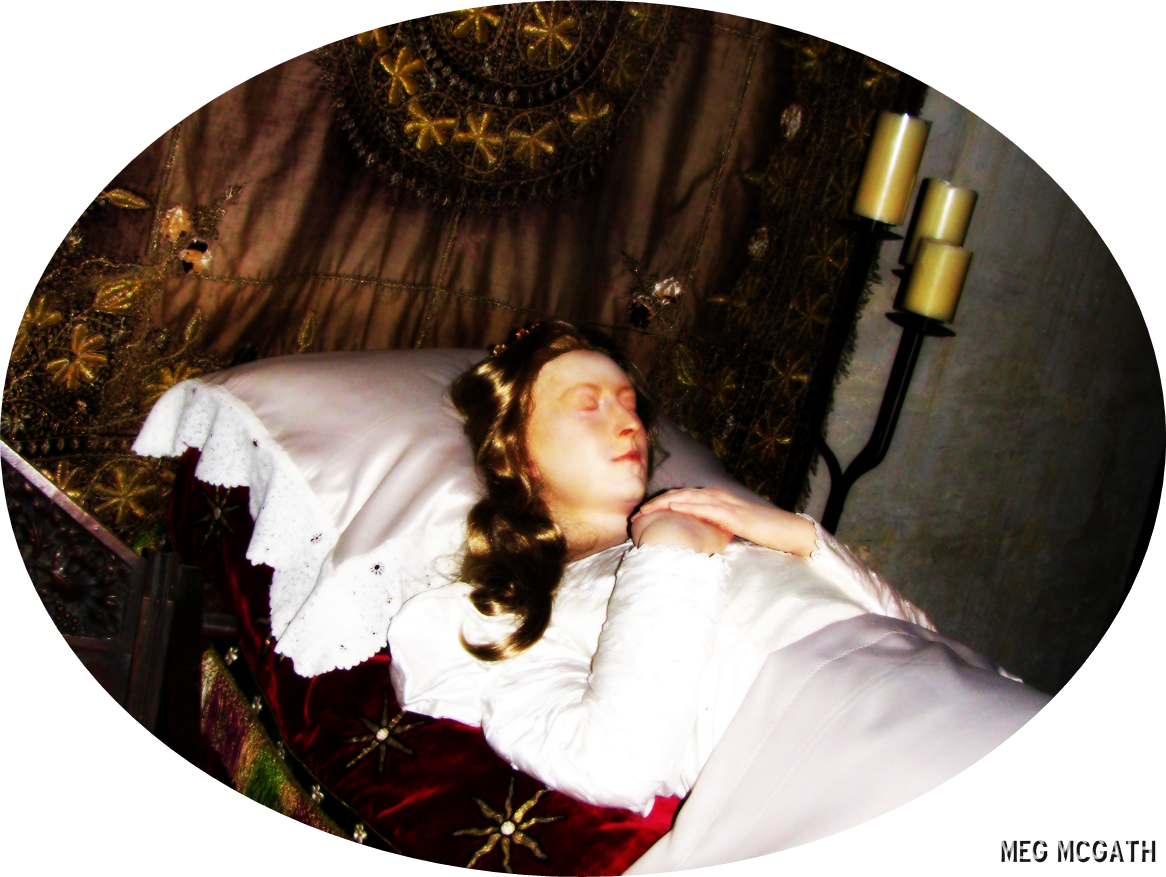
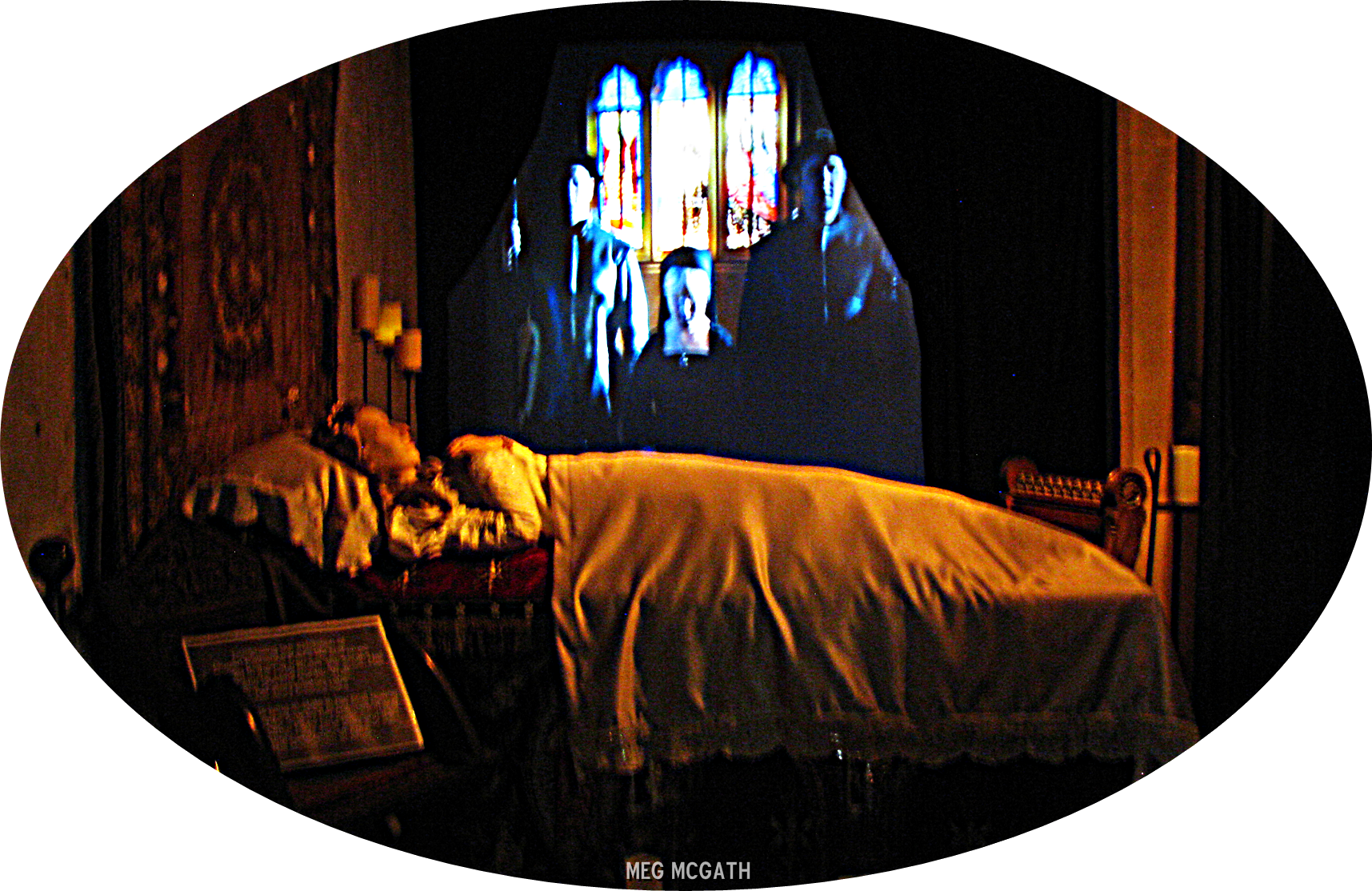
The queen lies in state inside St. Mary's Chapel at Sudeley Castle where she is buried, © Meg McGath, 2012.

The queen lies in state inside St. Mary’s Chapel at Sudeley Castle where she is buried, © Meg McGath, 2012.

Queen Katherine Parr died on Wednesday, the 5th of September, in the year of 1548; ‘between two and three of the clock in the morning.’

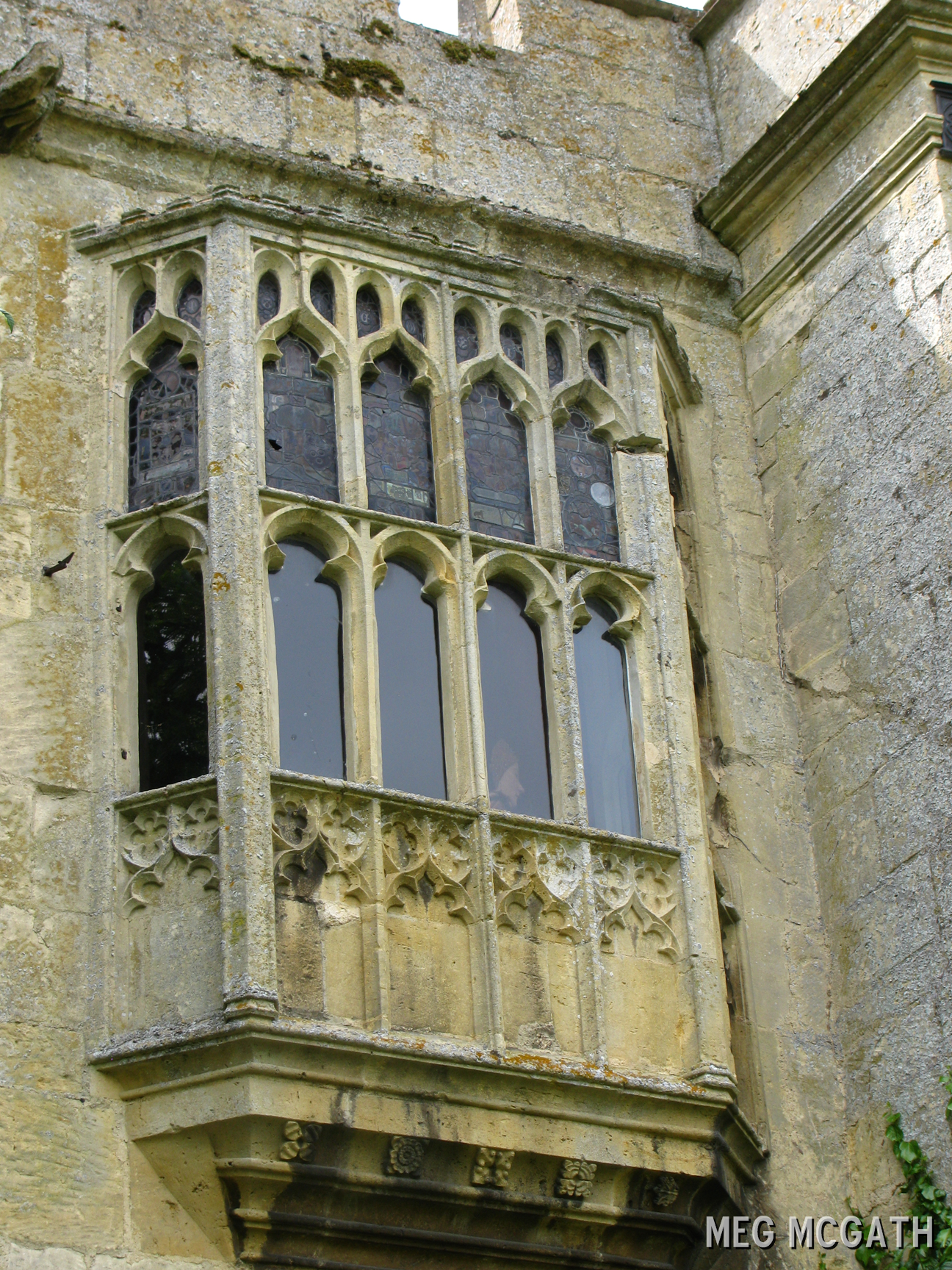
Nursery and Queen's apartment window from outside © Meg McGath, 2012.

Nursery and Queen’s apartment window from outside © Meg McGath, 2012.

John Parkhurst wrote two Latin epitaphs on Katherine Parr, circa 1548. Here is the first one.

On the incomparable woman, Katherine, formerly Queen of England, France, and Ireland, my most gentle mistress. An epitaph, 1547[8].

In this new sepulchre Queen Katherine sleeps,
Flower, honor, and ornament of the female sex.
To King Henry she was a wife most faithful;
Later, when gloomy Fate had taken him from the living,
Thomas Seymour (to whom the trident, Neptune, you extended)
was the distinguished man she wed.
She bore a baby girl; after the birth, when the sun had run
A seventh round, cruel Death did kill her.
For the departed, we her household flow with watery eyes;
Damp is the British earth from moistened cheeks.
Bitter grief consumes us, we unhappy ones;
But she rejoices ‘midst the heavenly host.

The queen lies in state inside St. Mary's Chapel at Sudeley Castle where she is buried, © Meg McGath, 2012.

The queen lies in state inside St. Mary’s Chapel at Sudeley Castle where she is buried, Lady Jane Grey and two yeomen watch over the queen’s body © Meg McGath, 2012.

Related Articles:

Sources:

  • Linda Porter. ‘Katherine, the queen,’ Macmillan, 2012.
  • Susan James. ‘Catherine Parr: Henry VIII’s Last Love,’ The History Press, Gloucestershire, 2008, 2009 [US Edition].
  • Janel Mueller. ‘Katherine Parr: Complete Works and Correspondences,’ University of Chicago Press, Jun 30, 2011.
  • Emma Dent. ‘Annals of Winchcombe and Sudeley,’ London, J. Murray, 1877.

Queen Katherine Parr: The Pregnancy and Birth of Lady Mary Seymour

From Sex and Sleaze: Time Traveller’s guide to Tudor England:

Childbirth is an exclusively female affair, with only female midwives in attendance and no doctors. After childbirth, babies are rapidly baptised because of high infant mortality, usually in the absence of their mothers. New mothers are not allowed in church until about 30 days after the birth, and then must be ‘churched’, or ritually purified.

In December of 1547, Queen Katherine Parr became pregnant for what most people believe to be the first time by her fourth and final husband, Sir Thomas Seymour. After four husbands and twenty years of marriage, Katherine was about to fulfill what she felt was the primary duty of a wife, to give birth to a healthy baby; boys being preferred in aristocratic circles. Like today, some titles still cannot be inherited by the eldest or only daughter of a peer; meaning a girl cannot inherit the title of her father which is usually then passed to the closest living male relative, that being usually an uncle or cousin.

Queen Katherine found pregnancy difficult. She still had an on-going feud with her brother-in-law, the Lord Protector and his rather nasty wife, had morning sickness, was constantly worrying about her step-daughter Lady Elizabeth, and the temper of her husband and lack of discretion towards his feelings for Lady Elizabeth must have made the early months of pregnancy extremely hard for the Queen Dowager.[1] In 1549, after the death of the Queen, two cramp rings for use against the pains of childbirth and three pieces of unicorn horn, sovereign remedy for stomach pains, were found in the chest of Katherine’s personal belongings which were talismans most likely from her husband and friend’s to alleviate the pains of childbirth and anticipated pangs of childbirth. Katherine was almost thirty-six, an advanced age to begin a pregnancy. The emotional strain of her household with Seymour’s infatuation with Lady Elizabeth couldn’t have helped her early months either.

As Katherine’s pregnancy progressed, her involvement in politics, if not her interest, diminished. She viewed her approaching motherhood with delight despite knowing the risks and the possibility that death in child birth was a very real possibility.

In June Katherine wrote to her husband from Hanworth:

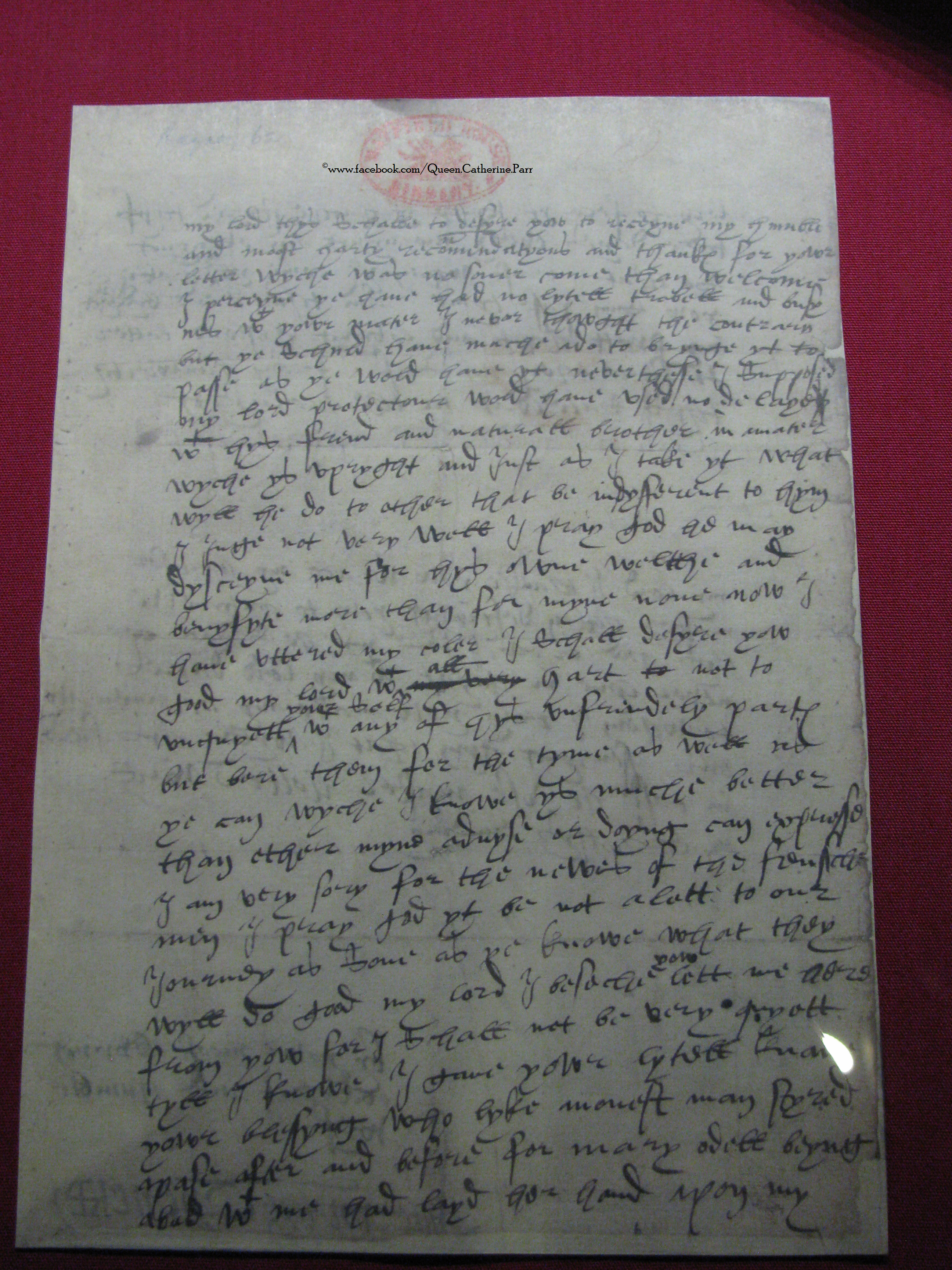
“I gave your little knave your blessing, who like and honest man stirred apace after and before. For Mary Odell being abed with me had laid her hand upon my belly to feel it stir. It hath stirred these three days every morning and evening so that I trust when ye come it will make you some pastime.”[2]

The Dowager Queen’s letter from Hanworth which is preserved at Sudeley Castle © Meg McGath, 2012.

Seymour, who was also aware of the perils of childbirth — from his own sister’s account — replied from Westminster:

“I do desire your highness to keep the little knave so lean and gaunt with your good diet and walking, that he may be so small that he may creep out of a mousehole. I hear my little man doth shake his poll [head], [and] trusting God should give him life to live as long as his father, he will revenge such wrongs as neither you nor I can.”[3]

The last part of the message obviously had to do with Seymour’s friction with his elder brother which at this time was on the verge of paranoia.

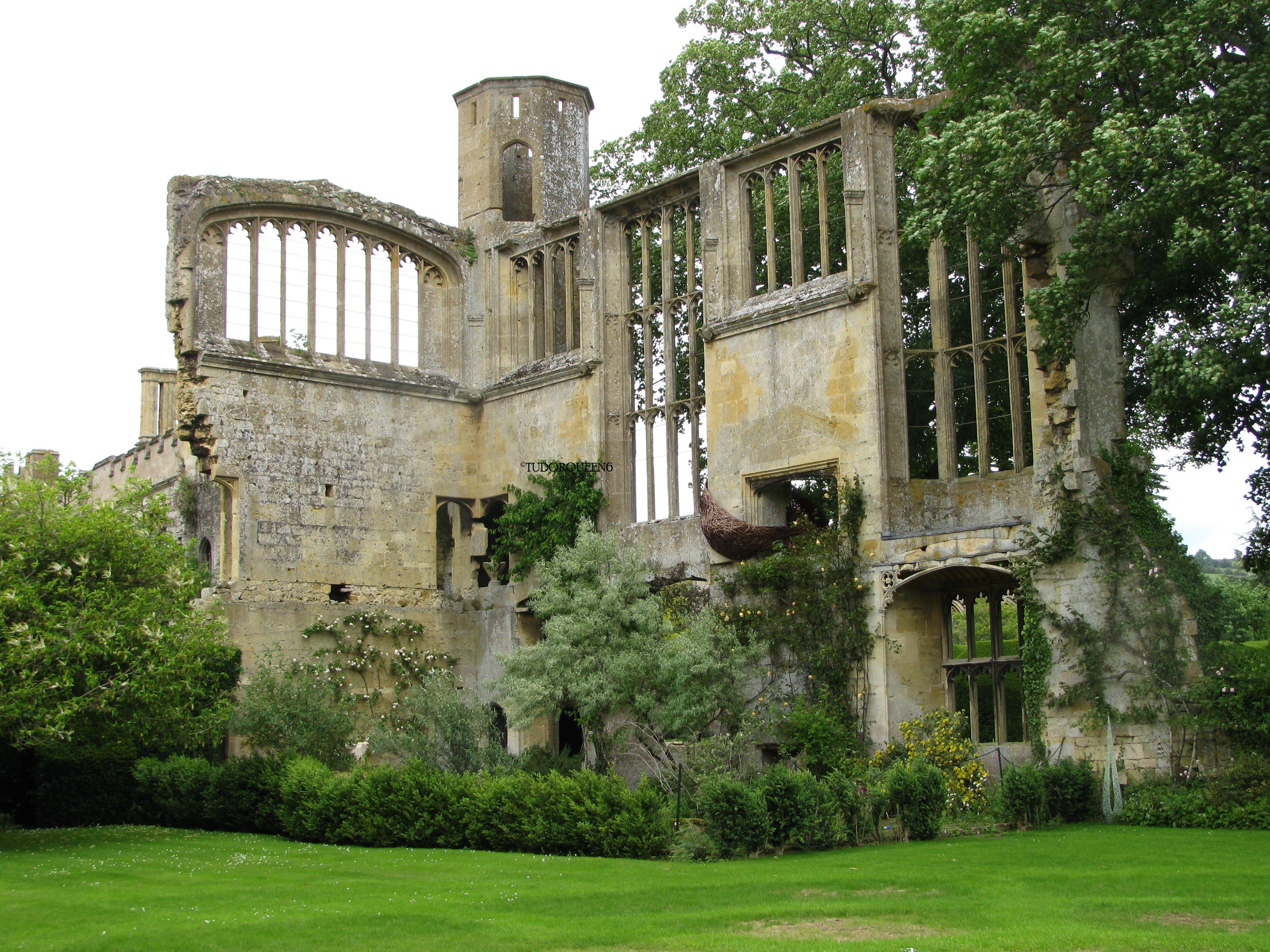
The Ruins of the 15th Century State Apartments, where Katherine would have spent her last few months © Meg McGath, 2012.

Seymour decided that Katherine should be confined as far away possible from the press of business and turmoil of the court as well as the summer plagues of London. Katherine was taken to Sudeley Castle in Winchcombe, England, outside of Cheltenham. The castle has a long history stretching back to William de Tracy. Richard III used the castle as campaign headquarters during the Battle of Tawkesbury; in which Katherine’s grandfather fought. Upon the death of Richard III, the castle reverted to the crown and new monarch, Henry VII; who gave the castle to his uncle, Jasper Tudor. After the death of Jasper Tudor, Sudeley reverted to the crown again, to King Henry VIII. In fact, the King made a visit to the castle with Anne Boleyn in 1535. Upon the ascension of Edward VI, Sir Thomas was created Lord Seymour of Sudeley and was granted the castle. In preperation for her lying-in, Seymour spent 1,000 pounds having the rooms prepared for her in his newly aquired house at Sudeley in Gloucestershire.[4] With beautiful gardens and walks, the castle would have been a perfect place for Katherine to spend the last three months of her pregnancy.

The Nursery at Sudeley Castle

On Wednesday, 13 June 1548, Seymour accompanied his wife, who was now six months pregnant, and his young ward, Lady Jane Grey, from Hanworth to Sudeley Castle in Gloucestershire. Lady Elizabeth Tudor had been sent away that Spring so she did not accompany them. In this castle, Katherine spent the last three months of her pregnancy and the last summer of her life. Typical of Queen Katherine, she spared no expense when it came to attendants. She was attended by her old friend and doctor, Robert Huicke, and was surrounded by other old friends, Miles Coverdale, her chaplain, her almoner, John Parkhurst, Sir Robert Tyrwhitt, and the ladies who had been with her over the years such as Elizabeth Trywhitt and Mary Wodhull. Katherine also had a full compliment of maids-of-honour and gentlewomen as well as 120 gentlemen and yeomen of the guard. In spite of his duties, Sir Thomas Seymour seems to have spent most of that summer with his wife. Katherine whiled away her summer days overseeing the education of Lady Jane Grey while preparing for her baby. Her affections for her husband seemed as strong as ever, as was her belief in the final analysis, Seymour would make the moral choice over the immoral one.

The queen wrote to her husband who had been called away on duty describing the baby as very active.

“I gave your little knave your blessing, who like an honest man stirred apace after and before. For Mary Odell being abed with me had laid her hand upon my belly to fell it stir. It hath stirred these three days every morning and evening so that I trust when you come it will make you some pastime…”

It was during this time that the queen dowager reconciled with Lady Mary who wrote to her stepmother on 9 August:

“I trust to hear good success of your Grace’s great belly; and in the meantime shall desire much to hear of your health, which I pray almighty God to continue and increase to his pleasure as much as your own heart can desire.”[6]

The Lady Elizabeth, who was now living away from her step-mother also wrote, too, answering a letter of Katherine’s in which the queen described the beauties of Sudeley and wished the princess with her once more:

“Although your Highness’ letters be most joyful to me in absence, yet considering what pain it is to you to write, your Grace being so great with child, and so sickly, your commendation were enough in my Lord’s letter. I much rejoice at your health with the well liking of the country. Your Highness were like to be cumbered, if I should not depart, till I were weary being with you; also it were in the worst soil in the world your presence would make it pleasant… God send you a most lucky deliverance.”[7]

One could reflect on this letter — seeing Lady Elizabeth’s concern when it came to childbirth. Perhaps this weariness and the eventual death of her beloved step-mother would confirm that she would never consider having children.

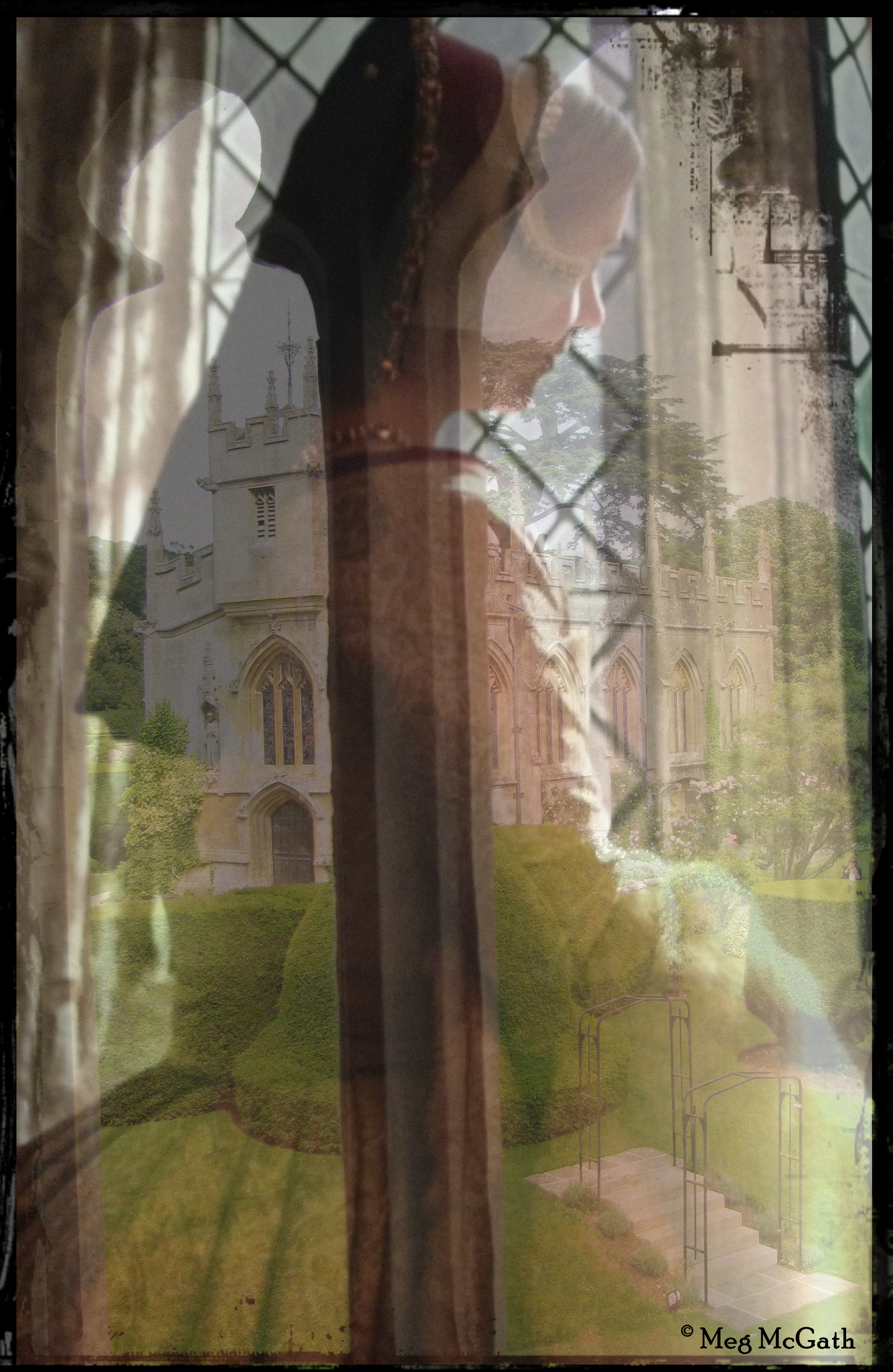
Queen Katherine looks from the window in her nursery which overlooks the gardens and Chapel.

Queen Katherine looks from the window in her nursery which overlooks the gardens and Chapel.

While Katherine awaited her confinement, Katherine continued decorating the nursery which overlooked the gardens and the Chapel. The nursery of an expected heir was done up in crimson and gold velvet and taffeta, with furniture and plate enough for a royal birth. In Seymour’s eyes, the child would be a member of the royal family as Katherine was still officially the only queen in England. After his daughter’s birth, Seymour was overheard telling Sir William Sharington that,

“it would be strange to some when his daughter came of age, taking [her] place above [the duchess of] Somerset, as a queen’s daughter.”[5]

Besides the baby’s cradle was a bed with a scarlet tester and crimson curtains and a separate bed for the nurse.

The Queen's Garden where Katherine would have walked.

The Queen’s Garden where Katherine would have walked.

The Queen continued to take the advice of her doctor and walked daily among the grounds of Sudeley, but she was still concerned about the politics and overseeing of the new boy king.

The nursery as it is today; the woman portrayed here is Queen Katherine's sister, Lady Anne Herbert [later Countess of Pembroke] who was Katherine's groom.

The nursery as it is today; the woman portrayed here is Queen Katherine’s sister, Lady Anne Herbert [later Countess of Pembroke] who was Katherine’s groom.

On Thursday, 30 August, [coincidentally in 2012, the celebration of Queen Katherine’s 500th anniversary of her birth, the 30th of August ALSO fell on a Thursday, on the eve of a blue moon] Katherine brought to bed a healthy baby girl who was named Lady Mary in honour of her step-sister, the Lady Mary Tudor. Disappointed briefly that the son and avenger he had hoped for had turned out to be a girl, Seymour rallied quickly and announced his daughter’s birth to the lord protector in ‘glowing terms’ and with a detailed description of her beauty. Somerset, the father of 12, was amused by his brother’s enthusiasm for fatherhood. But Seymour’s joy in his child’s birth was followed by fear at his wife’s worsening condition.

This portrait of a baby/small child hangs in the Nursery at Sudeley Castle. No identification on who it is.

This portrait of a baby/small child hangs in the Nursery at Sudeley Castle. No identification.

Links

Sources:

  • Linda Porter. ‘Katherine, the queen,’ Macmillan, 2012.
  • Susan James. ‘Catherine Parr: Henry VIII’s Last Love,’ The History Press, Gloucestershire, 2008, 2009 [US Edition].
  • Janel Mueller. ‘Katherine Parr: Complete Works and Correspondences,’ University of Chicago Press, Jun 30, 2011.
  • Emma Dent. ‘Annals of Winchcombe and Sudeley,’ London, J. Murray, 1877. Out of copyright; use of images and info.

Written and researched by Meg McGath, 29 August 2012

Family of Queen Katherine: Fogge of Kent

Sir John Fogge is know for being the great-grandfather of Queen Katherine Parr and other prominent Tudor courtiers.

Sir John Fogge (c.1417-1490) was Lord of the manor of Repton. His family was one of the first families in Kent, England. It was this John Fogge of Ashford who built and endowed the noble Church and the College at Ashford, Kent circa 1450, where he is also buried.

There is some uncertainty over the parents of Fogge. The most well-known source, “The Family Chronicle of Richard Fogge” shows John as the son of Sir William Fogge and an un-named daughter of William Wadham (his second wife).[17] “The Antiquary” states that he was the son of Sir William and his first wife, a daughter of Sir William Septvans.[15] However, Rosemary Horrox argues that he was the son of another John [and Jane Cotton]; Sir William’s younger brother.[12] Horrox also states he must have been born about 1417, since he was of legal age in 1438, and came to prominence when he inherited the senior line of the family by February 1447.[12]

John Fogge was for certain the grandson of Sir Thomas Fogge, who died in 1407. Fogge was buried in Canterbury Cathedral. He had been a soldier and courtier under King Richard II and his successor, the Lancastrian usurper, King Henry IV. Fogge’s standing in Kent was owed much to his early career as a Captain of war in France. His military service began in the retinue of Henry, Duke of Lancaster, the King’s lieutenant in Brittany from 1356. Like the Parrs’, he served John, Duke of Lancaster; the third surviving son of Edward III. He was of service to Lancaster in Spain in 1386.[13] It is uncertain for how long Fogge had been a retainer of Lancaster, but on 13 June 1372, the Duke formally retained him for life. Lancaster made mention of Fogge’s good service in the past and indicated by the size of the annuity granted (100 marks) that he ranked him high in his esteem. Under Lancaster, Fogge was Captain of Calais among other high postings.[19]

Thomas Fogge’s eldest son, John, came to the court of the Lancastrian King Henry IV. John served on a number of commissions and was appointed Sheriff of Kent in 1453.  John would continue to hold favor under the new King and gained the esteemed office of Comptroller of the Household in 1460 and keeper of the wardrobe to Henry VI in the last year of his first reign. John was knighted by the King in 1461.

In 1461 and 1463, under the Yorkist King, Edward IV, John Fogge was elected to Parliament as knight of the shire for Kent. Fogge became a Privy Councillor. From 1461-68, he was Comptroller and Treasurer of the Household [later known as Lord Chamberlain under the Tudor monarchs]. Fogge would continue that role for the Prince of Wales (later King Edward V). In 1461, Fogge was granted the office of keeper of the writs of the Court of Common Pleas.[2] He took part in the investigation of the possible treason of Sir Thomas Cooke. In 1467, he was MP for Canterbury and Sheriff of Kent, again, in 1472 and 1479. He represented Kent in parliament in 1478 and 1483.[1] It is thought that Fogge may have accompanied Edward into exile.[16] For Fogge’s continued loyalty to the Crown, he was awarded the Constableship of Rochester Castle, the keeping of Hothfield Manor, and the manors of Towton and Dane, which had formerly belonged to the Lancastrian loyalist, Sir Thomas Brown.[16]

From 1473, he was on the council and one of the tutors of Prince Edward (the future King Edward V).[16] He undertook administration of his property and was made Chamberlain jointly with Sir John Scott.[1] Fogge’s kinsman, Anthony, Earl of Rivers, was appointed the Prince’s Governor.[16] Fogge’s Haute kinsmen also rose in royal favor; Richard Haute had also become one of Prince Edward’s tutors and councilors and by 1483 Haute was controller of this household.[16]

In 1483, he supported Richard Guildford in Kent against Richard III, this rising being in support of Edward V, and becoming part of the unsuccessful Buckingham’s rebellion.[4] This was despite an apparent reconciliation with the king as soon as he came to the throne, after Fogge had taken sanctuary in June 1483 at the time of Richard’s coup in Westminster Abbey.[5][6] The rising was blocked at Gravesend by John Howard, 1st Duke of Norfolk; and the rebel force retreated.[7] The king acted mercifully once order had been restored;[8] but Fogge later did have lands in Kent confiscated and given to Sir Ralph Ashton.[9]Throughout the many conflicts which arose with the War of the Roses, Sir John was lucky enough to survive, especially when Richard III came to the throne. Sir John was a supporter of Henry Tudor and reportedly had a role in the Battle of Bosworth field. Because of this, Sir John’s lands that were attained during King Richard’s reign were restored as soon as King Henry VII came to power.

There is some confusion as to which wife he married first; they were both named Alice. It is thought that Alice Haute was Fogge’s first wife. His second wife was Alice de Criol or Kyriell, the daughter of the Yorkist Sir Thomas de Kyriell who was killed at the second battle of St. Albans. This marriage brought him Westenhanger Castle.[10]The “History of Ashford” states that Alice de Kyriell was Fogge’s first wife and that Alice Haute was his subsequent marriage. However, it then states that Alice was formerly married to a Woodville; which is not true. She was the daughter of a Woodville.

Fogge’s switch from the Red Rose of Lancaster to the White Rose of York was most likely due to his marriage into either the Woodville or Kyriel family; both families joined the Duke of York [later King Edward IV] in 1460. Fogge, Sir William Haute [father of Alice], and Sir Thomas Kyriel [father of Alice] were part of the first group to join the Yorkist earls when they arrived at Kent in 1460.[16]

Family

Edward IV and Elizabeth Woodville by Sophie Carter.

Edward IV and Elizabeth Woodville by Sophie Carter.

Fogge’s first wife was Alice Haute or Hawte (born circa 1444),[11] whom he had married c. 1465. She was the daughter of Sir William Haute of Hautsbourne, Kent (c.1390-1462) and Joan Woodville, sister of Richard Woodville, 1st Earl Rivers; and as so Alice was first cousin to Elizabeth Woodville, queen consort to Edward IV, and mother to Elizabeth of York.[12][13] When Elizabeth became queen, she brought her favorite female relatives to court.[21] As Lady Alice Fogge, Alice was one of the queen’s five ladies-in-waiting during the 1460s.[21]

According to Susan James and Linda Porter, they believe Sir John Fogge was the great-grandfather of Queen Katherine Parr.[11]  The other children included Sir John Fogge of Repton Manor and Margaret, Lady Stafford (mother of Sir William Stafford, husband to Mary Boleyn).[14][18]

His son Sir Thomas Fogge, Sgt of Calais was the son of his second marriage to Alice Kyriell.[14][15] His daughters Anne and Elisabeth were probably from the second marriage as well.[12]Illegitimate Daughter of Richard III Theory

There is a very slight possibility that Richard III’s mistress (or one of them) and mother to his illegitimate daughter was the sister-in-law to Lady Fogge. Katherine was the wife of James Haute (son of William Haute and Joan Woodville). Little is known about her; however in 1477 Richard in a grant gave to Katherine Haute 100 shillings per annum for life (DL29/637/10360A). There is no apparent reason for Richard to give her an annuity, and her Christian name is of course that of Richard’s illegitimate daughter, an uncommon one in the Yorkist Neville families. All of this may of course be far from the truth, although it is suggestive.[23]

Burial

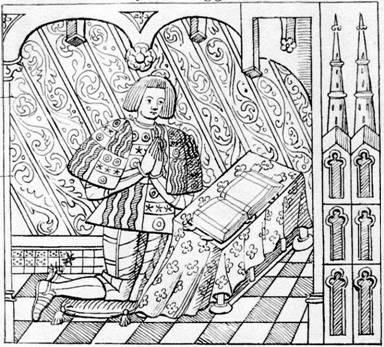
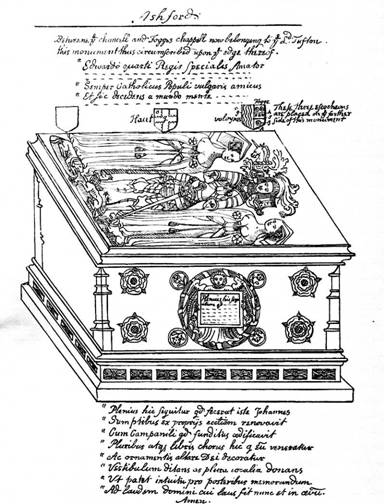
The tomb of Sir John Fogge and his two wives at Repton Church, Kent, England. An inscription round the margin of the slab, of which only a part remained in the days of Dering, completed the memorial. It seems to have recorded “that Sir John was a special friend of Edward IV., … and departed this world universally esteemed by the common people.”

Fogge died in 1490. The tomb in which he’s buried stands on the North side of the altar between the chancel and Fogge Chapel. The original ornaments have been stripped, but there were originally brass effigies of his two wives, Alice Kyriell and Alice Haute. The mantels of the wives were fastened with a rose. At their feet were crouched dogs with knotted leading strings. On the south side of the tomb had been enriched with Gothic arches where three shields were found; Kryiell, Haute, and Valoignes impaling Fogge. Fogge’s effify was attired in rich armor and decorated with the Yorkist collar of suns and roses with the white lion of Marche. His head reclined on his helmet, adorned with mantlings and crest. At his feat sat an Italian greyhound. On the north side the center ornament was an angel supporting an inscription panel with an endless circle formed of rose sapling sticks firmly bound together perhaps to show the stability of the family unity, the vitality of which is indicated four small sprouts of rose branches with leaves and blossoms. Four large bosses of the united Roses proclaimed a Yorkist’s acquiescence in the peaceable conclusion of the commotion.[22]

Coat of Arms

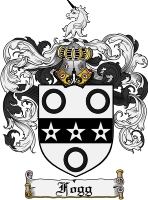
Fogge of Kent

Fogge of Kent

Their arms, Argent, on a fess, between three annulets, sable, three mullets, pierced of the first, which coat is carved in stone on the porch of Ashford church, on the roof of the cloysters at Canterbury, and in several windows of the cathedral there.[20]

Images

  • Drawings by Sir Edward Dering, 17th Century, published in Archaelogica Cantiana, Vol 2, 1859 [out of copyright].

Notes

    1. Charles Ross, Richard III (1981), p.106.
    2. J. R. Lander, Conflict and Stability in Fifteenth-century England (1971), p. 180.
    3. Arelene Okerlund, Elizabeth, England’s Slandered Queen (2006), p. 104.
    4. Paul Murray Kendall, Richard III (1972), p. 261.
    5. Ross, p. 112.
    6. Michael Bennett, The Battle of Bosworth (1987), p. 41 and p. 43.
    7. Kendall p. 271.
    8. Kendall p. 276.
    9. Ross, p. 119.
    10. http://www.fortifiedengland.com/Home/Categories/ViewItem/tabid/61/Default.aspx?IID=3415
    11. The Lineage and Ancestry of H.R.H. Prince Charles, Prince of Wales, by Gerald Paget, Vol. I, p. 95.
    12. Rosemary Horrox. “Fogge, Sir John“, on the website of the Oxford Dictionary of National Biography
    13. Peter Fleming. “Haute family“, on the website of the Oxford Dictionary of National Biography
    14. ‘Parishes: Stanford’, The History and Topographical Survey of the County of Kent: Volume 8 (1799), pp. 63-78. URL: http://www.british-history.ac.uk/report.aspx?compid=63459&strquery=fogge Date accessed: 05 December 2012.
    15. E.W. Allen. “The Antiquary,” Vol. 3-4, 1873.
    16. Sheila Sweetinburgh. “Later Medieval Kent, 1220-1540,” Boydell & Brewer, Nov 18, 2010. pg 258.
    17. Archaelogica Cantiana, Vol 5, 1863
    18. Douglas Richardson. “Plantagenet Ancestry: A Study In Colonial And Medieval Families,” 2nd Edition, 2011. pg 219-25.
    19. The History of Parliament: the House of Commons 1386-1421, ed. J.S. Roskell, L. Clark, C. Rawcliffe., 1993.
    20. Edward Hasted. ‘The town and parish of Ashford’, The History and Topographical Survey of the County of Kent: Volume 7 (1798), pp. 526-545.
    21. Barbara J. Harris. “English Aristocratic Women, 1450-1550 : Marriage and Family, Property and Careers: Marriage and Family, Property and Careers,” Oxford University Press, Jul 26, 2002. pg 218.
    22. Rev. A. J. Pearman. “History of Ashford,” H. Igglesden, 1868.
    23. Peter Hammond. “His Illegitimate Children,” Dr Rosemary Horrox notes. Richard III Society: Richard III — His Family.

Sir Thomas Burgh, 1st Baron Burgh of Gainsborough

Sir Thomas Burgh, 1st Baron Burgh of Gainsborough

Sir Thomas Burgh (pronounced: Borough), 1st Baron Burgh of Gainsborough KG (c. 1431[1] – 18 March 1496[2]) was an English peer. Sir Thomas was the son of Thomas Burgh and Elizabeth Percy, daughter of Sir Henry of Athol Percy (grandson of Henry Percy, 1st Earl of Northumberland and Margaret Neville). Sir Henry of Athol’s mother was Elizabeth Strathbogie, the daughter of David of Strathbogie, titular 12th Earl of Atholl (d. 10 October 1369) and his wife Elizabeth Ferrers. David was also the de jure Earl of Strathbogi; a title that would pass to the Baron Burgh’s as Baron Strabolgi.[2][3]

The family sprang from Hubert de Burgh, younger son of Hubert de Burgh, 1st Earl of Kent and his wife Beatrice de Warrenne, daughter of William de Warrenne, Lord of Wormegay, and Beatrice de Pierrepont.[4] The Burghs were rich, flamboyant and powerful people. Thomas was in great favour with the King as many offices, positions, land grants, and pensions were bestowed upon him. Thomas was Esquire of the Body to King Edward IV and by Christmas 1462, Thomas was created a Knight by the King and a Privy Councillor. Sir Thomas slowly became the King’s chief man in Lincolnshire where he held manors, land, tenemants from Northumberland (from his mother’s inheritance, which he shared with her sister Margaret, Baroness Grey of Codnor) through Westmorland, Yorkshire, and Lincolnshire, down to his wife’s dower lands in Somerset. Thomas became a rich man who was backed by the King and soon found himself giving advice and legal help to the people of Lincolnshire as well as becoming their Sheriff and representative in Parliament.

It was Sir Thomas Burgh with Sir Thomas Stanley who rescued King Edward IV from the Earl of Warwick whom the Earl had kept prisoner in his castle of Middleham. In 1471, when Edward IV reclaimed his throne it was Sir Thomas who was first to rally to his side. Sir Thomas fought at the battles of Barnet and Tewkesbury.(Sir Bernard Burke. A genealogical history of the dormant, abeyant, forfeited, and extinct peerages of the British empire. Harrison, 1866. pg 90.)

After the unexpected death of Edward IV, Sir Thomas was courted by King Richard III who made Thomas a Knight of the Garter. Thomas initially support King Richard, but was more interested in securing the future of Henry Tudor, Earl of Richmond, who would become King in 1485. Sir Thomas was part of the Battle of Bosworth, but his role was kept silent by chroniclers and he soon found himself in the King’s graces. After his accession to the throne, King Henry confirmed Thomas as Knight of the Body and Privy Councillor. It was King Henry VII who, on 1September 1487, created Thomas the first Baron Burgh of Gainsborough.[9]

This slideshow requires JavaScript.

In 1460, Sir Thomas built the great Old Hall in Gainsborough, Lincolnshire. Gainsborough Old Hall was not only their home, but also a demonstration of their wealth and importance. Sir Thomas was a great benefactor to Newark Church and also the founder of the Chantry and Alms House at Gainsborough. In 1470, the manor was attacked by Sir Robert Welles over a clash about lands, status, and honour, but it was not severely damaged. It was in 1484 that Sir Thomas entertained King Richard III in his hall. Today, the Hall with its elaborate timber roof survives as well as the kitchen — possibly the most complete medieval kitchen in England. The Hall is over five hundred years old and one of the best preserved medieval manor houses in England.[5]

Marriage

Sir Thomas married Margaret de Ros (1432-1488) widow of William Botreaux, 3rd Baron Bocastle. Margaret was the daughter of Sir Thomas de Ros, 9th Baron de Ros and Lady Eleanor Beauchamp, second daughter of Richard Beauchamp, 13th Earl of Warwick and Elizabeth Berkeley. Lady Eleanor was an older paternal half-sister of Henry de Beauchamp, 1st Duke of Warwick and Anne Neville, Countess of Warwick. After the death of the 9th Baron Ros, Margaret’s mother, Lady Eleanor, married Edmund Beaufort, 2nd Duke of Somerset thus making Margaret a maternal half-sister of the 3rd and 4th Duke of Somerset.[6][7]
Sir Thomas and Margaret had the following children:

  • Sir Edward Burgh, 2nd Baron Burgh, married the Hon. Anne Cobham, daughter of Sir Thomas Cobham, 5th Baron Cobham and Lady Anne Stafford and had issue.[7] His grandson, Sir Edward Burgh, would marry Katherine Parr, later Queen consort to King Henry VIII.[8]
  • Hon. Elizabeth Burgh (d. 1 August 1507), married Richard FitzHugh, 6th Lord FitzHugh [brother of Hon. Elizabeth FitzHugh; therefore the queen’s paternal great-grand uncle] and secondly Sir Henry Willoughby.[7]
  • Hon. Margaret Burgh (d. before April 1493), married Sir George Tailboys.[7]
  • Hon. Thomas Burgh[7]
  • Hon. Anne Burgh[7]

Lord Thomas died on 18 March 1496. He was buried next to his wife, Margaret, in the family vault in Holy Trinity Church, Gainsborough. His son, Edward succeeded him in title as the 2nd Baron Burgh of Gainsborough, but was never called to Parliament as such. Lord Thomas’s grandson by Edward, was created 1st Baron Burgh in a new creation in 1529.[9]

References

  1. ^ Charles Mosley, editor, Burke’s Peerage, Baronetage & Knightage, 107th edition, 3 volumes (Wilmington, Delaware, U.S.A.: Burke’s Peerage (Genealogical Books) Ltd, 2003), volume 1, page 587.
  2. ^ a b George Edward Cokayne. The Complete Peerage of England, Scotland, Ireland, Great Britain, and the United Kingdom, Vol. II. p. 422.
  3. ^ G.E. Cokayne; with Vicary Gibbs, H.A. Doubleday, Geoffrey H. White, Duncan Warrand and Lord Howard de Walden, editors, The Complete Peerage of England, Scotland, Ireland, Great Britain and the United Kingdom, Extant, Extinct or Dormant, new ed., 13 volumes in 14 (1910-1959; reprint in 6 volumes, Gloucester, U.K.: Alan Sutton Publishing, 2000), volume I, page 308.
  4. ^ Sir Bernard Burke. A genealogical history of the dormant, abeyant, forfeited, and extinct peerages of the British empire. Harrison, 1866. pg 90.
  5. ^ John Julius Norwich. Treasures of Britain; the architectural, cultural, historical and natural heritage of Britain. W. W. Norton & Company, 2002. pg 262.
  6. ^ George Edward Cokayne. The Complete Peerage of England, Scotland, Ireland, Great Britain, and the United Kingdom, Vol. II, p. 422.
  7. ^ a b c d e f Douglas Richardson, Plantagenet Ancestry, p. 503.
  8. ^ Linda Porter. Katherine, the Queen. Macmillan. 2010. pg 49, 53.
  9. ^ Charles Mosley, editor, Burke’s Peerage, Baronetage & Knightage, 107th edition, 3 volumes (Wilmington, Delaware, U.S.A.: Burke’s Peerage (Genealogical Books) Ltd, 2003), volume 1, page 587.
© Meg McGath, 6 March 2011

Family of Queen Katherine Parr: Lady Alice Neville, Baroness FitzHugh of Ravensworth

Lady Alice Neville (c. 1430 – after 22 November 1503), Baroness (Lady) FitzHugh of Ravensworth, was an English noblewoman and part of the great noble Neville family. She was the daughter of Sir Richard Neville, 5th Earl of Salisbury and his wife, Lady Alice Montacute, suo jure 5th Countess of Salisbury. Alice became Lady FitzHugh upon her marriage to Sir Henry FitzHugh, 5th Baron FitzHugh of Ravensworth Castle.[1]

She is best known for being the great-grandmother of Queen consort Katherine Parr and her siblings, Anne and William, as well as one of the sisters of Sir Richard Neville, 16th Earl of Warwick, known as the ‘Kingmaker’. Her family was one of the oldest and most powerful families of the North. They had a long standing tradition of military service and a reputation for seeking power at the cost of the loyalty to the crown as was demonstrated by her brother, the Earl of Warwick.[2] Warwick was the wealthiest and most powerful English peer of his age, with political connections that went beyond the country’s borders. One of the main protagonists in the Wars of the Roses, he was instrumental in the deposition of two kings, a fact which later earned him his epithet of “Kingmaker”.

Lady Alice was born in her mother’s principal manor in Wessex.[3] Lady Alice is thought to be named after her mother, Lady Alice Montacute.[3] Lady Alice Neville was the third daughter of six, out of the ten children of Sir Richard Neville, 5th Earl of Salisbury jure uxoris and Lady Alice Montague, suo jure 5th Countess of Salisbury. Alice’s godmother was her paternal aunt, Lady Anne Neville, Duchess of Buckingham, wife of Sir Humphrey Stafford, 1st Duke of Buckingham.[3]

By her paternal grandmother, Lady Joan Beaufort, Countess of Westmorland, she was the great-great-granddaughter of King Edward III of England and Philippa of Hainault. Lady Joan Beaufort was the legitimized daughter of Prince John of Gaunt, 1st Duke of Lancaster and Aquitaine, and his mistress, later wife, Katherine Roët Swynford. As such, Lady Alice was a great-niece of King Henry IV of England. By her father, the Earl of Salisbury, she was niece to Cecily, Duchess of York, mother to Edward IV and Richard III. Alice’s mother was the only child and sole heiress of Sir Thomas Montacute, 4th Earl of Salisbury by his first wife Lady Eleanor Holland [both descendants of King Edward I].  Alice’s maternal grandmother, Lady Eleanor Holland, was the granddaughter of Princess Joan of Kent, Countess of Kent and Princess of Wales. Princess Joan was of course the mother of the ill-fated King Richard II making Eleanor Holland his grandniece. Princess Joan herself was the daughter of Prince Edmund of Woodstock, 1st Earl of Kent; son of Edward I by his second wife, Marguerite of France.

Lady Alice’s siblings included:

  • Lady Joan Neville, Countess of Arundel (1423-9 September 1462), who married William FitzAlan, 16th Earl of Arundel. They had issue including the 17th Earl.
  • Lady Cecily Neville, Duchess of Warwick (1424-28 July 1450), who first married Henry de Beauchamp, 1st Duke of Warwick and the only King of the Isle of Wight (as well as of Jersey and Guernsey). Their only daughter was Anne Beauchamp, 15th Countess of Warwick. Her title as Countess of Warwick was inherited by her paternal aunt, Lady Anne Beauchamp, who married her maternal uncle, Sir Richard Neville, who became the 16th Earl by right of his wife. Cecily’s second husband was John Tiptoft, 1st Earl of Worcester.
  • The infamous, Sir Richard “the Kingmaker” Neville, 16th Earl of Warwick (1428–1471), whose younger daughter, Lady Anne, would marry Edward, Prince of Wales, son of Henry VI and Margaret of Anjou who died in 1471, and secondly Prince Richard, Duke of Gloucester who would become the last Plantagenet king as Richard III. By Richard, Queen Anne had one son; Edward of Middleham, Prince of Wales. Queen Anne died in 1485 at the age of 28 perhaps of tuberculosis. Neville’s eldest daughter, Lady Isabel, became Duchess of Clarence as the wife of Prince George, Duke of Clarence, who was brother to Edward IV and Richard III. Their children would be the last line of the Plantagenets’, ending with Lady Margaret, suo jure 8th Countess of Salisbury who was executed under the orders of her cousin’s son, King Henry VIII.
  • Sir John Neville, 1st and last Marquess of Montagu (c. 1431 – 14 April 1471), who’s son George, was intended to marry his cousin, Princess Elizabeth of York. Instead, Elizabeth became wife of the Tudor King Henry VII. In anticipation, George was made Duke of Bedford in 1470. John’s daughter, Margaret, married Charles Brandon, 1st Duke of Suffolk, but had no issue; the marriage was annulled on the grounds of consanguinity. Coincidentally, Neville’s granddaughter and niece of Margaret, Anne Browne, would also marry Charles and have issue; Lady Anne Brandon, Baroness Grey of Powis and Lady Mary Brandon, Baroness Monteagle.[12][13]
  • George Neville, Archbishop of York and Chancellor of England (1432–1476)
  • Lady Eleanor Neville, Countess of Derby (1438–1504); her husband Sir Thomas Stanley, Earl of Derby crowned Henry Tudor as King Henry VII after the death of Richard III at Bosworth Field. He would go on to marry Henry’s mother, Lady Margaret Beaufort, Countess of Richmond.
  • Lady Katherine Neville, Baroness Hastings (1442- after 22 November 1503) who married firstly William Bonville, 6th Baron of Harington and secondly William Hastings, 1st Baron Hastings. By Bonville, she was the mother of Cecily Bonville who was great-grandmother to the nine day queen of England, Lady Jane Grey.
  • Sir Thomas Neville (1443–1460), who was knighted in 1449 and died at the Battle of Wakefield.
  • Lady Margaret Neville, Countess of Oxford (1444-20 November 1506), who married John de Vere, 13th Earl of Oxford. No issue.

Life

Alice and her siblings would visit their grandmother, Lady Joan Beaufort, the Countess of Westmorland, often at her manors in Middleham and Sheriff Hutton. After Beaufort’s death in 1440, her father inherited the manors and Alice and her siblings began living in the manors on a more permanent basis. At the age of four, Alice started lessons in Latin and French with an introduction to law and mathematics. Alice began every day by attending mass with her family. As the tradition of most nobility of the times, the parents were absent attending to the King’s matters or personal business. They only saw each other on special occasions.

The uneasy years of the 1450s were used by Salisbury to conclude the marriages of the rest of his children. The rest of the daughters married members of solid, baronial families, but in some cases poorer and less influential than the other matches Salisbury made for his elder daughters. Salisbury obviously preferred to arrange great, rather than acceptable marriages, but as the War of the Roses continued his ability to secure them became more difficult.[3] With the death of Salisbury’s mother, Lady Joan Beaufort, his direct link to the royal family (Henry VI) was broken. That may have also stippled his matches for his daughters. Henry VI was a second cousin of the half blood. However, the children of Salisbury’s sister, the Duchess of York — were his nephews and nieces (the future King Edward IV and King Richard III, etc).

Lady Alice was either married in her late teens or early twenties to her father’s associate, Sir Henry, 5th Baron FitzHugh of Ravensworth. Lord FitzHugh had been a long-standing supporter of the Neville family; he supported Alice’s father, the Earl of Salisbury, in his dispute with the Percy family in the 1450s. Lord FitzHugh also served with the earl on the first protectorate council. Lord FitzHugh would go on to become a close ally of Alice’s brother, “Warwick, the Kingmaker”, during the War of the Roses. After her marriage to Lord FitzHugh, Alice immediately began to have children.

Lady Fitzhugh was very much the same temperament of her brother the Earl of Warwick. Although her husband, Henry, Lord FitzHugh is generally given credit for instigating the 1470 rebellion which drew King Edward IV into the north and allowed a safe landing of the Earl of Warwick in the West country, the boldness of the stroke is far more in keeping with Alice, Lady Fitzhugh’s temperament and abilities than with her husband’s.[8]

After the death of her husband on 3 June 1472, Lady Fitzhugh along with her children Richard, Roger, Edward, Thomas, and Elizabeth joined the Corpus Christi guild at York.[9] Lady FitzHugh never remarried. As Dowager Lady FitzHugh, Alice spent much of her widowhood at West Tanfield in Yorkshire as to not overshadow the new Lady FitzHugh, Elizabeth Borough (or Burgh), daughter of Sir Thomas Borough (or Burgh), 1st Baron of Gainsborough and his wife Margaret de Ros.[3] [see note 1]

Lady Alice, who was close to her niece Lady Anne [Neville], Duchess of Gloucester, was very supportive of Anne’s husband, Richard, Duke of Gloucester after he had become Lord Protector of the Realm. After watching the outcome of her brother, the Earl of Warwick’s, involvement with both the houses of York and Lancaster she influenced her family members to support the Duke of Gloucester as well.[2] Richard was also related to Alice who was his cousin through his mother Lady Cecily Neville, Duchess of York. Alice was most likely tired of the lost family members from the Wars between the Houses of York and Lancaster, and no doubt wanted to stay in favour with whomever came to the throne next, which would be the Duke as King Richard III of England and the Duchess, Anne Neville, who became Queen of England in June 1483.

The FitzHugh family was invited to the Coronation. The Dowager Lady Alice FitzHugh, her daughters Lady Elizabeth Parr and Lady Anne Lovell, and her daughter-in-law Lady Elizabeth FitzHugh were given presents from the King which included yards of the grandest cloth available to make dresses. Alice’s gifts are described as ‘long gownes made of vij yerdes of blue velvet and purfiled with v yerdes and a quarter of crymsyn satyn and vij yerdes of crymysy velvet and purfiled with v yerdes and a quarter of white damask’.[14]

It has been said that at the coronation in 1483, it was Alice and Elizabeth who were two of the seven noble ladies given the honour to ride behind the queen in her coronation train.[2] Further research states it was the Dowager Lady Alice FitzHugh, the Lady Elizabeth FitzHugh, and Lady Anne, Viscountess Lovell who rode behind the Queen. But the Dowager Lady [Alice] FitzHugh’s daughter, Elizabeth FitzHugh is apparently listed under her marital name ‘Lady Elizabeth Parr’ in contemporary documents. So, it would seem that the “Lady Elizabeth FitzHugh” listed in documents was actually the current Lady FitzHugh who was Elizabeth Burgh (or Borough).[see note 1] The three women were all noblewoman (by right of their husband). Alice’s daughter, Elizabeth, had only married a knight. Lady Alice and her daughter, Elizabeth, were appointed by Queen Anne as her ladies-in-waiting. The position of lady-in-waiting to the Queens of England became a family tradition spanning down to Lady FitzHugh’s great-granddaughter, Lady Anne Herbert (Parr), Countess of Pembroke who apparently served all of King Henry VIII’s six wives.[7]

There isn’t much on her later life after her cousin, the King, was defeated at the Battle of Bosworth in 1485. The new King, Henry VII, was a Lancastrian from the House of Tudor. He married her cousin, Elizabeth of York, who was the eldest of the children of King Edward IV and Elizabeth Woodville. It was to be a union of the two houses of Lancaster and York. There is no evidence Alice stayed at court to attend the new Queen. She probably retired to West Tanfield.

Lady FitzHugh died on 22 November 1503 probably at West Tanfield, Yorkshire, where she spent her widowhood. There is no record as to where Alice chose to be buried. She may have chosen to be buried with her husband, Lord FitzHugh, and his ancestors at Jervaulx Abbey in Yorkshire or the church of St. Nicholas at West Tanfield (Yorkshire) near the Marmion Tower where she spent the last years of her life.[3]

Issue

Lady Alice and Lord Fitzhugh had 11 children; five sons and six daughters:

  • Henry, 6th Baron FitzHugh who married Hon. Elizabeth Burgh, daughter of Thomas Burgh, 1st Baron Burgh; their son, George, inherited the barony of FitzHugh, but after his death in 1513 the barony fell into abeyance between his aunt Alice and her nephew Sir Thomas Parr, son of his other aunt Elizabeth. This abeyance continues to the present day.[10]
  • George FitzHugh, Dean of Lincoln (1483-1505)[10]
  • Alice FitzHugh, Lady Fiennes, married Sir John Fiennes, the son of Sir Richard Fiennes and Joan Dacre, suo jure 7th Baroness Dacre.[11][10] Their descendants became Barons/Baroness Dacre.
  • Elizabeth FitzHugh, grandmother to Queen consort Katherine Parr, who married firstly Sir William Parr, 1st Baron Parr of Kendal [staunch supporter of King Edward IV], then Sir Nicholas Vaux, later 1st Baron Vaux of Harrowden [a Lancastrian protege of Lady Margaret Beaufort].[10] By both husbands she had issue.[10]
  • Agnes FitzHugh, wife of Francis Lovell, 1st Viscount Lovell.[10]
  • Margery FitzHugh, who married Sir Marmaduke Constable.[10]
  • Joan FitzHugh, who became a nun.[10]
  • Edward FitzHugh (dsp.)[10]
  • Thomas FitzHugh (dsp.)[10]
  • John FitzHugh (dsp.)[10]
  • Eleanor FitzHugh[10]

Genealogy

By her mother, Alice Neville descended from Henry I of England, Henry II of England, John I of England, Henri I of France, William I “the Lion” of Scotland, David I of Scotland, and by two children of King Edward I of England: Princess Joan of Acre, daughter of Edward and his first wife, Eleanor of Castile by her marriage to Sir Ralph Monthermer, Earl of Gloucester and Hereford; Prince Edmund of Woodstock, 1st Earl of Kent, son of Edward and his second wife, Princess Marguerite of France. She also descended from Infanta Berenguela of León, Empress of Constantinople.

Lady Alice’s maternal grandmother was Lady Eleanor Holland. Eleanor’s sister, Lady Joan Holland married Edmund of Langley, 1st Duke of York, the younger son of Edward III and Philippa of Hainault. The marriage resulted in no children, but Edmund married again to Infanta Isabella of Castile, the younger sister of Infanta Constance of Castile, the second wife of John of Gaunt. If that doesn’t give you a headache — one of their sons was Richard of Conisburgh, 3rd Earl of Cambridge who married Anne Mortimer, niece of Lady Eleanor Holland who descended from Lionel of Antwerp, 1st Duke of Clarence, another son of Edward III — their son (Richard and Anne Mortimer’s son), Richard Plantagenet, 3rd Duke of York, already a cousin, became the husband of Lady Alice’s aunt, Cecily Neville, Duchess of York. Through the Duchess of York, Alice was first cousins of Edward IV of England; Edmund, Earl of Rutland; Margaret of York; George Plantagenet, 1st Duke of Clarence, and Richard III of England.

Lady Fitzhugh’s niece, Anne of Warwick, daughter of Warwick, was the wife of Richard, Duke of Gloucester, who became King of England as Richard III. On April 1483, the Duke of Gloucester was appointed as Lord Protector to his nephew Edward V of England, who was only 12 at the time. After assembling a council which declared his brother, King Edward IV’s children by Elizabeth Woodville illegitimate, he threw Edward V and his brother into the Tower of London and the children were never seen again. Richard’s death in 1485 during the Battle of Bosworth Field, ended the House of York and the the Plantagenet dynasty.[4] Queen Anne’s elder sister, Lady Isabella Neville would marry King Richard III’s brother, the Duke of Clarence; this marriage would produce the last generation of Plantagenet’s — Lady Margaret Plantagenet, the 8th Countess of Salisbury, better known as Margaret Pole and her brother Edward Plantagenet, 17th Earl of Warwick.[5] Both would be executed by the new dynasty of the House of Tudor; Edward by King Henry VII and Margaret by Henry’s son, King Henry VIII.[6]

Notes

  1. Elizabeth Burgh was of the future family of Katherine Parr’s first husband, Sir Edward. Elizabeth was sister to the 2nd Baron Burgh who is sometimes mistaken as the first husband of Katherine Parr.

References

  1. ^ Charles Mosley, editor, Burke’s Peerage and Baronetage, 106th edition, 2 volumes (Crans, Switzerland: Burke’s Peerage (Genealogical Books) Ltd, 1999), volume 1, page 17.
  2. ^ ab Linda Porter. Katherine the Queen; The Remarkable Life of Katherine Parr, the Last Wife of Henry VIII. Macmillan, 2010.
  3. David Baldwin. The Kingmaker’s Sisters: six powerful women in the War of the Roses. The History Press, 2009.
  4. ^ Kendall, Paul Murray (1955). Richard The Third. London: Allen & Unwin. pp. 41–42. ISBN 0049420488.
  5. ^ Charles Mosley, editor, Burke’s Peerage and Baronetage, 106th edition, 2 volumes (Crans, Switzerland: Burke’s Peerage (Genealogical Books) Ltd, 1999), volume 1, page 16.
  6. ^ DWYER, J. G. “Pole, Margaret Plantagenet, Bl.” New Catholic Encyclopedia. 2nd ed. Vol. 11. Detroit: Gale, 2003. 455-456.
  7. ^ Susan James. Catherine Parr: Henry VIII’s Last Love. The History Press; 1st Ed. edition (January 1, 2009).
  8. ^ Cumberland and Westmorland Antiquarian and Archaeological Society. Transactions of the Cumberland & Westmorland Antiquarian & Archaeological Society , Volume 94. Printed by T. Wilson and sons, 1994.
  9. ^ Jennifer C. Ward. Women in England in the Middle Ages. Continuum International Publishing Group, 2006. pg. 186.
  10. ^ abcdefghijk Douglas Richardson, Plantagenet Ancestry (Baltimore, Maryland, U.S.A.: Genealogical Publishing Company, 2004), page 326, 566.
  11. ^ G.E. Cokayne; with Vicary Gibbs, H.A. Doubleday, Geoffrey H. White, Duncan Warrand and Lord Howard de Walden, editors, The Complete Peerage of England, Scotland, Ireland, Great Britain and the United Kingdom, Extant, Extinct or Dormant, new ed., 13 volumes in 14 (1910-1959; reprint in 6 volumes, Gloucester, U.K.: Alan Sutton Publishing, 2000), volume II, page 135.
  12. Maria Perry. ”The Sisters of Henry VIII: The Tumultuous Lives of Margaret of Scotland and Mary of France,” Da Capo Press, 2000. pg 84.
  13. Charles Mosley, editor, Burke’s Peerage, Baronetage & Knightage, 107th edition, 3 volumes (Wilmington, Delaware, U.S.A.: Burke’s Peerage (Genealogical Books) Ltd, 2003), volume 1, page 1103
  14. The Coronation of Richard III, the Extant Documents pp.169.170.  Edited by Anne F Sutton and P W Hammond. (Original Source: THE SIX SISTERS OF WARWICK THE KINGMAKER by Medieval Potpourri)

See also

Reading

  • The Kingmaker’s Sisters: Six Powerful Women in the Wars of the Roses by David Baldwin

Written by Meg McGath
© 11 March 2011

Update: 13 May 2025

Childbearing: Queen Katherine of Aragon and Lady Maud Parr

Childbearing; the Tale of Katherine of Aragon and Maud Parr

Queen Katherine of Aragon; first wife of Henry VIII and mother to Queen Mary I

As most Tudor enthusiasts know, Katherine of Aragon, first wife of Henry, had many troubles when it came to childbearing. This wasn’t an unusual thing for women in Tudor times. The infant mortality rate was also an issue as many newborns did not live past birth or even their first birthday.

During the first year of Katherine’s marriage to King Henry, Katherine had a miscarriage within the initial six months of pregnancy in January 1510. This mishap began a pattern which resulted in many miscarriages and stillbirths.

On New Year’s day in 1511, a son was finally born. He was christened Henry, Duke of Cornwall. The whole court was ecstatic and a great tournament was thrown in honour of the birth of Henry’s son. But to Katherine and Henry’s dismay, he died fifty-two days later on 23 February 1511. Contemporary reports state that both parents were distraught at the loss of their second child and expected future king. The deeply religious Catherine spent many hours kneeling on cold stone floors praying, to the worry of courtiers. Henry distracted himself from his grief by unsuccessfully waging war against Louis XII of France with his father-in-law, Ferdinand II of Aragon.

By 1513, Katherine was with child again. It was at this time that Katherine was appointed Regent as Henry took on a military mission in France. In was within her regency that she rode north, heavily pregnant, after the Battle at Flodden Field to address soldiers. The journey no doubt was painful as a woman in that stage of pregnancy should have begun her lying in already. When Henry returned from France, instead of embracing a new baby boy, the two were saddened by another death.

Historians have speculated as to the course English history might have taken, had either of the two Henrys, Duke of Cornwall, or any other legitimate son survived. Given that Henry’s search for a male heir, after Catherine’s failure to give birth to any more live sons, was the cited reason which led him to have their marriage annulled, a living male child might have at least forestalled, or even prevented, the marriage to Anne Boleyn and placed England in a different relationship with Roman Catholicism during the Protestant Reformation.

This theme has also been explored in some alternate history science fiction, such as Kingsley Amis’ The Alteration (1976), in which another alternate history English Reformation is depicted, even without the succession crisis caused by the absence of a male heir until the birth of Edward VI to Henry and Jane Seymour. However, Amis’ book within a book does not specify whether this alternate history Henry IX is any specific son of Henry VIII.

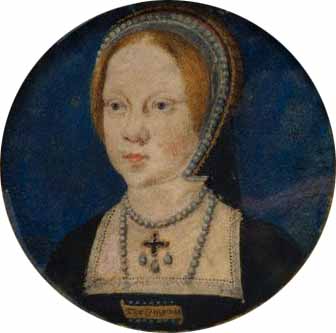
Portrait miniature of Princess Mary at the time of her engagement to Charles V.

After finally giving birth to a healthy baby girl in 1516, christened Mary (the future Queen Mary), Katherine became pregnant yet again in 1518 gave birth to another girl. This baby died within a week of her birth date. It became apparent in 1526 that Katherine’s health was deteriorating which made it highly unlikely that she would have any more children.

Katherine Parr’s mother, Maud, became lady-in-waiting to Queen Katherine of Aragon after she married Sir Thomas Parr. Maud stayed with Queen Katherine until the end of her life; she stayed with her even through the tumultuous times of the 1520s when Henry started his infatuation with one of Katherine’s ladies, Anne Boleyn.

Maud’s relationship with the Queen was a relationship that went much deeper than “giddy pleasure”. Both knew what it was like to lose a child in stillbirths and in infancy. It was Katherine Parr’s mother, Maud, who shared in the horrible miscarriages and deaths in which Queen Katherine would endure from 1511 to 1518. The two bonded over the issue and became close because of it. When Maud Green became Lady Parr she became pregnant shortly after her marriage to Sir Thomas Parr. Most people think that Katherine Parr, the future queen and last wife of Henry, was the first to be born to the Parrs; not so. In or about 1509, a boy was born to Maud and Thomas. The happiness of delivering an heir to the Parr family was short lived as the baby died shortly after — no name was ever recorded. It would be another four years before Maud became pregnant again. In 1512, Maud finally gave birth to a healthy baby girl. She was christened Katherine, after the queen, and speculations are that Queen Katherine was her godmother. In about 1513, Maud would finally give birth to a healthy baby boy who was named William. Then again in 1515, Maud would give birth to another daughter named Anne, possibly after Maud’s sister. This pregnancy and childbirth is usually seen as the last for Maud; that she did not have anymore. Again, not so.

In or about 1517, Maud became pregnant again. It was in autumn of that year that her husband, Sir Thomas, died. It is believed that the stress from his death and leaving Maud with three children to raise alone caused the baby to be lost or die shortly after birth. No further record of the child is recorded. In a way Maud might have been relieved as she already had three young children to provide for.

Maud continued her position at court as one of Katherine of Aragon’s household and stayed close to the Queen even when her relationship with Henry started to decline. Henry’s infatuation with Anne Boleyn, one of the Queen’s ladies, became apparent and inevitably the ladies began to take sides. In these times, Queen Katherine never lost the loyalty and affection of women like Maud Parr, Gertrude Courtenay, and Elizabeth Howard, who had been with the Queen since the first years of her reign.

The theories of if Henry, Duke of Cornwall lived have been written about — but that of if Katherine Parr’s older brother had lived — perhaps the story would have been different and Kat would have never become the last wife of Henry — never have restored the royal family which made way for Lady Mary and Elizabeth to become part of the succession again. Perhaps the cause of the Reformation, which started to entice King Henry in his great matter, would have never been furthered. Kat went on to try continuing what Henry’s second wife, Anne Boleyn, had started yet she wanted to help Henry make peace with his children. She took on the role of step-mother for Lady Elizabeth and Prince Edward, but remained good friend’s with the Lady Mary as Mary was only a few years younger than Kat. Some have called her the perfect combination of all of Henry’s wives; I would like to think they are referring to Henry’s first three wives; Katherine of Aragon, Anne Boleyn, and Jane Seymour. To this day some believe that Kat shaped the little girl who would become the last reigning Tudor; Elizabeth. Certainly many of the characteristics which Kat had were emulated by Elizabeth and she continued the beliefs her own mother and step-mother had in religion. Of the many things that Kat Parr did; many that are not listed here — I would like to think that her best influence and legacy lived on through Elizabeth, as she was basically the daughter she never had the opportunity to raise. Kat Parr would go on to give birth to a baby girl in her 4th and final marriage to Prince Edward’s uncle, Sir Thomas Seymour — but the joy was short lived as Katherine died shortly after.  Her three previous marriage were obviously childless. There has never been recorded evidence that she ever became pregnant or gave birth to any children before Lady Mary Seymour. The Parr legacy would continue within her sister’s family — the Herbert’s — as the Earls of Pembroke, whom today, still hold that title among others.

The Relationships of Lady Mary Tudor: Henry VIII and his consort Katherine Parr pt. 2

Henry VIII, Lady Mary Tudor, and Katherine Parr

Your Excellency, what I have done for the Lady Mary is much less than I would like to do; as well as being my duty in every respect. As for the friendship between our two countries, I have done and will do nothing to prevent it from growing still further as the friendship is so necessary and both sovereigns [are] so good.”
Katherine’s relationship with Mary was one of friendship rather than motherly. When Katherine became queen the royal children were by then acquainted with her. It is not known whether it was Katherine herself that suggested meeting the Ladies Mary and Elizabeth before the wedding, but Henry obviously approved. In any case, Katherine wanted to establish a good rapport with the king’s daughters before the wedding. While Katherine had been contemplating the kings proposal there is no doubt that the three children and the role in which she would play came to mind. With Mary, Katherine wanted nothing more than to become a supporter and friend to her. Being a mother to another woman’s child was a responsibility that Katherine assumed with grace and dedication.
History may not have viewed Henry as an attentive parent but he cannot be judged by our modern standards as times were different back then. Henry did not visit his children’s establishments on a regular basis, but claimed to love them all. Royal children were brought up separately. A separate household was always established for the Prince of Wales while princesses, often living together, had smaller establishments. As in Katherine’s time, court was not a place for small children and Mary as Princess had a household of her own until her parents’ divorce when she was forced to live with her half-sister, Elizabeth. Buried in a legacy of failed marriages and just the everyday duties of a king, Henry’s affections towards his children were understandably lacking. Katherine was convinced that Henry needed to be more involved with his children. The uncertainty that filled all of their lives, especially Mary and Elizabeth, needed to be relieved. Katherine promised and made sure as long as Henry was alive and she was consort that the children would have a stable future.
Katherine’s marriage to the King gave Mary the longest period of unbroken happiness she had known since childhood. It was much needed after a decade of turmoil. Katherine was a staunch champion of the princess and her regard for Mary certainly helped improve her prospects, as well as enriching her life. Soon after the wedding, Katherine gave Mary a present of gold bracelets. Katherine would go on to exchange purses of money with Mary as was done throughout the aristocracy as a token of female friendship. The two shared a love for clothes and jewels. They also had a love of music in common. The two thrived on conversation and diversion. Both were dedicated to studying and religion. History has made it seem that Katherine and Mary were so set in their ways of religion that they had absolutely nothing in common. In fact some people have gone as far as saying that if Katherine had lived into Mary’s reign, Mary would have had Katherine burned at the stake! Truth be told, within their relationship, neither was firmly set in their ways and their relationship never suffered. Mary had somewhat accepted her father’s religious changes. Katherine’s faith as queen would eventually develop along different lines than that of Mary. But much would change in Mary’s life before she became pegged as “Bloody Mary”.
The Imperial Ambassador, Chapuys, recounts that the two were almost always together and would come to thank Katherine in time, in the name of his Master Charles V, for all that she had done and would continue to do for the Lady Mary.

By 1544, a new act of succession was introduced. Since becoming queen, Katherine had set out to reconcile Henry and Mary and to restore her as a potential heir to the throne. Chapuys was most impressed with the queen’s attempts at favoring the Princess and wrote frequently to Charles V about it. Charles was also most pleased and encouraged Chapuys to continue good relations with Queen Katherine. The act was the first succession act in England to give females the right to succeed to the throne as queen. Lady Mary and Elizabeth were again part of the succession after their brother Edward. Though both Mary and Elizabeth remained illegitimate and were denied the title of princess, they were Henry’s official heirs. This Act signified the rehabilitation of the royal children with their father; which Katherine could take more than a little credit for. Based on ambassadorial reports, it was Katherine who was the chief instrument of Henry’s decision to name all of his children in his will as heirs to the throne. The terms of Henry’s Will would later legitimize both Mary’s seizure of the crown from Lady Jane Grey and Elizabeth’s succession after Mary’s death. It was Katherine who helped insure their legitimacy as queens.

Lady Mary Tudor c.1544 attributed to Master John

It was in 1544, that Mary would be painted by an artist commemorating her re-in-statement to the succession. In the portrait, attributed to Master John, Mary is still young and quite beautiful. Portraiture was another common interest of Katherine Parr. Throughout her reign she would have portraits done of her and the two daughters of Henry. It is thought that perhaps these portraits of Katherine were done to make up for the fact that Henry had commissioned a painting of the royal family during her reign; only to put Jane Seymour in posthumously as queen. Perhaps that is the case, but the portrait of Mary is memorable and a favorite of many admirers to this day.
By summer of 1544, Katherine had been appointed Regent of England as Henry went off to battle in France. During her reign, most historians believe it was Elizabeth who was most affected by watching her step-mother rule over the country. Mary, herself, would also pay close attention to Katherine’s regency which no doubt influenced her. Both daughters would come to see that it was possible for a queen to handle all that was expected of a king; that perhaps one day they too could rule as queen of England. As regent, Katherine possessed a considerable amount of power. During Katherine’s regency five proclamations were issued and she was granted the right to disburse money from the Treasury. Throughout his time in France, Katherine would write often informing Henry of her progress. Often included were her sentiments, her time with the children, and worries about his health.
At the end of Henry’s reign as King he started to not only distant himself from Queen Katherine, but also from his children. Henry knew that his health was failing and that he must make provisions for his son Prince Edward’s minority as the next Tudor king. Henry’s final Christmas was spent alone at Whitehall, apart from Katherine and Mary who were at Greenwich Palace. On 11 January, it is accounted that the queen’s apartments were prepared for her arrival, but there is an uncertainty as to whether or not Katherine saw her husband one last time. On 28 January 1547, King Henry died. Neither Katherine nor his children were present.

Henry VIII with his daughter, the Lady Mary Tudor, later Queen Mary I.

After the death of King Henry, Mary was not told of his death for several days. Edward’s minority council took elaborate precautions to ensure all was in place before they made an official announcement. This action made Mary extremely angry, but she could do nothing about it. Yet how ever wary Edward’s councillors were, nothing could alter the fact that Mary was in her own right heiress to the throne. For the time being, Mary would stay with Katherine who was again for the third time, a widow. At the time of her father’s death Mary was aged 31. Mary’s reaction to her father’s death was never recorded as she never publicly mourned his death.  She was apparently more irritated at the fact that no one had told her that her father had died until days later. Most likely her reaction to the news was mixed grief and some kind of relief. At Henry’s death both Mary and Elizabeth became two of the richest women in England. They both had an income, the promise of a dowry, and extensive holdings of property. Mary was now an owner of 32 houses and manors. These lands had previously belonged to the Duke of Norfolk and his son Surrey but were attained by the King after their arrest. It is noted that after all that the Howard’s had put Mary through she still came out on top owning most of Norfolk, Suffolk, and land in Essex.

Until April 1547, Mary remained in the household of the Dowager Queen Katherine. Mary went into deep mourning and it is not recorded whether or not she attended her father’s funeral or even her brother’s coronation. In her mourning, Mary went into deep reflection upon the way the country was now being run. While Henry was alive, she didn’t dare questioning his advisers. Now with Edward’s council, many of the members she had known for quite a while now, she came to her own opinion and was no longer afraid to voice her opinion as she did not think much of the men who ruled in her brother’s name. By Spring, Mary had left the household of the Dowager queen as a dispute between the Lord Protector and his family was about to devolve. Truth being that Mary was a lady with many households and of age; she was mistress of her own manors and needed to start living her own life. While her father had been alive, Mary had been denied her very own family. She missed out on many marriage proposals and the chance to bear children of her own. Before Henry died, he promised the queen many things and gave her permission to marry again if it pleased her. Within months of his death Mary would find that her step-mother had renewed her liaison with her former love, Sir Thomas Seymour. Thomas was the younger brother of the Lord Protector. Thomas was jealous of his older brother as he had no part in the regency council. Therefore it has been proposed that perhaps he saw that by marrying the queen dowager he would obtain some sort of recognition. After surviving nearly four years of marriage to Henry, which was a feet among itself, Katherine was now letting her heart rule over her head. As she had no political role in Edward’s reign, Katherine looked to the possibility of her own happiness. The two would marry on an unknown date. Of course Katherine’s marriage was solemnized by God, but it had not been sanctioned by the king and his council. There was nothing in the will of Henry saying that Katherine could not marry again – but some saw the marriage as untimely as it was too soon after the king’s death. In attempts to gain favour and have the marriage be accepted, Seymour wrote to Mary asking for her approval and consent. The jest of the letter was strong, but at the same time clever and revealing. Mary knew what had been happening in the household before she left and was not one to play dumb. Mary knew Seymour’s reputation with women and was not fooled by his appeal to win her favour. Mary was still upset over the fact that Katherine would even consider marrying so soon after her father’s death and in a way felt it insulted the memory of her father. Although Mary was unhappy about Katherine’s choices, she realized that she would no longer share in the company of her step-mother who had done so much to re-store her relationship with her father and to re-instate her into the Act of Succession. Katherine had been regarded as an equal by Mary. The two had shared so much time together that it most likely hurt her deeply when she heard the news of Katherine’s death.

A portrait of Queen Mary I hangs in the Queen’s chambers at Sudeley Castle where Queen Katherine gave birth to her daughter, the Lady Mary Seymour, whom the queen named after her step-daughter.

The Relationships of Lady Mary Tudor: Henry VIII and his consort Katherine Parr pt. 1

Sources

  • Susan James. Catherine Parr: Henry VIII’s Last Love, The History Press, 2009.
  • Linda Porter. Katherine the queen: The Remarkable Life of Katherine Parr, the Last Wife of Henry VIII, MacMillan, 2010.
  • Linda Porter. The Myth of “Bloody Mary”: A Biography of Queen Mary I of England, St. Martin Griffins, 2010.
  • Anna Whitelock. Mary Tudor: England’s First Queen, Bloomsbury Publishing PLC, 2009.

The Relationships of Lady Mary Tudor: Henry VIII and his consort Katherine Parr pt. 1

A modern interpretation of Lady Mary’s stepmother’s was shown in the historical fiction series “The Tudors.”

Throughout the reign of Henry VIII, as many know, he had six different wives. The first of these wives was the daughter of King Ferdinand II of Aragon and Queen Isabella I of Castile, Infanta Catalina; or as most have come to know her in England – Katherine of Aragon. Katherine came to England to marry the older brother of Henry who was then heir to the throne of England; Arthur, Prince of Wales. Shortly after their marriage Arthur died and Katherine was left a widow at an early age. To avoid returning her large dowry to her father Katherine was married to Arthur’s younger brother, then Henry, Duke of York. The marriage between Katherine and Henry produced only one child who would live to adulthood, a girl, the future Queen Mary I of England. In Tudor times, not having a male heir was particularly troublesome as the country had just been through a civil war in which Henry’s father seized the crown. Henry VIII was only the second Tudor monarch, a son of both the houses of Lancaster and York. Henry felt that a male heir was essential; after all, the last woman to reign as queen regent was the tumultuous reign of Empress Matilda, daughter of Henry I.

Born Princess Mary of England, Mary was the daughter of King Henry VIII and his first wife Katherine of Aragon. Her mother, after two decades of marriage to the King, had given birth to six children. Out of the six, only one would survive infancy, their daughter Mary. Katherine had produced no surviving sons, leaving their daughter, the future Mary I of England, as heiress presumptive at a time when there was no established precedent for a woman on the throne. At this time is when Henry began to take interest in one of Katherine’s ladies, Anne Boleyn. In Anne, Henry saw the possibility of having a male heir; to continue his father’s legacy. After going through a great bit of trouble – which included a break from Rome – Henry “divorced” Katherine and “married” Anne under his Church of England. This break and marriage would come to change England and inevitably changed Henry for the rest of his life. Henry would go on to have again, one daughter, with Anne. During this marriage, Princess Mary, now within her teens, went from being a legitimate Princess and daughter of Henry VIII to an illegitimate “bastard” under Henry’s new succession act. Mary was forced to live below the standards of what she had become accustomed to and was forced to accept that her mother was no longer queen of England. After only a few years of marriage to Anne, Henry became convinced that his second wife could not produce a male heir and literally disposed her for yet another lady-in-waiting, Jane Seymour. During her short reign, Jane tried to reconcile Henry with his daughter Mary. It was through this “precious” lady that Henry finally got what he wanted; a male heir, named Edward. To Henry’s misfortune, only twelve days after giving birth to Edward, Jane died. Henry would go on to marry three more times after Jane. Anne of Cleves, Katherine Howard, and a woman named Katherine Parr. It was the last of Henry’s wives who would come to reconcile Mary, along with her half-siblings, with Henry.
Katherine Parr was born in 1512. By both parents, Princess Mary was related to Katherine Parr. By her paternal grandparents, Mary was related by Katherine’s descent from the Beaufort’s, children of John of Gaunt, a son of Edward III making Mary by her paternal grandmother, Elizabeth of York, a 4th cousin. By the Woodville connection, they were 4th cousins. By her paternal grandfather, Henry VII (by Beaufort and Holland), Mary was a double 5th cousin, once removed. By her maternal grandmother, Isabel of Castile (by John of Gaunt), she was a fifth cousin and a fifth cousin, once removed. Jane Seymour is the next closest after Parr sharing Edward III (6th cousins, once removed).
Katherine was a few years older than Mary who was born in 1516. Katherine’s mother, Maud, had become a lady-in-waiting to Princess Mary’s mother shortly after her marriage to Sir Thomas Parr. Katherine was named after the queen and it is thought that the queen was her godmother.
Maud’s relationship with the Queen was unlike that of most queens and their ladies. It was a relationship that went much deeper than “giddy pleasure”. Both knew what it was like to lose a child in stillbirths and in infancy. It was Katherine Parr’s mother, Maud, who shared in the horrible miscarriages and deaths in which Queen Katherine would endure from 1511 to 1518. The two bonded over the issue, as Maud had experienced the death of her eldest, an infant boy, and later a miscarriage or early infant mortality after the birth of three healthy children. Because of these shared experiences, the queen and Maud became close.
After her husband died in 1517, Maud continued her position at court as one of Katherine of Aragon’s household and stayed close to the Queen even when her relationship with Henry started to decline in the 1520s. In 1525, when Henry’s infatuation with one of Katherine’s ladies, Anne Boleyn, became apparent, inevitably the ladies began to take sides. In these times, Queen Katherine never lost the loyalty and affection of women like Maud Parr, Gertrude Courtenay, and Elizabeth Howard, who had been with the Queen since the first years of her reign. Maud stayed with Queen Katherine until the end of her own life in 1531.
It has been said that Katherine Parr and Princess Mary were educated together. While Katherine’s mother attended on the queen, Katherine was at Parr house in Blackfriars, London. Katherine was not brought to court with her mother and probably the only time, if any, that she was in contact with the royal family was at her christening. Katherine and other daughters of the court were taught separately while Princess Mary, who had her own household, was taught by private tutors.

King Henry and his fifth consort Katherine Howard

After the disastrous marriage of the King and Katherine Howard, the King was no longer looking for flighty relationships that stirred his passions. Henry had learned a tough lesson with Katherine Howard and was determined more than ever to find an intelligent, honest, loving, and devoted wife. He wanted someone he could hold an actual conversation with; a companion. Another quality Henry looked for in a wife was someone who could be a perfect companion to his eldest daughter, now styled The Lady Mary Tudor. After years of tension and multiple step-mothers whom Mary had mixed relations with, Henry must have felt he owed her that much.
After the death of Katherine Howard, Mary enjoyed far greater favor from her father and presided over court feasts as if she was queen herself. For New Year’s, Mary was showered with lavish gifts from her father. Within the presents were ‘two rubies of inestimable value.’ However, it was during this time that Mary suffered from chronic ill-health linked to anxiety, depression, and irregular menstruation. These health issues along with others would continue until Mary’s death. Thankfully by Christmas 1542, Mary had recovered and was summoned to court for the great Christmas festivities. Her quarters at Hampton court were worked on day and night to prepare for her arrival. The Imperial Ambassador, Chapuys, reported that the King ‘spoke to her in the most gracious and amiable words that a father could address to his daughter.’
Katherine Parr would marry twice before her marriage to King Henry in 1543. Her first marriage would be to her distant relative, Sir Edward Borough in 1529; which ended in about 1533 with his death. Her next marriage was to her father’s second cousin, Sir John Neville, 3rd Baron Latimer of Snape in 1534. With this marriage, Katherine became Lady Latimer. She was the first of her family to marry into peerage since her great-aunt, Maud Parr, Lady Dacre. With this marriage also came two step-children from Latimer’s first marriage to Dorothy De Vere. For about a decade, Katherine would experience the joy of being a step-mother. It was during this time that she became extremely close to her step-daughter, Margaret, which was somewhat of a pre-cursor to Katherine’s future relationship with the Lady Elizabeth, Henry’s youngest daughter. By the time Lord Latimer had died, Katherine was left a rich widow and was asked by Latimer to look after his daughter until the age of her maturity. It has been said that Katherine became a lady in the household of Lady Mary during this time, but biographers Susan James and Linda Porter have different opinions. It was thought by James that because Mary remembered the kindness Katherine’s mother had shown her mother that she gladly took Katherine as one of her ladies. Porter disputes this saying it would have been below Katherine’s standing as the widow of a peer who had her own establishments and a large settlement from her husband’s death. Truth be told, many courtiers and wives of peers were ladies to royals in Tudor England. It was a wonderful opportunity, kept them busy, and at the center of court. Katherine’s sister, Anne, would serve all of Henry’s wives, including her. After the death of Lord Latimer, Katherine began a fling with the brother of former queen Jane Seymour, Sir Thomas Seymour. The two were most likely planning to be wed, but before the two could marry, Katherine would first catch the attention of King who quickly proposed.

Lady Mary and Lady Elizabeth from the “Succession Portrait” which was commissioned while Katherine Parr was queen.

In spring before the wedding, Katherine would appear at court with both Lady Mary and Lady Elizabeth. The fact that the two had not been together earlier that spring and were now with Katherine and her sister at court was seen as significant. Katherine believed that a good relationship with the two was fundamental to her strategy. Once married, and confident as queen, she could develop the relationships further.

Katherine would go on to marry the King in July of that year. Within those who were present were the Ladies Mary and Elizabeth. With the marriage came three new step-children for Katherine to take care of. Instead of seeing it as her “duty”, she saw it as an opportunity as she had still not produced any children of her own.

Sources:

  • Susan James. Catherine Parr: Henry VIII’s Last Love, The History Press, 2009.
  • Linda Porter. Katherine the queen: The Remarkable Life of Katherine Parr, the Last Wife of Henry VIII, MacMillan, 2010.
  • Linda Porter. The Myth of “Bloody Mary”: A Biography of Queen Mary I of England, St. Martin Griffins, 2010.
  • Anna Whitelock. Mary Tudor: England’s First Queen, Bloomsbury Publishing PLC, 2009.