Unknown's avatar

About tudorqueen6

Meg McGath is the author behind the articles on “tudorqueen6”; she has been studying the history and genealogy of the Parr family for well over a decade. In 2025, she is still writing about her favorite Tudor queen, Kateryn Parr (1512-1548) even after becoming severely disabled. Meg studied at several top colleges which included Richmond University in London. As a violinist, she studied at Penn State Music School & Towson University School of Music where her minor became Women’s Studies. In 2009, ‘10, and ‘12, her summers were spent studying abroad in London where she was lucky enough to see Tudor artifacts, Palaces, and Sudeley Castle where Parr is officially buried. One of her goals is to end the myth that Queen Kateryn Parr was nothing more than a nursemaid to the aging King Henry VIII. "It simply isn't true, she did so much more for the family and her country," says Meg. A book has always been her end game with Parr, but as stated, she is now disabled and can only write on occasion. She was a moderator and heavy editor for the official Tudors Wiki (Showtime), has a massive genealogy tree she’s been working on since the late 2000s on Ancestry which follows Royalty, aristocratic families, and even Colonial Aristocratic lineage. She heavily edits & has started articles on Wikipedia. She also spent a lot of time writing & researching Royal tiaras and jewels of various Royal families & the weddings of the British Royals. Her research can be found on the old Tudor Wiki site under the name “Goldenaged.ER”. In the summer of 2012, she finally took a trip to Sudeley Castle while studying abroad. In London, she was privy to the Queen’s Diamonds at Buckingham Palace which included pieces like the Queen Alexandra Diamond Kokoshnik, the Williamson Brooch, the Delhi Durbar necklace, the small crown of Queen Victoria, and more.

Family of Queen Katherine: Lady Margaret, Countess of Oxford

Redrawn effigy of John de Vere, 13th Earl of Oxford and Lady Margaret before it was destroyed; original illustration was by Daniel King, Colne Priory Church, destroyed c. 1730. Redrawn effigy of John de Vere, 13th Earl of Oxford and Lady Margaret before it was destroyed; original illustration was by Daniel King, Colne Priory Church, destroyed c. 1730.

Margaret Neville, Countess of Oxford (c.1443[1]-after 20 November 1506/1506[1][2]) was the daughter of Sir Richard Neville, 5th Earl of Salisbury and Lady Alice [Montague], suo jure 5th Countess of Salisbury [in her own right]. Margaret was born in her mother’s principal manor in Wessex.[1] She was the last of six daughters and ten children.[1] Margaret’s godmother and namesake may have been after Margaret Beauchamp (1404 – 14 June 1468), eldest daughter of Sir Richard Beauchamp, 13th Earl of Warwick and his first wife Elizabeth Berkeley. Beauchamp was wife to John Talbot, 1st Earl of Shrewsbury [a brother to Mary Talbot, Lady Greene, the maternal 3x great-grandmother to Queen Katherine Parr and thus a 4x great-uncle]. Margaret Talbots’s sister, Anne, suo jure 16th Countess of Warwick would marry Margaret Neville’s brother, Richard, and he would inherit Anne’s title through marriage making him the 16th Earl of Warwick.

The Neville family was one of the oldest and most powerful families of the North. They had a long standing tradition of military service and a reputation for seeking power at the cost of the loyalty to the crown as was demonstrated by her brother, the Earl of Warwick.[5] Warwick was the wealthiest and most powerful English peer of his age, with political connections that went beyond the country’s borders. One of the main protagonists in the Wars of the Roses, he was instrumental in the deposition of two kings, a fact which later earned him his epithet of “Kingmaker”.

By her paternal grandmother, Lady Joan Beaufort, Countess of Westmorland, Margaret was the great-great-granddaughter of King Edward III of England and Philippa of Hainault. Lady Joan Beaufort was the legitimized daughter of Prince John of Gaunt, 1st Duke of Lancaster and Aquitaine, and his mistress, later wife, Katherine Roët Swynford. As such, Margaret was a great-niece of the Lancastrian King Henry IV. Margaret’s paternal grandfather was Sir Ralph Neville, 1st Earl of Westmorland, the second husband of Lady Joan. One of their daughters (Margaret’s aunt), Lady Cecily, became Duchess of York and mother to the York kings, Edward IV and Richard III. Margaret’s mother, Lady Salisbury, was the only child and sole heiress of Sir Thomas Montacute, 4th Earl of Salisbury by his first wife Eleanor Holland [both descendants of King Edward I].  Margaret’s grandmother, Lady Eleanor, was the granddaughter of Princess Joan of Kent, another suo jure Countess (of Kent) and Princess of Wales. Princess Joan was of course the mother of the ill-fated King Richard II making Eleanor Holland his niece. Princess Joan herself was the daughter of Prince Edmund of Woodstock, 1st Earl of Kent; son of Edward I by his second wife, Marguerite of France.

Margaret married to John de Vere, 13th Earl of Oxford, the second son of John de Vere, 12th Earl of Oxford, and Elizabeth Howard. Oxford was one of the principal Lancastrian commanders during the English Wars of the Roses. Margaret was the last of the sisters to marry. It was her brother, Warwick, who secured the marriage between Margaret and Oxford.[3] Margaret had 1000 marks to offer as a dowry which had been settled upon her in her father’s will in 1460. The financial gain for Oxford was important, but with Margaret he gained a whole family of political advantage; as Margaret was the sister of Warwick. Oxford’s family had been on the Lancastrian side. His father had been executed after trying to replace Edward IV with Henry VI.

At the battle of Bosworth and Stoke, Oxford is recorded as fighting beside the Stanleys’ (husband and son of Oxford’s sister-in-law, Eleanor Neville) on behalf of the House of Lancaster.

As for the wives of rebels, Richard III did indeed give the Countess of Oxford, Margaret Neville, £100, but this was a continuation of a grant from Edward IV, who is not given any particular credit for generosity. In any case, as David Baldwin notes, Richard had been given the Earl of Oxford’s estates following the Battle of Barnet and could presumably afford to part with £100. Back in the 1470′s, the young Richard had bullied Margaret Neville’s mother-in-law, Elizabeth de Vere, the dowager Countess of Oxford, into giving him her own estates for an inadequate consideration, but this inglorious episode doesn’t find its way into Kendall’s biography.

Sources:

  1. David Baldwin. The Kingmaker’s Sisters: Six Powerful Women in The War of the Roses, Gloucestershire: The History Press, 2009.
  2. Douglas Richardson. “Magna Carta Ancestry: A Study in Colonial and Medieval Families,” 2nd Edition, 2011. p. 274. (“She was living 20 Nov. 1506.”)
  3. Anne Crawford. “The Yorkists: The History of a Dynasty,” Continuum International Publishing Group, Apr 15, 2007. p. 78, 98, 108.
  4. James Ross. “John de Vere, Thirteenth Earl of Oxford (1442-1513): The Foremost Man of the Kingdom,” Boydell Press, Mar 17, 2011. p. 51.
  5. Linda Porter. “Katherine the Queen; The Remarkable Life of Katherine Parr, the Last Wife of Henry VIII,” Macmillan, 2010.

The White Queen: romance, sex, magic, scowling, social snobbery and battles

“The White Queen: romance, sex, magic, scowling, social snobbery and battles” by Amy Licence

How important is authenticity when filming historical dramas?
Terribly important! You should see the notes I sent to the series producers waxing lyrical about the use of horses, clothes, how people travelled, and so on. That sort of thing really matters. However, there are a number of compromises you do have to make when working in film, which can be  very frustrating – that’s why I’m a novelist, I suppose.

Historical fiction, when written well, can teach you these things without you having to study it. (Philippa Gregory, BBC History Magazine Interview)

“It is a little more Romeo and Juliet than accurate medieval protocol.” (Licence)

cecily_1

Elizabeth and her mother Lady Rivers meet the King’s mother in ‘The White Queen’, episode 1.

Sunday nights episode of ‘The White Queen’ in my opinion was great. Put a woman screenwriter together with the BBC and bam! However there was something that really made me angry about the episode and surprise, surprise — I’M NOT THE ONLY ONE who had a problem with it.

Lady Cecily, Duchess of York portrayed by Caroline Goodall.

Lady Cecily, Duchess of York portrayed by Caroline Goodall.

Amy Licence, author of the latest biography of Queen Anne Neville and Elizabeth of York reviewed the first episode. Licence and I agree on this both — she basically sums up that they (screenwriter or Gregory herself) REALLY screwed up on behalf of Lady Cecily Neville, Duchess of York (grandaunt of Anne Neville); thank you Lord!

Jacquetta Rivers portrayed by Janet McTeer and Lady Cecily portrayed by Caroline Goodall

Jacquetta Rivers portrayed by Janet McTeer and Lady Cecily portrayed by Caroline Goodall

“It was in the exchange with Duchess Cecily (Caroline Goodall) however, that Jacquetta, as her daughter’s mouthpiece, really overstepped the historical mark. The disapproving Duchess, who was known in real life as “proud Cis,” is too easily overcome by her social inferiors when they whip out her apparent “secret” affair with a French archer. Lost for words, she is silenced within minutes, almost cowed by them. While contemporary notions of “courtesy” dictated extreme forms of submission to the queen, this is a Cecily straight from the pages of a novel rather than the actual proud aristocrat who asserted her own right to rule.”

I’m going to be brutally honest here — are you kidding me?? I don’t like Jacquetta’s “holier than thou” attitude that is emerging. This was obviously a horrid and tasteless attempt to boost Jacquetta’s influence and “power” over the Duchess. It’s more than obvious that Gregory has become obsessed with Jacquetta and her daughter. In my opinion, if they REALLY wanted to boost Jacquetta SO much — they could have done it in a different way. They didn’t have to insult the King’s mother, the daughter of a powerful Earl and Countess Lady Joan Beaufort, granddaughter of a royal Duke of Lancaster and titular King of Castile [son of King Edward III of England], and widow of the Duke of York [double descendant of Edward III]! I know it didn’t happen in history, but still — that scene should have been cut or done differently. If they had been at court and the Duchess had been sitting with her son, I do not think the two would have addressed each other as such and Elizabeth wouldn’t have pulled the Queen card after letting her mother b***h out her mother-in-law. It’s rather ironic that Elizabeth comes in flabbergasted, but after her mother calls her mother-in-law a whore she has the nerve and guts to demand the Duchess bow down to her; then gloats to her husband how everyone is “great friend’s” now. Yeah, sure — Elizabeth is now best friends with “Duchess Cecily”. I don’t think Gregory thought about court etiquette when writing these books and whoever approved the scene has not read any history books lately.

Margaret Beaufort portrayed by Amanda Hale and Lord Warwick portrayed by James Frain

Margaret Beaufort portrayed by Amanda Hale and Lord Warwick portrayed by James Frain

“James Frain, recently lauded for his performance as Thomas Cromwell in The Tudors, may well emerge to steal the show alongside Margaret Beaufort and the other York brothers…” Even Licence applauds Lady Margaret Beaufort early on.

For the complete review — http://www.newstatesman.com/culture/2013/06/white-queen-romance-sex-magic-scowling-social-snobbery-and-battles

Jacquetta of Luxembourg and the Dukes of Burgundy?

Duke of Burgundy (1364-1404) as Philip II and King Philip II of France.

Duke of Burgundy (1364-1404) as Philip II and King Philip II of France.

Since the beginning of Philippa Gregory’s obsession with the Woodville family and Jacquetta of Luxembourg, she has claimed that Jacquetta was descended from the Dukes of Burgundy. For the past few weeks I have been trying to find a link to what she might be talking about. Jacquetta’s tree doesn’t show any connection or descent from the Dukes of Burgundy since before .. well .. I’m still looking back past the 1100s.

OK… I think I found what they are talking about; two explanations and a HUGE stretch.

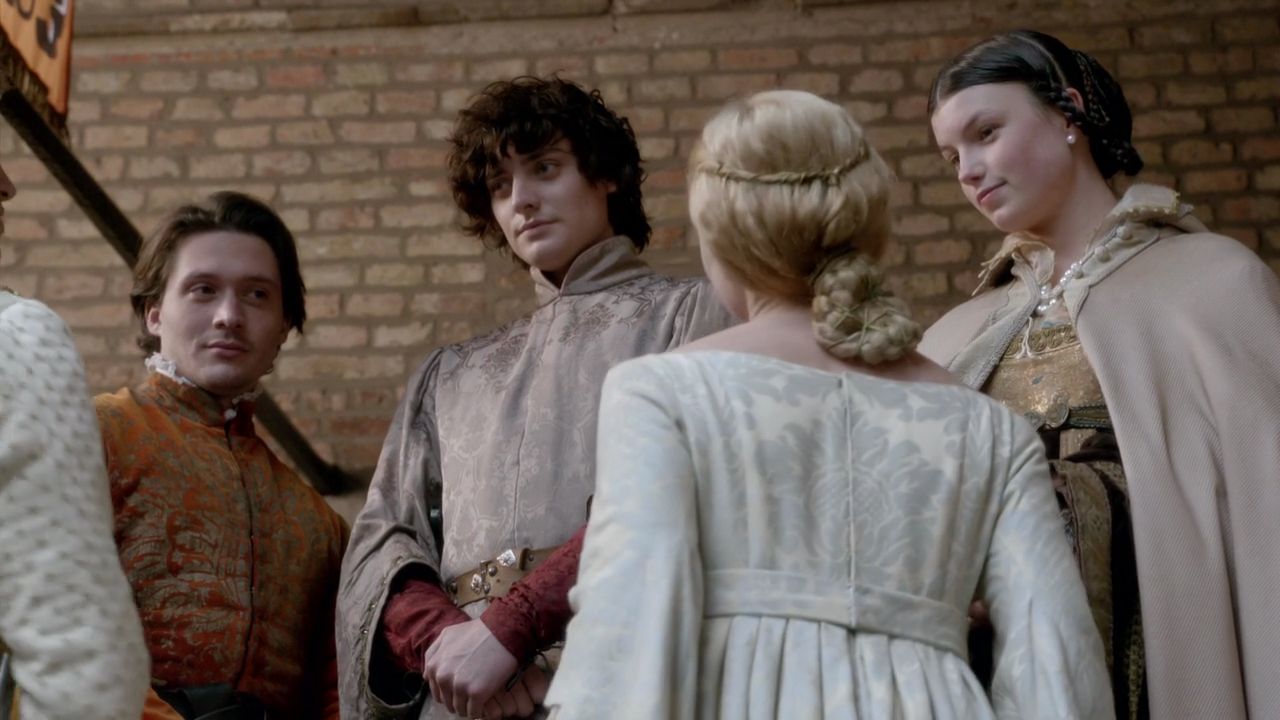
Jacquetta sits with Charles "the Bold', Duke of Burgundy.

Jacquetta sits with Charles “the Bold’, Duke of Burgundy.

Theory One — Bedford’s Wives

Remember “The Tudors” brilliant idea of lumping King Henry VIII’s sisters in to one character? Perhaps Philippa Gregory and the writer Emma Frost are doing the same; two historical characters compiled in to one. Here’s how it works: Jacquetta was married to the Lancastrian Duke of Bedford. Bedford’s FIRST wife, Anne of Burgundy, was from Burgundy; the daughter of John II, Duke of Burgundy. Anne’s brother was Philip “the Good”, Duke of Burgundy and father of Charles, the Bold, who was featured in the second episode of “The White Queen” as “cousin” to Jacquetta. A year after the death of Anne of Burgundy, Bedford remarried to Jacquetta, but faced opposition for various political reasons in this decision from Anne’s brother the Duke of Burgundy.[1][2] From this time on, relations between the two became cool, culminating in the 1435 peace negotiations between Burgundy and Charles VII, the exiled king of France. Later that year, a letter was dispatched to Henry VI, formally breaking their alliance.[2] 

The series doesn’t mention the fact that Jacquetta was married to the Duke of Bedford – she is *just* a powerful noblewoman related to the Dukes of Burgundy which is not really the case as I will explain. The series chose to omit that the Duke of Bedford existed and married Jacquetta, and Jacquetta in my opinion is seen as a mix of two historical women – Anne of Burgundy, Bedford’s first wife, and Jacquetta of Luxembourg.

Theory Two — Taranto Relations

Second possible explanation Jacquetta’s grandfather, the Duke of Andria (Francesco del Balzo) married Marguerite of Taranto whose mother was Empress Catherine of Constantinople, daughter of Charles, Count of Valois (4th son of Philip III of France, brother to the 2nd queen consort of Edward I of England, Marguerite of France and uncle to queen consort Isabel of France of Edward II of England).

Francesco and Marguerite had two kids that produced NO surviving issue! Any who, Empress Catherine (of Valois) was a paternal sister to Philip VI of France (son of Charles of Valois and his first wife, Margaret, Countess of Anjou). Philip VI married Joan of Burgundy, daughter of Robert II, Duke of Burgundy. In 1361, Joan’s grandnephew, Philip I of Burgundy, died without legitimate issue, ending the male line of the Dukes of Burgundy. The rightful heir to Burgundy was unclear: King Charles II of Navarre, grandson of Joan’s elder sister Margaret, was the heir according to primogeniture, but John II of France (Joan’s son) claimed to be the heir according the proximity of blood. In the end, John won.

So Jacquetta wasn’t related to them at all by my calculations; only by marriage. Her half-uncle (James of Baux) died in 1383 and her half-aunt (Antonia, Queen of Sicily) died in 1373. They were the only blood connection to the Dukes of Burgundy as cousins. Jacquetta wasn’t born until 1416 — so there would be no close connection.

Other Possible Theory — Henry V of Luxembourg

Henry V "the blond", Count of Luxembourg.

Henry V “the blond”, Count of Luxembourg.

However, there is a stretch here — Bonne of Bohemia [of Luxembourg] was the mother of Philip the Bold, Duke of Burgundy, himself the great-grandfather of Charles the Bold. Bonne of Bohemia was the great-great-granddaughter of Henry V, Count of Luxembourg. Jacquetta herself was a 5x great-granddaughter of Henry V. Funny thing being — anyone who descended from King Edward III of England [most to all of the nobility at court and royal houses of Europe by the reign of King Edward IV] descended from Henry V of Luxembourg via his great-granddaughter, Philippa of Hainault, queen consort to Edward III of England. Included in that long list are Queens Katherine of Aragon, Jane Seymour, Anne of Cleves, and Katherine Parr [wives 1,3,4, and 6 of King Henry VIII of England].

Cecily, Duchess of York as portrayed in 'The White Queen' by actress Caroline Godall.

Cecily, Duchess of York as portrayed in ‘The White Queen’ by actress Caroline Godall.

So using that connection, Jacquetta and Charles would have been at the closest 6th cousins, once removed. Where as the King’s mother, Cecily [Neville], was a 1st cousin, once removed of the Duke. Cecily’s mother, Lady Joan Beaufort [daughter of John of Gaunt, Duke of Lancaster], was a grandaunt of Charles of Burgundy. So who are we kidding when it comes to the show — we saw the King’s mother treated rather poorly [imo extremely] while Jacquetta was positioned as a high born noblewoman with close connections to Burgundy and what not. Wiki [not a good source] even tried to pull that Jacquetta was cousin to Sigismund of Luxembourg, the Holy Roman Emperor (1368–1437); that her first marriage to the Duke of Bedford [John of Lancaster, a younger son of the first Lancastrian King, Henry IV] was

“to strengthen ties between England and the Holy Roman Empire and to increase English influence in the affairs of Continental Europe.”

Portrait of Emperor Sigismund, painted by Albrecht Dürer after the emperor’s death [Source: Wiki]

In actuality, Jacquetta was a fourth cousin, twice removed of Sigismund. Not a bad match for a younger son of King Henry IV, but how is marrying a fourth cousin, twice removed going “to strengthen ties between England and the Holy Roman Empire“?

To add to the distance between Jacquetta and the Holy Roman Emperors — the second Luxembourg Holy Roman Emperor, Sigismund, had only one child; a daughter. Elisabeth of Luxembourg was the only child of the Emperor and his second wife and consort, Barbara of Cilli. When Sigismund died in 1437, Elisabeth was expected to ascend to her father’s thrones, but her rights were ignored and the titles of King of Germany, Hungary, and Bohemia was passed to Elisabeth’s husband Albert V, Duke of Austria. The title of Holy Roman Emperor was passed to the House of Habsburg [Philip the Bold would marry Juana I of Castile, sister of Queen Katherine of Aragon] where it would stay for three centuries [1440-1740]. Frederick V, Duke of Austria would become Frederick III of the Holy Roman Empire. After only two Emperors from the House of Luxembourg, the title was passed to the Habsburg dynasty where it would remain until 1740 upon the death of Charles IV. Charles, like Sigismund, had only one surviving daughter. Maria Theresa, was obviously denied her rights to succeed as Holy Roman Empress because she was a woman. Her father, Charles IV, was succeeded by Charles VII of the House of Wittlesbach. Charles VII ruled until his death in 1745. It was then that Maria Theresa’s husband was elected as Holy Roman Emperor and she became his consort. The House was now called Habsburg-Lorraine.

Note

George, Duke of Clarence; Richard, Duke of Gloucester; and Margaret of York, episode 1.

George, Duke of Clarence; Richard, Duke of Gloucester; and Margaret of York, episode 1.

In the show, the marriage of Edward’s sister, Margaret of York, is hinted to be due to Jacquetta’s relations. Margaret of York would marry Charles as his third wife on 27 June 1468. They had no issue, but Margaret was a wonderful stepmother to her husband’s children.

Sources

  1. Chipps Smith, Jeffrey (1984). “The Tomb of Anne of Burgundy, Duchess of Bedford, in the Musée du Louvre“. Gesta 23 (01): 39–50.
  2. Weir, Alison (1996). “The Wars of the Roses: Lancaster and York“. London: Ballantine Books.

Did Elizabeth Have More than Just “the Heart and Stomach of a King”? Part I

*Side note — Elizabeth’s brother Edward wasn’t older. He was a boy and as such was in front of Elizabeth. Elizabeth had an older brother, Henry Fitzroy (illegitimate), but he died.

thecreationofanneboleyn's avatarSemper Eadem

Well, my hand has finally been forced. When I first began this blog, I wrote a post about one day addressing all of the myths that surrounded Elizabeth I. Particularly, I promised that I would cover the rumor that she was really a man. I promised and promised that I would get around to it, but research on other subjects and a toddler entering his Terrible Twos led me to believe that the rumor that Elizabeth I was really a man didn’t need immediate attention. It took the Internet blowing up with posts like “Was Queen Elizabeth a Drag Queen in Disguise?” to get me typing.

The source of the buzz first came from an article in the Daily Mail, which admittedly should have made all of us wade into the story rather warily. The gist can be boiled down to this: an author named Steve Berry wrote a 

View original post 724 more words

7 June 1520: The Field of the Cloth of Gold

The Field of the Cloth of Gold started on 7 June 1520. It took place between Guînes and Ardres, in France, near Calais, from 7 June to 24 June 1520. It was a meeting arranged to increase the bond of friendship between King Henry VIII of England and King Francis I of France following the Anglo-French treaty of 1514.

"The Field of the Cloth of Gold" British School, 16th century (artist) c.1545 (Royal Collection under Wiki Commons)

“The Field of the Cloth of Gold” British School, 16th century (artist) c.1545 (Royal Collection under Wiki Commons)

Among those present was the widowed Lady Maud Parr and 1 woman; Lady Joan Guildford the elder (Joan Vaux, sister of Katherine Parr’s uncle-in-law AND step-grandfather Sir Nicholas, Lord Vaux of Harrowden) and 2 gentlewomen; Lady Vaux (most likely Catherine’s maternal aunt, Anne Green (d.1523)) and 1 woman; and Lady Mary Parr (Mary Salisbury, wife of Katherine’s uncle, William, Lord Parr of Horton) and 1 woman. These women accompanied and attended the queen, Katherine of Aragon.

STARZ ‘The White Queen’: Lady Margaret Beaufort

1beaufort_1

The Red Queen

Lady Margaret Beaufort portrayed by Amanda Hale.

Lady Margaret Beaufort portrayed by Amanda Hale.

A loyal Lancastrian and cousin to the deposed King Henry VI (David Shelley). Margaret suffered a difficult childhood, raised by a loveless and vindictive mother (Lady Beauchamp – Frances Tomelty). In her darkest hour, she turned to God for comfort. She now believes she has been sent a sign that her young son Henry Tudor is destined to be King. Margaret’s terrifying determination to see her son take the throne, leaves her enduring loveless marriages solely to improve her political standing. She is willing to lay down her own life or even kill, so that her son Henry can be fitted for the crown. Her world is filled with cold, calculated maneuvering strictly for her and her son’s gain. — STARZ

Lady Margaret portrayed by Amanda Hale.

Lady Margaret portrayed by Amanda Hale.

Heiress to the red rose of Lancaster, Margaret Beaufort fervently believes that her house is the true ruler of England. Ignored by her sainted cousin Henry VI, mocked by her mother, married at age twelve, and endangered by childbirth, she vows to put her son on the throne. Naming him Henry, she sends him into exile and pledges him in marriage to the daughter of her sworn enemy. 

Philippa Gregory's new covers to promote "The White Queen."

Philippa Gregory’s new covers to promote “The White Queen.”

Margaret charts her own way through loveless marriages, treacherous alliances, and secret plots. Finally, she gambles her life to mastermind one of the greatest rebellions of all time – all the while knowing that her grown son and his army await the opportunity to win the greatest prize. (Gregory)

The White Queen BBC one commercial - Directors cut from Jamie Childs.

The White Queen BBC one commercial – Directors cut
from Jamie Childs.

Sir Thomas Parr’s father, William, 1st Baron Parr of Kendal, had once been Lady Margaret Beaufort’s revisionary heir to her substantial lands in Westmoreland, known as the “Richmond fee.” Lord Parr married to Hon. Elizabeth FitzHugh, daughter of Henry, 5th Baron FitzHugh and Lady Alice Neville (sister of Warwick). Lady Margaret Beaufort was a double second cousin to Elizabeth FitzHugh, Lady Parr [so she would have been a double second cousin, thrice removed of Katherine]. After the death of Lord Parr, his widow made a marriage with the Lancastrian family, the Vauxs’ of Harrowden. The Vaux family was close to Margaret, enjoying a long-term relationship with her. The previous Lady Vaux, mother of Thomas Parr’s step-father Nicholas, had been lady and friend to the Lancastrian queen Margaret of Anjou. Katherine, Lady Vaux served the queen during her exile. Nicholas Vaux (later 1st Baron Vaux) was a protege of Lady Margaret Beaufort. The young Thomas Parr [Katherine’s father and Margaret’s cousin] most likely studied under Maurice Westbury of Oxford who had been installed as a teacher by Lady Margaret Beaufort at her estate of Colyweston. It was at Colyweston that certain gentlemen, including the son of the Earl of Westmoreland [cousin of Sir Thomas], not only received an education but also gained political connections that would prove useful in their future careers.[1][2]

This slideshow requires JavaScript.

STARZ Official Trailer


The White Queen BBC one commercial – Directors cut from Jamie Childs on Vimeo.


See also —

STARZ ‘The White Queen’: Elizabeth Woodville

STARZ ‘The White Queen’: The Kingmaker’s Daughters

Sources

  1. Linda Porter. “Katherine the Queen; The Remarkable Life of Katherine Parr, the Last Wife of Henry VIII.” Macmillan, 2010.
  2. Barbara J. Harris. “English Aristocratic Women, 1450-1550 : Marriage and Family, Property and Careers: Marriage and Family, Property and Careers,” Oxford University Press, Jul 26, 2002. pg 218.

Links

Family of Queen Katherine: The Baux Family of Andria

Francesco de Balzo, 1st Duke of Andria (or Baux) (c.1330[1] – 23 April 1422) Count of Montescaglioso and Squillace, Signore of Berre, Mison, and Tiano.

Original coat of arms of the House of Baux (Lords of Baux). Some authors, and local tradition, with a hagiographic aim, fancifully claimed that the family was descended from Balthazar, one of the three Magi (the 16-rayed star symbolizing the star of Bethlehem). Some, that they descended from the first kings of Armenia, the star signifying that they directly knew Jesus. The motto of the family was ‘Au Hasard Baltasar', as well as 'Jamais Vassal’ and ‘Semper Ardentius’

Original coat of arms of the House of Baux (Lords of Baux). Some authors, and local tradition, with a hagiographic aim, fancifully claimed that the family was descended from Balthazar, one of the three Magi (the 16-rayed star symbolizing the star of Bethlehem). Some, that they descended from the first kings of Armenia, the star signifying that they directly knew Jesus. The motto of the family was ‘Au Hasard Baltasar’, as well as ‘Jamais Vassal’ and ‘Semper Ardentius’

Balzo was the son of Bertrand III del Balzo, Count of Andria and Montescaglioso and his second wife, Marguerite d’Aulnay.[1] Balzo’s father was a Senator of Rome, Captain General of Tuscany, and Justiciar of Naples.[1] The half-royal Balzo (Baux) family was one of the greatest families of Regno after the Duke’s marriage to Marguerite of Taranto in 1348.[2]

In 1349, Balzo was given an extant grant by Louis, Prince of Taranto. Prince Louis had married his cousin Joanna I of Naples in 1346 as her second husband. Louis of Taranto and Queen Joanna’s mothers (Empress Catherine and Marie of Valois) were sisters. Queen Joanna had named Louis, King of Naples; he was crowned in 1352/53. The King was brother to Balzo’s second wife, Marguerite of Taranto, whom he had married in 1348.[1][3] Balzo was created Duke of Andria and was the first magnate to be raised to ducal dignity in the kingdom.[2] Andria had been a royal fief which the Duke’s father received from Beatrice of Anjou, by virtue of her dower.[4]

On the death of Philip II, Prince of Taranto in 1373, Marguerite and Balzo declared Taranto and Philip’s Greek lands and titles for themselves and their son, James of Baux, as the last male descendant of Philip I, Prince of Taranto.[2] Margaret’s claim was supported by Pope Gregory XI.[2] Queen Joanna, however, decided to exercise direct rule over the Prince of Taranto’s Greek possessions.[2] In April 1374, Queen Joanna decided to suppress the family and stripped Baux of all his lands and titles.[2] This action led to a civil war between the Queen and the del Balzo family.[2] An account is recorded in the Aragonese version of Chronicle of Morea.[2]

Family

Balzo married three times.[1] In 1337, he married firstly to Luisa de San Severino, daughter of Tamasso III de San Severino, Count of Marsico; they had no issue.[1]

In 1348, Balzo married secondly to Marguerite of Taranto, daughter of Philip I, Prince of Taranto by his second wife, Catherine of Valois, titular Empress of Constantinople.[1] She died about September 1380 in imprisonment.[1] They had two children:

  • James of Baux, Prince of Achaea and the last titular Latin Emperor of Constantinople.[1]
  • Antonia de Balzo, queen consort to Frederick III, King of Sicily.[1]
Elizabeth Woodville from "Kings & Queens: The story of Britain's monarchs from pre-Roman times to today"

Elizabeth Woodville from “Kings & Queens: The story of Britain’s monarchs from pre-Roman times to today”

In 1381, Balzo married thirdly to Sueva Orsini, by whom he had issue including Margherita del Balzo; mother of Jacquetta of Luxembourg.[1] By Margherita, Balzo was a great-grandfather of queen consort Elizabeth Woodville, wife of King Edward IV of England.[1]

Queen Katherine Parr was related to Marguerite of Taranto through many lines including Parr’s descent from Charles II, King of Sicily, Prince Charles, Count of Valois (son of Philip III of France), etc. Parr was distantly related to Sueva Orsini by her descent from King John; Parr’s ancestors included Simon de Montfort, lord of Montfort l’Amaury and Amicia de Beaumont (grandparents of the Earl of Leicester), several legitimate and illegitimate children of King John, etc.

References

  1. Douglas Richardson. Plantagenet Ancestry: Plantagenet Ancestry: A Study In Colonial And Medieval Families, 2nd Edition, 2011. pg 401.
  2. Kenneth Meyer Setton. A History of the Crusades: Fourteenth and fifteenth centuries, edited by Harry W. Hazard. Univ of Wisconsin Press, 1969. pg 142-46.
  3. Pietro Giannone. The civil history of the Kingdom of Naples, Volume 2, London, 1723. pg 241.
  4. Welbore St. Clair Baddeley. Robert the Wise and His Heirs, 1278-1352, W. Heinemann, 1897. pg 463.

Written and Researched by Meg McGath; 5 May 2013.

Elizabeth Fremantle: ‘The Reluctant Queen’

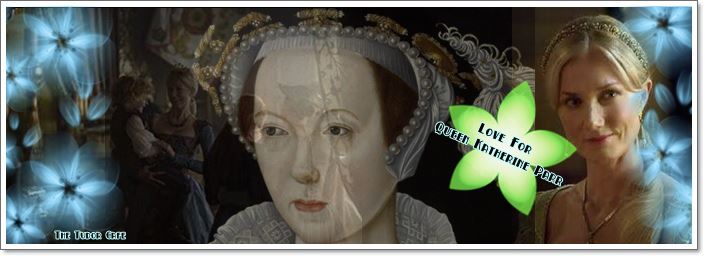
"Love for Queen Catherine Parr" -- Sophie Carter

“Love for Queen Katherine Parr” — The Tudor Cafe

Historical novelist Elizabeth Fremantle explains why for her, Katherine Parr will always be the most fascinating of Henry’s wives —

“Foxe’s Book Of Martyrs, published when the Catholic and Protestant factions within England had become dangerously polarised, cited women like Lady Jane Grey and Katherine Parr as female ƒ gureheads for the Protestant cause: the godly girl martyr and the devout royal consort. This view crystallised with the Victorians, who sought representations of the perfect Protestant wife: biddable, silent and domestic. And so Katherine became cast as the dull wife who nursed her husband through his dotage, surviving by dint of her meek nature.

When you begin to dig a little deeper though, a very ˜different woman emerges.” (Fremantle)

For the rest of this article, see:

The reluctant Queen

Queen's Gambit: A Novel [Hardcover] by Elizabeth Fremantle. Due 11 June 2013 in the US. See Amazon.com

Queen’s Gambit: A Novel [Hardcover] by Elizabeth Fremantle. Due 11 June 2013 in the US. See Amazon.com

STARZ ‘The White Queen’: Elizabeth Woodville

The “common” Queen

Rebecca Ferguson as Queen Elizabeth.

Rebecca Ferguson as Queen Elizabeth.

A young commoner from the House of Lancaster with angelic beauty and high intellect, Elizabeth becomes widowed when her first husband is killed in battle. She is left to fend for herself with two small boys, until fate introduces her to the noble King Edward IV (Max Irons) from the House of York. They both fall madly in love, and after a secret wedding she becomes Queen of England. At the outset of their lives together, Elizabeth’s motives are pure but once she finds herself on the throne, Elizabeth becomes fiercely protective of her family as she sees the dangerous forces surrounding her in the perilous politics of the day. — STARZ

The first in a stunning new series, The Cousins’ War, is set amid the tumult and intrigue of the Wars of the Roses. Internationally bestselling author Philippa Gregory brings this extraordinary family drama to vivid life through its women – beginning with Elizabeth Woodville, the White Queen.

Philippa Gregory's new covers to promote "The White Queen."

Philippa Gregory’s new covers to promote “The White Queen.”

Elizabeth Woodville, of the House of Lancaster, is widowed when her husband [Sir John Grey of Groby, by whom she has issue] is killed in battle. Aided and abetted by the raw ambition and witchcraft skills of her mother Jacquetta, Elizabeth seduces and marries, in secret, reigning king Edward IV, of the family of the white rose, the House of York. As long as there are other claimants to Edward’s throne, the profound rivalries between the two families will never be laid to rest. Violent conflict, shocking betrayal and murder dominate Elizabeth’s life as Queen of England, passionate wife of Edward and devoted mother of their children.

In The White Queen Philippa Gregory brilliantly evokes the life of a common woman who ascends to royalty by virtue of her beauty, a woman who rises to the demands of her position and fights tenaciously for the survival of her family, a woman whose two sons become the central figures in a mystery that has confounded historians for centuries: the Princes in the Tower whose fate remains unknown to this day. — Gregory

Philippa Gregory's new covers to promote "The White Queen."

Philippa Gregory’s new covers to promote “The White Queen.”

Elizabeth Woodville’s (Rebecca Ferguson) mother. Jacquetta hails from royalty through the House of Burgundy. She is a kind, caring and loving mother. As the matriarch of the family and a woman who feels she is in tune with the Earth and worldly callings, Jacquetta encourages the romance between Elizabeth and Edward, claiming it to be destiny. Jacquetta wants only the best for her daughter, and in Edward, she has gotten it, along with a proper place for herself and the rest of her family in history. That is, if they all can weather the raging political storm. — STARZ

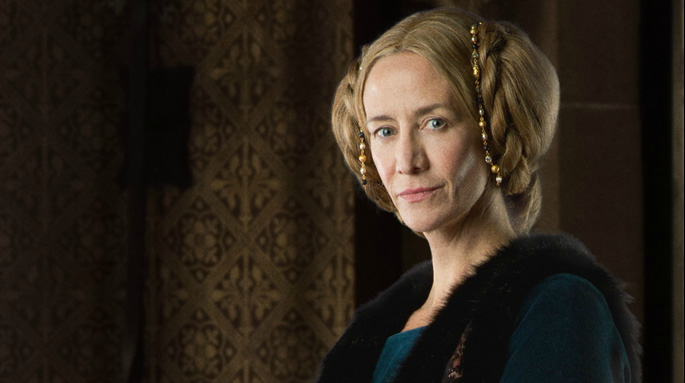
Jacquetta of Luxembourg portrayed by Janet McTeer.

Jacquetta of Luxembourg portrayed by Janet McTeer.

Elizabeth Woodville was the niece of Queen Katherine’s maternal great-great-grandmother Joan Wydeville [Katherine would have been a first cousin, thrice removed of Queen Elizabeth by her mother, Maud Green]. Joan Wydeville married Sir William Haute/Hawte. Their daughter, Alice, married Sir John Fogge. The Haute family which Joan married into was quite prominent during the reign of Edward IV and Richard III. Fogge had originally been a supporter of the Lancastrian king, but in 1460 Fogge joined the Yorkist earls in Kent. It is obvious however that he was a Yorkist by the families which he married into; Alice Kyriel (daughter of Yorkist Sir Thomas) and Alice Haute c. 1465 who was a cousin of Queen Elizabeth. The previous year, Elizabeth Woodville had married Edward. Queen Elizabeth brought her favorite female relatives to court to serve her. Lady Alice Fogge (Haute) would be one of five ladies-in-waiting to her cousin, queen consort Elizabeth Woodville during the 1460s. (Harris) The other ladies included her sister Lady Anne (wife of William Bourchier, Viscount Bourchier and George Grey, 2nd Earl of Kent) and her sister-in-law Lady Elizabeth Scales (wife of Sir Anthony Woodville, 2nd Earl Rivers). (Harris)

Katherine Parr was also a descendant of Henry V, Count of Luxembourg and Marguerite de Bar; William II, Baron of Tingry and Blanche de Brienne; Guy of Dampierre, Count of Flanders; and several other paternal ancestors of Jacquetta of Luxembourg.

Elizabeth Woodville portrayed by Rebecca Ferguson.

Elizabeth Woodville portrayed by Rebecca Ferguson.

This slideshow requires JavaScript.


STARZ Official Trailer

The White Queen BBC one commercial – Directors cut from Jamie Childs on Vimeo.


See also —

Starz ‘The White Queen’: The Kingmaker’s Daughters

Starz ‘The White Queen’: Lady Margaret Beaufort

Sources

  • Philippa Gregory.The White Queen (the family tree is not correct and has many links missing!)
  • STARZ. “The White Queen,” August 2013.
  • Philippa Gregory. “The New Cousins’ War Series Book Covers,” 9 May 2013.
  • Barbara J. Harris. “English Aristocratic Women, 1450-1550 : Marriage and Family, Property and Careers: Marriage and Family, Property and Careers,” Oxford University Press, Jul 26, 2002. pg 218.

Links