
Lady Frances Neville, (née Manners) Lady Bergavenny (c.1530 – circa September 1576) was an English noblewoman and author. Little is known of either Lady or Lord Bergavenny, except that the latter was accused of behaving in a riotous and unclean manner by some Puritain commentators. Lady Bergavenny’s work appeared in The Monument of Matrones in 1582 and was a series of “Praiers“. Her devotions were sixty-seven prose prayers, one metrical prayer against vice, a long acrostic prayer on her daughter’s name, and an acrostic prayer containing her own name.
Family
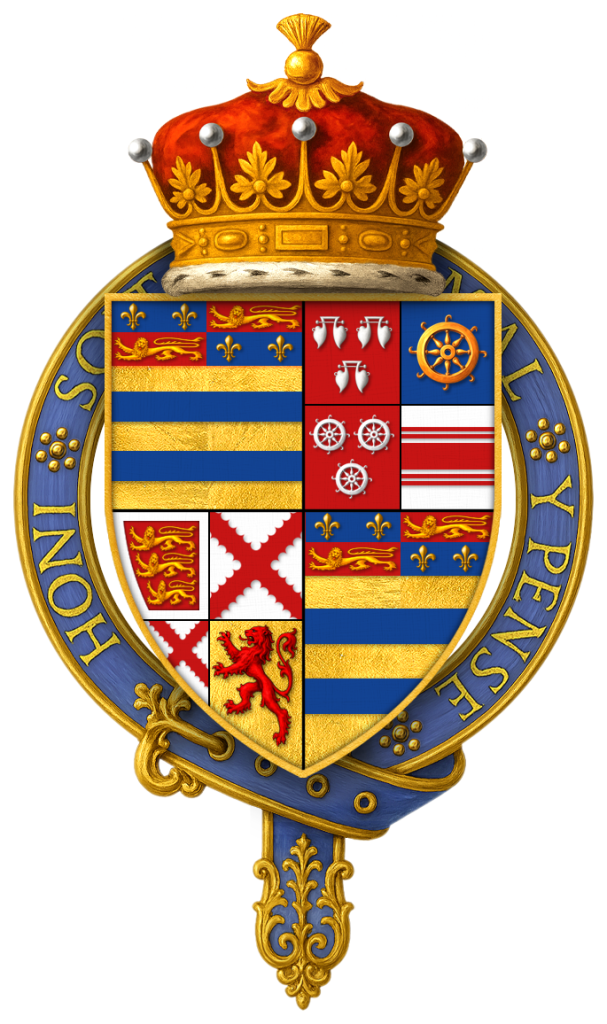
Rutland’s stall plate remains installed within St. George’s Chapel. The arms are: quarterly:
1 and 4, or, two bars azure, a chief quarterly of the last and gules, on the 1st and 4th, two fleurs-de-lis or, on the 2nd and 3rd, a lion passant gaurdant or (Manners);
2, a grand quarter consisting of
1, gules, three water bougets argent (Ros)
2, azure, a Catherine wheel or (Belvoir)
3, gules, three Catherine wheels argent (Espec)
4, argent, a fess between two bars gemels gules (Badlesmere)
3, a grand quarter consisting of
1, gules, three lions pasant guardant or, within a bordure argent (Holland, Earls of Kent)
2 and 3, argent, a saltire engrailed gules (Tiptoft)
4, or, a lion rampant gules (Edward Charleton, 5th Baron Charleton of Powys (1370-1421))
Lady Frances Bergavenny was the third daughter of Thomas Manners, 1st Earl of Rutland and his second wife, Eleanor Paston. Her father was a soldier and the eldest son of Sir George Manners of Belvoir, Leicestershire, and his wife, Anne St. Leger. By Anne St. Leger, Frances was thus a great-granddaughter of Anne of York, the elder sister of Edward IV and Richard III.
Before 1554, Frances had married Henry Nevill, 6th Baron Bergavenny. Nevill or Neville, was born between 1527 and 1535. He was the son of George Neville, 5th Lord Bergavenny and Lady Mary Stafford. Neville succeeded to the title of 4th Lord Bergavenny after his father’s death in 1535. He held office of Chief Larderer at the coronation of Queen Mary in 1553. When Lady Bergavenny died in 1576, Neville remarried to Elizabeth Darrell, daughter of Stephen Darrell and Philippe Weldon, before 1586; they had no issue. He died 10 February 1586/87 without male issue. He was buried on 21 March 1586/87 at Birling, Kent, England.
She died circa September 1576 and was buried at Birling, Kent, England.
Children
Lord and Lady Bergavenny had one daughter Hon. Mary Neville, Baroness Le Despenser (25 March 1554 — 28 June 1626). Mary gained the title of suo jure 3rd/7th Baroness le Despenser. She had claimed the succession to the Barony of Bergavenny, but this was settled on her cousin, Edward Neville, who became the 7th Baron Bergavenny.
The first, second, and fourth creations of Baron le Despenser had been under attainder from 1400 upon the death of Mary’s ancestor, Thomas le Despencer, 2nd Baron le Despencer, [1st Earl of Gloucester] (1373–1400) and became abeyant as well in 1449 after the death of the infant Lady Anne Beauchamp, the 15th Countess of Warwick. The representation of the three Baronies of le Despencer fell into abeyance between Anne’s cousin George Nevill, 4th Baron Bergavenny and aunt, Anne de Beauchamp, 16th Countess of Warwick. On the attainder and execution of Lady Margaret Plantagenet [Margaret Pole], Countess of Salisbury on 28 May 1541 any claim to the three Baronies by the descendants of the 16th Countess of Warwick, lapsed and the sole representation lay with the Barons Bergavenny. The attainder of Thomas, 2nd Baron le Despenser, was reversed in 1461 but the abeyancies continued until 25 May 1604, when the abeyancy of the 1295 Barony of le Despencer was terminated in favour of Mary Neville. She married Sir Thomas Fane, son of George Fane, on 12 December 1574. They were parents to Sir Francis Fane, who gained the title of 1st Earl of Westmorland. The title of Earl of Westmorland was forfeit after the death of Mary’s cousin, Charles Neville, 6th Earl of Westmorland. The title was revived in 1624 in favour of Fane because Mary was a descendant of Sir Edward Neville, 1st Baron Bergavenny, a younger son of the 1st Earl of the 1329 creation [Ralph Neville, husband of Lady Joan Beaufort and son-in-law to Prince John of Gaunt, 1st Duke of Lancaster].
Lady Despenser died on 28 June 1626 at age 72.
Relations to Queen Kateryn
Both Kateryn and Frances descend from the Ros family, Lady Joan of Kent (Princess of Wales) who married into the Holland family, and Lady Joan Beaufort who married into the Neville family among others lines.
Works
Her Praiers in prose and verse were later published in 1582 by Thomas Bentley in the Second Lamp of his anthology of Protestant women writer’s prayers, The Monument of Matrones. In a deathbed dedication of her work to her daughter, she calls it a “jewell of health for the soule, and a perfect path to paradise.” Her collection includes sixty-seven pages of prose prayers for private use and public worship linked to various occasions and times of day; a five-page acrostic prayer based on her daughter Mary Fane’s name, and a concluding prayer based on her own name.
References
- Beilin, Elaine V. “Frances Neville, Lady Bergavenny” in Matthew, H.C.G. and Brian Harrison, eds. The Oxford Dictionary of National Biography. vol. 45, 490-491. London: OUP, 2004.
- McCoy, Richard, Kathleen Lynch, Carol Brobeck, Martha Fay, Roque Rueda, “Redefining the Sacred–Monument of Matrones,” Redefining the Sacred in Early Modern England: An NEH Summer Institute. -Folger Shakespeare Library, 1998. Web. 30 Nov. 2011. http://www.folger.edu/html/folger_institute/sacred/image13.html
- Bentley, Thomas. Monument of Matrones. London, imprinted by Henrie Denham, [1582]. http://luna.folger.edu/luna/servlet/s/6z39cc
- The Oxford Dictionary of National Biography. The Oxford Dictionary of National Biography. vol. 45, 490-491. London: OUP, 2011
Written by Meg McGath (September 2012)
(Update 8 September 2025)




 tudorqueen6 by Meg McGath