20 September: Queen Katherine Parr’s Letter in Latin to Princess Mary

Written by Meg McGath

The official date of the letter is actually confusing. It was either written while Katherine Parr was Queen Regent in 1544 or as Dowager Queen in 1547.

The messenger mentioned in the letter is most likely Walter Erle, groom of the Queen’s privy chamber, who also served as her musician on the virginals, but possible Robert Cooch, steward of her wine cellar whose skill in music was commended by Parr’s chaplain, John Pankhurst.

Also mentioned in the letter is Francis Mallet who became chaplain to the Princess Mary in 1544 leaving the employment of Parr. (Wikipedia)

While the reasons are many, most notable and most beloved lady, that readily invite me at this time to writing, still nothing quite so much moves me as care for your health, which as I hope it is the best, so I very greatly desire to be made of certain of it. Wherefore, I send you this messenger who, I judge, will be very pleasing to you both because of his skill in music, in which, I am not unaware, you as well as I delight exceedingly, and also because he, having been in service to me, can report to you most certainty on my whole state and health. And truly, before this day it was in my mind to have made a journey to you and greeted you in person, but indeed not all things answer to my will: I hope now that, at a very early day this winter, you will be visiting us. Then which truly nothing will be a greater joy or a greater pleasure.

Since, however, as I have heard, the last touch has now been put by Mallet on Erasmus’s work On John (which he saw through translation), and nothing else now remain except some due attention and care to be applied in correcting it, I pray you to send to me this very fine and very useful work, now emended by Mallet or someone of yours, that it may be given to the press in its time. And further, that you signify whether you wish it to go out most happily into the light under your name, or whether rather by an unknown author. To which work really, in my opinion, you will be seen to do an injury, if you refuse the book to be transmitted to posterity on the authority of your name: for the most accurate translating of which you have undertaken so many labors for the highest good of the commonwealth; and more than these (as is well enough known) you would have undertaken, if the health of tour body had permitted. Since no one does not know the amount of sweat that you have laboriously put into this work, I do not see why you should reject the praise that all confer on you deservedly. However, I leave this whole matter to your prudence, so that whatever position you wish to take, I will esteem it most greatly to be approved.

As for the sum of money you sent to me as a gift, I thank you exceedingly. I pray the most good and most great God that He will think it fit to bless you perpetually with true and unblemished happiness: in whom, indeed, may you fare well a very long while. From Hanworth September 20.

You most devoted and most loving,
Katherine the Queen KP

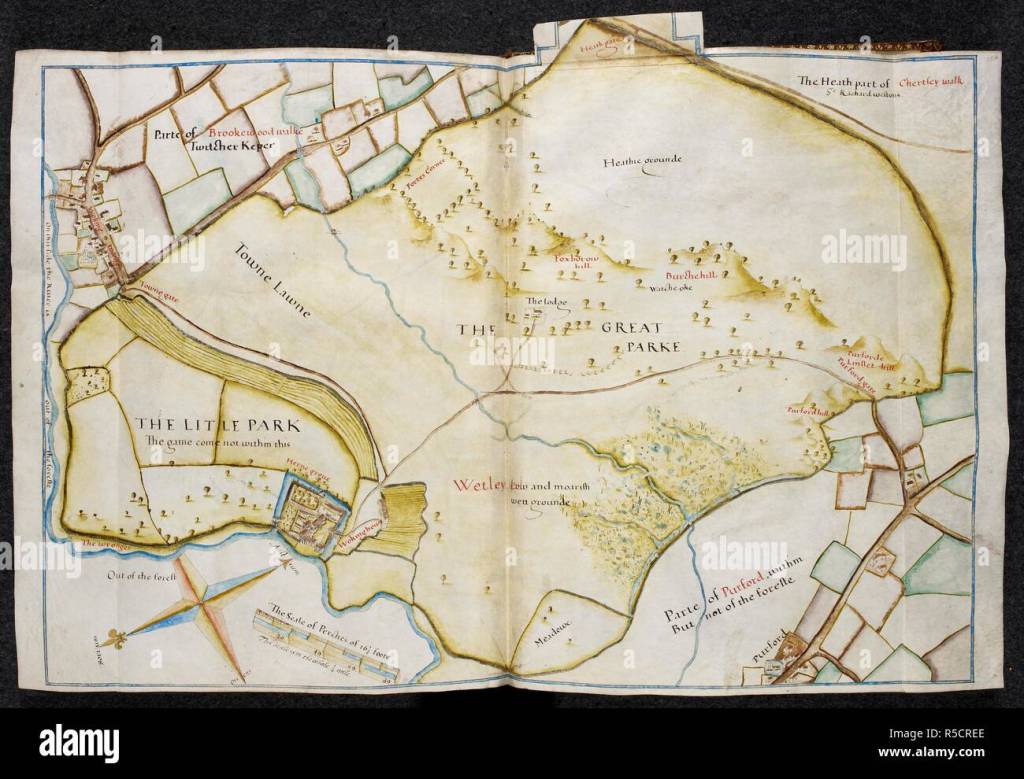
Hanworth by David Bridges

Sources

Katherine Parr: Works and Correspondence by Katherine Parr, Janel Mueller (Google eBook preview)

© 2024 Meg McGath. All research and original commentary belong to the author.

18 September 1544: Proclamation of the Queen Regent

Written by Meg McGath

During her regency in 1544, Queen Kateryn Parr issued five proclamations. The following was written on the 18th of September in 1544. The proclamation was made at the outbreak of plague to keep people who had been exposed away from the court at Oking (Woking) Palace in Surrey where she and the children of the King resided.

No. 19 The Queen Regent’s proclamation that no person exposed to the plague may come to court, September 18, 1544

[Headed] The 36th year of Henry VIII. 1544.

A proclamation that no person, in whose house the infection of the plague doth reign, shall repair to the court.

King Henry VIII to the mayor, alderman, and the citizens of London, greetings. We charge you that

Forasmuch as the Queen’s highness, General Regent of the realm in the King’s majesty’s absence, hath been incredibly informed that the infection of the plague reigneth in sundry parts within these the cities of London and Westmister, whereby great danger might ensure to her grace’s person, the Prince’s grace, and the other the King’s majesty’s children, in case any of the inhabitants of the said cities, who have had the infection in their houses, or have resorted to any infected persons, or dwell near any place where the infection is or lately hath been, should repair to court or permit any of those which attend in the court to enter their houses:

Her highness straitly chargeth and commandeth that no manner of person or persons, in whose houses the plague is or hath been, or have resorted to any other infected persons, or dwell near any place where the infection is or lately hath been, do from henceforth repair to the court, or do suffer any of the attendant of the said court to enter their houses where the infection hath been, upon pain of her grace’s indignation, and further punishment at her highness’s pleasure.

And of this, under the applicable legal penalty, let nothing to all be omitted. By Katherine, Queen of England, and its General Regent. From Oking, the eighteenth day of September, the thirty-sixth year of our reign.

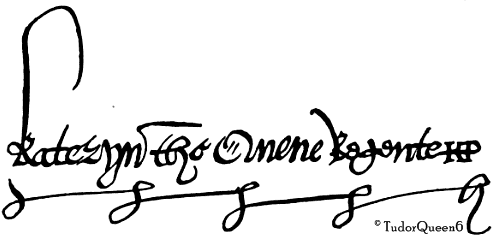
Here is one of the documents found at the National Archives from 1547, after the death of Henry that was signed “Kateryn the quene Regente-KP”

Image credit: Elizabeth Norton

Source: Katherine Parr: Complete Works and Correspondence By Katherine ParrJanel Mueller · 2011 (Google eBook)

© 2024 Meg McGath. All research and original commentary belong to the author.
Queen Katherine Parr: Not Important Enough?

I love how much people dismiss Queen Kateryn Parr. There may be evidence that she WAS supposed to be Regent for Edward VI. See her signature AFTER Henry died.

Credit: Elizabeth Norton

She was apparently signing as “Kateryn, the quene regente KP”. The theory goes that she was indeed made Regent for her stepson, King Edward VI. Which would make sense with the use of her signature. It is believed that Edward Seymour, Duke of Somerset, Kateryn’s brother the Marquess of Northampton, her brother-in-law the Earl of Pembroke and the council ousted her and rewrote the will. She would have made a wonderful Queen Regent. She proved she was capable of being Regent while Henry went to war with France. Perhaps she would have lived longer and prevented the succession from being rewritten. She gets credit for the placement of Princesses Mary & Elizabeth back into the line of succession behind their brother in 1545. That succession act seems to have overwritten or they disregarded King Edward’s will and supported the actual heir to the throne, Mary. Mary WAS the rightful heir. Jane was further down the approved line of succession. Why would you accept someone below the status of the actual daughters of King Edward’s father, Henry VIII? Kateryn Parr’s brother and brother in law were again involved in matters of the state and actually pulled off putting Lady Jane Grey on the throne for 9 days! Jane somehow outranked her own mother who was STILL alive and technically would have been the next heiress to the throne after Princesses Mary & Elizabeth. I never understood that. The Protestants feared the Catholic “Bloody Mary” (her nickname was started as Protestant propaganda, the pro Queen Elizabeth movement, lol) would try to return the country to the Pope and Catholicism. Mary was deeply religious. Kateryn Parr and Mary got on despite differences in matters like religion. Parr’s mother, Lady Maud, had served Mary’s own mother, Queen Katherine of Aragon, the first wife and crowned Queen consort to King Henry. The two women were pretty close. The Parrs backed Queen Katherine of Aragon when her lady in waiting became the Kings new obsession. Parr let Mary be and encouraged her every chance she could. One could argue she loved Mary more than Elizabeth. Heck, Kateryn named her only daughter and child, Mary, before the queen passed on 5 September 1548. Don’t think there were any other important Marys. The French Queen, Mary Tudor, had died long before Parr became Queen. Pretty sure it’s not after The Virgin Mary. Protestants aren’t that attached to her, right? I was raised Catholic, so I honestly don’t know. Anyway, Queen Kateryn Parr was VERY important. Read a book. She wasn’t an ex-queen. She remained Queen (consort) of England, Ireland, and France until she died. She was the LAST Tudor Queen Consort as King Edward died young. She was also the FIRST Queen of Ireland. Her funeral was the FIRST Protestant funeral for a Queen. Her mourner was none other than Lady Jane Grey, who would have probably stayed with Kateryn had the queen lived. Having Parr around seemed to pacify things. She knew how to handle tricky and dangerous situations. For Gods sake, she almost lost her head after she spoke with the King. It was overheard by the queens enemy, Bishop Gardiner, who saw an opportunity to “get rid” of Kateryn. I mean why not? He already KILLED TWO WIVES!! Lordy, so Gardiner tried to fuck with the Kings head. Saying shit like “it is a petty thing when a woman should instruct her husband” or some stupid sexist bs! Story goes, Kateryn was warned by an anonymous source who found her death warrant lying on the ground. YEAH RIGHT!! That’s straight up narcissistic abuse, my man!! Why do I feel like Henry set her up to test her loyalty? He was such a theatrical douche bag. No, no love for King Henry here. I have yet to see the film “Firebrand” which follows the reign of Kateryn as queen consort and queen Regente I believe. It’s based off Elizabeth Freemantle’s “Queen’s Gambit”. Anyway, Kateryn talked her way out of being arrested or worse by stroking the Kings ego and basically submitting to him just to fuvking survive. Imagine going through this marriage without psych meds like Benzos. I do believe they dabbled in potions however and she was known to “treat” melancholy with herbs from the gardens. Sudeley Castle where she is buried has a garden full of deadly herbs. Physic gardens. I have photos somewhere…

My page: Queen Catherine Parr

© 2024 Meg McGath. All research and original commentary belong to the author.

25 August 1544: The ‘Quene Regente’ writes Henry VIII

[Endorsed] The queen’s Grace to the King’s majesty 25 August 1544

[Addressed] To the King’s most excellency majesty

Pleaseth it your majesty to be advertised: albeit I had at this present none occurrences of importance to be signified unto your highness, your realm being, thanks to almighty God, in very good order and quiet: yet, foreasmuch as Richard Higham is at this time dispatched hence unto your majesty with a mass of twenty thousand pounds, I thought it my duty to advertise your majesty of the sending of the same, praying almighty God to send your majesty continuance of health and most prosperous success in all your highness’s most notable enterprises.

My Lord Prince and the rest of your majesty’s children be in very good health. And thus, with my most humble commendations unto your majesty, I pray almighty God have the same in His most blessed keeping. From your majesty’s honor of Hampton Court, the twenty-fifth of August, the thirty-sixth year of your majesty’s most noble reign.

Your grace’s most humble, loving wife and servant,

Kateryn the quene, KP

Katherine Parr: Complete Works and Correspondences edited by Janel Mueller, 2011. (Google eBooks preview)

It was in August of 1544 that the General Regent is recorded as signing her letter “Kateryn the quene Regente, KP” keeping with her signature of “Kateryn the quene, KP” as consort.

Source: “Henry VIII: July 1544, 21-25.” Letters and Papers, Foreign and Domestic, Henry VIII, Volume 19 Part 1, January-July 1544. Eds. James Gairdner, and R H Brodie. London: His Majesty’s Stationery Office, 1903. 581-596. British History Online. Web. 26 August 2023. http://www.british-history.ac.uk/letters-papers-hen8/vol19/no1/pp581-596.

Katherine’s signature as Queen Regent.

English Ancestry of The Six Wives: Descent from Edward I

The Six Wives of King Henry VIII

Yes, all six wives of King Henry VIII had English ancestry; some more than others.

Henry VIII after Hans Holbein c. 1535-44

Miniature of Henry VIII [1540-1570] after Hans Holbein the Younger. Watercolour and bodycolour on vellum, diameter 3.6 cm, Royal Collection, Windsor Castle.

FACT: King Henry VIII descends from Edward I of England only six times!

  • By his paternal grandmother, Lady Margaret Beaufort, Henry descended from Edward I by Margaret’s paternal grandparents; John Beaufort, 1st Earl of Somerset and his wife Lady Margaret of Kent [born Holland], later Duchess of Clarence.
    • Lord Somerset was a grandson of Edward III [grandson of Edward I and his first wife, Eleanor of Castile] by his father Prince John of Gaunt, 1st Duke of Lancaster.
    • Lady Margaret of Kent was a granddaughter of Princess Joan of Kent, Princess of Wales [wife of Edward, Princes of Wales, heir to Edward III, and mother to Richard II]; granddaughter of Edward I and his second wife, Marguerite of France, by their second son, Edmund of Woodstock, 1st Earl of Kent.
  • By his maternal grandfather, Edward IV, Henry descended from Edward I by Edward’s parents; Lord Richard, Duke of York and Lady Cecily [born Neville], Duchess of York:
    • The Duke of York’s parents, Lord Richard, 3rd Earl of Cambridge and his wife Lady Anne [born Mortimer], Countess of Cambridge both descended from Edward I.
      • Cambridge was a grandson of Edward III by his father, Edmund of Langley, Duke of York, 4th surviving son of Edward III.
      • Lady Anne Mortimer was a granddaughter of Edward III by her paternal grandmother, Lady Philippa of Clarence, 5th Countess of Ulster; granddaughter of Edward III by his second surviving son, Lionel of Antwerp, 1st Duke of Clarence. Lady Anne also had a second connection to Edward I, by her maternal grandfather, Sir Thomas Holland, 2nd Earl of Kent; son of Princess Joan, Princess of Wales. Princess Joan was, as mentioned before, a granddaughter of Edward I and his second wife Marguerite.
    • Lady Cecily, Duchess of York, was the youngest daughter of Sir Ralph, Earl of Westmorland and his second wife, Lady Joan Beaufort. Lady Joan was the only daughter of Prince John of Gaunt, 1st Duke of Lancaster and his third wife, Katherine [Roet]. John of Gaunt was of course the son of Edward III.

292px-Tudor_Rose_Royal_Badge_of_England.svgWould it surprise you to know that even Katherine of Aragon and Anne of Cleves had Edward I in their pedigree?

In fact, Katherine of Aragon descended from two wives of Prince John of Gaunt, 1st Duke of Lancaster, Titular King of Castile [the son of Edward III of England and Philippa of Hainault]; Blanche of Lancaster AND Constanza of Castile, heir to the throne of Castile.

Royal Emblem of Queen Katherine of Aragon

1. Katherine of Aragon – daughter of Ferdinand II of Aragon and Isabella I of Castile [2 times]

  • By her mother — Isabella of Castile’s paternal grandmother, Katherine of Lancaster, daughter of Prince John of Gaunt [son of Edward III] and his second wife, Constanza of Castile, she descended from Edward I and Eleanor of Castile.
  • Isabella of Castile’s maternal great-grandmother, Philippa of Lancaster, was also a daughter of Prince John of Gaunt, but by his first wife, Blanche of Lancaster. Lady Philippa was brother to King Henry IV [Bolingbroke]. Queen Katherine’s Hampton Court Pedigree shows this line from Edward I’s son, Edward II, onwards.

Royal Emblem of Queen Anne Boleyn

2. Anne Boleyn – daughter of Sir Thomas Boleyn and Lady Elizabeth Howard [5 times]

  • By both paternal great-great-grandparents [through the Butler’s of Ormonde], Sir James, 4th Earl of Ormonde and Joan Beauchamp; she descended from Edward I and Eleanor’s daughter Princess Elizabeth of Rhuddlan. The Earl and Countess of Ormonde were parents to the 7th Earl of Ormonde.
  • By her paternal great-great-grandmother, Lady Anne Montacute, daughter of the 3rd Earl of Salisbury [also an ancestor of Queen Katherine Parr] she descends from Princess Elizabeth’s elder sister, Princess Joan of Acre. Lady Anne was the mother of Anne Hankford, Countess of Ormonde as wife to the 7th Earl.
  • By her maternal [Howard] line she descended from Edward I and Eleanor of Castile via her great-great-grandmother Lady Margaret Mowbray, wife of Sir Robert Howard; Lady Margaret descended from Elizabeth of Rhuddlan, by way of Lady Eleanor Fitzalan [wife of Thomas Mowbray, 1st Duke of Norfolk].
  • By Sir Thomas Mowbray, 1st Duke of Norfolk, she descended from Edward I and Marguerite of France through their son, Thomas of Brotherton Plantagenet, Duke of Norfolk [Hampton Court Pedigree shows this line from Edward I’s son, Thomas of Brotherton onwards]

Royal Emblem of Queen Jane Seymour

3. Jane Seymour – daughter of Sir John Seymour and Margery Wentworth [twice]

  • By her maternal great-grandmother, Hon. Margaret Clifford, whose father John Clifford, 7th Lord descended from Joan of Acre, daughter of Edward I and Eleanor of Castile. Lord Clifford’s great-great-grandmother was Lady Margaret de Clare, Countess of Gloucester [daughter of Princess Joan] who married Sir Hugh Audley, 1st and last Earl of Gloucester.
  • By Hon. Margaret Clifford’s mother, Lady Elizabeth Percy, whose grandmother was Lady Philippa of Clarence, 5th Countess of Ulster who was the daughter of Lionel of Antwerp, the second son of Edward III. [Hampton Court Pedigree shows this line from Edward I’s son, Edward II, onward]

Royal Emblem of Queen Anne of Cleves

4. Anne of Cleves – daughter of John III, Duke of Cleves and Marie von Julich [twice]

  • By both paternal great-grandparents, Johan I Duke of Cleves and Elizabeth of Nevers; who were great-grandchildren of Marguerite of Dampierre, suo jure Countess of Flanders. Marguerite was the great-granddaughter of Margaret of England, Duchess of Brabant; daughter of Edward I and Eleanor. [Hampton Court Pedigree shows the lineage of Johan I of Cleves from Edward’s daughter, Margaret of England who’s son became Johan III, Duke of Brabant]

Royal Emblem of Queen Katherine Howard

5. Katherine Howard – daughter of Lord Edmund Howard and Jocasa Culpepper [3 times]

  • Like Anne Boleyn, by her paternal line [Howard] she descended from Edward I and Eleanor by Elizabeth of Rhuddlan by way of Lady Eleanor Fitzalan [wife of Thomas Mowbray, 1st Duke of Norfolk].
  • By Sir Thomas Mowbray, 1st Duke of Norfolk, she descended from Edward I and Marguerite of France through their son, Thomas of Brotherton Plantagenet, 1st Duke of Norfolk [Katherine’s Hampton Court Pedigree shows this line from Edward I’s son, Thomas of Brotherton onwards]
  • By her maternal great-great-grandfather, Sir William Ferrers, 5th Baron Groby, she descends from Princess Joan of Acre, daughter of Edward I and Eleanor, via her daughter Lady Elizabeth de Clare, wife of Sir Theobald, 2nd Lord Verdun.

Royal Emblem of Queen Katherine Parr

6. Katherine Parr – daughter of Sir Thomas Parr of Kendal and Maud Greene [6 times]

  • By her paternal grandmother the Hon. Elizabeth FitzHugh, daughter of Lady Alice Neville [sister of “Warwick, the Kingmaker”] she descended from Lady Joan Beaufort and her second husband Sir Ralph Neville, 1st Earl of Westmorland; Lady Joan was the legitimized daughter of Prince John of Gaunt, 1st Duke of Lancaster, third son of Edward III and thus she descended from Edward I and Eleanor of Castile. [Katherine’s Hampton Court Pedigree shows this line from Edward I’s son, Edward II onwards]
  • By her paternal great-great-grandmother, Lady Alice Montacute, suo jure Countess of Salisbury [wife of Sir Richard, 5th Earl of Salisbury, son of Lady Joan and Sir Ralph mentioned above]. Both parents of the Countess of Salisbury descended from Edward I; by her father the 4th Earl of Salisbury she descended from Princess Joan of Acre, daughter of Edward I and Eleanor by her son 2nd Lord Monthermer by her second husband Lord Monthermer, Earl of Gloucester. By her mother Lady Eleanor de Holland [daughter of Lady Joan of Kent, Princess of Wales and niece of King Richard II] she descended from Prince Edmund of Woodstock, son of Edward I and his second wife Marguerite of France.
  • By her maternal great-great-grandfather, Sir Thomas Greene, Sheriff of Northamptonshire, she descended from Princess Elizabeth of Rhuddlan, daughter of Edward I and Eleanor; Sir Thomas Greene descended from Princess Elizabeth’s daughter Lady Eleanor Bohun, Countess of Ormonde. His wife, Hon. Philippa de Ferrers descended from Elizabeth of Rhuddlan’s elder sister, Princess Joan of Acre, TWICE; by her daughters Lady Margaret de Clare, Countess of Gloucester and Lady Eleanor de Clare, Lady Despenser.

For more on their pedigrees, featuring the windows from Hampton Court Palace — see also —

The Hampton Court Pedigrees

Written and researched by Meg McGath, 2012.

Review of “The Royals” by Leslie Carroll

This book was a major disappointment and had major flaws in The Tudors section. First off, Henry VII was basically skipped over, no picture — the Tudors section starts with the portrait of Elizabeth I. According to the author “Henry Tudor’s blood was barely blue being five generations from Edward III” and “Henry was not born to the crown” — the latter being true, but to skip such an important figure along with Elizabeth of York is unforgivable.

Image thought by some, uh who, to be Anne Boleyn

Another major error was the portrait of Anne Boleyn; the style of the clothes and hair is from the late 16th/early 17th century – Anne would not have worn the ‘Elizabethan collar’. It may be a modern interpretation, but to use it as the sole portrait of Anne is rather odd.

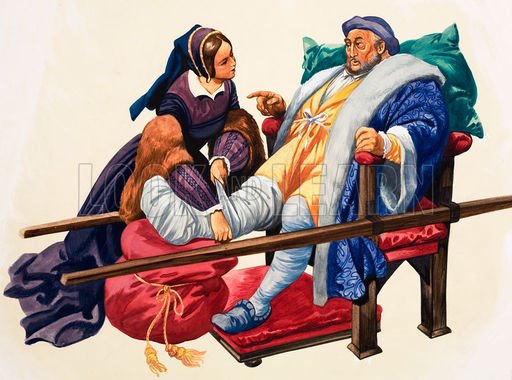
Queen Katherine nurses her husband the King.

I also disliked how Katherine Parr’s section was full of errors and made her look like a harlot after the death of Henry VIII.

First off, there is no proof that Katherine was romantically involved [meaning sleeping with] with Thomas Seymour before the death of Lord Latimer or before the marriage of Henry and Katherine. Also, Thomas was sent away on business for the king, he didn’t make himself scarce.

The statement that four out of six wives were redheads is incorrect.

Historians are not 100% sure that Katherine was part of Lady Mary’s household.

The discussion of theology became a problem when Katherine started preaching to the King — after the whole scandal they continued talking about religion, but it was more toned down.

I’m not sure where the info is coming from that Henry told his physician that he wanted to “get rid of” Katherine Parr. There were rumors, set up most likely by the Catholics at court, which also included Henry wanting to marry the Dowager Duchess of Suffolk, Queen Katherine’s friend, who was even more prone to speak her mind when it came to matters of religion. There was no doctor involved in telling Queen Katherine about Henry’s intentions. A warrant was drawn up which was taken to Queen Katherine. She went to King Henry arguing that she was “but a woman” and that she was merely trying to distract the King from his infirmities.

Katherine pushed Henry’s wheelchair in the gardens?? The correct info has the two sitting in the garden when they were approached by Henry’s guards.
The Queen Dowager, Katherine, waited a few MONTHS, not weeks, before re-entering into her “relationship” with Seymour. I don’t think Katherine would have been that disrespectful, but just to be clear — the King gave her the go ahead to re-marry who she wanted. They were thought to be married in the spring months, possibly May of that year.

Where the statement that Katherine was acting like a “trollop” came from, I would love to know. Seymour asked the King for permission to marry the Dowager Queen. Yes, Lady Mary was upset and thought Catherine should have waited a tad longer but in the two biographies I’ve read on Mary (Anna Whitelock and Linda Porter) she never once called Katherine a trollop. In fact, Mary disliked Seymour more than anything as he pestered her about matters of state. Mary eventually came to forgive Katherine — Katherine received a letter from Mary while she was pregnant and Katherine named the baby girl after her step-daughter.

The stories of Seymour and Elizabeth are quite interesting and many theories have been put out there, but what actually happened in that household is another story as Elizabeth’s lady, Kat Ashley, was the main contributor to the testimony. Kat herself encouraged Elizabeth to flirt with Seymour and had a crush on him herself. “But the doctor’s dirty hands caused an infection”… there are many contributing factors to the fever that caused Katherine to die, much like the death of Jane Seymour. And the last sentence of Lady Jane being raised as a surrogate daughter — she was a ward. This book and this chapter reads more like a romance novel then an actual history book.

The author put an actual biography of Katherine Parr (Susan James) within her chapter full of sources that is actually well respected; perhaps the author should have actually read the book before “quoting” it.

The chapter on The Tudors reads more like a romance novel than a history book; that might explain why the author chose the “romanticized” portrait of Anne Boleyn. No citations are given as to where the info comes from and major mistakes were made. The only good thing about the book is the reproduction of one of Anne Boleyn’s letters and the letter from Katherine Howard to Master Culpepper.

One positive note the author made about Katherine Parr:

“Perhaps the most mature and educated of Henry’s wives.”

So why did she paint Katherine as such a “trollop”?? You’ve got me! Other then that, don’t waste your money. Historically inaccurate indeed!