29 May [1575]: Lady Anne Talbot writes the Countess of Shrewsbury

Lady Pembroke and her daughter, also named Anne (Lady Talbot). Wilton Church.

Written by Meg McGath

Lady Anne Herbert was the daughter of Sir William Herbert, 1st Earl of Pembroke & his first wife, Anne Parr. As such, she was the niece of Queen Kateryn Parr. In 1563, at Baynard’s Castle, Lady Anne married Sir Francis, Lord Talbot (d.1582) in a double marriage between the two children of the 6th Earl of Shrewsbury and the two children of the 1st Earl of Pembroke. Lady Talbot’s brother, Henry, the future 2nd Earl of Pembroke, married Lady Catherine Talbot. Lord Talbot and Lady Catherine were child of Sir George Talbot, 6th Earl of Shrewsbury and his first wife, Lady Gertrude Manners, daughter of Sir Thomas Manner, 1st Earl of Rutland and his second wife, Eleanor Paston. In addition to the double marriage, Lord Talbot’s great-aunt, Lady Anne Talbot, had married secondly to Lady Anne Herbert’s father, the 1st Earl of Pembroke (d.1570) after the death of his first wife, Anne Parr, in 1552. This may have been the reason for the double marriage.

In her letter, Lady Talbot talks about how her sister, Lady Catherine, Countess of Pembroke, was frequently visited by Queen Elizabeth I at Baynard’s Castle. The Queen was fond of her. By 1575, Lady Catherine had become gravely ill and developed a fatal illness. The Queen even gave the Pembroke’s a ship to even travel to the continent in search of a cure. She returned to England without success by September 1575 and died on 24 April 1576. They had no issue.

Lady Anne Talbot writes to her husband’s stepmother, Bess of Hardwick, the Countess of Shrewsbury.

To the ryght honorable and my assured good lady, and mouther the Countes of Shrowsbery:

Good madam, acordynge to my dewty, I would haue wrytene oftener, yf I could haue learned, any newes worthey the wryrtynge, but my comeynge to the court, Is so selldome, as I knowe your Ladyshype, doth here from thensse, by othersse, a great dell more, then I can hereof, yet I truste your Ladyship wyll geue me leue, to remember my dewtye, In wrytynge, after my olde acoustemed manner. whych I wyll not slake god wyllynge, though my matter be never so small, yet my dewtyfull good wyll I hope your Ladyship wyll exepte, In as good part, as I meane yt, yf I could haue sent, any good newes of my syster of Penbrokes good delyuery, your Ladyship should haue hard of yt or nowe, but I fear yt wyll not fall out so well as I could wyshe yt had and for thys tyme, I humbly take my leue, besycheing, god to send your Ladyship your hartes desyre, From Eareth the xxjxth of Maye:

your Ladyship’s assured louyng daughter to comande:

Anne Talbott

Letter signed by Lady Talbott from letter dated 29 May [1575]. Courtesy of Bess of Hardwick Letters: The Complete Correspondence 1550-1608

Sources

From: Anne Talbot (Earith, Huntingtonshire);
To: Bess of Hardwick;
Date: 29 May [1575]
Summary: Anne Talbot (née Herbert) writes to Bess (countess of Shrewsbury) that she has
little news to report due to her infrequent visits to court. She promises to write ‘after my old
accustomed manner’ and expresses fears that ‘my sister of Pembroke’s good delivery [. . .] will
not fall out so well as I could wish’.
Archive: Folger Shakespeare Library, Cavendish-Talbot MSS, X.d.428 (122)
Delivery status: to Bess, sent
Letter features: Seal intact – no. Ribbon/floss – no. Letter packet – accordion
Hands: Anne Talbot | archivist |
Version: 1.0
Further information on copyright and citation can be found at:- (URL: http://
http://www.bessofhardwick.org/background.jsp?id=171) https://www.bessofhardwick.org/letter.jsp?letter=93

© 2024 Meg McGath. All research and original commentary belong to the author.

Family of Queen Katherine: THE FUNERAL of William Herbert, 1st Earl of Pembroke

Old St. Paul's before the fire of 1666. Old St. Paul’s before 1561. (Benham)

18 APRIL 1570: THE FUNERAL of Sir William Herbert, 1st Earl of Pembroke took place at Old St. Paul’s Cathedral in London. Pembroke had been the husband of Lady Anne (Parr), sister of the late Queen Katherine and the Marquess of Northampton.

Lord Pembroke died on 17 March 1570 at Hampton Court Palace. William was eldest son of Sir Richard Herbert of Ewyas, Herefordshire, by his wife Margaret, daughter of Sir Matthew Cradock of Swansea. Pembroke’s father, Sir Richard, was an illegitimate son of the original Herbert first creation of the Earldom, William Herbert, 1st Earl of Pembroke (d. 1469), by a mistress, Maud, daughter of Adam ap Howell Graunt. He married firstly to Anne Parr in 1538 and after her death, Lady Anne Talbot, daughter of the Earl of Shrewsbury. Parr gave Pembroke an heir (the 2nd Earl), an heir to spare (ancestor to the Earls of Powis), and a daughter (no issue). Talbot had no issue by Pembroke.

In his will, Pembroke listed two possible burial places; Old Saint Paul’s or Canterbury Cathedral. If he died near London, his wishes were to be buried in St. Paul’s Cathedral next to his first wife, Lady Anne (Parr). Pembroke obviously loved his wife for when he wrote his will, despite being married again, he wanted nothing more than to be buried “near the place where Anne my late wife doth lie buried” in St. Paul’s.

On Tuesday, 18 April 1570, Pembroke was buried with great state and ceremony in Old St. Paul’s Cathedral. His funeral was attended by all the principle members of the Government, as well as all the numerous officers of his household. A full list is provided in “Wiltshire Archaeological and Natural History Society,” 1879. The list states the various positions and who attended to them.

“An ordre of Proceedinge at the funerall of the late right Honorable William Erle of Penbrooke one tuisdaye the xviijth daye of April 1570,”

Some highlights of the list:

Chief Mourner: Sir Henry Herbert, 2nd Earl of Pembroke (eldest son of Lord Pembroke).

Mourners assistants with their hoods on:

  • The Earl of Leicester
  • Edward Herbert (second son of Lord Pembroke)
  • Sir James Crofts
  • Sir William Cecil
  • Sir Walter Myldemaye
  • Sir Nicholas Throckmorton (cousin to Pembroke’s wife, Lady Anne (Parr))

Six noblemen with their rolls:

  • Lord Admiral (Edward Clinton, Lord Clinton (later Earl of Lincoln))
  • Lord Chamberlain (Lord Howard of Effingham)
  • Lord Talbot
  • Lord Cobham
  • Lord Grey of Wilton
  • Lord Buckherst

One of the three knights with their hoods on their shoulders included Sir Francis Knollys.

“The proceedinge to the offringe as heerafter folowith: First the chief mourner, his trayne borne, and all the rest of the mourners to folowe and none to offerre but he and the officers of Arms before him.

Then the chief mourner to goe upp alone, and to offerre for himself, and ther to remayne untill all the hatchements  be offred, whiche he shall receyve and delyuer to York Herauld, who shall set theim one the communion boord: then he to be brought downe agayne to his place.

Then the hatchements to be offred as folowith, and at all tymes…Herauld before them..

First my Lord Keper and The Erl of Leicester offred the Coat of Armes

Then Mr Edward Herbert and Sr James Crofte offred the sword

Then Sr William Cicill [Cecil] and Sr Walter Myldemay offred the Targe

Sr Nicholas Throckmorton [and] Mr Gerard attorney generall offred the heaulme and crest

Then the viij mourners to offerre for theime selfes as folowith ij and ij

First the Lorde Keper [and] The Erle of Leicester; Garter Kinge of Armes before them

Mr Comptroller, Mr Edward Herbert; Richemond Harauld before theim

Sr William Cicill [Cecil], Sr Walter Myldemay; Chester Harauld before theim

Sr Nicholas Throckmorton, Mr Gerard attorney generall; Richemond Harauld before theim

The the iiij assistantes York Harauld before theim

Then the noble men in blackes ioyntly togither Richemond Haruald before theim

Then the Steward Threasorer & comptroller; Chester Harauld before theim

Then the Knightes Master Coferer and Clerkes of the greene clothe and all other Esquyres and gentlemen to folowe theime ioyntly ij and ij Richemond Harauld before

Then the banner of his armes, Then the Standert; a Harauld before either of theim

Then all other gentlemen having no blackes that will offere

Then the offringe donn and a certayne collect reade all the chief mourners and noble men departed leauinge the officers and assistantes to see the body buryed . Which officers did putt  the Defunctes staff into the graue and brake eche of theim ther owne staves and cast theim into the graue with him.”

Choir in Old St. Paul's Cathedral. Choir in Old St. Paul’s Cathedral. (Benham)

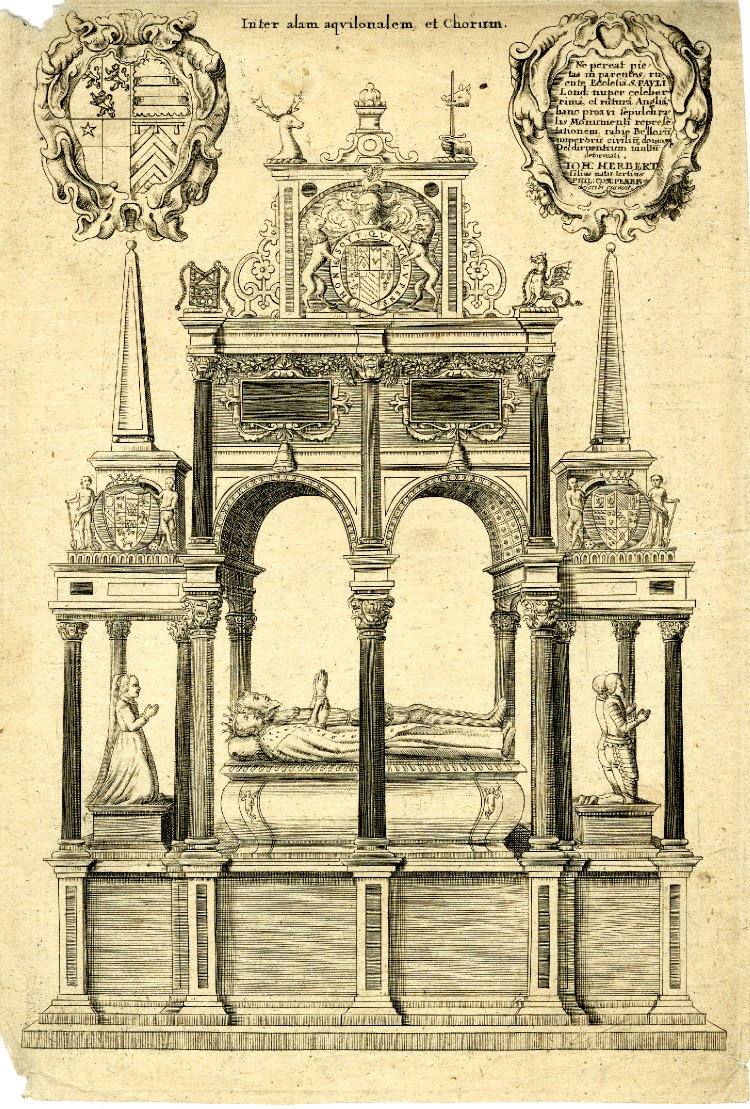
Pembroke’s tomb (along with Lady Anne Parr) was located between the choir and the North aisle. The tomb was/is by John of Gaunt and Blanche of Lancaster, between the pillars of the 6th bay of the Choir. (Benham) It was a magnificent structure consisting of effigies of the earl and his lady (Anne Parr) lying on a sarcophagus, attended by kneeling children, and the whole covered by an elaborate canopy resting on stone shafts. (Clinch)

Tomb of William, Earl of Pembroke, in St Paul's; the tomb on a tall base on which lie a man and wife, in ermine robes, heads to left; eleven columns support a double arch above and obelisk topped extensions at the sides; two cartouches at top, to the left with coat of arms and to the right with dedication by 'Ioh Herbert'; illustration to William Dugdale's 'History of St Paul's' (London, 1658 and 1716) Tomb of William, Earl of Pembroke, in St Paul’s; the tomb on a tall base on which lie a man and wife, in ermine robes, heads to left; eleven columns support a double arch above and obelisk topped extensions at the sides; two cartouches at top, to the left with coat of arms and to the right with dedication by ‘Ioh Herbert’; illustration to William Dugdale’s ‘History of St Paul’s’ (London, 1658 and 1716) Trustees of the British Museum

See also

Sources

Links

28 February 1552: The Burial of the Queen’s Sister

Lady Anne Herbert [Parr], Countess of Pembroke died at Baynard’s Castle on 20 February 1552; at the age of thirty-six. Lady Pembroke had out-lived her sister, the Dowager Queen Katherine (d. 5 September 1548), who had also died in the year of her thirty-sixth birthday (Katherine was born in 1512, no official date is recorded). Unlike her sister and brother, the Marquess of Northampton, Lady Pembroke left two sons and a daughter to continue her legacy. Lady Pembroke  was buried with huge pomp in Old St. Paul’s Cathedral in London next to her ancestor Prince John of Gaunt, 1st Duke of Lancaster [and his first wife, Blanche of Lancaster] on 28 February 1552.

On the 28th February was buried the noble countess of Pembroke, sister to the late Queen Katharine, wife of King Henry VIII. She died at Baynard’s Castle and was so carried into Paul’s. There were a hundred poor men and women who had mantle frieze gowns, then came the heralds; after this the corpse, and about her, eight banner rolls of arms. Then came the mourners both lords and knights and gentlemen, also the lady and gentlewomen mourners to the number of two hundred. After these were two hundred of her own and other servants in coats. She was buried by the tomb of the Duke of Lancaster. Afterwards her banners were set up over her and her arms set on divers pillars. (Diary of Henry Machin citizen of London Camden Soc vol 42)

Tomb of William, Earl of Pembroke, in St Paul's; the tomb on a tall base on which lie a man and wife, in ermine robes, heads to left; eleven columns support a double arch above and obelisk topped extensions at the sides; two cartouches at top, to the left with coat of arms and to the right with dedication by 'Ioh Herbert'; illustration to William Dugdale's 'History of St Paul's' (London, 1658 and 1716)

Tomb of William, Earl of Pembroke, in St Paul’s; the tomb on a tall base on which lie a man and wife, in ermine robes, heads to left; eleven columns support a double arch above and obelisk topped extensions at the sides; two cartouches at top, to the left with coat of arms and to the right with dedication by ‘Ioh Herbert’; illustration to William Dugdale’s ‘History of St Paul’s’ (London, 1658 and 1716)

The tomb is located between the choir and the North aisle. The tomb was by the magnificent tomb of John of Gaunt, Duke of Lancaster and Blanche of Lancaster, between the pillars of the 6th bay of the Choir. (Benham) The Pembroke tomb was a magnificent structure consisting of effigies of the earl and his Lady Pembroke lying on a sarcophagus, attended by kneeling children, and the whole covered by an elaborate canopy resting on stone shafts. (Clinch) Her memorial there read: “a most faithful wife, a woman of the greatest piety and discretion” and “Her banners were set up over her arms set on divers pillars.“ On her tomb her epitath read that she had been “very jealous of the fame of a long line of ancestors.“ Her husband, Lord Pembroke, died on 17 March 1570 and by his wishes was also buried in St. Paul’s Cathedral on 18 April 1570 next to Lady Pembroke.

Lady Pembroke figure, Wiltshire Archeological and Natural History, 1879, pg 98.

Lady Pembroke figure, Wiltshire Archeological and Natural History Magazine, 1879, pg 98.

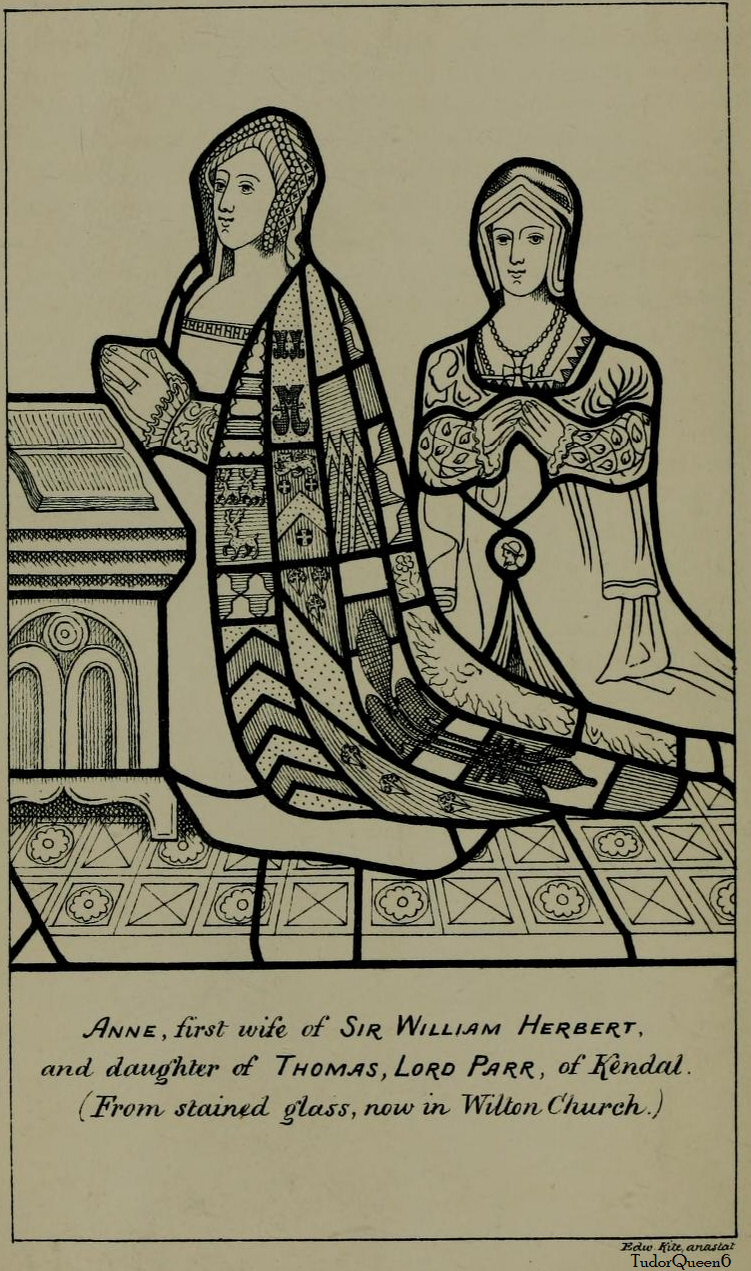
In her honor, in the old chapel at Wilton House was preserved a stained glass window in which were painted the kneeling figures of Lord Pembroke and his two sons also that of his wife Anne Parr and her daughter (also named Anne). The glass is now removed to the new Church at Wilton and will be found in the first window to the right on entering. Lady Pembroke is represented as wearing a rich mantle covered with her armorial bearings.

Lady Pembroke and her daughter, also named Anne (Lady Talbot). Wilton Church.

Lady Pembroke and her daughter, also named Anne (Lady Talbot). Wilton Church.

The lady’s mantle bears the following quarterings

  1. Argent, two bars azure within a bordure engrailed Sable–Parr
  2. Or, three water bougets Sable–Ros of Kendal
  3. Azure, three bucks trippant Vert–Green
  4. Gules, a chevron between three cross-crosslets, and in chief a lion passant Or–Mablethorpe
  5. Azure, three chevronels braced in base, and a chief Or–Fitzhugh
  6. Vaire, a fess Gules–Marmion
  7. Or, three chevronels Gules, a chief Vaire–St. Quentin
  8. Gules, a bend between six cross-crosslets Or–Furneaux
  9. Barry of eight Argent and Gules a fleur-de-lis Sable–Stavely
  10. This last quartering now replaced by a fragment of flowered glass was no doubt that of Gernegan–barry of ten Or and Azure an eagle displayed Argent.

Sources

See also

King Henry VIII: the account of marriage to wife no. 6 to Kateryn Parr

Letters and Papers, Foreign and Domestic, Henry VIII, Volume 18 Part 1: January-July 1543

The wedding of Henry and Kateryn, Dowager Baroness Latimer as recorded
Written by Meghan McGath

Notarial instrument witnessing that, on 12 July 1543, 35 Hen. VIII., in an upper oratory called “the Quynes Pryevey closet” within the honor of Hampton Court, Westm. dioc., in presence of the noble and gentle persons named at the foot of this instrument and of me, Ric. Watkins, the King’s prothonotary, the King and lady Katharine Latymer alias Parr being met there for the purpose of solemnising matrimony between them, Stephen bp. of Winchester proclaimed in English (speech given in Latin) that they were met to join in marriage the said King and Lady Katharine, and if anyone knew any impediment thereto he should declare it. The licence for the marriage without publication of banns, sealed by Thos. abp. of Canterbury and dated 10 July 1543, being then brought in, and none opposing but all applauding the marriage, the said bp. of Winchester put the questions (recited) to which the King, hilari vultu, replied “Yea” and the lady Katharine also replied that it was her wish; and then the King taking her right hand, repeated after the Bishop the words, “I, Henry, take thee, Katharine, to my wedded wife, to have and to hold from this day forward, for better for worse, for richer for poorer, in sickness and in health, till death us depart, and thereto I plight thee my troth.” Then, releasing and again clasping hands, the lady Katharine likewise said “I, Katharine, take thee Henry to my wedded husband, to have and to hold from this day forward, for better for worse, for richer for poorer, in sickness and in health, to be bonayr and buxome in bed and at board, till death us depart, and thereto I plight unto thee my troth.” The putting on of the wedding ring and proffer of gold and silver (described) followed; and the Bishop, after prayer, pronounced a benediction. The King then commanded the prothonotary to make a public instrument of the premises. Present : John lord Russell, K.G., keeper of the Privy Seal, Sir Ant. Browne, K.G., captain of the King’s pensioners, and Thos. Henage, Edw. Seymer, Hen. Knyvet, Ric. Long, Thos. Darcy, Edw. Beynton, and Thos. Speke, knights, and Ant. Denny and Wm. Herbert, esquires, also the ladies Mary and Elizabeth the King’s children, Margaret Douglas his niece, Katharine duchess of Suffolk, Anne countess of Hertford, and Joan lady Dudley, and Anne Herbert.
Notarial attestation by Ric. Watkins, Ll. B., King’s prothonotary.
Large parchment.

The marriage of Henry VIII and Kateryn Parr ©Meghan McGath (2009)
Source: 

James Gairdner and R. H. Brodie (editors). “Henry VIII: July 1543, 11-15.” Letters and Papers, Foreign and Domestic, Henry VIII, Volume 18 Part 1: January-July 1543 (1901): 480-489. British History Online. Web. 10 January 2012. <http://www.british-history.ac.uk/report.aspx?compid=76754&strquery=queen+catherine&gt;