Queen Katherine Parr: The First Woman and Queen of England to be Published

First published in 1545, Prayer of Meditations by Katherine Parr. Photo by Meg Mcgath (2012)

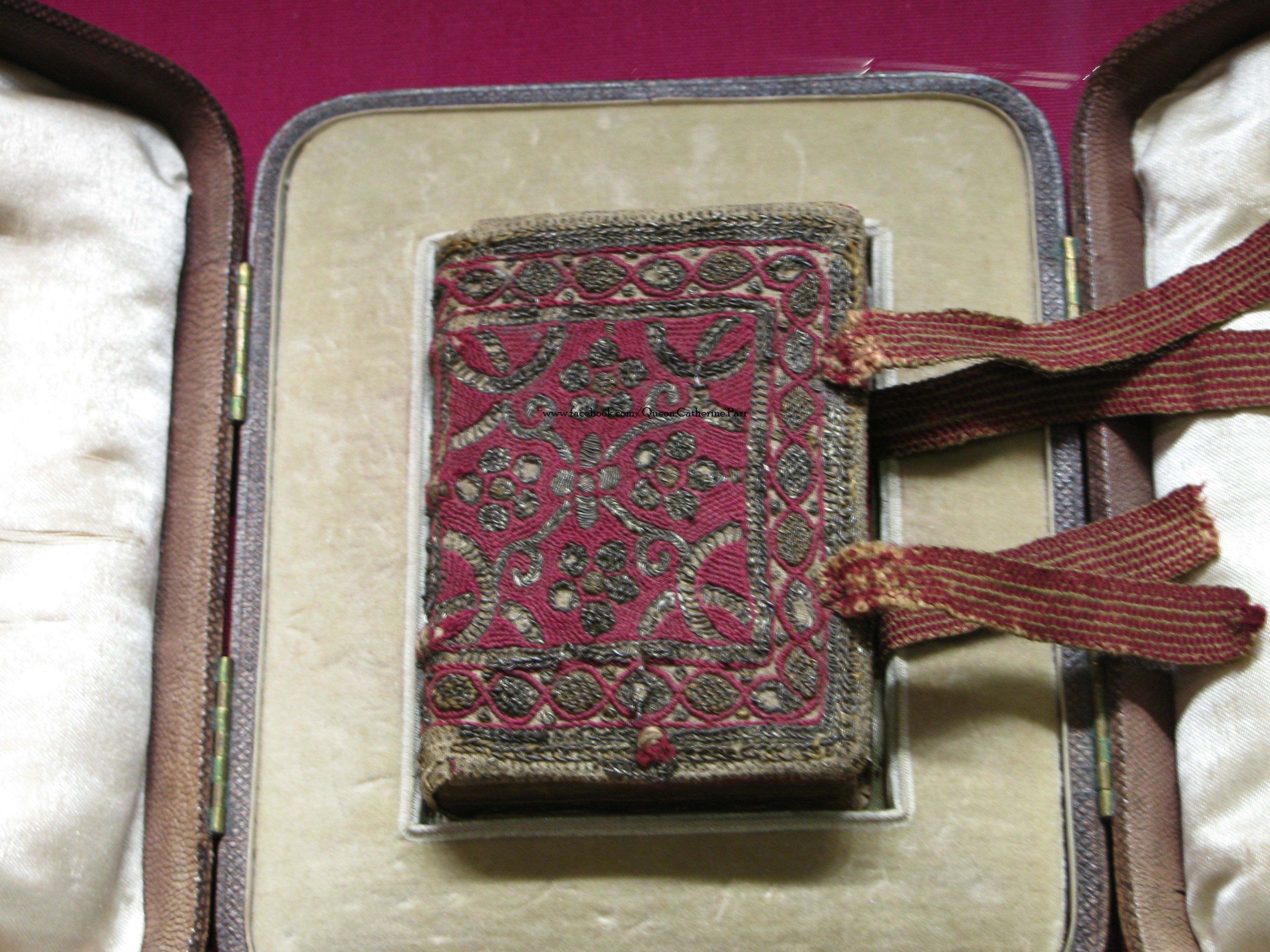
“Prayers or Meditations” by Queen Katherine Parr at Sudeley Castle. Photo by Meg Mcgath (2012).

First published in 1545, “Prayers or Meditations” by Queen Katherine Parr became so popular that 19 new editions were published by 1595 (reign of Elizabeth I). This edition was published in 1546 and bound by a cover made by the Nuns of Little Gedding. Located at Sudeley Castle, Winchcombe.

Queen Katherine Parr published two books in her lifetime. The first, ‘Prayers and Meditations’, was published while King Henry VIII was still alive [1545].

Folger Shakespeare Library PDI Record: --- Call Number (PDI): STC 4824a Creator (PDI): Catharine Parr, Queen, consort of Henry VIII, King of England, 1512-1548. Title (PDI): [Prayers stirryng the mind unto heavenlye medytacions] Created or Published (PDI): [1550] Physical Description (PDI): title page Image Root File (PDI): 17990 Image Type (PDI): FSL collection Image Record ID (PDI): 18050 MARC Bib 001 (PDI): 165567 Marc Holdings 001 (PDI): 159718 Hamnet Record: --- Creator (Hamnet): Catharine Parr, Queen, consort of Henry VIII, King of England, 1512-1548. Uniform Title (Hamnet): Prayers stirryng the mind unto heavenlye medytacions Title (Hamnet): Praiers Title (Hamnet): Prayers or meditacions, wherein the minde is stirred, paciently to suffre all afflictions here, to set at nought the vayne prosperitee of this worlde, and alway to longe for the euerlastinge felicitee: collected out of holy workes by the most vertuous and gracious princesse Katherine Queene of England, Fraunce, and Ireland. Place of Creation or Publ. (Hamnet): [London : Creator or Publisher (Hamnet): W. Powell?, Date of Creation or Publ. (Hamnet): ca. 1550] Physical Description (Hamnet): [62] p. ; 8⁰. Folger Holdings Notes (Hamnet): HH48/23. Brown goatskin binding, signed by W. Pratt. Imperfect: leaves D2-3 and all after D5 lacking; D2-3 and D6-7 supplied in pen facsimile. Pencilled bibliographical note of Bernard Quaritch. Provenance: Stainforth bookplate; Francis J. Stainforth - Harmsworth copy Notes (Hamnet): An edition of: Prayers stirryng the mind unto heavenlye medytacions. Notes (Hamnet): D2r has an initial 'O' with a bird. Notes (Hamnet): Formerly STC 4821. Notes (Hamnet): Identified as STC 4821 on UMI microfilm, reel 678. Notes (Hamnet): Printer's name and publication date conjectured by STC. Notes (Hamnet): Running title reads: Praiers. Notes (Hamnet): Signatures: A-D⁸ (-D8). Notes (Hamnet): This edition has a prayer for King Edward towards the end. Citations (Hamnet): ESTC (RLIN) S114675 Citations (Hamnet): STC (2nd ed.), 4824a Subject (Hamnet): Prayers -- Early works to 1800. Associated Name (Hamnet): Harmsworth, R. Leicester Sir, (Robert Leicester), 1870-1937, former owner. Call Number (Hamnet): STC 4824a STC 4824a, title page not for reproduction without written permission. Folger Shakespeare Library 201 East Capitol Street, SE Washington, DC 20003 Folger Shakespeare Library
PDI Record:

Call Number (PDI):
STC 4824a
Creator (PDI):
Catharine Parr, Queen, consort of Henry VIII, King of England, 1512-1548.
Title (PDI):
[Prayers stirryng the mind unto heavenlye medytacions]
Created or Published (PDI):
[1550]
Physical Description (PDI):
title page
Image Root File (PDI):
17990
Image Type (PDI):
FSL collection
Image Record ID (PDI):
18050
MARC Bib 001 (PDI):
165567
Marc Holdings 001 (PDI):
159718
Hamnet Record:

Creator (Hamnet):
Catharine Parr, Queen, consort of Henry VIII, King of England, 1512-1548.
Uniform Title (Hamnet):
Prayers stirryng the mind unto heavenlye medytacions
Title (Hamnet):
Praiers
Title (Hamnet):
Prayers or meditacions, wherein the minde is stirred, paciently to suffre all afflictions here, to set at nought the vayne prosperitee of this worlde, and alway to longe for the euerlastinge felicitee: collected out of holy workes by the most vertuous and gracious princesse Katherine Queene of England, Fraunce, and Ireland.
Place of Creation or Publ. (Hamnet):
[London :
Creator or Publisher (Hamnet):
W. Powell?,
Date of Creation or Publ. (Hamnet):
ca. 1550]
Physical Description (Hamnet):
[62] p. ; 8⁰.
Folger Holdings Notes (Hamnet):
HH48/23. Brown goatskin binding, signed by W. Pratt. Imperfect: leaves D2-3 and all after D5 lacking; D2-3 and D6-7 supplied in pen facsimile. Pencilled bibliographical note of Bernard Quaritch. Provenance: Stainforth bookplate; Francis J. Stainforth – Harmsworth copy
Notes (Hamnet):
An edition of: Prayers stirryng the mind unto heavenlye medytacions.
Notes (Hamnet):
D2r has an initial ‘O’ with a bird.
Notes (Hamnet):
Formerly STC 4821.
Notes (Hamnet):
Identified as STC 4821 on UMI microfilm, reel 678.
Notes (Hamnet):
Printer’s name and publication date conjectured by STC.
Notes (Hamnet):
Running title reads: Praiers.
Notes (Hamnet):
Signatures: A-D⁸ (-D8).
Notes (Hamnet):
This edition has a prayer for King Edward towards the end.
Citations (Hamnet):
ESTC (RLIN) S114675
Citations (Hamnet):
STC (2nd ed.), 4824a
Subject (Hamnet):
Prayers — Early works to 1800.
Associated Name (Hamnet):
Harmsworth, R. Leicester Sir, (Robert Leicester), 1870-1937, former owner.
Call Number (Hamnet):
STC 4824a
STC 4824a, title page not for reproduction without written permission.
Folger Shakespeare Library
201 East Capitol Street, SE
Washington, DC 20003

Henry was said to be proud and at the same time jealous of his wife’s success. ‘Lamentations of a Sinner’ was not published until after Henry died [in 1547]. In ‘Lamentations‘, Catherine’s Protestant voice was a bit stronger. If she had published ‘Lamentations’ in Henry’s lifetime, she most likely would have been executed as a heretic despite her status as queen consort. Henry did not like his wives outshining him [i.e. Anne Boleyn]…hence her compliance and submission to the King when she found that she was to be arrested by the Catholic faction at court. Her voice may have been dialed down a notch, but once her step-son, the Protestant boy King Edward took the throne — she had nothing to hold her back. Her best friend, the Dowager Duchess of Suffolk, and brother Northampton encouraged Parr to publish.

A publication of the book The Lamentation of a Sinner c.1550 [after the death of Queen Katherine] from the book “Vivat Rex!: An Exhibition Commemorating the 500th Anniversary of the Accession of Henry VIII” by Arthur Schwarz

Published in 1547 [according to Sudeley Castle] after the death of King Henry VIII, “The Lamentation of a Sinner” was Katherine’s second book which was more extreme than her first publication. She was encouraged by her good friend the Duchess of Suffolk and her brother, the Marquess, to publish. The transcription of the title page here is… “The Lamentacion of a synner, made by the most vertuous Lady quene Caterine, bewailyng the ignoraunce of her blind life; let foorth & put in print at the inflance befire of the right gracious lady Caterine, Duchesse of Suffolke, and the ernest request of the right honourable Lord William Parre, Marquesse of Northampton.”

I was lucky enough to see a copy both a Sudeley Castle and at the Folger Shakespeare Library in Washington, D.C. I am really interested in going to the Library and studying the actual book…one day!

Queen Katherine's Queen Katherine’s “Lamentations of a Sinner” on display at the Vivat Rex Exhibition at the Folger Shakespeare Library. Photo by Meg Mcgath (2009). See above for full description of the book the Folger has in their collection which can be seen in this photo.

The Lamentation of a Sinner

Lamentations of a Sinner

by Catherine Parr, Queen of England and Ireland

A publication of the book c.1550 [after the death of Queen Katherine]

A publication of the book c.1550 [after the death of Queen Katherine]

“The Lamentacion of a synner, made by the most vertuous Lady quene Caterine, bewailyng the ignoraunce of her blind life; let foorth & put in print at the inflance befire of the right gracious lady Caterine, Duchesse of Suffolke, and the ernest request of the right honourable Lord William Parre, Marquesse of Northampton.”

Published in 1548 after the death of King Henry VIII, “The Lamentation of a Sinner” was Catherine’s second book which was more extreme than her first publication. She was encouraged by her good friend the Duchess of Suffolk and her brother, the Marquess, to publish.
[Vivat Rex Exhibition, Folger Shakespeare Library, STC 4828]

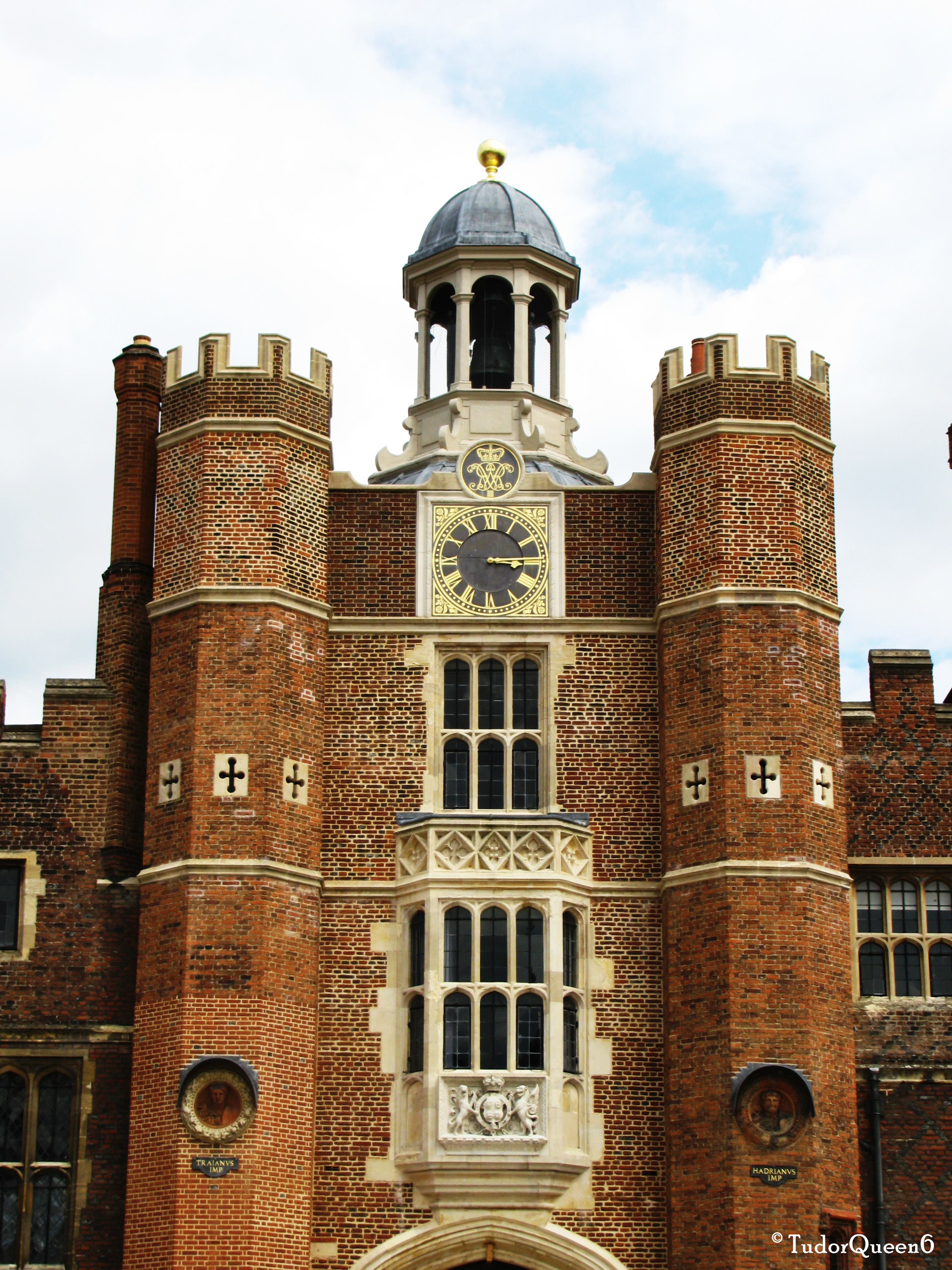
The Hampton Court Pedigrees: The Six Wives of Henry VIII

All of King Henry’s wives had one thing in common, they all descended from Edward I; some by his first wife Eleanor of Castile or by his second, Marguerite of France; and in some cases both! In Hampton Court Palace in King Henry VIII’s apartment there are six stained glassed windows showing his wives pedigrees from King Edward I. As some were descended multiple times or by both wives the more prominent ancestry was featured.

henry_viii

From Atonia Fraser’s The Wives of Henry VIII, pg 363:

The following genealogy should be seen as a reflection of the narrowness of aristocratic society in a world of small population, rather than as some unconscious desire [that King Henry VIII might have] to commit forms of incest as has been suggested. The wives of Henry VIII were not “closely” related or to King Henry himself. The exception would be of the first cousins Anne Boleyn and Catherine Howard; Henry’s 2nd and 5th wife whom shared the same grandfather, Sir Thomas Howard, 2nd Duke of Norfolk by his 1st wife Elizabeth Tilney (herself the daughter of Elizabeth Cheney by her first husband Sir Philip Tilney. Elizabeth married secondly Sir John Say. Her daughter Anne would become grandmother to Queen consort Jane Seymour, thus making Queen Anne, Queen Jane, and Queen Catherine Howard second cousins).

In actuality, King Henry was closely related to two of his wives; Katherine of Aragon and his last wife, Katherine Parr. All three shared common ancestry and the ancestor Prince John of Gaunt, 1st Duke of Lancaster. Thus, Katherine of Aragon was a 3rd cousin, once removed and 4th cousin (by Lancaster’s first two wives). Katherine’s lineage made her more eligible to the throne of England than her father-in-law, Henry VII. The lineage from both Henry VIII and Katherine of Aragon gave their daughter, Princess Mary, the stronghold that she would have needed to be Queen Regnant from birth. Her claim to the throne was undeniable, yet Henry VIII threw away her chances–when he declared Mary illegitimate and moved on to wife no. 2, Anne Boleyn.

Parr, however, had multiple links via her father and mother. Queen Katherine Parr and Henry VIII’s closest relations: 3rd cousins via Lady Maud Parr (through Sir Richard Wydeville and Joan Bedlisgate; grandparents of Queen consort Elizabeth Woodville, wife of Edward IV); and by Lord Parr — 3rd cousins, once removed (through Ralph Neville, 1st Earl of Westmorland and Lady Joan Beaufort; parents to Lady Cecily, Duchess of York, mother to Edward IV and Richard III); 4th cousins by John of Gaunt, 1st Duke of Lancaster and Katherine Swynford (grandparents to John Beaufort, 1st Earl of Somerset); 4th cousins, once removed and 5th cousins through Sir Thomas Holland, 2nd Earl of Kent and Lady Alice FitzAlan (parents of Lady Margaret, Countess of Somerset and Lady Alianore, Countess of March).

The Hampton Court Pedigrees 

The SIX pedigrees of Henry VIII’s Wives, Henry’s Apartments;
linking them all back to King Edward I of England

Katherine Of AragonQueen Katharine of Aragon 

(1509-1533)

Not for my Crown” (As Princess of Wales)

&

Humble and Loyal” (As queen consort)

Katharine of Arragon 1st wife of King Henry ye Eighth, her pedigree from King Edward ye First and his 1st wife Eleanor of Castile

Pedigree window of Katherine of Aragon

Pedigree window of Queen Katherine of Aragon

Katharine of Aragon was the daughter of

Ferdinand King of Spain
Ferdinand, King of Spain married Isabel of Leon
John, King of Leon married Isabel of Portugal
John, Prince of Portugal married Isabel of Braganza
John, Grand Master of Avis [de jure King of Portugal] married Philippa of Lancaster
John, Duke of Lancaster married Blanch Plantagenet
King Edward ye Third [of England] married Philippa of Hainault
King Edward ye Second [of England] married Isabel of France
King Edward ye First [of England] married 1st Eleanor of Castile
Queen Katherine's royal emblem, the Pomegranate, a symbol her mother Queen Isabel of Castile used in her own coat of arms.

Queen Katherine’s royal emblem, the Pomegranate, a symbol her mother Queen Isabel I of Castile (1474-1504) used in her own coat of arms as queen regnant from 1492.

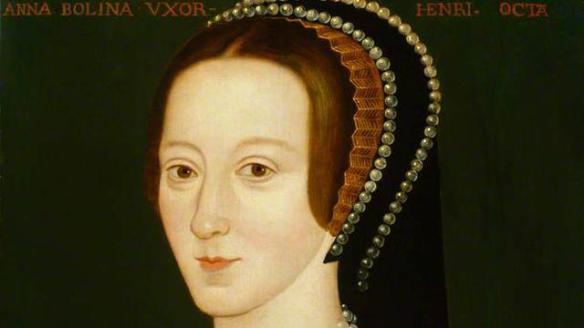
anne_boleynQueen Anne Bullen 

(1533-1536)

The Most Happy

Anne Bullen the 2nd wife of King Henry ye Eighth, her pedigree from King Edward ye First and his second wife Margaret of France

Pedigree window of Queen Anne Boleyn.

Pedigree window of Queen Anne Boleyn.

Anne Bullen, daughter of

Thomas, Earl of Wiltshire
Thomas, Earl of Wiltshire married Elizabeth Howard
Thomas, Duke of Norfolk married Elizabeth Tylney
John, Duke of Norfolk married Katharine Molyns
Syr Robert Howard married Margaret Mowbray
Thomas, Duke of Norfolk married Elizabeth Fitzalan
John, Lord Mowbray married Elizabeth Segrave
John, Lord Segrave married Margaret of Brotherton
Thomas, Earl of Norfolk married Alice Halys
King Edward ye first [of England] married 2nd Margaret of France
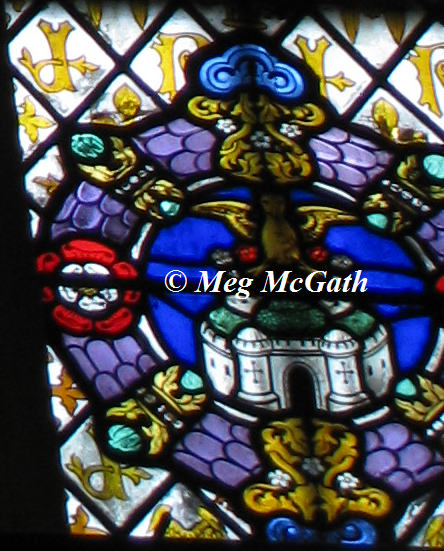
Royal emblem of Anne Boleyn as queen, the falcon.

Royal emblem of Anne Boleyn as queen, the falcon.

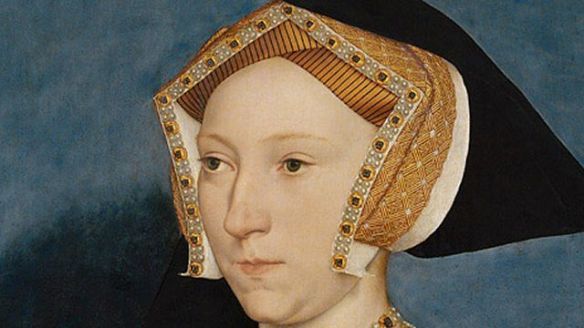
jane_seymourQueen Jane Seymour 

(1536-1537)

Bound to Serve and Obey

Jane Seymour 3rd wife of King Henry ye Eighth, her pedigree from King Edward ye First and his 1st wife Eleanor of Castile

Pedigree window of Queen Jane Seymour

Pedigree window of Queen Jane Seymour

Jane Seymour was the daughter of

Syr John Seymour
Syr John Seymour married Margaret Wentworth
Syr Henry Wentworth married Anne Say
Syr Philip Wentworth married Mary Clifford
John, Lord Clifford married Elizabeth Percy
Henry, Lord Percy married Elizabeth Mortimer
Edmond, Earl of March married Philippa of Clarence
Lionel, Duke of Clarence married Elizabeth Burgh
King Edward ye Third [of England] married Philippa of Hainault
King Edward ye Second [of England] married Isabel of France
King Edward ye First [of England] married 1st Eleanor of Castile
Royal emblem of Queen Jane Seymour, the Phoenix.

Royal emblem of Queen Jane Seymour, the Phoenix.

p02h9h78Queen Anne of Cleve 

(1540)

God Send Me Well to Keep

Anne of Cleve, 4th wife of King Henry ye Eighth, her pedigree from King Edward ye First and his 1st wife Eleanor of Castile

Pedigree window of Queen Anne of Cleves

Pedigree window of Queen Anne of Cleves

Anne of Cleve was the daughter of

 John, Duke of Cleve
John Duke of Cleve married Mary of Jüliers
John, Duke of Cleve married Maud of Hesse
John, Duke of Cleve married Elizabeth of Nevers
Adolphus of Cleves married Mary of Burgundy
John, Duke of Burgundy married Margaret of Bavaria
Philip, Duke of Burgundy married Margaret of Flanders
Lewis, Count of Flanders married Margaret of Brabant
John, Duke of Brabant married Margaret of France
John, Duke of Brabant married Margaret Plantagenet
King Edward ye first married 1st Eleanor of Castile
Anne of Cleves window emblem

Anne of Cleves Royal window emblem

otd-february-13-catherine-howard-jpgQueen Katharine Howard

(1540-1541)

No Other Will But His

Katharine Howard, 5th wife of King Henry ye Eighth, her pedigree from King Edward ye First and his 2nd wife Margaret of France

Pedigree window of Queen Katherine Howard

Pedigree window of Queen Katherine Howard

Katharine, daughter of

 Lord Edmond Howard

Lord Edmond Howard married Joyce Culpeper
Thomas, Duke of Norfolk married Elizabeth Tylney
John, Duke of Norfolk married Katharine Molyns
Syr Robert Howard married Margaret Mowbray
Thomas, Duke of Norfolk married Elizabeth Fitzalan
John, Lord Mowbray married Elizabeth Segrave
John, Lord Segrave married Margaret of Brotherton
Thomas, Earl of Norfolk married Alice Halys
King Edward ye first [of England] married 2nd Margaret of France
Katherine Howard window emblem

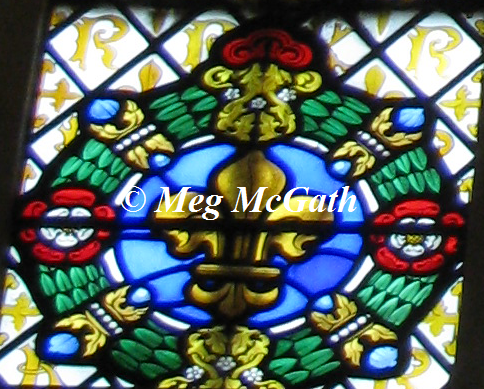
Katherine Howard’s Royal emblem was a Tudor Rose; there was no feature but this Fleur-de-Lis window emblem in her Pedigree

images-of-henry-viii-children-i19Queen Katherine Parr 

(1543-1547)

To be Useful in All That I Do

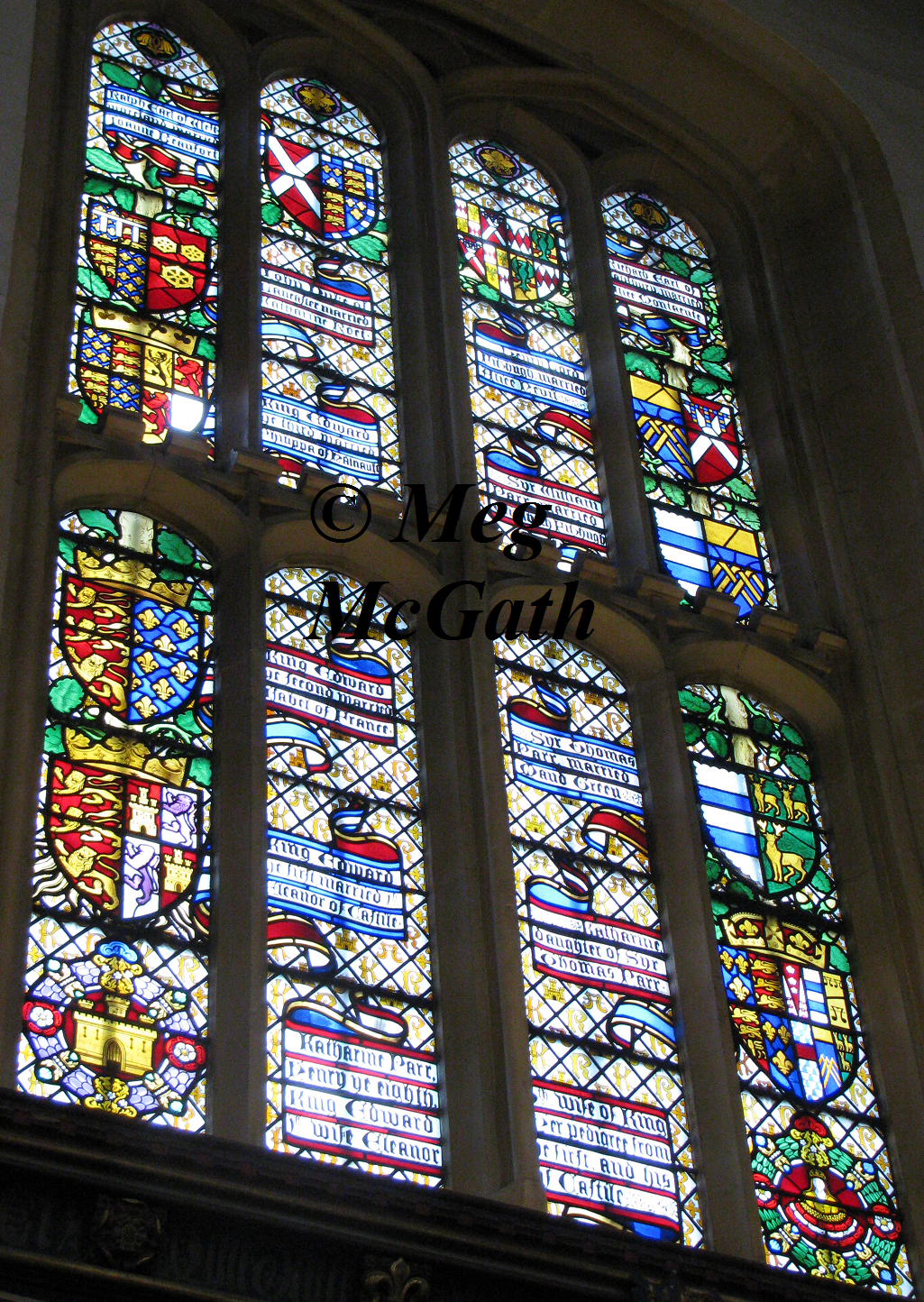
Katharine Parr, 6th wife of King Henry ye Eighth, her pedigree from King Edward ye First and his 1st wife Eleanor of Castile

Pedigree window of Queen Katherine Parr
Pedigree window of Queen Katherine Parr

Katharine daughter of

Syr Thomas Parr
Syr Thomas married Maud Green
Syr William Parr married Elizabeth FitzHugh
Henry, Lord FitzHugh married Alice Nevil
Richard, Earl of Salisbury married Alice Montacute
Ralph, Earl of Westmorland married Joanne Beaufort
John, Duke of Lancaster married Katharine de Roet
King Edward ye Third [of England] married Philippa of Hainault
King Edward ye Second [of England] married Isabel of France
King Edward ye First [of England] married 1st to Eleanor of Castile
Royal emblem of Queen Katherine Parr, maidenhead of the Lord Parrs of Kendal

Royal emblem of Queen Katherine Parr, maidenhead of the Lord Parrs of Kendal (taken from the de Ros Family)

Family of Queen Katherine: DEATH of William, 1st Earl of Pembroke

Pembroke family of Wilton. Wilton Church. Pembroke family of Wilton. Wilton Church.

Yesterday was the anniversary of the death of Sir William Herbert, 1st Earl of Pembroke, husband of Anne Parr, and thus sister-in-law to Queen Katherine. Lord Pembroke died on 17 March 1570 at Hampton Court Palace. William was eldest son of Sir Richard Herbert of Ewyas, Herefordshire, by his wife Margaret, daughter of Sir Matthew Cradock of Swansea. Pembroke’s father, Sir Richard, was an illegitimate son of the original William Herbert, 1st Earl of Pembroke of the first creation (d. 1469), by a mistress, Maud, daughter of Adam ap Howell Graunt. He married firstly to Anne Parr in 1538 and after her death, Lady Anne Talbot, daughter of the Earl of Shrewsbury. Parr gave Pembroke an heir (the 2nd Earl), an heir to spare (ancestor to the Earls of Powis), and a daughter (no issue). Talbot had no issue by Pembroke.

Hampton Court Palace, London, England. Hampton Court Palace, London, England.

On the eve of 17 March 1570, Pembroke took to his bed in his quarters at Hampton Court Palace. He was joined by his younger son, Sir Edward Herbert and the Earl of Leicester, Robert Dudley.

Pembroke had written his will back on 28 December 1569. Pembroke’s executors/witnesses of his will were his heir Henry Herbert (later 2nd Earl of Pembroke was the sole executor), the Earl of Leicester (Robert Dudley); Sir Walter Milday; Sir Nicholas Throckmorton (cousin to his first wife); Gilbert Gerrard. To those men he bequethed £50 to be delivered either in money, plate of jewels, within one month. And by codicil it is mentioned that Pembroke declared to Leicester and his son, Sir Edward Herbert, that on the night before his death, the Lord Keeper of the Great Seal, Sir James Crofts, and Mr. Secretary Cecil be joined in the oversee and receive the same gifts. To his wife, (Anne Talbot) he left her, her own clothes and jewels, which would otherwise go to his son Henry, Lord Herbert and his wife. Lady Pembroke was to be looked after and to be allowed to stay at Baynard’s Castle where Pembroke’s previous wife had died in 1552. Pembroke’s second son, Edward, was given a plate with the value of 500 marks. Pembroke’s daughter, Anne, Lady Talbot, was to receive £500. To his brother-in-law, the Marquess of Northampton (William Parr), he left his second-best gold sword. Leicester received Pembroke’s best gold sword. Pembroke also wanted £200 bestowed upon the poor near Baynard castleward in London, Salisbury in Wiltshire, and Hendon. To the Queen (Elizabeth), he left his “newest fairest and richest bed” and his greatest jewel called the “Great Ballace.” Most importantly, the ordinary men (his servants, etc) were to be looked after by his heir, Henry.

That my lorde Herbert do consider Thomas Gregorie and Tidie with money for their travaile and paines beside that he hath bequethed to them in annuity that he speciallie do appointe to Francis Zouche and Charles Arundell fit and good annuities for them. That he have special care of Henrie Morgan, George Morgan, Phillip Williams, Robert Vaughan, and Thomas Scudamore and either entertaigne them into his service payinge them their wages beforehand or else appoint them sufficient annuities. That he do entertaigne his household and keep them together

Philip Williams had been Pembroke’s secretary; Robert Vaughan, his treasurer; Thomas Scudamore was one of the men who carried his coffin.

Leicester then left Pembroke’s bedside, leaving Pembroke with his son and physicians. Pembroke died the next morning, 17 March 1570 at the age of sixty-three.

In his will, Pembroke listed two possible burial places; Old Saint Paul’s or Canterbury Cathedral. If he died near London, his wishes were to be buried in St. Paul’s Cathedral next to his first wife, Anne Parr. Pembroke obviously loved his wife for when he wrote his will, despite being married again, he wanted nothing more than to be buried “near the place where Anne my late wife doth lie buried” in St. Paul’s. He was buried in April.

Shortly after his death, the Dowager Lady Pembroke received a letter from the Queen in the hand of Cecil, but heavily corrected (most likely by Elizabeth). The Queen expressed her condolences of the loss of “our late cousin.”

See also: “Funeral of William Herbert, 1st Earl of Pembroke

References

  • Adam Nicolson. “Quarrel with the King: The story of an English family on the high road to Civil War,” HarperCollins, Oct 6, 2009.
  • Wiltshire Archaeological and Natural History Society, Devizes : Wiltshire Archaeological and Natural History Society, 1879. pg 126-28.

Alison Weir: “New” Portrait of Katherine Parr

20130315-162933.jpg

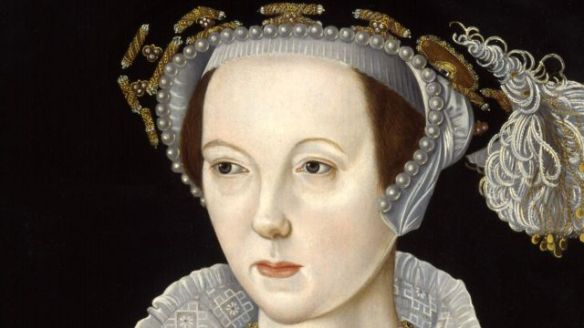
Catherine the Chameleon: some of the wildly different faces of Catherine Parr.
Perhaps she was just hard to capture in paint.
The image on the bottom right, previously thought to be Elizabeth I, has now been identified by Alison Weir as another portrait of Catherine. (Alex David)

I would love to know on what basis Weir has identified the “new” portrait of Katherine Parr. No other actual historian or biographer of Parr has agreed with her findings and the portrait is not officially recognized.

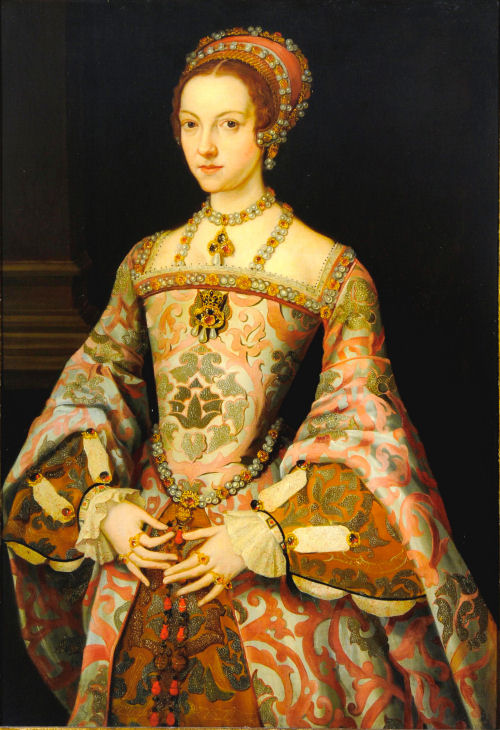
First off–the one on the bottom right is reported to be done by Holbein, the younger c.1542 (before the marriage of Queen Katherine in 1543). The one of the top right was done posthumously and has been officially identified by Katherine’s biographer Susan James. That portrait was done after her death (d.1548). The two on the left were done during Parr’s time as Queen. Although the two on the left look at tad different as the blogger states (David) — during studies done on the full length portrait done c.1545 show that the face, among other parts of the portrait, were altered. An x-ray study shows this below.

X-ray comparison of NPG portrait of Queen Katherine Parr by Master John compared to the queen's portrait attributed to Scrots (right).
X-ray comparison of NPG portrait of Queen Katherine Parr by Master John compared to the queen’s portrait attributed to Scrots (right). The two without altering do look very similar.
According to Art History Today’s blog (7 October 2011), “Rediscoveries & Revelations. Book Review: The Secrets of Leonardo da Vinci,” the portrait is actually that of the future Queen Elizabeth Tudor. The portrait is labeled ‘Hans Hoblein the Younger, Portrait of Elizabeth Tudor, the future Elizabeth I, Private Collection, tempera and oil on oak panel, 52 x 42 cm.’

Graeme Cameron’s last major revelation is the publication of a Holbein’s Portrait of Elizabeth the First a beguiling image of the beautiful, young English princess dating from about 1542. Despite its strong provenance, and its approval by a leading Holbein scholar, Paul Ganz in The Conoisseur in 1952, the painting has never been accepted into the artist’s oeuvre. Cameron supplies strong evidence and arguments for overturning the dis-attribution. Apart from the web of historical evidence and fact tying the work to the young Elizabeth, there is the iconography of the Judgement of Paris, reappearing again, this time on the brooch around the woman’s neck, which must relate to her virtue and beauty. (Art History Today)

Weir, who is no expert on Parr, has more than a few errors in Parr’s section of her book, “The Six Wives.” While I applaud her efforts at writing, I do not use her for a reference and neither do most scholarly authors/historians.

Weir states that the portrait is identified by the necklace the sitter is wearing; which is present in the newly identified portrait of Katherine Parr by Susan James (2009). As stated before, James’s find is posthumous. Christie’s describes it as:

“It has been suggested that the present portrait dates to circa 1590-1620, and may be a rare record of the lost depiction of the Queen by Hans Eworth, showing the Queen in costume typical of 1545-1550.”

Weir states: “actually it’s a carcanet, or choker, and it’s very distinctive, and in fact unique in Tudor portraits of this period – is identical to the one in the portrait said to be Elizabeth (above, right). It’s almost certainly the same one, and fits a description of a carcanet listed in the Queen’s inventory.” To which I ask… which inventory of Queen Katherine? The inventory listed in Janel Mueller’s compilation of Katherine Parr’s works and correspondences has no mention of the carcanet.

"A Lady called Anne Boleyn," Henry Bone Pierce, Royal Collection.

“A Lady called Anne Boleyn,” Henry Bone Pierce, Royal Collection.

The above portrait, the traditional identification of the sitter as Anne Boleyn has now been discredited and the image no longer forms part of the accepted limited iconography of Anne Boleyn. (Royal Collection Trust)

Weir goes on to compare the portrait to a newer version recorded in the Royal Collection as “Anne Boleyn.” The woman in the miniature wears the same necklace — Weir believes it to be a copy of the larger portrait. She then states:

For 300 years, it  was owned by her cousin, Sir Lionel Duckett, and his family. In 1832, it was put on sale in London with the rest of Sir George Duckett’s collection, and sold to Sir Joseph Neeld of Grittleton House near Chippenham Wiltshire. In 1851, it was described in the Grittleton catalogue as ‘the portrait of Queen Anne Boleyn’. It follows that Katherine Parr’s cousin would own a portrait of her. No doubt he was proud to display one of his kinswoman as queen.

"Lady called Anne Boleyn," Christie's Auction.

“Lady called Anne Boleyn,” Christie’s Auction.

Lot Notes for the Christie’s Auction state:

“the traditional identification of the sitter as Anne Boleyn has been questioned, first raised by Lionel Cust in 1880. It has been suggested that the identity of the sitter is possibly that of Katherine Parr (1512-1548), daughter of Sir Thomas Parr (1478-1517) and his wife Jane Fogge. She was the sixth wife of King Henry VIII and Queen of England from 1543 until her death in 1548.”

However, anyone who knows anything about Queen Katherine knows that her mother and the wife of Sir Thomas Parr was Maud Green, daughter of Joan Fogge.

Looking back into the genealogy of Queen Katherine, modern genealogy amateurs state there is apparently a connection to Lionel Duckett. It is not clear, though. I looked into it and found a RootsWeb tree that connects an Eleanor Harrington to a daughter of Sir Thomas Parr of Kendal and Alice Tunstall who apparently married a William Harrington. Looking into the sources, The Duckett line from ‘Pedigrees Recorded at the Heralds’ visitations of the counties of Cumberland and Westmorland’, does not spell out who Eleanor’s mother is. It simply says “daug. of Wm. Harrington, of Wresham, in co. Lane”. The lineage also names only two sons of Eleanor–Richard and Robert. No William Duckett is listed; father of Lionel. In the lineage listed for Harrington in the same book, the pedigree lists that William Harrington of Wreysham married to “…dau. and co-heir of … Parr”. This again, leaves us with no solid evidence. Looking into Burke’s ‘A Genealogical and Heraldic Dictionary of the Peerage and Baronetage of the United Kingdom’, the Duckett line quotes an Eleanor Harrington, ‘dau of William Harrington, who had considerable possessions both in Lancashire and the barony of Kendal’. No mother listed. As I look through Douglas Richardson’s ‘Plantagenet Ancestry’, 2nd edition, there is indeed a daughter named Eleanor as the child of Thomas and Alice. Eleanor is listed as marrying Sir Henry Agard. Another daughter, Anne, is listed as the wife of William Harrington. However, it ends there with no documentation to further the connection between Duckett and Harrington. It seems to be a big mess that has yet to be figured out.

Lionel married a Mary Leighton — if I’m not mistaken, the Leighton family was connected directly and indirectly to the Boleyn’s via Mary Boleyn’s descendants. Yes, Mary Leighton’s uncle Sir Thomas Leighton married Elizabeth Knollys (granddaughter of Mary Boleyn, sister of Queen Anne). So Weir’s whole thing about them claiming it is Anne Boleyn..[which she doesn’t agree with] would make MORE sense!

Alison Weir's website with the two portraits "she found" of Katherine Parr (2012).

Alison Weir’s website with the two portraits “she found” of Katherine Parr (2012).

Before she put this portrait out as Parr, she had another which was thought to be Lady Jane which has already been thoroughly studied and found not to be her (see “The Norris Portrait”). Weir then tried to pass it off as Parr. It’s odd how the specialist’s findings from “The Norris Portrait” were then found on her site, same portraits and all, only the info was changed around slightly to fit “her” findings (something all too familiar to Weir’s writing). The writing was all very eerily familiar to the website that had already done research on the portrait only her conclusion was that it was “indeed” Parr. As soon as she was confronted by the researcher and page owner, she took it all down and kept this “new” portrait of “Katherine Parr.”

So nice try, but until her biographers and other art specialists agree–the portrait, bottom right, is NOT a portrait of Katherine. Weir should really stick to writing and leave portraiture to the experts!

Reference:

Links

Kendal Castle and Katherine Parr

Many books and local legends of Cumbria place the birth of Queen Katherine Parr at Kendal Castle in 1512. Is this true? No.
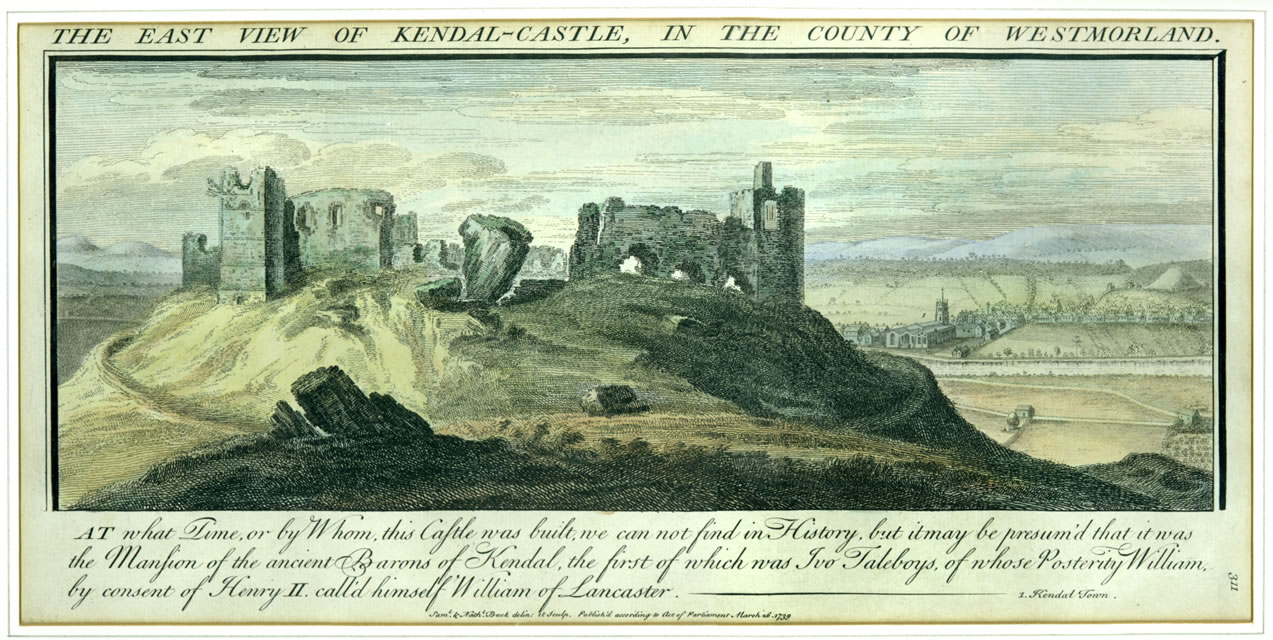
Kendal Castle, 1739.

Kendal Castle, 1739.

It’s false of course. By the time of her birth — her father, Sir Thomas, had abandoned the castle which was falling into disrepair for the court life. Who wouldn’t want to be at the court of Henry VIII? It was THE place to be! Plus, Catherine’s mother was in attendance upon the Queen. It would appear that Catherine’s grandfather, William, was the last to reside in the Castle. Shortly after the coronation of Richard III, Parr left for Kendal to distance himself from Edward IV’s “successor.” He died a few months later and is buried in Kendal Parish Church.

No one knows where Katherine, her brother William and sister Anne were born.

In spite of long held beliefs and old stories, the future Queen Katherine was not born in Kendal Castle which, after years of neglect, was becoming ruinous and by 1572 it was derelict and left in the hands of the Steward.

More probably the children were born in the house in Blackfriars which Sir Thomas Parr had leased shortly before Katherine was born, or in one of the other properties owned by the family in the south of England.(The Stricklandgate House Trust Limited)

28 February 1552: The Burial of the Queen’s Sister

Lady Anne Herbert [Parr], Countess of Pembroke died at Baynard’s Castle on 20 February 1552; at the age of thirty-six. Lady Pembroke had out-lived her sister, the Dowager Queen Katherine (d. 5 September 1548), who had also died in the year of her thirty-sixth birthday (Katherine was born in 1512, no official date is recorded). Unlike her sister and brother, the Marquess of Northampton, Lady Pembroke left two sons and a daughter to continue her legacy. Lady Pembroke  was buried with huge pomp in Old St. Paul’s Cathedral in London next to her ancestor Prince John of Gaunt, 1st Duke of Lancaster [and his first wife, Blanche of Lancaster] on 28 February 1552.

On the 28th February was buried the noble countess of Pembroke, sister to the late Queen Katharine, wife of King Henry VIII. She died at Baynard’s Castle and was so carried into Paul’s. There were a hundred poor men and women who had mantle frieze gowns, then came the heralds; after this the corpse, and about her, eight banner rolls of arms. Then came the mourners both lords and knights and gentlemen, also the lady and gentlewomen mourners to the number of two hundred. After these were two hundred of her own and other servants in coats. She was buried by the tomb of the Duke of Lancaster. Afterwards her banners were set up over her and her arms set on divers pillars. (Diary of Henry Machin citizen of London Camden Soc vol 42)

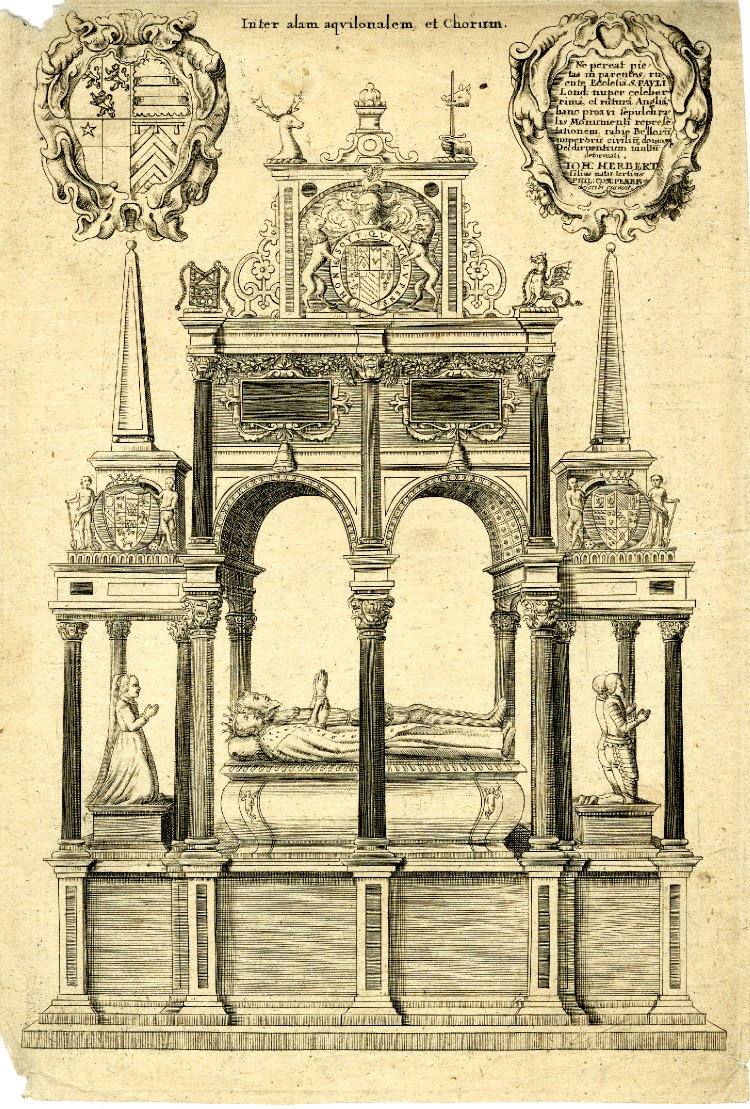
Tomb of William, Earl of Pembroke, in St Paul's; the tomb on a tall base on which lie a man and wife, in ermine robes, heads to left; eleven columns support a double arch above and obelisk topped extensions at the sides; two cartouches at top, to the left with coat of arms and to the right with dedication by 'Ioh Herbert'; illustration to William Dugdale's 'History of St Paul's' (London, 1658 and 1716)

Tomb of William, Earl of Pembroke, in St Paul’s; the tomb on a tall base on which lie a man and wife, in ermine robes, heads to left; eleven columns support a double arch above and obelisk topped extensions at the sides; two cartouches at top, to the left with coat of arms and to the right with dedication by ‘Ioh Herbert’; illustration to William Dugdale’s ‘History of St Paul’s’ (London, 1658 and 1716)

The tomb is located between the choir and the North aisle. The tomb was by the magnificent tomb of John of Gaunt, Duke of Lancaster and Blanche of Lancaster, between the pillars of the 6th bay of the Choir. (Benham) The Pembroke tomb was a magnificent structure consisting of effigies of the earl and his Lady Pembroke lying on a sarcophagus, attended by kneeling children, and the whole covered by an elaborate canopy resting on stone shafts. (Clinch) Her memorial there read: “a most faithful wife, a woman of the greatest piety and discretion” and “Her banners were set up over her arms set on divers pillars.“ On her tomb her epitath read that she had been “very jealous of the fame of a long line of ancestors.“ Her husband, Lord Pembroke, died on 17 March 1570 and by his wishes was also buried in St. Paul’s Cathedral on 18 April 1570 next to Lady Pembroke.

Lady Pembroke figure, Wiltshire Archeological and Natural History, 1879, pg 98.

Lady Pembroke figure, Wiltshire Archeological and Natural History Magazine, 1879, pg 98.

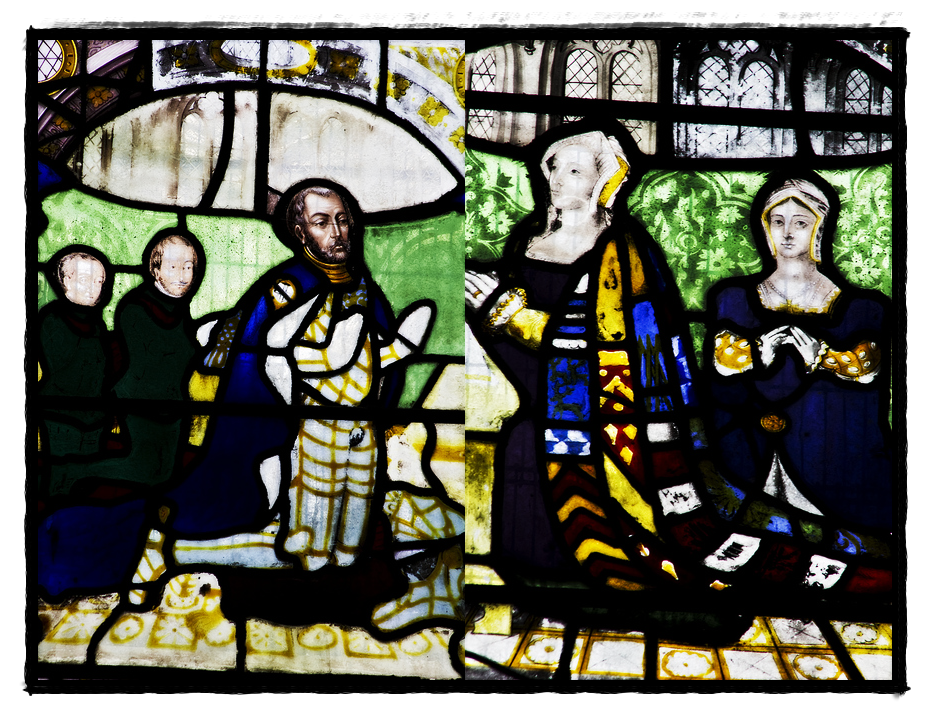
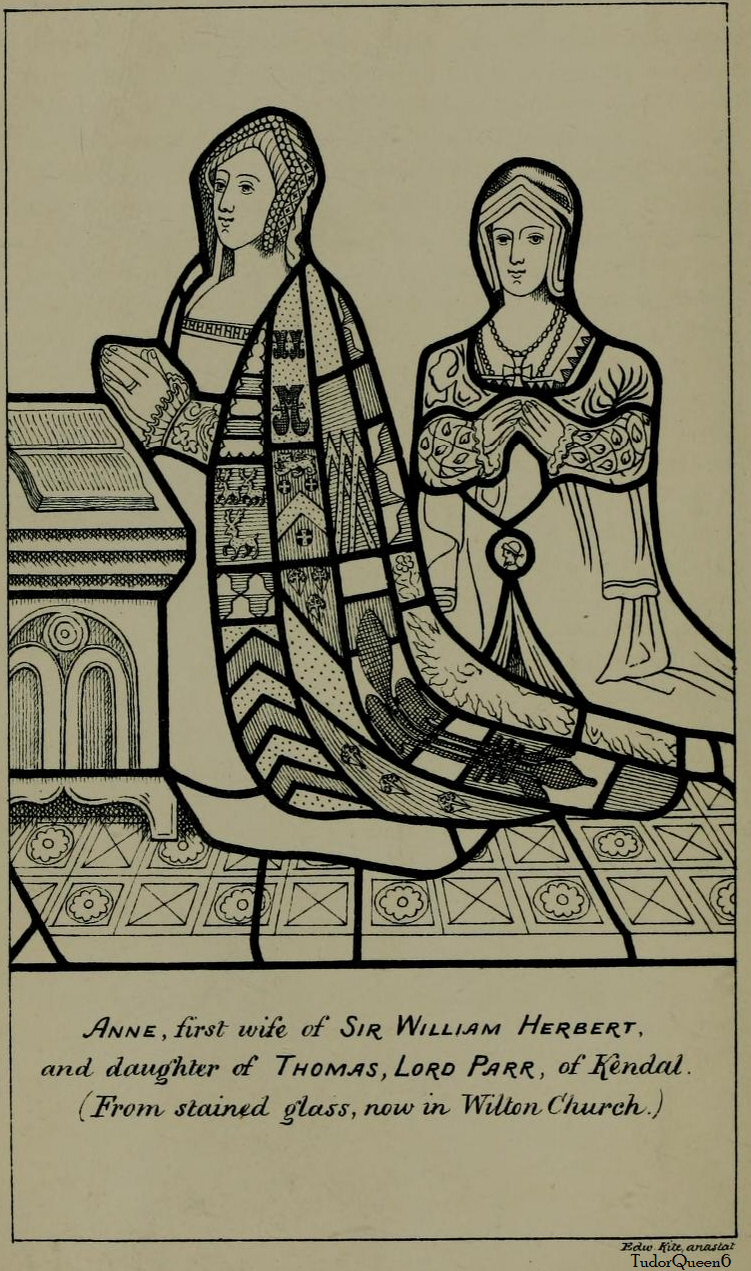
In her honor, in the old chapel at Wilton House was preserved a stained glass window in which were painted the kneeling figures of Lord Pembroke and his two sons also that of his wife Anne Parr and her daughter (also named Anne). The glass is now removed to the new Church at Wilton and will be found in the first window to the right on entering. Lady Pembroke is represented as wearing a rich mantle covered with her armorial bearings.

Lady Pembroke and her daughter, also named Anne (Lady Talbot). Wilton Church.

Lady Pembroke and her daughter, also named Anne (Lady Talbot). Wilton Church.

The lady’s mantle bears the following quarterings

  1. Argent, two bars azure within a bordure engrailed Sable–Parr
  2. Or, three water bougets Sable–Ros of Kendal
  3. Azure, three bucks trippant Vert–Green
  4. Gules, a chevron between three cross-crosslets, and in chief a lion passant Or–Mablethorpe
  5. Azure, three chevronels braced in base, and a chief Or–Fitzhugh
  6. Vaire, a fess Gules–Marmion
  7. Or, three chevronels Gules, a chief Vaire–St. Quentin
  8. Gules, a bend between six cross-crosslets Or–Furneaux
  9. Barry of eight Argent and Gules a fleur-de-lis Sable–Stavely
  10. This last quartering now replaced by a fragment of flowered glass was no doubt that of Gernegan–barry of ten Or and Azure an eagle displayed Argent.

Sources

See also

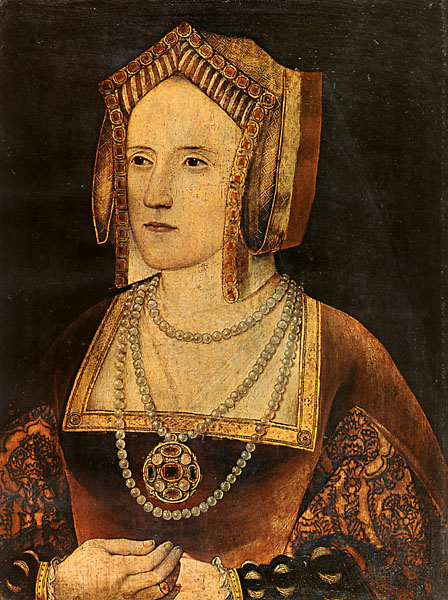
Which Queen Katherine: The Lambeth Portrait

It has been identified as Queen Katherine Parr for centuries. Thanks to modern technology used to examine the portrait by the NPG in London, it has been concluded that the portrait is indeed that of wife no.1, Queen Katherine of Aragon.

Disputed Lambeth Palace portrait; Katherine Parr or Katherine of Aragon

Lambeth Palace portrait; now identified as Queen Katherine of Aragon, wife no. 1

The young woman in the picture is blessed with good features, an oval-shaped face with a firm jawline and a clear complexion. But it is the overall impression of intelligence and intensity that is so compelling. There is an inner strength in the face that commands attention. The woman looks confident. This is a woman full of grace and maturity. The portrait is carefully composed. She is very much the aristocratic lady, expensively dressed and already demonstrating a love of jewels and fashion that would develop over the years. Her clothing is red and gold, with the hood perfectly matching the gown. At the period of time the portrait was painted the Telegraph quotes,

Academics working on the ‘Making Art in Tudor Britain’ project had noticed the facial features and costume worn by the woman were far more similar to works depicting the first Catherine, and dated from the 1520s or 30s. (Furness)

The 1520s — Katherine’s mother was still negotiating for a marriage. In 1529, she was married to Sir Edward Borough, son of Sir Thomas, 3rd Baron Borough of Gainsborough (Lord Chamberlain to Queen Anne Boleyn). The status wouldn’t have made her that important enough to paint. However, the 3rd Barons wife, Agnes Tyrwhitt had her portrait done by Holbein. Sir Thomas, however, had to pull his connections just to get his wife, Lady Borough, painted by Holbein. (Porter pg 55) By 1533, Katherine was a widow. Her next marriage to Lord Latimer took place in 1534 and it lasted until 1543. The hood was most likely outdated by the 1530s, but Katherine had not been living at court so perhaps she did not know the current fashions. Her home from 1529-1534 was spent in the Northern part of England; Lincolnshire. After her marriage to Sir John Neville, 3rd Lord Latimer her home was Snape Castle, in North Yorkshire. Her mother and sister would have been at court. Her mother served Katherine of Aragon until her household was dissolved. Her sister, Anne, would continue to serve under Queen Anne Boleyn. The two sisters were close so perhaps Anne wrote about the current fashions at court; Katherine was to become a fashionable queen so her interest must have developed early on. Therefore it is contradictory as to what Katherine actually wore.

Lambeth Portrait of Katherine of Aragon.

Lambeth Portrait of Katherine of Aragon.

Interestingly, although the gown has fashionable slashed undersleeves and a gauzy partlet, covering the throat and chest, the coifed gable hood that the woman is wearing was a more conservative choice. Anne Boleyn supposedly made the French hood popular, but the hood had been introduced to England well before she returned from France in 1522. The French hood showed more hair, so therefore in some circles it was still considered unseemly. Jane Seymour favoured the gabled hood, though this may have been less a personal preference than a conscious decision to differentiate herself from her more flighty, disgraced predecessor. (Porter)

In Katherine Parr’s case, she had married a man whose overall outlook was conservative and it is possible that her head-wear reflected his taste. Her jewels, three ropes of pearls and a large, round gold, pearl and ruby brooch, are also a sign of wealth without ostentation. In this portrait, Katherine is very much the elegant nobleman’s wife. (Porter on the portrait being Katherine as Lady Latimer)

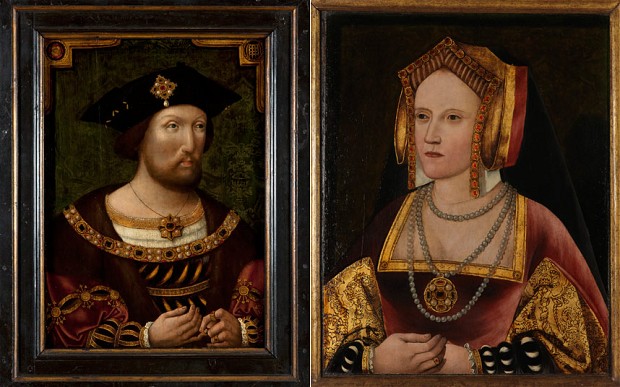
The two paintings will now be hung together for the first time in the National Portrait Gallery, nearly 500 years after they were painted Photo: National Portrait Gallery

The two paintings will now be hung together for the first time in the National Portrait Gallery, nearly 500 years after they were painted. Photo: National Portrait Gallery

Technical analysis of the paint and “rare” engraved frame by the NPG (National Portrait Gallery in London) are believed to show it was painted at the same time as a portrait of Henry VIII, with a similar style and scale. (Furness) (See above)

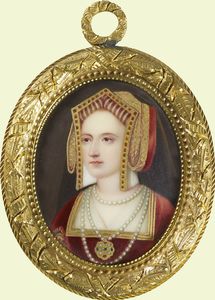
However, there is still more than a few portraits with Henry and his other wives that still use this depiction as Katherine Parr. For example, the only miniature in the Royal Collection (from Queen Victoria’s miniature collection) that depicts Queen Katherine Parr is this same depiction. Hopefully they will not change the description now as there is no other depiction of Parr and all six wives are represented.

Katherine Parr or Katherine of Aragon

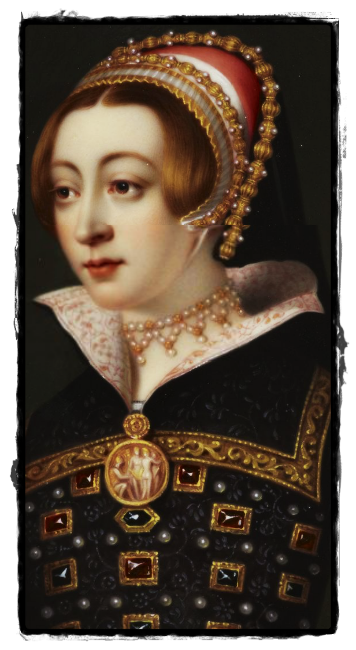
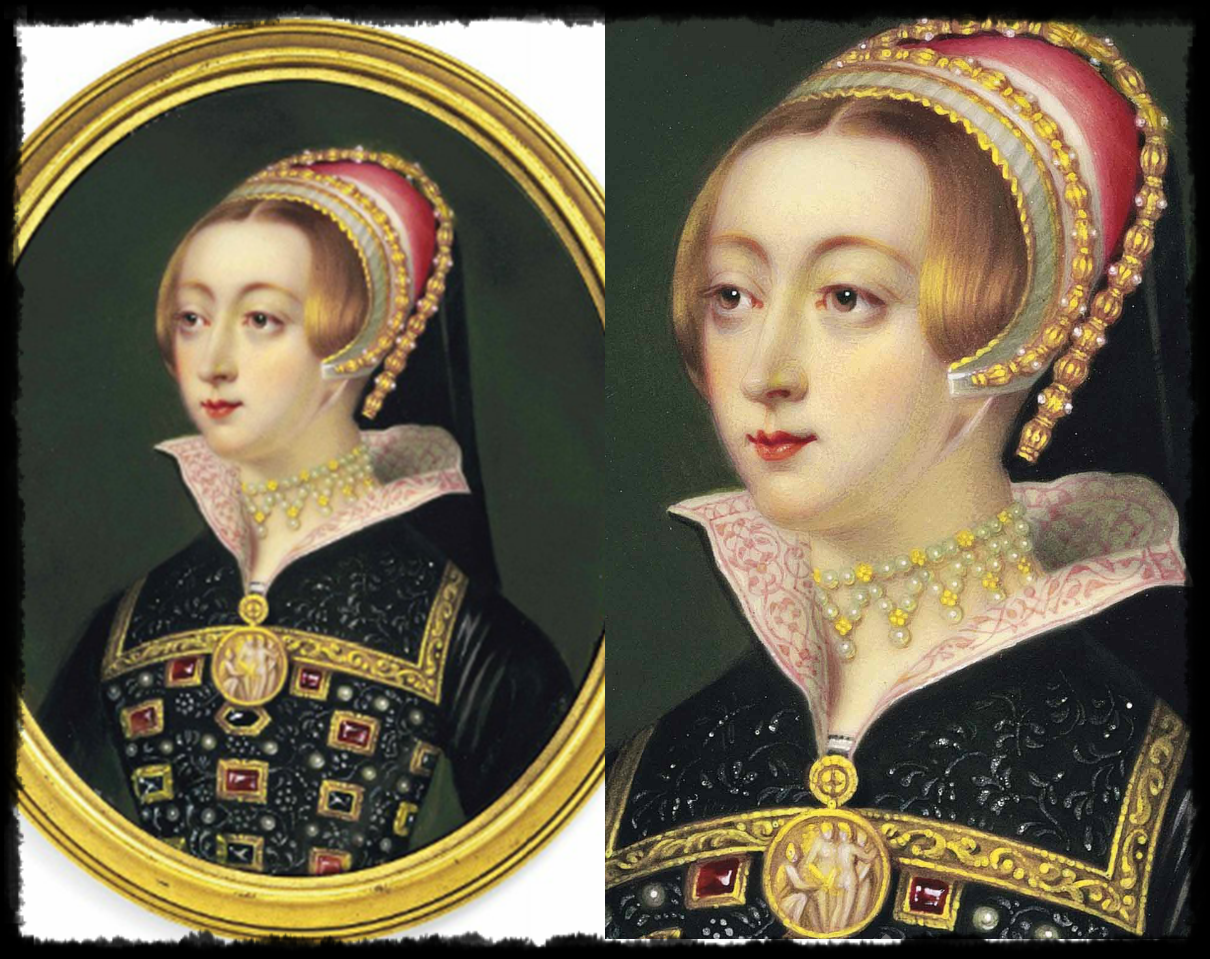
‘Portrait of a lady called Katherine Parr’, by Henry Pierce Bone, 1844. Enamel; 4.8 x 3.9cm.The miniature was purchased by Queen Victoria in 1844, to add to her growing collection of portraits of sixteenth-century figures. It is still part of the Royal Collection.
The Earliest Portrait of Katherine Parr or Katherine of Aragon?

On the back of the portrait is the following inscription:

‘Katharine Parr / London Febr 1844 / Painted by Henry Pier. / Bone Enamel Painter / to Her Majesty & H.R.H. / Prince Albert &c. From / the Original in / Lambeth Palace.’

Detail of the Miniature.

Detail of the Miniature.

In early 2011, after inquiring about the portrait, I was told (by email from the Lambeth Palace Library) that this had been re-identified as Katherine of Aragon. Lambeth Palace’s site had this image as Katherine Parr; the image was uploaded in 2008. The re-identification took place in 2009, but was not officially announced or re-identified until recently.

The portrait you are inquiring about used to be referred to as the “Unknown Woman” thought to be Katherine Parr.  However, in 2009 we had the National Portrait Gallery here to look at another painting in our possession.  As we walked by the portrait a period costume expert, who so happened to be among them, took great notice in it and declared that the clothes were far too early to be Katherine Parr.  The National Portrait Gallery took it away with them to research further.  The conclusion was that it was in fact a rare survival of a Tudor portrait of Catherine of Aragon, not Katherine Parr as originally thought.  You can imagine it was rather exciting for all concerned.

Obviously they had not made the announcement official until now — due to years of research at the NPG. But as of 24 January 2013, this is now identified as Queen Katherine of Aragon. For details on the examination process and the conservation of the portrait — see links.

Links

References

Family of Queen Katherine: Thomas Dacre, 2nd Lord of Gilsland

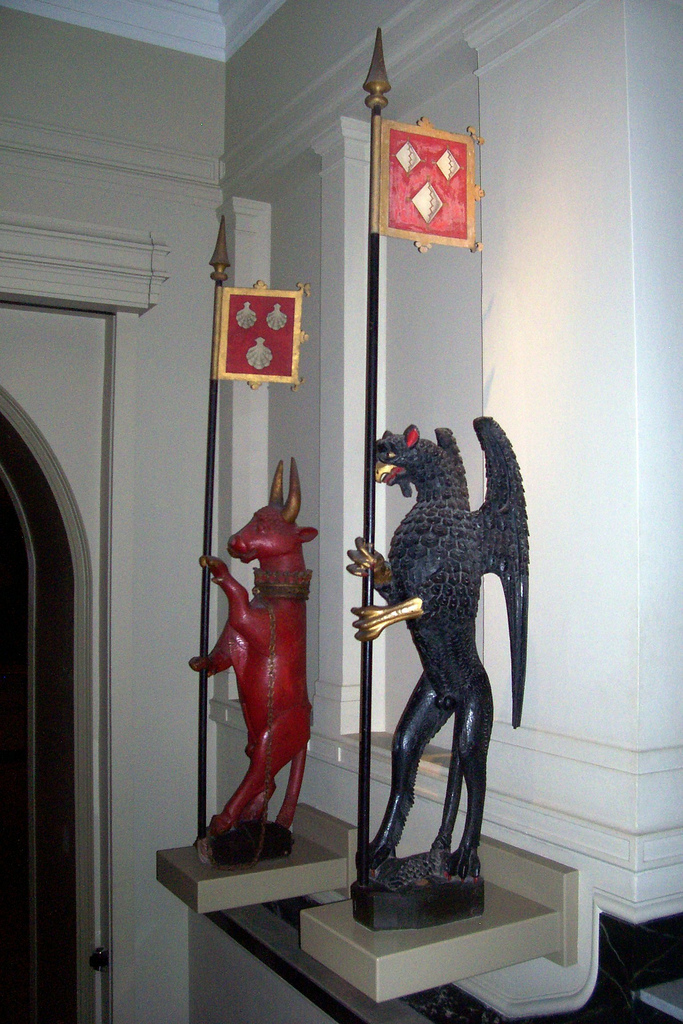
Coat of arms of the Barons of Dacre showing their heraldic charges, the Bull. European Heraldry

SIR THOMAS DACRE, 2nd Lord (Baron) Dacre of Gillesland (25 November 1467 – 24 October 1525) was the eldest son and heir of Sir Humphrey Dacre, 1st Lord Dacre and his wife, Mabel Parr (great-aunt of Queen Katherine Parr).[1]

Dacre was summoned to parliament from 17th October 1509 to 12th November 1515. This nobleman in the 9th Henry VII, served under Thomas, Earl of Surrey (later the 2nd Duke of Norfolk), at the siege of Norham Castle, and his lordship obtained great celebrity in the command of a body of horse reserve at the famous fight of Floddin in the 4th Henry VIII under the same gallant leader. He was subsequently, at different times, engaged in Scotland and he filled the important office of warden of the West Marches from the 1st year of King Henry VIII.

Naworth Castle, home to the Dacre family from 1335-1601. http://www.flickr.com/photos/23408986@N06/4260147660/lightbox/

Naworth Castle, also known as, or recorded in historical documents as “Naward”, is a castle in Cumbria (formally Westmorland), England near the town of Brampton. It is on the opposite side of the River Irthing to, and just within sight of, Lanercost Priory. It was the seat of the Barons Dacre. The castle is thought to have late 13th-century origins, in the form of a square keep and bailey. It was first mentioned in 1323, and in 1335 a licence to crenellate was granted to Ralph Dacre, 1st Baron Dacre (ca. 1290 – April 1339). Residential quarters were added in the early 16th century by Thomas, 2nd Lord Dacre. He built the whole of the south and east wings including the 100ft Great Hall, and what is now known as Lord William’s Tower. Unfortunately for the Dacre family, in 1560 the then Lord Dacre died, leaving a widow, three daughters and a young son called George. Thomas Howard, 4th Duke of Norfolk, Queen Elizabeth’s cousin, married the widowed Lady Dacre, and arranged to marry his three sons to her three daughters. Young George was killed in a fall from a vaulting horse and the vast Dacre estates which covered great tracts of the north of England- including 70,000 acres of the Barony of Gilsland, lands in Cumberland including Greystoke and Dacre, 20,000 acres around Morpeth and 30,000 acres in Yorkshire – now part of Castle Howard estate, all came under the control of the Howard family.The castle is currently occupied by Philip Howard, brother and heir presumptive of the 13th Earl of Carlisle.[2]

Two of the four two metre-high Dacre Heraldic Beasts (a bull and a gryphon), which used to stand in the hall of Naworth Castle in Cumbria, now the seat of the Howard family, the Earls of Carlisle, from whom they were recently purchased. They date from 1519-21. http://www.flickr.com/photos/24151047@N05/3286962813/

Marriage and issue

He married c. 1488 to Elizabeth, suo jure 6th Baroness Greystock, daughter and heiress of Sir Robert de Greystoke by Lady Elizabeth Grey, daughter of Edmund Grey, 1st Earl of Kent [descendant of Lady Elizabeth of Lancaster, daughter of John of Gaunt and Blanche of Lancaster] and Lady Katherine Percy [descendant of Edward III’s granddaughter, Lady Joan Beaufort and also his son, Lionel of Antwerp]. Elizabeth was the granddaughter and sole heiress of Ralph de Greystock, 5th Baron Greystock KG [descendant of Edward III by his granddaughter, Lady Joan Beaufort’s, first marriage to Lord Ferrers].[1]

They had eight children:

  1. William Dacre, 3rd Baron Dacre of Gilsland, who married Lady Elizabeth Talbot, 5th daughter of George Talbot, 4th Earl of Shrewsbury and Lady Anne  Hastings.[1]
  2. Hon. Mary Dacre who married Francis, 5th Earl of Shrewsbury, brother of the above Lady Elizabeth Talbot. Had issue.[1]
  3. Hon. Anne Dacre, wife of Christopher Conyers, 2nd Baron Conyers. Had issue.[1]
  4. Hon. Mabel Dacre who married Henry Scrope, 7th Baron Scrope of Bolton. Had issue which included their son, John, 8th Baron. The 7th Lord Scrope would enter into marriage negotiations with Lady Maud Parr for the hand of his eldest son and heir, Henry. If everything had gone according to plan, Katherine would have married her 2nd cousin [twice removed, closest relation out of several shared ancestors]. Luckily for Katherine the marriage was rejected as Henry died a few years later. His brother John succeeded their father in the barony.[1]
  5. Hon. Jane Dacre, wife of Lord Tailboys.[1]
  6. Hon. Philippa Dacre, most likely named after her paternal grandmother, Lady Philippa Neville.[1]
  7. Hon. Humphrey Dacre.[1]
  8. Hon. Jane Dacre, of the second name.[1]

His lordship died on 24 October 1525 due to a fall from his horse.[1] He had his wife, who had died in August of 1516, were buried in Lanercost Priory, Cumberland, England.[1] He  was succeeded by his elder son William.

References

  1. Douglas Richardson. Magna Carta Ancestry: A Study in Colonial and Medieval Families, 2nd Edition, 2011. pg 16-18.
  2. Naworth Castle History