29 JULY 1504: THE DEATH of Thomas Stanley, 1st Earl of Derby

29 JULY 1504: THE DEATH of Thomas Stanley, 1st Earl of Derby

Portrait purported to be of the first Earl of Derby but the costume is of a later period.

Thomas Stanley was born c. 1435 to Sir Thomas Stanley, 1st Baron Stanley and Joan Goushill, daughter of Sir Robert of Heveringham Goushill and Lady Elizabeth FitzAlan, Duchess of Norfolk; herself the daughter of the 11th Earl of Arundel and Lady Elizabeth de Bohun. Lady Elizabeth was aunt to a royal Duchess, Lady Eleanor, who married Prince Thomas of Woodstock, Duke of Gloucester [youngest son of King Edward III] and the wife of the future King Henry IV, Lady Mary [she died in 1394; Henry was crowned in 1399]. Mary was the mother of Henry IV’s heir, Henry V.

King Henry VI, unknown artist, late 16th or early 17th century. Transferred to the National Portrait Gallery in 1879 from the British Museum.

So, Thomas was born in to good stock having connections to the Lancastrian monarchs. Thomas would have been a 3rd cousin of King Henry VI having shared 2nd great-grandparents; Sir William de Bohun, 1st Earl of Northampton [grandson of Edward I] and Lady Elizabeth [born Badlesmere].

Although Henry VI was King during Stanley’s career at court, Stanley’s family married him to a daughter of Sir Richard Neville, 5th Earl of Salisbury and Lady Alice Montacute, Countess of Salisbury.

Through his paternal grandmother, Lady Elizabeth Stanley [born Harrington], Lord Stanley was a first cousin, twice removed of Sir Thomas Parr of Kendal. The two shared Sir Nicholas Harrington and Isabel English as grandparents [Parr was a 2nd great-grandchild]. Lady Elizabeth Stanley was aunt to Lady Alice Parr [born Tunstall] by her sister, Lady Elizabeth Tunstall [born Harrington]. Lady Alice Parr married Sir Thomas Parr, Sheriff of Westmorland; they were grandparents to Sir Thomas Parr of Kendal.

In addition to being related to Thomas Parr by Lady Alice, Parr’s grandaunt was Lady Eleanor Neville; wife of Thomas Stanley. Eleanor and Thomas had seven sons and six daughters. Eleanor died shortly after Edward IV was reinstated as King for the second time [1471].

"The White Queen", BBC. The portrayal of the marriage of Lord Stanley to Lady Margaret Beaufort.

“The White Queen”, BBC. The portrayal of the marriage of Lord Stanley to Lady Margaret Beaufort.

Upon Stanley’s marriage to Lady Margaret Beaufort in 1482–it was not expected of Margaret to supply him with anymore children. Margaret must have been relieved. After her birth of her only child, Henry Tudor, at the age of 12/13, she probably didn’t want to experience the pain that she had at such a young age.

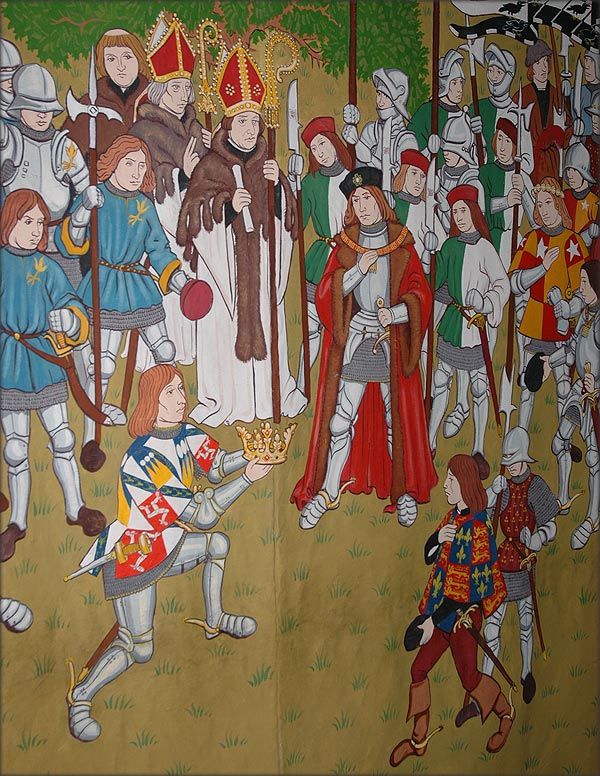
Stanley offers the crown to Henry of Richmond on the battlefield.

Stanley offers the crown to Henry of Richmond on the battlefield.

Stanley is known for his support of his stepson, Henry Tudor, against Richard III at the Battle of Bosworth. His decision to back Tudor ultimately decided the fate of the outcome. Richard would be defeated. On the battlefield, it is said that Stanley crowned his stepson, King of England, as King Henry VII [of the House of Tudor]. Did Stanley’s attachment to Henry’s mother have anything to do with the defeat? Most likely. However, there was another reason Stanley may have switched loyalties.

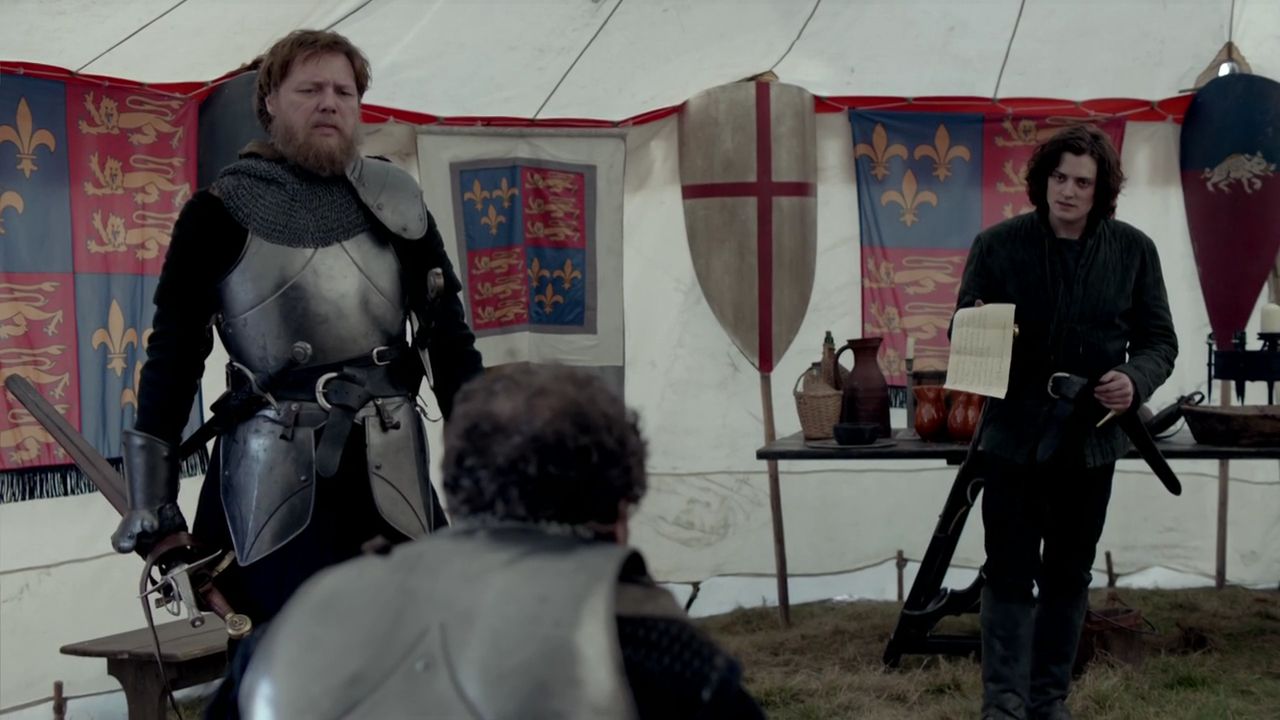
"The White Queen", BBC. Richard III detains Stanley's eldest son, Lord Strange.

“The White Queen”, BBC. Richard III detains Stanley’s eldest son, Lord Strange.

The following is the statement of the Croyland Chronicler, a contemporary of the events which he records:

A little before the landing of these persons (Richmond and his adherents) Thomas Stanley, Steward of the King’s Household, had received permission to go into Lancashire to visit his house and his family, from whom he had long been separated. Still, however, he was permitted to stay there on no other condition than that of sending his eldest son, George Lord Stanley, to the King at Nottingham in his stead, which he accordingly did“.

The same chronicler avers that after the landing of Richmond was known to Richard, the King summoned Lord Stanley to join him at Nottingham, and received a refusal on the plea of sickness. Soon afterwards, it is added, Lord Strange attempted to escape, was prevented, then confessed his guilt, acknowledging that his uncle, Sir William Stanley, was privy to Richmond’s expedition, but declaring that his father was innocent, and if his own life were spared would still join the King.

If Lord Stanley did not join Richmond on his landing, it was, we are told, because he feared for the life of his son, then very possibly safe and sound at Latham. It is Lord Strange’s perilous position that, in the old chronicles, makes Lord Stanley pretend to retreat from Lichfield, which he left open to Richmond; this is what he pleaded as an excuse for his neutrality, during, the alleged interview with Richmond at Atherstone three nights before the battle; and this is to account for his indecision during the battle itself. Perhaps it may turn out that Lord Strange was never in Richard’s hands at all, and that Lord Stanley never stirred a finger or moved a man until the fate of the battle was decided. All accounts agree that Richard’s final charge might have been successful had not Sir William Stanley, with his three thousand men, suddenly come to the rescue of Richmond. But Sir William seems to have been a rasher, or rapider man than his elder brother, and much more ready to run risks. When Richard was killed and the battle over, the battered crown which had fallen from his helmet during the conflict was, according to a plausible tradition, placed by Lord Stanley or his brother on the head of the victorious Richmond. There was no longer room for doubts, scruples, hesitations. Nor did the Stanleys show any pity for those of their coadjutors of the ended reign, who to the last had remained faithful and true to Richard. Three days after the battle a batch of Richard’s adherents was executed -Catesby among them. He made his will on the day of execution, and it contained this significant, this striking passage and petition: “My Lord Stanley, Strange, and all that blood! help! and pray for my soul, for ye have not for my body, as I trusted in you“.

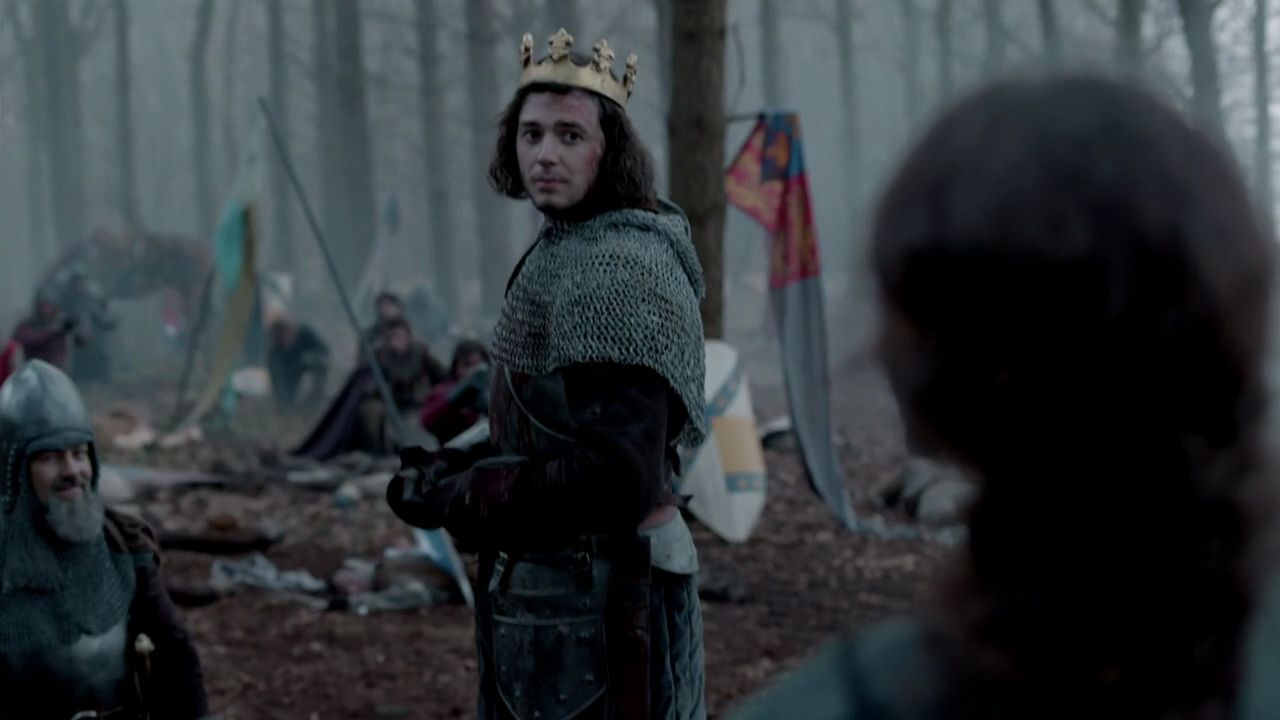
"The White Queen", BBC. Lord Stanley offers the crown to Henry Tudor. Lady Margaret stands on the battlefield to see her son crowned.

“The White Queen”, BBC. Lord Stanley offers the crown to Henry Tudor. Lady Margaret stands on the battlefield to see her son crowned.

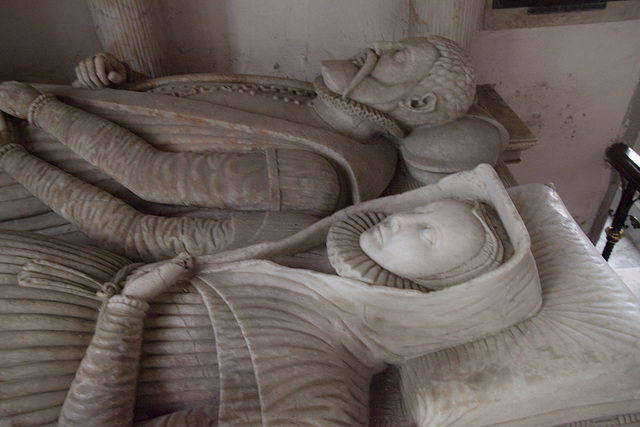
Eleanor was buried in London’s St. James’s Church, Garlickhithe. There is no evidence that her body was reinterred at Burscough Abbey, the Stanleys burial place in Lancashire; although an effigy of her was added to Lord Stanley’s grave when he was buried in 1504.

Effigy of the Earl of Derby and Lady Stanley [Lady Eleanor Neville].

Effigy of the Earl of Derby and Lady Stanley [Lady Eleanor Neville].

Lord Stanley [Earl of Derby by now] died, probably about the age of seventy. His death must have occurred between the 28 Jul 1504, on which day his will was dated, and the 29 Nov in the same year, the day on which it was proved. He left to the King a cup of gold, and legacies to this abbey and to that, duly providing too for masses on behalf of his own soul, of those of his wives, relations, friends, servants, and in one case, especially for the souls of all them lie had in any wise offended, and for all Christian souls.

Sources

  • David Baldwin. The Kingmaker’s Sisters: Six Powerful Women in the War of the Roses, 2009. The History Press, Gloucestershire, England, UK.
  • Tudor Place Bios. Thomas Stanley, 1st Earl of Derby, Online Source.

Family of Queen Katherine Parr: Sir John Throckmorton of Coughton

John was born at Coughton Court circa 1524. He was one of the eight sons and of the seventeen children of Sir George Throckmorton of Coughton Court and his wife Kathryn Vaux, daughter of Sir Nicholas, Baron Vaux of Harrowden and his first wife, the widowed Lady Elizabeth Parr [born FitzHugh]. By his mother, he was cousin to Queen Katherine Parr, the sixth queen and wife of King Henry VIII.

Household of Katherine Parr at Chelsea Manor.

Household of the Dowager Queen Katherine Parr.

Throckmorton isn’t as well known as his elder brothers like Sir Nicholas and Sir Robert. John most likely started his career at court inside the household of Queen Katherine. In the years to come, he definitely had his cousin, Queen Katherine, to thank for his advancement at court. However, when she died in 1548, the advancement wasn’t favored as much and John had to rely on others like the Duke of Northumberland who took over after Edward VI sent his uncle [and Lord Protector] to the scaffold. Among the leading men, Throckmorton had several friends and family links; Queen Katherine’s brother, William, who was now Marquess of Northampton, and the Earl of Pembroke who had married the queen’s sister, Anne.
 
When the little curbuffle with Lady Jane Grey came to pass — loyalties changed. After Sir William Cecil refused to write up the proclamation of Lady Jane becoming queen, the task was given to Throckmorton. Like Cecil, he refused to have anything to do with it. Throckmorton would go on to back the Lady Mary [eldest daughter of King Henry VIII by his first wife, Katherine of Aragon] at Framlingham. Those who remained with Lady Jane [including one of his brothers and the Marquess of Northampton], were met with harsh penalties and punishment for their treason against Mary. His cousin, John [II], was eventually executed under Mary’s command for his role in the Dudley conspriracy.
 
During the five Marian parliaments, Throckmorton would be present for four. His first appearance, with his brother Nicholas, was most likely due to their cousin-in-law, William Herbert, Earl of Pembroke [husband to the late Anne Parr, sister of Queen Catherine and the Marquess of Northampton]. As a Catholic, Throckmorton suffered somewhat under the reign of Mary’s sister, Elizabeth. Four years after his death, his heir would be executed for his role in a revolt against the Protestant queen Elizabeth.
 
Throckmorton married to Margaret Puttenham, daughter of Robert of Sherfield-upon-Loddon. They had at least four sons and two daughters. His son, Francis, would be involved in the great Throckmorton Plot of 1584 which would have replaced Queen Elizabeth with Mary, Queen of Scots [a senior legitimate descendant of the Tudor family by King Henry VIII’s elder sister, Princess Margaret]. Francis is featured in the film Elizabeth: The Golden Age.
The children of Sir Thomas and Lady Maud Parr.

The children of Sir Thomas and Lady Maud Parr. [L to R: William, later Marquess of Northampton; Queen Katherine; and Anne, later Countess of Pembroke]

By both parents, John was cousin to Queen Katherine Parr. However, his mother was the queen’s paternal aunt as her father and Katherine shared the same mother. Parr’s father was the result of his mother’s first marriage to Sir William Parr, Lord of Kendal, while Katherine was the result of their mother’s second marriage to the Lancastrian Sir Nicholas Vaux [later Baron Vaux of Harrowden]. By Katherine Parr’s mother, Maud Green, Katherine was a second cousin, once removed of Sir George Throckmorton as they shared Sir John Throckmorton (born circa 1380) and Eleanor de la Spiney (born circa 1385) as common ancestors.

Queen Katherine Parr: The First Woman and Queen of England to be Published

First published in 1545, Prayer of Meditations by Katherine Parr. Photo by Meg Mcgath (2012)

“Prayers or Meditations” by Queen Katherine Parr at Sudeley Castle. Photo by Meg Mcgath (2012).

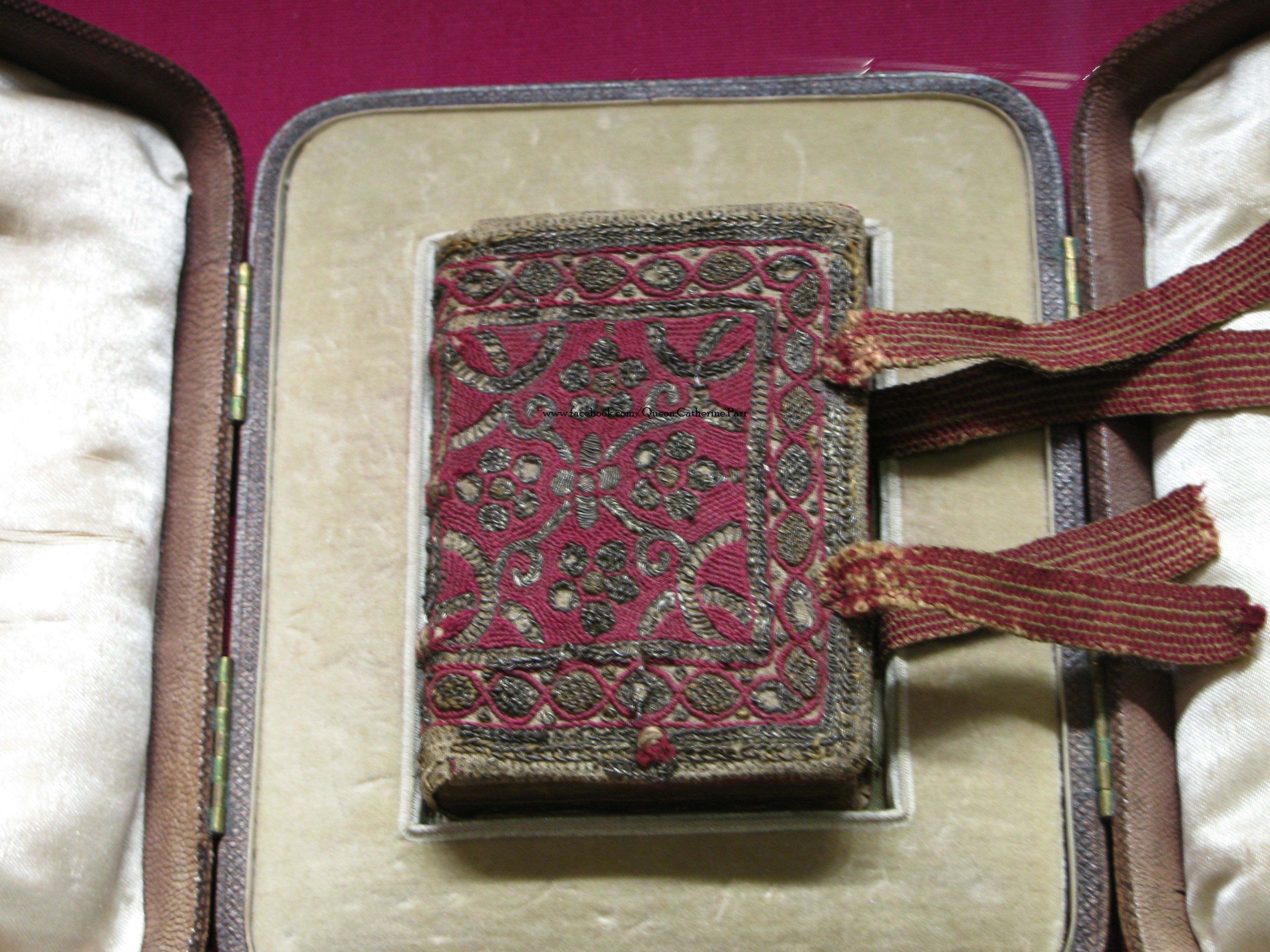
First published in 1545, “Prayers or Meditations” by Queen Katherine Parr became so popular that 19 new editions were published by 1595 (reign of Elizabeth I). This edition was published in 1546 and bound by a cover made by the Nuns of Little Gedding. Located at Sudeley Castle, Winchcombe.

Queen Katherine Parr published two books in her lifetime. The first, ‘Prayers and Meditations’, was published while King Henry VIII was still alive [1545].

Folger Shakespeare Library PDI Record: --- Call Number (PDI): STC 4824a Creator (PDI): Catharine Parr, Queen, consort of Henry VIII, King of England, 1512-1548. Title (PDI): [Prayers stirryng the mind unto heavenlye medytacions] Created or Published (PDI): [1550] Physical Description (PDI): title page Image Root File (PDI): 17990 Image Type (PDI): FSL collection Image Record ID (PDI): 18050 MARC Bib 001 (PDI): 165567 Marc Holdings 001 (PDI): 159718 Hamnet Record: --- Creator (Hamnet): Catharine Parr, Queen, consort of Henry VIII, King of England, 1512-1548. Uniform Title (Hamnet): Prayers stirryng the mind unto heavenlye medytacions Title (Hamnet): Praiers Title (Hamnet): Prayers or meditacions, wherein the minde is stirred, paciently to suffre all afflictions here, to set at nought the vayne prosperitee of this worlde, and alway to longe for the euerlastinge felicitee: collected out of holy workes by the most vertuous and gracious princesse Katherine Queene of England, Fraunce, and Ireland. Place of Creation or Publ. (Hamnet): [London : Creator or Publisher (Hamnet): W. Powell?, Date of Creation or Publ. (Hamnet): ca. 1550] Physical Description (Hamnet): [62] p. ; 8⁰. Folger Holdings Notes (Hamnet): HH48/23. Brown goatskin binding, signed by W. Pratt. Imperfect: leaves D2-3 and all after D5 lacking; D2-3 and D6-7 supplied in pen facsimile. Pencilled bibliographical note of Bernard Quaritch. Provenance: Stainforth bookplate; Francis J. Stainforth - Harmsworth copy Notes (Hamnet): An edition of: Prayers stirryng the mind unto heavenlye medytacions. Notes (Hamnet): D2r has an initial 'O' with a bird. Notes (Hamnet): Formerly STC 4821. Notes (Hamnet): Identified as STC 4821 on UMI microfilm, reel 678. Notes (Hamnet): Printer's name and publication date conjectured by STC. Notes (Hamnet): Running title reads: Praiers. Notes (Hamnet): Signatures: A-D⁸ (-D8). Notes (Hamnet): This edition has a prayer for King Edward towards the end. Citations (Hamnet): ESTC (RLIN) S114675 Citations (Hamnet): STC (2nd ed.), 4824a Subject (Hamnet): Prayers -- Early works to 1800. Associated Name (Hamnet): Harmsworth, R. Leicester Sir, (Robert Leicester), 1870-1937, former owner. Call Number (Hamnet): STC 4824a STC 4824a, title page not for reproduction without written permission. Folger Shakespeare Library 201 East Capitol Street, SE Washington, DC 20003 Folger Shakespeare Library
PDI Record:

Call Number (PDI):
STC 4824a
Creator (PDI):
Catharine Parr, Queen, consort of Henry VIII, King of England, 1512-1548.
Title (PDI):
[Prayers stirryng the mind unto heavenlye medytacions]
Created or Published (PDI):
[1550]
Physical Description (PDI):
title page
Image Root File (PDI):
17990
Image Type (PDI):
FSL collection
Image Record ID (PDI):
18050
MARC Bib 001 (PDI):
165567
Marc Holdings 001 (PDI):
159718
Hamnet Record:

Creator (Hamnet):
Catharine Parr, Queen, consort of Henry VIII, King of England, 1512-1548.
Uniform Title (Hamnet):
Prayers stirryng the mind unto heavenlye medytacions
Title (Hamnet):
Praiers
Title (Hamnet):
Prayers or meditacions, wherein the minde is stirred, paciently to suffre all afflictions here, to set at nought the vayne prosperitee of this worlde, and alway to longe for the euerlastinge felicitee: collected out of holy workes by the most vertuous and gracious princesse Katherine Queene of England, Fraunce, and Ireland.
Place of Creation or Publ. (Hamnet):
[London :
Creator or Publisher (Hamnet):
W. Powell?,
Date of Creation or Publ. (Hamnet):
ca. 1550]
Physical Description (Hamnet):
[62] p. ; 8⁰.
Folger Holdings Notes (Hamnet):
HH48/23. Brown goatskin binding, signed by W. Pratt. Imperfect: leaves D2-3 and all after D5 lacking; D2-3 and D6-7 supplied in pen facsimile. Pencilled bibliographical note of Bernard Quaritch. Provenance: Stainforth bookplate; Francis J. Stainforth – Harmsworth copy
Notes (Hamnet):
An edition of: Prayers stirryng the mind unto heavenlye medytacions.
Notes (Hamnet):
D2r has an initial ‘O’ with a bird.
Notes (Hamnet):
Formerly STC 4821.
Notes (Hamnet):
Identified as STC 4821 on UMI microfilm, reel 678.
Notes (Hamnet):
Printer’s name and publication date conjectured by STC.
Notes (Hamnet):
Running title reads: Praiers.
Notes (Hamnet):
Signatures: A-D⁸ (-D8).
Notes (Hamnet):
This edition has a prayer for King Edward towards the end.
Citations (Hamnet):
ESTC (RLIN) S114675
Citations (Hamnet):
STC (2nd ed.), 4824a
Subject (Hamnet):
Prayers — Early works to 1800.
Associated Name (Hamnet):
Harmsworth, R. Leicester Sir, (Robert Leicester), 1870-1937, former owner.
Call Number (Hamnet):
STC 4824a
STC 4824a, title page not for reproduction without written permission.
Folger Shakespeare Library
201 East Capitol Street, SE
Washington, DC 20003

Henry was said to be proud and at the same time jealous of his wife’s success. ‘Lamentations of a Sinner’ was not published until after Henry died [in 1547]. In ‘Lamentations‘, Catherine’s Protestant voice was a bit stronger. If she had published ‘Lamentations’ in Henry’s lifetime, she most likely would have been executed as a heretic despite her status as queen consort. Henry did not like his wives outshining him [i.e. Anne Boleyn]…hence her compliance and submission to the King when she found that she was to be arrested by the Catholic faction at court. Her voice may have been dialed down a notch, but once her step-son, the Protestant boy King Edward took the throne — she had nothing to hold her back. Her best friend, the Dowager Duchess of Suffolk, and brother Northampton encouraged Parr to publish.

A publication of the book The Lamentation of a Sinner c.1550 [after the death of Queen Katherine] from the book “Vivat Rex!: An Exhibition Commemorating the 500th Anniversary of the Accession of Henry VIII” by Arthur Schwarz

Published in 1547 [according to Sudeley Castle] after the death of King Henry VIII, “The Lamentation of a Sinner” was Katherine’s second book which was more extreme than her first publication. She was encouraged by her good friend the Duchess of Suffolk and her brother, the Marquess, to publish. The transcription of the title page here is… “The Lamentacion of a synner, made by the most vertuous Lady quene Caterine, bewailyng the ignoraunce of her blind life; let foorth & put in print at the inflance befire of the right gracious lady Caterine, Duchesse of Suffolke, and the ernest request of the right honourable Lord William Parre, Marquesse of Northampton.”

I was lucky enough to see a copy both a Sudeley Castle and at the Folger Shakespeare Library in Washington, D.C. I am really interested in going to the Library and studying the actual book…one day!

Queen Katherine's Queen Katherine’s “Lamentations of a Sinner” on display at the Vivat Rex Exhibition at the Folger Shakespeare Library. Photo by Meg Mcgath (2009). See above for full description of the book the Folger has in their collection which can be seen in this photo.

Family of Queen Katherine Parr: Anne Devereux, Countess of Pembroke

Lady Anne Devereux, Countess of Pembroke

© Meg McGath 24 January 2015

Pembroke Castle which was taken over from Jasper Tudor [uncle of the future King Henry VII], Earl of Pembroke. The castle and Tudor’s title was then given to the Yorkist supporter, Sir William Herbert. Anne Devereux would have spent time here while she was married.

Lady Anne Devereux, Countess of Pembroke, Baroness Herbert (c. 1430, Bodenham – after June 25, 1486), was a daughter of a Yorkist Knight. By her marriage to Sir William Herbert, 1st Earl of Pembroke and Baron Herbert, Anne became a leading noblewoman in Wales.

Family

Walter_Devereux,_7th_Baron_Ferrers_of_Chartley,_KGAnne was the daughter of Sir Walter Devereux, the Lord Chancellor of Ireland, and his wife Elizabeth Merbury.[1] Lord Devereux and his son-in-law, Lord Herbert, were responsible for the capture of Sir Edmund Tudor [father to the future King Henry VII]. Tudor was a half-brother to the Lancastrian King Henry VI by his mother’s second marriage to Owen Tudor. 

Anne had two siblings, Walter and John. Walter was knighted after the Battle of Towton on 29 March 1461 by the Yorkist King Edward IV. By right of his wife, the heiress Lady Anne, 7th Baroness Ferrers of Chartley, he was raised to Baron Ferrers of Chartley on 26 July 1461. Lord Walter held various positions during the ruling of the House of York [Kings Edward IV, Edward V, and Richard III] but was ultimately killed in the last battle of the War of the Roses, the Battle of Bosworth 22 August 1485. He was succeeded by his son and heir, John, who became the 8th Baron Ferrers of Chartley. The 8th Baron would marry Lady Cecily Bourchier [her paternal grandparents were both descendants of King Edward III. Cecily was also a niece of queen consort Elizabeth Woodville by Cecily’s mother, Anne]. The couple were 2nd great-grandparents to Sir Robert Devereux, 2nd Earl of Essex who was a favorite of Queen Regnant Elizabeth I [daughter of King Henry VIII of the House of Tudor].[8][9][10]

The Crophull Inheritance

Anne’s grandfather, Walter, was the son of Agnes Crophull. By Crophull’s second marriage to Sir John Parr, Anne was a cousin to the Parr family which included Sir Thomas Parr; father of King Henry VIII’s last queen consort, Katherine Parr.[2][3][4] 

Tomb of Agnes Crophull and her third husband, Sir John Merbury. Weobley, Herefordshire, England.

Anne’s great-grandmother was a great heiress of her father. She was married firstly to Sir Walter Devereux [died 1402] while she was still underage. Upon Agnes’s coming of age in September 1385, Devereux seized the remaining estates based on his marriage right in 1386.[7] These included Weobley manor (Herefordshire); Sutton Bonnington manor and lands at Arnold (Nottinghamshire); the manors of Cotesbach, Braunston, and Hemington (Leicestershire); and an estate at Market Rasen (Lincolnshire). Weobley would become his principal residence.

When Agnes Crophull died on 9 Feb 1436, Crophull’s heir was Anne Devereux’s father, Sir Walter Devereux [grandson of Crophull]. Estates like Lyonshall passed to Walter from Agnes, and also by right of his wife, Elizabeth Merbury, who was the daughter [step-daughter of Agnes] of Agnes Crophull’s third husband, John Merbury, by a previous marriage. Merbury and Agnes were buried together in Weobley’s Parish of St. Peter and St. Paul. Anne’s great-grandfather, Walter [first husband to Agnes Crophull], is also supposedly buried there in a separate tomb. Through her father, Anne was a descendant of King Henry II and his wife Eleanor of Aquitaine by their children John, King of England and Eleanor of England, Queen of Castile.[1]

Marriage

About 1445, Anne married Sir William Herbert, [later 1st Earl of Pembroke], in Herefordshire, England. He was the second son of Sir William ap Thomas of Raglan, a member of the Welsh Gentry Family, and his second wife Gwladys ferch Dafydd Gam.[1]

William_Herbert,_1st_Baron_Herbert,_KG

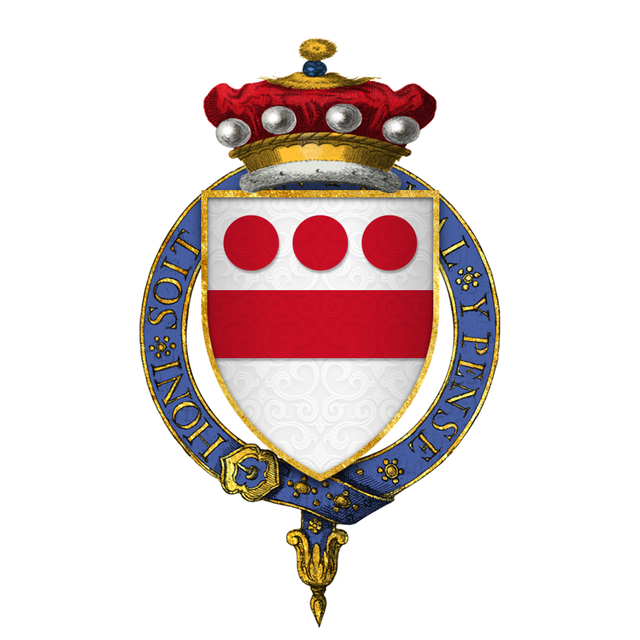
The arms of Lord William Herbert, K.B.

Sir William Herbert was a very ambitious man. During the War of the Roses, Wales heavily supported the Lancastrian cause. Jasper Tudor, 1st Earl of Pembroke and other Lancastrians remained in control of fortresses at Pembroke, Harlech, Carreg Cennen, and Denbigh. On 8 May 1461, as a loyal supporter of King Edward IV, Herbert was appointed Life Chamberlain of South Wales and steward of Carmarthenshire and Cardiganshire. King Edward’s appointment signaled his intention to make replace Jasper Tudor with Herbert who would become the premier nobleman in Wales. Herbert was created Lord Herbert on 26 July 1461. Herbert was then ordered to seize the county and title of Earl of Pembroke from Jasper Tudor. On 29 March 1461, Lord Herbert became the 1st Earl of Pembroke. By the end of August, Herbert had taken back control of Wales with the well fortified Pembroke Castle capitulating on 30 September 1461. With this victory for the House of York came the inmate at Pembroke; the five year old nephew of Jasper Tudor, Henry, Earl of Richmond. Determined to enhance his power and arrange good marriages for his daughters, in March 1462 he paid 1,000 for the wardship of Henry Tudor. Herbert planned a marriage between Tudor and his eldest daughter, Maud. At the same time, Herbert secured the young Henry Percy who had just inherited the title of Earl of Northumberland. Herbert’s court at Raglan Castle was where young Henry Tudor would spend his childhood, under the supervision of Herbert’s wife, Anne Devereux. While at Raglan Castle, Anne must have understood the importance of the potential marriage between her daughter and Henry Tudor. Therefore, Anne insured that young Henry was well cared for.[5]
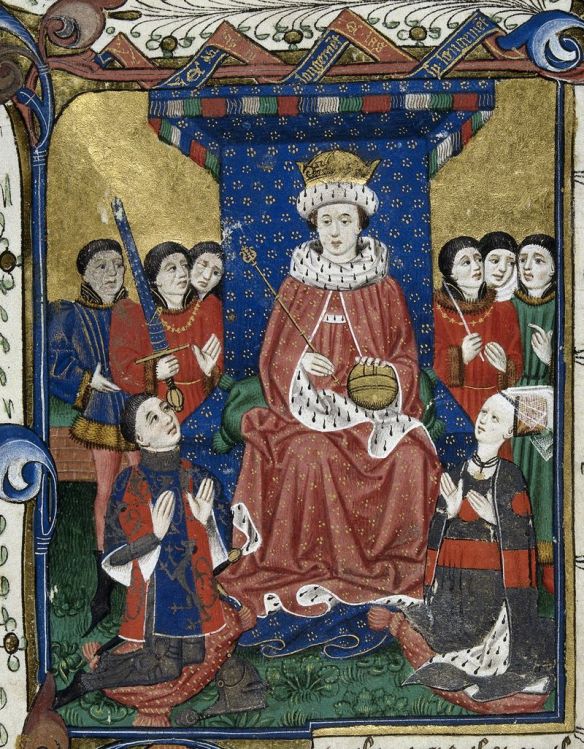
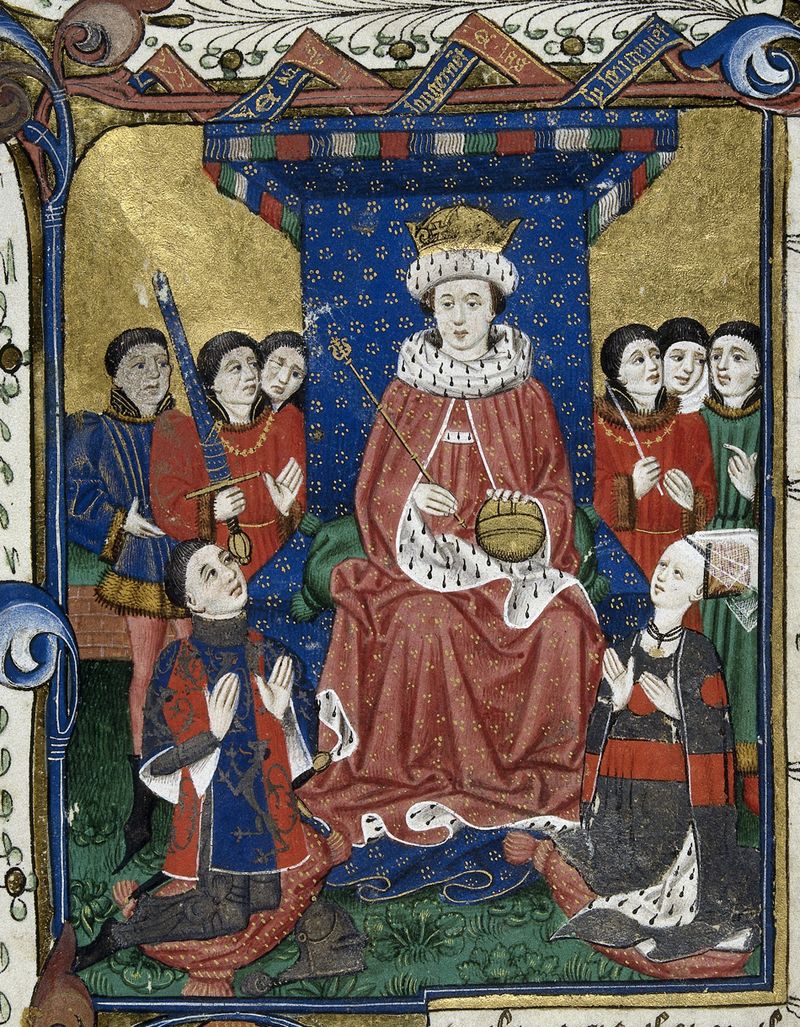
Detail of a miniature of a king enthroned surrounded by courtiers with Sir William Herbert and his wife, Anne Devereux kneeling before him, wearing clothes decorated with their coats of arms, from John Lydgate's Troy Book and Siege of Thebes, with verses by William Cornish, John Skelton, William Peeris and others, England, c. 1457 (with later additions), Royal 18 D. ii, f. 6.

Detail of a miniature of a king enthroned surrounded by courtiers with Sir William Herbert and his wife, Anne Devereux kneeling before him, wearing clothes decorated with their coats of arms, from John Lydgate’s Troy Book and Siege of Thebes, with verses by William Cornish, John Skelton, William Peeris and others, England, c. 1457 (with later additions), Royal 18 D. ii, f. 6. © British Library, 2015.

In the Battle of Edgecote on 26 July 1469, the Yorkists, led by Pembroke, were defeated by the Lancastrians. The Lancastrians were lead by Sir Richard Neville, 16th Earl of Warwick; the man who helped Edward, Earl of March become King Edward IV.[a] Warwick had decided to fight against his cousin Edward and restored the Lancastrian King Henry VI for a few years while Edward went into exile. After the battle, the Earl of Pembroke and his brother Richard were executed near Banbury by the Lancastrians. Henry Tudor was lead from the battlefield to the home of Pembroke’s brother-in-law, Lord Ferrers, at Weobley in Herefordshire. It was there that Sir Reginald Bray, a servant of Henry Tudor’s mother Lady Margaret Beaufort, found Tudor six days after the battle. Anne, now Dowager Countess of Pembroke, was found sheltered by Lord Ferrers where she continued to look after Henry Tudor.[5]

Issue

The Earl and Countess of Pembroke had three sons and seven daughters:[1]

  • Sir William Herbert, 2nd Earl of Pembroke, Earl of Huntingdon[1], married firstly to Mary Woodville; daughter of Richard Woodville, 1st Earl Rivers and thus sister to King Edward IV’s queen consort Elizabeth Woodville. He married secondly to Lady Katherine Plantagenet, the illegitimate daughter of King Richard III.[1] [b]
  • Sir Walter Herbert[1]
  • Sir George Herbert[1]
  • Lady Maud Herbert, wife of Sir Henry Percy, 4th Earl of Northumberland, 7th Lord Percy.[1]
  • Lady Katherine Herbert, wife of Sir George Grey, 2nd Earl of Kent.[1]
  • Lady Anne Herbert, wife of Sir John Grey, 1st Baron Grey of Powis.[1]
  • Lady Margaret Herbert, wife of Sir Thomas Talbot, 2nd Viscount Lisle, and of Sir Walter Bodrugan.[1]
  • Lady Cecily Herbert, wife of John Greystoke.[1]
  • Lady Elizabeth Herbert, wife of Sir Thomas Cokesey.[1]
  • Lady Crisli Herbert, wife of Mr. Cornwall.[1]

Sadly, the earldom did not pass down through his son, the 2nd Earl of Pembroke. The 2nd Earl’s only child by Mary Woodville was a daughter, Lady Elizabeth Herbert. Lady Elizabeth became Baroness Herbert in her own right. As a woman, Lady Herbert could not inherit the Earldom of Pembroke. She did receive extensive lands in Wales.[c]

The Earl of Pembroke also fathered several children by various mistresses.[1]

  • Sir Richard Herbert of Ewyas, Herefordshire was the illegitimate son of William Herbert, 1st Earl of Pembroke and most likely Maud, daughter of Adam ap Howell Graunt (Gwynn). Their son, William, would be created Earl of Pembroke [of the tenth creation] on 11 October 1551 by King Edward VI [son of King Henry VIII]. This brought the Earldom back into the Herbert family where it remains to this day. Pembroke was lucky enough to marry to Anne Parr.[d]
  • Sir George Herbert. The son of Frond verch Hoesgyn. Married Sybil Croft.[2]
  • Sir William Herbert of Troye. Son of Frond verch Hoesgyn. Married, second, Blanche Whitney (née Milborne) see Blanche Herbert, Lady Troy. They had two sons.[6]

After the death of her husband, the Dowager Countess was recorded as still living after 25 June 1486. She most likely died soon after.

Notes

[a] Lord Warwick was the son of Sir Richard Neville, 5th Earl of Salisbury and Lady Alice, Countess of Salisbury [in her own right]. Salisbury and his siblings by Lady Joan Beaufort was a grandson of Prince John of Gaunt, 1st Duke of Lancaster and Titular King of Castile [son of King Edward III]. One of Salisbury’s siblings was none other then Lady Cecily [Duchess of York] who would marry to the Yorkist rival, Richard, 3rd Duke of York. The couple were parents to both Kings Edward IV and Richard III. Lord Warwick’s siblings included Lady Alice FitzHugh [born Neville] who was mother to Lady Elizabeth Parr; the second husband of Sir William Parr, Baron Parr of Kendal. The two were grandparents to queen consort of Henry VIII [great-grandson of the Duke and Duchess of York], Katherine Parr.

[b] Lady Herbert married to Lord Charles Somerset, Earl of Worcester, a legitimized son of Lord Henry Beaufort, 3rd Duke of Worcester. The 3rd Duke was a son of Lord Edmund, 2nd Duke and Lady Elizabeth Beauchamp. Both parents had royal and noble descent. The 2nd Duke was from the legitimized line, the Beauforts, who were children of Prince John of Gaunt, 1st Duke of Lancaster. Elizabeth Beauchamp was the daughter of the 13th Earl of Warwick who was the father of Lady Anne Beauchamp who became the 16th Countess of Warwick in her own right after the death of her brother. Her title was inherited by her husband, the infamous “Warwick, the Kingmaker” [Sir Richard Neville,16th Earl of Warwick].

[c] In 1479, the Earldom was bestowed upon Prince Edward of York, later King Edward V [Plantagenet]. When the King went missing after being lodged in The Tower of London, the Earldom merged into the crown. It was restored under the new King, Henry Tudor, who became Henry VII of England. An interesting turn of events was in 1532. Henry VII’s son, Henry VIII decided to grant the title to Anne Boleyn as ‘Marquess of Pembroke’ two months before their marriage to elevate her status. Anne Boleyn had been lady-in-waiting to Henry VIII’s first wife, Queen Katherine of Aragon. A romance blossomed between the two despite her position as the daughter of a knight. They were eventually married under the “new religion” that made Henry VIII Supreme Head of the Church of England. The Catholic Church never granted an annulment from his first marriage and never recognized the marriage of Henry and Anne. Anne was crowned queen and gave birth to a daughter, Elizabeth [later queen]. After failing to produce a son, Anne had charges brought up against her that eventually led to her execution. Coincidentally, her own lady-in-waiting Jane Seymour, took Anne’s place as the next wife and queen consort. Queen Jane did give birth to a son, Edward [later King].

[d] Herbert married to Anne Parr, daughter of Sir Thomas [a courtier and favorite of King Henry VIII] and Lady Maud Parr [Green]. At the time, it was a step up for Herbert as Anne was descended from a great lineage. It has been said, that because of his marriage to Anne, it brought some legitimacy to the Herbert family. In 1543, Herbert’s sister-in-law, the Dowager Lady Katherine Latimer [widow of Sir John Neville, 3rd Baron Latimer of Snape], would become the sixth and final queen consort to King Henry VIII. Both Lord and Lady Herbert were present at the ceremony. The marriage only brought on more advancement for Herbert and his family. After the death of King Henry VIII in 1547, Herbert became one of the guardians of the young King Edward VI. He was made a Knight of the Garter in 1549, and created Baron Herbert of Cardiff on 10 October 1551, and 1st Earl of Pembroke of the [tenth creation] the following day.

References

  1. :a b c d e f g h i j k l m n o p Douglas Richardson. Plantagenet Ancestry, 2nd Edition, 2011. pg 249.
  2. Douglas Richardson. Magna Carta Ancestry, 2nd Edition, Vol. II, pg 2.
  3. Douglas Richardson. Magna Carta Ancestry, 2nd Edition, Vol. III, pg 297-298.
  4. Douglas Richardson. Royal Ancestry, Vol. V, pg 248.
  5. Chris Skidmore. The Rise of the Tudors: The Family That Changed English History, Macmillian, 14 January 2014. pg 47.
  6. Ruth E. Richardson. Mistress Blanche: Queen Elizabeth I’s Confidante, Logaston Press. 1 November 2007.
  7. Calendar of Close Rolls, Richard II, Volume 3. H.C. Maxwell Lyte (editor). 1921. pages 32 to 35, 27 September 1385, Westminster.
  8. Douglas Richardson. Plantagenet Ancestry, 2nd Edition, 2011. pg 607-8.
  9. Douglas Richardson. Plantagenet Ancestry, 2nd Edition, 2011. pg 45-6.
  10. Charles Mosley (editor). Burke’s Peerage & Baronetage, 106th Edition. Chicago: Fitzroy Dearborn Publishers, 1999. Volume 1, pages1378-80

Written and Researched by Ms. McGath

© Meg McGath 24 January 2015

All Rights Reserved

TudorQueen6: 2014 in review

The WordPress.com stats helper monkeys prepared a 2014 annual report for this blog.

Here’s an excerpt:

The concert hall at the Sydney Opera House holds 2,700 people. This blog was viewed about 56,000 times in 2014. If it were a concert at Sydney Opera House, it would take about 21 sold-out performances for that many people to see it.

Click here to see the complete report.

6 DECEMBER 1548: The Will of Dowager Queen Katherine Parr Proved

On 5 September 1548, shortly before the death of the Dowager Queen Katherine, her will was written out and signed by the queen. The testament attests to the sanity of the dowager queen as she dictated her will. Other observations by the queen’s ladies differ from the statement in her will that “Lying on her deathbed, sick in body, but of good mind, perfect memory and discretion” as written in ‘The State of Mind of the Dowager Queen’.

It wasn’t until December 6th, 1548 that the will and testament was proved by the Archbishop Thomas Cranmer of Canterbury. It was probated or officially verified  and approved–referring not only to the will itself but also to the certification of its having been proved, which was delivered to its executors. The original will was in Latin; it was edited and transcribed into English in Janel Mueller’s Katherine Parr: Complete Works & Correspondence (2011).

The actual letter from Katherine to Seymour as shown at Sudeley Castle, February 1547.

Not the last will and testament of the Dowager Queen, but an actual letter from Katherine to Lord Seymour as shown at Sudeley Castle, February 1547.

THE LAST WILL AND TESTAMENT OF DOWAGER QUEEN KATHERINE PARR, SEPTEMBER 5, 1548

By the lady Katherine Queen and wife

In the name of God, Amen.

Be it remembered and known that the fifth day of September, in the year of our Lord God a thousand five hundred forty eight, and the second year of the reign of the most excellent prince Edward VI, by the grace of God King of England, France, and Ireland, Defender of the Faith, and the Church of England and also Ireland, in earth the Supreme Head:

The most noble and excellent princess, Dame Katherine, Queen of England, France, and Ireland; late the wife of the most excellent prince of famous memory, King Henry VIII, late King of England; and then wife to the right honorable Sir Thomas Seymour, knight of the noble Order of the Garter, Lord Seymour of Sudeley, and High Admiral of England.

Lying on her deathbed, sick in body, but of good mind, perfect memory and discretion; being persuaded, and perceiving the extremity of death to approach her; disposed and ordained by the permission, assent, and consent of her dear, beloved husband, the Lord Seymour aforesaid, a certain disportion, gift, testament, and last will of all her goods, chattels, and debts, by these words or other, like in effect, being by her advisedly spoken to the intent of a testament and last will in the presence of the witnesses and records undernamed:

This is to say, the said most noble Queen, by permission, consent, and assent aforesaid, did not only, with all her heart and desire, frankly and freely give, will, and bequeath to the said Lord Seymour, Lord High Admiral of England, her married espouse and husband, all the goods, chattels, and debts that she then had, or in value than they were or been; but also most liberally gave him full power, authority, and order, to dispose and prosecute the same goods, chattels, and debts at his own free will and pleasure, to his most commodity.

These were witness to the premises: Robert Huick, Doctor of Physic, and John Parkhurst. Given [at] the castle of Sudeley, the day and year aforesaid.

[Certification of probate]

The testament was probate in the presence of the lord Archbishop of Canterbury at London the sixth day of December, in the year of the Lord one thousand five hundred and forty-eight. He conjointly appointed Roger Lynute procurator and Thomas Seymour executor of this testament. And completion and approval were attended to with all due honors, so that we have faithfully attended to the same.

References
• Janel Mueller. Katherine Parr: Complete Works & Correspondences, 2011.

2 DECEMBER 1571: THE BURIAL of Sir William Parr, 1st Marquess of Northampton

The Collegiate Church of St Mary in the town of Warwick, England. It is a Parish Church of the Church of England. (Wikipedia)

On 2 December 1571 Sir William Parr, 1st Marquess of Northampton was laid to rest in St. Mary’s Collegiate Church, Warwick, England.

The only commemoration of Northampton even being buried in St. Mary's is marked by only a stone tablet.

The only commemoration of Northampton even being buried in St. Mary’s is marked by a stone tablet.

The inscription on the stone tablet reads:

‘Died in Warwick 28 October 1571. [Unknown] with the ceremonial due [of a] Knight of the Garter to the Order of Queen Elizabeth who bore the expense of the funeral, 2 December 1571.

Lord Robert Dudley, Earl of Leicester and favorite of Elizabeth I was also buried in St. Mary's in September of 1588.

Lord Robert Dudley, Earl of Leicester and favorite of Elizabeth I was also buried in St. Mary’s in September of 1588.

Coincidentally, William was buried in the same church as Elizabeth’s favorite, Robert Dudley, 1st Earl of Leicester. As he had requested, Leicester was buried in the Beauchamp Chapel—in the same chapel as Richard Beauchamp, his ancestor, and the “noble Impe”, his little son.

Collegiate Church of St Mary in Warwick, Beauchamp Chapel, tomb of Lord Robert and Lettice Dudley (born Knolly). (Wiki Commons)

His widow, Countess Lettice, was also buried there when she died in 1634, alongside the “best and dearest of husbands”, as the epitaph, which she commissioned says.

Wenceslaus Hollar, ‘Richard Beauchamp, Earl of Warwick (tomb)‘, University of Toronto Wenceslas Hollar Digital Collection. Wikimedia Commons.

The Beauchamp family vault is also in St. Mary’s. The tomb of the 13th Earl of Warwick features several of Northampton’s ancestors and cousins such as the Neville family. Northampton’s paternal great-grandmother, Lady Alice FitzHugh (born Neville), was sister to Richard Neville, 16th Earl of Warwick (“Warwick, the Kingmaker”) who is featured on the Beauchamp Monument. Also featured is the parents of Lady FitzHugh and Lord Warwick, The Earl and Countess of Salisbury, Richard and Lady Alice Montacute.

Tomb of Richard Beauchamp, 13th Earl of Warwick which is surrounded by mourners of his family and in-laws. (Moriarty Blog)

Lord Robert, Earl of Leicester descended from the 13th Earl via his paternal great-great-grandfather John Talbot, 1st Viscount of Lisle who was the son of Lady Margaret Beauchamp, Countess of Shrewsbury; eldest daughter of the 13th Earl of Warwick and his first wife, Elizabeth Berkeley.

© Meg McGath; author. All Rights Reserved.

12 JUNE 1492: THE BURIAL of Elizabeth Woodville

Tomb of Edward IV and consort queen Elizabeth at St. George's Chapel, Windsor Castle, Windsor, England.

Tomb of Edward IV and consort queen Elizabeth at St. George’s Chapel, Windsor Castle, Windsor, England.

On Whit-Sunday, the queen-dowager’s corpse was conveyed by water to Windsor, and there privily, through the little park, conducted into the castle, without any ringing of bells or receiving of the dean … and so privily, about eleven of the clock, she was buried, without any solem dirge done for her obit. (Gristwood)
The body was only accompanied by the prior of Charter-house, and Dr. Brent, and Mr. Haute. (Strickland) The only gentlewoman to accompany the body was Grace, one of the illegitimate daughters of Edward IV. The only children to accompany their mother was Princesses Anne, Katherine, and Bridget. Also present was Woodville’s son and daughter-in-law, the Marquess and Marchioness of Dorset. Elizabeth of York and her sister Cecily were not present. (Gristwood) The priest of the college received the queen in the Castle.
On the morn thither came Audley, Bishop of Rochester, to do the office, but that day nothing was done solemnly for her saving; also a hearse, such as they use for the common people, with wooden candlesticks about it, and a black [pall] of cloth of gold on it, four candlesticks of silver gilt, every one having a taper of no great weight. (Strickland)
On the Tuesday hither came, by water, king Edward’s three daughters, the lady Anne, the lady Katherine, and the lady Bridget [the nun princess] from Dartford, accompanied by the marchioness of Dorset, daughter of the duke of Buckingham, the queen’s niece, the daughter of the marquis of Dorset; Lady Herbert, also niece to the queen; dame Katherine Grey; dame Guildford (governess to the children of Elizabeth of York); their gentlewomen walked behind the three daughters of the dead. Also that Tuesday came the marquis of Dorset, son to the queen; the of Essex, her brother-in-law and; the viscount Welles, her son-in-law. And that night began the dirge. But neither at the dirge were twelve poor men clad in black, but a dozen divers old men that old men dressed in the many coloured garments of poverty– “and held old torches and torches ends. And the next morning one the canons called master Vaughan sang Our Lady mass at which lord Dorset offered a piece of gold he kneeled at the hearse head ladies came not to the mass of requiem and the lords sat about in quire My lady Anne came to offer the mass penny and herofficers arms went before her she offered the penny at the head of the queen she had the carpet and the oushion And the viscount Welles his wife’s offering and dame Katherine Gray bare the lady Anne’s every one of the king’s daughters offered. The marquis of offered a piece of gold and all the lords at their pleasure the knights of Windsor dean canons yeomen and officers at arms
Twelve poor men neatly clad in black that custom would have dictated at the ceremony, there were only “a dozen divers old men, and they held old torches and torches’ ends.” (Gristwood)

References

Sarah Gristwood. Blood Sisters: The Women Behind the War of the Roses, Basic Books, Mar 4, 2014.

Agnes Strickland. Lives of the queens of England, from the Norman conquest, 1864.

The Lamentation of a Sinner

Lamentations of a Sinner

by Catherine Parr, Queen of England and Ireland

A publication of the book c.1550 [after the death of Queen Katherine]

A publication of the book c.1550 [after the death of Queen Katherine]

“The Lamentacion of a synner, made by the most vertuous Lady quene Caterine, bewailyng the ignoraunce of her blind life; let foorth & put in print at the inflance befire of the right gracious lady Caterine, Duchesse of Suffolke, and the ernest request of the right honourable Lord William Parre, Marquesse of Northampton.”

Published in 1548 after the death of King Henry VIII, “The Lamentation of a Sinner” was Catherine’s second book which was more extreme than her first publication. She was encouraged by her good friend the Duchess of Suffolk and her brother, the Marquess, to publish.
[Vivat Rex Exhibition, Folger Shakespeare Library, STC 4828]

Guest Post: The Paternity of King Edward IV by Carolina Casas

King Edward IV’s Paternity and The Duchess of York’s Reputation

(Intro and editing by Meg McGath)

The Duchess is accosted by Lady Rivers about her supposed affair in 'The White Queen'.

The Duchess is accosted by Lady Rivers about her supposed affair in ‘The White Queen’.


Intro

Edward IV was born on April 28th, 1442 in Rouen, France. He was the eldest surviving son of Lord Richard, Duke of York and Lady Cecily (Neville), later known as “Queen by Right”. Edward became the first York monarch after his father was killed in battle. His father had planned on being crowned as soon as possible, but his untimely death left his son and heir the new King of England. Edward was King from 1460 to 1470 then again in 1471 until his death in 1483. Edward was cousin to queen Katherine Parr’s paternal great-grandmother, Lady Alice FitzHugh (born Neville). The relationship between Katherine Parr’s paternal grandfather, Lord Parr of Kendal, and Edward IV has been well documented as the two were close due to his marriage to Edward’s cousin, Elizabeth FitzHugh. The FitzHugh’s were closely affiliated with the Earl of Salisbury (Katherine Parr’s great-great-grandfather) and the Earl of Warwick (Parr’s great-granduncle). The FitzHugh and the Earl of Warwick’s properties were in close proximity so Elizabeth grew up next to her cousins Ladies Isabel (later Duchess of Clarence) and Anne (later queen).

King Edward IV’s Paternity and The Duchess of York’s Reputation by Carolina Casas

The ‘White Queen‘ (BBC) popularized the myth that Edward IV was the son of a Welsh archer called Blaybourne; a result of an affair Blaybourne had with Edward’s mother Cecily while she and the Duke of York were in Rouen. Several historians have given credence to this myth arguing that Cecily conceived while her husband was away fighting at Pontoise. While the fact that York fought in Pontoise in August is true – it is in no way proof that Edward was the product of an illicit union. What none of these historians and novelists factored in however, is the time between conception and giving birth. Nowadays with modern science it is easier to predict when one conceives and one gives birth, but it is not an exact science yet. There will be mistakes. There will be factors that determine whether a pregnancy comes to term or not, whether the baby arrives at the exact date the doctor or midwife foresees is 50/50. Now imagine yourself in the first half of the fifteenth century with no modern medicine and only midwives and religious superstition to tell you whether you were pregnant or not, if the child you expected was a boy or girl, or if you were closer to term according to the fullness of your belly. Doesn’t sound like it would give us much accuracy, does it?


This is the world that medieval women lived in. They had to rely on the science of the day which was religion and they had no other experts to go on to give them advice except for midwives and they had to believe in (outrageous to us now) methods of conception such as potions made of different ingredients like rabbit’s blood, sheep urine, mare’s milk, quale’s testicles, etc. Edward was Cecily’s third pregnancy. She and the Duke were married by October 1429 (some put their marriage two years before when she had reached the age of majority that was required of girls to marry at twelve); he would have been eighteen and she fourteen. They didn’t have their first child until 1439, more than eight years after their marriage. If Cecily and Richard were eager to conceive why wait so long? Like with most arranged marriages, there was bound to be some shyness. Richard and Cecily were by no means strangers to each other. Before Cecily’s father died, he passed on Richard’s custody to his wife Lady Joan Beaufort, Countess of Westmorland (only daughter of John of Gaunt, Duke of Lancaster and Katherine Swynford Roet). Cecily was the youngest of Lady Joan’s children and being so close in age, Cecily and Richard grew up under the same roof and it is highly likely that when Lady Joan took Richard to London, she brought along her daughter. But being so young, they could have been hesitant to consummate the marriage and waited until they knew each other better. There is no indicator that the couple was unhappy, it soon became known that Cecily was an excellent mistress of the Duke’s household and tried in every way to imitate the royal court by ordering expensive fabrics and arranging for extravagant banquets, especially after he became Lord Lieutenant in Normandy and moved to Rouen. The reason as to why the couple might not have had children is because before moving to Normandy, Richard was often away. This was the reality many wives had to face. Husbands were often gone for long periods of time due to war or business. Another possibility could be that because during this period miscarriages and births were not often recorded, she could have been pregnant but suffered several other miscarriages that we simply do not know about.

Either way, the fact remains that when Edward was born there was not a lot of fanfare for his christening. This could have been due to him being conceived after Richard, Duke of York returned from Pontoise which would make Edward premature and make his parents alarmed since this was an age where infant mortality was very high. Newborns that were too small or too weak were christened immediately to save them from the eternal damnation of limbo. This makes even more sense when we take into account that the year before Cecily had given birth to a boy who lived less than a week. It was vital at the time for the two to have a male heir to continue the York line.

During his lifetime, Richard, Duke of York never showed any indication that he suspected Edward was not his. In fact during their last years at Rouen before they were recalled to England, he was negotiating a marriage between his son and the King of France (Charles) daughter, Marie, who was born in 1444. Had Edward not been his son, he would not have shown this much favor or invested so much in his education and military training. As for the silly rumors of his appearance that he was fair while his father and brother (Richard III) were dark, we must remember that Edward III (from where both his parents descended) was fair and tall so he could have gotten his looks either from their ancestor or his mother.

The theories that still surround his parentage are nothing but wild rumors and conjectures based on propaganda and history is filled with this. History is made by the winner but I would also add, by conspiracy and fantasy and very often these get mixed up with the truth that in the end we lose track of what is fact and what is fantasy.
The fact of the matter is, the name Blaybourne did not come up until 1460 which was the year let us all remember that England was in open war with itself, two rivaling Houses –Lancaster and York- competing for the English throne. York had used years before the same device against the Lancastrian Queen, Marguerite of Anjou to strengthen his own claim, now it was only fair that her side shot back by saying the same thing about his wife. It was a way to discredit Richard and discredit his son who was the Earl of March at this time. That was what was often done to opponents of the king when they wanted to take his crown, they spread rumors surrounding their rival’s parentage or their families, and the targets would always be women.

Duchess Cecily played by Caroline Goddall in 'The White Queen'

Duchess Cecily played by Caroline Goddall in ‘The White Queen’

Cecily Neville is known today by many names –“proud Cis” “Queen by Rights” “Rose of Raby” –etc. She’s been portrayed countless of times in fiction, sometimes negatively, sometimes positively, but all of these portrayals miss the real woman behind the myth. The real truth about Cecily lies buried in the pages of her religious books, in her sons, her actions, her words and her religion which she always held dear. As a noble woman, she held to the standards of the time by giving opulent parties and indulging in the fashions of the time, she was known to be one of the best dressed women in England, as a woman she was a mother and peacemaker, she always tried to bring her sons together when she sensed there was trouble. And as a Duchess, she was her husband’s equal. Richard relied on her for everything. Whenever he returned he always asked for her to accompany him, after his short-lived triumph in 1460, he sent for his wife to London to join him in his triumphant moment when he attempted to take the throne. After he had been recognized as the King’s legal heir years back, Cecily began using the moniker “Queen by Rights”; after he died she became her son’s advisor and the first woman in the fifteenth century to use the title “my lady the King’s mother”, and until her son married in 1464, she was the top woman in England. After years of fighting however, Cecily retired and chose to lead an ascetic life. Like her mother, she was very religious and aware of her lineage. While there were cases of spousal infidelity, a woman like Cecily was unlikely to risk everything she had for an affair.

Sources:

Amy Licence. ‘Cecily Neville: Mother of Kings

Amy Licence. ‘On Bed with the Tudors’

Sarah Gristwood. ‘Blood Sisters

Claire Ridgeway. ‘On This Day in Tudor History