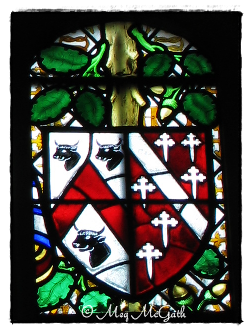
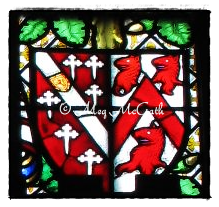
12 FEBRUARY: The Throckmorton Brothers

Coughton Court, Warwickshire, England

Coughton Court, Warwickshire, England

The Throckmorton family of Coughton Court in Warwickshire is one of the oldest Catholic families in England. The Throckmortons were prominent in the reigns of Henry VIII, Edward VI, Mary I, and Elizabeth I (Tudor). Sir George Throckmorton was a favorite of King Henry VIII during his early years as King. He owed his position probably due to his brother-in-law, Sir Thomas Parr, comptroller of the King’s household and loyal friend of the King. However, his marriage to the Lancastrian Vaux family may have had something to do it. Throckmorton’s wife, Lady Katherine (Vaux), was the younger half-sister of Lord Parr, both being children from one of Lady Elizabeth’s (born FitzHugh) two marriages; Lord Parr and Lord Vaux. The Vaux family was loyal to Henry VI and especially Margaret of Anjou when she was exiled to France. George’s father-in-law, Nicholas, became a protege and favorite of Lady Margaret Beaufort, mother of Henry VII Tudor. As the stepson of Lord Vaux (Lord William Parr died shortly after the coronation of Richard III in 1483), Thomas Parr is noted to have been a possible pupil in the household of Henry VIII’s grandmother as a young lad.

The connection to the Parr family made Throckmorton an uncle by marriage to queen consort Katherine Parr, the Marquess of Northampton, and Lady Anne Herbert (wife of William, 1st Earl of Pembroke). The Parrs also shared common ancestry with the Throckmorton’s through their maternal great-grandmother Matilda Throckmorton (Lady Green), daughter of Sir John Throckmorton and Eleanor de la Spiney (great-grandparents of Sir George). George Throckmorton, however, would become involved in a scandal to keep the King from divorcing his first wife, Queen Katherine of Aragon, to marry her lady-in-waiting, Anne Boleyn. Throckmorton didn’t approve and supported the queen. Most members, including Sir Thomas Parr’s widow and his cousin, Lady Maud Parr (Green), stuck by Katherine of Aragon until her household was dissolved.

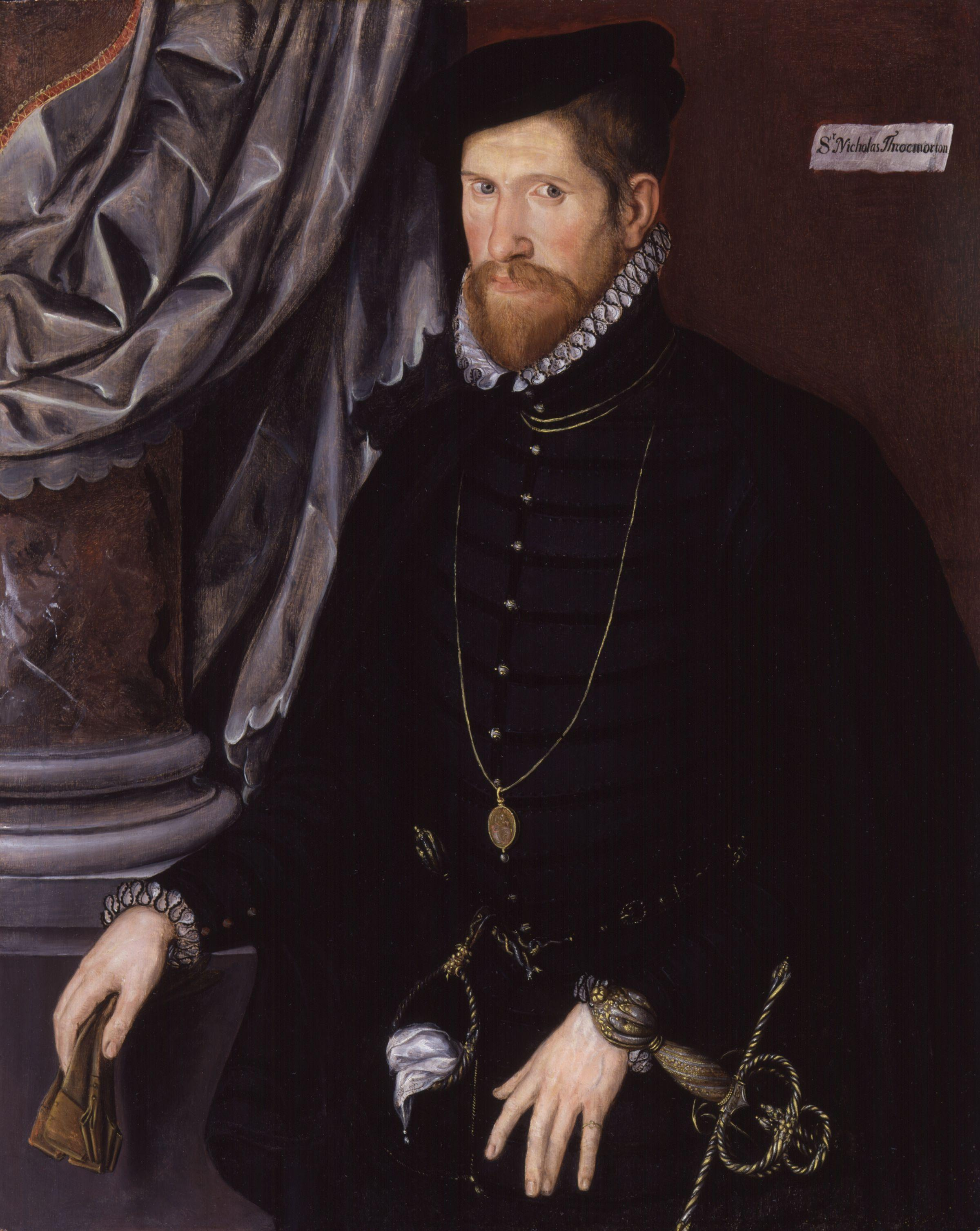
12 FEBRUARY 1570: THE DEATH of Sir Nicholas Throckmorton

Sir Nicholas Throckmorton by Unknown Anglo-Netherlandish artist. © National Portrait Gallery, London

Sir Nicholas Throckmorton by Unknown Anglo-Netherlandish artist. © National Portrait Gallery, London

A cousin of Katherine Parr, Throckmorton was a staunch Protestant, and a supporter of Lady Jane Grey, though he served as a Member of Parliament under all the Tudor monarchs including the Catholic queen, Mary I. His importance during the reign of Elizabeth I was mainly as an ambassador to France and to Scotland. Throckmorton was the son of Katherine’s paternal aunt, Hon. Katherine Vaux and cousin Sir Robert Throckmorton of Coughton Court (a supporter of Queen Katherine of Aragon). Throckmorton was a page in the household of Henry Fitzroy, Duke of Richmond by 1532-6; his cousin, William Parr (brother of Queen Katherine) had been raised and educated with Fitzroy and the Earl of Surrey and his maternal uncle, also named William Parr, was head of the household there. Throckmorton then became a servant in the household of his cousin, William, Baron Parr by 1543. Throckmorton, along with his brother Clement, would go on to serve in the household of their cousin Queen Katherine Parr by 1544-7 or 8. After the reign of Henry VIII, Throckmorton continued to serve at court. Upon the death of the Dowager Queen, he returned to the household of his cousin, the 1st Marquess of Northampton (William Parr).

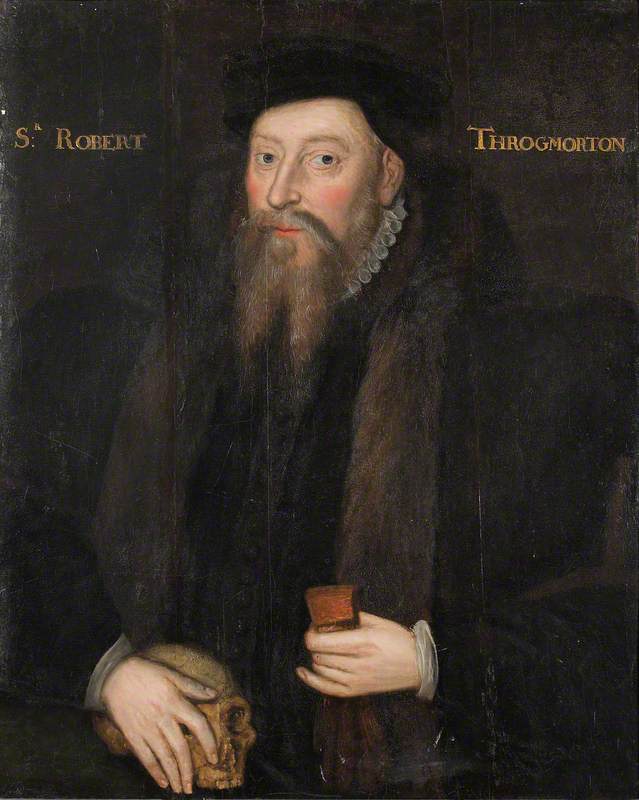
12 FEBRUARY 1581: THE DEATH of Sir Robert Throckmorton

Robert Throckmorton by British School (c) National Trust, Coughton Court; Supplied by The Public Catalogue Foundation

Robert Throckmorton by British School (c) National Trust, Coughton Court; Supplied by The Public Catalogue Foundation

Sir Robert Throckmorton (c.1513-12 February 1581) was the eldest son of Sir George Throckmorton of Coughton Court and Hon. Katherine Vaux. As such, Robert was the elder brother of Nicholas, above. Throckmorton, like his father, was Catholic. His role in the succession crisis of Queen Mary is not clear, but it seems that he backed Mary’s claim because of the positions he was given. He was knighted in 1553 and appointed Constable of Warwick Castle among other positions. His Catholicism explains his disappearance from the Commons in the reign of Elizabeth I, although the most Catholic of his brothers, Anthony Throckmorton, was to sit in the Parliament of 1563. Judged an ‘adversary of true religion’ in 1564, Throckmorton remained active in Warwickshire until his refusal to subscribe to the Act of Uniformity led to his removal from the commission of the peace. (A. L. Rowse) Throckmorton married twice and had issue by both wives who would continue his legacy at Coughton Court.

References

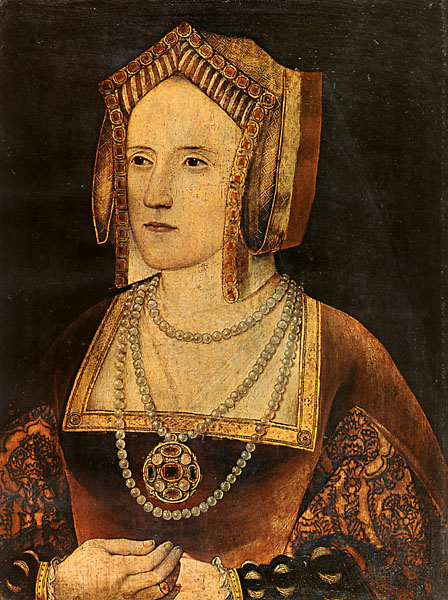
Which Queen Katherine: The Lambeth Portrait

It has been identified as Queen Katherine Parr for centuries. Thanks to modern technology used to examine the portrait by the NPG in London, it has been concluded that the portrait is indeed that of wife no.1, Queen Katherine of Aragon.

Disputed Lambeth Palace portrait; Katherine Parr or Katherine of Aragon

Lambeth Palace portrait; now identified as Queen Katherine of Aragon, wife no. 1

The young woman in the picture is blessed with good features, an oval-shaped face with a firm jawline and a clear complexion. But it is the overall impression of intelligence and intensity that is so compelling. There is an inner strength in the face that commands attention. The woman looks confident. This is a woman full of grace and maturity. The portrait is carefully composed. She is very much the aristocratic lady, expensively dressed and already demonstrating a love of jewels and fashion that would develop over the years. Her clothing is red and gold, with the hood perfectly matching the gown. At the period of time the portrait was painted the Telegraph quotes,

Academics working on the ‘Making Art in Tudor Britain’ project had noticed the facial features and costume worn by the woman were far more similar to works depicting the first Catherine, and dated from the 1520s or 30s. (Furness)

The 1520s — Katherine’s mother was still negotiating for a marriage. In 1529, she was married to Sir Edward Borough, son of Sir Thomas, 3rd Baron Borough of Gainsborough (Lord Chamberlain to Queen Anne Boleyn). The status wouldn’t have made her that important enough to paint. However, the 3rd Barons wife, Agnes Tyrwhitt had her portrait done by Holbein. Sir Thomas, however, had to pull his connections just to get his wife, Lady Borough, painted by Holbein. (Porter pg 55) By 1533, Katherine was a widow. Her next marriage to Lord Latimer took place in 1534 and it lasted until 1543. The hood was most likely outdated by the 1530s, but Katherine had not been living at court so perhaps she did not know the current fashions. Her home from 1529-1534 was spent in the Northern part of England; Lincolnshire. After her marriage to Sir John Neville, 3rd Lord Latimer her home was Snape Castle, in North Yorkshire. Her mother and sister would have been at court. Her mother served Katherine of Aragon until her household was dissolved. Her sister, Anne, would continue to serve under Queen Anne Boleyn. The two sisters were close so perhaps Anne wrote about the current fashions at court; Katherine was to become a fashionable queen so her interest must have developed early on. Therefore it is contradictory as to what Katherine actually wore.

Lambeth Portrait of Katherine of Aragon.

Lambeth Portrait of Katherine of Aragon.

Interestingly, although the gown has fashionable slashed undersleeves and a gauzy partlet, covering the throat and chest, the coifed gable hood that the woman is wearing was a more conservative choice. Anne Boleyn supposedly made the French hood popular, but the hood had been introduced to England well before she returned from France in 1522. The French hood showed more hair, so therefore in some circles it was still considered unseemly. Jane Seymour favoured the gabled hood, though this may have been less a personal preference than a conscious decision to differentiate herself from her more flighty, disgraced predecessor. (Porter)

In Katherine Parr’s case, she had married a man whose overall outlook was conservative and it is possible that her head-wear reflected his taste. Her jewels, three ropes of pearls and a large, round gold, pearl and ruby brooch, are also a sign of wealth without ostentation. In this portrait, Katherine is very much the elegant nobleman’s wife. (Porter on the portrait being Katherine as Lady Latimer)

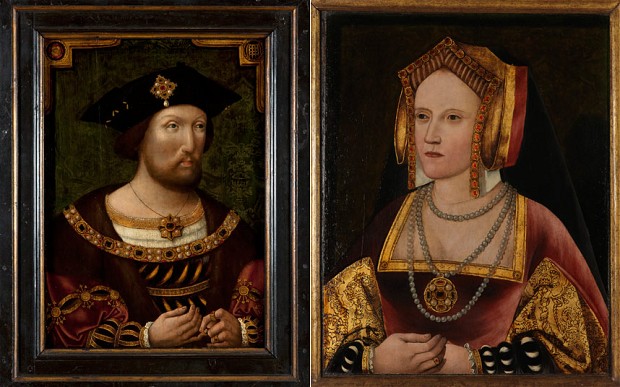
The two paintings will now be hung together for the first time in the National Portrait Gallery, nearly 500 years after they were painted Photo: National Portrait Gallery

The two paintings will now be hung together for the first time in the National Portrait Gallery, nearly 500 years after they were painted. Photo: National Portrait Gallery

Technical analysis of the paint and “rare” engraved frame by the NPG (National Portrait Gallery in London) are believed to show it was painted at the same time as a portrait of Henry VIII, with a similar style and scale. (Furness) (See above)

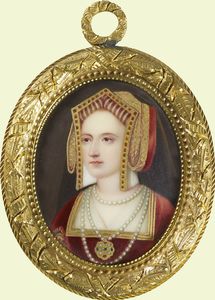
However, there is still more than a few portraits with Henry and his other wives that still use this depiction as Katherine Parr. For example, the only miniature in the Royal Collection (from Queen Victoria’s miniature collection) that depicts Queen Katherine Parr is this same depiction. Hopefully they will not change the description now as there is no other depiction of Parr and all six wives are represented.

Katherine Parr or Katherine of Aragon

‘Portrait of a lady called Katherine Parr’, by Henry Pierce Bone, 1844. Enamel; 4.8 x 3.9cm.The miniature was purchased by Queen Victoria in 1844, to add to her growing collection of portraits of sixteenth-century figures. It is still part of the Royal Collection.
The Earliest Portrait of Katherine Parr or Katherine of Aragon?

On the back of the portrait is the following inscription:

‘Katharine Parr / London Febr 1844 / Painted by Henry Pier. / Bone Enamel Painter / to Her Majesty & H.R.H. / Prince Albert &c. From / the Original in / Lambeth Palace.’

Detail of the Miniature.

Detail of the Miniature.

In early 2011, after inquiring about the portrait, I was told (by email from the Lambeth Palace Library) that this had been re-identified as Katherine of Aragon. Lambeth Palace’s site had this image as Katherine Parr; the image was uploaded in 2008. The re-identification took place in 2009, but was not officially announced or re-identified until recently.

The portrait you are inquiring about used to be referred to as the “Unknown Woman” thought to be Katherine Parr.  However, in 2009 we had the National Portrait Gallery here to look at another painting in our possession.  As we walked by the portrait a period costume expert, who so happened to be among them, took great notice in it and declared that the clothes were far too early to be Katherine Parr.  The National Portrait Gallery took it away with them to research further.  The conclusion was that it was in fact a rare survival of a Tudor portrait of Catherine of Aragon, not Katherine Parr as originally thought.  You can imagine it was rather exciting for all concerned.

Obviously they had not made the announcement official until now — due to years of research at the NPG. But as of 24 January 2013, this is now identified as Queen Katherine of Aragon. For details on the examination process and the conservation of the portrait — see links.

Links

References

20 JANUARY 1569: THE DEATH of Myles Coverdale

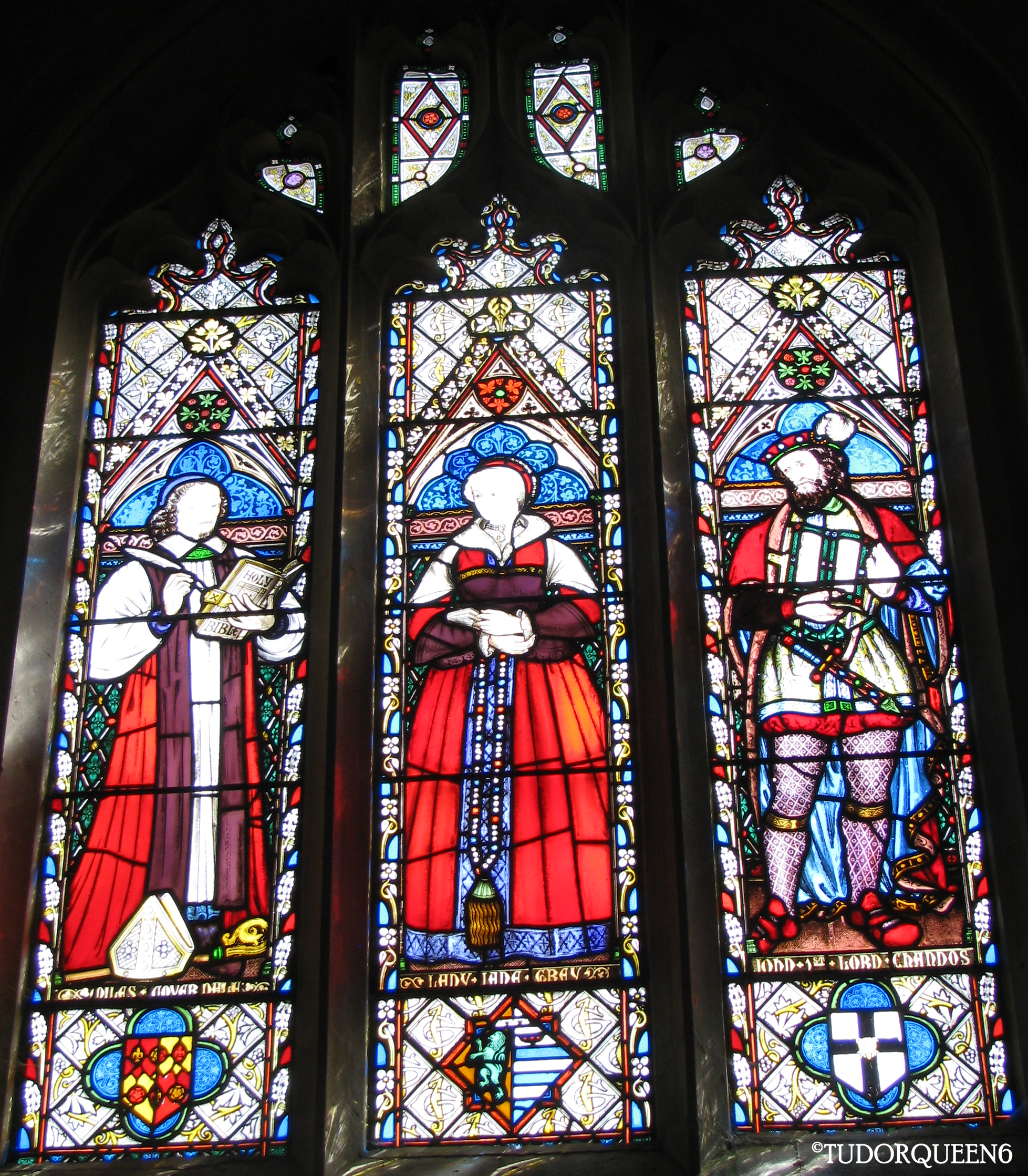
Stained glass at St. Mary's, Sudeley Castle (where Queen Catherine is buried). The window is shared with Lady Jane Grey and John Brydges, 1st Baron Chandos.

Stained glass at St. Mary’s, Sudeley Castle (where Queen Catherine is buried). The window depicts Myles Coverdale (L) with Lady Jane Grey (C) and John Brydges, 1st Baron Chandos (R).

20 JANUARY 1569: THE DEATH of Myles Coverdale, Bishop of Exeter. Coverdale assisted William Tyndale in the complete version of the Bible, printed probably at Hamburgh in 1535. After the death of King Henry, Coverdale became the Dowager Queen’s personal almoner. He assisted her in her endeavours to popularise Erasmus’ works. He preached her funeral sermon in September 1548. Coverdale died in London and was buried in the church of St. Bartholomew. When that church was demolished in 1840 to make way for the new Royal Exchange, his remains were moved to St. Magnus.

Family of Queen Katherine Parr: William Herbert, 1st Baron Powis

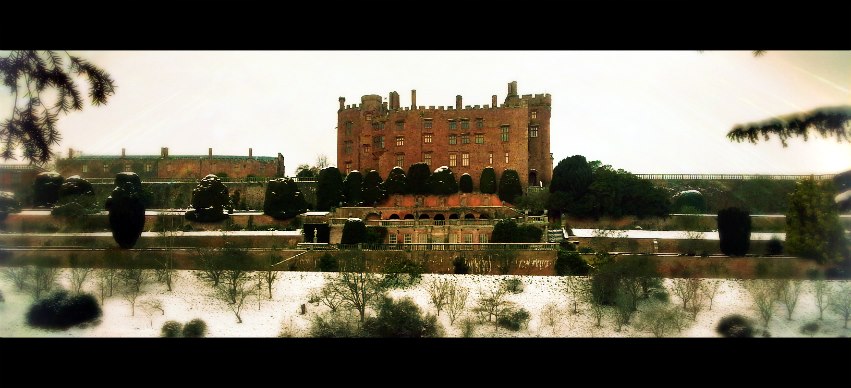
Powis Castle, Welshpool, Powys, Wales, UK photo by Cluke.

Powis Castle, Welshpool, Powys, Wales, UK photo by Cluke.

William Herbert, 1st Baron Powis of Powis Castle (c.1573[1] – 7 March 1655/6[1][2][3]) was a Welsh nobleman and politician who sat in the House of Commons at various times between 1597 and 1629.

Herbert was born in Powis Castle, the son of Sir Edward Herbert (June 1544–1593) and his wife Mary Stanley, daughter of Sir Thomas Stanley, Under-Treasurer of the Royal Mint.[1][2] His paternal grandparents were William Herbert, 1st Earl of Pembroke and Lady Anne (Parr).[1][2] He was a nephew of Henry Herbert, 2nd Earl of Pembroke and Lady Anne Herbert, Lady Talbot. By his grandmother, Lady Pembroke (Anne Parr), he was a great-nephew of Queen Katherine Parr.

Marquesses of Powis and Earls of Powis, First Creation. The arms of William Herbert, 1st Marquess and Earl of Powis, grandson of the 1st Baron Powis.

The arms of the Herbert Marquesses of Powis and Earls of Powis, First Creation (1674). Sir William Herbert, 1st Marquess and Earl of Powis was the grandson of the 1st Baron Powis.[4]

Herbert was a member of the Herbert family, a Welsh noble family who descended from Sir William ap Thomas of Raglan Castle. His grandfather, Sir William Herbert, 1st Earl of Pembroke of the second creation (within the Herbert family) was the grandson of the first creation also named William (1423-1469). From birth, William Herbert had the backing of his family’s powerful clan. It also didn’t hurt that his grandfather, the Earl of Pembroke had been a large influence at court during the last few years of Henry VIII and in the reign of his children Edward VI and Elizabeth I (the Protestant monarchs). His grandmother Anne Parr was sister to Queen Katherine. Lord Pembroke’s marriage to the queen’s sister advanced the family and Anne gave legitimacy to the Herbert family. Anne’s descendants also had the luxury of becoming the sole heir of the Parr inheritance once Anne’s brother, William, 1st Marquess of Northampton died in 1571 without issue.

Herbert inherited Powis Castle (at the time it was called “Poole Castell”) from his father.[5] Sir Edward Herbert bought the lordship and castle in 1587 from Edward Grey, a feudal Lord of Powis.[1] Edward Grey was the illegitimate child of the last Lord Powis and Jane Orwell; therefore his father’s estates, which he inherited, came with limitations within Lord Powis’s will.[6] One of those limitations was the obvious title, Baron Powis, which would be bestowed on the Herbert’s in the reign of James I. Edward Grey’s father, Sir Edward Grey, 4th Baron Powis had married firstly to Lady Anne Brandon, daughter of the Duke of Suffolk and his second wife Anne Browne.[7] The marriage however produced no children.[7]

Herbert was High Steward to Elizabeth I of England. In 1597, he was elected Member of Parliament for Montgomeryshire. He served as Custos Rotulorum of Montgomeryshire from 1602 to 1641. Upon the coronation of James I in 1603, Herbert was made a Knight of the Bath.[1][2] In 1604, he was elected MP for Montgomeryshire again. He was appointed High Sheriff of Montgomeryshire in 1613. In 1614, he was re-elected MP for Montgomeryshire and was re-elected in 1624, 1625, 1626 and 1628. He was created Baron Powis (a new creation) of Powis Castle on 2 April 1629.[1][2] The creation made him the legitimate successor of the ancient princes of Powis, with undisputed primacy in Montgomeryshire. (CSP Dom. 1628-9, pp. 503, 511, 584)

Before 1600, Lord Powis married Lady Eleanor Percy, third daughter of Henry Percy, 8th Earl of Northumberland and his wife, Hon. Katherine Neville.[1][2] Lady Northumberland was the daughter and co-heiress of John Neville, 4th Baron Latimer of Snape, the step-son of Queen Katherine Parr by her second marriage to his father, the 3rd Baron, also named John.

They had several children including:

  • Percy Herbert, later 2nd Baron Powis.[1][2]
  • Katherine Herbert, who married firstly to Sir Richard Vaughan of Lydiard and secondly to Sir James Palmer, Knt. By her second husband, she was the mother of Roger Palmer, 1st Earl of Castlemaine.[2] Lord Castlemaine was married to Barbara Villiers; mistress to King Charles II of Great Britain who was created Duchess of Cleveland.
  • Lucy Herbert, who married in early 1633 to William Habington (or Abington) of Hinlop.[2][4]

He was succeeded by his son Percy Herbert, 2nd Baron Powis.

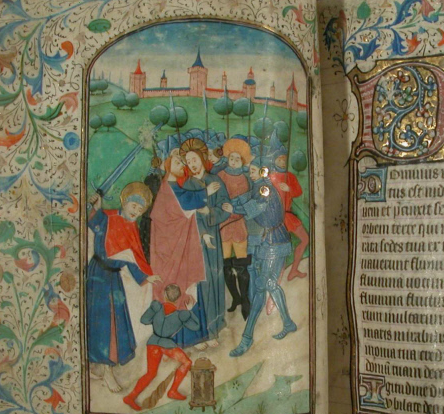
Books of Hours belonging to Lady Eleanor Powis, wife to Sir William, 1st Baron Powis.  Lady Eleanor used her Book of Hours to remind her of important anniversaries writing these dates against the Feast Days of the Catholic Calendar at the front of her book. She includes the birthdays of herself, her husband William, and her children. © National Trust Collections

Books of Hours belonging to Lady Eleanor Powis, wife to Sir William, 1st Baron Powis. Lady Eleanor used her Book of Hours to remind her of important anniversaries writing these dates against the Feast Days of the Catholic Calendar at the front of her book. She includes the birthdays of herself, her husband William, and her children. © National Trust Collections

Lady Powis died on 24 October 1650 and was buried in the vault of Lady Latimer (her maternal grandmother Dorothy de Vere, the 1st wife of Sir John Neville, 3rd Baron Latimer of Snape, himself the 2nd husband of Katherine Parr) in Hackney, Middlesex, London.[1] Lord Powis died five years later, abt 83 years of age, and was buried at St. Mary’s Church in Hendon, Middlesex, London.[1]

References

  1. George Edward Cokayne. Complete Peerage of England, Scotland, Ireland, Great Britain and the United Kingdom, Extant, Extinct, Or Dormant , Volume 6. G. Bell & sons, 1895. pg 295.
  2. Sir Bernard Burke. A Genealogical History of the Dormant, Abeyant, Forfeited, and Extinct Peerages of the British Empire, Harrison, 1866. pg 275.
  3. There is confusion as to his death date. Burke states 1655. Cokayne and the History of Parliament states 1656.
  4. The Encyclopedia of English Renaissance Literature, Volume 1. John Wiley & Sons, Feb 7, 2012. pg 416. Google eBook
  5. European Heraldry. House of Herbert.
  6. A letter dated 8 October 1590 from Sir Edward Herbert at “The Poole Castell.” Kynaston Peerage Papers No 148.
  7. Morris Charles Jones. The Feudal Barons of Powis, 1868.
  8. Douglas Richardson. Magna Carta Ancestry: A Study in Colonial and Medieval Families, 2nd Edition, 2011. pg 300.

Links:

© Meg McGath, 20 January 2013.

BBC ‘THE WHITE QUEEN’: Queen Katherine Parr Family Relations

The White Queen covers to promote the series by Philippa Gregory.

The White Queen covers to promote the series by Philippa Gregory.

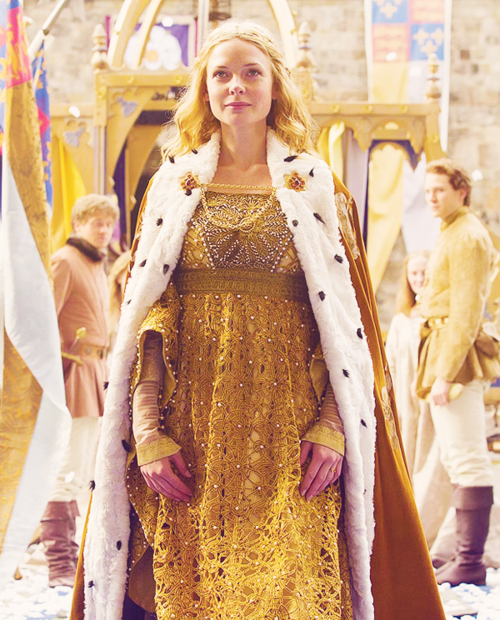
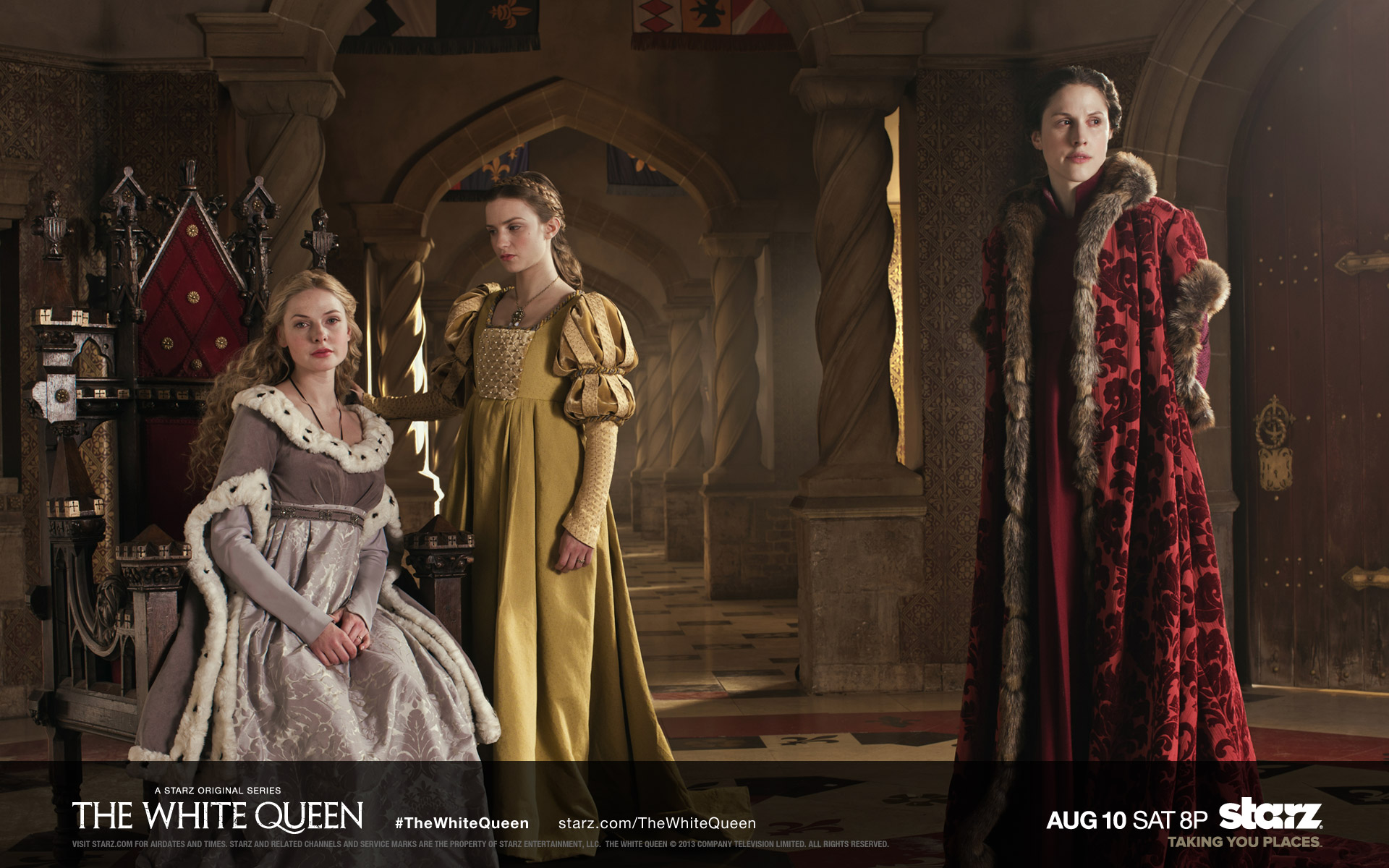
The 3 cousins are coming to tv soon in the BBC Series “The White Queen”; which features Lady Anne Neville (daughter of Warwick, the Kingmaker and later Queen to Richard III), Elizabeth Woodville (mother of Elizabeth of York), and Lady Margaret Beaufort (mother of Henry VII Tudor). All three women were cousins to Katherine Parr. The series will air on STARZ in the US in August.

The White Queen

The White Queen

The White Queen Elizabeth Woodville.

The White Queen Elizabeth Woodville.

Based on the The Cousin’s War series of novels by Phillipa Gregory and developed for TV by Emma Frost, The White Queen is set in 1464, during the height of the War of the Roses, and tells the story of the women caught up in the ongoing conflict for the throne. The House of York’s young and devilishly handsome Edward IV is crowned King of England with the help of the master manipulator Lord Warwick “The Kingmaker.” But when Edward falls in love and secretly marries a beautiful young widow, the commoner Elizabeth Woodville, Warwick’s plan for control over the English throne comes crashing down around him. Frustrated by the new Queen’s influence he will stop at nothing to maintain his grip on the King. The ten-part drama series stars Max Irons, James Frain, Rebecca Ferguson, Janet McTeer, Amanda Hale, Faye Marsay, Aneurin Bernard, David Oakes, Juliet Aubrey, Eleanor Tomlinson, Frances Tomelty, Michael Maloney, Ben Lamb, Hugh Mitchell, Simon Ginty, Eve Ponsenby and Robert Pugh. Company Pictures is producing with John Griffin, George Faber, Charles Pattinson, Eurydice Gysel and Polly Hill serving as executive producers. — (Patrick Munn)

Lord and Lady Warwick, Sir Richard Neville (James Frain) and Lady Anne Beauchamp (Juliet Aubrey). STARZ "The White Queen" (2013)

Lord and Lady Warwick, Sir Richard Neville, “Warwick, the Kingmaker” (James Frain) and Lady Anne Beauchamp, suo jure 16th Countess of Warwick (Juliet Aubrey). STARZ “The White Queen” (2013)

Lady Anne Neville, daughter of Richard Neville, 16th Earl of Warwick (“Warwick, the Kingmaker”) was a first cousin of Hon. Elizabeth FitzHugh, Lady Parr/Vaux [so she would have been Queen Katherine’s first cousin, twice removed].

Lady Isabel (Eleanor Tomlinson) and Lady Anne (Faye Marsay); daughters of Lord and Lady Warwick.

Lady Isabel (Eleanor Tomlinson) and Lady Anne (Faye Marsay); daughters of Lord and Lady Warwick.

Elizabeth and her mother, Lady Alice [sister of Warwick], were appointed personally by Queen Anne to be ladies when she became queen and participated in the coronation, receiving gifts from Richard III himself. They were close.[1]

Lady Margaret Beaufort portrayed by Amanda Hale.

Lady Margaret Beaufort portrayed by Amanda Hale.

Sir Thomas Parr’s father, William, 1st Baron Parr of Kendal, had once been Lady Margaret Beaufort’s revisionary heir to her substantial lands in Westmoreland, known as the “Richmond fee.” Lord Parr married to Hon. Elizabeth FitzHugh, daughter of Henry, 5th Baron FitzHugh and Lady Alice Neville (sister of Warwick). Lady Margaret Beaufort was a double second cousin to Elizabeth FitzHugh, Lady Parr [so she would have been a double second cousin, thrice removed of Katherine]. After the death of Lord Parr, his widow made a marriage with the Lancastrian family, the Vauxs’ of Harrowden. The Vaux family was close to Margaret, enjoying a long-term relationship with her. The previous Lady Vaux, mother of Thomas Parr’s step-father Nicholas, had been lady and friend to the Lancastrian queen Margaret of Anjou. Katherine, Lady Vaux served the queen during her exile. Nicholas Vaux (later 1st Baron Vaux) was a protege of Lady Margaret Beaufort. The young Thomas Parr [Katherine’s father and Margaret’s cousin] most likely studied under Maurice Westbury of Oxford who had been installed as a teacher by Lady Margaret Beaufort at her estate of Colyweston. It was at Colyweston that certain gentlemen, including the son of the Earl of Westmoreland [cousin of Sir Thomas], not only received an education but also gained political connections that would prove useful in their future careers.[1][2]

The "White Queen," Elizabeth Woodville.

The “White Queen,” Elizabeth Woodville.

Elizabeth Woodville was the niece of Queen Katherine’s maternal great-great-grandmother Joan Wydeville [Katherine would have been a first cousin, thrice removed of Queen Elizabeth by her mother, Maud Green]. Joan Wydeville married Sir William Haute/Hawte. Their daughter, Alice, married Sir John Fogge. The Haute family which Joan married into was quite prominent during the reign of Edward IV and Richard III. Fogge had originally been a supporter of the Lancastrian king, but in 1460 Fogge joined the Yorkist earls in Kent. It is obvious however that he was a Yorkist by the families which he married into; Alice Kyriel (daughter of Yorkist Sir Thomas) and Alice Haute c. 1465 who was a cousin of Queen Elizabeth. The previous year, Elizabeth Woodville had married Edward. Queen Elizabeth brought her favorite female relatives to court to serve her.[2] Lady Alice Fogge (Haute) would be one of five ladies-in-waiting to her cousin, queen consort Elizabeth Woodville during the 1460s.[2] The other ladies included her sister Lady Anne (wife of William Bourchier, Viscount Bourchier and George Grey, 2nd Earl of Kent) and her sister-in-law Lady Elizabeth Scales (wife of Sir Anthony Woodville, 2nd Earl Rivers).[2]

WQS1_wallpaper1920x1200Concept3

The White Queen BBC one commercial – Directors cut from Jamie Childs on Vimeo.

SEE ALSO

STARZ ‘The White Queen’: Elizabeth Woodville

STARZ ‘The White Queen’: The Kingmaker’s Daughters

STARZ ‘The White Queen’: Lady Margaret Beaufort

References

  1. Linda Porter. “Katherine the Queen; The Remarkable Life of Katherine Parr, the Last Wife of Henry VIII.” Macmillan, 2010.
  2. Barbara J. Harris. “English Aristocratic Women, 1450-1550 : Marriage and Family, Property and Careers: Marriage and Family, Property and Careers,” Oxford University Press, Jul 26, 2002. pg 218.

Links

TUDORQUEEN6: 2012 in review

The WordPress.com stats helper monkeys prepared a 2012 annual report for this blog. Thank you everyone for your support!!

Here’s an excerpt:

600 people reached the top of Mt. Everest in 2012. This blog got about 3,500 views in 2012. If every person who reached the top of Mt. Everest viewed this blog, it would have taken 6 years to get that many views.

Click here to see the complete report.

Family of Queen Katherine: Lady Cecily, Duchess of Warwick

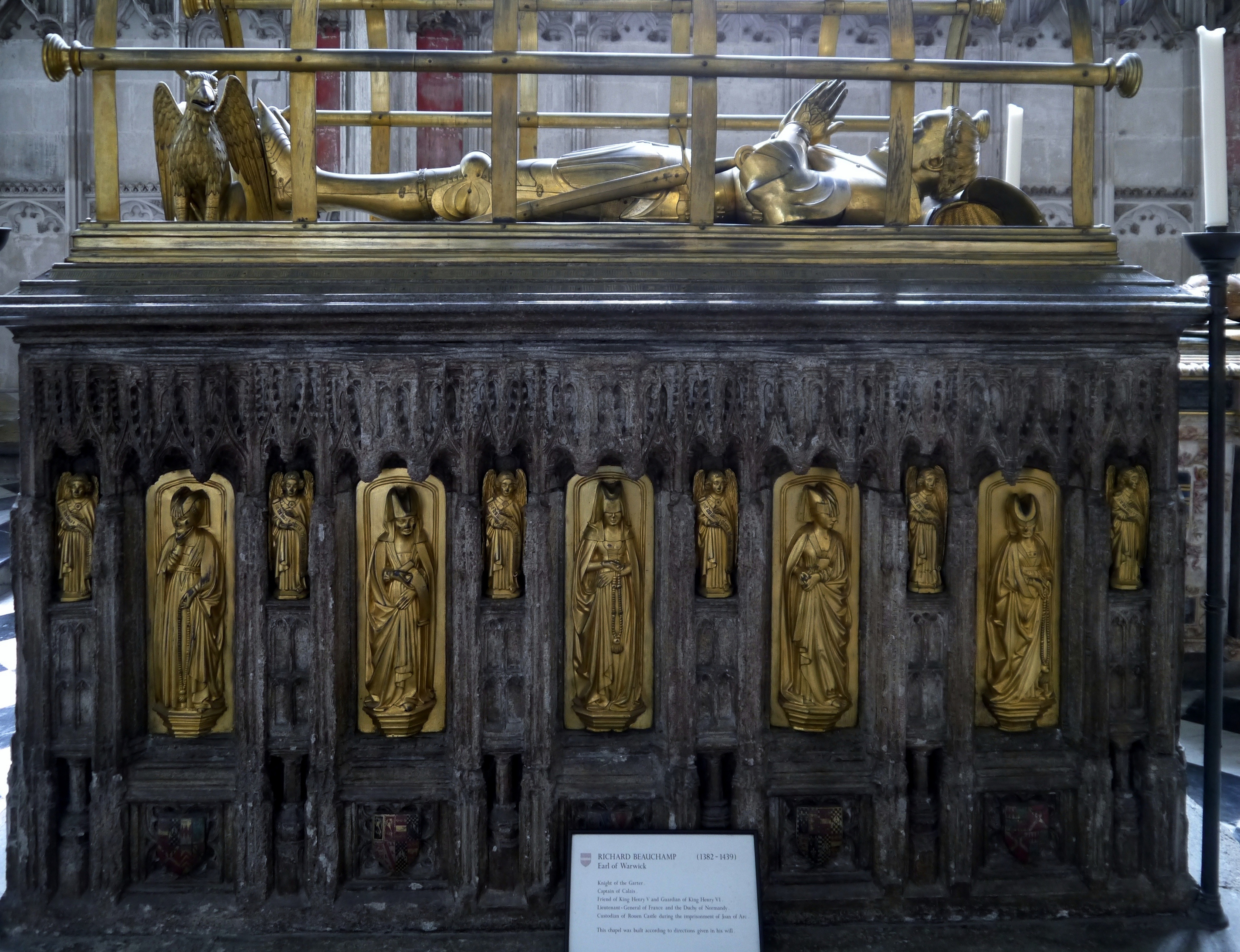
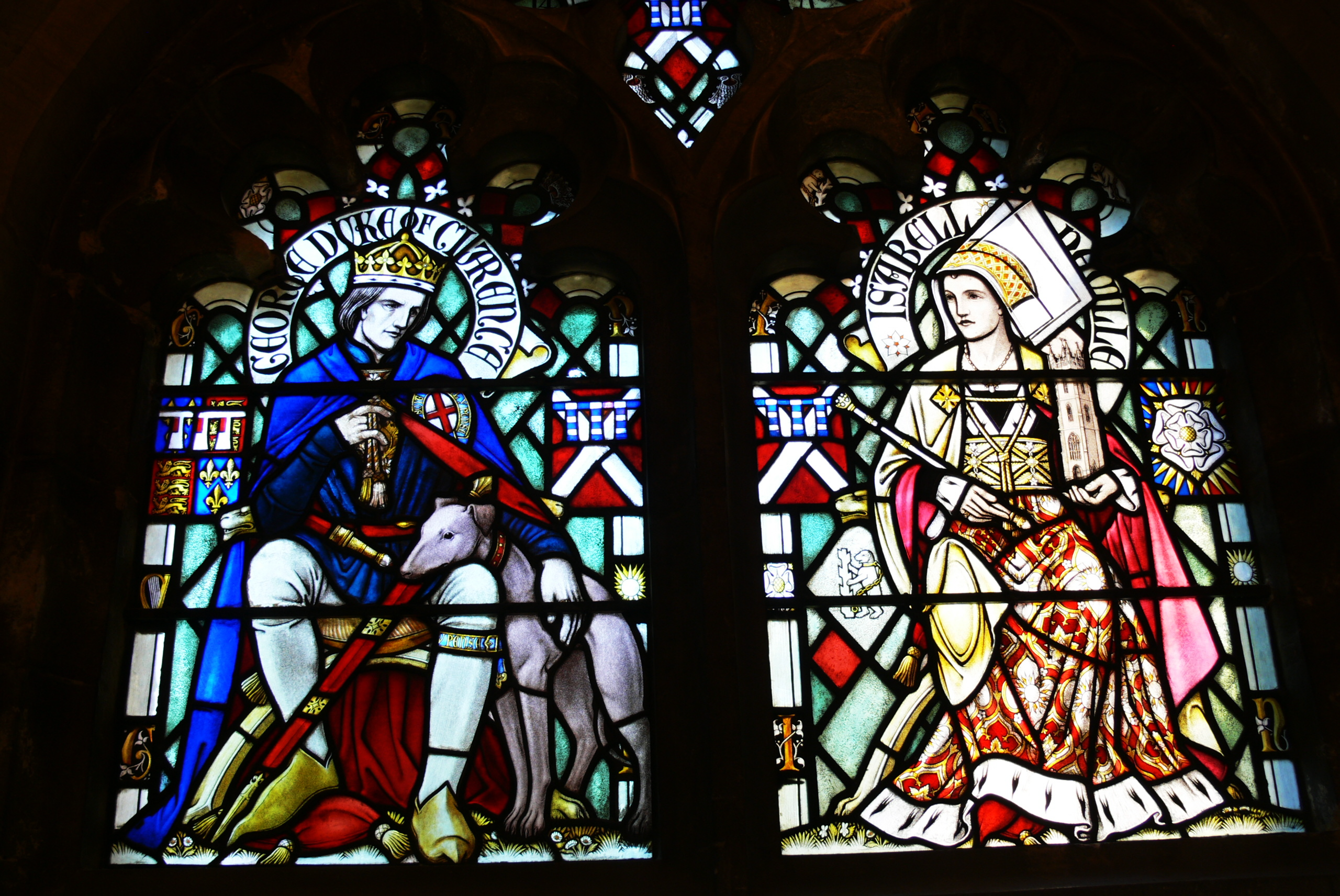
Detail of the magnificent tomb chest that bears the effigy of Richard Beauchamp, 13th Earl of Warwick in the chapel he founded at St Mary's, Warwick. This effigy is that of his daughter-in-law, Lady Cecily Neville.

Detail of the magnificent tomb chest that bears the effigy of Richard Beauchamp, 13th Earl of Warwick in the chapel he founded at St Mary’s, Warwick. This effigy is that of his daughter-in-law, Lady Cecily Neville.

Lady Cecily Neville, Duchess of Warwick, Countess of Worcester (c.1425[2][5] – 26 July 1450[3]) was the second child and daughter of Sir Richard Neville, 5th Earl of Salisbury and Lady Alice Montacute, suo jure 5th Countess of Salisbury.[2] Her nine siblings included Richard Neville, 16th Earl of Warwick; John Neville, 1st Marquess of Montagu; George Neville, (Archbishop of York and Chancellor of England); Sir Thomas Neville; Lady Joan, Countess of Arundel; Lady Katherine, Baroness Hastings; Lady Alice, Baroness FitzHugh; Lady Eleanor, Countess of Derby; and Lady Margaret, Countess of Oxford.[2]

She was most likely named after her paternal aunt, Lady Cecily Neville, later Duchess of York.[2] Her first cousins by the Duchess of York included Anne of York; Edmund, Earl of Rutland; Elizabeth of York; Margaret of York; George Plantagenet, 1st Duke of Clarence; and Kings Edward IV and Richard III. Other cousins included John Mowbray, 3rd Duke of Norfolk; Lord Humphrey Stafford, 7th Earl of Stafford [father of 2nd Duke of Buckingham]; Lady Katherine Stafford, Countess of Shrewsbury [wife of the 3rd Earl]; Henry Percy, 3rd Earl of Northumberland; Ralph, 2nd Earl of Westmorland; George Neville, 4th and 2nd Baron of Abergavenny; Thomas Dacre, 1st Baron Dacre of Gillesland; and Ralph Greystoke, 5th Baron.
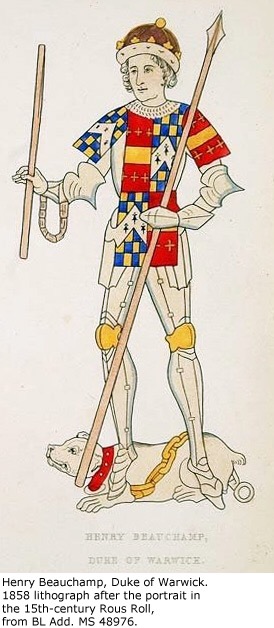
In 1436, it was decided that Cecily would marry Henry de Beauchamp, Lord Despenser (later 1st Duke of Warwick and King of the Isle of Wight, as well as of Jersey and Guernsey).[2] Henry was the son and heir of son of Richard de Beauchamp, 13th Earl of Warwick and Lady Isabel le Despenser, the sole heiress of Thomas le Despenser, 1st Earl of Gloucester (d.1399) by his wife, Constance of York. At the same time, it was decided that her elder brother, Richard, would marry Beauchamp’s younger sister, Lady Anne.[2] The marriage negotiations were not easy or inexpensive; Salisbury had to promise to pay Warwick a large sum of 4, 700 marks (£3, 233.66).[2] In 1436, the two couples married in a double marriage ceremony.[2]

After the death of the Duke of Warwick in 11 June 1446, the Dowager Duchess married to Sir John Tiptoft, 1st Earl of Worcester. They had no children.

By the Duke of Warwick, Cecily gave birth to a daughter and their heiress, Lady Anne, who was most likely named after her aunt, who had married Cecily’s brother Richard [later known as “Warwick the Kingmaker”]. Richard’s wife, Lady Anne, would inherit the Beauchamp fortunes and became Countess of Warwick in “her own right” after the death of her niece in 1449.

The Warwick Inheritance

The advantage of this marriage, which came in the form of Cecily’s husband being created Duke of Warwick on 14 April 1445, was short lived as her husband died on 11 June 1446 and the couple’s only daughter, Lady Anne Beauchamp, was allowed to succeed only as suo jure 15th Countess of Warwick. Upon the death of Cecily’s daughter in 1449, the title was inherited by her paternal aunt, also named Lady Anne Beauchamp. Lady Anne, who had married Cecily’s brother Sir Richard Neville, became suo jure 16th Countess of Warwick thus making Neville jure uxoris 16th Earl of Warwick. There were no objections as the elder half-sisters from the 13th Earl of Warwick’s marriage to his first wife, Elizabeth Berkeley; their husband’s, John Talbot, 1st Earl of Shrewsbury and Edmund Beaufort, 2nd Duke of Somerset, were off defending Normandy.[2] The third half-sister had been married to George Neville, 1st Baron Latimer who had been declared insane and his brother Salisbury already possessed his lands.[2] The three sisters had to settle for nine manors, while the Despenser lands were preserved for George Neville, later 4th Baron Bergavenny, the heir of the 16th Countess of Warwick’s maternal sister, Lady Elizabeth Beauchamp, suo jure Baroness Bergavenny.[2] Cecily and her second husband, the Earl of Worcester, however had custody of the land up until two months before Cecily died in July 1540.[2] Upon that time, the lands were handed over to Cecily’s brother, Warwick.[2] However in 1457, when Bergavenny became of age — the rights were ignored and Warwick’s wife, Anne, became the sole heiress of her mother’s inheritance in the first parliament of Edward IV in 1461.[2] Both Warwick and Bergavenny were cousins to the King, however Warwick was the older brother of Bergavenny’s father. Warwick’s wife was also the daughter of the 13th Earl of Warwick, who was senior to his cousin, Richard Beauchamp, 1st Earl of Worcester — first husband of Lady Isabel le Despenser.

The Future of the Warwick Inheritance

Richard Neville, Earl of Warwick was a supporter of the House of York as cousin to the King and his siblings. However, at the Battle of Barnet, Warwick and his brother-in-law, Oxford, both sided with the Lancastrian King.[2] Warwick’s allegiance to the House of York was damaged after Edward IV married the Lancastrian widow, Lady Elizabeth Grey [born Woodville]. As Lady Elizabeth’s large family followed her to court, so did the titles, marriages, and grants. The Woodvilles were of common descent, but their fortunes improved when a Woodville squire married the Dowager Duchess of Bedford [widow of John of Lancaster, son of Henry IV]. The marriage was not favored by the nobles at court and the favors granted to the Woodvilles did not stop–in that, the nobility became extremely frustrated and resentful. Warwick rebelled and paid the price with his life. His only children were two daughters. Warwick had no male heir. However, his two daughters both married a brother of King Edward IV and became Royal Duchesses. After the Battle of Barnet, Warwick’s wife Anne [the holder of the title Countess of Warwick and inheritance], forfeited her right to all of her inheritance due to being the wife of the traitor, Warwick. The inheritance was eventually divided between Warwick’s eldest daughter, Isabel, the Duchess of Clarence and Anne, who would become the Duchess of Gloucester [later queen consort]. The Duke of Clarence forfeited his right to any of the inheritance after his execution [his wife was already dead]. Their son, Edward, was imprisoned in The Tower and was executed by order of Henry VII in 1499.[7]

An ironic twist to the history of this Abbey came during the reign of the Tudor King Edward VI; the Manor of Tewkesbury, a possession of the Beauchamps, was granted to Lord Seymour of Sudeley. Sudeley was non other than the husband of the Dowager Queen Katherine Parr. Parr, herself, was a descendant of Warwick’s sister, Lady Alice; her paternal great-grandmother.[7]
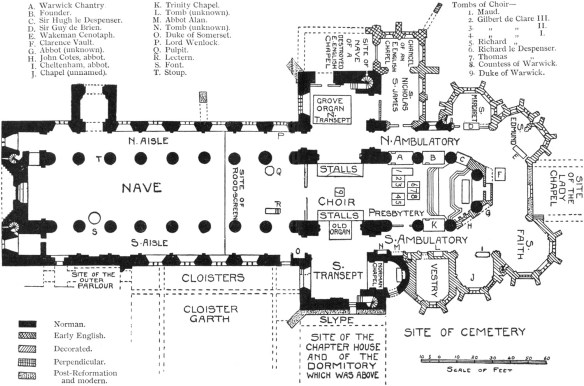
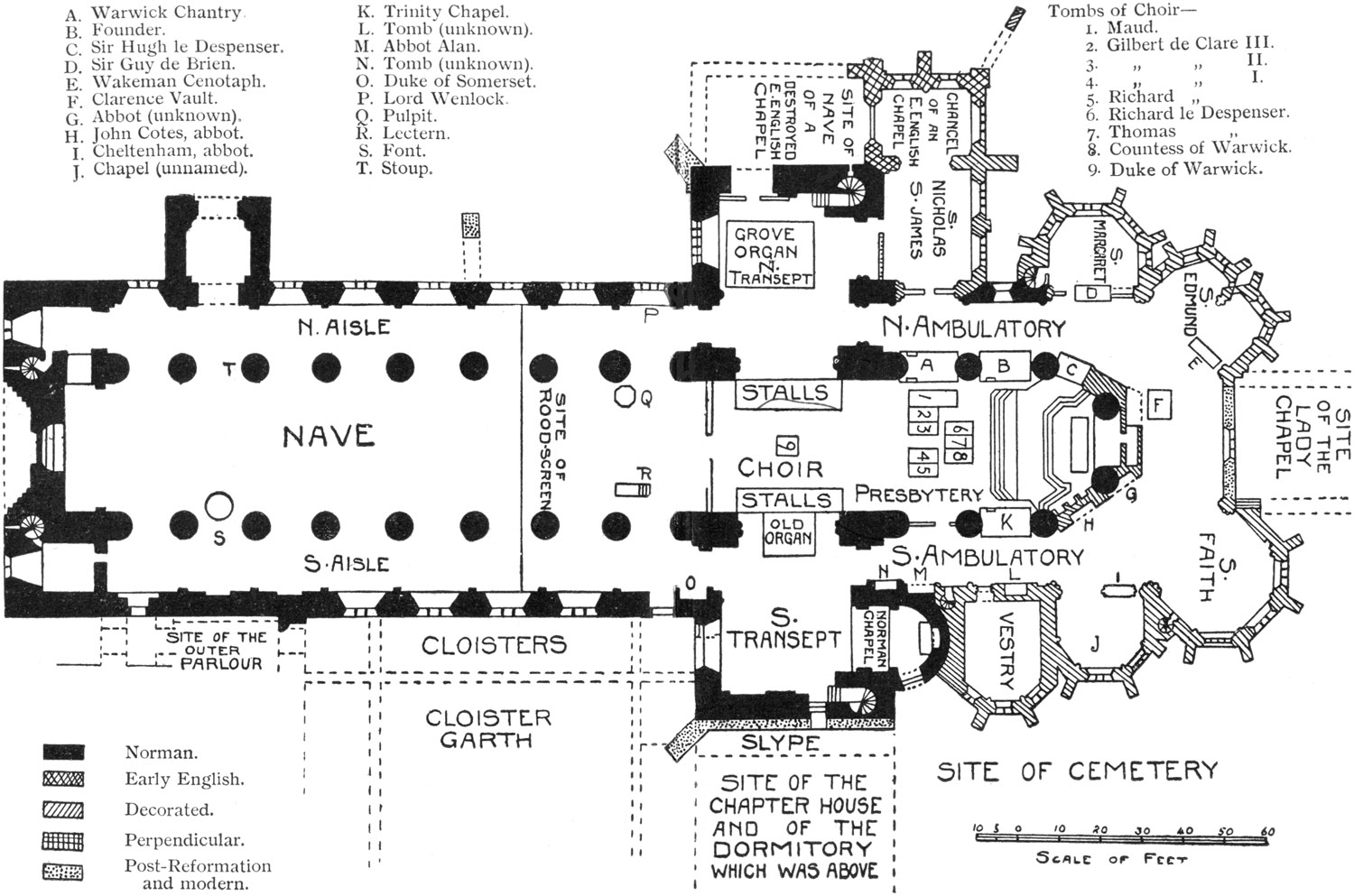
A map of Tewksbury Abbey.

A map of Tewksbury Abbey.

Lady Cecily, the Dowager Duchess of Warwick and Countess of Worcester died on 26 July 1450. She was buried with her first husband, the Duke of Warwick, at Tewkesbury Abbey; with no monument.[1] Warwick was buried at his own request between the stalls in the choir upon his death in 1446. At the time the choir was repaved in 1875, a grave of stone filled with rubble was found together with some bones of a man of herculean size. These, no doubt, were those of the Duke who was buried here. The large marble slab that formerly covered the grave disappeared early in this century but the brasses that were originally in it had been taken away long before, Cecily, the Dowager Duchess of Warwick was buried in the same place on 31 July 1450.[3][4]

Effigy of John Tiptoft and his two wives which included Cecily, Dowager Duchess of Warwick.

Effigy of John Tiptoft and his second and third wives, Elizabeth Greyndour and Elizabeth Hopton at Ely Cathedral

Cecily is portrayed on the tomb of her father-in-law, Richard Beauchamp, 13th Earl of Warwick, within the Chapel. The Purbeck Marble tomb chest is decorated with a superb and complete set of 14 gilt bronze mourners (all male to the south, all female to the north) complimented by 18 smaller figures of angels. The mourners are identified by their enamelled coats of arms which survive beneath them. English medieval bronze sculpture of this kind (c.1460), of this quality and in such excellent preservation is extremely rare! (Aidan McRae Thomson)
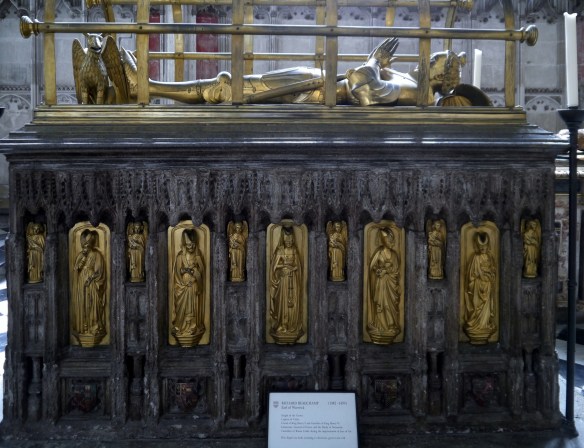
Beauchamp Chapel, Warwick. Also buried near this monument is Katherine Parr's brother, the Marquess of Northampton whose funeral and burial was paid for by Elizabeth I.

Beauchamp Chapel, Warwick. Also buried near this monument is Katherine Parr’s brother, the Marquess of Northampton whose funeral and burial was paid for by Elizabeth I.

The 1448 contract for making this tomb survives: it indicates that it is not a portrait and refers to the following who were involved in its making: John Bourde of Corfe supplied the Purbeck Marble, William Austen of London cast the metal, John Massingham, carver, made the model, Bartholomew Lambespring, goldsmith, polished and gilded the effigy; one Roger Webb is also referred to in this contract but it is not known what his role was in the construction. A separate contract of the following year with William Austen to cast the effigy. A third contract of 1453 is for brass plates for the lid, sides and the hearse; in this contract John Essex of London, marbler and Thomas Stevyns of London, coppersmith, also appear with William Austen.
Cast gilt bronze effigy in armour on a Purbeck marble tomb chest. The Earl’s hands are held in a curious separated position. Head on helmet with crest of a swan and his feet on both a bear and griffin. The details of the armour are very fine. Charles Stothard lifted the effigy down from the tomb chest to draw its dorsal surface where the armour is again shown in very fine detail. Over the whole is a hooped framework – the ‘hearse’ referred to above; this would have supported a fabric cover and only be removed when masses were said for his soul. Around the tomb chest are gilt bronze ‘mourners’ – seven male and seven female. The mourners include the 13th Earl’s children and in-laws. They include [among others] his son Henry who became Duke of Warwick, his daughter-in-law Duchess Cecily [daughter of the 5th Earl of Salisbury], the 5th Earl and Countess of Salisbury [Richard Neville and Lady Alice Montacute], his daughter Lady Anne [sister of the Duke] and her husband Richard Neville [brother of Duchess Cecily], who inherited the Beauchamp estates to become Earl and Countess of Warwick.[6]
Richard Beauchamp fought with Henry IV and Henry V and was guardian of the infant Henry VI. At the time of his death he was Governor of Normandy.

Ancestry of Cecily, Duchess of Warwick

Ancestry of Cecily, Duchess of Warwick

References

  1. Henri Jean Louis Joseph Massé. “The Abbey Church of Tewkesbury:with some account of the Priory Church of Deerhurst, Gloucestershire,” G. Bell. 1906. pg 79.
  2. David Baldwin. “The Kingmaker’s Sisters: Six Powerful Women in the Wars of the Roses,” The History Press; First Edition edition, 1 August 2009.
  3. Michael Hicks. “Warwick, the Kingmaker,” John Wiley & Sons, 15 April 2008. pg 47.
  4. G.E. Cokayne; with Vicary Gibbs, H.A. Doubleday, Geoffrey H. White, Duncan Warrand and Lord Howard de Walden, editors, The Complete Peerage of England, Scotland, Ireland, Great Britain and the United Kingdom, Extant, Extinct or Dormant, new ed., 13 volumes in 14 (1910-1959; reprint in 6 volumes, Gloucester, U.K.: Alan Sutton Publishing, 2000), volume XII/2, page 845.
  5. The eldest child of the Salisbury’s, Lady Joan (later Countess of Arundel) was born before 2 November 1424. Lady Cecily, the second child, was followed by Richard Neville (later 16th Earl of Warwick) in 1428. Cecily is noted to be born shortly after Joan in Baldwin’s “The Kingmaker’s Sisters.
  6. Anne MacGee Morganstern, John A. A. Goodall. “Gothic Tombs of Kinship in France, the Low Countries, and England,” Penn State Press, Jan 1, 2000. pg 137.
  7. H.J.L.J. Masse. The Project Gutenberg Ebook of Bell’s Cathedrals: The Abbey Church of Tewksbury, [1906] Public Domain: 2007. Gutenberg eBook

Queen Katherine Parr: “The Jersey Portrait”

The portrait known as “The Jersey Portrait,” was once thought to depict Lady Jane Grey. Through thorough research however, the conclusion is that this is a portrait of Queen Katherine Parr.

“Parr is known to have commissioned numerous portraits of herself while married to Henry VIII, and this portrait was no doubt one of the many produced and given to friends and family.” (Susan James)

From Dr. Edwards, author of the site “Some Grey Matter“: “The Earl of Jersey informed me via email on 12 November 2012 that an unnamed friend of his mother had previously conducted an unpublished study of the painting. That friend concluded independently that the sitter was Katherine Parr. The friend’s findings were reviewed by experts at Sotheby’s auction house, and Sotheby’s “concurred” with the findings. None of this was known to me prior to 12 November, and neither the friend nor Sotheby’s have published that independent report.”

Little is known about the painting. It is oil on wood panel, consistent with sixteenth-century practices. It is about three-quarter life-size, according to the current Earl of Jersey, measuring 34 inches high by 24 inches wide. The frame bears a label of unknown age and origin identifying the sitter as Queen Mary. No detailed provenance information has ever been published, so that it is not possible to know when or how it came into the Jersey collection at Osterley House. It is worth noting that the original Tudor-era Osterley House had been built in the 1570s by Sir Thomas Gresham, who held Lady Jane’s sister Lady Mary Keyes [Grey] in custody from 1569 to 1572. The Osterley House built by Gresham fell into ruin in the eighteenth century, however, making it unlikely that the portrait originated there. Osterley was acquired and rebuilt in the 1760s by Sir Francis Child, ancestor of the 9th Earl of Jersey. The painting almost certainly entered the Jersey collection after 1760 as decoration for the new house. The painting survives and is now owned by The Earldom of Jersey Trust and held at Radier Manor in the Isle of Jersey. (Edwards)

For more information on the portrait: “Some Grey Matter: THE JERSEY PORTRAIT

COAT OF ARMS: Anne Boleyn vs. the other English Queens

The English Queens of Henry VIII: Anne Boleyn, Jane Seymour, Katherine Howard, and Katherine Parr.

The English Queens of Henry VIII: Anne Boleyn, Jane Seymour, Katherine Howard, and Katherine Parr.

COAT OF ARMS — ANNE BOLEYN AND THE OTHER ENGLISH QUEENS

4 English Queens; the royal coats of arms of Queen Anne, Queen Jane, Queen Katherine Howard, and Queen Katherine Parr.

4 English Queens; the royal coats of arms of Queen Anne, Queen Jane, Queen Katherine Howard, and Queen Katherine Parr.

The coat of arms of Queen Anne Boleyn do not include that of her Boleyn ancestors. Anne was a great-granddaughter of a Geoffrey Boleyn, who started his dazzling career as a hatter. He became one of the wealthiest merchants in London, later Lord Mayor. People tend to forget that even if Anne was related to the Dukes of Norfolk and Earls of Ormond, it was only through her mother and paternal grandmother — this did not make her “royal” or “noble” at court. The most important factor of anyone’s genealogy was paternal line. And in such, Anne came from the family of merchants. She avoided her paternal coat of arms and used her mother’s and grandmother’s arms against the hereditary rules. Anne was the only one of Henry’s English wives who avoided her paternal coat of arms. Katherine Parr, Katherine Howard, and Jane Seymour all displayed their paternal coats of arms because that was the rule which Anne contradicted. (from Ecclesiastical biography, ed. Christopher Wordsworth, p. 590.)

“In the arms which she bore as marchioness of Pembroke, her paternal coat of Bullen (being that alluded to in the prophecy, argent a chevron gules between three bulls’ heads couped sable), is wholly omitted. Her arms as marchioness consisted of four quarters, viz., Butler of Ormond; Thomas of Brotherton, earl of Norfolk; Rochford; and Warren and Surrey. As queen she bore the same, with three additional quarters, granted to her as augmentations by Henry, viz. Lancaster, Angouleme, and Guienne; still omitting the coat of Bullen. To Katherine Howard, Jane Seymour, and Katherine Parr, Henry also granted augmentations, but in their several achievements the coats of Howard, Seymour, and Parr formed the second quarter. Anne Bullen’s is the exception.” (Zupanec)

Simplified: Quarterly of six, 1st, 2nd and 3rd quarter, were Augmentations,

  1. 1st; Gules, three lions passant guardant Or, a label Azure, with three fleur-de-lis on each point Or (Duchy of Lancaster),
  2. 2nd; Azure, semé-de-lys Or, a label of three points Gules (Anjou-Naples),
  3. 3rd; Gules, a lion passant guardant Or (Aquitaine/Guyenne).
  4. 4th; Quarterly, I and IV, Or, a chief indented Azure (Butler), II and III, Argent, a lion rampant Sable crowned Gules (Rochford).
  5. 5th; Gules, three lions passant guardant Or, a label of three point Argent (Thomas of Brotherton).
  6. 6th; Chequy Or and Azure (Warenne).
2nd to 4th Duke of Norfolk by European Heraldry.

2nd to 4th Duke of Norfolk by European Heraldry. Look familiar?

Apparently it didn’t matter how remote the ancestors, which are represented on Anne’s coats of arms, were. The Duchy of Lancaster as one of her quarters eluded to perhaps her descent from Henry, 3rd Earl of Lancaster, son of Prince Edmund, 1st Earl of Lancaster, son of Henry III of England [the 3rd Earl was a 6x great-grandfather via the Howard’s and her great-great-grandmother, Elizabeth Beauchamp, Countess of Ormonde]. The Anjou-Naples doesn’t even apply to her ancestry [the House of Anjou-Naples started with Charles I of Naples]; at the very least, Anne only descended from Margaret of France [7x great-grandmother], daughter of Philip III of the House of Capet! As for Aquitaine, the most recent ancestor would have been Eleanor of Aquitaine [10x great-grandmother]. The Butler/Rochford arms are that of her father’s maternal grandfather, the 7th Earl of Ormonde [which went against the law of heraldry]. Something interesting to point out here is her 5th and 6th quarterings which can be found as the 3rd and 4th quarterings of the 2-4th Dukes of Norfolk (her maternal grandfather, the 2nd Duke of Norfolk’s arms). As for Warren and Surrey, the closest ancestress being her 6x great-grandmother, Lady Alice Warenn, Countess of Arundel. So we see that Anne most likely took those two quarterings from the Howard family. All of these coat of arms were part of Katherine Parr’s ancestry, but she was not granted these elaborate arms. In fact, Katherine actually descended from Charles I, King of Naples of the House of Anjou-Naples — as did Jane Seymour.

Arms of Sir Thomas Boleyn and his wife, Lady Elizabeth Howard.

Arms of Sir Thomas Boleyn and his wife, Lady Elizabeth Howard.

Anne’s supporter creature, a bird like creature, is that which apparently descended from the Earls of Ormonde which apparently ended up on the Boleyn arms — the Boleyn arms had been using the bull BEFORE and after Anne.

Coat of arms of Sir Thomas Howard, Earl of Surrey and his wife Elizabeth Tilney.

Coat of arms of Sir Thomas Howard, Earl of Surrey and his wife Elizabeth Tilney.

The creature looks very much like the creature on the arms of Elizabeth Tilney, Countess of Surrey, NOT the Boleyn’s!

The other English wives were not ashamed of their paternal roots.

Jane Seymour’s descent from Edward III was in fact by her mother; a trickle down from Lionel of Antwerp, yet you do not see any reference to this lineage. Her quarters included some valid claims while others were not. Jane received:

  • Quarterly of six, 1st; an Augmentation, Or, on a pile Gules, between six fleur-de-lis Azure, three lions passant guardant Or. [augmentation granted by King Henry]
  • 2nd; Gules, two wings conjoined in lure Or (Seymour).
  • 3rd; Vair Azure and Argent (Beauchamp). Jane was not descended from the Beauchamp family for at least five generations and the quarter differs from the Beauchamp family; they were most likely put in due to her brother’s elevation, a subsidiary title of Viscount Beauchamp of Hache was created for him on 5 June 1536.
  • 4th; Argent, three demi-lions rampant, Gules (Stiny).
  • 5th; Per bend, Argent and Gules, three roses, bendwise countercharged (MacWilliams). Most likely pertaining to her Williams ancestors, her paternal great-great-grandmother, Isabella Williams, wife of John Seymour.
  • 6th; Argent, on a bend Gules, three leopard’s head Or. Another augmentation that does not relate to her family.

Katherine Howard by right had the option to use her father’s arms. As a son of the 2nd Duke of Norfolk, Lord Edmund Howard, bore the arms of the Dukes. However, several other quarters were granted much like Anne Boleyn.

  • Quarterly of four, 1st and 4th were Augmentations, 1st; Azure, three Fleurs-de-lys, in pale Or, between two flasches Ermine, each charged with a Rose Gules. [augmentation granted by King Henry]
  • 2nd; Gules, three lions passant guardant Or, a label of three point Argent (Thomas of Brotherton). Again, like Anne Boleyn, this was a very distant ancestor, her 6x great-grandfather, who was the son of Edward I and an ancestor of the Dukes of Norfolk.
  • 3rd; Gules, a bend between six cross-crosslets fitchy Argent, for augmentation to be charged on the bend, the Royal Shield of Scotland having a demi-lion only, which is pierced through the mouth with an arrow (Howard).
  • 4th; Azure, two Lions of England, the verge of the escutcheon charged with four half fleurs-de-lys Or. Like Jane Seymour, another augmentation not relating to her family.

Katherine Parr out of all four actually received the correct arms which represented her family and the baronies her father was heir to but never received due to his early death in 1517. The arms allude to those of her family and the titles of her father Sir Thomas Parr.

  • Quarterly of six, 1st; an Augmentation, Argent, on a Pile Gules, between six Roses Gules, three other Roses Argent. [augmentation granted by King Henry]
  • 2nd; Argent, two bars Azure, within a bordure engrailed Sable (Parr).
  • 3rd; Or, three water-bougets Sable (Ross of Kendal).
  • 4th; Vairy, a fesse Gules (Marmion).
  • 5th; Azure, three chevrons interlaced in base, a chief Or (FitzHugh).
  • 6th; Vert, three harts at gaze Or (Green).

3rd quarter Ros of Kendal: The Parr’s received their title, lands, and inheritance of Kendal due to the marriage of her 3x great-grandfather, Sir William of Kendal Parr and Elizabeth de Ros, heiress of Sir John of Kendal and Hon. Katherine Latimer.
4th quarterMarmion: The 3rd Baron FitzHugh married Eleanor Grey, granddaughter and heiress of Avice Marmion, the daughter of the 2nd Baron Marmion; the barony of Marmion thus went into the FitzHugh family.
5th quarterFitzHugh of Ravensworth: the FitzHugh quarter was due to the fact that Katherine’s father, through his mother the Hon. Elizabeth FitzHugh, was in fact in line for the Barony of FitzHugh [baronies could be inherited and passed by females] because it died out and went into abeyance after the death of Parr’s cousin, George, the 7th Baron. The barony is still in abeyance today between the descendants of Thomas Parr’s aunt, Alice Fiennes, and that of his daughter, Anne, Countess of Pembroke.
6th quarter Green of Greens Norton: Katherine’s mother, Maud, was co-heiress with her sister Anne to the Green inheritance being the last children of that line.

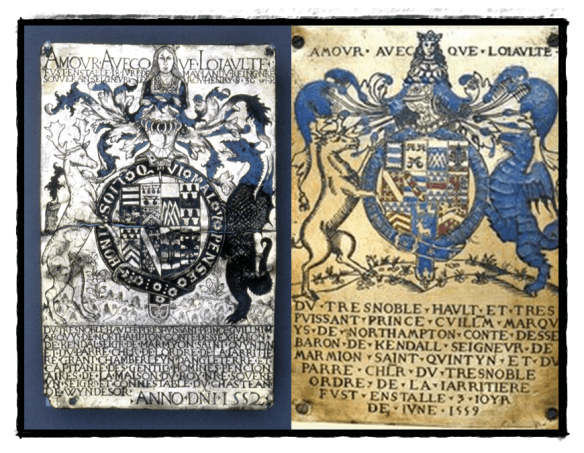
Two stall plates of Sir William Parr, Marquess of Northampton.

Two stall plates of Sir William Parr, Marquess of Northampton, 1552 and 1559.

LEFT: Garter stall plate of William Parr, 1st Marquess of Northampton, 1552. The plate was in St. George’s Chapel, Windsor Castle, among other Garter plates, but upon the ascension of Queen Mary, Parr was stripped of his titles. His stall plate was taken down and broken apart. Parr had been part of the conspiracy which put Lady Jane Grey on the throne instead of Mary Tudor.

Dv, tres noble, havlt ettre

savissant Prince Gvillmim arovys de Northampton, conte Dessex, Baron de Kendal, Seigr de Marmyon, saint Qvyntyn et dv Parre, Chlr de Lordre de la iarritie re grant chamberleyn dangleterre et capitanie des gentil homines pencion aires de la maison dv roy dre sovereyn seigr et connestable dv chastean de wyndesor; anno dni 1552.

RIGHT: Restored Knight of the Garter stall plate of William Parr, 1st Marquess of Northampton and Earl of Essex, 1559. Upon the ascension of Queen Elizabeth I, William Parr was restored to his titles and lands. Elizabeth also honored William’s separation from his adulterous first wife, Lady Anne Bourchier, which Queen Mary had proclaimed was null and void. William was allowed to continue his “common law marriage” with Elisabeth and she was treated as Marchioness of Northampton within the court and elsewhere. ROYAL COLLECTION.

DV tresnoble havlt et trespvissant prince cvillm, marqvys de northampton conte dessex baron de kendall seignevr de marmion saint qvintyn et dv parre chlr dv tresnoble order de la iarritiere fvst estalle 3 10yr de ivne 1559.

References

  1. Christopher Wordsworth. “Ecclesiastical biography or, Lives of eminent men, connected with the history of religion in England: from the commencement of the Reformation to the Revolution,” 3d edition, London: J.G. & F. Rivington, 1839.
  2. Sylwia S. Zupanec. “The daring truth about Anne Boleyn: cutting through the myth,” 8 November 2012.
  3. David Starkey. “Six Wives: The Queens of Henry VIII,” Chapter: Catherine Parr, HarperCollins, May 4, 2004.
  4. Thomas Willement. “Regal Heraldry: The Armorial Insignia of the Kings and Queen of England,” London: W. Wilson. 1821.

Family of Queen Katherine: Parentage of Margaret Parr, Lady Radcliffe

Sir Richard Radcliffe/Ratcliffe (d.1485)

Sir Richard Radcliffe/Ratcliffe (d.1485)

There seems to be a lot of confusion as to the parentage of Margaret Parr, Lady Radcliffe. Several sources state that she was the daughter of Sir William Parr of Kendal Castle, an ancestor of Queen Katherine Parr. Others state that she was the daughter of Sir William Parr, Baron Parr of Kendal, grandfather of Queen Katherine Parr. This cannot be despite an entry in the D.N.B. stating that she is the aunt of Queen Katherine!

“His maternal grandfather’s connection with the court as comptroller of the household to Edward IV will no doubt explain the origin of Radcliffe’s intimacy with Richard of Gloucester. He and his uncle, John Parr, were knighted by the king on the field of Tewkesbury, and Gloucester made him a knight-banneret during the siege of Berwick in August 1482 (Paston Letters, iii. 9; Davies, p. 48).”

The author, Sidney Lee, seems to be making a broad assumption here about a connection to William Parr, comptroller of the household of Edward IV. For in his article about William Parr he states that Parr only had one daughter, Anne.

Margaret Parr’s parents are in fact Sir Thomas Parr of Kendal (1407-1464) and Alice Tunstall. Her brother, Sir William Parr (grandfather of Queen Katherine), whom several sources have confused her as being the daughter of, wasn’t born until 1439. Margaret is stated as being born c.1440. Margaret and William both had a brother named John Parr [he was knighted and was made Sheriff of Westmoreland for life]. Margaret’s nephew, son of William, was ALSO named John Parr, Esq. He was not born until AFT 1483 [after the Battle of Tewskesbury on 4 May 1471 AND after the siege of Berwick]. He was never knighted.

Margaret’s husband, Thomas Radcliffe, was born on 28 November 1422; his son, Nicholas, would have born shortly after.

Possibly Thomas Radcliffe and Margaret Parr; Great Crosthwaite, Cumberland

Possibly Thomas Radcliffe and Margaret Parr; Great Crosthwaite, Cumberland

William Parr and Elizabeth FitzHugh [grandparents of Queen Katherine] had two daughters and three sons; Anne Cheney, Alice Parr (d. young), Sir Thomas, Sir William, and John, Esq. D.N.B ENTRY ON SIR WILLIAM PARR

Sources for Margaret Parr (c.1440) being the sister of William Parr (born 1439; grandfather of Queen Katherine Parr); both children of Sir Thomas Parr and Alice Tunstall:

  1. Edward Baines, William Robert Whatton, Brooke Herford, James Croston. “The history of the county palatine and duchy of Lancaster,” Volume 5, J. Heywood, 1893. pg 20.
  2. Douglas Richardson. “Magna Carta Ancestry: A Study in Colonial and Medieval Families“2nd Edition, 2011. pg 298.
  3. Sir Bernard Burke. “A Genealogical History of the Dormant, Abeyant, Forfeited, and Extinct Peerages of the British Empire,” Harrison, 1866. pg 418.
  4. Linda Porter. “Katherine the Queen: The Remarkable Life of Katherine Parr, the Last Wife of Henry VIII,” Macmillan, Nov 23, 2010.
  5. Susan James. “Catherine Parr: Henry VIII’s Last Love,” History Press, Jan 1, 2009.

Through their son Sir Edward Radcliffe, they were ancestors to Lady Elizabeth Bowes-Lyon, mother of HM Queen Elizabeth II. [Source: John Burke, George Ormerod. ”A genealogical and heraldic history of the commoners of Great Britain and Ireland enjoying territorial possessions or high official rank, but uninvested with heritable honours,” Volume 2, Genealogical Pub. Co., 1977.]