17 February: the Duke of Najera’s Visit to Court


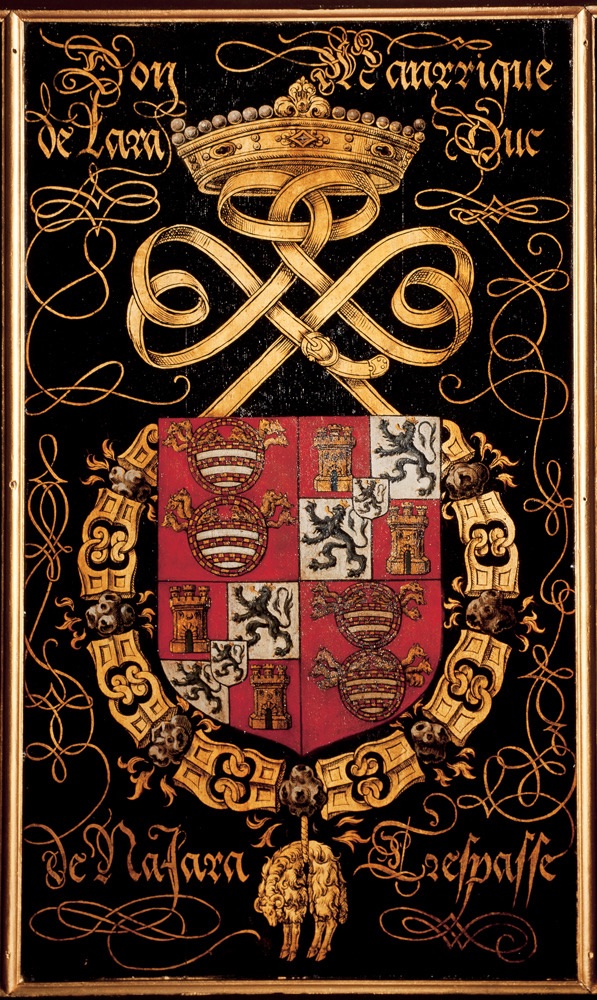
Coat of arms of the 
3rd Duke of Nájera, knight of the 
Order of the Golden Fleece, in the 
Cathedral of Ghent (Wikipedia)

Written by Meg McGath

On 17 FEBRUARY 1544, Sir William Parr, Earl of Essex and Sir Henry Howard, Earl of Surrey dined with the Spanish envoy to Charles V of Spain, Don Juan Esteban, Manriquez de Lara, the Duke of Najera, at his Palace lodgings and afterwards they took the Duke to Westminster to introduce him to King Henry VIII who received him graciously.

Juan Esteban Manrique de Lara y Cardona, 3rd Duke of Najera (1504-1558) was a Spanish diplomat from the court of Charles V, King of Spain and Holy Roman Emperor, who was cousin to Lady Mary.

On the occasion of the visit of the Duke of Najera, the Queen was called to entertain as the King was indisposed. The Queen and her ladies were dressed in different silks, with splendid headdresses. The Queen was sumptuously clothed and adorned by jewels. Kateryn was praised as having “a lively and pleasing appearance,” and for being “a virtuous woman.” (Armbruster) The Lady Mary, future Queen, was also there to entertain as well as Henry’s niece, Lady Margaret Douglas.
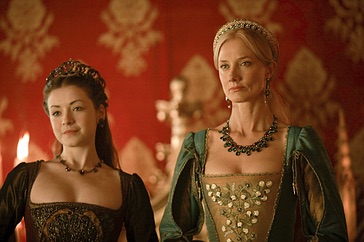
Queen Kateryn (Catherine) Parr (Joely Richardson) and the Lady Mary (Sarah Bolger) in “The Tudors” (2010)

In Season 4 of “The Tudors”, we see the actress Joely Richardson as Queen Kateryn (Catherine) Parr along with Lady Mary played by Sarah Bolger. In the show, the Duke of Najera is sent to the court of King Henry VIII of England in London, and he is entertained by Henry Howard, Earl of Surrey. There is no mention of the Queen’s brother, William, the Earl of Essex, in the show. The Duke of Najera talks about seeing the Tower of London and the swans along the River Thames before being brought to meet with the King. He speaks of the marvels of the River Thames and the circus show that Surrey brought him to.

The Queen introduces the Duke of Najera to the Lady Mary in “The Tudors” (2010)

Later on he attends festivities at court led by Queen Kateryn and Lady Mary. The Queen introduces herself and Mary who speaks to the Duke in almost perfect Spanish, to his surprise, to which she responds, “Am I not my mother’s daughter?”.
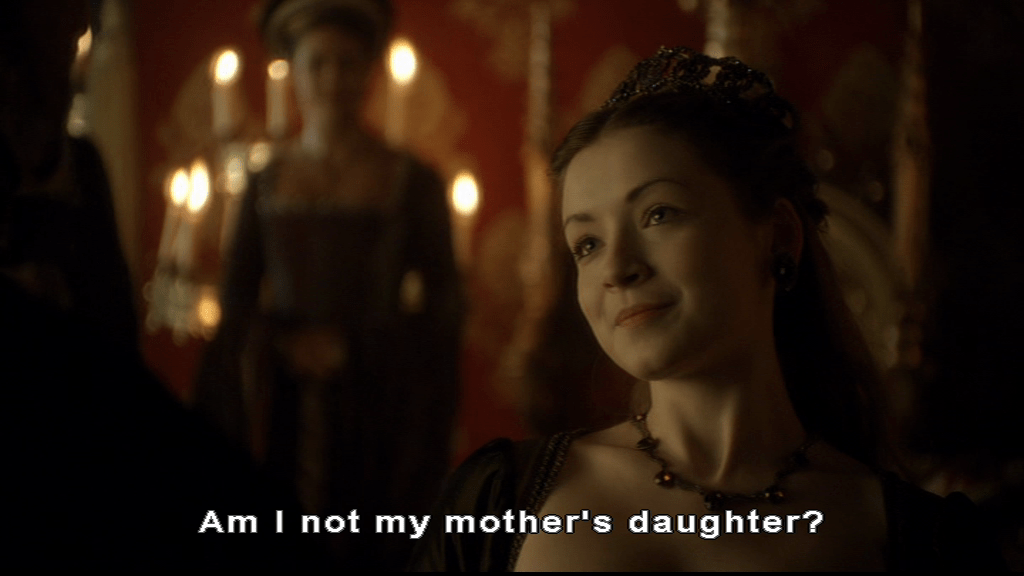
Lady Mary as played by Sarah Bolger in “The Tudors” (2010)

He is introduced to the Queen and kisses her hand, and the Queen immediately introduces him to Princess Mary, who intends to reduce this handsome Iberian to dust with a charm and awe offensive. She starts, as she was reported actually historically doing, by giving the Duke the good old “English Gentlewoman’s Formal Hello”, an often surprising kiss right on the lips.

Before the poor, young, worldly general has time to recover, The Tudors‘ Mary follows it up with dropping into what (to my uneducated and unpractised ear) sounds like maybe not completely fluent but pretty good Spanish that gets more confident as she goes on. 

During the visit of the Duke of Najera, Kateryn is recorded historically as wearing her favorite colour, crimson — sadly, not the lovely shade of green shown in “The Tudors”! The color name “jade green” was first used in Spanish in the form “piedra de ijada” in 1569. The first recorded use of “jade green” as a color name in English was in 1892.
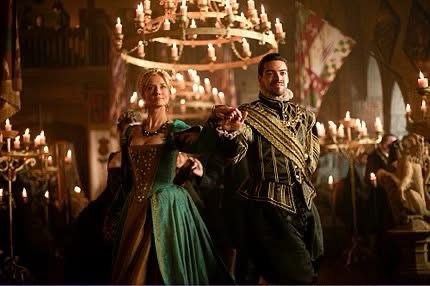
The Queen (Joely Richardson) and the Duke of Najera (Fabio Tassone) dance together in “The Tudors”, Season 4, episode 7 (2010).

The song used in “The Tudors” scene where the Queen and Duke dance together is “Dansereye: Rondes I & VII”. The song was also used in the movie “Elizabeth” in 1998 during the scene where Robert Dudley proposes and there is attempt on the Queen’s life.

Sources

© 2025 Meg McGath. All research and original commentary belong to the author.

20 September: Queen Katherine Parr’s Letter in Latin to Princess Mary

Written by Meg McGath

The official date of the letter is actually confusing. It was either written while Katherine Parr was Queen Regent in 1544 or as Dowager Queen in 1547.

The messenger mentioned in the letter is most likely Walter Erle, groom of the Queen’s privy chamber, who also served as her musician on the virginals, but possible Robert Cooch, steward of her wine cellar whose skill in music was commended by Parr’s chaplain, John Pankhurst.

Also mentioned in the letter is Francis Mallet who became chaplain to the Princess Mary in 1544 leaving the employment of Parr. (Wikipedia)

While the reasons are many, most notable and most beloved lady, that readily invite me at this time to writing, still nothing quite so much moves me as care for your health, which as I hope it is the best, so I very greatly desire to be made of certain of it. Wherefore, I send you this messenger who, I judge, will be very pleasing to you both because of his skill in music, in which, I am not unaware, you as well as I delight exceedingly, and also because he, having been in service to me, can report to you most certainty on my whole state and health. And truly, before this day it was in my mind to have made a journey to you and greeted you in person, but indeed not all things answer to my will: I hope now that, at a very early day this winter, you will be visiting us. Then which truly nothing will be a greater joy or a greater pleasure.

Since, however, as I have heard, the last touch has now been put by Mallet on Erasmus’s work On John (which he saw through translation), and nothing else now remain except some due attention and care to be applied in correcting it, I pray you to send to me this very fine and very useful work, now emended by Mallet or someone of yours, that it may be given to the press in its time. And further, that you signify whether you wish it to go out most happily into the light under your name, or whether rather by an unknown author. To which work really, in my opinion, you will be seen to do an injury, if you refuse the book to be transmitted to posterity on the authority of your name: for the most accurate translating of which you have undertaken so many labors for the highest good of the commonwealth; and more than these (as is well enough known) you would have undertaken, if the health of tour body had permitted. Since no one does not know the amount of sweat that you have laboriously put into this work, I do not see why you should reject the praise that all confer on you deservedly. However, I leave this whole matter to your prudence, so that whatever position you wish to take, I will esteem it most greatly to be approved.

As for the sum of money you sent to me as a gift, I thank you exceedingly. I pray the most good and most great God that He will think it fit to bless you perpetually with true and unblemished happiness: in whom, indeed, may you fare well a very long while. From Hanworth September 20.

You most devoted and most loving,
Katherine the Queen KP

Hanworth by David Bridges

Sources

Katherine Parr: Works and Correspondence by Katherine Parr, Janel Mueller (Google eBook preview)

© 2024 Meg McGath. All research and original commentary belong to the author.

18 September 1544: Proclamation of the Queen Regent

Written by Meg McGath

During her regency in 1544, Queen Kateryn Parr issued five proclamations. The following was written on the 18th of September in 1544. The proclamation was made at the outbreak of plague to keep people who had been exposed away from the court at Oking (Woking) Palace in Surrey where she and the children of the King resided.

No. 19 The Queen Regent’s proclamation that no person exposed to the plague may come to court, September 18, 1544

[Headed] The 36th year of Henry VIII. 1544.

A proclamation that no person, in whose house the infection of the plague doth reign, shall repair to the court.

King Henry VIII to the mayor, alderman, and the citizens of London, greetings. We charge you that

Forasmuch as the Queen’s highness, General Regent of the realm in the King’s majesty’s absence, hath been incredibly informed that the infection of the plague reigneth in sundry parts within these the cities of London and Westmister, whereby great danger might ensure to her grace’s person, the Prince’s grace, and the other the King’s majesty’s children, in case any of the inhabitants of the said cities, who have had the infection in their houses, or have resorted to any infected persons, or dwell near any place where the infection is or lately hath been, should repair to court or permit any of those which attend in the court to enter their houses:

Her highness straitly chargeth and commandeth that no manner of person or persons, in whose houses the plague is or hath been, or have resorted to any other infected persons, or dwell near any place where the infection is or lately hath been, do from henceforth repair to the court, or do suffer any of the attendant of the said court to enter their houses where the infection hath been, upon pain of her grace’s indignation, and further punishment at her highness’s pleasure.

And of this, under the applicable legal penalty, let nothing to all be omitted. By Katherine, Queen of England, and its General Regent. From Oking, the eighteenth day of September, the thirty-sixth year of our reign.

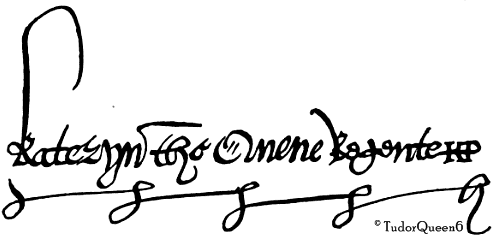
Here is one of the documents found at the National Archives from 1547, after the death of Henry that was signed “Kateryn the quene Regente-KP”

Image credit: Elizabeth Norton

Source: Katherine Parr: Complete Works and Correspondence By Katherine ParrJanel Mueller · 2011 (Google eBook)

© 2024 Meg McGath. All research and original commentary belong to the author.

Queen Katherine Parr: Not Important Enough?

I love how much people dismiss Queen Kateryn Parr. There may be evidence that she WAS supposed to be Regent for Edward VI. See her signature AFTER Henry died.

Credit: Elizabeth Norton

She was apparently signing as “Kateryn, the quene regente KP”. The theory goes that she was indeed made Regent for her stepson, King Edward VI. Which would make sense with the use of her signature. It is believed that Edward Seymour, Duke of Somerset, Kateryn’s brother the Marquess of Northampton, her brother-in-law the Earl of Pembroke and the council ousted her and rewrote the will. She would have made a wonderful Queen Regent. She proved she was capable of being Regent while Henry went to war with France. Perhaps she would have lived longer and prevented the succession from being rewritten. She gets credit for the placement of Princesses Mary & Elizabeth back into the line of succession behind their brother in 1545. That succession act seems to have overwritten or they disregarded King Edward’s will and supported the actual heir to the throne, Mary. Mary WAS the rightful heir. Jane was further down the approved line of succession. Why would you accept someone below the status of the actual daughters of King Edward’s father, Henry VIII? Kateryn Parr’s brother and brother in law were again involved in matters of the state and actually pulled off putting Lady Jane Grey on the throne for 9 days! Jane somehow outranked her own mother who was STILL alive and technically would have been the next heiress to the throne after Princesses Mary & Elizabeth. I never understood that. The Protestants feared the Catholic “Bloody Mary” (her nickname was started as Protestant propaganda, the pro Queen Elizabeth movement, lol) would try to return the country to the Pope and Catholicism. Mary was deeply religious. Kateryn Parr and Mary got on despite differences in matters like religion. Parr’s mother, Lady Maud, had served Mary’s own mother, Queen Katherine of Aragon, the first wife and crowned Queen consort to King Henry. The two women were pretty close. The Parrs backed Queen Katherine of Aragon when her lady in waiting became the Kings new obsession. Parr let Mary be and encouraged her every chance she could. One could argue she loved Mary more than Elizabeth. Heck, Kateryn named her only daughter and child, Mary, before the queen passed on 5 September 1548. Don’t think there were any other important Marys. The French Queen, Mary Tudor, had died long before Parr became Queen. Pretty sure it’s not after The Virgin Mary. Protestants aren’t that attached to her, right? I was raised Catholic, so I honestly don’t know. Anyway, Queen Kateryn Parr was VERY important. Read a book. She wasn’t an ex-queen. She remained Queen (consort) of England, Ireland, and France until she died. She was the LAST Tudor Queen Consort as King Edward died young. She was also the FIRST Queen of Ireland. Her funeral was the FIRST Protestant funeral for a Queen. Her mourner was none other than Lady Jane Grey, who would have probably stayed with Kateryn had the queen lived. Having Parr around seemed to pacify things. She knew how to handle tricky and dangerous situations. For Gods sake, she almost lost her head after she spoke with the King. It was overheard by the queens enemy, Bishop Gardiner, who saw an opportunity to “get rid” of Kateryn. I mean why not? He already KILLED TWO WIVES!! Lordy, so Gardiner tried to fuck with the Kings head. Saying shit like “it is a petty thing when a woman should instruct her husband” or some stupid sexist bs! Story goes, Kateryn was warned by an anonymous source who found her death warrant lying on the ground. YEAH RIGHT!! That’s straight up narcissistic abuse, my man!! Why do I feel like Henry set her up to test her loyalty? He was such a theatrical douche bag. No, no love for King Henry here. I have yet to see the film “Firebrand” which follows the reign of Kateryn as queen consort and queen Regente I believe. It’s based off Elizabeth Freemantle’s “Queen’s Gambit”. Anyway, Kateryn talked her way out of being arrested or worse by stroking the Kings ego and basically submitting to him just to fuvking survive. Imagine going through this marriage without psych meds like Benzos. I do believe they dabbled in potions however and she was known to “treat” melancholy with herbs from the gardens. Sudeley Castle where she is buried has a garden full of deadly herbs. Physic gardens. I have photos somewhere…

My page: Queen Catherine Parr

© 2024 Meg McGath. All research and original commentary belong to the author.

25 August 1544: The ‘Quene Regente’ writes Henry VIII

[Endorsed] The queen’s Grace to the King’s majesty 25 August 1544

[Addressed] To the King’s most excellency majesty

Pleaseth it your majesty to be advertised: albeit I had at this present none occurrences of importance to be signified unto your highness, your realm being, thanks to almighty God, in very good order and quiet: yet, foreasmuch as Richard Higham is at this time dispatched hence unto your majesty with a mass of twenty thousand pounds, I thought it my duty to advertise your majesty of the sending of the same, praying almighty God to send your majesty continuance of health and most prosperous success in all your highness’s most notable enterprises.

My Lord Prince and the rest of your majesty’s children be in very good health. And thus, with my most humble commendations unto your majesty, I pray almighty God have the same in His most blessed keeping. From your majesty’s honor of Hampton Court, the twenty-fifth of August, the thirty-sixth year of your majesty’s most noble reign.

Your grace’s most humble, loving wife and servant,

Kateryn the quene, KP

Katherine Parr: Complete Works and Correspondences edited by Janel Mueller, 2011. (Google eBooks preview)

It was in August of 1544 that the General Regent is recorded as signing her letter “Kateryn the quene Regente, KP” keeping with her signature of “Kateryn the quene, KP” as consort.

Source: “Henry VIII: July 1544, 21-25.” Letters and Papers, Foreign and Domestic, Henry VIII, Volume 19 Part 1, January-July 1544. Eds. James Gairdner, and R H Brodie. London: His Majesty’s Stationery Office, 1903. 581-596. British History Online. Web. 26 August 2023. http://www.british-history.ac.uk/letters-papers-hen8/vol19/no1/pp581-596.

Katherine’s signature as Queen Regent.

Queen Katherine Parr: Letter Up for Auction

Queen Katherine Parr | Letter signed, announcing her marriage to Henry VIII, 20 July 1543
Sotheby’s
“To our right dear and entirely beloved brother, the Lord Parr, Lord Warden of the Marches,” Sotheby’s

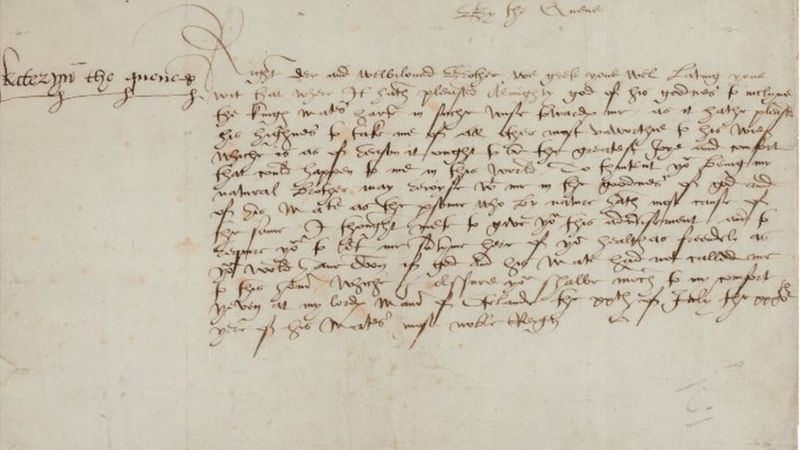
Right dear and well-beloved brother, we great you well. Letting you wit that when it hath pleased almighty God of His goodness to incline the King’s majesty in such wise towards me, as it hath pleased his highness to take me of all others, most unworthy, to his wife, which is, as of reason it ought to be, the greatest joy and comfort that could happen to me in this world:

To the intent, you being my natural brother, may rejoice with me in the goodness of God and of his majesty, as the person who by nature hath most cause of the same, I thought meet to give your this advertisement. And to require you to let me sometime hear of your health as friendly as you would have done, if God and his majesty had not called me to this honor: which, I assure you, shall be much to my comfort. Given at my lord’s manor of Oatlands, the twentieth of July, the thirty-fifth year of his majesty’s most noble reign.

Kateryn, the quene

Katherine Parr: Complete Works and Correspondences, editor Janel Mueller. University of Chicago, 2011. pg 46.

Letter signed (“Kateryn the queen”), to her brother William Parr,

ANNOUNCING HER MARRIAGE TO KING HENRY VIII, explaining that “It hath pleased Almighty god of his goodness to incline the Kinges ma[jes]tes harte in suche wise towards me”, celebrating an event which is “the greatest Joye and comfort that could happen to me in this world”, and inviting her brother to “rejoyse with me in the goodness of god and of his Ma[jes]te”, 1 page, oblong folio, Oatlands, 20 July 1543, integral address leaf (“To our right der and entirely beloved Brother the Lord Parre Lord Warden of the Marches…”), docketed, fragile at folds, crude repair to marginal tear, spotting

HENRY VIII’S FINAL QUEEN ANNOUNCES HER MARRIAGE TO THE KING. This remarkable letter was written just days after the marriage between the aging Henry VIII and his final Queen. The wedding ceremony had taken place on 12 July in the Queen’s Closet at Hampton Court Palace, attended by only 18 people. The couple immediately started on the court’s summer progress and this letter was written from the first stop on their journey, Oatlands Palace in Surrey.

Description of Lot from Sotheby’s

The letter is up for auction. I noticed that this is not her handwriting and her signature is not followed by her maiden initials KP. Did the initials come later in her reign as queen?

Queen Katherine Parr: The Cameo Beads

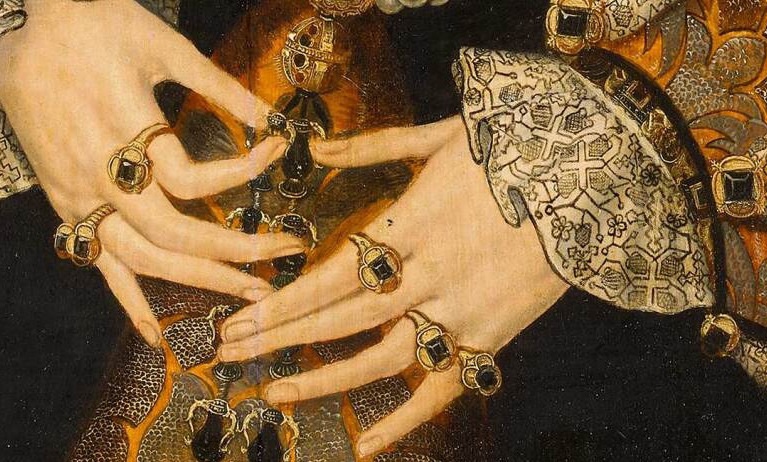
PORTRAIT JEWELRY DETAIL OF QUEEN KATHERINE PARR

Katherine Parr
attributed to Master John
oil on panel, circa 1545
71 in. x 37 in. (1803 mm x 940 mm)
Purchased with help from the Gulbenkian Foundation, 1965
Primary Collection
NPG 4451

Katherine Parr was a true Renaissance queen. The Renaissance was literally a time of the rebirth of Classical knowledge and learning, and humanists venerated the wisdom of Ancient scholars, spending their time translating and philosophising of the surviving texts. And of course, this fascination with Antiquity was reflected in other areas of society, such as art, literature, even dress. Katherine was very engaged with humanist scholars and participated in humanist activities such as the study of languages and the translation of classical texts. This appreciation of classical learning can even be seen in her portraiture.

The National Portrait Gallery houses a portrait of Katherine painted by Master John, an artist we know little about except he unusually seems to have been English born, and he had an incredible eye for detail in his work. The portrait is dated to 1545, a year or two into her third marriage to Henry VIII, and is one of three contemporary portraits of Katherine that are extant (for more on Catherine’s contemporary portraits, see my post here: https://tinyurl.com/2p973nph ). It is a beautiful portrait, however it is very easy to miss the exquisite detail work that has gone into it. I certainly did, until I read the wonderful Nicola Tallis’ ‘All The Queen’s Jewel’s, 1445-1548,’ which discusses the minutiae of the jewels of the Tudor queens, as can be found in a whole range of different records, including inventories and portraits.

Up close of the NPG 4451

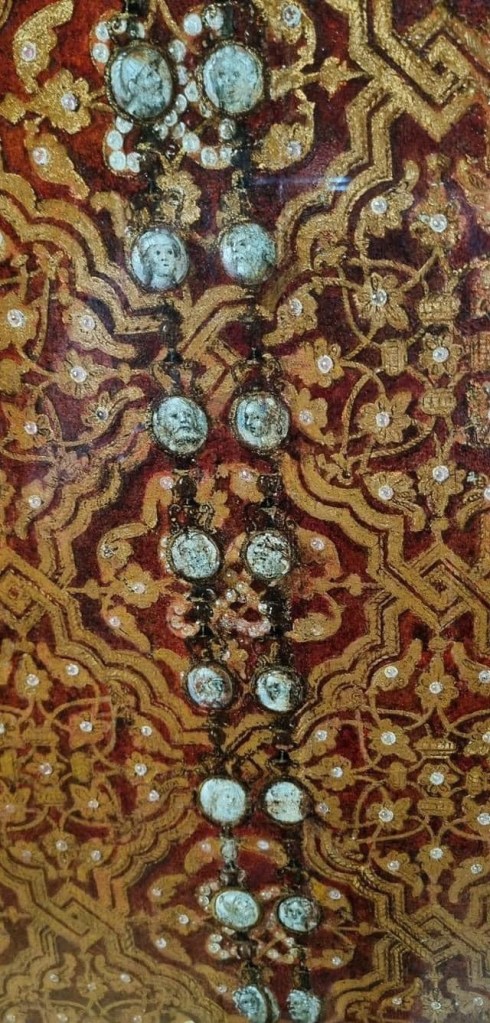
Several aspects of this particular portrait are highlighted by Nicola, but I think the most fascinating are the girdle beads hanging from Katherine’s waist. At first glance, they seem like any other girdle beads – a standard accessory for any Tudor lady – but once you get up close and personal to the portrait, it becomes clear that each bead is a cameo face.

From Nicola Tallis, All the Queen’s Jewels

Cameos were very fashionable, very valuable, and very rare during this period. They most commonly depicted figures from the Ancient world, just as these ones do. In this portrait, the uniqueness of each cameo suggests that each one was supposed to represent a specific figure from Antiquity. Unfortunately, their identities have not survived. From Parr’s inventories as queen we do know that she owned a number of cameos and jewels with ‘antiquez personz.’ From Katherine’s records, and by comparing inventories, we know that some of these pieces were actually inherited from her predecessors, Jane Seymour and Katherine Howard, whilst others were commissioned by Katherine herself.

That Katherine carefully selected this piece to be portrayed in is significant. It shows how much she valued her own learning, and it aligned her with the brightest minds of her day. It also showed her status, to be able to afford such a valuable item. It signalled that she was a lady of learning, and a queen that humanists could approach for patronage.

These cameo beads are such a small detail, but they speak volumes about fashion trends, the skill of the artist, and the character of Katherine herself.

Reference: Nicola Tallis ‘All the Queen’s Jewels’. Pages 126-127 discuss this portrait and the beads in particular, and there is a discussion about the use of cameos and ‘antique faces’ in jewellery on page 87. Thanks to Jessica Carey-Bunning for researching!

More reading

How did the portrait become reidentified as Katherine Parr in 1996?

National Portrait Gallery’s 4451 Conservation

Susan James. Lady Jane Grey or Queen Kateryn Parr?, Burlington Magazine, vol. 138, January 1996, pp. 20-4.

Queen Katherine Parr: Prayers or Meditations (1545)

“She was the first queen of England to write and publish her own books and to become a recognized author during her lifetime and the first Englishwoman to publish a work of prose in the sixteenth century.” (Susan James, “Catherine Parr: Henry VIII’s Last Love”, 2010, pg 12)

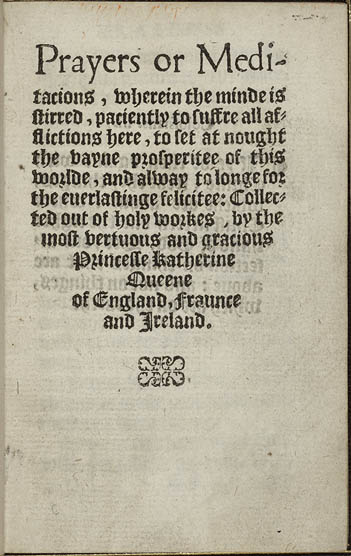
“The first edition of Queen Katherine Parr’s Prayers or Meditations appeared on June 2, 1545, under the title Prayers stirryng the mynd vnto heauenlye medytacions. This volume reprinted the two non-Biblical prayers—one for King Henry, the other for men to say going into battle—that concluded her translation Psalms or Prayers, published a year earlier. A second edition with the same contents, bearing the same date, carried the title Prayers or meditacions, wherin the mynde is styrred paciently to suffre all afflictions here. The definitive version (the third edition) appeared on November 6, 1545, under the title PRAYERS OR Medytacions, wherein the mynd is stirred, paciently to suffre all afflictions here, to set at nought the vayne prosperitee of this worlde, and alwaie to longe for the everlastynge felicitee: Collected out of holy wookes by the most vertuous and graciouse Princesse Katherine quene of Englande, Fraunce, and Irelande.1 This volume concluded with four prayers that may well be Queen Katherine’s compositions, the latter of the two just mentioned and three others that gradate from a public to a private perspective: “A devout prayer to be daily said,” “Another prayer,” and “A devout prayer.” The first two editions, identical except for their titles, and the third, definitive one rapidly gained popularity with English readers, who often knew the work as “The Queen’s Prayers.” Thirteen editions appeared before the end of the sixteenth century.” (Parr, Katherine, and Janel Mueller (ed.). “Introduction to Prayers or Meditations (1545).” In Katherine Parr: Complete Works and Correspondence. Edited by Janel Mueller (ed.).University of Chicago Press, 2011. Chicago Scholarship Online, 2013. https://doi.org/10.7208/chicago/9780226647265.003.0009.)

Folger Shakespeare Library PDI Record: — Call Number (PDI): STC 4824a Creator (PDI): Catharine Parr, Queen, consort of Henry VIII, King of England, 1512-1548. Title (PDI): [Prayers stirryng the mind unto heavenlye medytacions] Created or Published (PDI): [1550] Physical Description (PDI): title page Image Root File (PDI): 17990 Image Type (PDI): FSL collection Image Record ID (PDI): 18050 MARC Bib 001 (PDI): 165567 Marc Holdings 001 (PDI): 159718 Hamnet Record: — Creator (Hamnet): Catharine Parr, Queen, consort of Henry VIII, King of England, 1512-1548. Uniform Title (Hamnet): Prayers stirryng the mind unto heavenlye medytacions Title (Hamnet): Praiers Title (Hamnet): Prayers or meditacions, wherein the minde is stirred, paciently to suffre all afflictions here, to set at nought the vayne prosperitee of this worlde, and alway to longe for the euerlastinge felicitee: collected out of holy workes by the most vertuous and gracious princesse Katherine Queene of England, Fraunce, and Ireland. Place of Creation or Publ. (Hamnet): [London : Creator or Publisher (Hamnet): W. Powell?, Date of Creation or Publ. (Hamnet): ca. 1550] Physical Description (Hamnet): [62] p. ; 8⁰. Folger Holdings Notes (Hamnet): HH48/23. Brown goatskin binding, signed by W. Pratt. Imperfect: leaves D2-3 and all after D5 lacking; D2-3 and D6-7 supplied in pen facsimile. Pencilled bibliographical note of Bernard Quaritch. Provenance: Stainforth bookplate; Francis J. Stainforth – Harmsworth copy Notes (Hamnet): An edition of: Prayers stirryng the mind unto heavenlye medytacions. Notes (Hamnet): D2r has an initial ‘O’ with a bird. Notes (Hamnet): Formerly STC 4821. Notes (Hamnet): Identified as STC 4821 on UMI microfilm, reel 678. Notes (Hamnet): Printer’s name and publication date conjectured by STC. Notes (Hamnet): Running title reads: Praiers. Notes (Hamnet): Signatures: A-D⁸ (-D8). Notes (Hamnet): This edition has a prayer for King Edward towards the end. Citations (Hamnet): ESTC (RLIN) S114675 Citations (Hamnet): STC (2nd ed.), 4824a Subject (Hamnet): Prayers — Early works to 1800. Associated Name (Hamnet): Harmsworth, R. Leicester Sir, (Robert Leicester), 1870-1937, former owner. Call Number (Hamnet): STC 4824a STC 4824a, title page not for reproduction without written permission. Folger Shakespeare Library 201 East Capitol Street, SE Washington, DC 20003

Queen Katherine: Letter to Lady Wriothesley

Queen Katherine writes to Lady Wriothesley after the death of her son. The letter suggests that the two were not the best of friends. Katherine comes off a tad parental in her letter.

Good my lady Wriothesley,

Understanding it hath pleased God, of late, to disinherit your son of this world, of intent he should become partner and chosen heir of the everlasting inheritance (which calling and happy vocation ye may rejoice), yet when I consider you are the mother by flesh and nature, doubting how you can give place quietly to the same, inasmuch as Christ’s mother, endued with all godly virtues, did utter a sorrowful, natural passion of her Son’s death, whereby we have all obtained everlastingly to live: therefore…I have thought with mine own hand to recommend unto you my simple counsel and advice desiring you not to so utter your natural affection by inordinate sorrow that God have cause to take you as a m[urm]urer against His appointments and ordinances.

For what is excessive sorrow but a plain evidence against you, that your inward mind doth repine against God’s doings, and a declaration that you are not contented God hath put your son — but nature, but His by adoption — in possession of the heavenly kingdom? Such as have doubted of the everlasting life to come doth sorrow and bewail the departure hence. But those which be persuaded that, to die here, is life again, do rather hunger for death, and count it a foolish thing to bewail it as utter destruction. How much, Madam, are you to be counted godly wise that will and can prevent, through your godly wisdom, knowledge, and humble submission, that thing that time would at length finish? If you lament your son’s death, you do him great wrong and show yourself to sorrow for happiest thing there ever came to him, being in the hands of his best Father. If you be sorry for your own commodity, you show yourself to live to yourself…

Source

Mueller J. (ed.) Katherine Parr – Complete Works and Correspondences, Chicago, 2011, pp. 80-81.