Unknown's avatar

About tudorqueen6

Meg McGath is the author behind the articles on “tudorqueen6”; she has been studying the history and genealogy of the Parr family for well over a decade. In 2025, she is still writing about her favorite Tudor queen, Kateryn Parr (1512-1548) even after becoming severely disabled. Meg studied at several top colleges which included Richmond University in London. As a violinist, she studied at Penn State Music School & Towson University School of Music where her minor became Women’s Studies. In 2009, ‘10, and ‘12, her summers were spent studying abroad in London where she was lucky enough to see Tudor artifacts, Palaces, and Sudeley Castle where Parr is officially buried. One of her goals is to end the myth that Queen Kateryn Parr was nothing more than a nursemaid to the aging King Henry VIII. "It simply isn't true, she did so much more for the family and her country," says Meg. A book has always been her end game with Parr, but as stated, she is now disabled and can only write on occasion. She was a moderator and heavy editor for the official Tudors Wiki (Showtime), has a massive genealogy tree she’s been working on since the late 2000s on Ancestry which follows Royalty, aristocratic families, and even Colonial Aristocratic lineage. She heavily edits & has started articles on Wikipedia. She also spent a lot of time writing & researching Royal tiaras and jewels of various Royal families & the weddings of the British Royals. Her research can be found on the old Tudor Wiki site under the name “Goldenaged.ER”. In the summer of 2012, she finally took a trip to Sudeley Castle while studying abroad. In London, she was privy to the Queen’s Diamonds at Buckingham Palace which included pieces like the Queen Alexandra Diamond Kokoshnik, the Williamson Brooch, the Delhi Durbar necklace, the small crown of Queen Victoria, and more.

Bridgerton Films at Wilton House

Written by Meg McGath

The Earl of Pembroke’s Wilton House was used in the Netflix Series “Bridgerton”. 

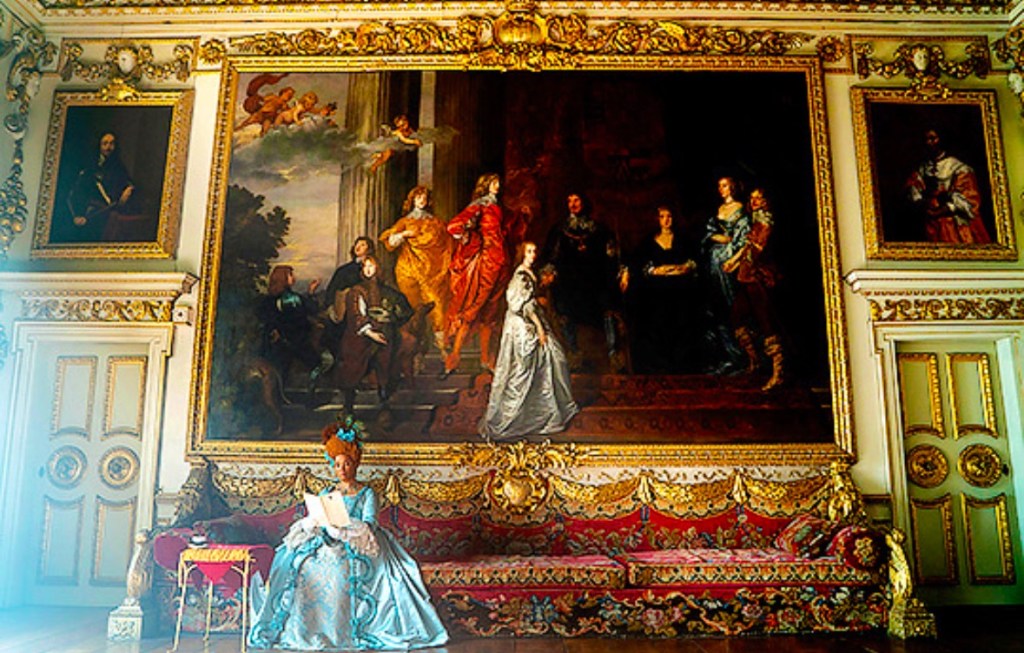
The character, Queen (consort) Charlotte of Mecklenburg-Strelitz, is seen in Wilton House reading in front of the portrait of the 4th Earl of Pembroke and his family by Anthony Van Dyck. Philip, Lord Pembroke, was a grandson of Lady Anne (Parr), Countess of Pembroke and her only husband, Sir William, 1st Earl of Pembroke. 

The character Queen Charlotte from Netflix’s “Bridgerton” played by Golda Rosheuvel at Wilton House in Wiltshire, England.

Wilton House has been used in several shows & movies which includes Pride & Prejudice (2005). The portrait is humongous!

VAN DYCK’S PHILIP HERBERT, 4TH EARL OF PEMBROKE, WITH HIS FAMILY

Philip Herbert, 4th Earl of Pembroke, and his Family (1635 – oil on canvas – 330 x 510 cm<) is the largest painting ever made by Anton van Dyck, a joint portrait of the 4th Earl of Pembroke, his wife and children. All figures are slightly larger than life size and the impressive painting dominates the so-called Double Cube room at Wilton House, the Pembroke’s ancestral home for over four and a half centuries.

Anton Van Dyck, Philip Herbert, 4th Earl of Pembroke, with his Family, c. 1635 © Ph. Will Pryce | Collection of The Earl of Pembroke & the Wilton House Trust

Sources Used

• VAN DYCK’S PHILIP HERBERT, 4TH EARL OF PEMBROKE, WITH HIS FAMILY The Factum Foundation for Digital Technology

© 2025 Meg McGath. All research and original commentary belong to the author.

Women of the Tudor Period: Margaret of Austria

Written by Meg McGath

Margaret of Austria (10 January 1480 – 1 December 1530) was Governor of the Habsburg Netherlands from 1507 to 1515 and again from 1519 until her death in 1530. She was the first of many female regents in the Netherlands. She was variously the Princess of Asturias, Duchess of Savoy, and was born an Archduchess of Austria.

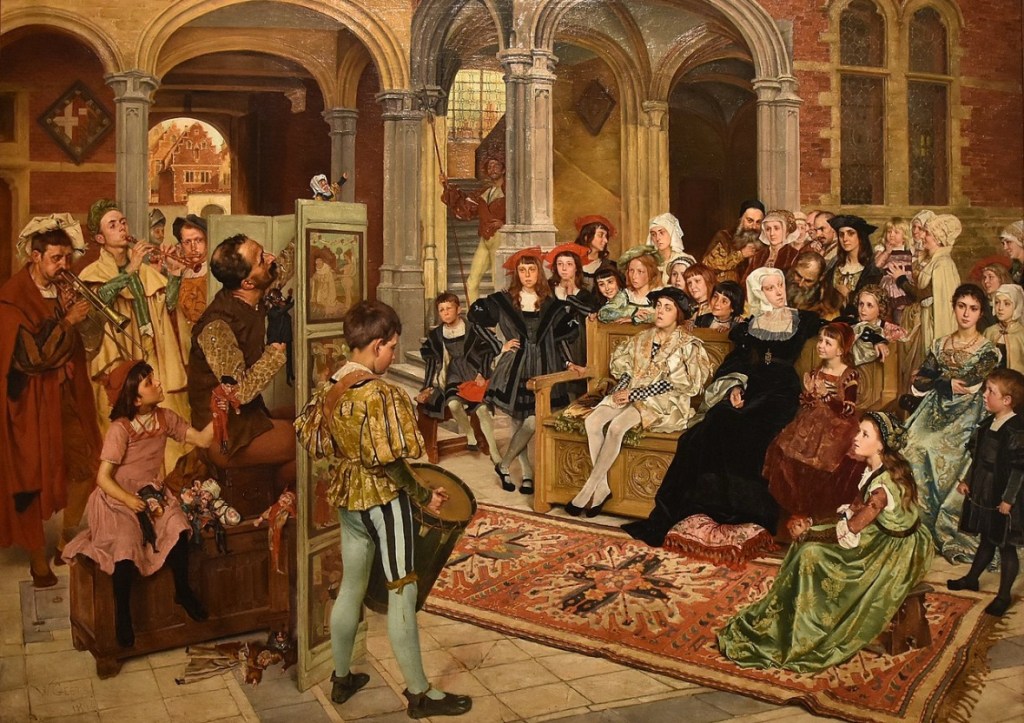
Margaret of Austria sits with her nephew, Charles V and his sisters. Willem Geets (1892)

Margaret was the second child and only daughter of Maximilian of Austria (future Holy Roman Emperor) and Mary of Burgundy, co-sovereigns of the Low Countries. She was named after her step grandmother, Margaret of York, who was sister to the York Kings Edward IV and Richard III.

Margaret was married to John, Prince of Asturias who was heir to Ferdinand II of Aragon & Isabel I of Castile. John was the eldest brother of future Queen Katherine of Aragon. Margaret’s brother married their sister, the future Juana I of Castile. That made Margaret a sister-in-law to Katherine and Juana. 

When the Prince died, Margaret stayed in Spain. In her time as Dowager Princess, it was suggested that she should teach her teenage sister-in-law, Katherine of Aragon, French. 

In 1501, Margaret married Philibert II, Duke of Savoy (1480–1504), whose realm played a decisive role in the rivalry between France and the Habsburgs.

Margaret was also familiar with English Ambassador Sir Thomas Boleyn, the father of the future Queen Anne Boleyn. In the Spring of 1513, a young Anne was sent to Margaret’s “Court of Savoy” at Mechelen Castle in Belgium. Anne was there until the late summer of 1514 when she moved to Paris to attend Queen Claude of France. Anne was eventually sent back to the English court of King Henry VIII of England. She became a lady to Katherine of Aragon who had married secondly to King Henry. By 1526, Henry became attracted to Anne after having an affair with her sister, Mary. Henry would go to extreme measures to move heaven and earth for Anne. In actuality, Henry just really needed to remarry and have a son. His current wife, Queen Katherine, would be banished from Court and would die alone as “Dowager Princess of Wales”. Their daughter Mary never saw her mother again. Mary would eventually become the first Queen Regnant of England and Ireland and Queen of Spain by marriage to Philip II who was a descendant of Margaret’s brother, Philip, who married Juana, Queen of Castile who was sister to Katherine of Aragon.

Willem Geets imagines (1892) a puppet show at Margaret’s court; the future Charles V sits next to her, with his sisters alongside.

The seated girl at right may be intended to be Anne Boleyn. No source is named on Wikipedia as to who thought the young girl is actually Anne Boleyn as of January 25th, 2025.

Is this Anne Boleyn?

© 2025 Meg McGath. All research and original commentary belong to the author.
The Elizabeth & Thomas Soap Opera

BRAVO @katherineparrsociety!!

The “Elizabeth and Thomas” Soap Opera we dare not discuss. Did Parr try to protect Elizabeth? What did Kat Ashley mean when she confessed that the Dowager Queen held Elizabeth? We’ve discussed it so many times. And Parr’s name has been dragged through the gutter by so many. What really happened?

Elizabeth was welcomed into the household of the Dowager Queen in 1547 at Chelsea Manor. The Queen had remarried to Sir Thomas Seymour, now 1st Baron Seymour of Sudeley, months after King Henry died. Weep some more. Henry only gave her a few months to mourn Lord Latimer. She could do what she wanted at this point. She didn’t have to remarry. She could have retained her status at court, but chose to retire to Chelsea after they made it clear she was no longer needed.

In the 16th century—the age a girl could get married was 12.

In 1508, Lady Maud Parr married Sir Thomas who was about 30 yrs old.

Lady Elizabeth Parr, daughter to the Baron FitzHugh, niece of the Kingmaker, married before 14 to King Edward IV’s friend, Sir William Parr. This gave the Parrs royal blood. Elizabeth’s birthdate needs to be researched further.

The Duchess of Suffolk was married to 40 something, Charles Brandon, at 14.

Lady Margaret Beaufort, grandmother to Elizabeth, was only 12.

Lady Anne Vaux, the aunt of the Queen and older sister of Lady Maud Parr, married Sir Nicholas, Baron Vaux who was born around 1460. See above for Maud’s marriage date and age.

Marriage contracts were made as early as 2 yrs old.

It’s a Sign of the Times.

We have evolved. We live longer now. We know more about the human body and the human brain. 🤷🏻‍♀️

Child Marriage in Tudor Times

See also

Till death do us part? Divorce in medieval England|Claire Kennan|— National Archives (London)

© 2025 Meg McGath. All research and original commentary belong to the author.

Lamentation of a Sinner Quote

“I embraced ignorance as perfect knowledge; and knowledge seemed to me superfluous and vain. I had little regard for God’s Word, but gave myself to vanities and shadows of the world. I forsook Him, in whom is all truth, and followed the vain, foolish imaginations of my own heart. I covered my sins with the pretense of holiness. I called superstition, “godly meaning”, and true holiness, “error”.” — Kateryn Parr

© 2024 Meg McGath. All research and original commentary belong to the author.

20 September: Queen Katherine Parr’s Letter in Latin to Princess Mary

Written by Meg McGath

The official date of the letter is actually confusing. It was either written while Katherine Parr was Queen Regent in 1544 or as Dowager Queen in 1547.

The messenger mentioned in the letter is most likely Walter Erle, groom of the Queen’s privy chamber, who also served as her musician on the virginals, but possible Robert Cooch, steward of her wine cellar whose skill in music was commended by Parr’s chaplain, John Pankhurst.

Also mentioned in the letter is Francis Mallet who became chaplain to the Princess Mary in 1544 leaving the employment of Parr. (Wikipedia)

While the reasons are many, most notable and most beloved lady, that readily invite me at this time to writing, still nothing quite so much moves me as care for your health, which as I hope it is the best, so I very greatly desire to be made of certain of it. Wherefore, I send you this messenger who, I judge, will be very pleasing to you both because of his skill in music, in which, I am not unaware, you as well as I delight exceedingly, and also because he, having been in service to me, can report to you most certainty on my whole state and health. And truly, before this day it was in my mind to have made a journey to you and greeted you in person, but indeed not all things answer to my will: I hope now that, at a very early day this winter, you will be visiting us. Then which truly nothing will be a greater joy or a greater pleasure.

Since, however, as I have heard, the last touch has now been put by Mallet on Erasmus’s work On John (which he saw through translation), and nothing else now remain except some due attention and care to be applied in correcting it, I pray you to send to me this very fine and very useful work, now emended by Mallet or someone of yours, that it may be given to the press in its time. And further, that you signify whether you wish it to go out most happily into the light under your name, or whether rather by an unknown author. To which work really, in my opinion, you will be seen to do an injury, if you refuse the book to be transmitted to posterity on the authority of your name: for the most accurate translating of which you have undertaken so many labors for the highest good of the commonwealth; and more than these (as is well enough known) you would have undertaken, if the health of tour body had permitted. Since no one does not know the amount of sweat that you have laboriously put into this work, I do not see why you should reject the praise that all confer on you deservedly. However, I leave this whole matter to your prudence, so that whatever position you wish to take, I will esteem it most greatly to be approved.

As for the sum of money you sent to me as a gift, I thank you exceedingly. I pray the most good and most great God that He will think it fit to bless you perpetually with true and unblemished happiness: in whom, indeed, may you fare well a very long while. From Hanworth September 20.

You most devoted and most loving,
Katherine the Queen KP

Hanworth by David Bridges

Sources

Katherine Parr: Works and Correspondence by Katherine Parr, Janel Mueller (Google eBook preview)

© 2024 Meg McGath. All research and original commentary belong to the author.
18 September 1544: Proclamation of the Queen Regent

Written by Meg McGath

During her regency in 1544, Queen Kateryn Parr issued five proclamations. The following was written on the 18th of September in 1544. The proclamation was made at the outbreak of plague to keep people who had been exposed away from the court at Oking (Woking) Palace in Surrey where she and the children of the King resided.

No. 19 The Queen Regent’s proclamation that no person exposed to the plague may come to court, September 18, 1544

[Headed] The 36th year of Henry VIII. 1544.

A proclamation that no person, in whose house the infection of the plague doth reign, shall repair to the court.

King Henry VIII to the mayor, alderman, and the citizens of London, greetings. We charge you that

Forasmuch as the Queen’s highness, General Regent of the realm in the King’s majesty’s absence, hath been incredibly informed that the infection of the plague reigneth in sundry parts within these the cities of London and Westmister, whereby great danger might ensure to her grace’s person, the Prince’s grace, and the other the King’s majesty’s children, in case any of the inhabitants of the said cities, who have had the infection in their houses, or have resorted to any infected persons, or dwell near any place where the infection is or lately hath been, should repair to court or permit any of those which attend in the court to enter their houses:

Her highness straitly chargeth and commandeth that no manner of person or persons, in whose houses the plague is or hath been, or have resorted to any other infected persons, or dwell near any place where the infection is or lately hath been, do from henceforth repair to the court, or do suffer any of the attendant of the said court to enter their houses where the infection hath been, upon pain of her grace’s indignation, and further punishment at her highness’s pleasure.

And of this, under the applicable legal penalty, let nothing to all be omitted. By Katherine, Queen of England, and its General Regent. From Oking, the eighteenth day of September, the thirty-sixth year of our reign.

Here is one of the documents found at the National Archives from 1547, after the death of Henry that was signed “Kateryn the quene Regente-KP”

Image credit: Elizabeth Norton

Source: Katherine Parr: Complete Works and Correspondence By Katherine ParrJanel Mueller · 2011 (Google eBook)

© 2024 Meg McGath. All research and original commentary belong to the author.

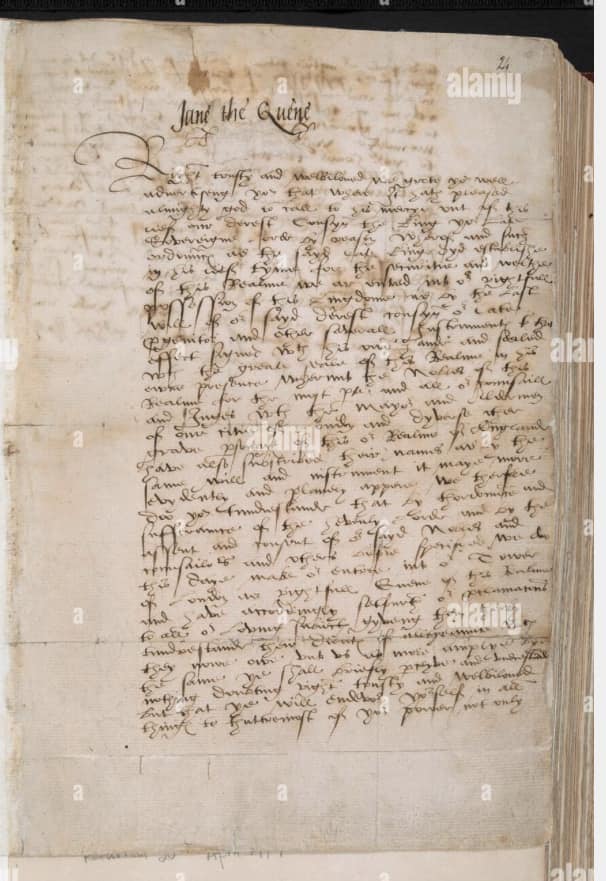
10 July 1553: Lady Jane Grey writes the Marquess of Northampton

10 JULY 1553: LETTER written to Sir William Parr, 1st Marquess of Northampton, Earl of Essex, Baron Parr of Kendal from ”Jane, the Quene” ordering him to levy forces, 1553 (British Library) from Alamy

Written by Meg McGath

A letter from Queen Jane to William Parr ordering him to levy forces, 1553 . folio.A Volume, containing Letters, &c. written by royal, noble, and eminent Persons of Great Britain, from the time of King Henry VI. to the reign of his present Majesty. These are originals, except where otherwise expressed. [1449]-1761. Source: Lansdowne 1236, f.24.

© 2024 Meg McGath. All research and original commentary belong to the author.

Three degrees of separation: alternatives to divorce in early modern England