Family of Queen Katherine: Elizabeth Seymour, Lady Cromwell

Unknown lady once thought to be Queen Katherine Howard; possibly Elizabeth Seymour, sister of Queen Jane.

Elizabeth Seymour (c. 1511 – between 13 April 1562 and 9 June 1563)[1] was the daughter of Sir John Seymour and Margery Wentworth. She is best known as the sister of Queen Jane Seymour, third wife to King Henry VIII and aunt to Edward VI. She was also wife to Gregory Cromwell, son of Sir Thomas Cromwell, Earl of Essex. Upon the Dowager Queen Katherine Parr’s fourth marriage to Lord Seymour, Elizabeth became the Dowager Queen’s sister-in-law.

Biography

One of ten children,[7] born at Wulfhall, Wiltshire, she was the sister of Jane Seymour, third queen consort of King Henry VIII, and aunt of King Edward VI. Two of Elizabeth’s brothers, Thomas Seymour, 1st Baron Seymour of Sudeley and Edward Seymour, 1st Duke of Somerset, were executed for treason during the reign of Edward VI. Like Katherine Parr, the Seymours’ descended from King Edward III. Wives 1, 3, and 6 were the only descendants of King Edward. The Seymours’ descended through their mother, Margery; through King Edward’s second surviving son, Lionel of Antwerp, Duke of Clarence. Katherine Parr and Katherine of Aragon were descendants of Lionel’s younger brother and the third surviving son of Edward III, John of Gaunt, 1st Duke of Lancaster.

Jane and Elizabeth served as maids of honour to Henry’s second wife, Anne Boleyn. Apparently Elizabeth was found of Queen Anne and was an attendant at the birth of Princess Elizabeth. Coincidentally, Queen Anne was their second cousin by their great-grandmother Elizabeth Cheney. By Cheney’s first marriage to Sir Frederick Tilney she was the mother of Elizabeth, Lady Surrey who was grandmother to both Queen Anne Boleyn and Katherine Howard. By her second marriage she was mother to Anne, Lady Wentworth, grandmother of Elizabeth and her siblings.

When King Henry began to tire of Queen Anne, Elizabeth was some what disappointed but delighted that the King had taken interest in her sister Jane.

The Seymour’s gained wealth and power as Henry’s attentions turned to Jane.

On 30 May 1536, eleven days after Anne’s execution, Henry and Jane were married. Elizabeth Seymour was chief lady-in-waiting to Jane, who died twelve days after giving birth to Edward VI in 1537.

Elizabeth was part of the official welcoming party for Anne of Cleves, when she arrived from Germany. After Henry and Anne’s marriage was annulled, Elizabeth became lady-in-waiting to his fifth wife, Catherine Howard. With Thomas Cromwell’s execution in 1540 for treason and heresy, there was a brief decline in his family’s fortunes. Elizabeth served as lady-in-waiting to Henry’s sixth wife, Katherine Parr. After Henry VIII’s death in 1547, Elizabeth’s brother Thomas secretly married Katherine Parr, who died a few days after giving birth to her only child Mary Seymour, in September 1548.

In 1551, when her brother Lord Somerset and his wife were arrested, Elizabeth was given charge of their daughters. After the death of Edward, the Seymour’s were somewhat shunned at court.

Marriage and issue

Elizabeth’s first husband was Sir Anthony Ughtred (or Oughtred), Governor of Jersey who died on 20 December 1534.[1][2] They were married circa 1530 at of Wolf Hall, Savernake, Wiltshire, England. The marriage was childless.

In August 1537, Elizabeth had married Gregory Cromwell, 1st Baron Cromwell, son of Henry’s chief minister, Thomas Cromwell, 1st Earl of Essex, at Wulfhall, Savernake, Wiltshire.[2] They had five children.

  • Henry Cromwell, 2nd Baron Cromwell, succeeded his father. Before 1560, he married to Lady Mary Paulet, daughter of Sir John Paulet, 2nd Marquess of Winchester and Elizabeth Willoughby, daughter of Sir Robert Willoughby, 2nd Lord Willoughby de Broke and Lady Dorothy Grey [granddaughter of Queen Elizabeth Woodville and Lady Katherine Neville. Lady Bonville]. They had two sons and one daughter.[1]
  • Katherine Cromwell, married Sir John Strode of Parnham.
  • Frances Cromwell, who married Richard Strode, Esq.
  • Thomas Cromwell, Esq.
  • Edward Cromwell

She became a widow again upon the death of Gregory Cromwell in 1551. Around 1 April 1554, she married as his second wife John Paulet, Lord St. John [later 2nd Marquess of Winchester]. Paulet was the father of Elizabeth’s daughter-in-law, Lady Mary. Elizabeth Seymour died at Launde, Leicestershire between 13 April 1562 and 9 June 1563 at Launde, Leicestershire, England.[2] She was buried before 9 June 1563 in Basing, Hampshire. According to the Complete Peerage, the inscription on the wall at her vault at Basing read, “Hic jacet Dna Cromwell, quondam conjux Johis, Marchionis Winton.” As Paulet did not attain the title of Marquess of Winchester until after Elizabeth’s death, Elizabeth was known as “Lady Cromwell”; thus her vault reads “Lady Cromwell.”

Portrait

Queen Jane Seymour [L] and possibly her sister Elizabeth as Dowager Lady Cromwell [R]

Victorian scholars had identified a portrait (shown above) by Hans Holbein the Younger as a likeness of Katherine Howard. Historian Antonia Fraser has argued that this image is far more likely to be Elizabeth Seymour. The sitter wears widow’s apparel. Katherine Howard would have had no reason to be dressed as a widow; but Elizabeth Seymour would, as her first husband had died in 1534. The portrait has long been associated with King Henry’s tragic young Queen and various people and places contest it to be a picture of Katherine Howard. The gift shop at the Tower of London  and many other places still depict the picture as being Katherine Howard on souvenirs. The National Portrait Gallery, which exhibits the painting at Montacute House in Somerset, remains undecided about the sitter’s identity.[3] The National Portrait Gallery who has professional curators is still examining the portrait.

According to their site:

Unknown woman, formerly known as Catherine Howard
after Hans Holbein the Younger
late 17th century
NPG 1119

This portrait of an unknown woman, formerly known as Catherine Howard (NPG 1119), highlights one of the many problems found when dating versions and copies. The original version, now in The Toledo Museum of Art, Ohio, was identified as Catherine Howard but this has since proved to be incorrect.


The painting style of the copy is more consistent with late seventeenth or early eighteenth-century workmanship. There is a variation in the quality of paint handling throughout the image. For example, the hands, face and fabric appear fairly simply painted, while the jewellery is very finely painted.

It is possible that the sitter was a member of the Cromwell family who once owned the picture. Previously it had been in the collection of a descendant of Oliver Cromwell. It is possible that this was a copy made for a descendant eager to trace or prove ancestry.

For more details see:

Titles

  • Elizabeth Seymour (c.1513-c.1530)
  • Lady Oughtred (c.1530-1534)
  • Lady Cromwell (1537-1551
  • Lady St. John (1554-1563)

Ancestry

Ancestry of Elizabeth Seymour

Sources

  1. Douglas Richardson. Magna Carta Ancestry, 2nd Edition, Vol. III, p. 111-112, 311.
  2. Douglas Richardson; Kimball G. Everingham (2005). Magna Carta Ancestry: A Study in Colonial and Medieval Families. Genealogical Publishing Company. pg 246. ISBN 0-8063-1759-0.
  3. Portrait NPG 1119; Unknown woman, formerly known as Catherine Howard, npg.org.uk
  4. Douglas Richardson. Magna Carta Ancestry, 2nd Edition, Vol. III, p. 311.
  5. Douglas Richardson. Plantagenet Ancestry, p. 247.
  6. Douglas Richardson. Plantagenet Ancestry, p. 572-573.
  7. Douglas Richardson. Plantagenet Ancestry, 2nd Edition, 2011. pg 82.
  • G.E. Cokayne; with Vicary Gibbs, H.A. Doubleday, Geoffrey H. White, Duncan Warrand and Lord Howard de Walden, editors, The Complete Peerage of England, Scotland, Ireland, Great Britain and the United Kingdom, Extant, Extinct or Dormant, new ed., 13 volumes in 14 (1910–1959; reprint in 6 volumes, Gloucester, U.K.: Alan Sutton Publishing, 2000), volume III, pages 555, 557 and 558.
  • Cecil Aspinall-Oglander, Nunwell Symphony (London, U.K.: The Hogarth Press, 1946), appendix

Katherine Parr: Vellutello’s Edition of Petrarch Works

Katherine Parr’s copy of Vellutello’s edition of Petrarch’s works (1544).

Katherine Parr: Vellutello’s Edition of Petrarch Works © The British Library Board

Thanks to the British Library, in this photo we can see the BEAUTIFUL purple velvet and detail of Katherine’s personal copy of Vellutello’s Edition of Petrarch Words. Most photos on the net show the book as a bluish green back round.

This volume of Petrarch’s works, with an exposition by Alessandro Vellutello, was first published in Venice. The book is bound in purple velvet and embroidered with gold and silver thread and coloured silks. The coat of arms topped with the royal crown may have been embroidered by Katherine. The book appears to have been bound after the death of Henry VIII (in January 1547) and before Katherine’s marriage to Sir Thomas Seymour (in May of the same year). Had it been bound whilst Henry was still alive, it would be expected that the supporters (the creatures flanking the coat of arms) would be the lion and the greyhound. As there is no reference to Seymour, it seems it was made sometime in the short space of Katherine’s widowhood.

Vellutello's edition of Petrarch's works. Close up of arms.

Vellutello’s edition of Petrarch’s works. Close up of arms.

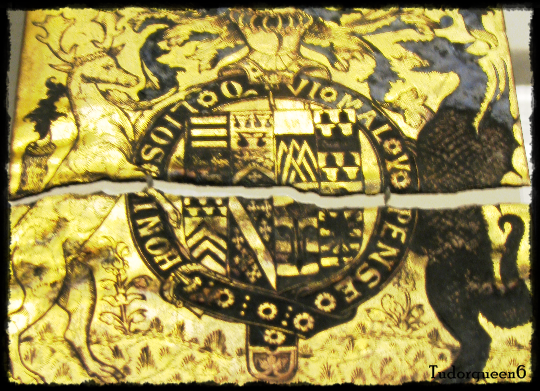
The British Library site states that the coat of arms are that of Katherine Parr, but my recent review of the coat of arms reveals perhaps that it is the arms of Katherine’s brother, Sir William Parr, 1st Marquess of Northampton and Earl of Essex. The coat of arms and quartertings are the same for the most part when compared to his stall plates from Windsor Chapel that were taken down and broken during the reign of Mary I and are now featured in the British Museum in London.
Garter stall plate of William Parr, 1st Marquess of Northampton, 1552. The plate was in St. George's Chapel, Windsor Castle, among other Garter plates, but upon the ascension of Queen Mary, Parr was stripped of his titles. His stall plate was taken down and broken apart.

Garter stall plate of William Parr, 1st Marquess of Northampton, 1552. The plate was in St. George’s Chapel, Windsor Castle, among other Garter plates, but upon the ascension of Queen Mary, Parr was stripped of his titles. His stall plate was taken down and broken apart.

It was subsequently owned by the Fitzhugh family (whose emblem of the creature breathing flames and gorged with a coronet, is depicted on the left). The creature on the right – a wyvern argent also gorged with a coronet – belongs to the Parr family.

The book went on public display in 2009 for the Henry VIII: Man and Monarch exhibit at the British Library. The event was to mark the 500th anniversary of Henry VIII’s accession.

Copy of Il Petrarcha con l’espositione d’A. Vellutello; con le figure a i triomphi et con piu cose utili in varii luoghi aggiunte (1544) owned by Katherine Parr, Henry VIII’s sixth wife. British Library, C.27.e.19.
Shelfmark: c27e19
Held By: BL [British Library]
Country: England
Period: 16c
Cover Material: Velvet
Decorative Technique: Embroidered
Style: Armorial
Edges: Gilt and gauffered
BookBinder Owner: Parr, Katharine, Queen Consort of Henry VIII (1512-1548)
Author: Petrarch
Title: aIl Petrarcha con l:espositione d:A. Vellutello
Place of Publication: Venice.
Date of Publication: 1544.
Notes: Rebacked by BM/BL bindery. Edges gilt, gauffered and painted in red. Arms of Queen Katherine Parr of England.

http://www.bl.uk/catalogues/bookbindings/LargeImage.aspx?RecordId=020-000000590&ImageId=ImageId%3D39900&Copyright=BL

Family of Queen Katherine Parr: Sir John Neville, 4th Baron Latimer

Effigy of John Neville, 4th Lord. By jmc4 – Church Explorer

Sir John Neville, 4th Baron Latimer of Snape Castle (1520[1][2] – 22 April 1577) was an English nobleman of the powerful House of Neville.

Early life

Born about 1520 (he was 23 when his father died, 2 March 1543), he was the only son of John Neville, 3rd Baron Latimer of Snape Castle and his first wife Dorothy, sister and co-heiress of John de Vere, 14th Earl of Oxford. After the death of his mother, Lord Latimer married secondly, Elizabeth Musgrave, by whom he had no children. After her death in 1530, Latimer married again in 1534 the widowed Katherine, Dowager Lady Borough [Parr].

From the beginning of his father’s marriage to Katherine, she tried to be a good step-mother to both children, but John proved to be difficult. There is some indication that Margaret, his sister, was their father and Katherine’s favourite. If that is true, it may explain the turbulence which would follow as John got older. As a “teenager”, John proved to be a confident sulking, lying, and over-sensitive boy. Lord Latimer did not name his son as heir to his properties and made sure that his son could not meddle with his inheritance or father’s legacy. In Lord Latimer’s will, Katherine was named guardian of his daughter and was put in charge of Lord Latimer’s affairs which were to be given over to his daughter at the age of her majority.

In January 1537, John, his sister Margaret, and step-mother Katherine, were held hostage at Snape Castle during the uprising of the North. The rebels ransacked the house and sent word to Lord Latimer, who was returning from London, that if he did not return immediately they would kill his family. When Lord Latimer returned to the castle he somehow talked the rebels into releasing his family and leaving, but the aftermath to follow with Lord Latimer would prove to be taxing on the whole family.[3]

Later life

Nevill became Baron Latimer on his father’s death in 1543. Although the relationship proved difficult during his youth, Katherine, did not forget Nevill. Katherine stayed close with her former stepchildren. In fact, Katherine made John’s wife, Lucy Somerset, a lady-in-waiting when she became queen consort to King Henry VIII.[1][3]

In May 1544, Nevill was involved with the siege of Edinburgh in Scotland and it was there that he was knighted. Nevill then went to war in France where he took part in the siege of Abbeville.

John became an emotionally unstable man later in life. In the summer of 1553, John was sent to Fleet Prison on charges of violence done to a servant. He was arrested for attempted rape and assault in 1557 and in 1563, he killed a man. Of the situation in 1553, Thomas Edwards wrote to the Earl of Rutland describing the violence which had taken place with the servant quoting “too great a villainy for a noble man, my thought.” That this public violence occurred after the death of his step-mother, Katherine, might suggest that at least she had some sort of control over Nevill while she was alive.[3]

Marriage and issue

In 1545, Latimer married Lady Lucy Somerset, daughter of Henry Somerset, 2nd Earl of Worcester and his second wife, Elizabeth Browne.[4] The new Lady Latimer was a cousin to Queen Katherine as the great-granddaughter of the Marquess of Montagu, brother to Lady Alice FitzHugh [great-grandmother of Queen Katherine]. Lady Lucy became a lady-in-waiting to her husband’s former step-mother, Queen Katherine Parr.

Together they had four daughters that all produced children by their first marriages:

  • Hon. Elizabeth Neville (c. 1545 – 1630), married firstly Sir John Danvers of Dauntsey, and secondly Sir Edmund Carey. Elizabeth’s descendants by Danvers included the Dukes of Leeds [extinct in 1964]; Earls of Lichfield; Earls of Leicester of Holkham from which Sarah of York descends.
  • Hon. Katherine Neville (1546 – 28 October 1596), married firstly Henry Percy, 8th Earl of Northumberland, and secondly Francis Fitton of Binfield. Lord and Lady Northumberland were parents to Sir Henry, 9th Earl of Northumberland. Her descendants include Lady Diana Spencer, Princess of Wales; HM Queen Elizabeth II by her mother; Sarah, Duchess of York; and others. Katherine was buried in the Chapel of St. Nicholas in Westminster Abbey, within the Percy family, Dukes of Northumberland.
  • Hon. Dorothy Neville (1547 – 23 March 1609), married Sir Thomas Cecil, Queen Elizabeth’s counselor, later Earl of Exeter. Cecil was the half-brother of the Earl of Salisbury. Her descendants also include Lady Diana Spencer, Princess of Wales.

Latimer’s daughter, the Hon. Dorothy Neville who became Countess of Exeter when her husband Thomas Cecil was elevated to Earl in 1605

  • Hon. Lucy Neville (c. 1549 – April 1608), married Sir William Cornwallis of Brome Hall. Their daughters made advantageous marriages to nobility such as the marriage of their daughter Anne to the 7th Earl of Argyll by whom she had issue. Another daughter, Elizabeth, became Viscountess Lumley as the wife of Sir Richard, 1st Viscount Lumley.

Lord Latimer died without sons in 1577; his four daughters became his joint heiresses. The barony became abeyant until 1913, when its abeyance was terminated in favour of Latimer’s distant descendant Francis Money-Coutts, 5th Baron Latymer.

Effigy and tomb of the 4th Lord Latimer in Nevilles’ Chapel, Wells, North Yorkshire Well Village Website © Well Parish Council 2011

He was buried in St. Michael’s Church, Well, North Yorkshire which adjoined Neville’s home, Snape Castle. The church had a long standing history with the Neville family going back to John and Queen Katherine Parr’s ancestor, Sir Ralph Neville, the 1st Earl of Westmorland. Westmorland married Lady Joan Beaufort; the only daughter of Prince John of Gaunt, 1st Duke of Lancaster by his mistress, later wife, Katherine Roet. Ralph was responsible for the building of the present church c. 1330. Latimer’s mural monument lies in Nevilles’ Chapel within Well’s Church. Latimer’s daughter, Hon. Dorothy, Countess of Exeter inherited Snape Castle and is also buried there with her husband Thomas Cecil, 1st Earl of Exeter.[5] According to a card placed upon the tomb, the four coat of arms on his tomb represent that of his four daughters and their husband.

His wife, Lucy, was buried in Hackney Parish Church in London. Her grand tomb has her effigy surrounded by her four daughters.[6] Her tomb is one of only a few in England which feature such noble bearings; the other being the tomb of George Clifford, Earl of Cumberland at Skipton which is surrounded by no fewer than seventeen richly adorned shields which include that of Brandon, Dacre, de Clare, St. John, and more.[7] The Earl himself was a descendant of Katherine Parr’s great-aunt, Mabel Parr, Lady Dacre. Lady Latimer’s tomb not only includes the arms many of those on Clifford’s tomb as Neville, Beauchamp, Dacre, Berkeley, and Percy but also those of de Vere Earl of Oxford, Walcot, and Cecil.[6] Lord Latimer’s arms (the Neville) are at one end of the tomb. The statues of the four daughters were two on each side of the monument; at the side of each the shield of the husband impaling the Neville arms. These arms are thus repeated five times. At the other end are Lady Latimer’s arms: the lions and fleur de lis that is France and England, quarterly, the arms of the Dukes of Beaufort, descended from the eldest legitimated son of John of Gaunt, her father being Henry Somerset, 2nd Earl of Worcester.[6]

Document on the magnificent tomb of Lady Lucy Somerset, Lady Latimer; wife of the 4th Lord Latimer and lady to HM Queen Katherine Parr. Courtesy of JMC4 Church Explorer.[8]

In Robinson’s History of Hackney we find:

“The effigy of Lady Latimer was exquisitely sculptured and was fixed on the top of the table monument She appears to be dressed in a scarlet robe with a coronet on her head and the other part of the dress was richly gilt This effigy was probably intended for a portrait of her.”[6]

Memorial to Lady Lucy Latimer in the old church. Watercolour by T. Fisher c.1795 [9]

Her epitaph reads:

Such as she, is such surely shall yee bee; Such as shee was, such if yee bee, be glad: Faire in her youth though fatt in age she grew; Virtuous in bothe whose glosse did never fade. Though long alone she ledd a widowe’s life, Yet never ladye live da truer wife. From Wales she sprang, a Branch of Worcester’s race, Grafte in a stock of Brownes her mother’s side: In Court she helde a maide of honor’s place, Whilst youth in her, and she in Court did byde. To John, Lord Latimer, then became she wife; Four daughters had they breathing yet in life. Earl of Northumberland tooke the first to wife; The nexte the heire of Baron Burleigh chose: Cornwallis happ the third for terme of life: And Sir John Danvers pluckt the youngest Rose. Their father’s heirs, them mothers all she sawe: Pray for, or praise her: make your list the Lawe, Made by Sir William Cornwallis, Knight, this Ladye’s Sonne in Lawe.[6]

Ancestry

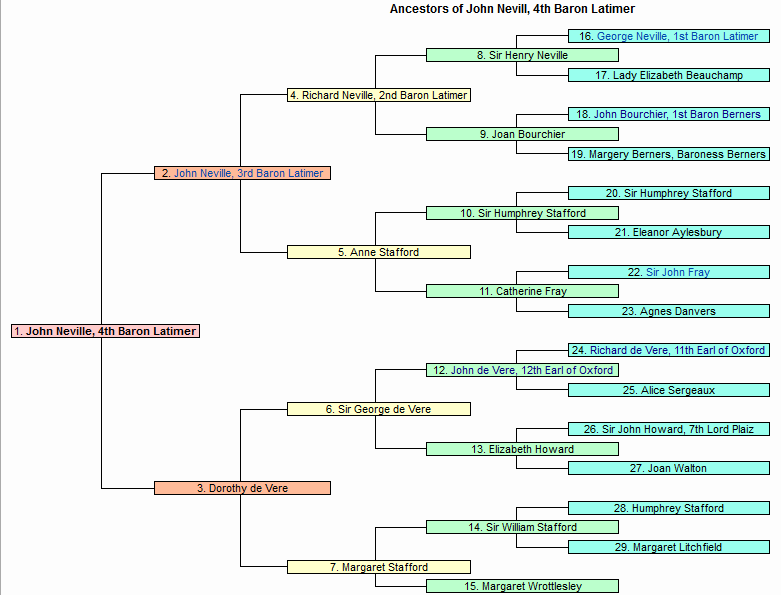
By his father, Latimer descended from King Edward III of England twice. Latimer’s great-grandparents were Sir Henry Neville, heir to the barony of Latimer and Earldom of Warwick, and the Hon. Joan Bourchier. Neville was a grandson of Sir Ralph Neville, 1st Earl of Westmorland and his second wife, Lady Joan Beaufort. Lady Joan was the legitimized daughter of Prince John of Gaunt, Duke of Lancaster by his mistress, later wife, Katherine Roet. Bourchier was a granddaughter of Sir William, 1st Count of Eu and Lady Anne of Gloucester, daughter of Prince Thomas of Woodstock [youngest son of Edward III] and his wife, Lady Eleanor de Bohun. This connection to the Bourchier family made Latimer a cousin of the Earls of Bath, Lords Dacre of the South, the Lady Margaret Bryan [governess of the King’s children], Lady Anne Bourchier [husband of Katherine Parr’s brother William Parr], and even the Duchess of Somerset Anne Stanhope.

Latimer’s mother was the granddaughter of the 12th Earl of Oxford and Elizabeth Howard. Oxford was himself a descendent of Edward I of England and Eleanor of Castile by their daughter Princess Joan of Acre. The Countess of Oxford, Elizabeth Howard, was a descendant of John I of England by his son Richard of England, Earl of Cornwall, King of the Romans as well as a descendant of Henry I’s illegitimate son Reynold de Dunstanville, 1st Earl of Cornwall.

The ancestry of John Neville, 4th Lord Latimer

References

  1. ^ Linda Porter. Katherine the Queen; the Remarkable Life of Katherine Parr, the Last Wife of Henry VIII. Macmillan, 2010. pg 66-67.
  2. According to Linda Porter’s Katherine, the Queen, Neville was 14 at the time of his father’s marriage to Catherine Parr.
  3. Susan E. James. Catherine Parr, Henry VIII’s Last Love. The History Press, 2009.
  4. G. E. Cokayne. The Complete Peerage of England, Scotland, Ireland, Great Britain, and the United Kingdom, Vol. VIII, G. Bell & sons, 1898. pg 200. Google eBook
  5. Village of Well, North Yorkshire, http://www.wellvillage.org.uk/history/
  6. Richard Simpson. Some Accounts of the Monuments in Hackney Church, Billing and Sons, 1881; Chapter: Lady Latimer.
  7. W. Harbutt Dawson. History of Skipton, Simpkin, Marshall, London, 1882.
  8. JMC4 Church Explorer . London, Hackney, Flickr, 2008.
  9. T. Fisher. Hackney Council, The Churchyard Memorials: Memorial to Lady lucy Latimer in the old church, c.1795.

Written and researched by Meg McGath
27 August 2012