Lady Frances Manners, Lady Bergavenny

Lady Frances Neville, (née Manners) Lady Bergavenny (c.1530 – circa September 1576) was an English noblewoman and author. Little is known of either Lady or Lord Bergavenny, except that the latter was accused of behaving in a riotous and unclean manner by some Puritain commentators. Lady Bergavenny’s work appeared in The Monument of Matrones in 1582 and was a series of “Praiers“. Her devotions were sixty-seven prose prayers, one metrical prayer against vice, a long acrostic prayer on her daughter’s name, and an acrostic prayer containing her own name.

Family
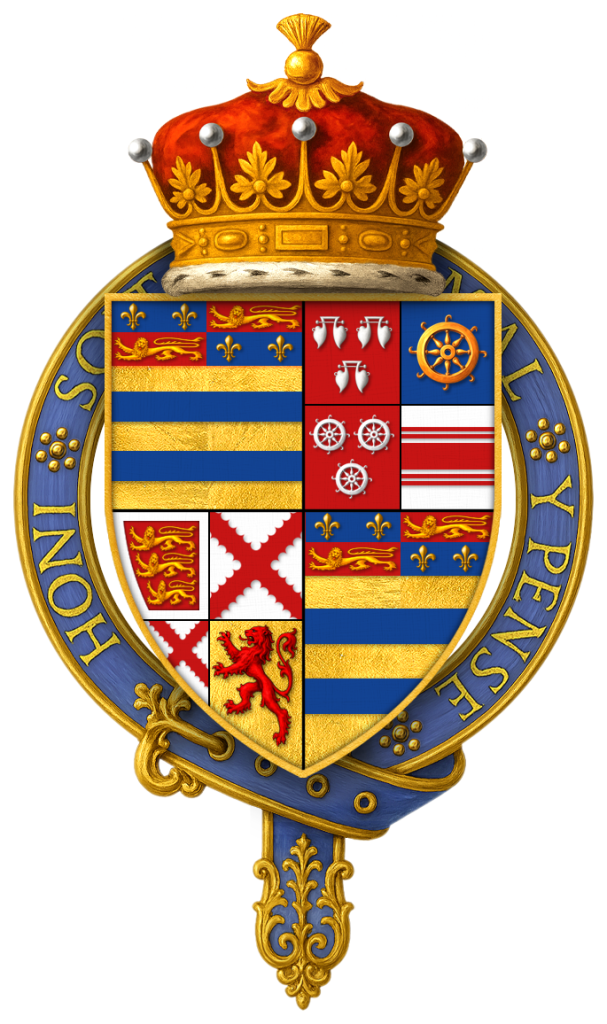
Coat of arms of Sir Thomas Manners, 1st Earl of Rutland, KG
Rutland’s stall plate remains installed within St. George’s Chapel. The arms are: quarterly:
1 and 4, or, two bars azure, a chief quarterly of the last and gules, on the 1st and 4th, two fleurs-de-lis or, on the 2nd and 3rd, a lion passant gaurdant or (Manners);
2, a grand quarter consisting of
1, gules, three water bougets argent (Ros)
2, azure, a Catherine wheel or (Belvoir)
3, gules, three Catherine wheels argent (Espec)
4, argent, a fess between two bars gemels gules (Badlesmere)
3, a grand quarter consisting of
1, gules, three lions pasant guardant or, within a bordure argent (Holland, Earls of Kent)
2 and 3, argent, a saltire engrailed gules (Tiptoft)
4, or, a lion rampant gules (Edward Charleton, 5th Baron Charleton of Powys (1370-1421))

Lady Frances Bergavenny was the third daughter of Thomas Manners, 1st Earl of Rutland and his second wife, Eleanor Paston. Her father was a soldier and the eldest son of Sir George Manners of Belvoir, Leicestershire, and his wife, Anne St. Leger. By Anne St. Leger, Frances was thus a great-granddaughter of Anne of York, the elder sister of Edward IV and Richard III.

Before 1554, Frances had married Henry Nevill, 6th Baron Bergavenny. Nevill or Neville, was born between 1527 and 1535. He was the son of George Neville, 5th Lord Bergavenny and Lady Mary Stafford. Neville succeeded to the title of 4th Lord Bergavenny after his father’s death in 1535. He held office of Chief Larderer at the coronation of Queen Mary in 1553. When Lady Bergavenny died in 1576, Neville remarried to Elizabeth Darrell, daughter of Stephen Darrell and Philippe Weldon, before 1586; they had no issue. He died 10 February 1586/87 without male issue. He was buried on 21 March 1586/87 at Birling, Kent, England.

She died circa September 1576 and was buried at Birling, Kent, England.

Children

Lord and Lady Bergavenny had one daughter Hon. Mary Neville, Baroness Le Despenser (25 March 1554 — 28 June 1626). Mary gained the title of suo jure 3rd/7th Baroness le Despenser. She had claimed the succession to the Barony of Bergavenny, but this was settled on her cousin, Edward Neville, who became the 7th Baron Bergavenny.

The first, second, and fourth creations of Baron le Despenser had been under attainder from 1400 upon the death of Mary’s ancestor, Thomas le Despencer, 2nd Baron le Despencer, [1st Earl of Gloucester] (1373–1400) and became abeyant as well in 1449 after the death of the infant Lady Anne Beauchamp, the 15th Countess of Warwick. The representation of the three Baronies of le Despencer fell into abeyance between Anne’s cousin George Nevill, 4th Baron Bergavenny and aunt, Anne de Beauchamp, 16th Countess of Warwick. On the attainder and execution of Lady Margaret Plantagenet [Margaret Pole], Countess of Salisbury on 28 May 1541 any claim to the three Baronies by the descendants of the 16th Countess of Warwick, lapsed and the sole representation lay with the Barons Bergavenny. The attainder of Thomas, 2nd Baron le Despenser, was reversed in 1461 but the abeyancies continued until 25 May 1604, when the abeyancy of the 1295 Barony of le Despencer was terminated in favour of Mary Neville. She married Sir Thomas Fane, son of George Fane, on 12 December 1574. They were parents to Sir Francis Fane, who gained the title of 1st Earl of Westmorland. The title of Earl of Westmorland was forfeit after the death of Mary’s cousin, Charles Neville, 6th Earl of Westmorland. The title was revived in 1624 in favour of Fane because Mary was a descendant of Sir Edward Neville, 1st Baron Bergavenny, a younger son of the 1st Earl of the 1329 creation [Ralph Neville, husband of Lady Joan Beaufort and son-in-law to Prince John of Gaunt, 1st Duke of Lancaster].

Lady Despenser died on 28 June 1626 at age 72.

Relations to Queen Kateryn

Both Kateryn and Frances descend from the Ros family, Lady Joan of Kent (Princess of Wales) who married into the Holland family, and Lady Joan Beaufort who married into the Neville family among others lines.

Works

Her Praiers in prose and verse were later published in 1582 by Thomas Bentley in the Second Lamp of his anthology of Protestant women writer’s prayers, The Monument of Matrones. In a deathbed dedication of her work to her daughter, she calls it a “jewell of health for the soule, and a perfect path to paradise.” Her collection includes sixty-seven pages of prose prayers for private use and public worship linked to various occasions and times of day; a five-page acrostic prayer based on her daughter Mary Fane’s name, and a concluding prayer based on her own name.

References

  • Beilin, Elaine V. “Frances Neville, Lady Bergavenny” in Matthew, H.C.G. and Brian Harrison, eds. The Oxford Dictionary of National Biography. vol. 45, 490-491. London: OUP, 2004.
  • McCoy, Richard, Kathleen Lynch, Carol Brobeck, Martha Fay, Roque Rueda, “Redefining the Sacred–Monument of Matrones,” Redefining the Sacred in Early Modern England: An NEH Summer Institute. -Folger Shakespeare Library, 1998. Web. 30 Nov. 2011. http://www.folger.edu/html/folger_institute/sacred/image13.html
  • Bentley, Thomas. Monument of Matrones. London, imprinted by Henrie Denham, [1582]. http://luna.folger.edu/luna/servlet/s/6z39cc
  • The Oxford Dictionary of National Biography. The Oxford Dictionary of National Biography. vol. 45, 490-491. London: OUP, 2011

Written by Meg McGath (September 2012)

(Update 8 September 2025)

Ladies-in-Waiting: Elizabeth Stonor

Elizabeth Stonor, Lady Hoby

Portrait of Lady Hoby, inscribed “The Lady Hobbei”. Black and coloured chalks, pen and Indian ink on pink-primed paper, 27.8 × 20.3 cm, Royal Collection, Windsor Castle. The drawing has been so rubbed and reinforced by later hands that it is disfigured, obliterating Holbein’s original work. If the inscription—added later and not necessarily reliable—is correct, the sitter is most likely Elizabeth Hoby, wife of the diplomat Sir Philip Hoby (1505–1558), whose portrait Holbein also drew. Reference K. T. Parker, The Drawings of Hans Holbein at Windsor Castle, Oxford: Phaidon, 1945, OCLC 822974, p. 50.

Elizabeth Stonor, Lady Hoby, daughter of Walter Stonor of Hawton, Nottinghamshire and Fenny Compton.

While most wives in the Tudor period cannot be documented, Elizabeth seems to have kept up correspondences with her father and they are well documented for two decades. Elizabeth’s first husband, Sir William Compton died in 1528. Unfortunately for her, the jointure she was promised had not been established by the time of his death. Her second husband, Sir Walter Walshe, sued Compton’s estate in Chancery. The matter was not settled and Walshe was dead by 1538. As a widow, Elizabeth returned home and her father took up the cause instead. Letters were sent to Cromwell to discuss the matter. Stonor sent the fee for the first year, reminding him to be her “good lord” and protect her from “great wrongs”.[1]

In 1540, Elizabeth married to Sir Philip Hoby,  the son of William Hoby of Leominster by his first wife, Catherine Forster. After their marriage, the two rented their chief residence, Wreysbury, from Elizabeth’s father.[1] Philip was a diplomat under King Henry VIII. He was also a huge supporter of the Protestant Reformation. Hoby was sent to places like Spain and Portugal. In 1538, he was tasked with getting a portrait done of Christina, Duchess of Milan by Holbein. Hoby and Holbein then went to France to paint Princess Margaret of France and Mary de Bourbon. Throughout the reign of Henry VIII, Hoby continued to advance and was eventually knighted after the siege of Boulogne. The couple had no children.

In respect to letters, after she married Hoby, Elizabeth was reluctant to spend time with her father despite his support during her first two marriages. One topic that comes up is one of religion. Sir Walter told his daughter’s servant, Richard Scudamore,[1]

“that he [Stonor] knew very well how to order himself and that my lady was much given to the Scriptures and that she always was arguing and contending with him in the same, and which thing he could in no wise bear and specially at her hands.”[1]

Another difficulty between Elizabeth and her father rose with his apparent new love, a “mistress Margaret”, who Elizabeth feared he would marry. Eventually, after much discussion between Scudumore and Stonor, Stonor replied with,[1]

“if it please my lady to come unto him to make merry and not meddle with him or any of his household she would be as welcome as ever she was.”[1]

The reply evidentely satisfied Elizabeth as she decided to spend Christmas at Stonor after all.[1]

When Tudor women married again, they used their subsequent husbands to safeguard their children’s inheritance. In some cases this worked and in others it did not. Luckily for Elizabeth, Sir Philip Hoby seems to have delivered in this area. Elizabeth asked Hoby to safeguard her inheritance for her daughters she had, had by her second husband, Walsh. Hoby delivered and made funds available for Elizabeth when she needed them.[1]

The couple were attendants upon Henry VIII’s sixth queen. Lady Hoby was a lady to Her Majesty and was part of her inner circle of ladies who read scriptures and continued to push the reformation of the Church. Lord Hoby was a part of the queen’s council from 1543, onward. He also was a steward, later on, to Baron Seymour of Sudeley.

By chance, the couple swapped the Abbey of Bisham with the former queen, Anne of Cleves. There was some delay as Anne was not satisfied with giving up the site as requested by Edward VI. In the church of All Saints is a window dedicated to the Hobys. The lights also feature the arms of several of the Hobys, including Sir Philip and Elizabeth. The Abbey at one time belonged to the Earls of Salisbury. It belonged to the last Plantagenet and York Princess, Margaret of Clarence–or–better known as “Lady Salisbury”. The Countess of Salisbury lost her head and her possessions when her cousin, Henry VIII decided to kill her. Lady Salisbury was a cousin to Queen Katherine Parr’s paternal grandmother, Lady Elizabeth Parr/Vaux.

Lady Hoby was lucky enough to be sketched by Hans Holbein. However, due to later rubbing and re-enforcing, the portrait is not in good quality. The description of the sitter was most likely added later and may not be reliable as most Tudor portraits were labeled after the period they were created. If the inscription is correct, the sitter is most likely Elizabeth Stonor.

Sources

  1. Barbara J. Harris. English Aristocratic Women, 1450-1550: Marriage and Family, Property and Careers, 2002. Google eBook

Family of Queen Katherine: Lady Anne Clifford

Lady Anne Clifford, Countess Dowager of Dorset, Pembroke and Montgomery, suo jure 14th Baroness de Clifford (30 January 1590 – 22 March 1676) was an English peeress in her own right. She descended from Princess Mary, Duchess of Suffolk, the daughter of King Henry VII and Elizabeth of York by Mary’s daughter, Lady Eleanor Brandon (aunt of Lady Jane Grey). She married into the Herbert family; Sir Philip, 4th Earl of Pembroke. Pembroke was the grandson of Lady Anne Herbert; the Queen’s sister.

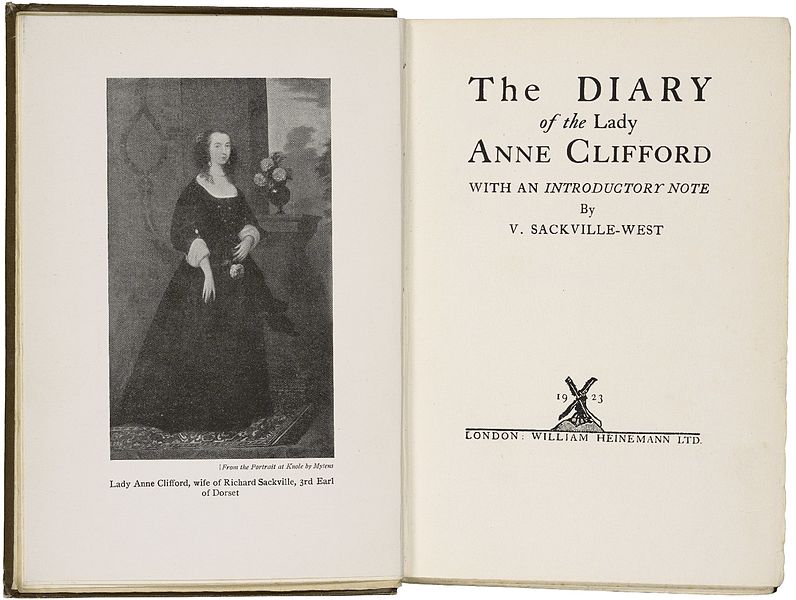
796px-1923_diary_of_lady_anne_clifford

Title page of a 1923 edition of Lady Anne Clifford’s diaries, with an introduction by Vita Sackville-West. Folger Library Collection, District of Columbia, USA.

Lady Anne become an important woman in her time. She was an important patron of literature and due to her own writings in the form of letters and the diary she kept from 1603 to 1616, was a literary figure in her own right. John Donne said of her that she could “discourse of all things from Predestination to Slea-silk”.

thegreatpicture_anneclifford_1646_byjanvanbelcamp

The Great Picture, a huge triptych measuring 8ft 5″ high and 16ft 2″ wide, commissioned in 1646 by Anne Clifford, attributed to Jan van Belcamp (1610-1653). Abbott Hall Art Museum. Kendal, UK.

Lady Anne Clifford was also a patron of art. She commissioned a large scale portrait that includes three separate panels detailing her life. The Great Picture, a huge triptych measuring 8ft 5″ high and 16ft 2″ wide, commissioned in 1646 by Anne Clifford. The artwork is attributed to Jan van Belcamp (1610-1653). It formerly hung in Appleby Castle, but is now displayed in the Abbot Hall Art Gallery, Kendal, Cumbria. The portrait depicts Anne as a girl at left and as a mature woman at right. The central panel shows her parents and young brothers. The painting is replete with significant elements referring to her life and to her succession to her paternal inheritance, gained after a lengthy legal dispute.
Abbott Hall Art Gallery had Lady Anne featured in an exhibition, Anne Clifford: A Life of Portrait and Print. Abbott Hall is in the Lake District where the Parr family originated. The Huddersfield University in Kendal, UK, wrote a feature PDF on two pieces presented in the exhibition.
  1. “Great Books of Record” which preserves Anne’s ancestral records and her own children and grandchildren. Three volumes were made specifically to highlight the inheritance the women of the Clifford family brought to their marriages. A nod to what would become “feminism” I suppose.
  2. The Great Picture” which is previously discussed and a portrait is provided in this post.