Lady Jane Grey Revisited: The Jersey Portrait & Katherine Parr
Reply


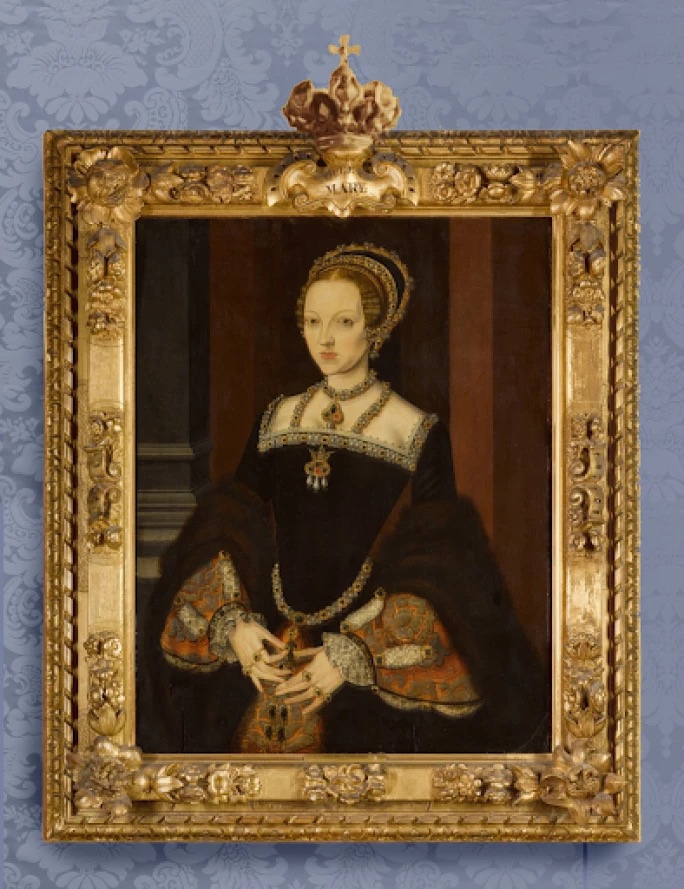
A rare portrait of Katherine Parr, the sixth wife of Henry VIII and an accomplished woman in her own right, shattered records yesterday (June 5) to become the most expensive Tudor painting of all time. Selling to a U.K. collector at Sotheby’s Old Master & 19th Century Paintings Evening Auction, the work realized $4.4 million, more than four times its initial high estimate.
Observer: A Rare Portrait of Henry VIII’s Sixth Wife Breaks Auction Records
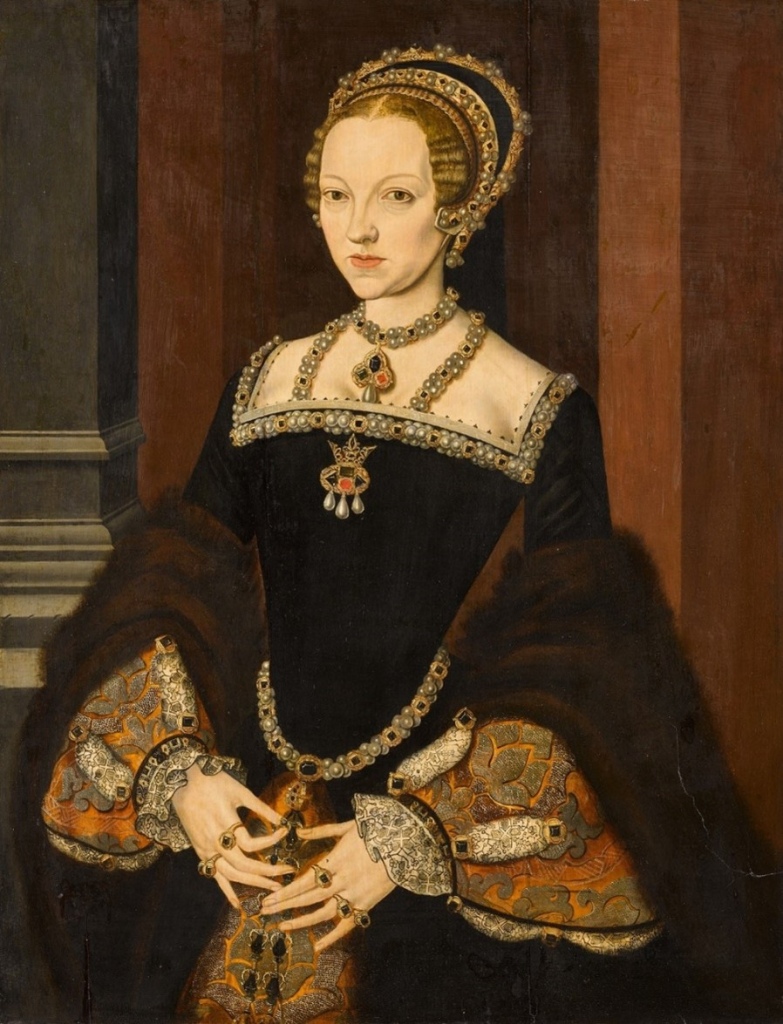
The Jersey portrait is one of only two surviving contemporary portraits of Queen Katherine Parr, the other being the slightly earlier, related full-length in the National Portrait Gallery previously mentioned. In both, the Queen’s jewellery is of further significance in identifying the sitter. In the 1960s both paintings were identified as likenesses of Lady Jane Grey by Strong, largely on the basis of comparison with an engraving in Henry Holland’s Herwologia Anglica of 1620, and a portrait at Seaton Delaval – which appears to be a derivation of the present work, on canvas, dating to the seventeenth or eighteenth century, and erroneously called ‘Lady Jane’.4Throughout the nineteenth century and until Strong’s publication, the Jersey portrait was in fact also erroneously identified as Queen Mary I. Both portraits were correctly reidentified in 1996 by Susan James (see Literature) on account of the jewellery the sitter is shown wearing, specifically the distinctive crown-headed brooch which appears on her bodice (fig. 2). This brooch, which may have been made for Katherine by her favourite goldsmith, the Dutch jeweller Peter Richardson, is traceable through three Tudor lists of jewels dating to before, during, and after Katherine’s time as Queen, one of which is entitled: ‘The Quene’s Jewells in a cofer having written upon it, “the Quene’s Juelles”’ [sic], and for all of which there is good evidence pointing to Katherine Parr’s ownership (the earliest list of 1542 is an inventory of the jewels belonging to Catherine Howard, which subsequently passed to her successor).5
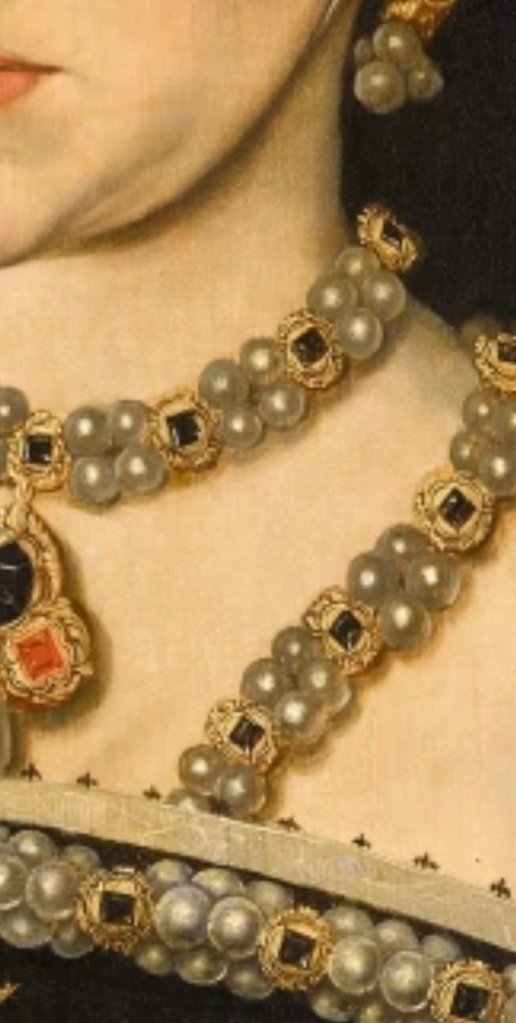
The last list, from 1550, describes the brooch as ‘one ouche or flower with a crown containing two diamonds, one ruby, one emerald; the crown being garnished with diamonds, three pearls pendant.’6 Interestingly, overpaint in the full-length portrait at the National Portrait Gallery now means that the square-cut emerald there appears red, but the brooch’s true character is plainly obvious in the present painting, where all the precious stones are clearly distinguished from one another. The accuracy of the depiction of the brooch – thus underlining the portrait’s royal status and sovereignty of the sitter – is further corroborated by its description in the jewel list of Elizabeth I, to whom the brooch passed with the rest of the royal jewellery in 1587, which specifies that the crown is ‘garnished with XV small diamonds’7 – all fifteen stones are clearly discernible here. At Elizabeth’s death the brooch passed to Anne of Denmark, queen of James I; it is found in her jewellery inventory of 1606, but an annotation recounts that in 1609, having lost the two triangular-cut diamonds, the brooch was broken up for ‘the making of Gold plate’.8
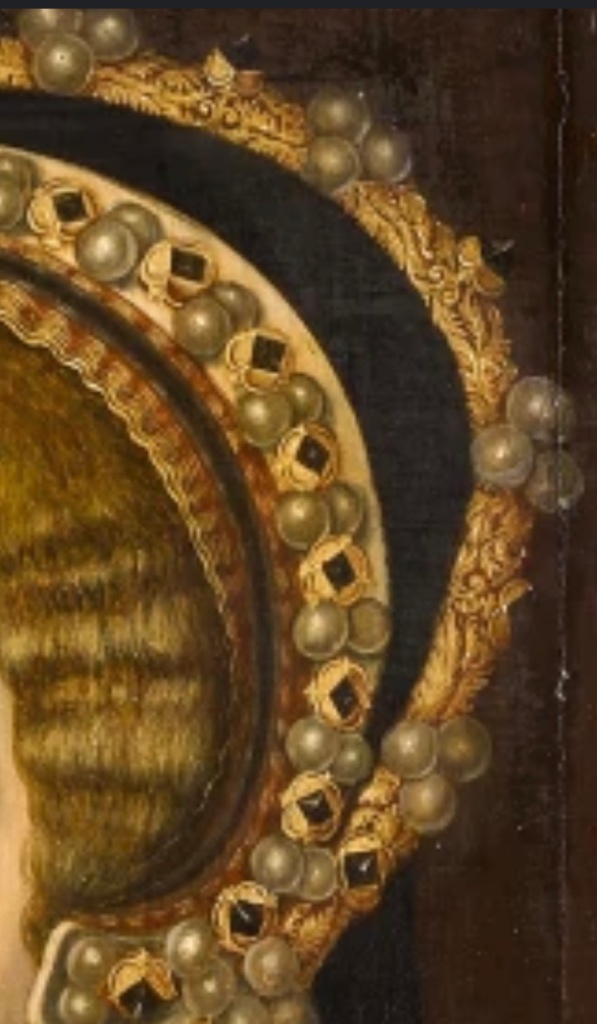
In the full-length portrait, and in a slightly later half-length portrait from the late sixteenth century, previously attributed to William Scrots (also in the National Portrait Gallery; fig. 3),9Katherine wears a pendant – probably another brooch adapted to be worn on a necklace – which may be identified as that described in the 1542 list of Catherine Howard’s jewels: ‘oone other Ooche of Golde wherein is averey feir large ruby and a rounde diamond with a verey feir peerle hangyng at the same [sic].’10 The pendant in the present portrait, by contrast, would appear also to include an emerald; nor does the sitter wear the girdle of antique cameos that appears in the full-length painting, and which is also identifiable in the 1542 list. Instead, here Katherine’s waist is encircled by a belt of large pearls and diamonds in gold settings, with pomanders and small antique urn-shaped pendants, which, together with the matching adornment to the line of her bodice across the chest and the pattern of her necklace, bears a remarkable similarity to that in a portrait of Elizabeth I, when Princess, in the Royal Collection, at Windsor.11The portrait of Princess Elizabeth and the Jersey portrait of Katherine also share similar embroidery in the sleeves and both sitters wear almost identical diamond rings, which display the latest styles in diamond cutting – the table-cut and pointed cut – which were symbolic of fidelity, though the pattern of their display follows that in the the portrait of Katherine in the National Portrait Gallery. Unlike either of these other two portraits, however, the jewels in Katherine’s cuffs, and the pomanders on her girdle, in the Jersey portrait are all inscribed multiple times with the words ‘LAVS DEVS’ (‘praise God’).
Sotheby’s


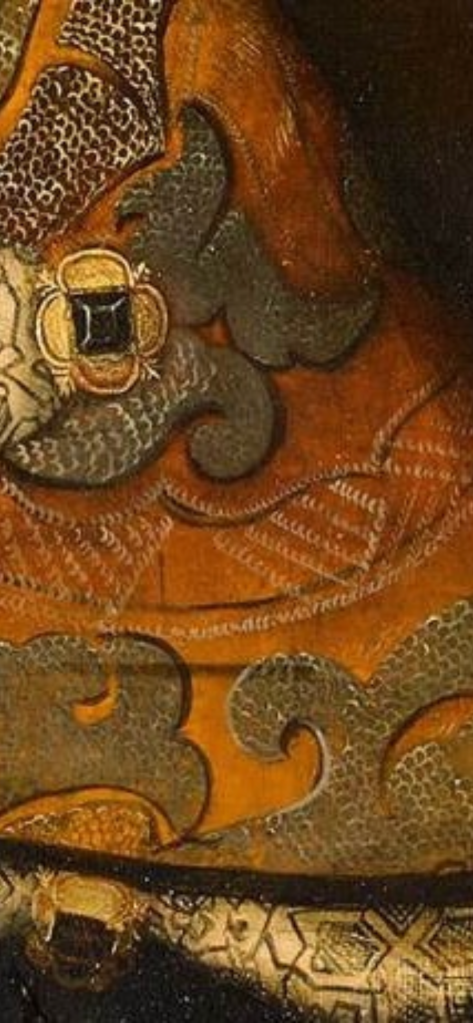
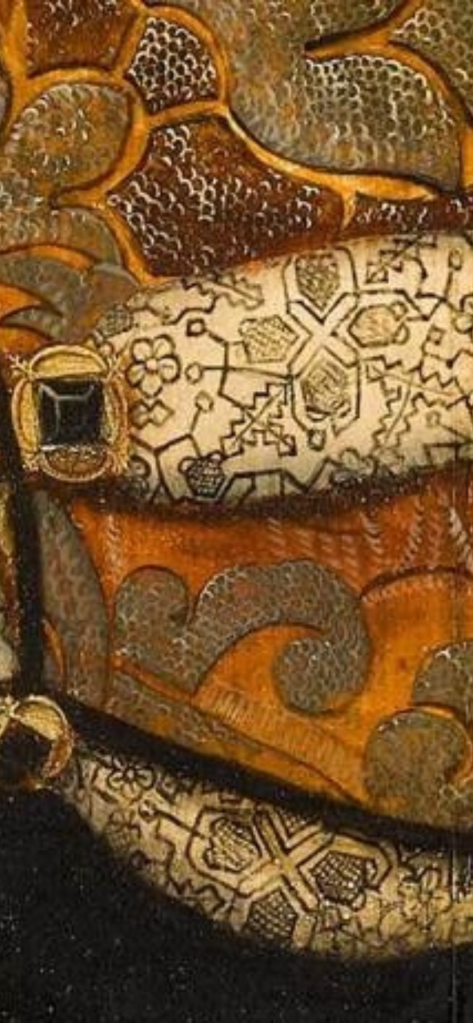


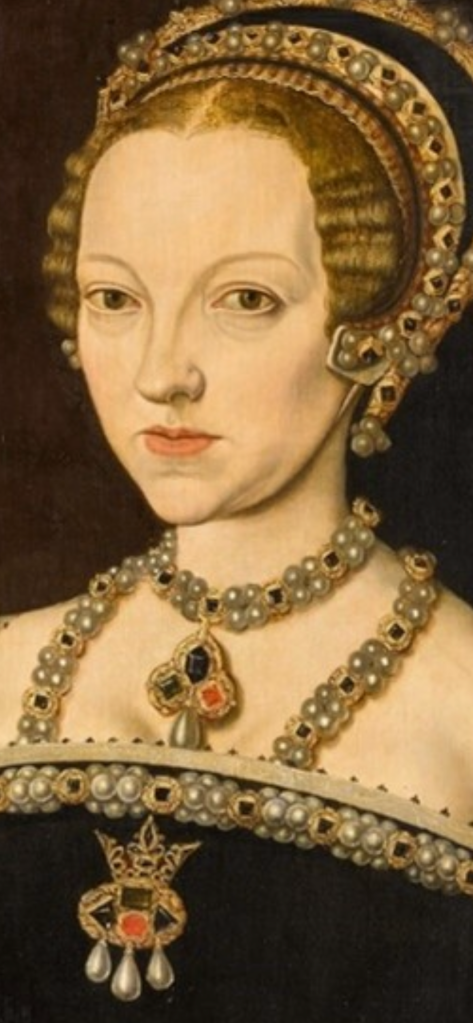


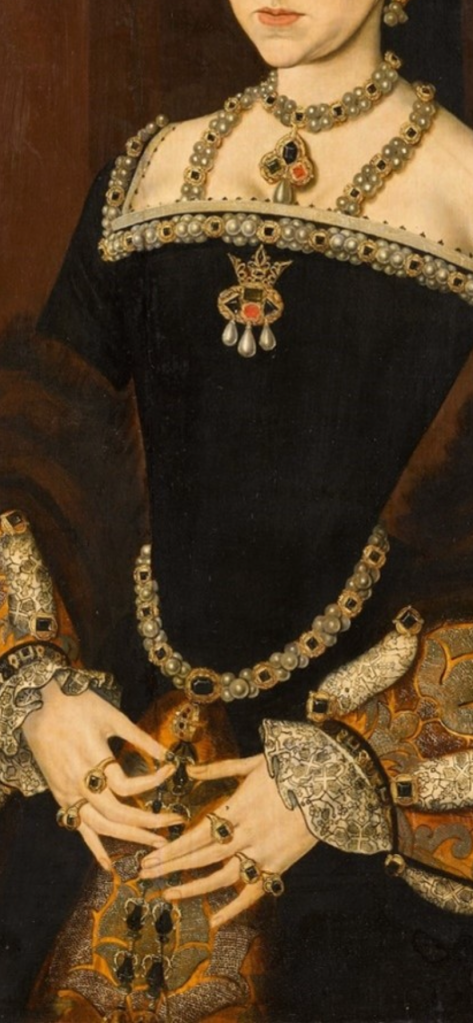
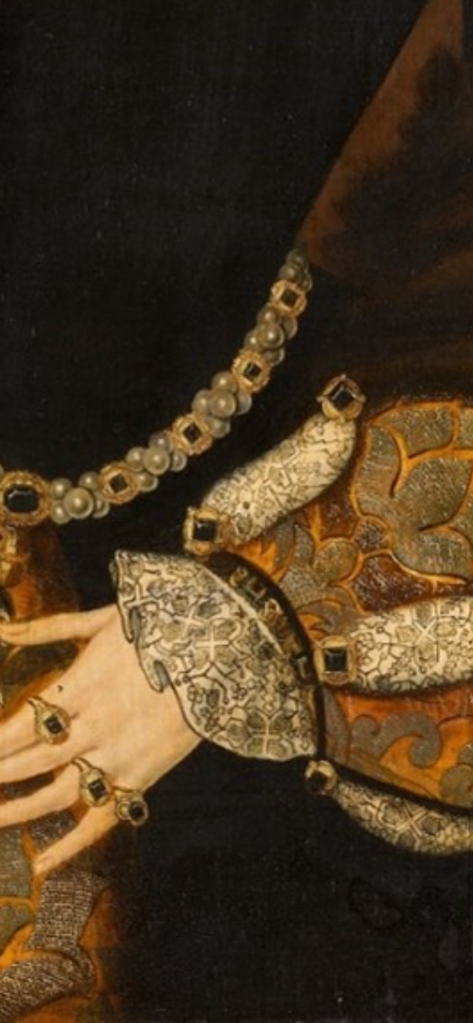
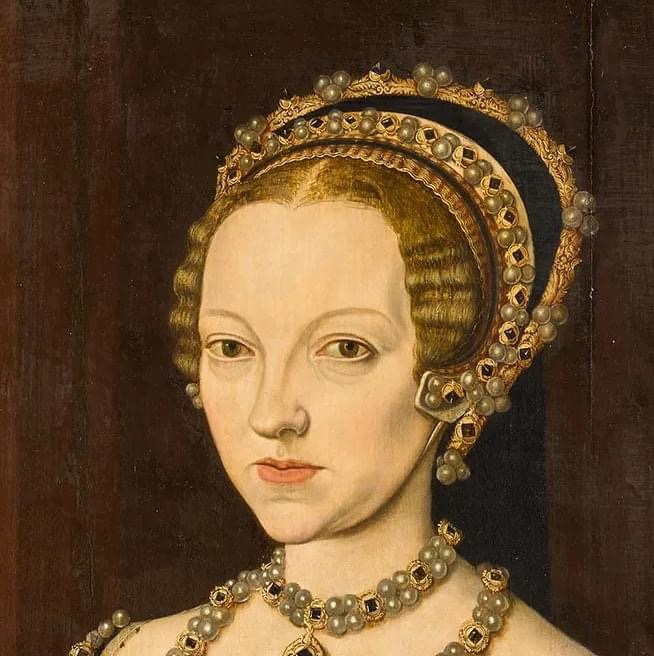

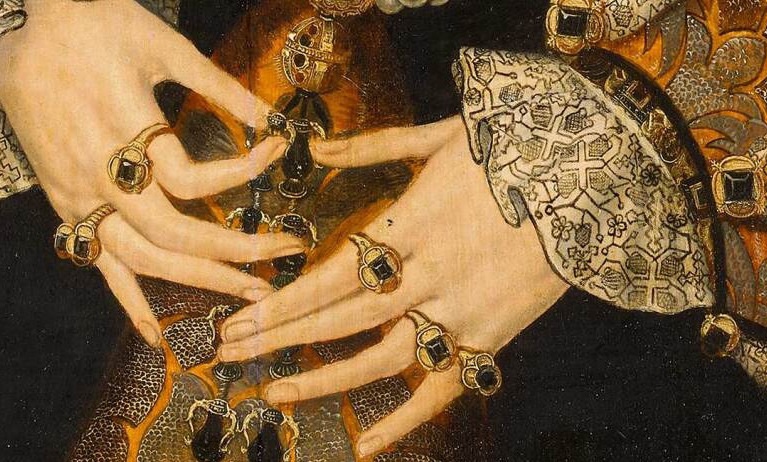


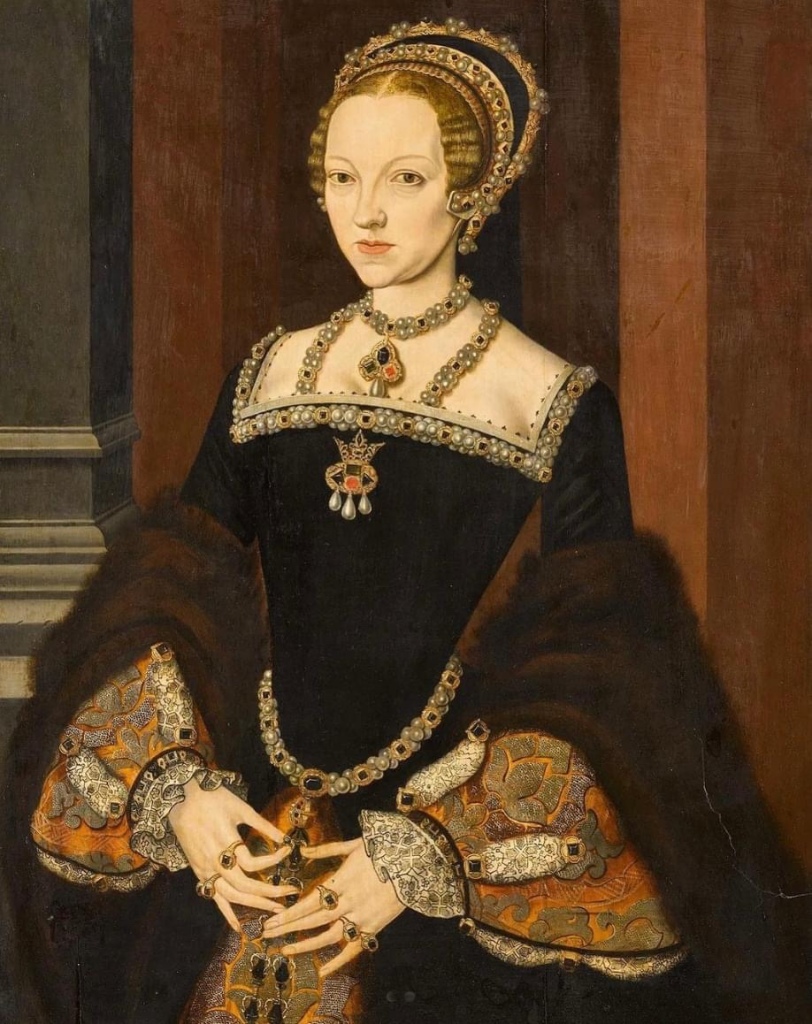
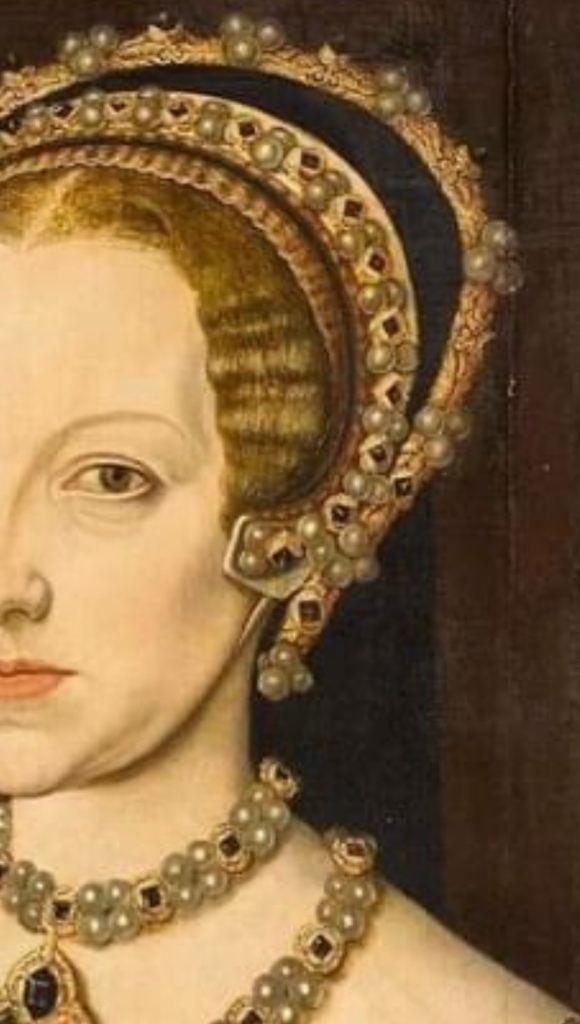
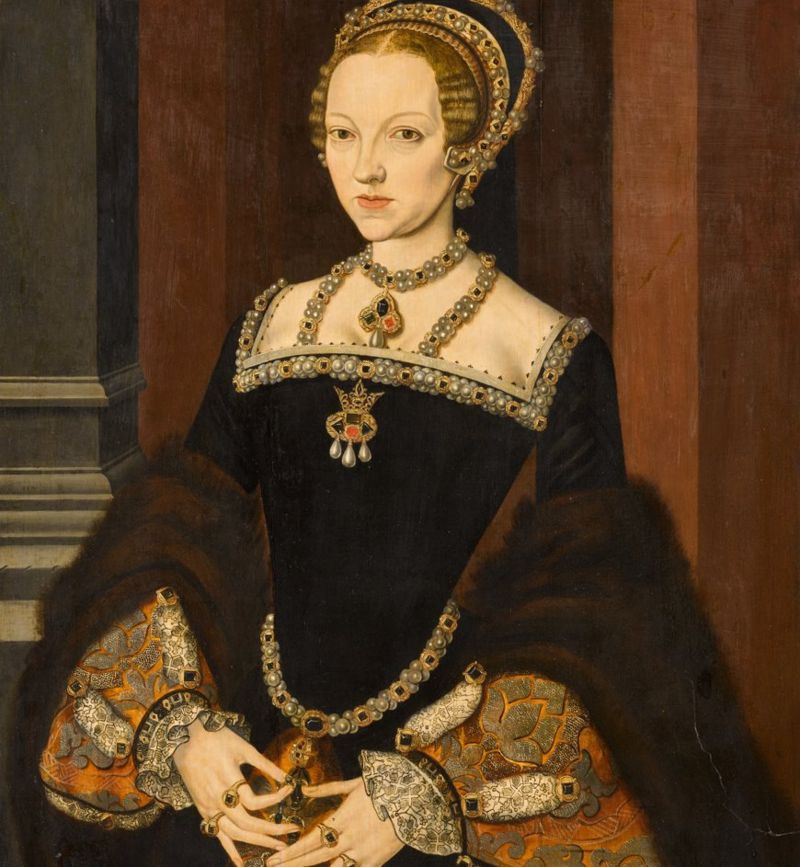

Attributed to Master John: Portrait of Katherine Parr (1512-1548), Queen of England and Ireland


The portrait known as “The Jersey Portrait,” was once thought to depict Lady Jane Grey. Through thorough research however, the conclusion is that this is a portrait of Queen Katherine Parr.
“Parr is known to have commissioned numerous portraits of herself while married to Henry VIII, and this portrait was no doubt one of the many produced and given to friends and family.” (Susan James)
From Dr. Edwards, author of the site “Some Grey Matter“: “The Earl of Jersey informed me via email on 12 November 2012 that an unnamed friend of his mother had previously conducted an unpublished study of the painting. That friend concluded independently that the sitter was Katherine Parr. The friend’s findings were reviewed by experts at Sotheby’s auction house, and Sotheby’s “concurred” with the findings. None of this was known to me prior to 12 November, and neither the friend nor Sotheby’s have published that independent report.”
Little is known about the painting. It is oil on wood panel, consistent with sixteenth-century practices. It is about three-quarter life-size, according to the current Earl of Jersey, measuring 34 inches high by 24 inches wide. The frame bears a label of unknown age and origin identifying the sitter as Queen Mary. No detailed provenance information has ever been published, so that it is not possible to know when or how it came into the Jersey collection at Osterley House. It is worth noting that the original Tudor-era Osterley House had been built in the 1570s by Sir Thomas Gresham, who held Lady Jane’s sister Lady Mary Keyes [Grey] in custody from 1569 to 1572. The Osterley House built by Gresham fell into ruin in the eighteenth century, however, making it unlikely that the portrait originated there. Osterley was acquired and rebuilt in the 1760s by Sir Francis Child, ancestor of the 9th Earl of Jersey. The painting almost certainly entered the Jersey collection after 1760 as decoration for the new house. The painting survives and is now owned by The Earldom of Jersey Trust and held at Radier Manor in the Isle of Jersey. (Edwards)
For more information on the portrait: “Some Grey Matter: THE JERSEY PORTRAIT“

 tudorqueen6 by Meg McGath