
From Bobbing, Kent to St. Mary’s City: My Family’s Journey Comes Home
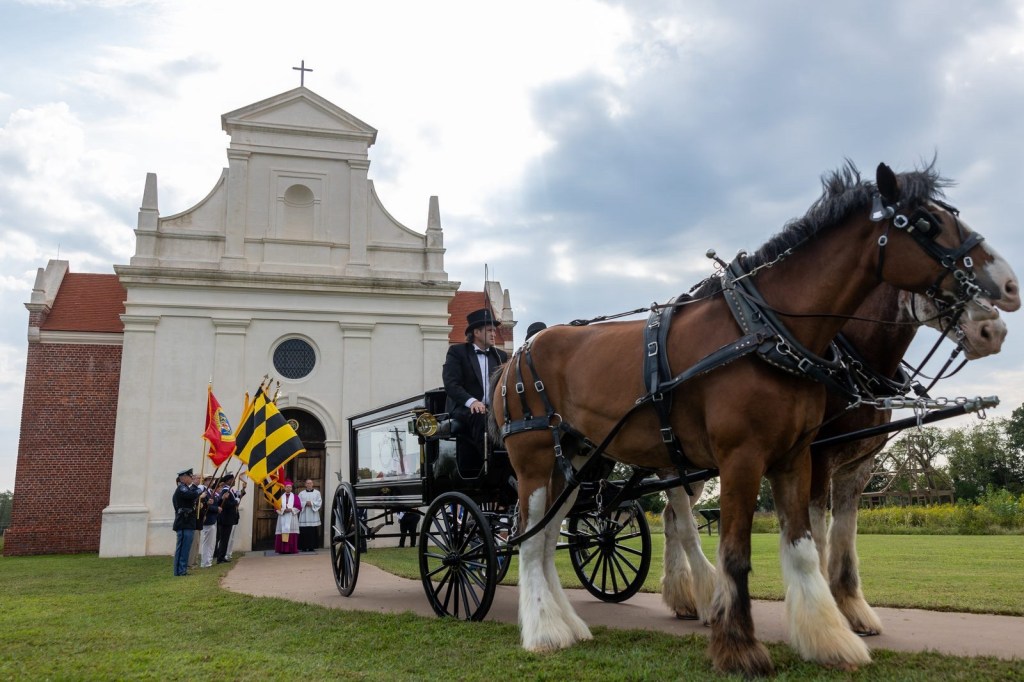
The hearse bearing the remains of eight young children from colonial-era Maryland arrives at the rebuilt 1667 Brick Chapel in Historic St. Mary’s City on Sept. 20, 2025 after being pulled by two Clydesdale horses in a procession from the reconstructed State House of 1676. Baltimore Archbishop William E. Lori, who presided at a reinterment ceremony at the Brick Chapel, can be seen in the background waiting at the chapel’s entrance. The Brick Chapel stands as a landmark of faith that symbolizes Maryland’s status as a birthplace of religious freedom in the United States. (Catholic Standard photo by Mihoko Owada)
In September 2025, history quite literally came full circle in Maryland. The remains of Chancellor Philip Calvert and members of his family were reinterred at Historic St. Mary’s City, the first capital of the Maryland colony. Among those present were two distant relatives of mine, DeAnna Poling and Debora Hansen, who served as honorary pallbearers.
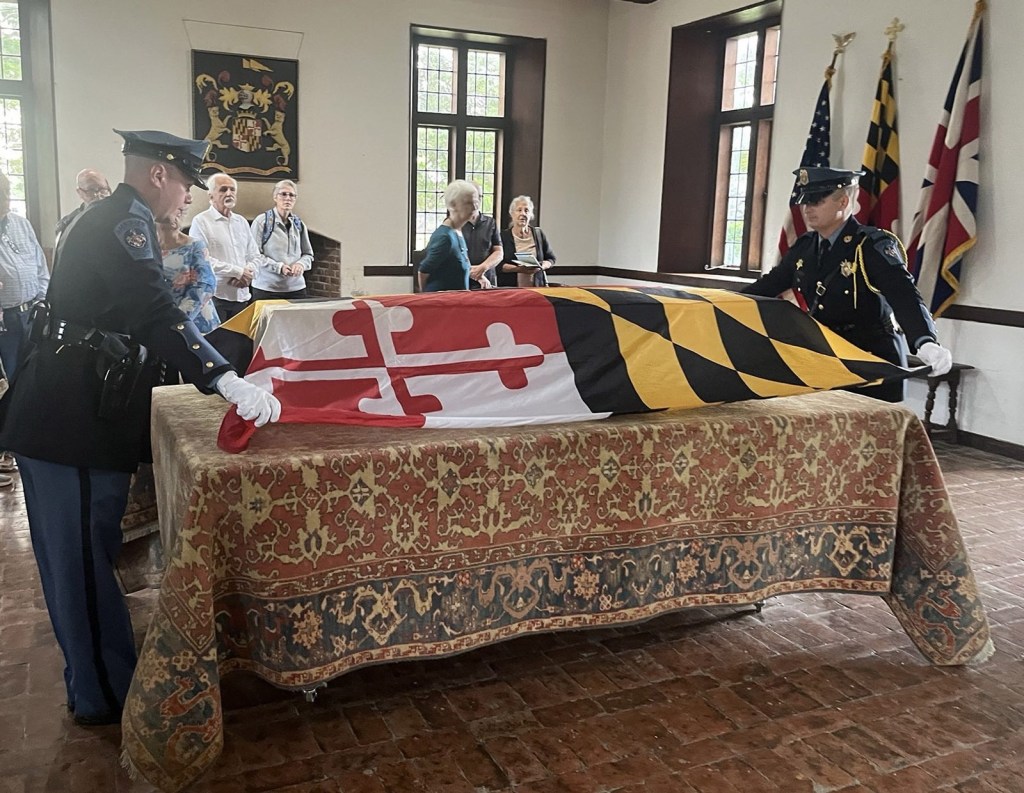
Before a reinterment ceremony for the remains of eight young children from colonial-era Maryland being brought back to the site of the rebuilt 1667 Brick Chapel in Historic St. Mary’s City on Sept. 20, 2025, Corporal Benjamin Luffey and Deputy Jordan Wagner of the St. Mary’s County Sheriff’s Office place the Maryland flag on the pine coffin bearing the remains. The procession for the ceremony began at the reconstructed State House of 1676 located about one-half mile from the Brick Chapel. (Catholic Standard photo by Mark Zimmerman)
Their presence felt deeply personal to me, because my own lineage flows through Governor Thomas Greene and Ann Cox Greene, two of Maryland’s earliest settlers. Thomas was the son of Sir Thomas Greene of Bobbing, Kent, who was knighted by King James I. In 1634, Thomas Greene sailed to Maryland on the Ark and Dove alongside Ann Cox, a gentlewoman whose courage carried her across the Atlantic into an unknown world. They married soon after arriving in the colony and are often described among the earliest married couples of colonial Maryland.
At the ceremony, DeAnna Poling captured what I often feel when I study our ancestors:
“What would compel you to leave from the Isle of Wight in 1633 and think that’s a good idea — at 21 years old — to voyage into the unknown?”
Her sister Debora Hansen added:
“I have three daughters and a granddaughter, and we talk about what courage it took to venture into the unknown.”
That courage lives on. It is the same daring spirit that carried our family from Kent to the Chesapeake, from the courts of England to the wilds of the New World — and, nearly four centuries later, back again to St. Mary’s.
This moment isn’t just commemoration; it’s connection — a living reminder that the people whose names fill our genealogies were real souls with courage, faith, and hope.
Sources
- Catholic Standard: Descendants of early Marylanders participate in ceremony bringing pioneer colonists’ remains home by Mark Zimmerman
Links
- Catholic Standard: Some of Maryland’s first colonists come home, as their remains brought back for reinterment ceremony at Brick Chapel in Historic St. Mary’s City by Mark Zimmerman.
© 2025 Meghan McGath. All rights reserved.



 tudorqueen6 by Meg McGath