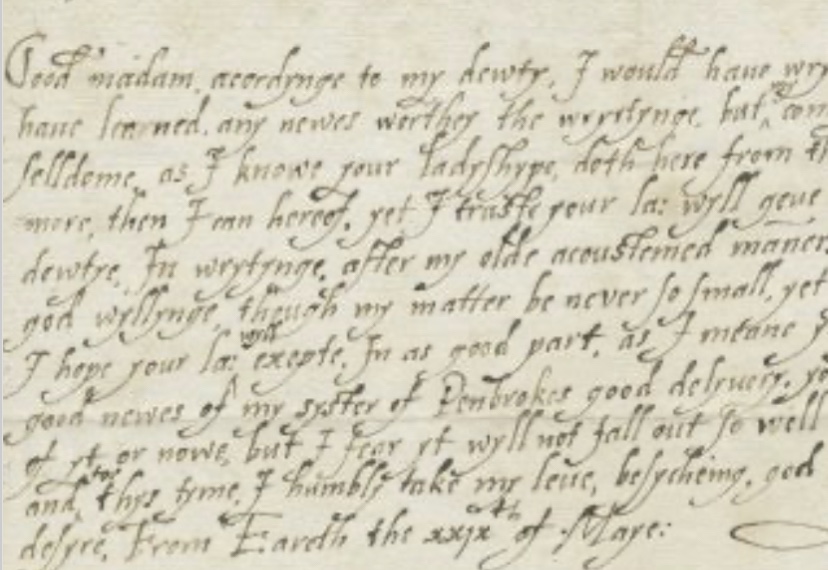
8 May 1575: Letter from Lady Anne Talbot to the Countess of Shrewsbury

Lady Anne Talbot (née Herbert) to Bess of Hardwick, Countess of Shrewsbury.

To the ryght honorable and my asurred good lady and moother the Countes of Shrowsbery./

Good madame, I am to craue pardon of you for not wryteinge by my lordes man Harry Grace, the causse I wylled hym to declare to your Ladyship whych was the extremty that my syster of Pembroke was In, at that tyme whych hath contenued tell theursdaye Laste, sethensse that daye she hath ben out of her soundynge, but not able to stand or gooe, her greatest gryf Is nowe want of slepe, and not able to away wyth the syght of meat, but consederynge her estat befor, we thynke our selfes hapy of thys change, hopenng that better wyll followe shortely, the Quynes Majesty hath ben here wyth her tywss, very latt both tymes, and last tyme, yt was x of the cloke at nyght or ever her Majesty whent hensse, being so great a myste, as ther were dyueres of the barges and Boottes that wayted of her loste ther wayes, and landed In wronge plases, but thankes be to god her Majesty came well home wythout colde or feare, for the holdyng of the Prograce, I am ssure your Ladyship hereth for my part I can wryt noe sertaynte, but as I am In all other matteres, as I haue alwayes professed and as dewtye doth bynd me, ready at your Ladyship’s comandement, and In any thynge I maye showe yt ether at thys tyme, or when occassyon seruet[h] yf I be not as wyllynge therto as any chylde of your owne, then lett me be condemened accordynge to my desertes, otherwyss I humbly craue your Ladyship’s good openyon of me not to decreasse, rememberynge your Ladyship’s comandement here to for to wryt to you as often as I coulde, whych nowe In thys plase I shall haue better meanes then I haue had In the country, and ther vpon pressumyng, to lengthen my letter vpon any occassyon, although I count thys of my syster very evell newes yet consederynge, her recouery, I hope my longe scryblynge, wyll the lesse trouble your Ladyship and so wyth my moste humble dewty to my Lorde and your Ladyship I humbly take my leue From Baynardes Castell the viijth of Maye: 

your Ladyship’s assured loueing daughter to comande

Anne Talbott

My styster of Pembroke hath wylled me to remember her humble dewty to my lorde and you, wyth desyre of hys dayly blessynge assoune as she Is able she wyll dowe yt her selfe/.

To the right honorable and my assured good lady and mother, the Countess of Shrewsbury

Good Madam, I am to crave pardon of you for not writing my lords man Harry Grace, the cause I willed him to declare to your Ladyship which was the [extremity] that my sister Pembroke was. In, at that time which has continued till Thursday. Last [sethensse] that day she has been out of her

Summary: Anne Talbot (née Herbert) writes to Bess (countess of Shrewsbury) apologising for not writing sooner. Her ‘sister of Pembroke’ has been very ill, but is now recovering. The queen has come to visit her sister twice – both times late at night. On one occasion the queen didn’t leave until 10 o’clock at night because ‘the barges and boats that waited of her lost their ways, and landed in wrong places’ due to a great mist. Letter features: papered seal, embossed Ribbon/floss – no. Letter packet – slit and band.

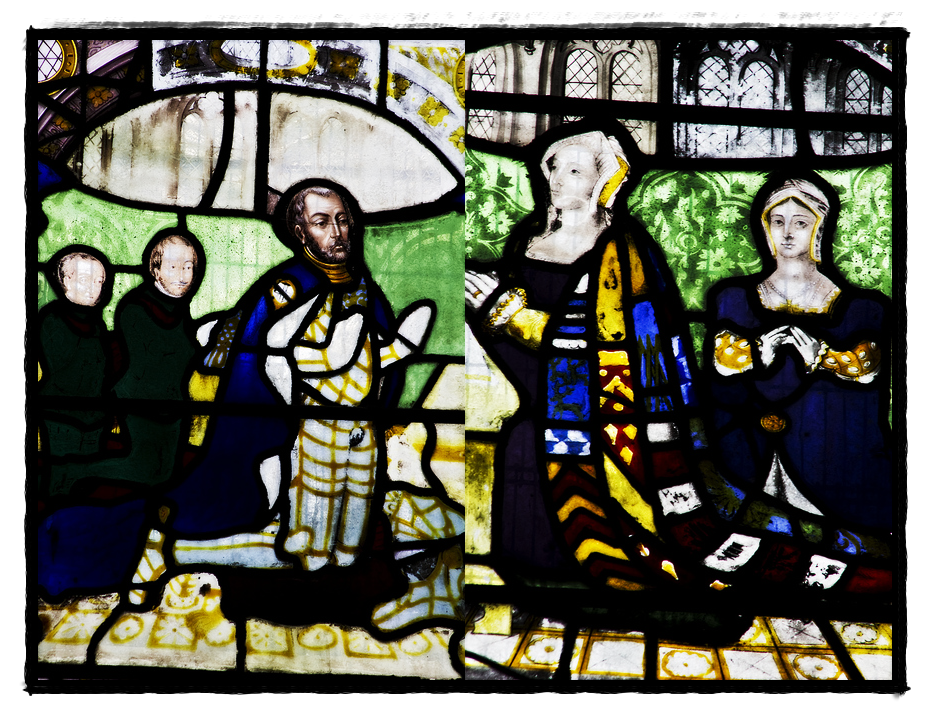
Lady Anne Talbot was born to Sir William Herbert, 1st Earl of Pembroke and his first wife, Anne Parr, sister to Queen Katherine Parr. She married Francis, Lord Talbot, eldest son of the 6th Earl of Shrewsbury and his first wife, Gertrude Manners. Elizabeth “Bess” Hardwick was the second wife. She had no issue from her marriage to the 6th Earl. Who is this ‘sister of Pembroke’? Catherine Talbot, Lady Herbert, wife of Lady Talbot’s brother, Sir Henry, Lord Herbert, later 2nd Earl of Pembroke?

Bess of Hardwick’s Letters: The Complete Correspondences c.1550-1608. Folger Shakespeare Library, Cavendish-Talbot MSS, X.d.428 (121)

18 JULY 1588: DEATH of Anne Talbot

Sheffield Manor Lodge [The Star]

18 JULY 1588: THE DEATH of Anne Talbot, Countess of Pembroke, 2nd wife to Sir William Herbert, Earl of Pembroke.

Anne Talbot (18 March 1523 – 18 July 1588) was the daughter of George Talbot, 4th earl of Shrewsbury and his second wife, Elizabeth Walden, dau. and coheir of Sir Richard Walden of Erith. She had been previously married to Peter Compton (d. 30 January 1544). Their posthumous son was Henry Compton, 1st Baron Compton.

After the death of his first wife, Anne née Parr, sister of Queen Catherine, Pembroke married Anne after 1552. The two had no issue, but she was stepmother to three children. Her nephew, the 6th Earls children included Lord Francis and Catherine Talbot who married her stepdaughter and elder stepson.

No info is given on where she’s buried. She wasn’t buried with her 2nd husband who’s buried with his 1st wife at St Paul’s Cathedral, London. Anne may be back at Sheffield Cathedral where the Shrewsbury family has a chapel. However, research into her finds on Tudor Place that she was buried in Elrith, Kent where her mom was heiress. Anne became heiress to her mother. The Complete Peerage says, “Anne Talbot was buried on 8 August 1588 at Erith, Kent, England.”

Image of Sheffield Manor, home of the 4th Earl of Shrewsbury and his family. The manor stayed in the Talbot family until the death of the 6th Earl. After the death of George Talbot, the Earls rarely visited the site and the land was leased to tenant farmers. It fell to the Duke of Norfolks in 1660.

Family of Queen Katherine: DEATH of William, 1st Earl of Pembroke

Pembroke family of Wilton. Wilton Church. Pembroke family of Wilton. Wilton Church.

Yesterday was the anniversary of the death of Sir William Herbert, 1st Earl of Pembroke, husband of Anne Parr, and thus sister-in-law to Queen Katherine. Lord Pembroke died on 17 March 1570 at Hampton Court Palace. William was eldest son of Sir Richard Herbert of Ewyas, Herefordshire, by his wife Margaret, daughter of Sir Matthew Cradock of Swansea. Pembroke’s father, Sir Richard, was an illegitimate son of the original William Herbert, 1st Earl of Pembroke of the first creation (d. 1469), by a mistress, Maud, daughter of Adam ap Howell Graunt. He married firstly to Anne Parr in 1538 and after her death, Lady Anne Talbot, daughter of the Earl of Shrewsbury. Parr gave Pembroke an heir (the 2nd Earl), an heir to spare (ancestor to the Earls of Powis), and a daughter (no issue). Talbot had no issue by Pembroke.

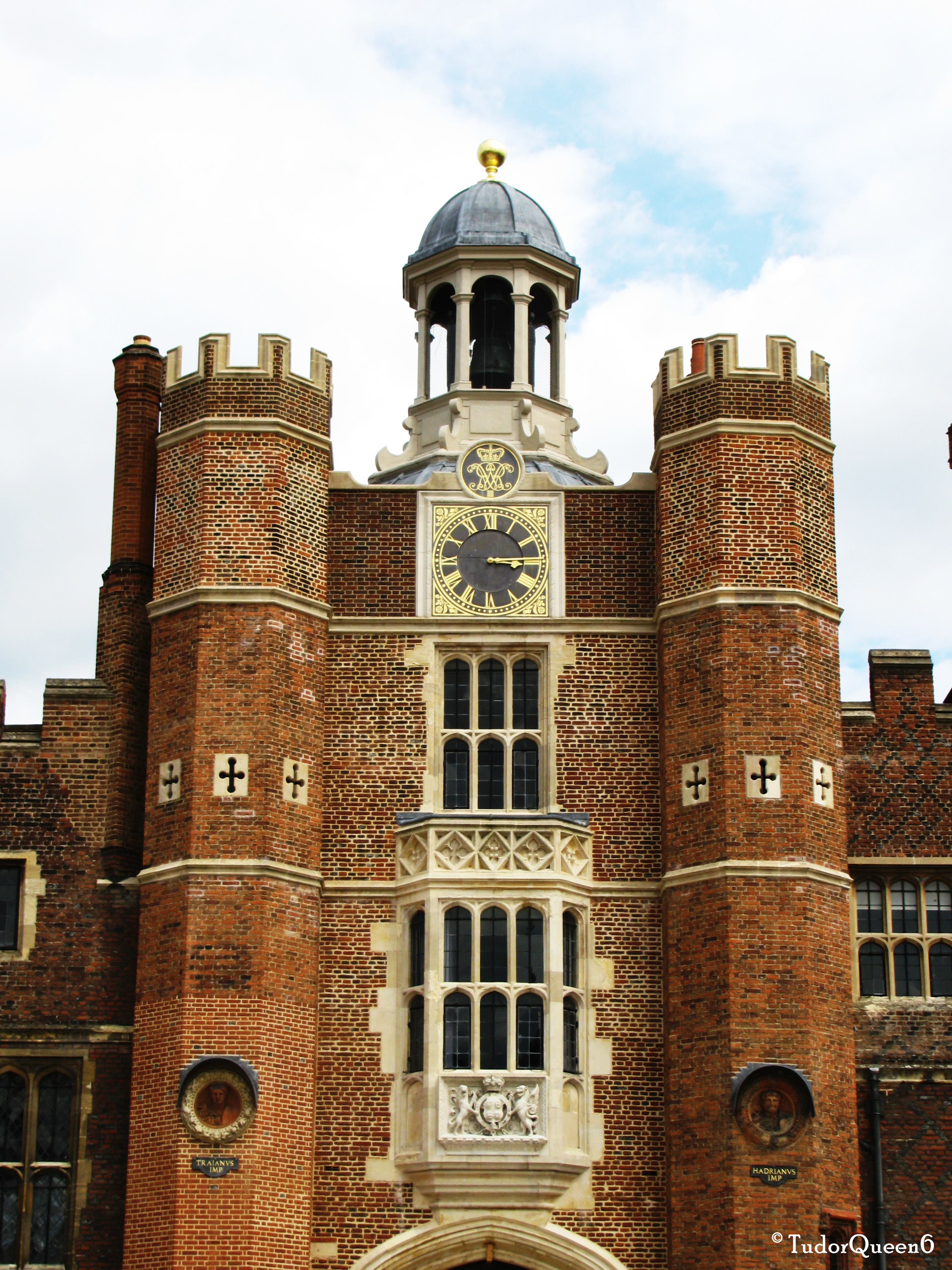
Hampton Court Palace, London, England. Hampton Court Palace, London, England.

On the eve of 17 March 1570, Pembroke took to his bed in his quarters at Hampton Court Palace. He was joined by his younger son, Sir Edward Herbert and the Earl of Leicester, Robert Dudley.

Pembroke had written his will back on 28 December 1569. Pembroke’s executors/witnesses of his will were his heir Henry Herbert (later 2nd Earl of Pembroke was the sole executor), the Earl of Leicester (Robert Dudley); Sir Walter Milday; Sir Nicholas Throckmorton (cousin to his first wife); Gilbert Gerrard. To those men he bequethed £50 to be delivered either in money, plate of jewels, within one month. And by codicil it is mentioned that Pembroke declared to Leicester and his son, Sir Edward Herbert, that on the night before his death, the Lord Keeper of the Great Seal, Sir James Crofts, and Mr. Secretary Cecil be joined in the oversee and receive the same gifts. To his wife, (Anne Talbot) he left her, her own clothes and jewels, which would otherwise go to his son Henry, Lord Herbert and his wife. Lady Pembroke was to be looked after and to be allowed to stay at Baynard’s Castle where Pembroke’s previous wife had died in 1552. Pembroke’s second son, Edward, was given a plate with the value of 500 marks. Pembroke’s daughter, Anne, Lady Talbot, was to receive £500. To his brother-in-law, the Marquess of Northampton (William Parr), he left his second-best gold sword. Leicester received Pembroke’s best gold sword. Pembroke also wanted £200 bestowed upon the poor near Baynard castleward in London, Salisbury in Wiltshire, and Hendon. To the Queen (Elizabeth), he left his “newest fairest and richest bed” and his greatest jewel called the “Great Ballace.” Most importantly, the ordinary men (his servants, etc) were to be looked after by his heir, Henry.

That my lorde Herbert do consider Thomas Gregorie and Tidie with money for their travaile and paines beside that he hath bequethed to them in annuity that he speciallie do appointe to Francis Zouche and Charles Arundell fit and good annuities for them. That he have special care of Henrie Morgan, George Morgan, Phillip Williams, Robert Vaughan, and Thomas Scudamore and either entertaigne them into his service payinge them their wages beforehand or else appoint them sufficient annuities. That he do entertaigne his household and keep them together

Philip Williams had been Pembroke’s secretary; Robert Vaughan, his treasurer; Thomas Scudamore was one of the men who carried his coffin.

Leicester then left Pembroke’s bedside, leaving Pembroke with his son and physicians. Pembroke died the next morning, 17 March 1570 at the age of sixty-three.

In his will, Pembroke listed two possible burial places; Old Saint Paul’s or Canterbury Cathedral. If he died near London, his wishes were to be buried in St. Paul’s Cathedral next to his first wife, Anne Parr. Pembroke obviously loved his wife for when he wrote his will, despite being married again, he wanted nothing more than to be buried “near the place where Anne my late wife doth lie buried” in St. Paul’s. He was buried in April.

Shortly after his death, the Dowager Lady Pembroke received a letter from the Queen in the hand of Cecil, but heavily corrected (most likely by Elizabeth). The Queen expressed her condolences of the loss of “our late cousin.”

See also: “Funeral of William Herbert, 1st Earl of Pembroke

References

  • Adam Nicolson. “Quarrel with the King: The story of an English family on the high road to Civil War,” HarperCollins, Oct 6, 2009.
  • Wiltshire Archaeological and Natural History Society, Devizes : Wiltshire Archaeological and Natural History Society, 1879. pg 126-28.