To the men like Lord Darnley, and all the men who mistake control for care
There’s a certain kind of man who doesn’t want to help — he wants to rule.
History has a name for him.
Lord Darnley wasn’t remembered because he governed wisely or protected anyone. He’s remembered because he demanded authority he didn’t earn, resented a capable woman, and destabilized everything around him while insisting he was entitled to power.
Sound familiar?
These men don’t build. They block.
They insert themselves as gatekeepers, slow down solutions, override competence, and insist that everything flow through them — not because it helps, but because it centers them.
Shakespeare understood this dynamic too.
In Hamlet, the rot isn’t just murder — it’s usurpation. A man who takes the throne without legitimacy, then demands loyalty while poisoning the household.
“Something is rotten in the state of Denmark” isn’t about madness. It’s about power taken where it doesn’t belong.
When someone insists on being “King” of a family while actively obstructing the people who know what they’re doing, that’s not leadership. That’s insecurity wearing a crown.
And history is very clear on how those stories end.
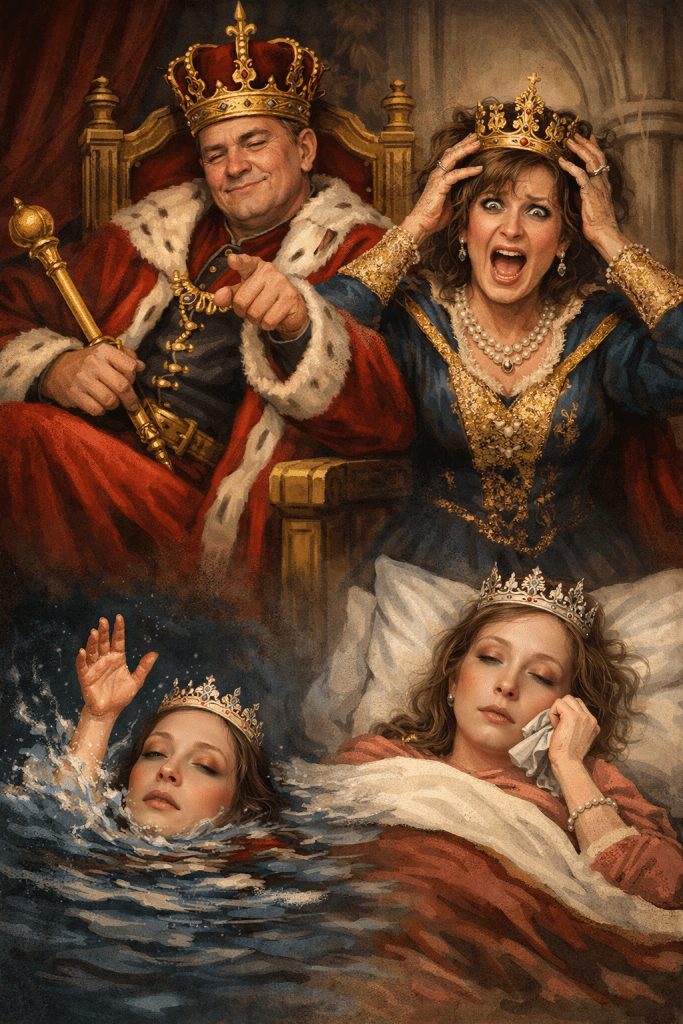
AI: Henry & his consort Kateryn surrounded by the ghost of Anne Boleyn, Henry Howard & Katherine Howard. The three cousins who Henry VIII executed.
Henry VIII didn’t just execute Anne Boleyn and Katherine Howard — he erased them.
Not because they were guilty.
Not because they were dangerous.
But because they injured his ego, and Henry VIII could not tolerate narcissistic shame.
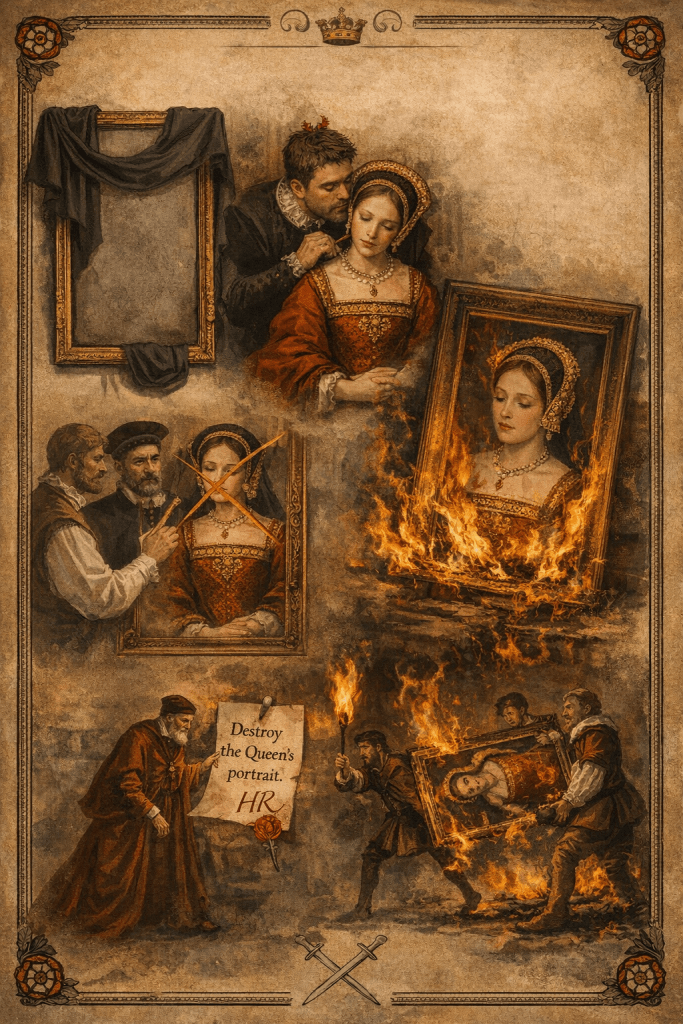
He ERASED them. • Their coats of arms torn down • Initials removed from palaces • Portraits hidden or destroyed • Their reputations smeared • Their names forbidden at court • Their supporters scattered • His daughter by Anne was sent away immediately and lost her status as Princess Elizabeth. She was hence Lady Elizabeth Tudor.
This is classic narcissistic annihilation: “If you injure me, you cease to exist.”
He literally rewrote history documents to frame himself as: • righteous • innocent • betrayed • the victim • morally justified
He needed to believe he wasn’t the problem — THEY were.
Typical narcissistic rewriting of the narrative.
The charges against both women were manufactured or exaggerated — not to seek justice, but to restore Henry’s fragile self-image.
Henry VIII’s entire marital history reads like a narcissistic abuse cycle
He: • love bombed • isolated • tested loyalty • demanded admiration • punished perceived slights • rewrote narratives • replaced women quickly • destroyed those who “shamed” him
The man was a pathological narcissist with absolute power.
(ChatGPT)
And Anne Boleyn and Katherine Howard were two women who suffered the worst aspect of that pathology: Total erasure as punishment for wounding him.
Anne and Katherine weren’t executed because they were guilty. They were executed because Henry was “wounded” by them. He became the victim in his eyes.
“How misfortunate I am to have so many ill-conditioned wives!” — King Henry VIII in ‘The Tudors’ (S4E5)
Margaret of Austria (10 January 1480 – 1 December 1530) was Governor of the Habsburg Netherlands from 1507 to 1515 and again from 1519 until her death in 1530. She was the first of many female regents in the Netherlands. She was variously the Princess of Asturias, Duchess of Savoy, and was born an Archduchess of Austria.
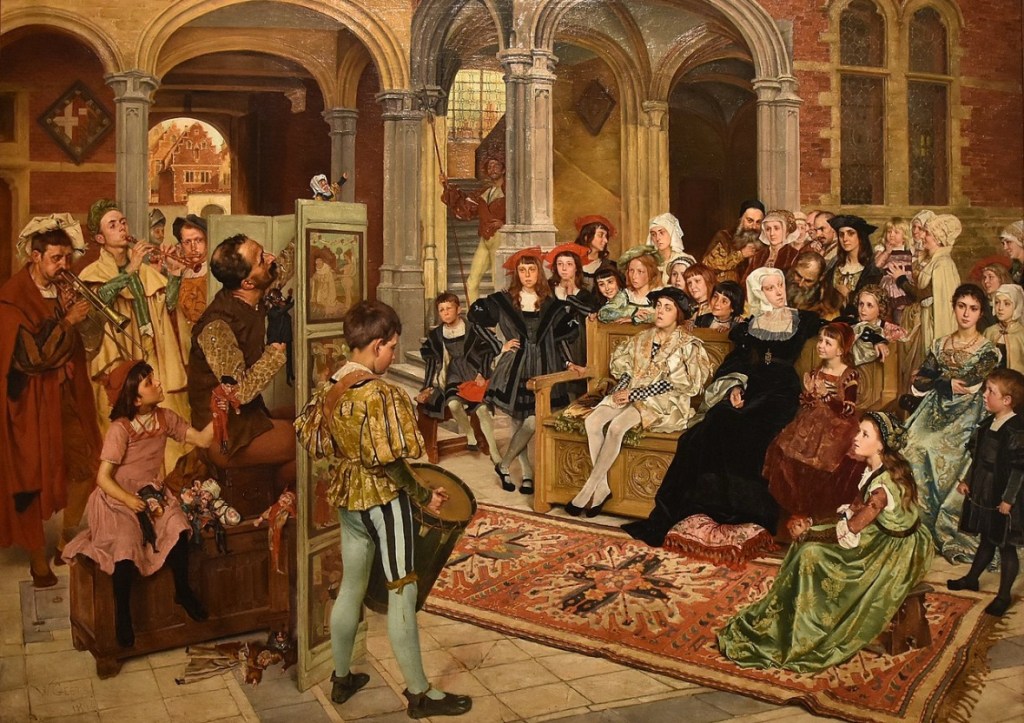
Margaret of Austria sits with her nephew, Charles V and his sisters. Willem Geets (1892)
Margaret was the second child and only daughter of Maximilian of Austria (future Holy Roman Emperor) and Mary of Burgundy, co-sovereigns of the Low Countries. She was named after her step grandmother, Margaret of York, who was sister to the York Kings Edward IV and Richard III.
Margaret was married to John, Prince of Asturias who was heir to Ferdinand II of Aragon & Isabel I of Castile. John was the eldest brother of future Queen Katherine of Aragon. Margaret’s brother married their sister, the future Juana I of Castile. That made Margaret a sister-in-law to Katherine and Juana.
When the Prince died, Margaret stayed in Spain. In her time as Dowager Princess, it was suggested that she should teach her teenage sister-in-law, Katherine of Aragon, French.
In 1501, Margaret married Philibert II, Duke of Savoy (1480–1504), whose realm played a decisive role in the rivalry between France and the Habsburgs.
Margaret was also familiar with English Ambassador Sir Thomas Boleyn, the father of the future Queen Anne Boleyn. In the Spring of 1513, a young Anne was sent to Margaret’s “Court of Savoy” at Mechelen Castle in Belgium. Anne was there until the late summer of 1514 when she moved to Paris to attend Queen Claude of France. Anne was eventually sent back to the English court of King Henry VIII of England. She became a lady to Katherine of Aragon who had married secondly to King Henry. By 1526, Henry became attracted to Anne after having an affair with her sister, Mary. Henry would go to extreme measures to move heaven and earth for Anne. In actuality, Henry just really needed to remarry and have a son. His current wife, Queen Katherine, would be banished from Court and would die alone as “Dowager Princess of Wales”. Their daughter Mary never saw her mother again. Mary would eventually become the first Queen Regnant of England and Ireland and Queen of Spain by marriage to Philip II who was a descendant of Margaret’s brother, Philip, who married Juana, Queen of Castile who was sister to Katherine of Aragon.
Willem Geets imagines (1892) a puppet show at Margaret’s court; the future Charles V sits next to her, with his sisters alongside.
The seated girl at right may be intended to be Anne Boleyn. No source is named on Wikipedia as to who thought the young girl is actually Anne Boleyn as of January 25th, 2025.







 tudorqueen6 by Meg McGath