25 JUNE 1547: Edward VI to the Dowager Queen

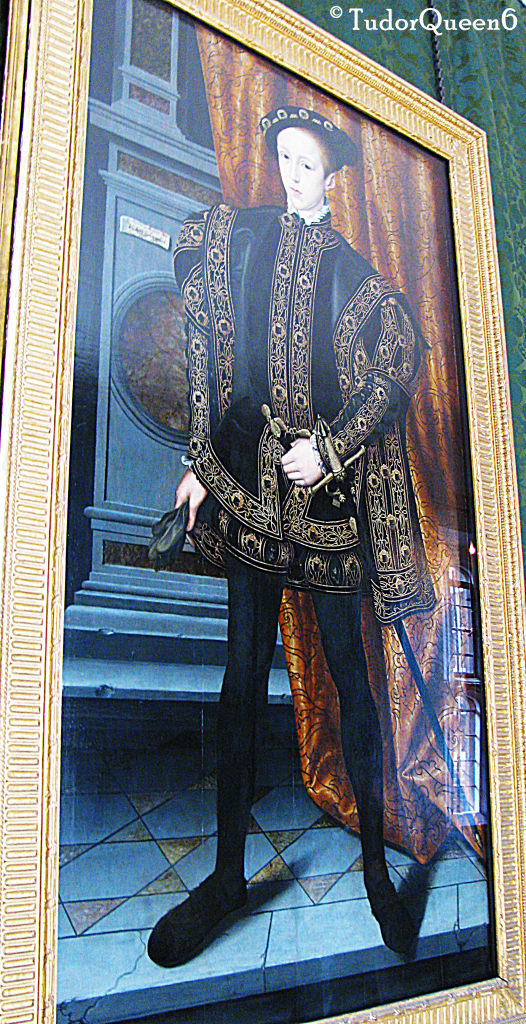
Hampton Court Palace -- King Edward VI
King Edward VI, c.1550, attributed to William Scrots. Hampton Court Palace. artist, after Holbein. RCT405751, Royal Collection Trust © tudorqueen6 (Meg McGath).

To Queen Katherine Parr, the king’s letter congratulatory, upon her marriage with the Lord Admiral

We thank you heartily, not only for the gentle acceptation of our suit moved unto you, but also for the loving accomplishing of the same, wherein you have declared, not only a desire to gratify us, but also moved us to declare the good will, likewise, that we bear to you in all your requests. Wherefore, ye shall not need to fear any grief to come or to suspect lack of aide in need, seeing that he, being mine uncle, is of so good a nature that he will not be troublesome by any means unto you, and I of such mind, that, for divers just causes, I must favour you.

But even as without cause you merely require help against him whom you have put in trust with the carriage of these letters, so may I merely return the same request unto you, to provide that he may live with you also without grief, which hath given him wholly unto you; and I will so provide for you both, that if hereafter any grief befall, I shall be a sufficient succour in your godly and praiseworthy enterprises.

Fare ye well, with much increase of honour and virtue in Christ.

From St James, the 25th day of June

Edward

Letters of the Kings of England: Now First Collected from the Originals in Royal Archives, and from Other Authentic Sources, Private as Well as Public · Volume 2 By James Orchard Halliwell-Phillipps · 1846

Katherine Parr: Complete Works and Correspondence By Katherine Parr, editor Janel Mueller · 2011, pg 147

4 JUNE 1547: Lady Mary writes The Lord Admiral

The letter was addressed in two different hands: “The Lady Mary to the Lord Admiral, 4th June.” “From the Lady Mary’s Grace“

Addressed to: “To my Lord Admiral”

My lord,

After my hearty commendations, these shall be to declare to you, according to your accustomed gentleness, I have received six warrants from you by your servant, this bearer: for the which, I do give you my hearty thanks. By whom also I have also received your letter, wherein, as me thinketh, I perceive strange news concerning a suit you have in hand to the Queen for marriage. For the sooner obtaining whereof, you seem to think that my letters might do you pleasure.

My lord, in this case I trust your wisdom doth consider that, if it were for my nearest kinsman and dearest friend alive, of all other creatures in the world, it standeth least with my poor honor to be a meddler in this matter, considering whose wife her grace was of late. And besides that, if she be minded to grant your suit, my letters shall do you but small pleasure. On the other side, if the remembrance of the King’s majesty, my father (whose soul God pardons), will not suffer her to grant your suit, I am nothing able to persuade her to forget the loss of him, who is at yet very ripe in my own remembrance.

Wherefore I shall most earnestly require you, the premises considered to think none unkindness in me, though I refuse to be a meddler any ways in this matter. Assuring you that, wooing matters set apart (wherein I, being a maid, am nothing cunning), if other ways it still lie in my little power to do you pleasure, I shall be as glad to do it as you to require it: both for his blood’s sake, that you be of, and also for the gentleness which I have always found in you. As knoweth almighty God, to whose tuition I commit you. From Wanstead this Saturday at night, being the fourth of June.

Your assured friend to my power,

Mary

Katherine Parr: Complete Works and Correspondence ed. by Janel Mueller, 2011. Pg 146-7.

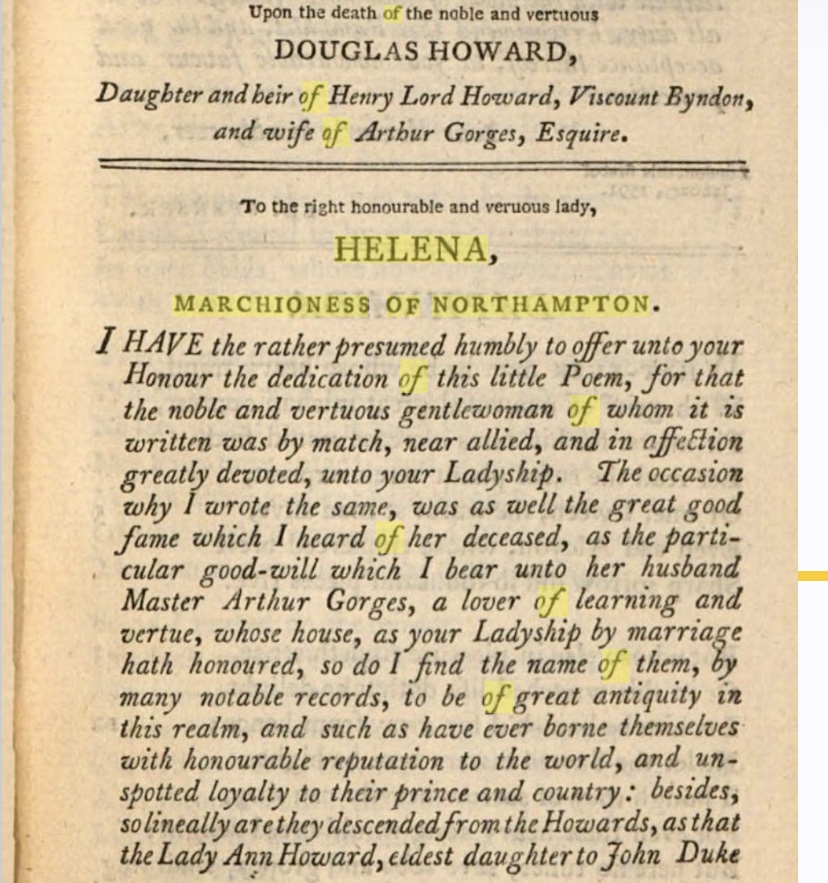
1 JANUARY 1591: LETTER to Helena, Marchioness of Northampton

The poet Edmund Spenser writes to Helena, Marchioness of Northampton dedicating his poem “Daphnaïda: An Elegy upon the Death of the Noble and Vertuous Douglas Howard, Daughter and Heire of Henry Lord Howard, Viscount Byndon, and Wife of Arthure Gorges Esquier” to her.

Source

Bell’s Edition: The Poets of Great Britain Complete from Chaucer to Churchill, 1788.

Queen Katherine Parr: Letter Up for Auction

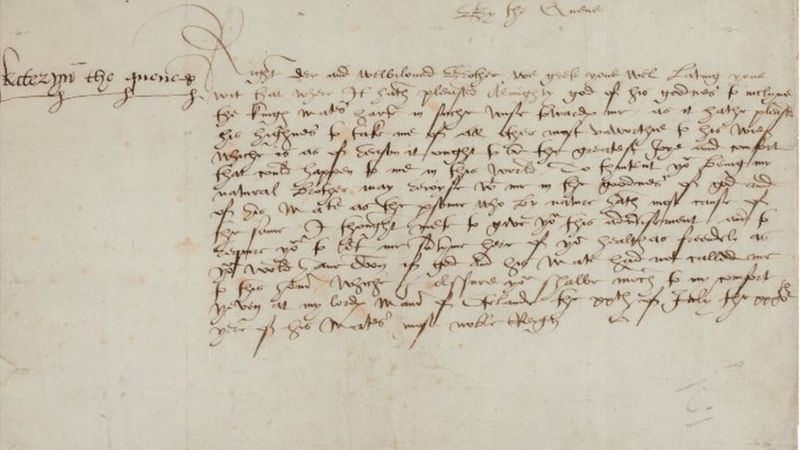
Queen Katherine Parr | Letter signed, announcing her marriage to Henry VIII, 20 July 1543
Sotheby’s
“To our right dear and entirely beloved brother, the Lord Parr, Lord Warden of the Marches,” Sotheby’s

Right dear and well-beloved brother, we great you well. Letting you wit that when it hath pleased almighty God of His goodness to incline the King’s majesty in such wise towards me, as it hath pleased his highness to take me of all others, most unworthy, to his wife, which is, as of reason it ought to be, the greatest joy and comfort that could happen to me in this world:

To the intent, you being my natural brother, may rejoice with me in the goodness of God and of his majesty, as the person who by nature hath most cause of the same, I thought meet to give your this advertisement. And to require you to let me sometime hear of your health as friendly as you would have done, if God and his majesty had not called me to this honor: which, I assure you, shall be much to my comfort. Given at my lord’s manor of Oatlands, the twentieth of July, the thirty-fifth year of his majesty’s most noble reign.

Kateryn, the quene

Katherine Parr: Complete Works and Correspondences, editor Janel Mueller. University of Chicago, 2011. pg 46.

Letter signed (“Kateryn the queen”), to her brother William Parr,

ANNOUNCING HER MARRIAGE TO KING HENRY VIII, explaining that “It hath pleased Almighty god of his goodness to incline the Kinges ma[jes]tes harte in suche wise towards me”, celebrating an event which is “the greatest Joye and comfort that could happen to me in this world”, and inviting her brother to “rejoyse with me in the goodness of god and of his Ma[jes]te”, 1 page, oblong folio, Oatlands, 20 July 1543, integral address leaf (“To our right der and entirely beloved Brother the Lord Parre Lord Warden of the Marches…”), docketed, fragile at folds, crude repair to marginal tear, spotting

HENRY VIII’S FINAL QUEEN ANNOUNCES HER MARRIAGE TO THE KING. This remarkable letter was written just days after the marriage between the aging Henry VIII and his final Queen. The wedding ceremony had taken place on 12 July in the Queen’s Closet at Hampton Court Palace, attended by only 18 people. The couple immediately started on the court’s summer progress and this letter was written from the first stop on their journey, Oatlands Palace in Surrey.

Description of Lot from Sotheby’s

The letter is up for auction. I noticed that this is not her handwriting and her signature is not followed by her maiden initials KP. Did the initials come later in her reign as queen?

16 APRIL 1614: THE DEATH of Jane, Lady Cheyne

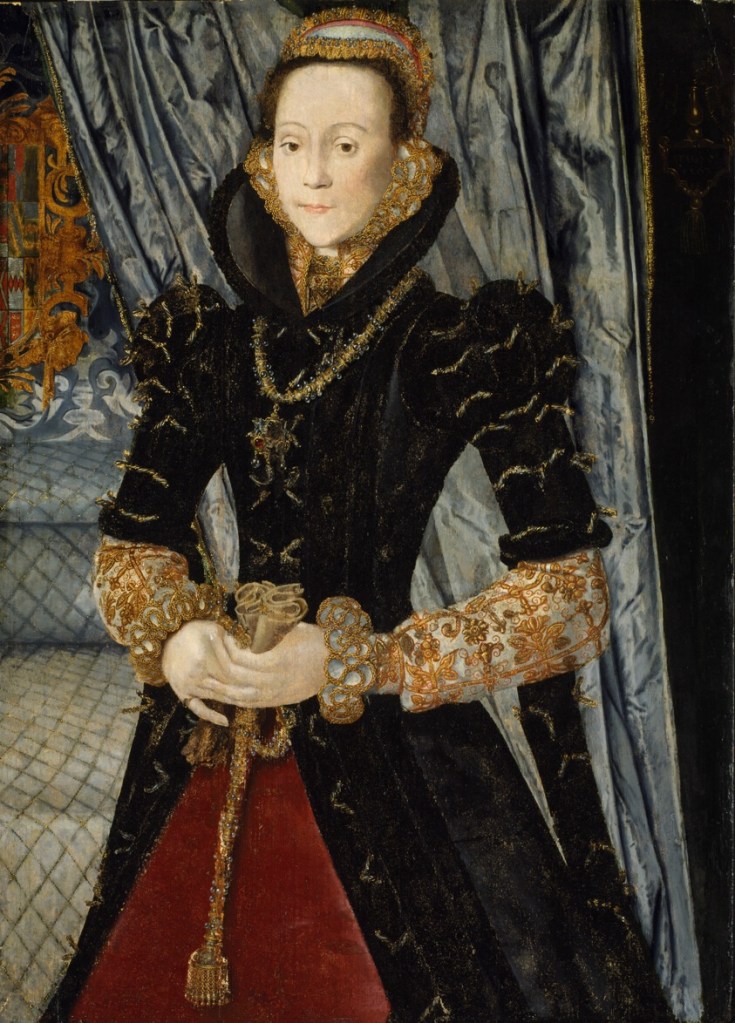
16 APRIL 1614: THE DEATH of Jane Wentworth, Lady Cheyne of Toddington. She was one of seventeen children, the eldest daughter of Sir Thomas Wentworth, Baron Wentworth of Nettlestead and Margaret Fortescue, a distant cousin of Sir Thomas Boleyn, Earl of Wiltshire (father of Queen Anne) and Sir Thomas Parr of Kendal (father of Queen Katherine). By her father, Lady Cheyne was a cousin to the Seymours, whose mother was Margery Wentworth (aunt to Jane’s father).

Portrait of a Lady of the Wentworth Family (Probably Jane Cheyne)
1563
Artist:
Hans Eworth
Netherlandish, active England 1545–73/74
Inscribed: AETATIS 24 / 1563 / HE (on tablet at upper right), coat of arms of the Wentworth (upper left)
Art Institute Chicago

She was married to Sir Henry Cheyne (Cheyney or Cheney) of Shurland who was created Baron Cheney of Toddington by Queen Elizabeth. He was “the extravagant Lord Cheney” who tore down his ancestral home, Peivre, and built a mansion. Henry was born on 31 May 1540 to Sir Thomas Cheyne of Blackfriars and Shurland and his second wife, Anne Broughton. Lord Cheyne’s father fought in France in 1544 while Queen Katherine Parr was Regent of the realm. After the death of Henry VIII, Thomas was the one who made arrangements for the coronation of Edward VI, son and heir of King Henry VIII and his third queen, Jane Seymour. Ironically, he ended up being part of the proceedings against Lord Seymour of Sudeley, uncle to Edward VI and the fourth husband of the late dowager queen, Katherine Parr. Thomas’ wife, Anne Broughton, was the daughter of Sir John of Toddington and the future Lady Anne (Sapcote) Russell, Countess of Bedford who had served as a lady to the late queen Katherine. She brought Toddington to the Cheyne family.

Queen Elizabeth was received at Toddington twice.

Lady Cheney is recorded in a lawsuit against Robert Pearce to recover the deeds and for an adjunction. The lawsuit seems to pertain to Toddington Manor, lands in the parish of Chalegrave and the manor of Chalgrave, late the estate of her husband, Lord Cheyne.

Lord Cheyne died on 3 September 1587. His remains were buried in Toddington Church where there are three mutilated tombs to the Cheyne family. Lady Cheyne erected a tomb for him. The effigy is in highly decorated armor. The head is on a cushion and on a mat rolled up, continued the whole length.

Through Lady Cheyne, Toddington passed to her great nephew, Thomas Wentworth, 4th Baron of Nettlested

Upon her death, Lady Cheyne was also buried in the Church. The effigy is still there, but is much worn away; the head which rested on a pillow is badly damaged. In pointed frontlet, veil, and wimple, and mantle faced with ermine. The arms of Wentworth and twenty-three quarterings are present. The head of the tomb is preserved and is inscribed:

“Here lyth Da Jane late wife of Sr Henrie Cheyne, Knight Ld Cheyne of Todington and eldest daughter of Sr Thomas Wentworth, Knight, Lo. Wentworth and Lord Chamberlaine to king Edward the sixt, who deceased the 16 daie of April A D 1614”

“Here lies my bodie in corrvptions bed, my sovle by faith and hope to heaven is led. Imprisoned by life, death set me free, then welcome death, step to æternity”

Sources

CHEYNEY (CHEYNE), Henry (1540-87), of Toddington, Beds. and Shurland, Kent.

CHEYNE, Sir Thomas (1482/87-1558), of the Blackfriars, London and Shurland, Isle of Sheppey, Kent.

Three Branches of the Family of Wentworth I. Wentworth of Nettlestead, Suffolk. II. Wentworth of Gosfield, Essex. III. Wentworth of Lillingstone Lovell, Oxfordshire By William Loftie Rutton · 1891.

The Topographer and Genealogist, Volume 1, 1846

The Complete Peerage of England, Scotland, Ireland, Great Britain, and the United Kingdom: Eardley of Spalding to Goojerat. 6. Gordon to Hustpierpoint By George Edward Cokayne, Vicary Gibbs, Herbert Arthur Doubleday, Duncan Warrand, Thomas Evelyn Scott-Ellis Baron Howard de Walden, Geoffrey Henllan White · 1926

Calendars of the Proceedings in Chancery, in the Reign of Queen Elizabeth To which are Prefixed Examples of Earlier Proceedings in that Court, Namely, from the Reign of Richard the Second to that of Queen Elizabeth, Inclusive · Volume 1 By Great Britain. Court of Chancery · 1827

The Reliquary & Illustrated Archæologist, Volume 6, 1900

The Strife of the Roses and Days of the Tudors in the West By William Henry Hamilton Rogers · 1890

Lawrence Washington of Sulgrave Manor

I found that the ancestor of US President George Washington, Lawrence Washington (c.1500-1584), father to Robert (c.1554-1619), on 26 July 1529, was a bailiff at Warton (in the Barony of Kendal) to Sir William Parr, Baron Parr of Horton, uncle to Queen Catherine. Lawrence was the son of John and Margaret Washington. By his mother, he was a nephew of Sir Thomas Kytson of Hengrave, son of Robert of Warton Hall. His cousin, Lady Katherine Spencer, married into the Spencer family and is an ancestor to the current Prince of Wales and his brother, Harry, Duke of Sussex.

By 1529/30, Washington married the wealthy widow, Elizabeth Gough (unknown maiden name).

By 1529, the future queen Katherine Parr had just married her first husband, Sir Edward Borough (or Burgh). Borough was the eldest son and heir of Sir Thomas, 1st (or 3rd) Baron Borough of Gainsborough and Agnes Tyrwhitt, kin to Elizabeth Tyrwhitt who was related to Parr by marriage and close to Parr during her tenure as queen and dowager queen. Elizabeth was responsible for writing an account of the last few days of the dowager queen. Upon Edward Borough’s death in 1533, his brother, William, became heir to his father. William, the future 2nd (or 4th) Baron, had married Katherine Clinton, daughter of Mistress Bessie Blount, so there is no doubt that the future Queen was associated with the future Lady Borough. Katherine Parr’s mother, Maud, would have known Bessie Blount from the early years of the reign of Henry VIII and Katherine of Aragon. Both were ladies to Queen Katherine. The families were also already connected through Bessie’s son by the king, Henry Firzroy. William Parr, later Baron Parr of Horton was the head of the household for the young boy. His nephew, also named William, was brought up alongside Fitzroy, the Earl of Surrey, and even Edward Seymour who was master of the horse. Lady Borough’s father, the Earl of Lincoln, remarried in 1552 to Parr’s cousin and lady in waiting, Elizabeth FitzGerald (1527-1590). Entries on Ancestry try to tie President Washington to Bessie through her granddaughter, Elizabeth Borough, but she is recorded as marrying a common man with the surname, Rider.

It is suggested that Lord Parr convinced Lawrence Washington to move from Wharton to Northampton where he was to become a wealthy wool merchant. At the dissolution of the monasteries under King Henry VIII, Washington profited by buying the properties he held as tenant of St.Andrew’s Priory, Northampton. In 1532 and 1545, Washington became Mayor of Northampton. In 1538 (some sources state c.1543), he remarried to another wealthy widow, Amy Tomson, daughter of Robert Pargitar. The estate of Sulgrave was brought to the marriage and was held by the family for a small fee. He eventually bought Sulgrave in 1539 from the crown and started the building of the Manor which was completed by 1560.

The Washingtons. Volume 3, Royal Descents of the Presidential Branch · Volume 3 By Justin Glenn · 2014

Sulgrave Manor: An Illustrated Survey of the Northamptonshire Home of George Washington’s Ancestors. By Gerald Michel Veit · 1953

8 APRIL 1516: Queen Margaret arrives in Newcastle

Margaret Tudor Arrives in York in 1503
Margaret Tudor enters York, 1503. During her journey to Scotland to marry James IV of Scotland. MT: Queen Consort of Scotland, Countess of Angus, Lady Methven, daughter of Henry VII of England and Elizabeth of York.
Photo credit
Lebrecht History / Bridgeman Images

8 APRIL 1516: QUEEN MARGARET commenced her progress under Thomas Dacre, 2nd Baron Dacre, son of Humphrey Dacre, 1st Baron Dacre of Gilsland and Mabel Parr, great-aunt of the future queen consort Katherine Parr, the sixth and final wife of King Henry VIII of England, brother of Queen Margaret. Margaret had been a guest, or prisoner for many months. The [4th] Lord Ogle and a few other nobles from Northumberland were also with the dowager queen.

Margaret arrives in Newcastle, is greeted by the Lord Mayor and Sir Thomas Parr, father of the future queen Katherine. The Queen’s daughter, Margaret Douglas, was with her and at the time was six months old. Her Upon her arrival, she meet Sir Thomas Parr, equerry to Queen Katherine of Aragon who had sent her favorite white palfrey with her very own easy pillion.

By the time they reached York, ‘her Grace rode upon a white palfrey behind Sir Thomas Parr, he riding bare head…and when the said Queen was anent the said Mayor [of York], the said Sir Thomas Parr advanced the Queen’s horse towards the said Mayor, saying to her grace — here is the Mayor of the city.’

By the time they reached London, almost a month later, Margaret was still clearly impressed by Parr. ‘Her grace did ride behind Sir Thomas Parr through Cheapside about six o’clock, and so to Baynard’s Castle…’

Sources

Agnes Strickland. Lives of the Queens of Scotland and English Princesses: Margaret Tudor. Magdalene of France. Mary of Lorraine, 1850. Google eBook

Sarah Gristwood. The Tudors in Love: Passion and Politics in the Age of England’s Most Famous Dynasty, 2022. Google eBook (preview)

Susan James. Catherine Parr: Henry VIII’s Last Love, 2010. Google eBook (preview)

Family of Queen Katherine: Helena, Marchioness of Northampton

Helena, Marchioness of Northampton c.1603 by Robert Peake, the elder. She’s wearing coronation robes for the coronation of James I.
Inscription, top left reads:
“Helena, Relict of WillmParr
Marquis of Northampton, and wife to
Sir Thos Gorge of Longford near
Salisbury, Daughter of Wafancus
Knacenburg of Sweden. She was
Chife Mourner at the Funeral of
Queen Elizabeth April 28, 1603.”
(Wikipedia)

Helena Parr, marchioness of Northampton (1548-1635), a courtier, was born in 1548 in Sweden, the daughter of Ulf Henriksson (d. 1560×68), a nobleman of Östergötland, and his wife, Agneta Knuttson (d. after 1568). Helena (Elin) had two brothers and several sisters. Her father was a supporter of Gustav Vasa, king of Sweden, and came from the old noble family of Bååt, while her mother was a descendant of the jarls or earls of Orkney. The name Snakenborg was taken from her mother’s family, which was originally from Mecklenburg.

Helena was one of six young Swedish girls appointed from 1564 to 1566 as maids of honour to Princess Cecilia, margravine of Baden, daughter of Gustav Vasa. Late in 1564, when she was fifteen, they embarked on a voyage to England. It was rumoured that Cecilia decided to visit England to revive the suit of her brother Erik XIV to marry Elizabeth I, but it is not clear that this was the case. Taking a roundabout route over land and travelling through Poland and Germany, in order to steer clear of hostile countries, the party was so hampered by bad weather that almost a year passed before it reached its destination.

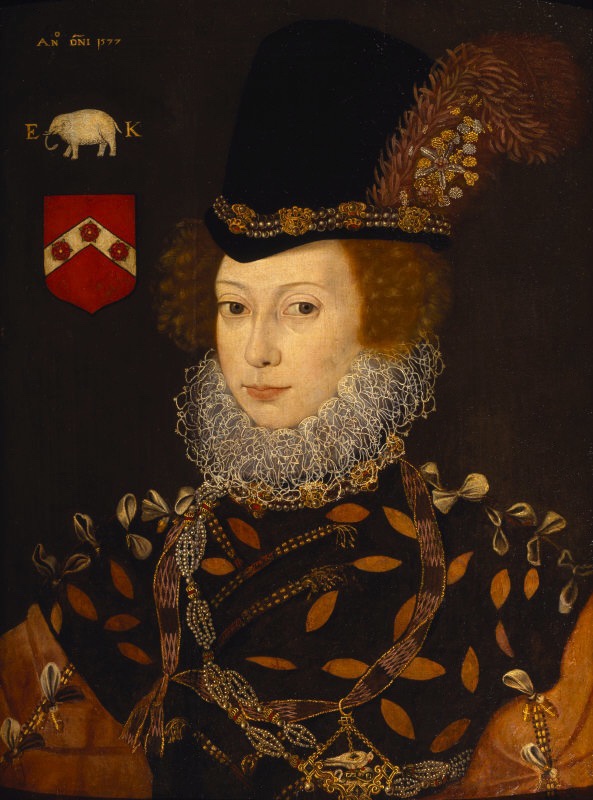
‘A Young Lady Aged 21, Possibly Helena Snakenborg, Later Marchioness of Northampton’
1569. (Tate Museum)

On its arrival in England many prominent members of the nobility received the party. Helena was by all accounts a beautiful woman, having large brown eyes, red hair, and a perfect pink and white complexion. She caught the attention of William Parr, marquess of Northampton (1513-1571), nobleman and courtier, the third and only surviving son of
Sir Thomas Parr of Kendal, Westmorland, and his wife, Maud. He soon endeavored to court her. Northampton presented her with many
extravagant gifts such as clothes and jewels, and ‘being an impressionable and romantic young girl, Helena was swept off her feet by the experienced older man’ (James, 395). Cecilia built up large debts due to a lavish lifestyle and left England in April 1566 in order to escape her creditors. She wanted to take Helena back to Sweden with her; however, her young maid, enjoying life in her new country and becoming
close to the marquess, was keen to remain. This wish was granted through Elizabeth’s influence.

Northampton hoped to marry Helena but felt prevented from doing so because, although divorced in 1551, his first wife, Lady Anne Bourchier, was still alive. Elizabeth was fond of Helena and appointed her a maid of honour from about 1567, before promoting her to gentlewoman of her privy chamber-a highly respected position at the heart of the court in
which she was among the queen’s most intimate servants and controlled access by the press of courtiers. She was entitled to many privileges,
such as her own lodgings at court, servants, and a horse. However, she was not a waged member of the privy chamber and it is not known how
regularly she attended court. Bourchier died on 26 January 1571 and Northampton and Helena were finally able to marry in May. The wedding
took place in Elizabeth’s presence in the queen’s closet at Whitehall Palace. The bride was twenty-two and the groom fifty-seven. They seemed
happy together and divided their time between their houses in Guildford, Surrey, and at Stanstead Hall, Essex. The marriage came to a sudden end within a few months when the marquess died on 28 October in Thomas
Fisher’s house in Warwick. There were no children. The marchioness received a substantial dower of £368 per annum, drawn from her husband’s estates in Cumberland. This may have been exchanged for lands worth £400 per annum in Huntingdonshire.

It was not too long before Helena captivated another admirer, Thomas Gorges [see below]. The queen was originally in favour of his approaches
to Helena but changed her mind and refused to consent to a marriage, perhaps as a result of her notorious sexual jealousy regarding gentlewomen of her privy chamber or because she had strong views on unequal marriages; Helena was a marchioness and Gorges only a gentleman.
The couple wed in secret about 1576. When Elizabeth learned of their deceit, Helena was banned from court, although she was later reinstated, possibly with the help of her influential friend Thomas Radcliffe, third
earl of Sussex, the lord chamberlain. The queen warmed to her again and with wholly uncharacteristic generosity granted her manors in Huntingdonshire and Wiltshire.

The couple’s first child was born in June
1578 and named Elizabeth (1578-1659) after the queen, who was her godmother. Their first son, Francis (d. in or before 1599), was probably
born in 1579. Gorges was persuaded by his wife to make his property of Longford, Wiltshire, bought after 1573, more appealing by rebuilding it.
The mansion had been damaged by fire when he acquired it and a replacement was completed at great expense by 1591, under the final
supervision of John Thorpe, since the entrance on its north-east front bears that date. Longford was the model for the ‘Castle of Amphialeus’
in Sir Philip Sidney’s Arcadia. Gorges was knighted in 1586. During this time Helena settled down to raise her family. She had two more
daughters, Frances (1580-1649) and Bridget (1584-c.1634), and four more sons, all of whom were knighted: Edward Gorges, first Baron Gorges of
Dundalk (b. 1582/3, d. in or before 1652); Theobald (1583-1647); Robert (1588-1648); and Thomas (b. 1589, d. after 1624).

Queen Elizabeth I’s Funeral Procession. Part of The Funeral Procession of Queen Elizabeth From a Drawing of the Time, Supposed to be by the Hand of William Camden (Society of Antiquaries, 1791). Folding panorama nearly 29 feet long.
Zoom in for Helena, Marchioness of Northampton.
Look and Learn / Peter Jackson Collection

The marchioness was still valued highly by Elizabeth and often acted as her deputy at the baptism of the children of distinguished noblemen, particularly towards the end of the reign, when the queen’s health was deteriorating. Helena must have been distressed when Elizabeth, whose friendship and guidance she had known ever since her arrival in England,
died in March 1603 and she was the chief mourner in the funeral procession as senior peeress because Arabella Stuart refused to
undertake the role. The accession of James VI to the English throne paved the way for the removal of many of Elizabeth’s old courtiers and
Gorges was demoted. Helena did not retain all her privileges but was probably glad to escape the rivalry that existed among the gentlewomen
of the privy chamber to Anne of Denmark. After Gorges died on 30 March 1610 at the age of seventy-four, Helena increasingly retreated from
public life, although she remained a devoted member of the Church of England.

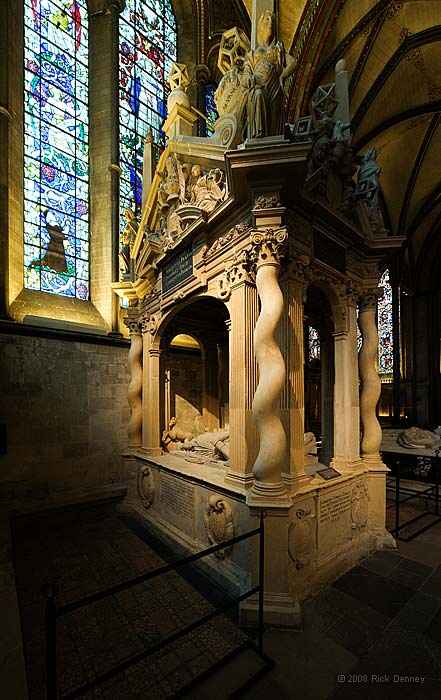
Helena, Marchioness of Northampton and Sir Thomas Gorges in Salisbury Cathedral.

Helena died on 10 April 1635 at Redlynch, Somerset, the residence of her son Sir Robert Gorges, and was buried on 14 May in Salisbury Cathedral. She had no fewer than ninety-two direct descendants at the time. She granted over £1700 in annuities and bequests in her will.

Sir Thomas Gorges (1536-1610), courtier, was born in Wraxall, Somerset, the fifth son of Sir Edward Gorges, landowner, of Wraxall, and his wife, Mary, daughter of Sir Anthony Poyntz of Iron Acton, Gloucestershire, and his wife, Elizabeth. He was a member of the royal household, groom of the privy chamber from 31 December 1571, JP for Huntingdon and Wiltshire
from about 1579, special ambassador to Sweden in 1582, and MP for Longford, Wiltshire, in 1586, as well as keeper of many important royal
estates. Gorges acted as Elizabeth’s ‘high grade messenger’ (HoP, Commons, 1558-1603, 2.208). He was one of the wealthiest gentlemen in
Wiltshire. Gorges, like his wife, was buried in Salisbury Cathedral.

Sources

C. A. Bradford, Helena, marchioness of Northampton (1936) · S.
E. James, Kateryn Parr: the making of a queen (1999), 394-7 · HoP,
Commons, 1558-1603, 2.208 · will, TNA: PRO, PROB 11/167, sig. 41 · TNA:
PRO, PROB 11/116, sig. 64 · administration, TNA: PRO, PROB 6/2, fol. 22r
· GEC, Peerage, 4.16
Paul Harrington, ‘Gorges , Helena, Lady Gorges [other married name Helena Parr, marchioness of Northampton] (1548-1635)’, Oxford Dictionary
of National Biography, Oxford University Press, Sept 2004; online edn, Jan 2008 http://www.oxforddnb.com/view/article/69751

Further reading

Roses Have Thorns: A Novel of Elizabeth I
Sandra Byrd

Tate Gallery Report, 1960-61, pp.16-17 Gunnar Sjogren, ‘Portrait of a young lady, 1569; an identification’, Burlington Magazine, October 1980, pp.698-700

The Myth of Catherine Middleton: Mary Boleyn

Originally written by Meg McGath, 30 May 2011

Before their wedding in 2011, there were several articles for the ancestry of Catherine Middleton, now HRH Princess of Wales. This claim—from the DailyMail (complete with a tree!)—is that Middleton is a descendant of Mary Boleyn, sister to Queen Anne, through Boleyn’s granddaughter, Elizabeth Knollys, who’s daughter, Elizabeth Leighton, married Sherrington Talbot (I).

ATTRIBUTED TO REMIGIUS VAN LEEMPUT (D. 1675) Portrait of a Lady called Mary Boleyn, Lady Stafford (c.1499-1543) c. 1630-70
Oil on panel | 39.4 x 31.2 x 0.5 cm (support, canvas/panel/stretcher external) | RCIN 402991
Mary, Queen of Scots’ Bedchamber,
Palace of Holyroodhouse
The portrait is thought to be a 17th century copy of a lost original.

The chart in the Daily Mail article continues with their son, Sherrington (II), who married Jane Lyttleton, who had a daughter, Elizabeth Talbot, who married to Henry Davenport. Up until they claim that Elizabeth and Henry were “parents” to William Davenport who married Elizabeth Marshall—the lineage is correct. It’s only when you look into the identity of William that things kind of fall apart.

Portrait of Elizabeth Knollys, Lady Leighton (b. 15 June 1549, d. circa 1605), maid of honor early in the reign of Queen Elizabeth. Married, in 1578, Thomas Leighton, Governor of Jersey (b. 1535 – d. circa 1611)

“Sir Thomas and Elizabeth’s daughter married one Sherrington Talbot, a member of an ancient and respectable family of landowners, but in a couple of generations’ time, things were beginning to look decidedly iffy.

Sherrington and Elizabeth’s granddaughter wed Henry Davenport,”

Probably Jane Lyttelton, Mrs Sharington II Talbot
British (English) School

The idenity of the sitter has been the subject of debate, but she is most probably Jane Lyttleton, who married Sharington II Talbot of Salwarp and Lacock (d.1677). Their son and heir was Sir John Talbot (d.1714), who was instrumental in transforming the fabric of Lacock. The sitter had tradtionally been indentified as Elizabeth Leighton, the first wife of Sharington I Talbot, and the mother of Sharington II. Given that he was born in about 1605, she would clearly have been too old around 1630 to have been the sitter here.

So I said, “let me check this out!” I started with Crofts Peerage‘s (which is currently offline). The Sherrington Talbot listed there, who married Jane Lyttelton, doesn’t mention an Elizabeth Talbot who married a Henry Davenport. The same goes for the book Charles Mosley, editor, Burke’s Peerage, Baronetage & Knightage, 107th edition, 3 volumes (Wilmington, Delaware, U.S.A.: Burke’s Peerage (Genealogical Books) Ltd, 2003), volume 1, page 838. But, then I looked in Burke’s Peerage. There is a mention of an Elizabeth Talbot, daughter of a “Sharington Talbot”, but there is NO mother and NO mention of an Elizabeth Talbot who married Henry Davenport and had William Davenport (that went on to marry a Grace Alloway). It states:

“Henry Davenport Esq who m 82 Oct 1665 Elizabeth dau of Sharington Talbot Esq of Lacock co Wilts and d. in July 1698 leaving with other daus who died unmarried, a dau Mary m 1st to the Rev William Hallifax DD who rf in 1720 and 2ndly to the Rev Prideaux Sutton of Itreedon co Worcester and two sons Sharington the elder a major general in the army who rf unm in Ireland 5 July 1719 and Henry Davenport Esq baptized 26 Feb 1677 8 who m 1st Mary Lucy dau of Daniel Charden Esq and had by her a son Sharington of whom presently and two daus Mary Elizabeth m to John Mytton Esq of Halftone and Mary Luce rf unm Mr Davenport m 2ndly Barbara second dau of Sir John Ivory of Ireland by Aline his wife dan of Sir John Talbot of Lacock co Wilts and by her who rf in 174ft left at his decease in 1731 a son William in holy orders DD rector of Bree don who m Mary dau of John Ivory Talbot of Lacock and had issue The only son of the first marriage”.

That was all my research, above.

I then found William Reitwiesner’s page, which did Middleton’s genealogy. They argued that this supposed link to Mary Boleyn is not correct. Reitwiesner’s page states that a correspondent “concludes that insufficient evidence exists to establish such a connection beyond a reasonable doubt.” From their article on Middleton:

“In Hobbs (full citation below), on p. 13, F. M. Lupton cites a pamphlet William Davenport, of Reading, and his descendants, by Rev. James Davenport, which claims that this William Davenport of Reading (number 636, above) was the same person as the William Davenport born at Worfield, Shropshire, on 24 Feb. 1679, a younger son of Henry Davenport of Hollon, Shropshire, by his wife Elizabeth Talbot.

Rev. James Davenport appears to have written several different works on William Davenport of Reading, as a correspondent refers to a publication by Rev. James Davenport, Rector of Harvington in Worcestershire, titled The Davenport Family of Reading and Welford on Avon, and printed in 1923 (long after Hobbs was printed). About the identification of William Davenport of Reading with the William Davenport baptized at Worfield, the correspondent states that the author “concludes that insufficient evidence exists to establish such a connection beyond a reasonable doubt.” This identification has been DISPROVEN.”

I don’t remember if I emailed first or if they updated the page after I questioned the parentage of William Davenport. Anyway…

Email from Reitweisner’s; wmaddamstrust@gmail.com 29 May 2011:
“Yes we have disproven it, both with the will of Elizabeth Davenport not mentioning a son William, other records showing her son William died in his 20s and with her research showing Kate’s William was likely the son of a Laurence Davenport.”

Since the publication of the Daily Mail’s article, several articles of their own have appeared “confirming” this lineage back to Mary Boleyn for Middleton. Common theme: NO sources! When you type in “Catherine Middleton Mary Boleyn” and search, the first source that pops up now is Sassy Jane Genealogy. They state their source as The Spectator’s “Another Boleyn girl: How Kate Middleton may descend from Henry VIII written by Charlotte Eager, 12 March 2011. Eager doesn’t go past the generation of Elizabeth Knollys and her marriage to Sir Thomas Leighton. Also: No sources! An article even turned up on The Anne Boleyn Files. I left comments (they were called harsh) saying the lineage could be disputed, with sources—however, they were never published or acknowledged as being correct by the TABF. They later updated the article, after yet another person called bs. It now says:

Update: Unfortunately, experts have now disproved this link between Kate and Mary Boleyn, see http://www.wargs.com/royal/kate.html

Family of Queen Katherine: Catherine Neville, Lady Constable

Lady Catherine Neville, Lady Constable (b. 1529/30), aged 60, Daughter of Henry Nevil, Earl of Westmorland, Second Wife of Sir John Constable
Robert Peake the elder (c.1551 – 1619)
Lytes Cary Manor © National Trust

Catherine NEVILLE, Lady Constable (1529/30-27 Mar 1591) was the daughter of Sir Henry NEVILLE, 5th Earl of Westmoreland and Anne MANNERS. They were parents to several children including Sir Charles, 6th Earl of Westmorland and Lady Eleanor Pelham. Her parents were related to Queen Katherine Parr through several lines, Neville, de Ros, etc. Her maternal grandmother, Lady Eleanor Manners (born Paston), Countess of Rutland, was related to Queen Anne Boleyn through her mother, Bridget Heydon, who’s mother was Anne Boleyn, great aunt to Queen Anne. Eleanor took advantage of her husband’s death in September 1543 to retire from the Court and she was replaced as the dominant force in Queen Katherine Parr’s Household by her sister, Lady Anne Herbert, who became Chief Lady of the Queen’s Privy Chamber.

Catherine married Sir John Constable of Holderness (1527-1579) in 1563-4 as his second wife at Raby. He was the son of Sir John CONSTABLE of Halsham and Joan NEVILLE, daughter of Sir Ralph Neville, Esq. They descended from Sir Ralph Neville, 2nd Baron Neville of Raby, who was the grandfather of Sir Ralph Neville, 1st Earl of Westmorland (ancestor to Queen Katherine Parr), who married twice, secondly to Joan Beaufort, daughter of John of Gaunt.

She was the Lady Constable who was a recusant and who spent time in prison at Sheriff Hutton in 1582-84.

Apparently they had a son, John CONSTABLE (b. ABT 1564)

Another image by Robert Peake the Elder, dated 1590, can be found at Burton Constable Hall