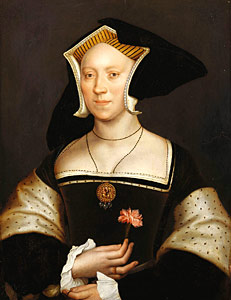
Family of Queen Katherine: Sir Thomas Parr of Kendal (b.1407)

Kendal Castle was acquired through the marriage of Sir William de Parr to the heiress and only child of Sir John de Ros of Kendal, Elizabeth de Ros in 1383.

Kendal Castle was acquired through the marriage of Sir William de Parr to the heiress and only child of Sir John de Ros of Kendal, Elizabeth de Ros in 1383.

Sir Thomas Parr of Kendal (1407–1461/[2]24 November 1464[1]*) was an English landowner and elected Member of Parliament six times between 1435 and 1459. He was great-grandfather of Queen Katherine Parr, the sixth wife of King Henry VIII.

Sir Thomas was the son of Sir John Parr and Agnes Crophull (or Crophill) (c.1371/72-3 February 1438).[1] By his mother’s previous marriage to Sir William Devereux of Bodenham, he was the maternal half-brother of Elizabeth and Walter Devereux, Esq., the great-grandfather of Anne Devereux who married William Herbert, 1st Earl of Pembroke (1468 creation) [grandfather of the 1st Earl who would marry Anne Parr] and the 5x great-grandfather of Walter Devereux, 1st Earl of Essex.[1] His father died before 6 October 1407[1] and when his mother remarried to John Merbury, Esq.[1] he was made the ward of Sir Thomas Tunstall of Thurland castle, Lancashire.

Thurland Castle, Tunstall, Lancashire, England.

Thurland Castle, Tunstall, Lancashire, England.

Within a year of his coming of age Thomas was escheator of Cumberland and Westmorland, and was knighted about the same time. He was elected Member of Parliament for Westmorland five times (in 1435, 1449, 1450, 1455 and 1459) and once for Cumberland (1445). He was actively involved in local administration and law enforcement, and became very influential. In 1435 he acted as the Under-sheriff for Thomas, 8th Baron Clifford, the hereditary sheriff of Westmorland.

He became involved in a long-running feud with Sir Henry Bellingham, another local landowner, which came to a head in 1445 when he was attacked in London by Bellingham’s men when attending Parliament, which caused a Parliamentary outcry.

By the time of the War of the Roses, Parr had formed close links with leading Yorkist Richard Neville, 5th Earl of Salisbury [great-great-grandfather of Queen Katherine] and when hostilities began joined him at the Battle of Ludford Bridge near Ludlow in 1459. After a Yorkists were defeated, he was forced to flee to Calais with Salisbury and was attainted in Parliament, but returned to fight at the Battle of Wakefield in 1460.

He died in 1461. He left three sons and six daughters by his wife Alice Tunstall, daughter of Sir Thomas. His eldest son, William became elevated as Baron Parr and married a granddaughter of the Earl of Salisbury, Hon. Elizabeth FitzHugh, and by her was grandfather of Queen Katherine Parr, wife of Henry VIII; his second son, Sir John Parr was made sheriff of Westmorland for life in 1462. His third son, Thomas, was killed at the Battle of Barnet in 1471. His daughters all married members of prominent northern families. Mabel married Humphrey Dacre, 1st Baron Dacre; thus becoming the first female Parr to marry into the peerage and be given a title.[2] The accession of the Yorkist King Edward IV in 1461 had saved most of Sir Thomas’s estates from confiscation.

Legacy

Great-grandchildren of Sir Thomas of Kendal; Sir William, 1st Marquess of Northampton, Queen Katherine Parr, and Lady Anne, Countess of Pembroke.

Through his son William, the family continued in favour with the culmination of his granddaughter, Katherine, becoming Queen consort of England and Ireland to King Henry VIII in 1543. His other grandchildren and the siblings of Queen Katherine would be raised by being created Marquess of Northampton and Earl of Essex; while a granddaughter, Anne, would become Countess of Pembroke as the wife of William Herbert, 1st Earl of Pembroke of the 1551 creation. Anne’s descendants to this day hold the title of Earl of Pembroke among other prominent titles.

* There is a conflict with the death date of Sir Thomas; Richardson states 1464 while Katherine’s biographer Linda Porter states 1461.

References

  1. ^ Douglas Richardson. Plantagenet Ancestry, Genealogical Publishing, 2005. pg 565. Google eBook
  2. ^ Linda Porter. Katherine, the Queen: The Remarkable Life of Katherine Parr, the Last Wife of Henry VIII, Macmillan, Nov 23, 2010.

Tudor Tart Lady Anne Bourchier: the unfairly treated wife?

Interesting blog on someone’s thoughts about William Parr and he getting what he deserved from his first wife who ran off with her lover and had illegitimate children by him. Right! Turns out the author of the blog DID use Alison Weir as her top source.
Tudor Tart Anne Bourchier

William Parr, Marquess of Northampton

William Parr, Marquess of Northampton

In response:
Where are you getting your info? Just wondering. Is this Wikipedia material? They were both unhappy when they married; it was a marriage of advantage which Maud Parr paid quite a deal of money towards only for the two to be incredibly unhappy. They were married at a young age [she was about 10] and they didn’t even live together for over 10 years. William was at court while Anne stayed behind in the country. Not defending William here, but it was a two way street and both sides were already unhappy with each other and decided their own fates. William was at least somewhat discreet and didn’t run off and father a bunch of bastards with Bray. The “tale” about William trying to get his wife executed is not proved to be entirely true. In fact it is only promoted on Wikipedia by Alison Weir’s book, “The Six Wives” which is full of inaccurate facts, especially in Katherine Parr’s section. Adultery wasn’t punishable by death back then or else everyone would have been sent to the block. Only Henry had that power to send his queens to the block for “adultery.” This tale seems to be played up by Alison Weir in her “Six Wives” book. Adultery by non-royals did not carry an assumption of being a capitol offense. For details of the actual account and reference to the primary sources that document what actually happened between Parr and Bourchier, see Susan James’s Catherine Parr, Henry VIII’s Last Love, pages 50-52 and 82. You could also take a look at this page: http://queryblog.tudorhistory.org/2009/07/question-from-marie-when-did-adultery.html
Also, the only reason Anne went to petition for her husband was most likely for money and land; because after she ran off with her lover she was exiled in poverty. The bill which had made her marriage to Parr null and void was reversed under Queen Mary so she most likely saw that as an opportunity. She wanted money and land and that is what she got from petitioning — December 1553 she was granted an annuity of 100 pounds; and in December 1556 she was further granted an annuity of 450 pounds and then retired to the country after Elizabeth succeeded Queen Mary. She obviously knew Elizabeth wouldn’t stand for her charades and she didn’t. Elizabeth promoted Parr who waited out Anne’s life to finally be able to marry again, this time for love.

The Family of Queen Katherine: Lady Anne Bourchier, suo jure 7th Baroness

Henry Bourchier, 5th Baron Bourchier, 1st Viscount Bourchier, 1st Earl of Essex (father of Lady Anne)

Henry Bourchier, 5th Baron Bourchier, 1st Viscount Bourchier, 1st Earl of Essex (grandfather of Lady Anne) [7]

Lady Anne Bourchier (1517 – 28 January 1571) was the suo jure 7th Baroness Bourchier, suo jure Lady Lovayne, and Baroness Parr of Kendal [by marriage]. She was the first wife of William Parr, 1st Marquess of Northampton, 1st Earl of Essex, and the sister-in-law of Queen Katherine Parr, the sixth wife of Henry VIII of England.

She created a scandal in 1541 when she deserted her husband to elope with her lover, John Lyngfield, by whom she would have several illegitimate children. According to Alison Weir’s Six Wives, “he [Parr] was pressing the King to authorize the highest penalty for her offense, which in those days was death” and due to the intervention of Catherine, who at that time was still Lady Latimer, who spoke to King Henry VIII on her behalf, Anne avoided the possible penalty of execution.[1][2]

Lady Anne Bourchier was born in 1517,[3] the only child of Henry Bourchier, 2nd Earl of Essex, 6th Baron Bourchier, Viscount Bourchier,[4] 2nd Count of Eu, and Mary Say, who was a lady-in-waiting to Henry VIII’s first Queen consort, Katherine of Aragon. Her paternal grandparents were Sir William Bourchier, Viscount Bourchier and Lady Anne Woodville, a younger sister of the English queen consort Elizabeth Woodville. This connection made her a 3rd cousin of Queen Katherine Parr. Her maternal grandparents were Sir William Say and Elizabeth Fray. Anne was related to three queen consorts of Henry VIII; Anne Boleyn, Jane Seymour, and Catherine Howard who all shared the same great-grandmother Elizabeth Cheney.

As the only child of the last Earl of Essex, as well as the contingent heiress of the Countess of Oxford, Anne was one of the wealthiest heiresses in England. The Bourchier wealth derived from the 14th century marriage of Sir William Bourchier to Eleanor de Lovayne (27 March 1345 – 5 October 1397), a rich heiress in her own right.

Marriage and inheritance

On 9 February 1527, Lady Anne was married to her 3rd cousin, William Parr. Parr was the only son of Sir Thomas Parr of Kendal, Sheriff of Northamptonshire and Maud Green. Anne was approximately ten years old at the time of her marriage which had been diligently arranged by her ambitious mother-in-law.[4] Anne later succeeded to the titles of suo jure 7th Baroness Bourchier at the time of her father’s accidental death. His viscounty of Bourchier and earldom of Essex did not pass to her, however, and both titles became extinct upon his death.[5] Her husband had been created 1st Baron Parr of Kendal in 1539.

Adultery

Anne and Parr were unhappy from the very start of their marriage. After their marriage in 1527, the couple did not live with each other until twelve years later. Anne was described as having been poorly-educated;[3] and she appeared to prefer the peace of the countryside to the excitement of Henry VIII’s court, as her first recorded appearance at court where she attended a banquet was on 22 November 1539 when she was aged 22.[3]

Lady Anne Bourchier abandoned her husband William Parr in 1541 and took up residence with a man now identified as John Lyngfield, the prior of St James’s Church, Tanbridge, in Surrey. Any wife acting in that manner was cause for public scandal, but the scandal was worsened when Anne became pregnant by Lyngfield. The birth of Anne’s child prompted Baron Parr to take action against her to protect his own interests, lest the baby should later in the future lay claim to his estates. In January 1543, William Parr then acted to protect his interests and secured a legal separation from Anne (but not a divorce or annullment). During 1541, after Anne had left, Parr started an affair with one of the ladies at court, Dorothy Bray.

From the Letters and Papers, Foreign and Domestic, of Henry VIII, dated 22 January 1543, there is this item:

“Whereas lady Anne, wife of Sir Wm Parre lord Parre continued in adultery notwithstanding admonition, and, finally, two years past, left his company and has since had a child begotten in adultery and that the said child and all future children she may have shall be held bastards.”[6]

Katherine Parr enters the picture in March 1543 when William relied on her influence to get a private bill through Parliament denouncing his wife’s behavior and declaring her child by Lyngfield a bastard. That bill did not include a sentence of execution for Anne Bourchier. All the bill actually did was publicly register William’s disapproval of his wife’s actions and prevent her son by Lyngfield from ever taking the Parr name. William and Anne remained legally married until 1552.


On 17 April 1543, he obtained an Act of Parliament, repudiating Anne and her child, who was declared a bastard, and unfit to inherit.

According to Alison Weir’s Six Wives: At this time, Parr’s sister Catherine was being courted by King Henry VIII. She was also a close friend of Anne, and according to Alison Weir, supported her against her brother who was pressing the King to apply the death penalty for his unfaithful wife.[1] Weir states that Catherine petitioned the King to grant clemency for Anne; Henry agreed, provided Parr himself pardoned her, saying to Catherine that “if your brother can be content, I will pardon her”.[1] After much pleading on Catherine’s part, Parr relented and Anne received the King’s pardon. She was, however, constrained to forfeit her titles and estates to her husband,[1] and spent the next few years living in exile at the manor of Little Wakering, in Essex.

ARGUMENTS against Weir:

First off, someone said that Weir’s info came from the Spanish Calendar. In the translation of “Chronica del rey Enrico otavo de Inglaterra“, published 1889 by G. Bell and sons, the “story” is about an “Earl of Rochford” who was in love with the daughter of Lord Cobham. No names are mentioned. The only reference to making the story possibly about Parr is the quote calling the person “brother of Queen Katherine, the last wife of King Henry.” Parr was not Earl of Rochford and he didn’t have a servant that fooled around with his wife and then left and died in Wales. Anne left Parr with another man and went into exile with him in Essex at the manor of Little Wakering where she became pregnant and had an illegitimate child. There are also NO dates present in this Chronica. It also doesn’t state “Parr prosecuted..” it states “the Earl..” Anne was prosecuted against to keep her illegitimate children from inheriting Parr’s inheritance and estates; he also wanted a legal separation from Anne.  The fact that Anne continued in adultery and had illegitimate children is recorded in the Letters and Papers of Henry VIII. I seriously think something either got lost in translation or I’m guessing by the time the news got to Spain it had been twisted into a completely different story which happened all the time in accounts of history. It’s like the Crusades — the 5 different accounts of the Speech of Pope Urban II at Clermont. The way word travels and the accounts of stories change over time unless they are immediately recorded at the time; which in England they were seeing how something was written in the LP’s of Henry VIII which deals nothing with Parr wanting Anne executed, just wanting her child declared illegitimate and wanting a separation. Unless you go into researching what Weir has to say, you are bound to agree with her and think that she knows what she’s talking about. This “account” is completely inaccurate and full of errors; somehow Weir twisted her story without really researching this document and then quotes it as a source when anyone who reads it can clearly see the constant errors.

Statement from Christine Hartweg,

The Spanish Chronicle is a bit notorious; it’s a typical gossip source, it’s also very likely this part was written some years after the events. I would think that he is in love with the daughter of the Lord Cobham is the ref to Elizabeth Brooke.

In a way the Spanish Chronicle is rather interesting, for example it is in many ways less biased in a purposeful sense than many of the ambassadorial reports; however it is completely garbled, clearly a source that interesting in respect what was talked AND then this got mixed up with the cultural prejudices and misunderstandings of the Spanish writer, who seems to have been in England for some time.

Statement from Hannah Stewart to make things clear about what we are dealing with [The Spanish Chronicles],

It is the Spanish Chronicle that also has Thomas Cromwell engaged in conversation with Katherine Howard shortly after her arrest (when in fact Cromwell had been dead for nearly two years). It is to be treated with a high degree of caution.

Secondly, it was highly unlikely that Anne would have been sentenced to death, as adultery was not a capital offense in 16th century England. Henry VIII’s wives, Anne Boleyn and Catherine Howard were both executed for treason. The act of adultery, when committed by a queen consort of England, was legally a crime of High treason, and punishable by death. What is interesting is that Weir gives no support or citation as to where she found the info on the execution of Anne Bourchier. As stated, adultery wasn’t punishable by death in the Tudor era and adultery by non-royals did not carry an assumption of being a capitol offense.

For details of the actual account and reference to the primary sources that document what actually happened between Parr and Bourchier, see Susan James’s Catherine Parr, Henry VIII’s Last Love, pages 50-52 and 82. First off, James never states anything about an execution and that Parr used his influence with Catherine to secure a separation. It then says that after all that was done with Anne, Parr embarked in an affair with Dorothy Bray. It was after Anne had committed adultery and run off, not before!

In 1543, William Parr had begun his courtship of the Hon. Elizabeth Brooke, who was a niece of Dorothy Bray, and a former Maid of Honour of Anne of Cleves and Catherine Howard. He was created 1st Earl of Essex on 23 December 1543 by his brother-in-law, King Henry VIII. On 31 March 1552, a bill was passed in Parliament which declared the marriage between Parr and Bourchier to be null and void. Parr had married Elizabeth Brooke in 1547. Their marriage was declared valid in 1548, invalid in 1553, and valid again in 1558 upon the ascension of Queen Elizabeth I. Three monarchs had influenced the status of Elizabeth Brooke; Edward VI, Mary I, and Elizabeth I.

William Parr, Marquess of Northampton

William Parr, Marquess of Northampton

Later years and death

Upon the ascension of Queen Mary, Parr was arrested and was committed to the Tower after his traitorous complicity with John Dudley, 1st Duke of Northumberland’s failed plot against Mary to place Lady Jane Grey upon the throne. After Parr was sentenced to death on 18 August 1553, Anne intervened on Parr’s behalf with Queen Mary I in hopes that they [she] would be able to keep their estates. Parr was released. The bill which had declared their marriage null and void was reversed on 24 March 1554. That December, Anne used the reversal to her advantage and was granted an annuity of £100. Again in December 1556, Anne was granted another annuity of £450. She remained at court until the ascension of Elizabeth I. Queen Elizabeth held Parr in high favour and Anne most likely knew that her charades would not be welcomed by the queen. Parr was restored to blood and was re-created Marquess of Northampton, re-elected to the Order of the Garter, and was made a privy councillor among other things.[3]

She had several more children by John Lyngfield but they, like her first child, were legally declared bastards. Only one daughter, Mary, is documented as having lived to adulthood. She married a Thomas York by whom she had children, but they all lived in obscurity. Author Charlotte Merton suggested that Katherine Nott, who held an unspecified position in Queen Elizabeth I’s household from 1577 to 1578, was also a daughter of Anne.[3]

Sir Robert Rochester and Sir Edward Waldegrave held Benington Park, in Hertfordshire, as feoffees for her use; however, upon the death of Rochester in 1557, Waldegrave transferred the property to Sir John Butler. In response, Anne brought a lawsuit against Waldegrave and Butler which was heard in the Court of Chancery.[3] She won the case but Butler petitioned to retry the case and continued to regard the park as his own.[3] Butler’s petition was apparently unsuccessful because following Queen Elizabeth I’s accession to the throne in November 1558, Anne had retired to Benington Park where she quietly spent the rest of her life.[3]

Anne Bourchier died on 28 January 1571 at Benington. Parr died the same year and was buried in the Collegiate Church of St. Mary in Warwick. His funeral and burial was paid by the Queen. He had married two times after Anne, but only his third wife, Helena Snakenborg, whom he had married after Anne’s death in May was considered legal. He fathered no children by any of his wives and the little money and estates he had left were passed to his cousins.

Upon Anne’s death, the barony of Bourchier passed to her cousin, Walter Devereux (husband of Lettice Knollys, cousin of Elizabeth I), who eventually was created Earl of Essex in 1572 after the death of Lady Anne’s husband, William Parr, the Earl of Essex, in 1571.

References

  1. Alison Weir. The Six Wives of Henry VIII, p. 492.
  2. What is interesting is that Weir gives no support or citation as to where she found the info on the execution of Anne Bourchier. Adultery wasn’t punishable by death in the Tudor era and adultery by non-royals did not carry an assumption of being a capitol offense. For details of the actual account and reference to the primary sources that document what actually happened between Parr and Bourchier, see Susan James’s Catherine Parr, Henry VIII’s Last Love, pages 50-52 and 82.
  3. Emerson, Kathy Lynn. A Who’s Who of Tudor Women, Bo-Brom.
  4. Martienssen, Anthony (1973). Queen Katherine Parr. New York: McGraw-Hill Book Company. p. 39.
  5. Dictionary of National Biography, 1885-1900, Volume 06 
  6. The Letters and Papers Foreign and Domestic of Henry VIII, Vol. 18, Part 1, Item 66, Part III, cap. xliii, dated 22 January 1543
  7. European Heraldry. The War of the Roses: Descendants of Thomas of Woodstock, Duke of Gloucester — Henry Bourchier, 5th Baron Bourchier, 1st Viscount Bourchier, 1st Earl of Essex.

Family of Queen Katherine: Sir Thomas Vaux, 2nd Baron Vaux of Harrowden

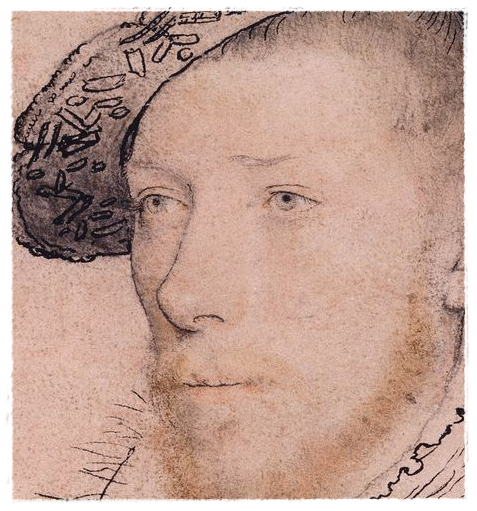
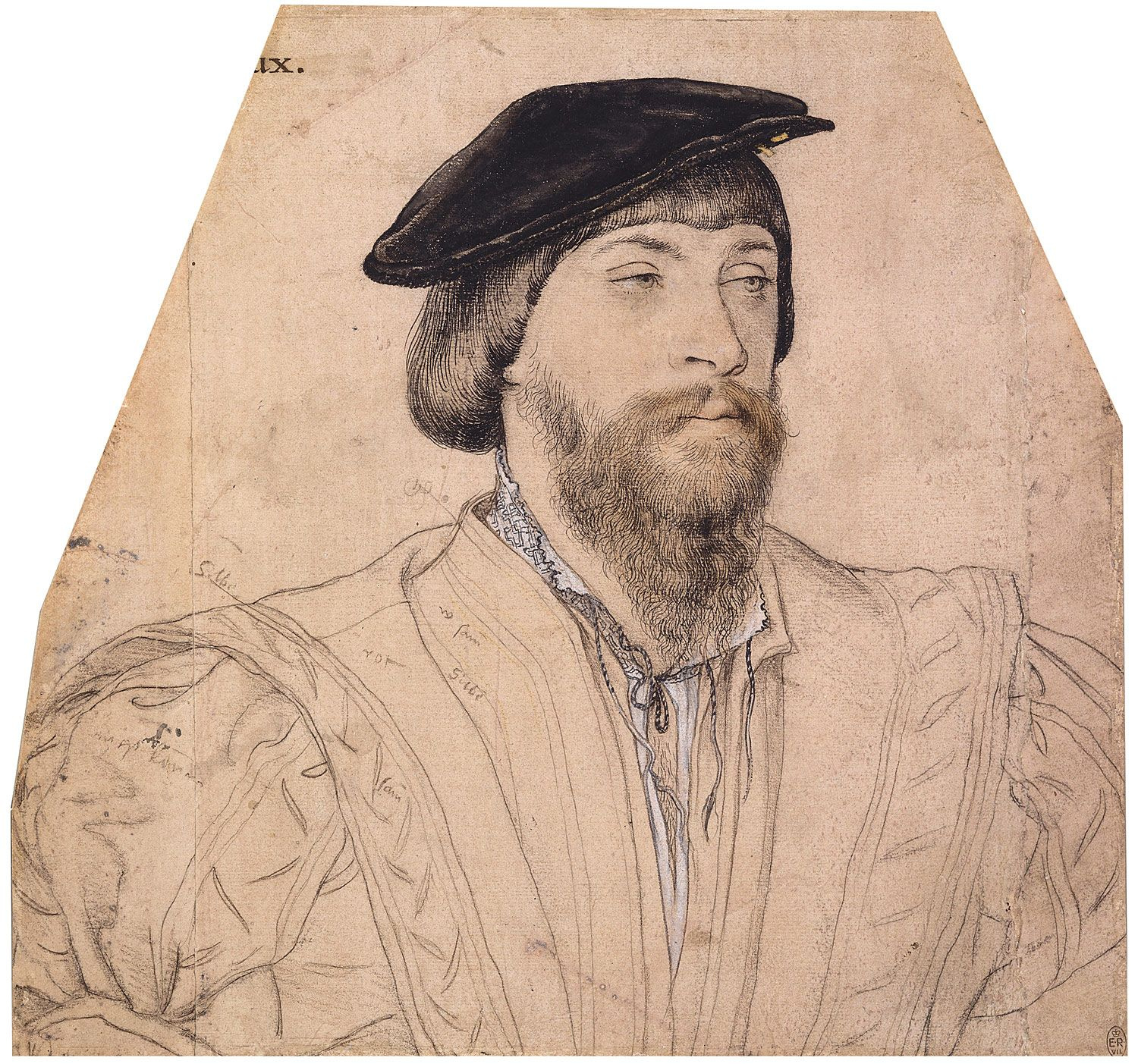
2nd Baron Vaux, sketch by Holbein.

2nd Baron Vaux, sketch by Holbein.

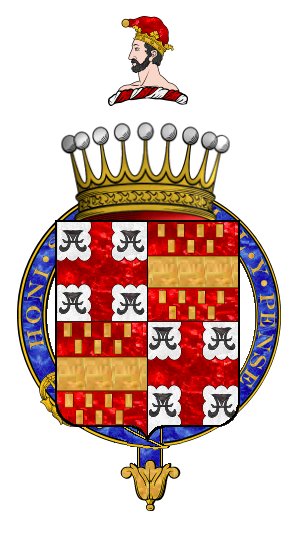
Sir Thomas Vaux, 2nd Baron Vaux of Harrowden K.B. (25 April 1509[1] – October 1556), an English poet, was the eldest son of Sir Nicholas Vaux, 1st Baron Vaux and his second wife, Lady Anne [Green] (born circa 1489), daughter of Sir Thomas Green, Lord of Greens Norton, and Joan Fogge [cousin to Edward IV’s consort Elizabeth], daughter of Sir John of Ashford.[2][3] Vaux was educated at Cambridge University.[4]  Vaux’s mother was the maternal aunt of queen consort Katherine Parr, while his wife, Elizabeth Cheney, was a paternal first cousin through her mother, Anne Parr.

Life
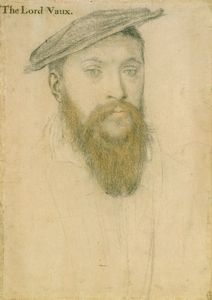
Lord Vaux by Holbein

Lord Vaux by Holbein

In 1527, Vaux accompanied Cardinal Wolsey on his embassy to France.

Vaux privately disapproved of Henry VIII’s divorce from his first queen consort, Katherine of Aragon.[5]

It is interesting to note the family circle that he was in. The Parrs and their extended family stuck by the queen and all had an opinion of Henry’s “Great Matter.” Vaux’s aunt, Lady Maud Parr, was a lady-in-waiting and good friend to Queen Katherine of Aragon. Lady Parr was given her own quarters at court to attend the queen and when she gave birth to a baby girl in 1512, it is thought that she named her after the queen who may have been her godmother. Lady Parr stayed with the queen until her household was divided; Parr died in 1531. Lord Vaux’s sister, Katherine, would marry the staunch Catholic Sir George Throckmorton; the outspoken courtier who dared to speak out against the king.

In 1531, Lord Vaux took his seat in the House of Lords. In 1532, he attended Henry VIII to Calais and Boulogne and was made Knight of the Bath at the coronation of Anne Boleyn on 1 June 1533. He was Lieutenant Governor of Jersey in 1536. Schism from Rome caused him to sell his offices; his position as Governor was sold to Sir Edward Seymour [later Lord Protector and Duke of Somerset]. He did not attend Parliament between 1534 and 1554.[5] Instead, Vaux retired to his country seat until the accession of Mary I, when he returned to London for her coronation.[5] Vaux was a friend of other court poets such as Sir Thomas Wyatt and Henry Howard, Earl of Surrey.[5]

Family and issue
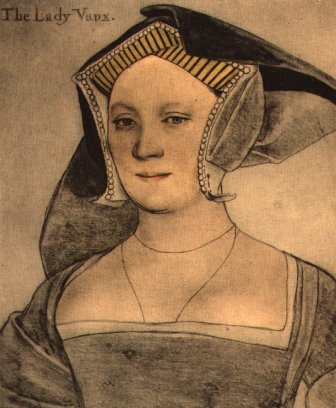
Elizabeth_Cheney_Lady_Vaux

Lady Elizabeth Vaux [born Cheney] was cousin to Queen Katherine by her mother, Lady Anne [Parr].

Vaux’s father, Nicholas, had been previously married to Hon. Elizabeth FitzHugh, daughter of Henry FitzHugh, 5th Lord FitzHugh of Ravensworth Castle and Lady Alice Neville, as her second husband.[3] By Elizabeth’s first marriage to Lord William Parr, she was the mother of Anne Parr, the mother of Thomas’ wife, Elizabeth Cheney, as well as Sir Thomas Parr, father to Queen Katherine.[3]

From the marriage of Nicholas Vaux and the dowager Lady Parr, the 2nd Lord Vaux had three older paternal half-sisters; Katherine, Lady Throckmorton; Alice, Lady Sapcote; and Anne, Lady Strange.[3] After the death of Elizabeth in about 1507, the 1st Lord Vaux married secondly, in about 1508, to Anne Green, the older sister of Maud Green, Lady Parr who had married Sir Thomas Parr; thus making the 2nd Lord Vaux a first cousin to queen Katherine. At the time of the marriage, Lord Vaux was aged c.47, she was aged c.18.

Sir Thomas had been contracted to marry Elizabeth Cheney, daughter and heir of Sir Thomas Cheney of Irtlingburgh and Anne Parr (aunt to Queen Katherine), since 6 May 1511 [he was aged 2].[3] Thomas married Elizabeth between 25 April 1523 and 10 November 1523.[3] They had three children.

  • Hon. William Vaux, 3rd Baron Vaux of Harrowden (born 1535), married firstly before 1557 to Elizabeth Beaumont, a distant cousin, by whom he had issue. In 1563, Vaux married to his second cousin, once removed, Mary Tresham, great-granddaughter of Sir William Parr, Baron Parr of Horton (uncle to Queen Katherine Parr) and had issue.
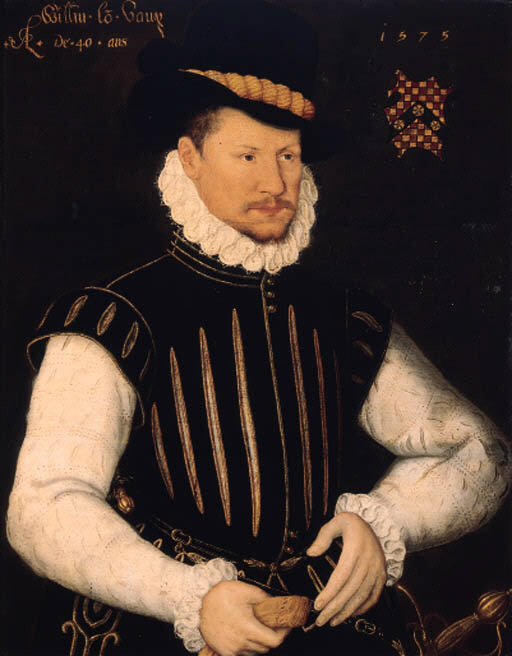
William, Lord Vaux of Harrowden (1535-1595), oil on panel 31 x 24½in. (78.8 x 62.2cm.). Inscribed

William, Lord Vaux of Harrowden (1535-1595), oil on panel 31 x 24½in. (78.8 x 62.2cm.). Inscribed “Willm. Lo. Vaux AE. ?de 40. ?ans 1575” 1575; Circle of Cornelius Ketel

  • Hon. Nicholas Vaux
  • Hon. Anne Vaux, married Reginald Bray of Stene, nephew of Edmund Braye, 1st Baron Braye; had issue.

Thomas Vaux died in October 1556.

Descendants

Among the many descendants of Thomas, Lord Vaux and his wife Elizabeth, Lady Vaux are:

  • Lady Diana Spencer, Princess of Wales and thus HRH Prince William, Duke of Cambridge and HRH Prince Henry of Wales.
  • Sarah, Duchess of York [by both parents], who was married to Prince Andrew, Duke of York and is mother to TRH Princess Beatrice and Princess Eugenie.
  • HRH Princess Alice [Montagu-Douglas-Scott], Duchess of Gloucester, who married HRH Prince Henry, 1st Duke of Gloucester [son of King George V and Queen Mary]. They were parents to HRH Prince Richard, 2nd Duke of Gloucester (b.1944).
  • Henry George Lascelles, 6th Earl of Harewood, husband to HRH Princess Mary, Princess Royal [only daughter of King George V and Queen Mary]. They had two sons including the 7th Earl of Harewood.

Art

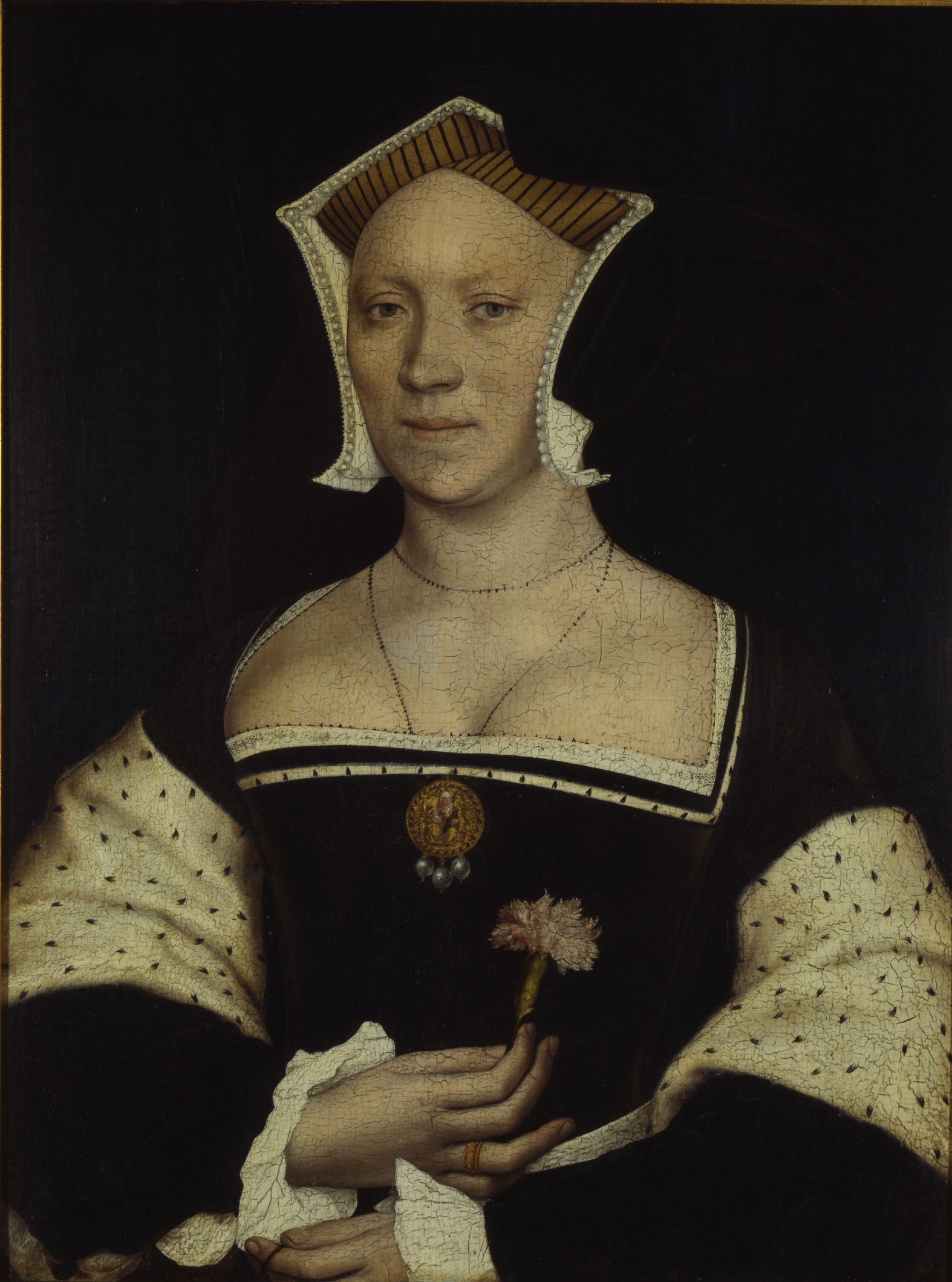
Sketches of Vaux and his wife by Holbein are at Windsor, and a finished portrait of Lady Vaux is at Hampton Court. Another hangs in Prague. More info: The OTHER Elizabeth Cheney
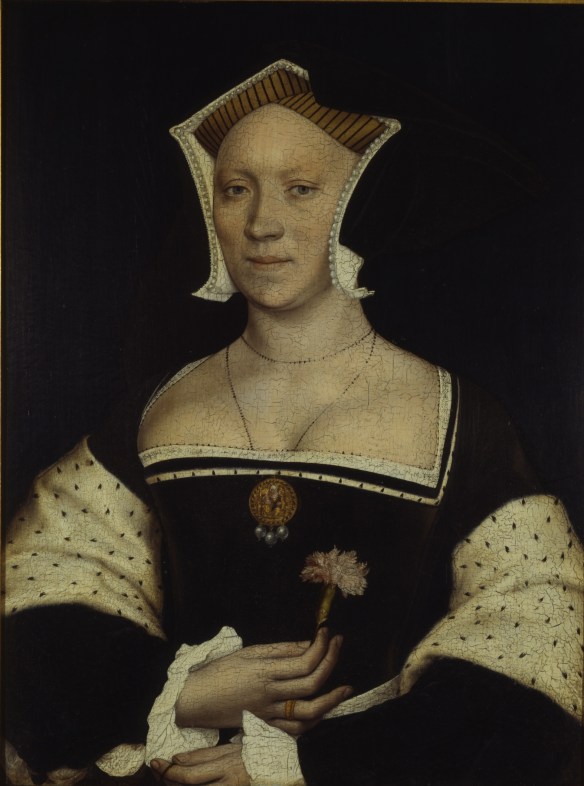
Elizabeth, Lady Vaux of Harrowden, wife to the 2nd Baron Vaux.

Elizabeth, Lady Vaux of Harrowden, wife to the 2nd Baron Vaux.

Elizabeth, Lady Vaux

Works

Two of his poems were included in the Songes and Sonettes of Surrey (Tottel’s Miscellany, published in 1557 (see 1557 in poetry). They are “The assault of Cupid upon the fort where the lover’s hart lay wounded, and how he was taken,” and the “Dittye … representinge the Image of Deathe,” which the grave-digger in Shakespeare’s Hamlet misquotes.[4]
Thirteen pieces in the Paradise of Dainty Devices, published in 1576 (see 1576 in poetry), are signed by him.[4] These are reprinted in Alexander Grosart’s Miscellanies of the Fuller Worthies Library (vol. iv, 1872).

Lord Vaux wrote during Queen Mary’s reign. The following lines by Vaux were first printed in The Paradise of Devices (1576).

OF A CONTENTED MIND
When all is done and said, in the end thus shall you find,
He most of all doth bathe in bliss that hath a quiet mind:
And, clear from worldly cares, to deem can be content
The sweetest time in all his life in thinking to be spent.
The body subject is to fickle Fortune’s power,
And to a million of mishaps is casual every hour:
And Death in time doth change it to a clod of clay:
Whenas the mind, which is divine, runs never to decay.
Companion none is like unto the mind alone; [or none]
For many have been harmed by speech, through thinking, few,
Fear oftentimes restraincth words, but makes not thought cease; [peace]
And he speaks best, that hath the skill when for to hold his
Our wealth leaves us at death; our kinsmen at the grave;
But virtues of the mind unto the heavens with us we have.
Wherefore, for virtue’s sake, I can bo well content,
The sweetest time of all my life to deem in thinking spent.

The introduction of a rhyme at the cesura or pause of the longer line in this measure breaks of its couplets into a four lined stanza. We have example of this by the same poet in what a MS copy describes as, “a dytte or sonet made by Lord Vaux in the time of the noble quene Marye representing the image of Death.” The first, third, and eighth stanzas of this poem, with a line from the last but one transferred to the third, were chosen by Shakespeare for the grave-digger’s song in fifth act of Hamlet; the clown giving, of course, his rudely remembered version of them [see Hamlet, act five].

So Shakespeare’s clown quoted it. This is the poem itself as written in Queen Mary’s reign by Lord Vaux:
THE IMAGE OF DEATH
I loathe that I did love,
In youth that I thought sweet,
As time requires for my behove
Methinks they are not meet.
My lusts they do me leave,
My fancies all arc fled,
And tract of time begins to weave
Grey hairs upon my head.
For Age with stealing steps
Hath clawed me with his crutch,
And lusty Life away she leaps
As there had been none such.
My Muse doth not delight
Me as she did before;
My hand and pen arc not in plight,
As they have been of yore.
For Reason me denies
This youthly idle rhyme;
And day by day to me she cries,
“Leave off these toys in time.”
The wrinkles in my brow,
The furrows in my face,
Say, limping Age will lodge him now.
Where Youth must give him place.
The harbinger of Death,
To mo I see him ride :
The cough, the cold, the gasping breath
Doth bid mo to provide.
A pickaxe and a spade,
And eke a shrouding sheet,
A house of clay for to be made
For such a guest most meet.
Methinks I hear the clerk,
That knolls the careful knell,
And bids mo leave my woeful work,
Ero Nature me compel.
My keepers knit the knot
That Youth did laugh to scorn,
Of me that clean shall be forgot,
As I had not been born.
Thus must I Youth give up,
Whose badge I long did wear;
To them I yield the wanton cup
That better may it bear.
Lo, here the bared skull,
By whose bald sign I know,
That stooping Age away shall pull
Which youthful years did sow.
For Beauty with her band
These crooked cares hath wrought,
And shipped me into the land
From whence I first was brought.
And ye that bide behind,
Have ye none other trust :
As ye of clay were cast by kind,
So shall ye waste to dust.
From: Cassell’s library of English Literature, selected, ed. and arranged by H. Morley
By Cassell, ltd.

References

  1. George Edward Cokayne. The Complete Peerage of England, Scotland, Ireland, Great Britain, and the United Kingdom, Vol. XII/2, p. 219-221.
  2. Unknown author, David Faris. Plantagenet Ancestry of 17th Century Colonists, p. 39.
  3. Douglas Richardson, Plantagenet Ancestry, pg 326, 561-562, 566.
  4. Dominic Head. The Cambridge Guide To Literature In English, Cambridge University Press, Jan 26, 2006. pg 1151.
  5. John Saward, John Morrill, Michael Tomko. Firmly I Believe and Truly: The Spiritual Tradition of Catholic England, Oxford University Press, Nov 15, 2011. pg 92.
Researched and written by Meg McGath

© 26 March 2012

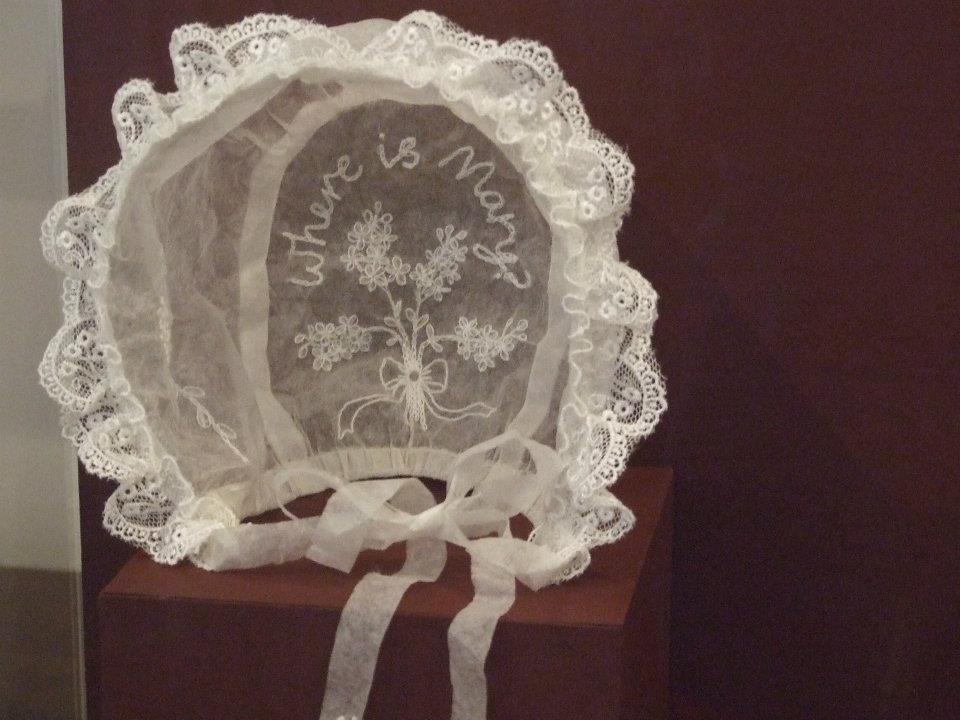
Belinda Durrant Exhibit at Sudeley Castle: Where’s Mary?

Belinda Durrant has three new works on display at Sudeley Castle as part of their exhibition celebrating the quincentenary of the birth of Katherine Parr. She was gracious enough to share them with us and to even write what inspired her to make these works. 

Sudeley Exhibit by Belinda Durrant ©

“It [the exhibit] was made as a direct response to visiting the castle. I am no history scholar…just couldn’t understand why there was so little info about the poor little child at the Castle and decided I was going to find out myself….and promptly discovered that there was nothing much more to find, which just made it all worse, somehow.

Katherine Parr was the 6th wife of Henry VIII. After his death in 1547 she married Thomas Seymour and moved to his country residence, Sudeley Castle in 1548 where she gave birth to a daughter, Mary on August 30th of that year. She died from puerperal (childbed) fever just seven days later and is buried in St Mary’s Church within the castle grounds. The site of baby clothing often provokes unexplained sentimental reactions, particularly from women. Freud tells us that this is fetish. Such clothing reminds us of the child itself and is embraced as a substitute for the ‘lost’ child. Freud means ‘lost’ in terms of the fleeting period of babyhood, but in this case, Lady Mary Seymour was apparently quite literally ‘lost’.

We are told that Mary became an orphan at just a few months old when her father was executed for treason and that she was sent to live with Katherine Willoughby, the Duchess of Suffolk. I have been able to find out very little else. It seems all record of her disappears after August 29 1550, the eve of her second birthday.

The three works I have displayed in the Castle exhibition centre, ‘Where is Mary? Bonnet, Mittens, Bib’ were made as a direct response to a visit I made to the castle in July 2011. The work is not about embroidery and stitch.

It is about the ACTS of embroidering and stitching; the almost ritualistic time, care and love which goes into the making of those very special first clothes which celebrate the arrival of a new child.

Bonnet which reads “Where is Mary” by Belinda Durrant, picture by Sudeley Castle.
 © 13 April 2012

20 July 1543: Queen Katherine to her brother, William Parr

Oatlands Palace, Surrey

From Oatland’s Palace in Surrey on 20 July 1543 to the queen’s brother, Sir William Parr.

[Addressed to] To our right dear and entirely beloved brother, the Lord Parr, Lord Warden of the Marches,

Right dear and well-beloved brother, we great you well. Letting you wit that when it hath pleased almighty God of His goodness to incline the King’s majesty in such wise towards me, as it hath pleased his highness to take me of all others, most unworthy, to his wife, which is, as of reason it ought to be, the greatest joy and comfort that could happen to me in this world:

To the intent, you being my natural brother, may rejoice with me in the goodness of God and of his majesty, as the person who by nature hath most cause of the same, I thought meet to give your this advertisement. And to require you to let me sometime hear of your health as friendly as you would have done, if God and his majesty had not called me to this honor: which, I assure you, shall be much to my comfort. Given at my lord’s manor of Oatlands, the twentieth of July, the thirty-fifth year of his majesty’s most noble reign.

Kateryn, the quene

Transcription by Janel Mueller, from her compilation of the Works and Correspondences of Katherine Parr.

Katherine Parr: Complete Works and Correspondences, editor Janel Mueller. University of Chicago, 2011. pg 46.