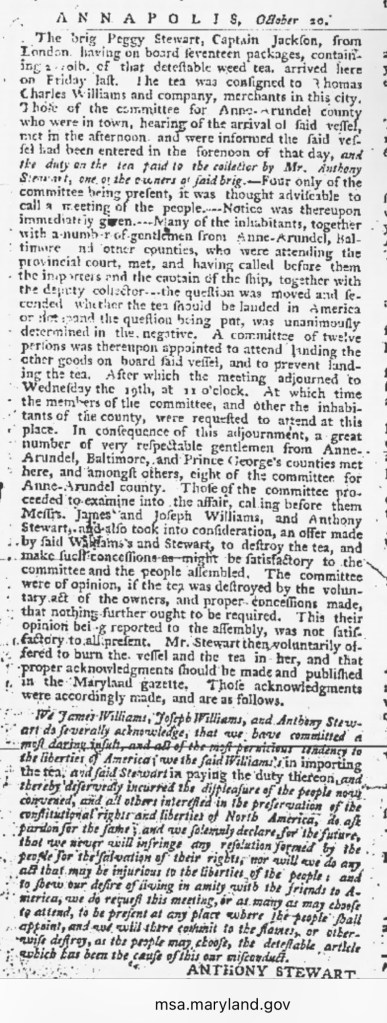
On October 15, 1774, the ship Peggy Stewart sailed up the Severn River into Annapolis harbor carrying “seventeen packages, containing 2,320 lb. of that detestable weed — tea.”
Handbills were immediately circulated through the city calling for a public meeting. The ship’s owner, Anthony Stewart, a British Loyalist deeply in debt from earlier failed ventures, took a desperate gamble by landing the tea in Maryland.
This ship would soon ignite what we Marylanders call “The Annapolis Tea Party.” On October 19, 1774, under public pressure, Stewart was compelled to burn his own vessel to the waterline.
Dr. Charles Alexander Warfield wasn’t merely an onlooker — he was reportedly among the men who ordered the destruction, declaring they must “destroy the ship and the cargo, or destroy the liberty of the people.” The surname may seem familiar to Marylanders as The Duchess of Windsor was born, Bessie Wallis Warfield. Wallis became Duchess when she married the abdicated King Edward VIII of the United Kingdom in 1937.
Last year marked the 250th anniversary of that act of protest. The very ground where the Peggy Stewart burned once belonged to my ancestors — they stood there as history turned to flame on their own shore.
Lady Frances Neville, (née Manners) Lady Bergavenny (c.1530 – circa September 1576) was an English noblewoman and author. Little is known of either Lady or Lord Bergavenny, except that the latter was accused of behaving in a riotous and unclean manner by some Puritain commentators. Lady Bergavenny’s work appeared in The Monument of Matrones in 1582 and was a series of “Praiers“. Her devotions were sixty-seven prose prayers, one metrical prayer against vice, a long acrostic prayer on her daughter’s name, and an acrostic prayer containing her own name.
Family
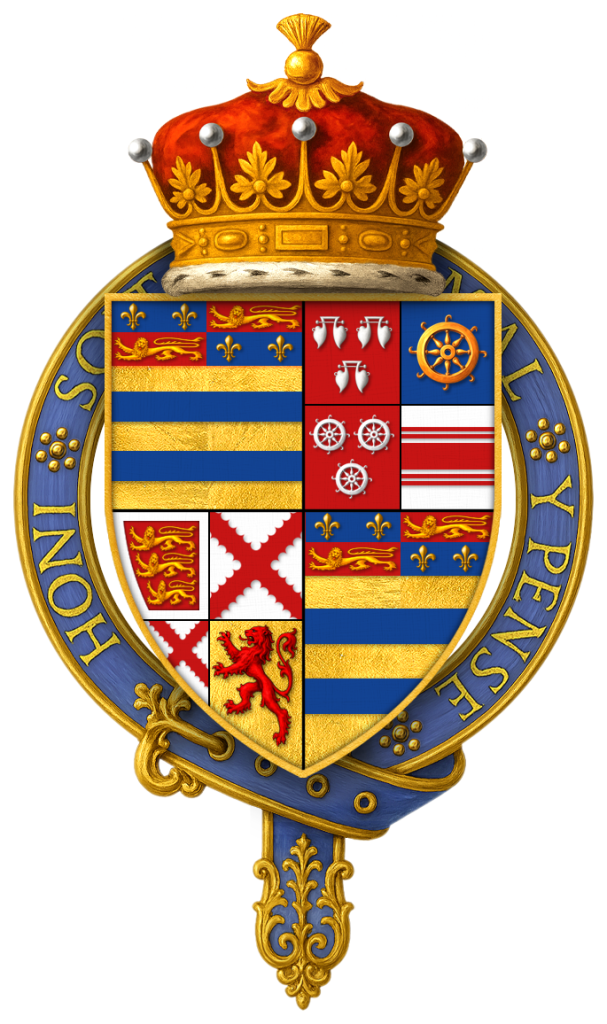
Coat of arms of Sir Thomas Manners, 1st Earl of Rutland, KG Rutland’s stall plate remains installed within St. George’s Chapel. The arms are: quarterly: 1 and 4, or, two bars azure, a chief quarterly of the last and gules, on the 1st and 4th, two fleurs-de-lis or, on the 2nd and 3rd, a lion passant gaurdant or (Manners); 2, a grand quarter consisting of 1, gules, three water bougets argent (Ros) 2, azure, a Catherine wheel or (Belvoir) 3, gules, three Catherine wheels argent (Espec) 4, argent, a fess between two bars gemels gules (Badlesmere) 3, a grand quarter consisting of 1, gules, three lions pasant guardant or, within a bordure argent (Holland, Earls of Kent) 2 and 3, argent, a saltire engrailed gules (Tiptoft) 4, or, a lion rampant gules (Edward Charleton, 5th Baron Charleton of Powys (1370-1421))
Lady Frances Bergavenny was the third daughter of Thomas Manners, 1st Earl of Rutland and his second wife, Eleanor Paston. Her father was a soldier and the eldest son of Sir George Manners of Belvoir, Leicestershire, and his wife, Anne St. Leger. By Anne St. Leger, Frances was thus a great-granddaughter of Anne of York, the elder sister of Edward IV and Richard III.
Before 1554, Frances had married Henry Nevill, 6th Baron Bergavenny. Nevill or Neville, was born between 1527 and 1535. He was the son of George Neville, 5th Lord Bergavenny and Lady Mary Stafford. Neville succeeded to the title of 4th Lord Bergavenny after his father’s death in 1535. He held office of Chief Larderer at the coronation of Queen Mary in 1553. When Lady Bergavenny died in 1576, Neville remarried to Elizabeth Darrell, daughter of Stephen Darrell and Philippe Weldon, before 1586; they had no issue. He died 10 February 1586/87 without male issue. He was buried on 21 March 1586/87 at Birling, Kent, England.
She died circa September 1576 and was buried at Birling, Kent, England.
Children
Lord and Lady Bergavenny had one daughter Hon. Mary Neville, Baroness Le Despenser (25 March 1554 — 28 June 1626). Mary gained the title of suo jure 3rd/7th Baroness le Despenser. She had claimed the succession to the Barony of Bergavenny, but this was settled on her cousin, Edward Neville, who became the 7th Baron Bergavenny.
The first, second, and fourth creations of Baron le Despenser had been under attainder from 1400 upon the death of Mary’s ancestor, Thomas le Despencer, 2nd Baron le Despencer, [1st Earl of Gloucester] (1373–1400) and became abeyant as well in 1449 after the death of the infant Lady Anne Beauchamp, the 15th Countess of Warwick. The representation of the three Baronies of le Despencer fell into abeyance between Anne’s cousin George Nevill, 4th Baron Bergavenny and aunt, Anne de Beauchamp, 16th Countess of Warwick. On the attainder and execution of Lady Margaret Plantagenet [Margaret Pole], Countess of Salisbury on 28 May 1541 any claim to the three Baronies by the descendants of the 16th Countess of Warwick, lapsed and the sole representation lay with the Barons Bergavenny. The attainder of Thomas, 2nd Baron le Despenser, was reversed in 1461 but the abeyancies continued until 25 May 1604, when the abeyancy of the 1295 Barony of le Despencer was terminated in favour of Mary Neville. She married Sir Thomas Fane, son of George Fane, on 12 December 1574. They were parents to Sir Francis Fane, who gained the title of 1st Earl of Westmorland. The title of Earl of Westmorland was forfeit after the death of Mary’s cousin, Charles Neville, 6th Earl of Westmorland. The title was revived in 1624 in favour of Fane because Mary was a descendant of Sir Edward Neville, 1st Baron Bergavenny, a younger son of the 1st Earl of the 1329 creation [Ralph Neville, husband of Lady Joan Beaufort and son-in-law to Prince John of Gaunt, 1st Duke of Lancaster].
Lady Despenser died on 28 June 1626 at age 72.
Relations to Queen Kateryn
Both Kateryn and Frances descend from the Ros family, Lady Joan of Kent (Princess of Wales) who married into the Holland family, and Lady Joan Beaufort who married into the Neville family among others lines.
Works
Her Praiers in prose and verse were later published in 1582 by Thomas Bentley in the Second Lamp of his anthology of Protestant women writer’s prayers, The Monument of Matrones. In a deathbed dedication of her work to her daughter, she calls it a “jewell of health for the soule, and a perfect path to paradise.” Her collection includes sixty-seven pages of prose prayers for private use and public worship linked to various occasions and times of day; a five-page acrostic prayer based on her daughter Mary Fane’s name, and a concluding prayer based on her own name.
References
Beilin, Elaine V. “Frances Neville, Lady Bergavenny” in Matthew, H.C.G. and Brian Harrison, eds. The Oxford Dictionary of National Biography. vol. 45, 490-491. London: OUP, 2004.
McCoy, Richard, Kathleen Lynch, Carol Brobeck, Martha Fay, Roque Rueda, “Redefining the Sacred–Monument of Matrones,” Redefining the Sacred in Early Modern England: An NEH Summer Institute. -Folger Shakespeare Library, 1998. Web. 30 Nov. 2011. http://www.folger.edu/html/folger_institute/sacred/image13.html
Lady Anne Talbot (née Herbert) to Bess of Hardwick, Countess of Shrewsbury.
To the ryght honorable and my asurred good lady and moother the Countes of Shrowsbery./
Good madame, I am to craue pardon of you for not wryteinge by my lordes man Harry Grace, the causse I wylled hym to declare to your Ladyship whych was the extremty that my syster of Pembroke was In, at that tyme whych hath contenued tell theursdaye Laste, sethensse that daye she hath ben out of her soundynge, but not able to stand or gooe, her greatest gryf Is nowe want of slepe, and not able to away wyth the syght of meat, but consederynge her estat befor, we thynke our selfes hapy of thys change, hopenng that better wyll followe shortely, the Quynes Majesty hath ben here wyth her tywss, very latt both tymes, and last tyme, yt was x of the cloke at nyght or ever her Majesty whent hensse, being so great a myste, as ther were dyueres of the barges and Boottes that wayted of her loste ther wayes, and landed In wronge plases, but thankes be to god her Majesty came well home wythout colde or feare, for the holdyng of the Prograce, I am ssure your Ladyship hereth for my part I can wryt noe sertaynte, but as I am In all other matteres, as I haue alwayes professed and as dewtye doth bynd me, ready at your Ladyship’s comandement, and In any thynge I maye showe yt ether at thys tyme, or when occassyon seruet[h] yf I be not as wyllynge therto as any chylde of your owne, then lett me be condemened accordynge to my desertes, otherwyss I humbly craue your Ladyship’s good openyon of me not to decreasse, rememberynge your Ladyship’s comandement here to for to wryt to you as often as I coulde, whych nowe In thys plase I shall haue better meanes then I haue had In the country, and ther vpon pressumyng, to lengthen my letter vpon any occassyon, although I count thys of my syster very evell newes yet consederynge, her recouery, I hope my longe scryblynge, wyll the lesse trouble your Ladyship and so wyth my moste humble dewty to my Lorde and your Ladyship I humbly take my leue From Baynardes Castell the viijth of Maye:
your Ladyship’s assured loueing daughter to comande
Anne Talbott
My styster of Pembroke hath wylled me to remember her humble dewty to my lorde and you, wyth desyre of hys dayly blessynge assoune as she Is able she wyll dowe yt her selfe/.
To the right honorable and my assured good lady and mother, the Countess of Shrewsbury
Good Madam, I am to crave pardon of you for not writing my lords man Harry Grace, the cause I willed him to declare to your Ladyship which was the [extremity] that my sister Pembroke was. In, at that time which has continued till Thursday. Last [sethensse] that day she has been out of her
Summary: Anne Talbot (née Herbert) writes to Bess (countess of Shrewsbury) apologising for not writing sooner. Her ‘sister of Pembroke’ has been very ill, but is now recovering. The queen has come to visit her sister twice – both times late at night. On one occasion the queen didn’t leave until 10 o’clock at night because ‘the barges and boats that waited of her lost their ways, and landed in wrong places’ due to a great mist. Letter features: papered seal, embossed Ribbon/floss – no. Letter packet – slit and band.
Lady Anne Talbot was born to Sir William Herbert, 1st Earl of Pembroke and his first wife, Anne Parr, sister to Queen Katherine Parr. She married Francis, Lord Talbot, eldest son of the 6th Earl of Shrewsbury and his first wife, Gertrude Manners. Elizabeth “Bess” Hardwick was the second wife. She had no issue from her marriage to the 6th Earl. Who is this ‘sister of Pembroke’? Catherine Talbot, Lady Herbert, wife of Lady Talbot’s brother, Sir Henry, Lord Herbert, later 2nd Earl of Pembroke?
The Earl of Pembroke’s Wilton House was used in the Netflix Series “Bridgerton”.
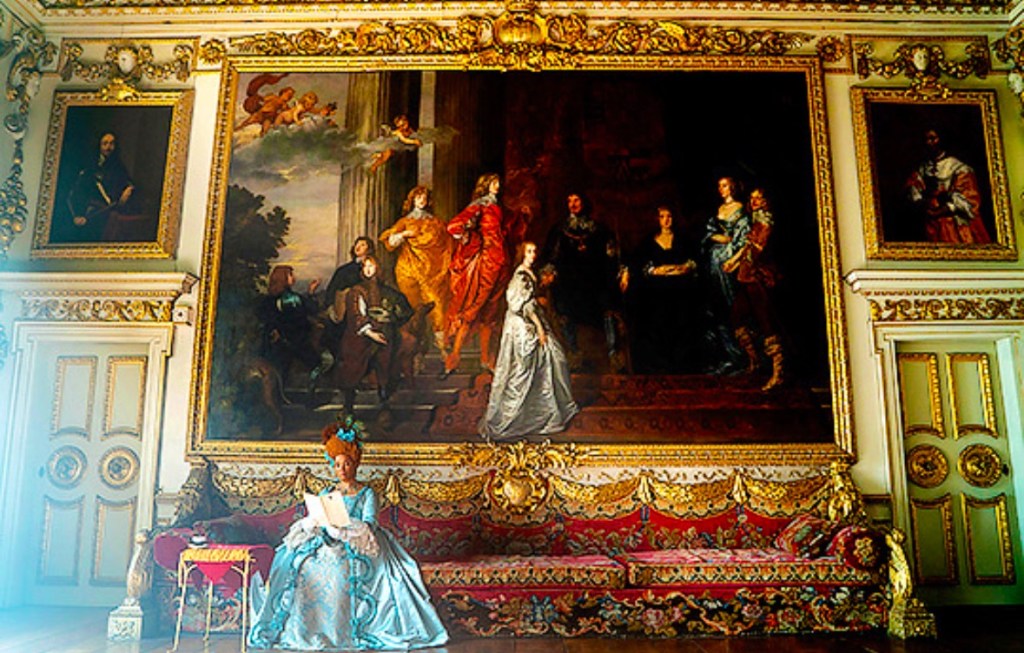
The character, Queen (consort) Charlotte of Mecklenburg-Strelitz, is seen in Wilton House reading in front of the portrait of the 4th Earl of Pembroke and his family by Anthony Van Dyck. Philip, Lord Pembroke, was a grandson of Lady Anne (Parr), Countess of Pembroke and her only husband, Sir William, 1st Earl of Pembroke.
The character Queen Charlotte from Netflix’s “Bridgerton” played by Golda Rosheuvel at Wilton House in Wiltshire, England.
Wilton House has been used in several shows & movies which includes Pride & Prejudice (2005). The portrait is humongous!
VAN DYCK’S PHILIP HERBERT, 4TH EARL OF PEMBROKE, WITH HIS FAMILY
Philip Herbert, 4th Earl of Pembroke, and his Family (1635 – oil on canvas – 330 x 510 cm<) is the largest painting ever made by Anton van Dyck, a joint portrait of the 4th Earl of Pembroke, his wife and children. All figures are slightly larger than life size and the impressive painting dominates the so-called Double Cube room at Wilton House, the Pembroke’s ancestral home for over four and a half centuries.
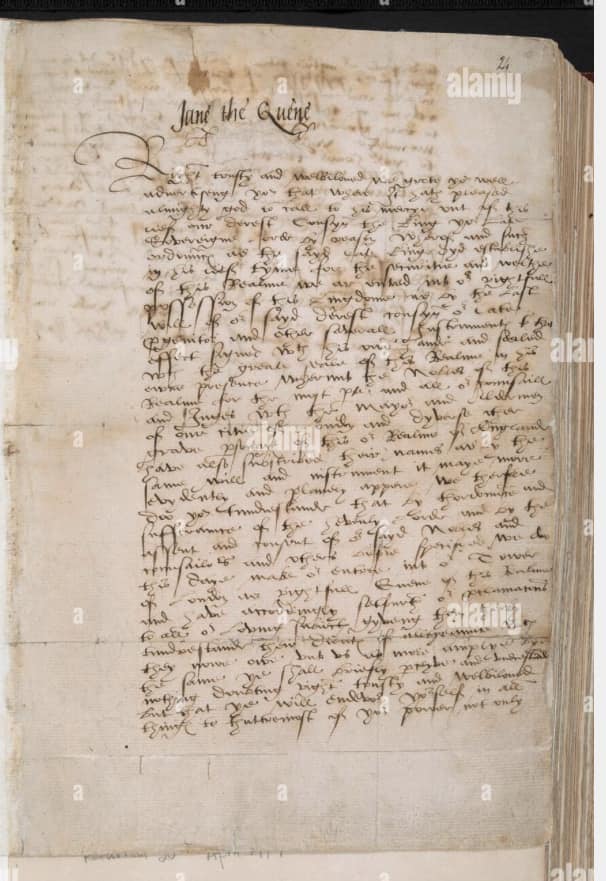
10 JULY 1553: LETTER written to Sir William Parr, 1st Marquess of Northampton, Earl of Essex, Baron Parr of Kendal from ”Jane, the Quene” ordering him to levy forces, 1553 (British Library) from Alamy
Written by Meg McGath
A letter from Queen Jane to William Parr ordering him to levy forces, 1553 . folio.A Volume, containing Letters, &c. written by royal, noble, and eminent Persons of Great Britain, from the time of King Henry VI. to the reign of his present Majesty. These are originals, except where otherwise expressed. [1449]-1761. Source: Lansdowne 1236, f.24.
Lady Pembroke and her daughter, also named Anne (Lady Talbot). Wilton Church.
Written by Meg McGath
Lady Anne Herbert was the daughter of Sir William Herbert, 1st Earl of Pembroke & his first wife, Anne Parr. As such, she was the niece of Queen Kateryn Parr. In 1563, at Baynard’s Castle, Lady Anne married Sir Francis, Lord Talbot (d.1582) in a double marriage between the two children of the 6th Earl of Shrewsbury and the two children of the 1st Earl of Pembroke. Lady Talbot’s brother, Henry, the future 2nd Earl of Pembroke, married Lady Catherine Talbot. Lord Talbot and Lady Catherine were child of Sir George Talbot, 6th Earl of Shrewsbury and his first wife, Lady Gertrude Manners, daughter of Sir Thomas Manner, 1st Earl of Rutland and his second wife, Eleanor Paston. In addition to the double marriage, Lord Talbot’s great-aunt, Lady Anne Talbot, had married secondly to Lady Anne Herbert’s father, the 1st Earl of Pembroke (d.1570) after the death of his first wife, Anne Parr, in 1552. This may have been the reason for the double marriage.
In her letter, Lady Talbot talks about how her sister, Lady Catherine, Countess of Pembroke, was frequently visited by Queen Elizabeth I at Baynard’s Castle. The Queen was fond of her. By 1575, Lady Catherine had become gravely ill and developed a fatal illness. The Queen even gave the Pembroke’s a ship to even travel to the continent in search of a cure. She returned to England without success by September 1575 and died on 24 April 1576. They had no issue.
Lady Anne Talbot writes to her husband’s stepmother, Bess of Hardwick, the Countess of Shrewsbury.
To the ryght honorable and my assured good lady, and mouther the Countes of Shrowsbery:
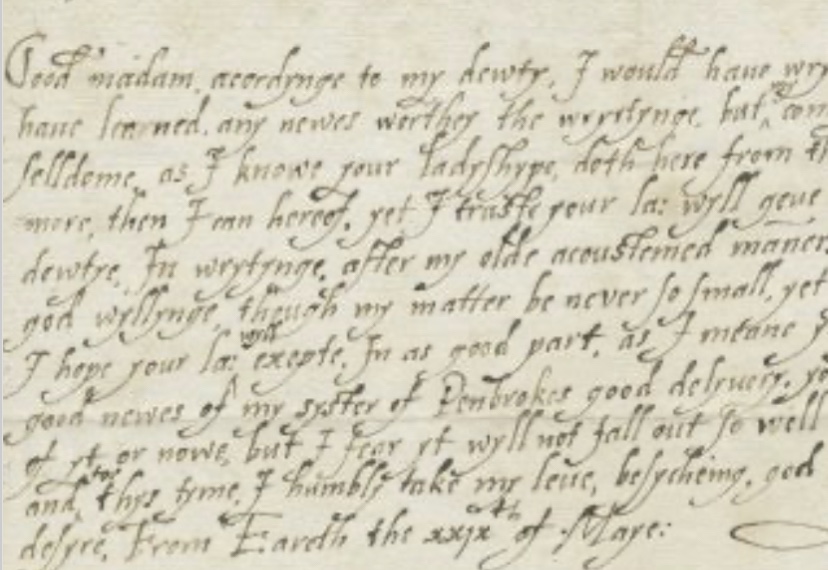
Good madam, acordynge to my dewty, I would haue wrytene oftener, yf I could haue learned, any newes worthey the wryrtynge, but my comeynge to the court, Is so selldome, as I knowe your Ladyshype, doth here from thensse, by othersse, a great dell more, then I can hereof, yet I truste your Ladyship wyll geue me leue, to remember my dewtye, In wrytynge, after my olde acoustemed manner. whych I wyll not slake god wyllynge, though my matter be never so small, yet my dewtyfull good wyll I hope your Ladyship wyll exepte, In as good part, as I meane yt, yf I could haue sent, any good newes of my syster of Penbrokes good delyuery, your Ladyship should haue hard of yt or nowe, but I fear yt wyll not fall out so well as I could wyshe yt had and for thys tyme, I humbly take my leue, besycheing, god to send your Ladyship your hartes desyre, From Eareth the xxjxth of Maye:
your Ladyship’s assured louyng daughter to comande:
Anne Talbott
Letter signed by Lady Talbott from letter dated 29 May [1575]. Courtesy of Bess of Hardwick Letters: The Complete Correspondence 1550-1608
Sources
From: Anne Talbot (Earith, Huntingtonshire); To: Bess of Hardwick; Date: 29 May [1575] Summary: Anne Talbot (née Herbert) writes to Bess (countess of Shrewsbury) that she has little news to report due to her infrequent visits to court. She promises to write ‘after my old accustomed manner’ and expresses fears that ‘my sister of Pembroke’s good delivery [. . .] will not fall out so well as I could wish’. Archive: Folger Shakespeare Library, Cavendish-Talbot MSS, X.d.428 (122) Delivery status: to Bess, sent Letter features: Seal intact – no. Ribbon/floss – no. Letter packet – accordion Hands: Anne Talbot | archivist | Version: 1.0 Further information on copyright and citation can be found at:- (URL: http:// http://www.bessofhardwick.org/background.jsp?id=171) https://www.bessofhardwick.org/letter.jsp?letter=93
The King has proclaimed that all who claim to do services on Coronation day shall be in the White Hall at Westminster Palace, 20 June next, and has authorised the Earl of Surrey, Treasurer of England, the Earl of Oxford, Sir John Fyneux, Chief Judge, Sir Thomas Englefeld, and others to determine claims. He has ordered 26 honorable persons to repair to the Tower of London on 22 June, to serve him at dinner, where those who are to be made knights shall bear dishes “in token that that they shall never bear none after that day”; and on 23 June, at the Tower, they are to be made Knights of the Bath; “whose names follow in order as they were made,” viz., Richard (sic) Radclyff lord Fitzwater, the lord Scroop of Bolton, the lord Fitzhugh, the lord Mountjoye, the lord Dawbeney, the lord Brooke, Sir Henry Clyfford, Sir Maurice Berkeley, Sir Thomas Knyvet, Sir Andrew Wyndesore, Sir Thomas Parr, Sir Thomas Boleyne, Sir Richard Wentworth, Sir Henry Owtrede, Sir Francis Cheyny, Sir Henry Wyotte, Sir George Hastynges, Sir Thomas Metham, Sir Thomas Bedyngfeld, Sir John Shelton, Sir Giles Alyngton, Sir John Trevanyon, Sir William Crowmer, Sir John Heydon, Sir Godarde Oxenbrige and Sir Henry Sacheverell.
‘Henry VIII: June 1509, 16-30 ‘, in Letters and Papers, Foreign and Domestic, Henry VIII, Volume 1, 1509-1514, ed. J S Brewer (London, 1920), pp. 36-55. British History Onlinehttp://www.british-history.ac.uk/letters-papers-hen8/vol1/pp36-55 [accessed 8 July 2023].
Sir Thomas Parr was knighted and Sir Thomas Boleyn followed behind him…wonder if the order in which they were knighted means anything…









 tudorqueen6 by Meg McGath