Unknown's avatar

About tudorqueen6

Meg McGath is the author behind the articles on “tudorqueen6”; she has been studying the history and genealogy of the Parr family for well over a decade. In 2025, she is still writing about her favorite Tudor queen, Kateryn Parr (1512-1548) even after becoming severely disabled. Meg studied at several top colleges which included Richmond University in London. As a violinist, she studied at Penn State Music School & Towson University School of Music where her minor became Women’s Studies. In 2009, ‘10, and ‘12, her summers were spent studying abroad in London where she was lucky enough to see Tudor artifacts, Palaces, and Sudeley Castle where Parr is officially buried. One of her goals is to end the myth that Queen Kateryn Parr was nothing more than a nursemaid to the aging King Henry VIII. "It simply isn't true, she did so much more for the family and her country," says Meg. A book has always been her end game with Parr, but as stated, she is now disabled and can only write on occasion. She was a moderator and heavy editor for the official Tudors Wiki (Showtime), has a massive genealogy tree she’s been working on since the late 2000s on Ancestry which follows Royalty, aristocratic families, and even Colonial Aristocratic lineage. She heavily edits & has started articles on Wikipedia. She also spent a lot of time writing & researching Royal tiaras and jewels of various Royal families & the weddings of the British Royals. Her research can be found on the old Tudor Wiki site under the name “Goldenaged.ER”. In the summer of 2012, she finally took a trip to Sudeley Castle while studying abroad. In London, she was privy to the Queen’s Diamonds at Buckingham Palace which included pieces like the Queen Alexandra Diamond Kokoshnik, the Williamson Brooch, the Delhi Durbar necklace, the small crown of Queen Victoria, and more.

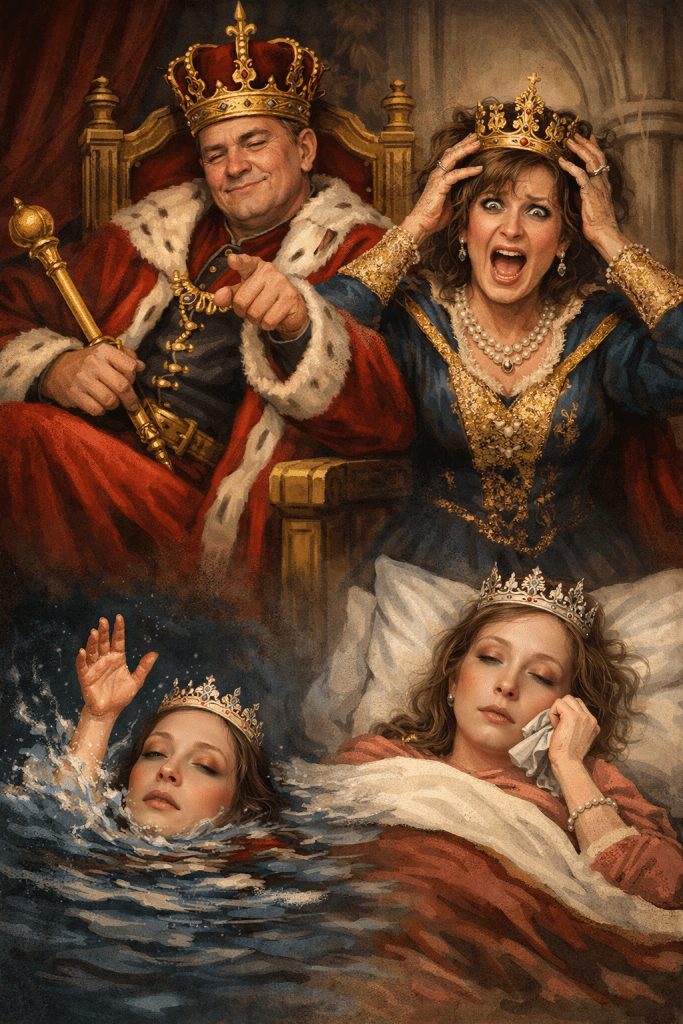
AI: Henry & his consort Kateryn surrounded by the ghost of Anne Boleyn, Henry Howard & Katherine Howard. The three cousins who Henry VIII executed.

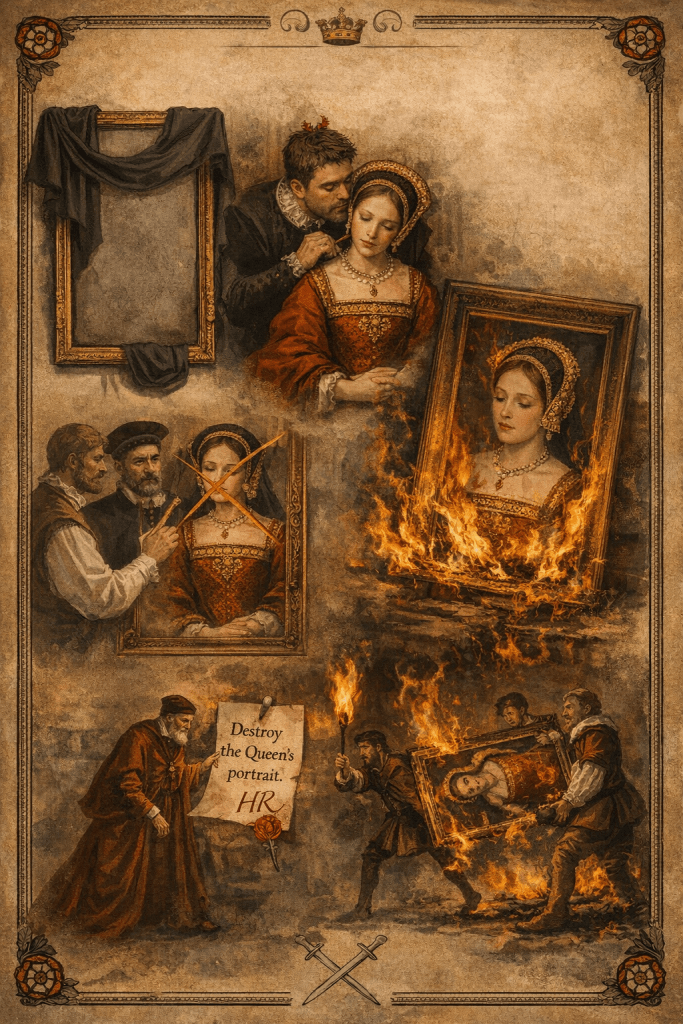
Henry VIII didn’t just execute Anne Boleyn and Katherine Howard — he erased them.

Not because they were guilty.

Not because they were dangerous.

But because they injured his ego, and Henry VIII could not tolerate narcissistic shame.

He ERASED them.
• Their coats of arms torn down
• Initials removed from palaces
• Portraits hidden or destroyed
• Their reputations smeared
• Their names forbidden at court
• Their supporters scattered
• His daughter by Anne was sent away immediately and lost her status as Princess Elizabeth. She was hence Lady Elizabeth Tudor.

This is classic narcissistic annihilation:
“If you injure me, you cease to exist.”

He literally rewrote history documents to frame himself as:
• righteous
• innocent
• betrayed
• the victim
• morally justified

He needed to believe he wasn’t the problem — THEY were.

Typical narcissistic rewriting of the narrative.

The charges against both women were manufactured or exaggerated — not to seek justice, but to restore Henry’s fragile self-image.

Henry VIII’s entire marital history reads like a narcissistic abuse cycle

He:
• love bombed
• isolated
• tested loyalty
• demanded admiration
• punished perceived slights
• rewrote narratives
• replaced women quickly
• destroyed those who “shamed” him

The man was a pathological narcissist with absolute power.

And Anne Boleyn and Katherine Howard were two women who suffered the worst aspect of that pathology:
Total erasure as punishment for wounding him.

Anne and Katherine weren’t executed because they were guilty.
They were executed because Henry was “wounded” by them. He became the victim in his eyes.

“How misfortunate I am to have so many ill-conditioned wives!” — King Henry VIII in ‘The Tudors’ (S4E5)

The Annapolis Tea Party

Francis Blackwell Mayer’s painting of the burning of the Peggy Stewart during the Annapolis Tea Party in 1774. (Source: https://boundarystones.weta.org/2012/12/16/annapolis-tea-party-1774)

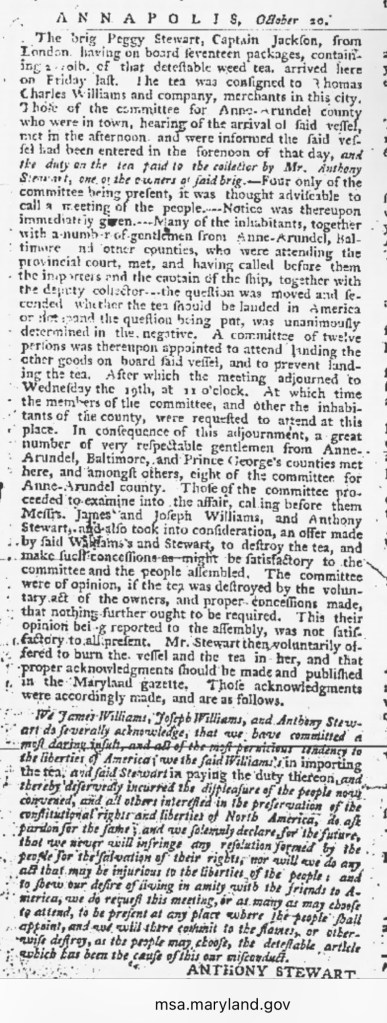
On October 15, 1774, the ship Peggy Stewart sailed up the Severn River into Annapolis harbor carrying “seventeen packages, containing 2,320 lb. of that detestable weed — tea.”

Handbills were immediately circulated through the city calling for a public meeting. The ship’s owner, Anthony Stewart, a British Loyalist deeply in debt from earlier failed ventures, took a desperate gamble by landing the tea in Maryland.

This ship would soon ignite what we Marylanders call “The Annapolis Tea Party.” On October 19, 1774, under public pressure, Stewart was compelled to burn his own vessel to the waterline.

Dr. Charles Alexander Warfield wasn’t merely an onlooker — he was reportedly among the men who ordered the destruction, declaring they must “destroy the ship and the cargo, or destroy the liberty of the people.” The surname may seem familiar to Marylanders as The Duchess of Windsor was born, Bessie Wallis Warfield. Wallis became Duchess when she married the abdicated King Edward VIII of the United Kingdom in 1937.

Last year marked the 250th anniversary of that act of protest. The very ground where the Peggy Stewart burned once belonged to my ancestors — they stood there as history turned to flame on their own shore.

Maryland Gazette 20 October 1774, pg 2. (See full document at Maryland State Archives)

Sources

From Mount Vernon to Montclair Dr: William Bernard Sears

Screenshot of the Mount Vernon website showing a Virtual Tour of the Dining Room which was painted green. My ancestor, William Bernard Sears, carved the fireplace for President Washington.

William Bernard Sears was a master joiner and architect in colonial Virginia, and the mantelpiece he created for Mount Vernon’s dining room is one of the finest surviving examples of mid-18th-century craftsmanship.

His work linked him directly with George Washington and George Mason — two of the most influential figures of the Revolutionary era — since he also contributed to Gunston Hall’s interiors. The fact that Washington personally commissioned him speaks volumes about his reputation for precision and artistry.

My connection to him means my family literally left its mark on one of the most historically important houses in America — and on the emerging American aesthetic blending British design (Abraham Swan’s The British Architect, 1745) with early Federal taste.

That vivid verdigris green (the one on the Mount Vernon mantel room walls) was a power color in the 18th century — expensive, vibrant, and a sign of sophistication and intellect. It was made from copper-based pigments, often imported from Europe, so when Washington had that room painted, it was a bold, fashionable choice.

So yeah — I unknowingly recreated the same palette that my ancestor, William Bernard Sears, helped bring to life at Mount Vernon at the house 🏡 on Montclair.

That’s some full-circle ancestral energy right there. 🤯

—Meg

I even made this years ago,,,🤷🏻‍♀️🤷🏻‍♀️🤷🏻‍♀️

Ancestry of Meghan Elizabeth McGath (b.1983)

The Moran family of Washington D.C. was the family of my great-grandmother, Sadie Woodbury Moran. Sadie married to Master Sergeant Joseph Lovey Smallwood, aka John Williams of Leesburg, Virginia—>Dorothy May Williams m. Corporal John Roger McGath—> Christopher John McGath married Susan Marie DeCamp—>Meghan Elizabeth McGath, who is recently divorced.

The obituary of Mrs Kate M LaPorte is that of my 2nd great-grandaunt who was the sister of Henry Clay Moran (Harry Moran in the Obituary). Henry married Cora Elizabeth Beavers. They were parents to Sadie W. Moran.

Obituary for Mrs Kate M. LaPorte of Peoria, Illinois. Kate was my 2nd great-grandaunt. Personal record of Meghan McGath.

🖤—Lady Meghan McGath, 5 October 2025—🖤

Donations can be sent to @tudorqueen6 on PayPal. 💸💰🤑💰💸

Reference & Sources

All photographs, artwork, & screenshots in this article were taken by the author, Meghan McGath (tudorqueen6).

Images include personal documentation of Mount Vernon’s dining room, the verdigris green wall restoration, and the Montclair Drive interior echoing that palette.

Research references include:

Mount Vernon Ladies’ Association restoration archives (architectural correspondence and pigment studies).

Gunston Hall Historic Site publications and conservation notes.

Family genealogical records tracing the Sears line through the Moran branches, verified by personal records of Ms. Meghan McGath from the papers of Mrs Dorothy McGath (born Williams).

Maryland State Archives.

The British Architect (Abraham Swan, 1745), used for stylistic context of 18th-century joinery and design motifs.

All commentary and historical synthesis © 2025 Meghan Elizabeth McGath. Please credit when sharing or excerpting.

Lady Frances Manners, Lady Bergavenny

Lady Frances Neville, (née Manners) Lady Bergavenny (c.1530 – circa September 1576) was an English noblewoman and author. Little is known of either Lady or Lord Bergavenny, except that the latter was accused of behaving in a riotous and unclean manner by some Puritain commentators. Lady Bergavenny’s work appeared in The Monument of Matrones in 1582 and was a series of “Praiers“. Her devotions were sixty-seven prose prayers, one metrical prayer against vice, a long acrostic prayer on her daughter’s name, and an acrostic prayer containing her own name.

Family

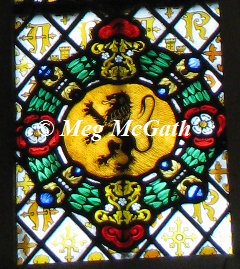
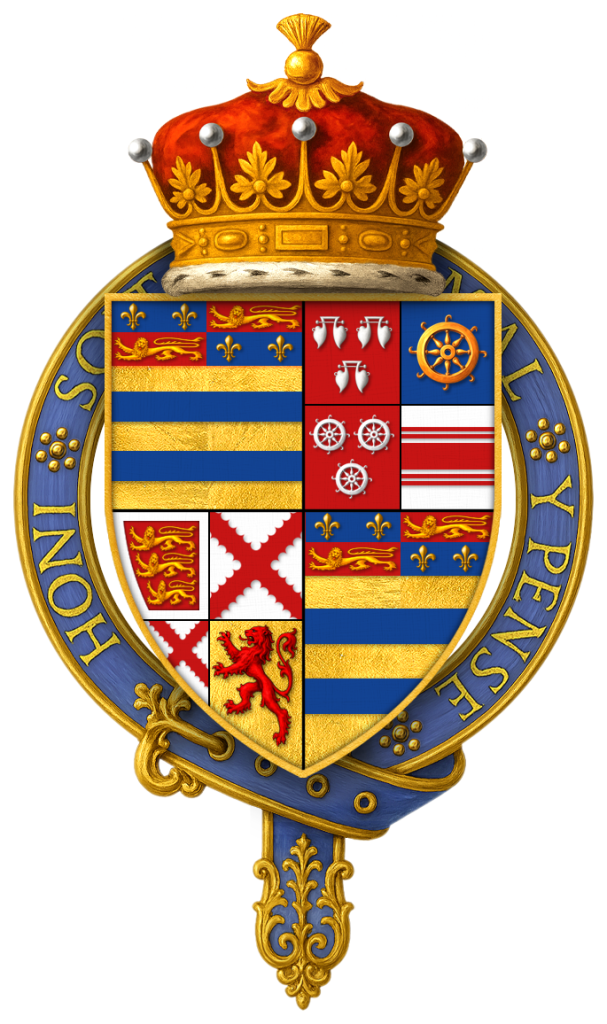
Coat of arms of Sir Thomas Manners, 1st Earl of Rutland, KG
Rutland’s stall plate remains installed within St. George’s Chapel. The arms are: quarterly:
1 and 4, or, two bars azure, a chief quarterly of the last and gules, on the 1st and 4th, two fleurs-de-lis or, on the 2nd and 3rd, a lion passant gaurdant or (Manners);
2, a grand quarter consisting of
1, gules, three water bougets argent (Ros)
2, azure, a Catherine wheel or (Belvoir)
3, gules, three Catherine wheels argent (Espec)
4, argent, a fess between two bars gemels gules (Badlesmere)
3, a grand quarter consisting of
1, gules, three lions pasant guardant or, within a bordure argent (Holland, Earls of Kent)
2 and 3, argent, a saltire engrailed gules (Tiptoft)
4, or, a lion rampant gules (Edward Charleton, 5th Baron Charleton of Powys (1370-1421))

Lady Frances Bergavenny was the third daughter of Thomas Manners, 1st Earl of Rutland and his second wife, Eleanor Paston. Her father was a soldier and the eldest son of Sir George Manners of Belvoir, Leicestershire, and his wife, Anne St. Leger. By Anne St. Leger, Frances was thus a great-granddaughter of Anne of York, the elder sister of Edward IV and Richard III.

Before 1554, Frances had married Henry Nevill, 6th Baron Bergavenny. Nevill or Neville, was born between 1527 and 1535. He was the son of George Neville, 5th Lord Bergavenny and Lady Mary Stafford. Neville succeeded to the title of 4th Lord Bergavenny after his father’s death in 1535. He held office of Chief Larderer at the coronation of Queen Mary in 1553. When Lady Bergavenny died in 1576, Neville remarried to Elizabeth Darrell, daughter of Stephen Darrell and Philippe Weldon, before 1586; they had no issue. He died 10 February 1586/87 without male issue. He was buried on 21 March 1586/87 at Birling, Kent, England.

She died circa September 1576 and was buried at Birling, Kent, England.

Children

Lord and Lady Bergavenny had one daughter Hon. Mary Neville, Baroness Le Despenser (25 March 1554 — 28 June 1626). Mary gained the title of suo jure 3rd/7th Baroness le Despenser. She had claimed the succession to the Barony of Bergavenny, but this was settled on her cousin, Edward Neville, who became the 7th Baron Bergavenny.

The first, second, and fourth creations of Baron le Despenser had been under attainder from 1400 upon the death of Mary’s ancestor, Thomas le Despencer, 2nd Baron le Despencer, [1st Earl of Gloucester] (1373–1400) and became abeyant as well in 1449 after the death of the infant Lady Anne Beauchamp, the 15th Countess of Warwick. The representation of the three Baronies of le Despencer fell into abeyance between Anne’s cousin George Nevill, 4th Baron Bergavenny and aunt, Anne de Beauchamp, 16th Countess of Warwick. On the attainder and execution of Lady Margaret Plantagenet [Margaret Pole], Countess of Salisbury on 28 May 1541 any claim to the three Baronies by the descendants of the 16th Countess of Warwick, lapsed and the sole representation lay with the Barons Bergavenny. The attainder of Thomas, 2nd Baron le Despenser, was reversed in 1461 but the abeyancies continued until 25 May 1604, when the abeyancy of the 1295 Barony of le Despencer was terminated in favour of Mary Neville. She married Sir Thomas Fane, son of George Fane, on 12 December 1574. They were parents to Sir Francis Fane, who gained the title of 1st Earl of Westmorland. The title of Earl of Westmorland was forfeit after the death of Mary’s cousin, Charles Neville, 6th Earl of Westmorland. The title was revived in 1624 in favour of Fane because Mary was a descendant of Sir Edward Neville, 1st Baron Bergavenny, a younger son of the 1st Earl of the 1329 creation [Ralph Neville, husband of Lady Joan Beaufort and son-in-law to Prince John of Gaunt, 1st Duke of Lancaster].

Lady Despenser died on 28 June 1626 at age 72.

Relations to Queen Kateryn

Both Kateryn and Frances descend from the Ros family, Lady Joan of Kent (Princess of Wales) who married into the Holland family, and Lady Joan Beaufort who married into the Neville family among others lines.

Works

Her Praiers in prose and verse were later published in 1582 by Thomas Bentley in the Second Lamp of his anthology of Protestant women writer’s prayers, The Monument of Matrones. In a deathbed dedication of her work to her daughter, she calls it a “jewell of health for the soule, and a perfect path to paradise.” Her collection includes sixty-seven pages of prose prayers for private use and public worship linked to various occasions and times of day; a five-page acrostic prayer based on her daughter Mary Fane’s name, and a concluding prayer based on her own name.

References

  • Beilin, Elaine V. “Frances Neville, Lady Bergavenny” in Matthew, H.C.G. and Brian Harrison, eds. The Oxford Dictionary of National Biography. vol. 45, 490-491. London: OUP, 2004.
  • McCoy, Richard, Kathleen Lynch, Carol Brobeck, Martha Fay, Roque Rueda, “Redefining the Sacred–Monument of Matrones,” Redefining the Sacred in Early Modern England: An NEH Summer Institute. -Folger Shakespeare Library, 1998. Web. 30 Nov. 2011. http://www.folger.edu/html/folger_institute/sacred/image13.html
  • Bentley, Thomas. Monument of Matrones. London, imprinted by Henrie Denham, [1582]. http://luna.folger.edu/luna/servlet/s/6z39cc
  • The Oxford Dictionary of National Biography. The Oxford Dictionary of National Biography. vol. 45, 490-491. London: OUP, 2011

Written by Meg McGath (September 2012)

(Update 8 September 2025)

21 September 2025: World Alzheimer’s Day

Dorothy May Williams (1924-2007)

Today I honor my Grandma, Dorothy Williams, on World Alzheimer’s Day. I realize it’s not Kateryn Parr related — however it is in a way. My ancestors were at court during her life and reign. Dorothy descends from and is related to several Tudor figures.

Her roots run deep in history — her father, Joseph AKA John, was born a Smallwood and her mom, Sadie, was also of Aristocratic descent tying our family to generations who helped build and shape this country. But to me, she was Grandma: a woman of strength, love, and quiet resilience.

I remember seeing her in the nursing home — I felt so bad — she couldn’t move, she couldn’t speak but when I saw her she started to cry and tears came to her eyes … I think she remembered me… she always loved me like a daughter especially after losing her two baby daughters.

I used to visit her a lot after going to the National Shrine for Mass while she still lived in Mount Rainer, Maryland. She would make dinner and we would hang out along with her dog while watching whatever was on TV. She never remarried after my grandpa died and always talked about how much she loved him — he was named John but she called him Johnny.

My Dad, Chris, and her mother, Sadie, lived with her in Mount Rainer. Dad attended Catholic University for his masters after graduating from Ohio State. He met my mom at St John’s and they were married at Caldwell Hall in the early 80s. Sadie would remain in her household until she became too sick to care for herself. She went into a nursing home and died in 1992 after almost a Century of being alive. Born in the Gilded Age, my Nana died a few years before the Millennium.

In early dementia, Dorothy was placed in assisted living where she stayed for some time. She had to give up her dog which must have been heartbreaking. My mom ended up giving it away like it meant nothing. Misty didn’t deserve that.

After running out of money, she entered a nursing home where she died from Alzheimer’s on 11 September 2007. She was flown back to Columbus, Ohio to be buried with the love of her life and her two daughters who were buried elsewhere in the cemetery. At her burial, a blue butterfly landed on her casket. She was fond of monarch butterflies and I still have her magnet from her refrigerator somewhere in storage, but my family won’t let me have access to my belongings from my condo for well over a year now.

I had planned on walking/running for the cause, but I got injured and became sick at the end of 2017 and into 2018. And it’s been hell ever since. Instead of helping me with my health, my maternal family has been abusive and discriminatory towards me. I have had almost no help since my ex walked out. Everyone I go to refuses to get involved or sided with my abusive ex. Sure wish I had met someone like my Grandma married. I never met my Grandpa.

Alzheimer’s may have dimmed my grandma’s memories, but it could never erase who she was — or how she lives on through me. 💜

8 May 1575: Letter from Lady Anne Talbot to the Countess of Shrewsbury

Lady Anne Talbot (née Herbert) to Bess of Hardwick, Countess of Shrewsbury.

To the ryght honorable and my asurred good lady and moother the Countes of Shrowsbery./

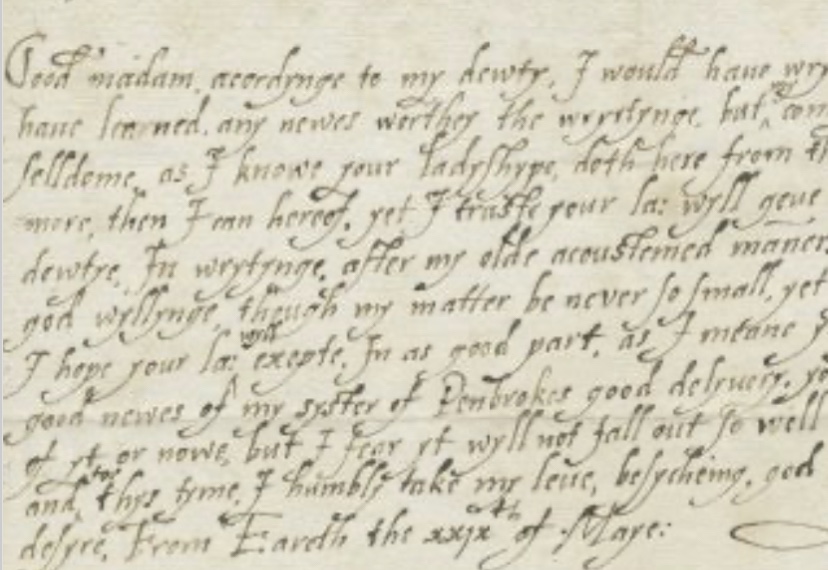
Good madame, I am to craue pardon of you for not wryteinge by my lordes man Harry Grace, the causse I wylled hym to declare to your Ladyship whych was the extremty that my syster of Pembroke was In, at that tyme whych hath contenued tell theursdaye Laste, sethensse that daye she hath ben out of her soundynge, but not able to stand or gooe, her greatest gryf Is nowe want of slepe, and not able to away wyth the syght of meat, but consederynge her estat befor, we thynke our selfes hapy of thys change, hopenng that better wyll followe shortely, the Quynes Majesty hath ben here wyth her tywss, very latt both tymes, and last tyme, yt was x of the cloke at nyght or ever her Majesty whent hensse, being so great a myste, as ther were dyueres of the barges and Boottes that wayted of her loste ther wayes, and landed In wronge plases, but thankes be to god her Majesty came well home wythout colde or feare, for the holdyng of the Prograce, I am ssure your Ladyship hereth for my part I can wryt noe sertaynte, but as I am In all other matteres, as I haue alwayes professed and as dewtye doth bynd me, ready at your Ladyship’s comandement, and In any thynge I maye showe yt ether at thys tyme, or when occassyon seruet[h] yf I be not as wyllynge therto as any chylde of your owne, then lett me be condemened accordynge to my desertes, otherwyss I humbly craue your Ladyship’s good openyon of me not to decreasse, rememberynge your Ladyship’s comandement here to for to wryt to you as often as I coulde, whych nowe In thys plase I shall haue better meanes then I haue had In the country, and ther vpon pressumyng, to lengthen my letter vpon any occassyon, although I count thys of my syster very evell newes yet consederynge, her recouery, I hope my longe scryblynge, wyll the lesse trouble your Ladyship and so wyth my moste humble dewty to my Lorde and your Ladyship I humbly take my leue From Baynardes Castell the viijth of Maye: 

your Ladyship’s assured loueing daughter to comande

Anne Talbott

My styster of Pembroke hath wylled me to remember her humble dewty to my lorde and you, wyth desyre of hys dayly blessynge assoune as she Is able she wyll dowe yt her selfe/.

To the right honorable and my assured good lady and mother, the Countess of Shrewsbury

Good Madam, I am to crave pardon of you for not writing my lords man Harry Grace, the cause I willed him to declare to your Ladyship which was the [extremity] that my sister Pembroke was. In, at that time which has continued till Thursday. Last [sethensse] that day she has been out of her

Summary: Anne Talbot (née Herbert) writes to Bess (countess of Shrewsbury) apologising for not writing sooner. Her ‘sister of Pembroke’ has been very ill, but is now recovering. The queen has come to visit her sister twice – both times late at night. On one occasion the queen didn’t leave until 10 o’clock at night because ‘the barges and boats that waited of her lost their ways, and landed in wrong places’ due to a great mist. Letter features: papered seal, embossed Ribbon/floss – no. Letter packet – slit and band.

Lady Anne Talbot was born to Sir William Herbert, 1st Earl of Pembroke and his first wife, Anne Parr, sister to Queen Katherine Parr. She married Francis, Lord Talbot, eldest son of the 6th Earl of Shrewsbury and his first wife, Gertrude Manners. Elizabeth “Bess” Hardwick was the second wife. She had no issue from her marriage to the 6th Earl. Who is this ‘sister of Pembroke’? Catherine Talbot, Lady Herbert, wife of Lady Talbot’s brother, Sir Henry, Lord Herbert, later 2nd Earl of Pembroke?

Bess of Hardwick’s Letters: The Complete Correspondences c.1550-1608. Folger Shakespeare Library, Cavendish-Talbot MSS, X.d.428 (121)

Dedication to All Women

Written by Meg McGath

For all the women whose names were never written down,

but whose legacies live in us.

This work is for the mothers, daughters, sisters, aunts, and grandmothers

who shaped history in silence—

who bore witness, raised families, held communities together,

and whose stories were never recorded

because they weren’t seen as important enough to remember.

I see you now.

Your names may not be etched in stone or inked in parchment,

but your strength runs in my blood.

This is my attempt to write you back into history—

to speak your names aloud,

to honor your lives, your losses, your love,

and to say:

you mattered. You still do.

This is for my ancestors

—and every woman whose story was buried beneath a man’s will,

but whose spirit carried generations forward

© 2025 Meg McGath. All research and original commentary belong to the author.

17 February: the Duke of Najera’s Visit to Court


Coat of arms of the 
3rd Duke of Nájera, knight of the 
Order of the Golden Fleece, in the 
Cathedral of Ghent (Wikipedia)

Written by Meg McGath

On 17 FEBRUARY 1544, Sir William Parr, Earl of Essex and Sir Henry Howard, Earl of Surrey dined with the Spanish envoy to Charles V of Spain, Don Juan Esteban, Manriquez de Lara, the Duke of Najera, at his Palace lodgings and afterwards they took the Duke to Westminster to introduce him to King Henry VIII who received him graciously.

Juan Esteban Manrique de Lara y Cardona, 3rd Duke of Najera (1504-1558) was a Spanish diplomat from the court of Charles V, King of Spain and Holy Roman Emperor, who was cousin to Lady Mary.

On the occasion of the visit of the Duke of Najera, the Queen was called to entertain as the King was indisposed. The Queen and her ladies were dressed in different silks, with splendid headdresses. The Queen was sumptuously clothed and adorned by jewels. Kateryn was praised as having “a lively and pleasing appearance,” and for being “a virtuous woman.” (Armbruster) The Lady Mary, future Queen, was also there to entertain as well as Henry’s niece, Lady Margaret Douglas.

Queen Kateryn (Catherine) Parr (Joely Richardson) and the Lady Mary (Sarah Bolger) in “The Tudors” (2010)

In Season 4 of “The Tudors”, we see the actress Joely Richardson as Queen Kateryn (Catherine) Parr along with Lady Mary played by Sarah Bolger. In the show, the Duke of Najera is sent to the court of King Henry VIII of England in London, and he is entertained by Henry Howard, Earl of Surrey. There is no mention of the Queen’s brother, William, the Earl of Essex, in the show. The Duke of Najera talks about seeing the Tower of London and the swans along the River Thames before being brought to meet with the King. He speaks of the marvels of the River Thames and the circus show that Surrey brought him to.

The Queen introduces the Duke of Najera to the Lady Mary in “The Tudors” (2010)

Later on he attends festivities at court led by Queen Kateryn and Lady Mary. The Queen introduces herself and Mary who speaks to the Duke in almost perfect Spanish, to his surprise, to which she responds, “Am I not my mother’s daughter?”.

Lady Mary as played by Sarah Bolger in “The Tudors” (2010)

He is introduced to the Queen and kisses her hand, and the Queen immediately introduces him to Princess Mary, who intends to reduce this handsome Iberian to dust with a charm and awe offensive. She starts, as she was reported actually historically doing, by giving the Duke the good old “English Gentlewoman’s Formal Hello”, an often surprising kiss right on the lips.

Before the poor, young, worldly general has time to recover, The Tudors‘ Mary follows it up with dropping into what (to my uneducated and unpractised ear) sounds like maybe not completely fluent but pretty good Spanish that gets more confident as she goes on. 

During the visit of the Duke of Najera, Kateryn is recorded historically as wearing her favorite colour, crimson — sadly, not the lovely shade of green shown in “The Tudors”! The color name “jade green” was first used in Spanish in the form “piedra de ijada” in 1569. The first recorded use of “jade green” as a color name in English was in 1892.

The Queen (Joely Richardson) and the Duke of Najera (Fabio Tassone) dance together in “The Tudors”, Season 4, episode 7 (2010).

The song used in “The Tudors” scene where the Queen and Duke dance together is “Dansereye: Rondes I & VII”. The song was also used in the movie “Elizabeth” in 1998 during the scene where Robert Dudley proposes and there is attempt on the Queen’s life.

Sources

© 2025 Meg McGath. All research and original commentary belong to the author.

Bridgerton Films at Wilton House

Written by Meg McGath

The Earl of Pembroke’s Wilton House was used in the Netflix Series “Bridgerton”. 

The character, Queen (consort) Charlotte of Mecklenburg-Strelitz, is seen in Wilton House reading in front of the portrait of the 4th Earl of Pembroke and his family by Anthony Van Dyck. Philip, Lord Pembroke, was a grandson of Lady Anne (Parr), Countess of Pembroke and her only husband, Sir William, 1st Earl of Pembroke. 

The character Queen Charlotte from Netflix’s “Bridgerton” played by Golda Rosheuvel at Wilton House in Wiltshire, England.

Wilton House has been used in several shows & movies which includes Pride & Prejudice (2005). The portrait is humongous!

VAN DYCK’S PHILIP HERBERT, 4TH EARL OF PEMBROKE, WITH HIS FAMILY

Philip Herbert, 4th Earl of Pembroke, and his Family (1635 – oil on canvas – 330 x 510 cm<) is the largest painting ever made by Anton van Dyck, a joint portrait of the 4th Earl of Pembroke, his wife and children. All figures are slightly larger than life size and the impressive painting dominates the so-called Double Cube room at Wilton House, the Pembroke’s ancestral home for over four and a half centuries.

Anton Van Dyck, Philip Herbert, 4th Earl of Pembroke, with his Family, c. 1635 © Ph. Will Pryce | Collection of The Earl of Pembroke & the Wilton House Trust

Sources Used

• VAN DYCK’S PHILIP HERBERT, 4TH EARL OF PEMBROKE, WITH HIS FAMILY The Factum Foundation for Digital Technology

© 2025 Meg McGath. All research and original commentary belong to the author.

Women of the Tudor Period: Margaret of Austria

Written by Meg McGath

Margaret of Austria (10 January 1480 – 1 December 1530) was Governor of the Habsburg Netherlands from 1507 to 1515 and again from 1519 until her death in 1530. She was the first of many female regents in the Netherlands. She was variously the Princess of Asturias, Duchess of Savoy, and was born an Archduchess of Austria.

Margaret of Austria sits with her nephew, Charles V and his sisters. Willem Geets (1892)

Margaret was the second child and only daughter of Maximilian of Austria (future Holy Roman Emperor) and Mary of Burgundy, co-sovereigns of the Low Countries. She was named after her step grandmother, Margaret of York, who was sister to the York Kings Edward IV and Richard III.

Margaret was married to John, Prince of Asturias who was heir to Ferdinand II of Aragon & Isabel I of Castile. John was the eldest brother of future Queen Katherine of Aragon. Margaret’s brother married their sister, the future Juana I of Castile. That made Margaret a sister-in-law to Katherine and Juana. 

When the Prince died, Margaret stayed in Spain. In her time as Dowager Princess, it was suggested that she should teach her teenage sister-in-law, Katherine of Aragon, French. 

In 1501, Margaret married Philibert II, Duke of Savoy (1480–1504), whose realm played a decisive role in the rivalry between France and the Habsburgs.

Margaret was also familiar with English Ambassador Sir Thomas Boleyn, the father of the future Queen Anne Boleyn. In the Spring of 1513, a young Anne was sent to Margaret’s “Court of Savoy” at Mechelen Castle in Belgium. Anne was there until the late summer of 1514 when she moved to Paris to attend Queen Claude of France. Anne was eventually sent back to the English court of King Henry VIII of England. She became a lady to Katherine of Aragon who had married secondly to King Henry. By 1526, Henry became attracted to Anne after having an affair with her sister, Mary. Henry would go to extreme measures to move heaven and earth for Anne. In actuality, Henry just really needed to remarry and have a son. His current wife, Queen Katherine, would be banished from Court and would die alone as “Dowager Princess of Wales”. Their daughter Mary never saw her mother again. Mary would eventually become the first Queen Regnant of England and Ireland and Queen of Spain by marriage to Philip II who was a descendant of Margaret’s brother, Philip, who married Juana, Queen of Castile who was sister to Katherine of Aragon.

Willem Geets imagines (1892) a puppet show at Margaret’s court; the future Charles V sits next to her, with his sisters alongside.

The seated girl at right may be intended to be Anne Boleyn. No source is named on Wikipedia as to who thought the young girl is actually Anne Boleyn as of January 25th, 2025.

Is this Anne Boleyn?

© 2025 Meg McGath. All research and original commentary belong to the author.