Anonymous painting of Greenwich Palace during the reign of Henry VIII. [Wiki]
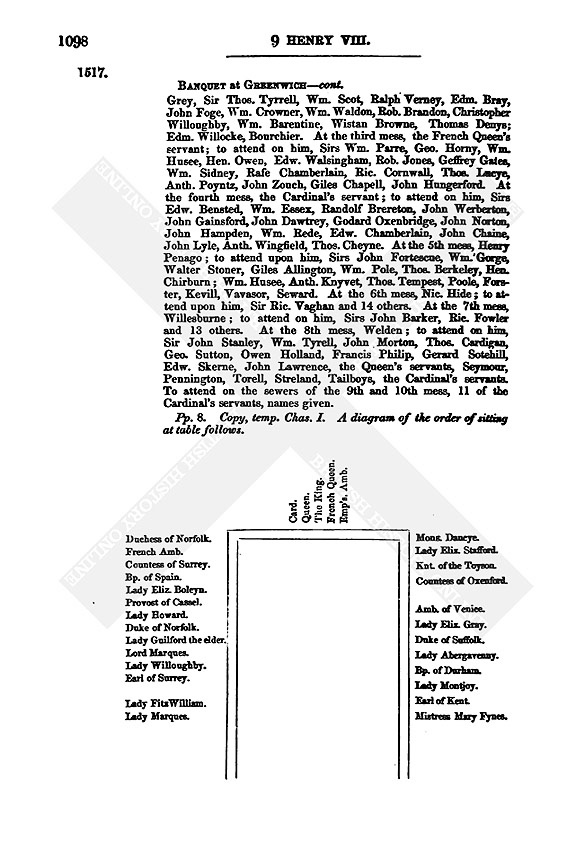
On 7 July 1517, a lavish banquet was held for the Emperor’s Ambassadors at Greenwich. The tables above show where several of the notables, including the King and Queen, sat. The banquet seems to have been largely a Howard family event.
The banquet was held on St Thomas’s day that is to say the summer feast the 7th of July. There were in all thirty three people seated at the banquet. The King had the centre place at the upper table; Queen Katherine was on his right and Cardinal Wolsey on hers; on the King’s left was the French Queen [Mary Tudor, Duchess of Suffolk] and the Emperor’s Ambassador was beside her. Then at the side tables with English peers and peeresses sat the Ambassadors of France, Aragon, and Venice. To attend on these thirty three persons no less than 250 names are given in a paper that was drawn up beforehand and these are almost all lords or knights. How they could avoid being in one another’s way is the difficulty. For instance Lords Abergavenny, Fitzwalter, Willoughby, and Ferrers to hold torches while the King washes. To bear towels and basons for the King the Earl of Surrey, Lords Richard Grey, Leonard Grey, and Clinton, Sir Maurice Berkeley, and eight other knights. The King’s server was Sir William Kingston and to attend on him Lord Edmund Howard [father of the future Queen Katherine] and fourteen knights the last named of whom is Sir Adrian Fortescue. To help the Vice-chamberlain in the ordering of the company, Sirs Thomas Perre and John Peche. At the third mess, the French Queen’s servant; to attend on him, Sirs William Parr [brother to Sir Thomas and uncle to the future queen] and several others.
Seating Chart of the banquet at Greenwich on St. Thomas Day, 1517. Thanks to my friend Katherine for this.
At the head table:
Card
Queen Katherine
King Henry
French Queen Mary Tudor
Emperor’s Ambassador
The table on the left:
Duchess of Norfolk
French Ambassador
Countess of Surrey
Bishop of Spain
Lady Elizabeth Boleyn [mother of the future Queen Anne]
Provost of Cassel
Lady Howard [mother of the future Queen Katherine]
John S. Brewer, Robert H. Brodie, James Gairdner. Letters and Papers, Foreign and Domestic, of the Reign of Henry VIII.:Preserved in the Public Record Office, the British Museum and Elsewhere: 1517 – 1518, Volume 2, Issue 2, H.M. Stationery Office, 1864.
John Morris. The Venerable Sir Adrian Fortescue, knight of the bath, knight of St. John, martyr, Burns and Oates, 1887.
The night before the coronation, like monarchs before her, the Duchess of Gloucester stayed in The Tower of London.
For the procession from the Tower to Westminster on the eve of the ceremony, she wore a kirtle and mantle made from 27 yards of white cloth-of-gold furred with ermine and miniver, and trimmed with lace and tassels of white silk and gold (Laynesmith, p. 92).
Queen Anne
On 6 July 1483, The Duke and Duchess of Gloucester were crowned King Richard III and Queen Anne of England. The couple shared a joint coronation. Not since the days of Edward II and Isabel of France had England seen such a magnificent event. The coronation day began at 7 am with a procession on foot from Westminster Hall to the Abbey. For that day, Anne dressed in a robe, curtle, “surcote overt”, and mantle, all of rich purple velvet, furred with ermine, and adorned with rings and tassels of gold; and another suit of crimson velvet, “furred with pure minever”. Her whole purple velvet suit had a fifty-six yard train. (Lawrance)
Both King and Queen had their own separate attendants and train. The Dowager Lady FitzHugh (born Lady Alice Neville) and her daughter, Lady Lovell (born Anne FitzHugh) along with the new Lady FitzHugh (born Elizabeth Burgh or Borough) were three of the seven noblewomen to ride behind the new Queen. Lady Elizabeth Parr (born Elizabeth FitzHugh) was also present. Lady FitzHugh was an aunt to Queen Anne and a cousin to King Richard. The Dowager Lady FitzHugh and Lady Parr were of course great-grandmother and grandmother to another queen consort, Katherine Parr. Both were dressed in fine dresses made by cloth that the King himself had given them. Lady Parr received seven yards of gold and silk while her mother received material for two gowns, one of blue velvet and crimson satin as well as one of crimson and velvet with white damask. As befitting of a Baroness, eight yards of scarlet cloth was given for mantles on the occasion. Lord Parr (Sir William Parr) chose not to attend the coronation despite being given a position as canopy bearer. Lord Parr had been a staunch supporter of King Edward IV through whom he rose.
In an attempt to conciliate with the Lancastrians, the trains of both the King and Queen were carried by the two lineal representatives of the house, the Duke of Buckingham and the Countess of Richmond (Lady Margaret Beaufort). (Lawrance)
An account from “The National and Domestic History of England“:
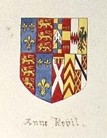
Queen Anne’s arms as Queen of England.
After the procession of the king followed that of his Queen. The Earl of Huntingdon bore her sceptre, the Viscount Lisle the rod and dove, and the Earl of Wiltshire her crown. Then came the queen herself habited in robes of purple velvet furred with ermine having on her head a circlet of gold with many precious stones set therein. Over her head was borne a cloth of estate. On one side of her walked the Bishop of Exeter and on the other the Bishop of Norwich. A Princess of the blood, the celebrated Margaret, Countess of Richmond and mother of the future King Henry VII, supported her train. After the Queen walked the King’s sister Elizabeth, Duchess of Suffolk, having on her head a circlet of gold and after her followed a train of highborn ladies succeeded by a number of knights and esquires. Entering the Abbey at the great west door the King and Queen took their seats of state staying till divers holy hymns were sung when they ascended to the high altar where the ceremony of anointing took place. Then the King and Queen put off their robes and there stood all naked from the middle upwards and anon the Bishop anointed both the King and Queen. This ceremony having been performed, they exchanged their mantles of purple velvet for robes of cloth of gold and were solemnly crowned by the Archbishop of Canterbury assisted by the other bishops. The Archbishop subsequently performed high mass and administered the holy communion to the King and Queen after which they offered at St Edward’s shrine where the king laid down King Edward’s crown and put on another and so returned to Westminster Hall in the same state they came.
Richard III with his queen Anne and son, Edward, Prince of Wales.
The banquet, which took place at four o clock in the great hall, is described as having been magnificent in the extreme. The king and queen were served on dishes of gold and silver. Lord Audley performed the office of state carver. Thomas Lord Scrope that of cupbearer. Lord Lovel, during the entertainment, stood before the king, “two esquires lying under the board at the king’s feet.” On each side of the queen stood a countess with a plaisance or napkin for her use. Over the head of each was held a canopy supported by peers and peeresses. The guests consisted of the cardinal archbishop the lord chancellor, the prelates, the judges, and nobles of the land, and the Lord Mayor, and principal citizens of London. The ladies sat by themselves on both sides of a long table in the middle of the hall. As soon as the second course was put on the table, the king’s champion Sir Robert Dymoke rode into the hall; his horse being trapped with white silk and red and himself in white harness the heralds of arms standing upon a stage among all the company. Then the king’s champion rode up before the king asking all the people if there was any man would say against King Richard III why he should not claim the crown. And when he had said so all the hall cried King Richard with one voice. And when this was done anon, one of the lords brought unto the champion a covered cup full of red wine and so he took the cup aud uncovered it and drank thereof. And when he had done anon he cast out the wine and covered the cup again and making his obeisance to the king turned his horse about and rode through the hall with his cup in his right hand and that he had for his labour. Then Garter king at arms supported by eighteen other heralds advanced before the king and solemnly proclaimed his style and titles. No single untoward accident marred the harmony or splendour of the day. When at length began to close the hall was illuminated by great light of wax torches and cressets apparently the signal for the king and queen to retire. Accordingly wafers and hipocras been previously served Richard and his rose up and departed to their private apartments in the palace. (Aubrey)
Aneurin Barnard as King Richard III and Faye Marsay and Queen Anne. Fictional portrayal in Philippa Gregory’s “The White Queen” (2013).
Sources
William Hickman S. Aubrey. “The National and Domestic History of England,” 1878. pg 193-4.
Hannah Lawrance. “Historical Memoirs of the Queens of England from the Commencement of the Twelfth Century,” Volume 2, Moxon, 1840.
Lady Anne (Faye Marsay) and Lady Isabel (Eleanor Tomlinson) in “The White Queen”.
“To anyone who has any interest in these two women: Please stop writing about Isobel and Anne Nevill as if they were weak women who had no control over their lives. Please stop using their early deaths as a sign that they were Doomed From the Start. Please read something about their father. (Both Hicks and Pollard have done a bang up job here.) Oh, and can we consign the overused, tired and meaningless word pawn to the dustbin of history? Let’s stop the nonsense. It’s starting to get depressing.”
To those of you watching “The White Queen”, please take some time to read this blog about THE REAL Ladies Isabel and Anne. You would be surprised that they are NOTHING like the show has portrayed them. They also didn’t constantly get b’ed out by the queen.
I stumbled on this while I was on the hunt for information for an upcoming post.
I feel that it needs a response, something to balance the books a little. I know, it’s an uphill battle – the view that poor Isobel and Anne were mere pawns (oh, and Doomed) is so entrenched that it’s going to take a miracle to shift it by so much as a millimetre.
Just to set the tone, here are some of the words used to described Warwick and/or his actions:
”political conniving”; “charismatic”; “self-centered”; “arrogant”; “man of moderate military skill”; “merciless”; “exploit”; “had no need to hold [his daughters] in esteem”; “hankering for supremacy and clout”; the only loyalty he held was to himself”; “enmesh in his pursuit for power”; “ego”; “narcissism”; “heedless”; “used his youngest daughter”; “spider web of intrigue”; “hopeless machinations”; “fanaticism for prestige and importance”.

![Anonymous painting of Greenwich Palace during the reign of Henry VIII. [Wiki]](https://tudorqueen6.com/wp-content/uploads/2013/07/greenwich_palace_anonymous.jpg) Anonymous painting of Greenwich Palace during the reign of Henry VIII. [Wiki]
Anonymous painting of Greenwich Palace during the reign of Henry VIII. [Wiki] Seating Chart of the banquet at Greenwich on St. Thomas Day, 1517. Thanks to my friend Katherine for this.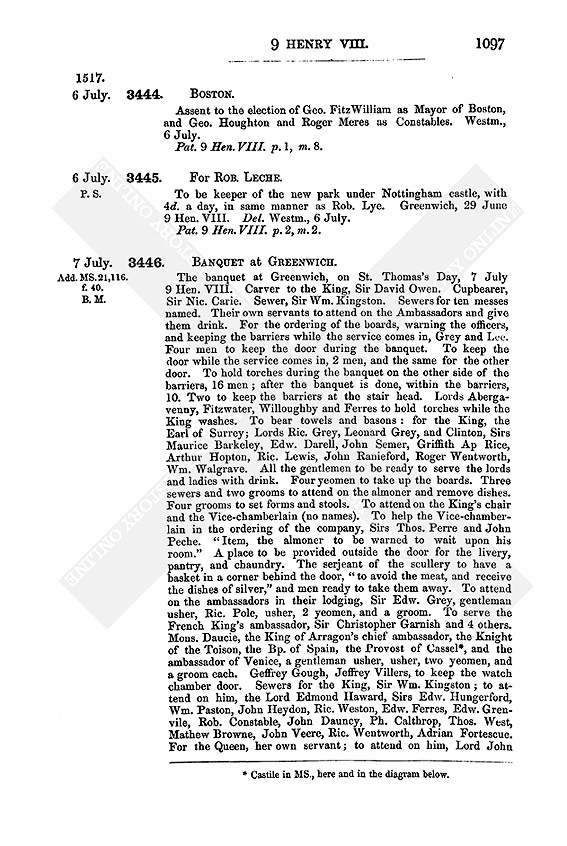




 tudorqueen6 by Meg McGath